
Winds of Change Questions and Answers | Class 9 Kaveri
Checked against NCERT Kaveri, first edition January 2026, pages 69–85; listening transcript 263–264. Personal, discussion and creative responses are samples: adapt them to your experience. This independent study guide is not an official NCERT answer key.
Chapter Overview
Unlike the stories of the first two units, Winds of Change is an expository article — a factual piece that traces the history and artistry of the Indian hand fan, the pankha. From its origins in the word pankh (a bird’s feather) and its representation in Ajanta wall paintings, as described in the passage, to the dazzling regional varieties of Rajasthan, Gujarat, Bengal, Uttar Pradesh and Bihar, the chapter shows how a simple object of comfort became a carrier of culture. It ends with a warning and a hope: technology has pushed the pankha to the margins, but celebrating the craft can give its artisans a sustainable livelihood and keep this heritage alive.
About the Text
The article is taken from Gaatha.com, a well-known Indian platform that documents and promotes traditional crafts and the stories of the artisans behind them (“gaatha” means story). True to its source, the chapter blends history, craft documentation and cultural commentary, and gives students a model of factual, descriptive writing — the same style they are asked to practise in this unit’s writing task.
Summary in English
The word pankha comes from pankh, the feather of a bird; the small plumed fan of ancient India was called a pankhi, and the passage cites Buddhist wall paintings at Ajanta as evidence of its use. In ancient times pankhas fanned deities in temples and kings in royal courts, ranging from two-inch miniatures to giants that needed a person’s full arm strength. Travelling along trade routes, they became prized cultural goods — exotic, stylish — and every region developed its own variety: bamboo, cane, palm leaf, silk, brass, leather and silver, decorated with beads and stones.
The article then tours India’s fan traditions. Rajasthan offers the appliqué fan of stitched fabric pieces, the zardozi fan of glittering gold threadwork, brass-engraved temple fans with long handles, and painted cardboard fans offered to gods. Gujarat contributes cotton fans with mirror work, bead-covered fans with silver handles (Gujarat being India’s bead-craft centre), and Kutch’s hand-stitched leather fans trimmed with thread and wool — much of it the work of industrious home-based women. Bengal’s artisans craft delicate fans from the milky-white spongy sola grass, and its palm-leaf Tal Patar Pankha remains a fixture of Bengali homes. Uttar Pradesh’s Phadh fans glitter with gold, silver zari, silk and satin frills, while Bihar’s sturdy bamboo fans and Odisha’s large palm-leaf fans are famed for antiquity and rarity. Many tribes embed grass and metal on bamboo frames with bold geometric patterns. Yet with the advent of technology, this beautiful culture risks fading. Once personal, the craft is now a commercial business that sustains artisans; the way forward, the writer argues, is to celebrate pankhas — through workshops and exhibitions that spread awareness, restore popularity and give craftspeople a sustainable livelihood.
Summary in Hindi (सारांश हिंदी में)
‘पंखा’ शब्द ‘पंख’ से बना है। प्राचीन भारत में पंखों वाले छोटे पंखे को ‘पंखी’ कहते थे, जिसके प्रमाण पाठ के अनुसार अजंता के बौद्ध भित्ति-चित्रों में मिलते हैं। प्राचीन काल में पंखे मंदिरों में देवताओं और राजदरबारों में राजाओं के लिए झले जाते थे — दो इंच के नन्हे पंखों से लेकर पूरी बाँह की ताकत माँगने वाले विशाल पंखों तक। व्यापार मार्गों से फैलकर पंखे विशिष्ट सांस्कृतिक वस्तु बन गए और हर क्षेत्र ने अपनी अलग शैली विकसित की — बाँस, बेंत, ताड़-पत्र, रेशम, पीतल, चमड़ा और चाँदी के पंखे, मोतियों और नगों से सजे।
राजस्थान में कपड़े के टुकड़ों से बना एप्लीक पंखा, सुनहरे धागों वाला ज़रदोज़ी पंखा, पीतल पर नक्काशीदार लंबी डंडी वाले मंदिर-पंखे और देवताओं को अर्पित चित्रित गत्ते के पंखे मिलते हैं। गुजरात के सूती पंखों में शीशे का काम, मोतियों से ढके चाँदी की मूठ वाले पंखे और कच्छ के हाथ-सिले चमड़े के पंखे प्रसिद्ध हैं — इनमें घर-बैठी परिश्रमी महिलाओं का बड़ा योगदान है। बंगाल के कारीगर शोला घास से कोमल पंखे बनाते हैं; ताड़-पत्र का ‘ताल पातार पंखा’ बंगाल के घरों से जुड़ी एक परिचित वस्तु बताया गया है। उत्तर प्रदेश के फड़ पंखे सोने-चाँदी की ज़री, रेशम और साटन की झालरों से सजे होते हैं; बिहार के बाँस के रंगीन मज़बूत पंखे और ओडिशा के बड़े ताड़-पत्र पंखे अपनी प्राचीनता के लिए विख्यात हैं। तकनीक के आगमन से यह सुंदर संस्कृति लुप्त होने के खतरे में है। लेखक का संदेश है — पंखों का उत्सव मनाइए; कार्यशालाओं और प्रदर्शनियों से जागरूकता फैलेगी, कला को लोकप्रियता मिलेगी और कारीगरों को स्थायी आजीविका।
Historical note: The passage gives “2nd century CE” for its Ajanta reference. Do not treat this as the date of every Ajanta painting. UNESCO’s account of Ajanta describes early cave monuments from the second and first centuries BCE and a later decorated phase in the fifth and sixth centuries CE. It does not identify the particular fan image meant by this chapter.
Word Meanings (शब्दार्थ)
| Word | English Meaning | हिंदी अर्थ |
|---|---|---|
| indigenous | local — from where it originated | देशज, स्थानीय |
| artefact | a handmade object of cultural interest | शिल्पकृति |
| innovative | new and original in approach | नवोन्मेषी |
| industrious | hardworking | परिश्रमी |
| intricate | elaborate, detailed | जटिल, बारीक |
| invoked | brought out, called forth | जाग्रत किया |
| initiatives | actions to improve a situation | पहल |
| plumed | made of feathers | पंखों वाला |
| deities | gods and goddesses | देवी-देवता |
| exotic | unusual and exciting, from far away | विदेशी आकर्षण वाला |
| appliqué | fabric pieces sewn onto cloth as decoration | कपड़े की कतरनों की सजावट |
| zardozi | ornate gold threadwork | ज़रदोज़ी (सुनहरी कढ़ाई) |
| encrusted | covered or decorated (with something) | जड़ा हुआ |
| embellished | decorated, beautified | अलंकृत |
| dainty | small and delicate | नाज़ुक, सुकुमार |
| sola | a type of water grass with a spongy centre | शोला घास |
| perpetually | constantly | निरंतर |
| antiquity | the distant past | प्राचीनता |
| advent | arrival | आगमन |
| sustainable livelihood | a stable, lasting means of earning | स्थायी आजीविका |
NCERT Exercise Solutions
Reflect and Respond
I. Does anyone in your family use a hand fan? What do you call it in your language? What is it made of?
Yes, my grandmother still keeps a hand fan beside her bed and uses it whenever the power goes off. In our language we call it a pankha (use the name actually spoken in your family). Hers is made of woven palm leaf with a bamboo handle and a red cloth border.
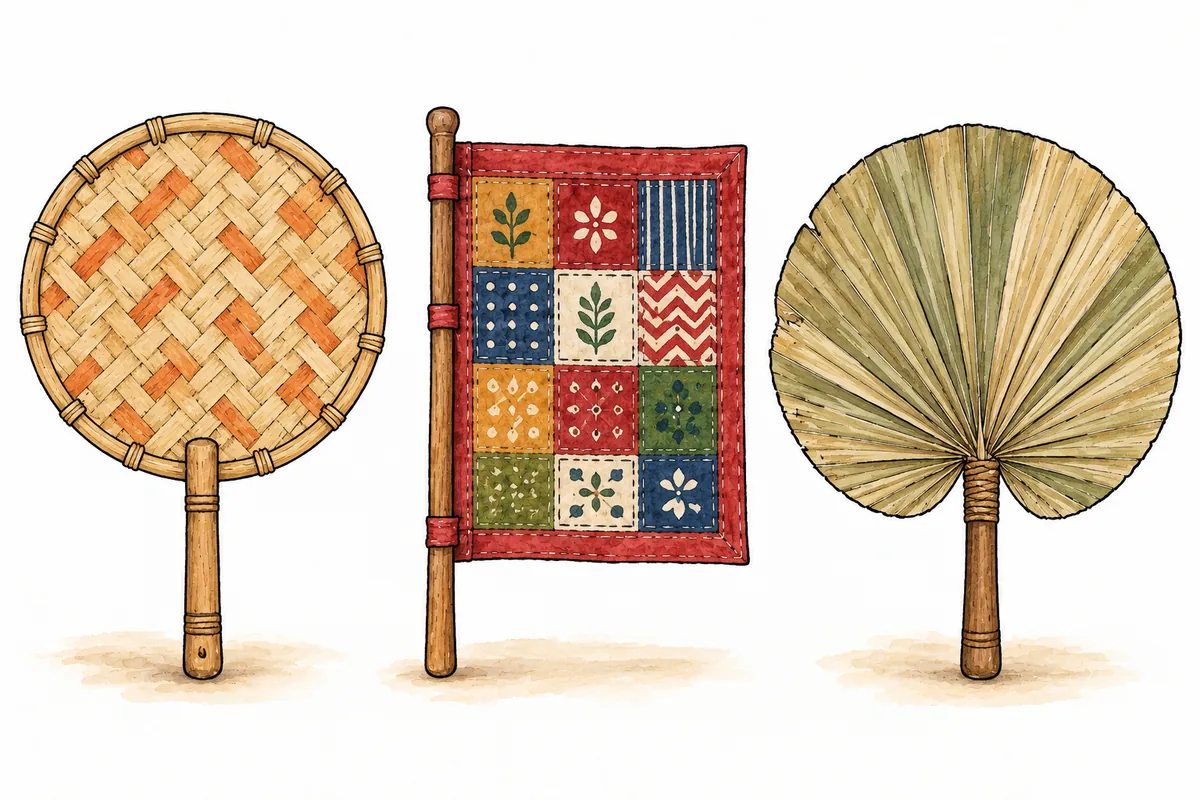
II. Work in pairs. Study the pictures given below carefully and complete the information.
| The State it is from | Assam | Kerala | Uttar Pradesh |
|---|---|---|---|
| Shape | Circular/round | Rounded | Rectangular |
| Made of | Bamboo (suggested material for the pictured woven fan) | Palm leaf (given) | Moonj grass (given) |
III. Match the underlined words in Column 1 with their meanings in Column 2.
1. indigenous — (iv) local, from where it originated | 2. innovative — (v) new and original in approach | 3. industrious — (i) hardworking | 4. intricate — (vi) elaborate/detailed | 5. invoked — (iii) brought out | 6. initiatives — (ii) actions to improve a situation
Check Your Understanding
I. Work in pairs to complete the table on pankha.
| State | Type of Fan | Material Used |
|---|---|---|
| Rajasthan | appliqué hand fan | pieces of fabric sewn with ornamental needlework |
| zardozi hand fan | gold thread | |
| temple hand fans | engraved brass (with a long handle) | |
| Gujarat | mirror work hand fans | pure cotton embellished with mirror work |
| beads hand fan | beads | |
| leather hand fans (Kutch) | leather, decorated with thread and wool | |
| West Bengal | sola hand fans | sola (milky-white spongy water grass) |
| Uttar Pradesh | Phadh hand fans | pure gold, silver zari, silk and satin frills |
| Bihar | bamboo hand fans | bamboo |
Critical Reflection
I. Read the extracts given below and answer the questions that follow. (Extract 1: pankhas as cultural goods on trade routes — textbook page 74)
(i) State whether the following sentence is true or false: Pankhas were one of the most popular items of commerce.
Not established by the extract; if restricted to True/False, choose False. It calls pankhas significant cultural goods traded across regions, but gives no comparison or ranking to show they were among the most popular items. Significance is not evidence of that superlative.
(ii) Why has the word ‘traditional’ been used to describe pankhas?
Because pankhas were developed over generations by particular villages and towns, using local materials and designs handed down within the community — they carry the customs and identity of their region.
(iii) The sentence ‘They were considered exotic and stylish’ is an opinion and not a fact because ______.
…it expresses how people perceived and judged the pankhas — a view that cannot be objectively measured or proved, unlike a verifiable fact.
(iv) Infer one reason for commonality in the use of pankhas across India.
A shared need for relief from heat is a reasonable inference — and shared customs like fanning deities in temples and kings in courts also made their use similar across regions.
(v) Select the correct assertion for the given reason (pankhas were made of indigenous materials, unique to the region, with elaborate designs).
A. Each kind of pankha could be distinguished from the other.
(Extract 2: the risk from technology and the change to a commercial business — textbook page 75)
(i) Infer one negative impact of technological advancement on pankha.
Electric fans and air conditioners can reduce demand for hand fans in everyday use, so the pankha culture is slowly losing its presence among Indians and the craft risks dying out.
(ii) The writer refers to ‘pankhas’ not just as an object but as a ‘culture’ because ______.
…pankhas embody the stories, artistry, rituals and regional identity of the communities that craft them — they carry a whole way of life, not merely a function.
(iii) Select a line from the extract which depicts how the role of the pankha has changed over the years.
“Once made for personal use, over time this handicraft has transformed into a commercial business.”
(iv) List one way in which the increase in demand of pankhas might benefit artisans.
Greater demand can bring more orders and income, helping artisans continue their work. It does not by itself guarantee a steady or sufficient livelihood.
(v) Select the factor that has contributed to the commercialisation of pankhas.
B. economic demand
II. Answer the following questions.
1. How does the title ‘Winds of Change’ capture the essence of the chapter?
The title works on two levels. Literally, fans create winds — the pankha’s very purpose. Figuratively, the chapter records the winds of change that have blown over the craft: from temples and royal courts to household use, from personal possession to commercial product, and from daily necessity to decorative heritage threatened by technology. The title thus joins the object and its history in a single elegant phrase.
2. ‘The structure and design of pankhas are testimony to the cultural identity of the region.’ Support with two examples.
Rajasthan’s zardozi fans, with their glittering ornate gold threadwork, reflect the state’s royal courtly traditions of rich embroidery. Gujarat’s bead-covered fans with silver handles reflect its standing as the centre of bead craft in India, while Kutch’s hand-stitched leather fans trimmed with thread and wool grow directly out of its leather-craft heritage. (Bengal’s sola fans, made from a local water grass, are an equally good example.)
3. Evaluate how the balance between preserving traditional craftsmanship and incorporating innovative designs will help pankhas survive.
Preservation keeps the soul of the craft alive — the regional materials, motifs and techniques that make each pankha a cultural document. Innovation keeps it relevant — new versions as wall décor, gifts and fashion accessories attract modern buyers, and the chapter itself notes that the slight rise in demand has come from different versions being crafted. Together they form a healthy balance: tradition gives the craft its identity and value, innovation gives it customers and income, and each sustains the other.
4. How might initiatives such as pankha-making workshops contribute to the preservation of this traditional craft?
Workshops spread awareness of the craft’s beauty and importance, let contemporary makers demonstrate their skill before the public, and teach the techniques to younger people so the knowledge is not lost. They also create buyers and markets, giving artisans a commercial platform and opportunities for a more sustainable livelihood, which may help the craft continue.
5. The writer mentions celebrating pankhas in the concluding part of the chapter. Assess how this could be beneficial to artisans and the craft.
Celebration restores pride and visibility. When the culture, stories and artistry of pankhas are appreciated at exhibitions and festivals, makers regain popularity and respect, demand rises, and artisans earn a stable income. For the craft itself, celebration attracts new learners and keeps its regional traditions alive — turning a fading heritage into a living, valued art.
6. How does the restriction of the use of pankha for decorative purposes reflect the changing cultural role of these traditional fans in modern India?
It shows that the pankha has moved from utility to heritage. Electric fans now do its practical work, so the hand fan survives as a thing of beauty — a wall decoration, a collectible, a craft item. The passage emphasises the growth of decorative and heritage value. This does not mean that hand fans have stopped serving practical purposes everywhere; the personal-response activity itself allows examples of household use.
Vocabulary and Structures in Context
I.1. Classify the pairs of words in the categories given.
| Appearance | Place | Material |
|---|---|---|
| exotic and stylish; ornate and encrusted | within and outside (given); villages and towns | thread and wool; silk and brass |
More pairs from the text: “cane and palm leaves” (material), “grass and metal” (material), “beads and stones” (material), “white ink and red background” (appearance).
II. Find the word pairs for the fixed expressions and match their meanings.
| Fixed Expression | Meaning |
|---|---|
| 1. high and dry | (i) in a difficult situation, without help or money |
| 2. cut and run | (vii) to make a quick or sudden escape |
| 3. facts and figures | (iii) accurate and detailed information |
| 4. all and sundry (given) | (v) everyone, not just a few special people |
| 5. wear and tear | (ii) the damage to an object due to normal use |
| 6. time and again | (vi) often; on many or all occasions |
| 7. thick and thin | (iv) even when there are problems or difficulties |
| 8. hard and fast | strict and fixed (a hard and fast rule) — not in the box |
III.1. Choose the appropriate word collocations for the following sentences.
(i) The students have to take the English exam tomorrow.
(ii) The interviewer asked the candidate to have a seat.
(iii) My scooter ran into a car.
(iv) I must take responsibility for my success.
(v) I would like to improve my grammar.
IV. Read the following sentences. Underline the verbs. Then fill in the blanks with the present perfect form of verbs.
Underlined verbs (present perfect): 1. have become 2. have worked 3. have adopted 4. has transformed
Paragraph: Puppeteers (i) have created intricate characters… They (ii) have mastered the delicate movements… Over the years, puppetry (iii) has evolved… Many puppeteers (iv) have passed down their craft… They (v) have performed in theatres, on television, and at festivals…
Listen and Respond
I. Select four true statements using the transcript on pages 263–264.
Best-fit intended selection: 1, 2, 3 and 6. Statements 3 and 6 are directly supported. Statements 1 and 2 are looser paraphrases: Rohan recalls that Grandma likes objects with some weight but worries about portability; Priya then suggests something neither too heavy nor too light.
| Statement | Evidence or qualification |
|---|---|
| 1 | Rohan acknowledges Grandma’s liking for some weight. The dialogue does not say she always prefers the heaviest item or explicitly give “feels substantial” as her reason. |
| 2 | Priya accepts the concern about moving it and proposes a moderate weight; ease of moving it is inferred from the exchange. |
| 3 | Rohan remembers her sitting in the veranda in the evenings. |
| 4 | Rohan, not Priya, introduces the point about keeping special things close. Priya hears it, so a literal claim about what she “knows” is ambiguous; it is not her stated observation. |
| 5 | False: Rohan admires the intricate appliqué fans, rather than rejecting them as too delicate. |
| 6 | Priya suggests bamboo with beadwork or embroidery with mirror work. |
| 7 | False: they agree to consult Mom before choosing. |
The exercise asks for four choices, but its wording is not an exact match to the speakers’ statements. Use the evidence above rather than claiming every selected sentence is verbatim.
Speaking Activity
I. In groups of four, each student imagines being one kind of fan (hand fan, ceiling fan, table fan, handheld fan) and speaks about it.
Hello friends! I am a hand fan — a palm-leaf pankha with a bamboo handle and a bright red border. I am light and easy to carry, and I work without electricity, fanning my owner in power cuts, temples and village fairs. What I love about myself is my heritage: my ancestors fanned kings and deities, and artists still paint and embroider my cousins across India. My weakness? I need a human hand to move me, and I cannot cool a whole room. But I am unique because I am not just a machine — I am a piece of culture, a story you can hold. (Prepare similar speeches for the ceiling fan, table fan and handheld electric fan.)
Writing Task
I. Give a factual description of an artefact you made.
Model description — adapt to your own object: The object is a folding paper hand fan made from coloured craft paper and glue. The sheet is folded into evenly spaced accordion pleats. The pleated strip is folded in half, and the two inner edges are glued together to form a fan that opens outward. A paper band holds the joined lower end. The surface has alternating blue and yellow strips. The fan folds flat for storage and moves air when waved by hand. It must be kept dry because its body is paper.
Record your own measured dimensions and materials. Do not invent a weight, origin, award or performance claim. A factual description reports observable features rather than opinions such as “the most beautiful fan”.
Learning Beyond the Text
I. Present a craft item from your region.
Research template: Give its local name; describe shape, size and colour; list materials and tools; explain the observed making process; identify uses; and record where your information came from. Ask the maker about traditional use and changes in design. Label an origin story as a story unless supported by reliable historical evidence. Do not assume that all examples use the same materials or method.
II. Make a paper hand fan and describe the process.
- Fold a rectangular sheet of craft paper into even accordion pleats.
- Press the folds, then fold the pleated strip in half.
- Glue the two inner edges together and let the join dry.
- Secure the joined base with a small paper band.
- Spread the pleats gently, display the fan and explain the materials and steps.
This is one simple model method; the textbook shows other designs too. Describe the method your group actually uses.
III. Read “The Last Leaf” by O. Henry.
Johnsy, seriously ill with pneumonia, mistakenly links her life to the falling leaves of an ivy creeper. Sue cares for her and seeks medical help. Behrman paints a leaf on the wall during the storm when the real last leaf falls. Seeing the apparently enduring leaf helps Johnsy regain hope and cooperate with care. Behrman later dies of pneumonia; Sue identifies the painted leaf as his masterpiece.
The story links art with compassion, hope and sacrifice. Johnsy’s belief about the leaves is not a true prediction, and her despair should not be treated as a moral failing. The literary ending does not make hope a replacement for medical treatment. No written answer is required by the textbook for this reading-for-enjoyment activity.
Extra Questions with Answers
Q1. What is the origin of the words ‘pankha’ and ‘pankhi’? (30–40 words)
‘Pankha’ comes from ‘pankh’, meaning a bird’s feather. ‘Pankha’ refers to all fans, while ‘pankhi’ was the small plumed fan of ancient India, represented in the Ajanta wall paintings cited by the passage; see the historical note above for the dating distinction.
Q2. How were pankhas used in ancient India? (30–40 words)
They were used in temples to fan deities and in royal courts to fan kings. They ranged from tiny two-inch fans to huge ones that required a person’s full arm strength to move.
Q3. What makes Gujarat special in the story of the pankha? (30–40 words)
Gujarat is India’s bead-craft centre — its dainty bead fans have silver handles — and Kutch makes hand-stitched leather fans trimmed with thread and wool, largely crafted by industrious home-based women workers.
Q4. Trace how the pankha’s journey reflects India’s changing times. (100–120 words)
The pankha’s journey mirrors India’s own. In ancient times it served gods and kings, painted on the walls of Ajanta; along trade routes it became an exotic cultural good, with every region weaving its identity into bamboo, silk, brass and leather. In households it remained a daily companion for centuries — until electricity arrived. Electric fans reduced reliance on hand fans in many settings, while decorative and heritage uses gained importance. Yet the change brought a new chapter: what was once made for personal use is now a commercial business that sustains artisans. The pankha thus tells the story of tradition adapting to technology — retaining cultural importance while its uses and markets change.
Q5. What steps does the writer suggest for preserving the pankha craft? Why are they important? (100–120 words)
The writer’s first step is celebration — appreciating the culture, stories and artistry that pankhas embody, so that the craft regains respect and visibility. Concretely, this means pankha-making workshops, both within and outside handicraft exhibitions, which spread awareness of the craft’s beauty and importance. Such platforms let contemporary makers demonstrate their skill, win back popularity and reach buyers, creating a commercial market that gives artisans a sustainable livelihood. These steps matter because the craft’s greatest threat is invisibility: technology can reduce everyday demand, while appreciation, practical use, teaching and fair markets can support the craft. When people value, buy and learn the craft, its knowledge passes on — and the winds of change become winds of revival.
Additional MCQs
1. The word ‘pankha’ originates from ‘pankh’, which means — (a) wind (b) feather of a bird (c) palm leaf (d) breeze
2. The site cited in the passage as evidence of pankhi use is — (a) Ellora (b) Ajanta (c) Khajuraho (d) Hampi
3. The date given in this textbook passage for its Ajanta reference is — (a) 2nd century CE (b) 5th century BCE (c) 8th century CE (d) 12th century CE
4. Zardozi hand fans of Rajasthan are known for — (a) mirror work (b) glittering gold threadwork (c) palm leaves (d) bead craft
5. The centre of bead craft in India is — (a) Rajasthan (b) Bihar (c) Gujarat (d) Odisha
6. Bengal’s sola fans are made from — (a) bamboo strips (b) a milky-white spongy water grass (c) palm bark (d) silk threads
7. The palm leaf fans of Bengal are locally called — (a) Phadh pankha (b) Tal Patar Pankha (c) zardozi pankha (d) pankhi
8. Phadh hand fans adorned with gold, zari, silk and satin frills belong to — (a) Uttar Pradesh (b) Kerala (c) Assam (d) Punjab
9. Bihar is known for its hand fans made of — (a) leather (b) brass (c) bamboo (d) sola
10. According to the writer, the first step to preserve the craft is — (a) banning electric fans (b) celebrating pankhas (c) exporting fans (d) building museums
Answer key: 1-b, 2-b, 3-a, 4-b, 5-c, 6-b, 7-b, 8-a, 9-c, 10-b
Assertion–Reason Questions
Options for each: (a) Both A and R are true and R explains A. (b) Both A and R are true but R does not explain A. (c) A is true, R is false. (d) A is false, R is true.
1. A: Pankhas differ from region to region. R: Each place developed pankhas with distinct local materials and intricate designs. — (a)
2. A: The pankha culture risks losing its presence among Indians. R: Technological alternatives can reduce everyday demand for hand fans. — (a)
3. A: The passage emphasises a shift towards decorative uses of pankhas. R: Hand fans have no practical use anywhere today. — (c)
4. A: Pankha-making workshops help preserve the craft. R: Workshops spread awareness and give artisans a commercial platform. — (a)
5. A: Gujarat’s bead pankhas are commonly used as wall decorations. R: Gujarat is the centre for bead craft in India. — (b)
FAQs
What type of text is Winds of Change?
It is an expository (factual, informative) article on the Indian hand fan — the pankha — taken from Gaatha.com, a platform that documents Indian crafts.
What is the main message of Winds of Change?
The pankha is a living piece of India’s culture now threatened by technology; celebrating the craft through workshops and exhibitions can preserve it and give artisans a sustainable livelihood.
Which regional pankhas are described in the chapter?
Rajasthan’s appliqué, zardozi, temple and painted fans; Gujarat’s mirror-work, bead and Kutch leather fans; Bengal’s sola and palm-leaf fans; Uttar Pradesh’s Phadh fans; Odisha’s palm-leaf fans; Bihar’s bamboo fans; and tribal fans of grass and metal.
Also read: Chapter 2 – The Pot Maker · Kaveri – All Chapters · NCERT Solutions Home. Official textbook catalogue: ncert.nic.in