
Class 9 Science Chapter 2: Cell — The Building Block of Life Solutions
These Class 9 Science Exploration Chapter 2 solutions cover Cell: The Building Block of Life from NCERT’s Exploration, first edition April 2026 (printed pages 8–27).
Class 9 Science Exploration Chapter 2 Solutions – Overview
Chapter 2 of Exploration, Cell: The Building Block of Life, establishes the cell as the basic structural and functional unit of all living things. It covers how cells are studied with light and electron microscopes, the cell membrane (selectively permeable) and cell wall, the nucleus and the main organelles (mitochondria, endoplasmic reticulum, Golgi apparatus, ribosomes, plastids, vacuoles, lysosomes), the processes of diffusion and osmosis, and cell division (mitosis and meiosis). The 16 end-of-chapter questions, introductory prompts, activities and Pause and Ponder questions are explained below.
Key Concepts & Definitions
Cell: the basic structural and functional unit of life; every cell arises from a pre-existing cell.
Cell membrane: the selectively permeable boundary controlling what enters and leaves the cell. Cell wall: a rigid outer layer in plants, fungi and most bacteria, permeable to water and many small dissolved substances.
Nucleus: contains most of a eukaryotic cell’s DNA and regulates many activities through gene expression. Prokaryotic cells (bacteria) have no true nucleus; eukaryotic cells do.
Key organelles: mitochondria (respiration/energy), ribosomes (protein synthesis), ER (transport; RER has ribosomes, SER does not), Golgi apparatus (packaging), plastids (chloroplasts, leucoplasts, chromoplasts), vacuole (storage/rigidity), lysosome (digestion).
Diffusion: net movement of particles from higher to lower concentration (no membrane needed). Osmosis: movement of water across a selectively permeable membrane.
Cell division: mitosis (growth and repair) and meiosis (halves chromosome number; contributes to gamete formation in animals).
“Think It Over” — Answers
Where does a cell come from?
How have technological interventions facilitated the creation of new knowledge in understanding the world beyond the naked eye?
How is the cell the structural and functional unit of life?
How does a cell multiply?
Before division, DNA is copied. In mitosis, duplicated chromosomes are separated into two nuclei and the cytoplasm divides, producing two daughter cells with the parent cell’s chromosome number. Bacteria multiply by binary fission; meiosis is a distinct two-division process that halves chromosome number.
Activities 2.1–2.5 and Pause and Ponder
Activity 2.1: Estimating cell size
Use the field diameter measured at the same microscope setting as the cell count. Here D is the field diameter, N is the number of cells across it, and ℓ is the estimated cell size. The estimate assumes cells lie approximately end to end along the diameter.
The numerical values above are the textbook’s worked example, not measurements made for this page.
Activities 2.2 and 2.3: Water movement and cell walls
Record actual initial and final masses; do not invent observations. A potato piece in plain water is expected to gain mass, whereas one in a sufficiently concentrated salt or sugar solution is expected to lose mass through osmosis. Equal starting dimensions and recorded initial masses support a fair comparison.
In concentrated sugar solution, the plant protoplast can pull away from its wall (plasmolysis), while the wall retains its outline. Cheek cells lack a wall and shrink. Carry out slide preparation and staining with teacher supervision.
Activity 2.4: Comparing cells
| Structure | Typical bacterium | Typical plant cell | Typical animal cell |
|---|---|---|---|
| Cell membrane and cytoplasm | Present | Present | Present |
| Cell wall | Usually present | Present | Absent |
| Membrane-bound nucleus | Absent | Present | Present |
| Nucleoid | Present | Absent | Absent |
| Membrane-bound organelles | Absent | Present | Present |
Bacteria are prokaryotic; plant and animal cells are eukaryotic. A nucleoid is a DNA-containing region, not a membrane-bound “primitive nucleus”.
Activity 2.5: Growing onion roots
New cells form by mitosis in the root-tip meristem, helping roots grow. A prepared or teacher-guided root-tip slide can show cells at different stages; record what is actually observed. Growth also includes cell enlargement. In mitosis, prophase comes first: chromosomes condense before alignment and separation. Root-tip preparation uses chemicals and heat and must be teacher-led.
Pause and Ponder: Answers 1–5
- Why a cell wall? It gives plant cells mechanical support and helps resist excessive expansion during water uptake. Animal cells require flexible boundaries for movement and changes of shape.
- If the wall became as flexible as the membrane: the cell would lose much of its rigid support and protection against osmotic expansion; plant tissues would be less firm.
- Why equal potato pieces and initial masses? To reduce differences in surface area and starting size, and calculate comparable changes in mass.
- Do white flowers contain pigment? White appearance usually reflects the absence or low amount of visible coloured pigments in the petals and scattering of light by their tissues. It does not prove every cell or every part of the flower lacks all pigments; other parts may contain chlorophyll and some petals have pigments not obvious to human vision.
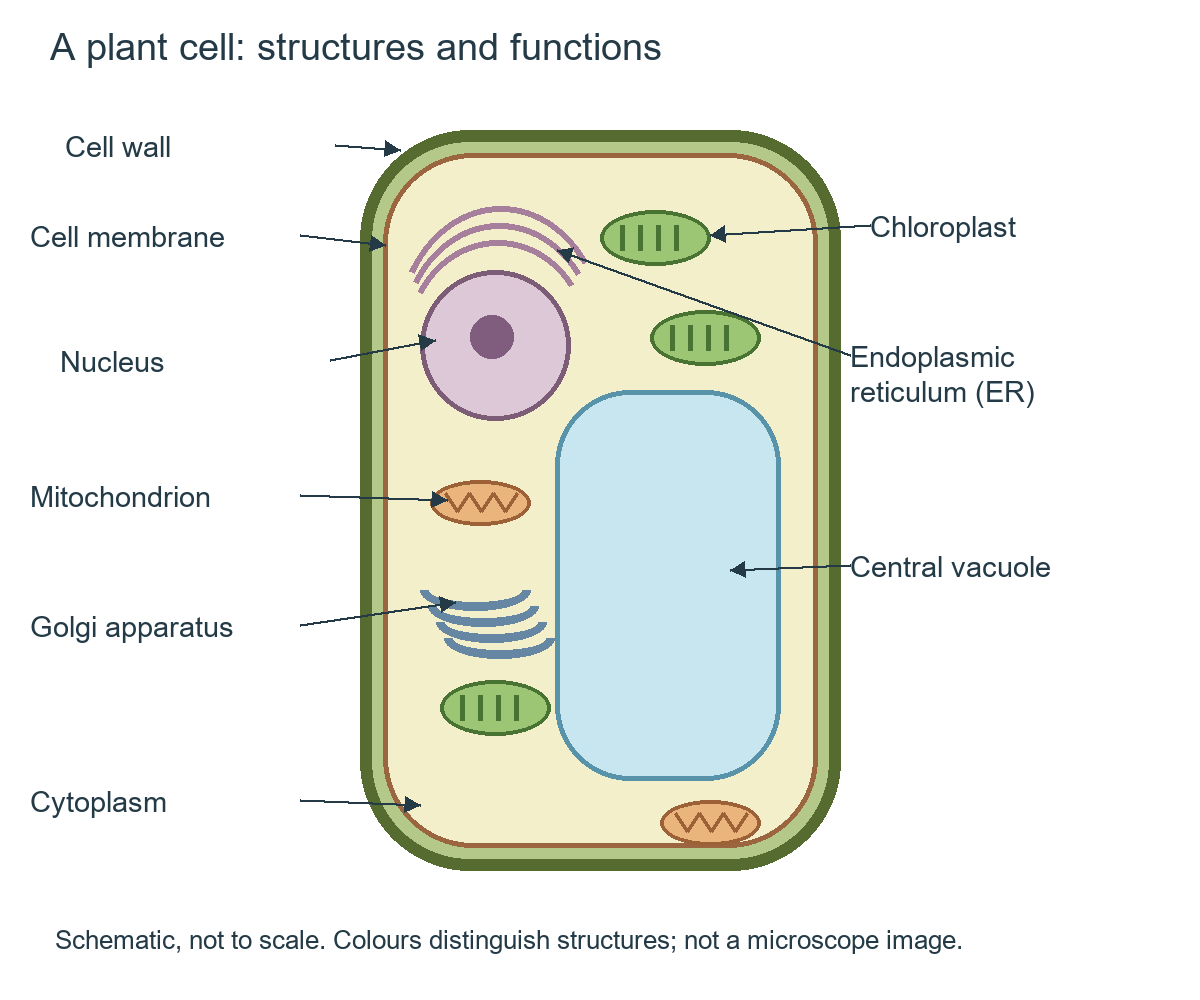
- Labelled cell: the schematic below shows a plant cell. The nucleus is rounded; ER lies near it; mitochondria and chloroplasts have their characteristic internal membranes. Shapes and sizes vary in real cells.
Open-ended extension: Sample response
A cell-division model can use reusable tokens for chromosomes and show DNA replication before division. A synthetic-cell discussion should distinguish a synthetic genome placed in an existing cell from making an entire cell from non-living materials, and consider containment, environmental effects and responsible oversight. Students’ models and ethical arguments may differ.
Class 9 Science Exploration Chapter 2 Solutions — Revise, Reflect, Refine
1. Differentiate between the following pairs of terms based on the clues given in parentheses: (i) Cell membrane and cell wall (permeability) (ii) RER and SER (structure) (iii) Chloroplasts and chromoplasts (pigments)
(i) The cell membrane is selectively permeable: passage depends on the substance and membrane transport mechanisms. The cell wall is relatively freely permeable to water and many small solutes, while providing support.
(ii) RER has ribosomes attached to its cytoplasmic surface and commonly forms flattened sacs; SER lacks attached ribosomes and is usually tubular.
(iii) Chloroplasts contain green chlorophyll (as well as accessory pigments). Chromoplasts accumulate coloured carotenoids, giving yellow, orange or red colours to many fruits and flowers.
2. Two similar animal cells are placed in two different solutions — Cell X in pure water, Cell Y in concentrated salt solution. Cell X swells and Cell Y shrinks. Which statement correctly explains this? (i) Salt molecules moved into Cell Y, causing it to shrink. (ii) Water moved into Cell X and more water moved out of Cell Y than the salt solution entered. (iii) Water moved into Cell X and moved out of Cell Y through the cell membrane. (iv) Solute movement caused osmosis in both cells.
3. Look at the diagram of a cell in Fig. 2.20. Identify the parts labelled (a) to (g) and match them with their functions: (i) Controlling all the activities of a cell.(ii) Site of cellular respiration.(iii) Storage organelle that also provides rigidity to the cell.(iv) Separates the cell contents from surroundings.(v) Provides structural rigidity to the cell.(vi) Packs and stores materials received from ER.(vii) Helps in manufacturing food.
Reading the arrow tips in textbook Fig. 2.20:
| Label | Structure | Function number | Role |
|---|---|---|---|
| a | Mitochondrion | ii | Most aerobic ATP production |
| b | Nucleus | i | Regulates cell activities |
| c | Golgi apparatus | vi | Modifies, sorts and packages ER materials |
| d | Chloroplast | vii | Photosynthesis |
| e | Cell wall | v | Structural support and rigidity |
| f | Cell membrane | iv | Selective boundary of the cell |
| g | Central vacuole | iii | Stores cell sap and maintains turgor |
The outer wall is (e); the membrane just inside it is (f).
4. Which of the following option(s) of pairs of cell organelles are correctly placed under the categories “Present in plant cells” and “Absent in animal cells”? (i) Leucoplast / Cell wall (ii) Mitochondria / Ribosome (iii) Cell wall / Golgi apparatus (iv) Lysosome / Endoplasmic reticulum
5. Renu says all parts of plants, even roots, contain plastids; Rohit says plastids are absent in roots because roots do not perform photosynthesis. Who is correct? Justify.
6. Discuss how mitochondria and chloroplasts are structurally and functionally similar to, and different from, each other.
Similarities: both have an outer and inner membrane, their own DNA and ribosomes, and roles in energy conversion.
Mitochondria: the inner membrane forms cristae around the matrix. They release energy from organic molecules during aerobic respiration, supplying ATP. They occur in most eukaryotic cells; mature mammalian red blood cells are an exception.
Chloroplasts: contain chlorophyll-bearing thylakoid membranes in the stroma. They use light energy to make organic food during photosynthesis, and occur in photosynthetic plant and algal cells. Plant cells also respire and generally contain mitochondria.
7. Which of the following pairs of cell organelles contains DNA? (i) Chloroplasts, Ribosomes (ii) Mitochondria, Nucleus (iii) Golgi bodies, Ribosomes (iv) Nucleus, Lysosomes
8. A researcher placed one carrot in plain water and another in concentrated salt solution (Fig. 2.21) and recorded observations after 24 hours. (i) What hypothesis does she want to test?(ii) What would you suggest to improve the experiment?(iii) Why does the carrot in plain water stay stiff and crunchy, but the one in salt solution become rubbery and limp?
9. Indicate the presence or absence of the following structures in bacterial and animal cells: Chromosome, Nucleus, Mitochondria, Golgi complex, Chromoplasts.
| Structure | Bacterial cell | Animal cell |
|---|---|---|
| Chromosome | Present (typically a circular chromosome) | Present |
| Nucleus (true) | Absent | Present |
| Mitochondria | Absent | Present |
| Golgi complex | Absent | Present |
| Chromoplasts | Absent | Absent |
10. Four peeled potato cups are placed in water: Cup A empty; Cup B + 1 tsp sugar; Cup C + 1 tsp salt; Cup D (boiled potato) + 1 tsp sugar. (i) Why does water gather in Cup B and Cup C?(ii) Why is Cup A necessary?(iii) Why does water not gather in Cups A and D?
11. Identify the pair that incorrectly matches the cell organelle with its function. (i) Ribosome — Protein synthesis (ii) SER — Lipid and cellulose synthesis (iii) Lysosome — Digestion of foreign agents
12. What outcome do you expect if all the mitochondria are removed from a eukaryotic cell?
Removing mitochondria from a typical mitochondria-containing eukaryotic cell would stop mitochondrial aerobic respiration and greatly reduce its ATP supply. Many energy-dependent processes would fail, and the cell would usually die.
Important correction: ATP production would not necessarily become zero. Glycolysis takes place in the cytoplasm and can still make a small amount of ATP. Some specialised cells, such as mature mammalian red blood cells, naturally function without mitochondria.
13. Which phenomenon inhibits the formation of tumours in the human body? Can plants also develop tumours? Explain.
Contact inhibition helps regulate growth: normal animal cells generally stop proliferating when crowded by neighbouring cells. Loss of this regulation can contribute to tumour formation, alongside other changes in cell-cycle control.
Plants can also develop tumours or tumour-like galls. For example, crown gall results from bacterial infection that alters plant growth regulation. Rigid walls do not make plants immune to abnormal growth.
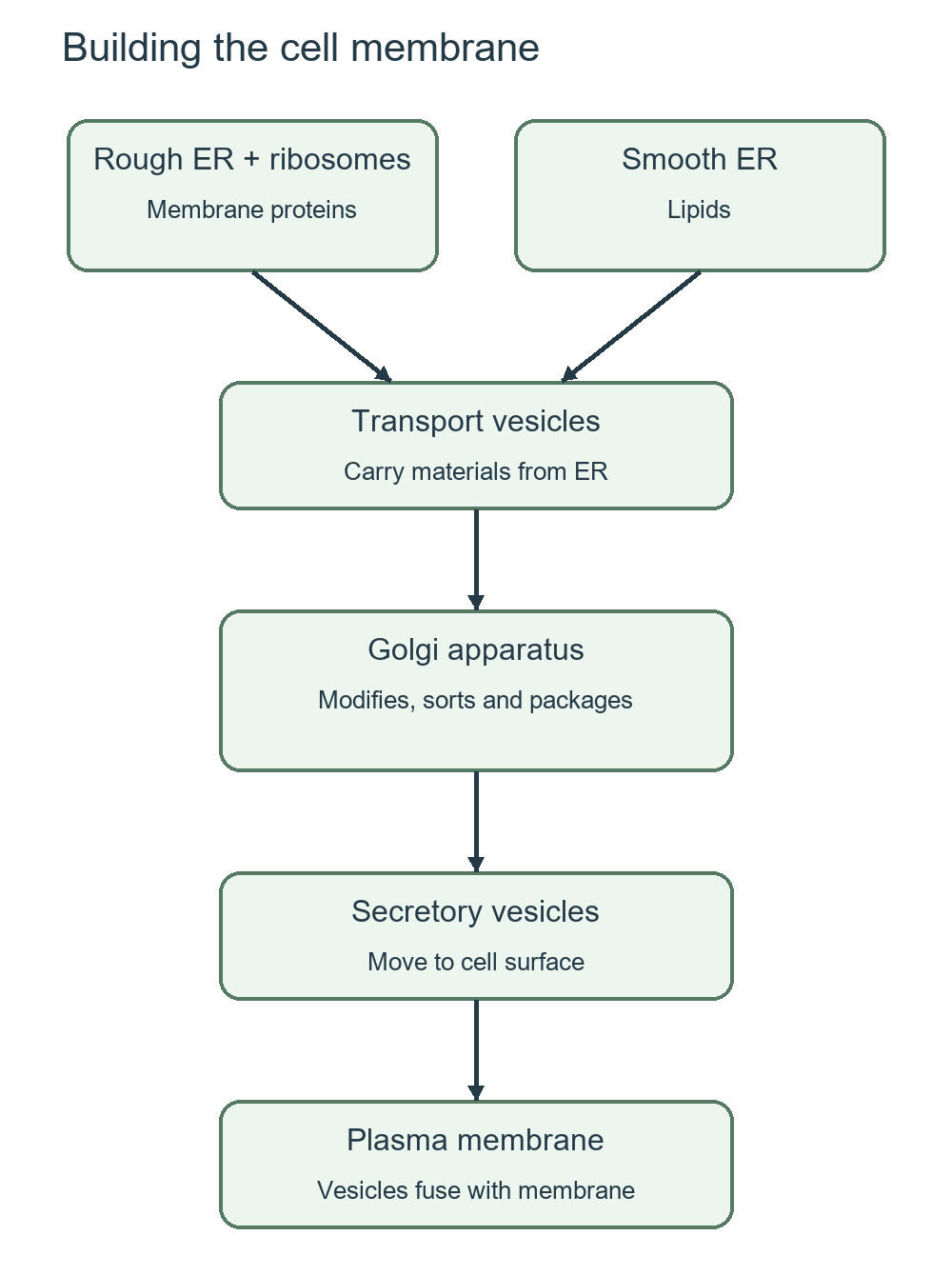
14. The cell membrane is made of proteins and lipids. Which organelles help synthesise it? Write the path of these compounds from their site of synthesis to the cell membrane (with a labelled diagram).
Ribosomes attached to the rough ER synthesise membrane proteins; the smooth ER is important in lipid synthesis. Materials move from ER in transport vesicles to the Golgi apparatus for modification and sorting, then in vesicles that fuse with the plasma membrane.
15. What would happen if gametes are formed by mitotic divisions?
Assume the question concerns a diploid animal whose gametes normally arise through meiosis. Mitosis would retain the diploid chromosome number instead of producing haploid gametes. Fusion of two such gametes would give a tetraploid zygote:
Normal meiosis and fertilisation instead maintain the species’ chromosome number:
Without a reduction step, chromosome number could double in successive generations. Scope: gametes are not universally formed directly by meiosis; in flowering plants, meiosis produces spores and subsequent mitoses contribute to gamete formation.
16. Farmer Deepa preserved amla and lemons by making pickles, murabbas and sharbat with salt, sugar or jaggery. Based on the passage: (i) Which scientific concept did she apply?(ii) How does adding high concentrations of salt and sugar prevent the growth of spoilage bacteria and fungi?(iii) Suggest a healthy recipe of this kind.(iv) What scientific values are addressed?
(i) Deepa uses osmosis and reduced water availability to help preserve produce.
(ii) Concentrated salt or sugar creates a hypertonic environment, drawing water out of many microbial cells and inhibiting their growth. It also lowers water activity. This does not sterilise food: some yeasts, moulds and salt-tolerant microbes may still grow.
(iii) Sample proposal: prepare small portions of amla murabba using a tested preservation recipe, with fruit as the main ingredient, and serve it in moderation because it contains added sugar. A preserved food is not automatically healthy merely because it contains fruit. Follow a tested recipe’s processing and storage directions rather than guessing salt or sugar quantities.
(iv) Scientific reasoning, reducing post-harvest waste, resourcefulness, sustainable use of produce, and improving local livelihoods.
Further reading: National Center for Home Food Preservation: pickling principles.
Common Misconceptions to Avoid
Watch out for these
- Treating the cell wall and cell membrane as the same — the wall is rigid and freely permeable; the membrane is selectively permeable.
- Calling osmosis the same as diffusion — osmosis is specifically the movement of water across a selectively permeable membrane.
- Thinking plastids occur only in leaves — roots have colourless plastids (leucoplasts).
- Believing only the nucleus has DNA — mitochondria and chloroplasts have their own DNA too.
- Assuming chloroplasts are in animal cells — they are characteristic of photosynthetic plant and algal cells.
- Confusing mitosis with meiosis — mitosis is for growth/repair; meiosis halves chromosome number and contributes to sexual reproduction.
Extra Practice Questions
Very Short Answer Type Questions
Q1. Which organelle is called the “powerhouse of the cell”?
Q2. Name the organelle that controls all the activities of the cell.
Q3. What is the green pigment present in chloroplasts called?
Short Answer Type Questions
Q1. Differentiate between diffusion and osmosis.
Q2. Why is the cell membrane called selectively permeable?
Long Answer Type Question
Q1. Compare mitosis and meiosis on the basis of where they occur, the number of divisions, and the daughter cells produced.
MCQs & Assertion–Reason
1. The basic structural and functional unit of life is the:
(a) tissue (b) cell (c) organ (d) molecule
2. Which organelle is known as the “powerhouse of the cell”?
(a) nucleus (b) ribosome (c) mitochondrion (d) Golgi apparatus
3. A cell wall is present in:
(a) animal cells only (b) plant (and bacterial) cells (c) no cells (d) only nerve cells
4. The movement of water across a selectively permeable membrane is called:
(a) diffusion (b) osmosis (c) respiration (d) transpiration
5. Which organelle controls all the activities of the cell?
(a) vacuole (b) nucleus (c) lysosome (d) ribosome
6. Chlorophyll is found in:
(a) mitochondria (b) chloroplasts (c) ribosomes (d) lysosomes
7. Which cell does NOT have a true nucleus?
(a) plant cell (b) animal cell (c) bacterial cell (d) muscle cell
8. Cell division for growth and repair is:
(a) meiosis (b) mitosis (c) osmosis (d) diffusion
9. Which organelle packs and dispatches materials received from the ER?
(a) ribosome (b) Golgi apparatus (c) mitochondrion (d) vacuole
10. Ribosomes are the site of:
(a) respiration (b) photosynthesis (c) protein synthesis (d) digestion
For each Assertion–Reason question, choose: (A) Both true and the Reason correctly explains the Assertion; (B) Both true but the Reason is not the correct explanation; (C) Assertion true, Reason false; (D) Assertion false, Reason true.
A-R 1. Assertion: Mitochondria are called the powerhouse of the cell.
Reason: They release energy in the form of ATP through cellular respiration.
A-R 2. Assertion: The cell membrane is selectively permeable.
Reason: It controls the movement of substances into and out of the cell.
A-R 3. Assertion: A bacterial cell has no true nucleus.
Reason: Bacteria are prokaryotes whose genetic material is not enclosed in a nuclear membrane.
A-R 4. Assertion: Osmosis is the movement of any particles from a higher to a lower concentration.
Reason: Osmosis is the movement of water across a selectively permeable membrane.
A-R 5. Assertion: Chloroplasts are found in animal cells.
Reason: Chloroplasts contain chlorophyll for photosynthesis.
Quick Revision Summary
- The cell is the basic structural and functional unit of life; new cells come from existing cells.
- Cell membrane = selectively permeable; cell wall = rigid and freely permeable (plants/bacteria).
- Nucleus controls activities; prokaryotes (bacteria) lack a true nucleus.
- Organelles: mitochondria (respiration), ribosomes (protein), ER & Golgi (synthesis/packing), plastids, vacuole, lysosome.
- Diffusion = particles high→low; osmosis = water across a selectively permeable membrane.
- Mitosis retains chromosome number for growth and repair; meiosis halves chromosome number.
Real-life Applications
Osmosis explains everyday preservation: salting fish or making fruit pickles, murabbas and jams draws water out of spoilage microbes so food lasts longer. It also explains why vegetables become crisp in plain water and limp in salty water, why salty soil can make water uptake difficult. Waterlogging mainly harms roots by reducing oxygen availability; it should not be explained simply as osmosis.
How to revise this chapter
Learn the organelles with one function each and be able to draw a labelled plant and animal cell. State the exact difference between diffusion and osmosis, and between mitosis and meiosis. For experiment questions, always identify the hypothesis, the control and the role of the selectively permeable membrane.
Frequently Asked Questions
What is Class 9 Science Exploration Chapter 2 about?
The cell as the unit of life — its structure, the membrane and wall, the nucleus and organelles, diffusion and osmosis, and cell division (mitosis and meiosis).
What is the difference between diffusion and osmosis?
Diffusion is the movement of particles from higher to lower concentration (no membrane needed); osmosis is the movement of water across a selectively permeable membrane.
How many questions are in the Revise, Reflect, Refine exercise?
16 questions, all solved on this page along with the “Think It Over” prompts.
Are these Class 9 Science Exploration Chapter 2 solutions free?
Yes. All solutions are free and follow the official NCERT Exploration textbook for 2026–27.