
Class 9 Science Chapter 3: Tissues in Action — Solutions
These Class 9 Science Exploration Chapter 3 solutions cover Tissues in Action from NCERT’s Exploration, first edition April 2026 (printed pages 28–47).
Class 9 Science Exploration Chapter 3 Solutions – Overview
Chapter 3 of Exploration, Tissues in Action, explains how groups of cells form tissues that share a common function. In plants it covers meristematic tissue (which keeps dividing) and permanent tissues — parenchyma, collenchyma, sclerenchyma, and the complex conducting tissues xylem and phloem — along with the protective epidermis. In animals it covers epithelial, connective, muscular and nervous tissues, and how each tissue’s structure suits its job. The 15 exercise questions and the activity and discussion prompts are explained below.
Key Concepts & Definitions
Tissue: a group of cells of similar origin that work together for a common function.
Meristematic tissue: dividing cells (thin walls, dense cytoplasm, large nucleus); apical, lateral (cambium) and intercalary. Permanent tissue: differentiated cells that normally do not divide while differentiated; some living plant cells can regain division under suitable conditions.
Simple plant tissues: parenchyma (soft, storage/photosynthesis), collenchyma (flexible support), sclerenchyma (dead, thick-walled, strength). Complex tissues: xylem (water + minerals, and support) and phloem (food transport) — made of more than one cell type.
Animal tissues: epithelial (covering/lining), connective (blood, bone, tendon, ligament, etc.), muscular (skeletal, smooth, cardiac), nervous (impulse conduction).
Tendon joins muscle to bone; ligament joins bone to bone.
“Think It Over” — Answers
How is the study of tissues important for life processes and human welfare?
How are tissues in plants and animals different, and why?
What makes cells group together to form tissues, and why do some tissues grow throughout life while others do not?
How does division of labour relate to structure and function?
Specialised cells form tissues, tissues combine in organs, and organs cooperate in systems. Thin alveolar epithelium permits rapid gas exchange; long muscle fibres contract; branched neurons receive and transmit signals. Their different structures allow the whole organism to perform tasks efficiently.
Activities and discussion answers
Activity 3.1: Onion-root growth
Record actual root lengths on days 1–7. Jar A is the intact-root comparison; cut tips in Jar B remove the apical meristem, so the cut roots are expected to stop normal elongation over the observation period. New roots may form from the bulb. Use the same onion variety, light, water and temperature, and compare several roots rather than inventing identical measurements.
Activities 3.2 and 3.3: Blood and connective tissues
Platelets and clotting factors help form a clot after a cut. White blood cells participate in defence; inflammation can cause redness and swelling. Exercise increases oxygen demand and blood flow. These are explanations of the textbook observations, not diagnoses.
At the elbow, hard bone gives support; the outer ear contains flexible cartilage; tendons transmit muscle pull to bones; ligaments stabilise joints by connecting bones. The permitted range of a joint also depends on its shape, capsule and other tissues.
Activity 3.4: Percentage estimates
Use age-appropriate reference data and treat the result as an estimate. A bathroom scale does not measure bone or muscle mass separately, and a skeleton percentage is not the same as the “bone mass” reading of a consumer body-composition scale.
For an illustrative 50 kg body mass and an assumed 14% skeletal proportion:
This is classroom arithmetic, not a personal measurement or health assessment. Real proportions vary with age, body composition and the measurement definition.
Activity 3.5: Joint movements — sample observations
| Region | Typical movement | Explanation |
|---|---|---|
| Elbow; knee | Bending and straightening | Mainly hinge action; the knee also has limited rotation when flexed |
| Shoulder | Forward, backward, sideways, rotation and circumduction | Ball-and-socket joint; circular arm movement is not unlimited rotation |
| Neck | Turning, nodding, tilting | Several joints cooperate; side-to-side turning mainly uses the atlas–axis pivot |
| Fingers; toes | Bending; some spreading at the bases | Interphalangeal joints are hinges; the thumb base has a different structure |
| Wrist | Bending, side movement and circumduction | Apparent hand rotation also uses the radioulnar joints |
Pause and Ponder: Answers 1–5
- Coir versus coriander: coconut husk contains thick, lignified sclerenchyma fibres; a young coriander stalk has living, more flexible supporting tissues.
- Cuticle: a thick waxy layer reduces water loss in desert plants. In a submerged plant, a strong barrier can impede exchange of gases and dissolved substances across the surface.
- Dead xylem and living leaves: hollow conducting cells provide a low-resistance pathway. Evaporation from leaves creates tension; cohesion between water molecules helps transmit this pull down the water column. Xylem does not actively pump using its dead cells.
- No stomata: gas exchange and control of transpiration would be severely affected in a typical land leaf, reducing carbon dioxide uptake and transpiration pull. This assumes a land plant normally dependent on stomata; some submerged leaves differ.
- Dance poses — sample: raised arms use shoulder ball-and-socket joints; bent knees and elbows use mainly hinge action; head turning uses the upper-neck pivot, while hips also use ball-and-socket joints. Identify the visible posture rather than assigning one joint to the entire dance.
Think as a Scientist: Carrot-cell culture (Table 3.6)
(a) Some mature living carrot cells can regain division and regenerate a whole plant under suitable culture conditions: totipotency.
(b) The light + air + liquid nutrient treatment has the highest reported increase (20%). Both other treatments say only “reduced”; the table cannot identify which has the lowest biomass. Also, light, aeration and medium state are not varied independently, so the results do not isolate a single cause.
(c) The same medium and conditions will not generally regenerate a complete animal from an ordinary differentiated animal cell. Animal cloning or pluripotent-cell methods require additional specialised procedures.
(d) Sample applications: rapid multiplication of selected crops and production of disease-free planting material using appropriate tissue-culture methods. These are potential applications, not proof that any culture is automatically pathogen-free.
Journey Beyond: Sample response
Pruning changes shoot growth and can encourage axillary buds; grafting requires compatible tissue and vascular connection; irrigation supports water uptake but waterlogging harms roots. A leaf survey should record real observations and distinguish traditional claims from tested evidence. Animal-cell regeneration raises technical, welfare and ethical questions and should not be treated as equivalent to routine plant micropropagation.
Class 9 Science Exploration Chapter 3 Solutions — Revise, Reflect, Refine
1. Meristematic tissues divide repeatedly. What property of their cells allows them to do this? (i) They have thick walls for protection. (ii) They contain large vacuoles that store nutrients. (iii) They have thin walls, dense cytoplasm and large prominent nucleus. (iv) They are functionally differentiated cells.
2. If a plant is unable to transport food from leaves to roots, which tissue is malfunctioning? (i) Xylem (ii) Phloem (iii) Epidermis (iv) Sclerenchyma
3. Why are the epithelial tissues that line an animal’s internal organs usually only one or a few cells thick? (i) To store food efficiently. (ii) To provide maximum strength. (iii) To allow quick exchange of materials across them. (iv) To reduce friction.
4. You can perform two jumps: a straight-leg jump (knees and ankles stiff) and a normal jump (knees and ankles bent naturally). How did your ankle, knee and hip positions differ between the two jumps?
Sample observation: In the straight-leg version, knees and ankles remain relatively stiff and the hips provide more of the movement. In a normal jump the hips and knees flex and the ankles dorsiflex during preparation; the hips and knees then extend and the ankles plantarflex during take-off. Bending again helps absorb landing forces. Describe your own observation without forcing stiff-joint landings.
5. Which type of joint is involved when you bend your knees and ankles? (i) Ball and socket (ii) Hinge (iii) Pivot
(ii) Hinge is the intended school-level answer. The knee acts mainly as a modified hinge, while the main ankle (talocrural) joint allows dorsiflexion and plantarflexion. The ankle-foot complex contains other joints too, so not every movement of the foot occurs at a single hinge.
6. In each case (A–D), choose: (i) Both A and R true and R is the correct explanation of A; (ii) Both true but R is not the correct explanation; (iii) A true, R false; (iv) A false, R true. A. Assertion: Epithelium is well-suited for gas exchange in the lungs. Reason: It consists of multiple layers of tall cells that slow down diffusion. B. Assertion: Cardiac muscle can contract continuously without fatigue. Reason: Cardiac muscle cells have a high number of mitochondria and an abundant blood supply. C. Assertion: Tendons connect bone to bone and allow joint movement. Reason: Tendons are made of tough connective tissue that transmits force from muscle to bone. D. Assertion: In a hinge joint, movement occurs primarily in one plane. Reason: The bone ends are shaped to allow sliding in all directions.
7. Using the data in Table 3.7 (age of a teak tree vs diameter and number of annual rings), plot a graph and answer: (i) Analyse the graph in terms of the diameter of the stem over time. (ii) What is the relation between the diameter of the teak tree and the annual rings formed? (iii) Which specialised tissue is responsible for the girth of the stem and where is it located?
| Age (years) | DBH (cm) | Annual rings |
|---|---|---|
| 5 | 4 | 5 |
| 10 | 8 | 10 |
| 20 | 24 | 20 |
| 25 | 28 | 25 |
| 30 | 32 | 30 |
| 40 | 40 | 40 |
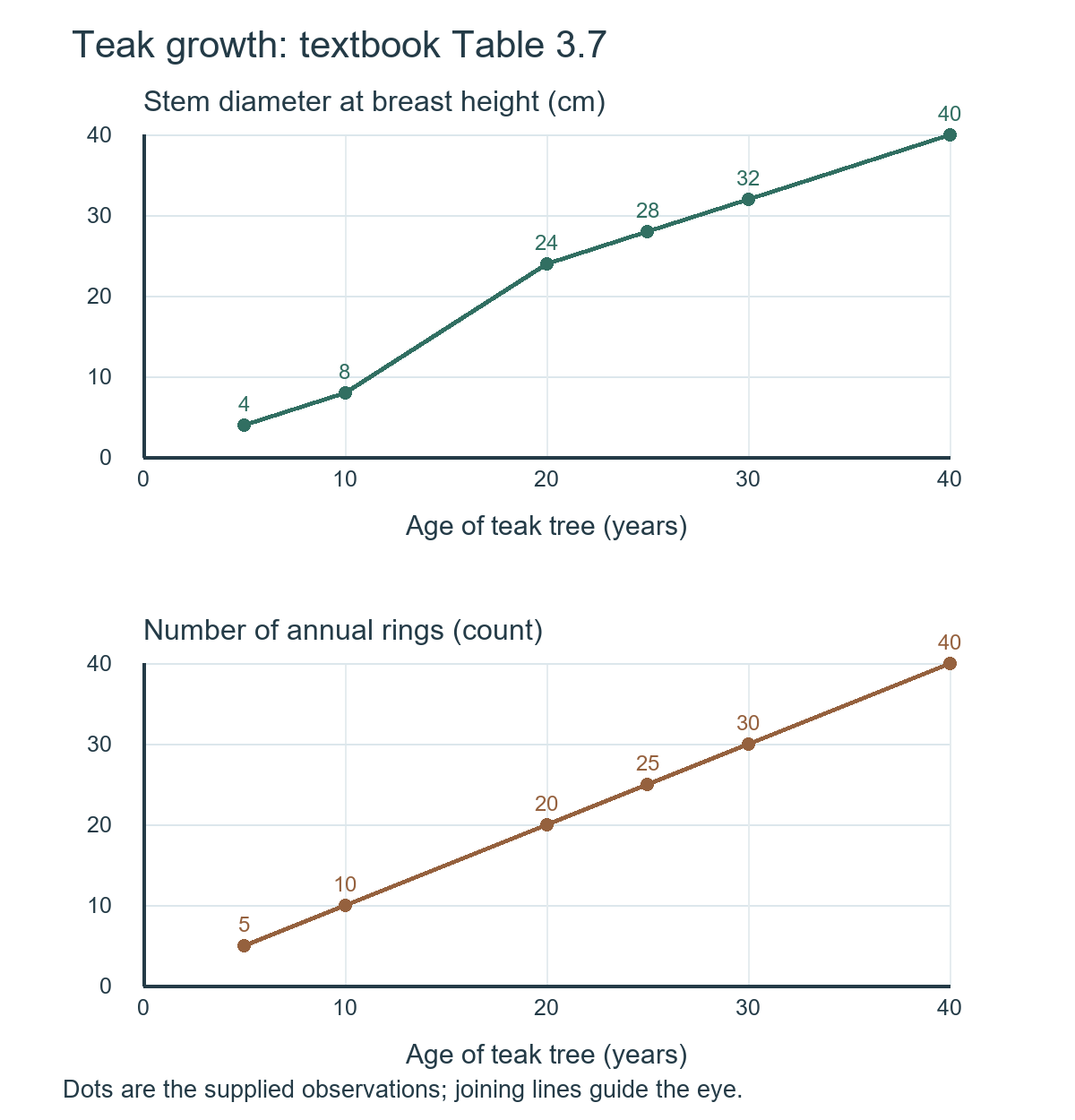
(i) Diameter increases, but not at a constant rate. From 10–20 years it increases by 16 cm (1.6 cm per year), compared with 4 cm in 5 years (0.8 cm per year) from 5–10 years.
(ii) Ring count equals age in this supplied dataset. More rings accompany greater diameter, but diameter is not proportional to ring count: ring widths depend on growth conditions. One ring per year is the model used here, not a universal rule for every tree and climate.
(iii) Vascular cambium, a lateral meristem between secondary xylem and secondary phloem, adds cells and increases stem girth.
8. A tree was severely debarked by an elephant (the bark is rich in nutrients). (i) Which function(s) of the tree is/are hampered by debarking? (ii) Which plant tissue would be affected by further damage to the tree trunk even after debarking? (iii) Which function of the tree would be hampered if the tissues beneath the bark were severely damaged? (iv) What assumptions are you making, and how would the answer change if the assumptions changed?
9. A young mango sapling’s stem bends flexibly in monsoon winds and does not break. Which tissue is responsible for this flexibility? Predict the impact if it were replaced by sclerenchyma.
10. Sohan grew sugarcane from two types of cuttings; type ‘B’ sprouted but type ‘A’ did not. (i) Why could type B grow but type A could not? (ii) What difference was present in type B compared to type A? (iii) What observation determined whether the change had an effect? (iv) What parameters should be kept the same for a fair comparison?
11. Rohan says, “A tissue is a group of similar cells performing similar functions”, but Rajiv argues this is true for simple tissues but different for complex tissues. Explain.
12. Coconut husk fibres used for mats are tough and fibrous. Which tissue provides this strength? Why could living parenchyma not serve the same purpose?
13. Vibha claims, “Meristematic cells are located only at the root and shoot apices.” What do you think, and what question could Neha ask to help correct the statement?
14. A plant cell and an animal cell are of the same size. (i) Which cell will have a larger vacuole? Give reasons. (ii) What assumptions are you making?
15. A textbook states, “Each plant tissue performs only one specific function.” What questions would you ask to critically examine this, and which tissues would you use as examples?
Common Misconceptions to Avoid
Watch out for these
- Confusing tendon (muscle–bone) with ligament (bone–bone).
- Swapping xylem (water and minerals, upward) and phloem (food, both directions).
- Thinking meristem is only at the tips — there are also lateral (cambium) and intercalary meristems.
- Believing every tissue has just one cell type — complex tissues (xylem, phloem) have several.
- Thinking parenchyma gives no support — turgid parenchyma supports soft parts, while collenchyma and sclerenchyma provide more specialised mechanical support.
- Thinking thick epithelium is best for exchange — a thin single layer speeds diffusion.
Extra Practice Questions
Very Short Answer Type Questions
Q1. Which tissue connects a muscle to a bone?
Q2. Name the tissue that transports water in a plant.
Q3. Which muscle works continuously throughout life without tiring?
Short Answer Type Questions
Q1. Differentiate between parenchyma, collenchyma and sclerenchyma.
Q2. Why is xylem called a complex tissue?
Long Answer Type Question
Q1. Name the four types of animal tissues and state one function of each.
MCQs & Assertion–Reason
1. The tissue that divides and helps a plant grow is:
(a) parenchyma (b) meristematic (c) sclerenchyma (d) epidermis
2. Phloem transports:
(a) water (b) minerals (c) food (d) air
3. Xylem transports:
(a) food (b) water and minerals (c) hormones (d) oxygen only
4. A tissue that connects muscle to bone is a:
(a) ligament (b) tendon (c) cartilage (d) nerve
5. A tissue that connects bone to bone is a:
(a) tendon (b) ligament (c) muscle (d) phloem
6. Flexibility in young plant stems is provided by:
(a) sclerenchyma (b) collenchyma (c) xylem (d) epidermis
7. The strength of tough fibres like coconut husk comes from:
(a) parenchyma (b) collenchyma (c) sclerenchyma (d) epidermis
8. Which muscle contracts continuously without fatigue?
(a) skeletal (b) smooth (c) cardiac (d) voluntary
9. The protective outer tissue of a plant is:
(a) epidermis (b) phloem (c) cambium (d) cardiac muscle
10. The increase in girth (thickness) of a stem is due to the:
(a) apical meristem (b) lateral meristem (cambium) (c) phloem (d) epidermis
For each Assertion–Reason question, choose: (A) Both true and the Reason correctly explains the Assertion; (B) Both true but the Reason is not the correct explanation; (C) Assertion true, Reason false; (D) Assertion false, Reason true.
A-R 1. Assertion: Meristematic cells can divide repeatedly.
Reason: They have thin walls, dense cytoplasm and a large prominent nucleus.
A-R 2. Assertion: Phloem transports food in plants.
Reason: Phloem transports water and minerals upward.
A-R 3. Assertion: Cardiac muscle does not tire.
Reason: It has many mitochondria and a rich blood supply.
A-R 4. Assertion: Tendons connect bone to bone.
Reason: Tendons are made of tough connective tissue.
A-R 5. Assertion: Sclerenchyma provides strength to plant parts.
Reason: Its cells are dead with thick, lignified walls.
Quick Revision Summary
- A tissue is a group of cells of similar origin with a common function.
- Plant: meristematic (dividing) vs permanent (parenchyma, collenchyma, sclerenchyma); complex tissues xylem and phloem.
- Xylem carries water and minerals (and supports); phloem carries food.
- Animal tissues: epithelial, connective, muscular, nervous.
- Tendon = muscle to bone; ligament = bone to bone; cardiac muscle is highly fatigue-resistant under normal conditions.
- Girth comes from the lateral meristem (cambium); annual rings record the tree’s age.
Real-life Applications
Tissue knowledge guides real practices: gardeners propagate sugarcane and many crops from cuttings with a node (meristem); foresters read annual rings to find a tree’s age and growth; coir from sclerenchyma fibres is used for ropes and mats; and understanding tendons, ligaments and cartilage helps in treating sports injuries.
How to revise this chapter
Be able to draw and label plant and animal tissues and give one function each. Clearly distinguish tendon vs ligament, xylem vs phloem, and the three simple plant tissues. For assertion–reason questions, judge the Assertion and the Reason separately before choosing the option.
Frequently Asked Questions
What is Class 9 Science Exploration Chapter 3 about?
Plant tissues (meristematic and permanent, including xylem and phloem) and animal tissues (epithelial, connective, muscular, nervous), and how their structure suits their function.
What is the difference between a tendon and a ligament?
A tendon connects muscle to bone; a ligament connects bone to bone at a joint.
How many Revise, Reflect, Refine questions are in Chapter 3?
15 questions, all solved on this page along with the “Think It Over” prompts.
Are these Class 9 Science Exploration Chapter 3 solutions free?
Yes. All solutions are free and follow the official NCERT Exploration textbook for 2026–27.