
Class 9 Science Chapter 5: Exploring Mixtures and their Separation — Solutions
These Class 9 Science Exploration Chapter 5 solutions cover Exploring Mixtures and their Separation from NCERT’s Exploration, first edition April 2026 (printed pages 72–93).
Class 9 Science Exploration Chapter 5 Solutions – Overview
Chapter 5 of Exploration, Exploring Mixtures and their Separation, explains the difference between homogeneous and heterogeneous mixtures, and between true solutions, suspensions and colloids. It introduces the Tyndall effect, ways of expressing concentration (mass percentage), and the idea of solubility and saturated solutions. It then covers the main separation techniques — filtration, evaporation, crystallization, distillation, fractional distillation, sublimation, centrifugation, chromatography and using a separating funnel. The exercise answers include concentration calculations, corrected apparatus labels and discussion of the textbook’s simplified models.
Key Concepts & Definitions
Homogeneous mixture: uniform throughout (e.g., salt solution, air, brass). Heterogeneous mixture: not uniform; parts can be seen/separated (e.g., muddy water, milk, smoke).
True solution: particle size < 1 nm, transparent, does not scatter light, cannot be separated by ordinary filter paper. Suspension: particle size > 1000 nm, settles down, can be filtered. Colloid: particle size 1–1000 nm, does not settle, scatters light (Tyndall effect).
Tyndall effect: scattering of a light beam by colloid/suspension particles, making the light path visible.
Mass percentage:
For a solution, the denominator includes both solute and solvent.
Solubility: maximum mass of a solute that dissolves in 100 g of water at a given temperature to make a saturated solution; it usually increases with temperature.
Separation methods: filtration, sedimentation/decantation, evaporation, crystallization, distillation, fractional distillation, sublimation, centrifugation, chromatography, separating funnel.
“Think It Over” — Answers
Why do suspended particles settle down over time, but the particles in milk do not?
Relatively large particles in muddy water settle under gravity. Milk contains small dispersed fat droplets and protein particles stabilised in the liquid. It does not rapidly settle like a chalk suspension, although unhomogenised milk can form a cream layer on standing.
How is evaporation different from boiling?
Evaporation occurs at the surface over a range of temperatures. Boiling produces vapour bubbles throughout the liquid at its boiling temperature for the prevailing pressure. Boiling temperature changes with pressure, so 100 °C applies to pure water at approximately standard atmospheric pressure.
Why are sunbeams visible between leaves?
Dust, smoke or tiny droplets scatter some incoming light toward our eyes. The illuminated path becomes visible against a darker background; a clear gas mixture alone does not show a strong visible beam path.
Activities and Pause and Ponder
Activities 5.1 and 5.9: Comparing mixtures
| Property | Salt solution | Chalk suspension | Diluted milk colloid |
|---|---|---|---|
| Nature | Homogeneous | Heterogeneous | Heterogeneous microscopically |
| Textbook particle size | Less than 1 nm | Greater than 1000 nm | About 1–1000 nm |
| Particle visibility | Not visible individually | May be visible | Not visible individually to the unaided eye |
| Ordinary filtration | Passes through | Solid retained | Dispersed material generally passes through |
| Standing | No settling | Settles | No rapid settling like chalk |
| Visible beam path | No clear Tyndall effect | Yes | Yes |
Record real observations. These are school-level size ranges and idealised behaviours, not strict descriptions of every commercial mixture.
Activity 5.2: Solubility curves
At the temperatures shown, B is more soluble than A. Blanks: (i) less than; (ii) less than; (iii) B, A. B’s curve rises more steeply. Cooling a hot saturated solution can deposit crystals if the solubility falls.
Activities 5.3 and 5.4: Crystals and salt pans
In a suitable hot saturated solution, slow cooling generally favours fewer, larger crystals. Rapid cooling tends to produce more small crystals. To test this, split one hot solution into equal portions, cool at different rates, keep other conditions constant and compare actual crystal sizes. In salt pans, evaporation concentrates seawater until salts crystallise. A small drop on a clean plate may form crystals as water evaporates, but dust contamination and rapid drying can reduce crystal quality.
Activities 5.5–5.8: Separation principles
Chromatography: keep the pencil baseline and sample spot above the initial solvent surface. The solvent rises through paper, and components move at different rates. A single spot does not prove purity under every solvent system.
Separating funnel: see Question 5. Sublimation: camphor changes from solid to vapour, then deposits as solid on the cooler funnel while sand remains. Teacher supervision and ventilation are necessary. Model centrifuge: use a safe sealed classroom sample, such as chalk suspension, rather than biological material; denser suspended particles move outward and separate more rapidly during spinning.
Pause and Ponder: Answers 1–10
- Zinc oxide mass in 300 g powder:
- Two 15 mL tablespoons give 30 mL concentrate in 150 mL final drink:
- Vinegar dilution — calculation only: a 5% v/v solution contains 5 mL acetic acid per 100 mL final solution. In a properly equipped laboratory, a trained teacher would add the measured acid to water and make up to the final volume. Glacial acetic acid is corrosive; this is not a home food recipe.
- Equal masses of saturated solutions: B is expected to deposit more solid on cooling 80→60 °C. Compare the fall in solubility relative to the original solution mass, not just per 100 g water. For solution mass M and solubilities S:
The graph gives roughly 360→287 for B, compared with about 65→55 for A, in g per 100 g water. The estimated deposited fractions are about 16% and 6%, respectively, assuming no solvent loss.
- Slower evaporation generally permits larger, better-developed salt crystals; rapid evaporation tends to produce smaller ones. Other conditions also affect crystal growth.
- (i) True: evaporation leaves salt; distillation also recovers water while salt remains. (ii) False: simple boiling-point separation is ineffective for liquids with the same volatility/boiling behaviour. (iii) False: start with solvent below the sample spot. (iv) False: evaporation is liquid-to-vapour change, while crystallisation forms an ordered solid.
- Immiscible liquids do not form one uniform phase. Gravity places the denser layer below the less dense one.
- Sublimation is solid→vapour; evaporation is liquid→vapour. Vapour→solid is deposition.
- Clouds are aerosols: small water droplets or ice particles dispersed in air.
- Smoke and dust scatter light and reduce visibility, making air look hazy.
Journey Beyond: Sample responses
Paper chromatography may reveal green chlorophyll in red leaves even when other pigments mask it. Report actual bands and the solvent used; do not assume every sample has the same colours. A solar still can demonstrate evaporation and condensation, but a school-built still is not proof that contaminated water is safe to drink. No one artificial-blood product should be assumed to replace all functions of real blood for every patient.
Class 9 Science Exploration Chapter 5 Solutions — Revise, Reflect, Refine
1. Which of the following mixtures are correctly classified as homogeneous (Hm) and heterogeneous (Ht)? Choose the correct option. (i) Air — Hm, Milk — Ht, Sugar solution — Hm, Smoke — Hm (ii) Brass — Ht, Fog — Ht, Vinegar — Ht, Muddy water — Hm (iii) Copper sulfate solution — Hm, Salt solution — Hm, Milk — Hm, Bronze — Hm (iv) Muddy water — Ht, Milk — Ht, Blood — Ht, Brass — Hm
2. Which among the following mixtures show the Tyndall Effect? A mixture of: (a) air and dust particles (b) copper sulfate and water (c) starch and water (d) acetone and water Options: (i) a and b (ii) b and d (iii) a and c (iv) c and d
3. A mixture can be a solution, a suspension or a colloid. Use the given words/phrases to complete Table 5.2.
| Solution | Suspension | Colloid | |
|---|---|---|---|
| Properties | Small-sized particles (less than 1 nm diameter); particles remain evenly distributed; does not settle down; transparent; cannot be separated by filtration. | Large-sized particles; settles down when left undisturbed (more than 1000 nm in diameter); separates by filtration; heterogeneous mixture. | Moderate-sized particles (1–1000 nm); particles remain evenly distributed; does not settle down; scatters light; cannot be separated by filtration; heterogeneous mixture. |
| Examples | Salt solution; Brass. | Sand in water; Mud. | Milk; Smoke; Butter. |
4. Solve the following problems: (i) A cake recipe uses 75 g of sugar for 420 g of all-purpose flour and 5 g of sodium hydrogencarbonate. Express the concentration of each component using an appropriate method. (ii) A brass alloy contains 70% copper by mass. Calculate the quantities of copper and zinc present in 120 g of brass.
(i) Total dry-ingredient mass is 75 + 420 + 5 = 500 g. Use mass percentage:
The percentages add to 100%.
(ii) Assuming brass contains only copper and zinc:
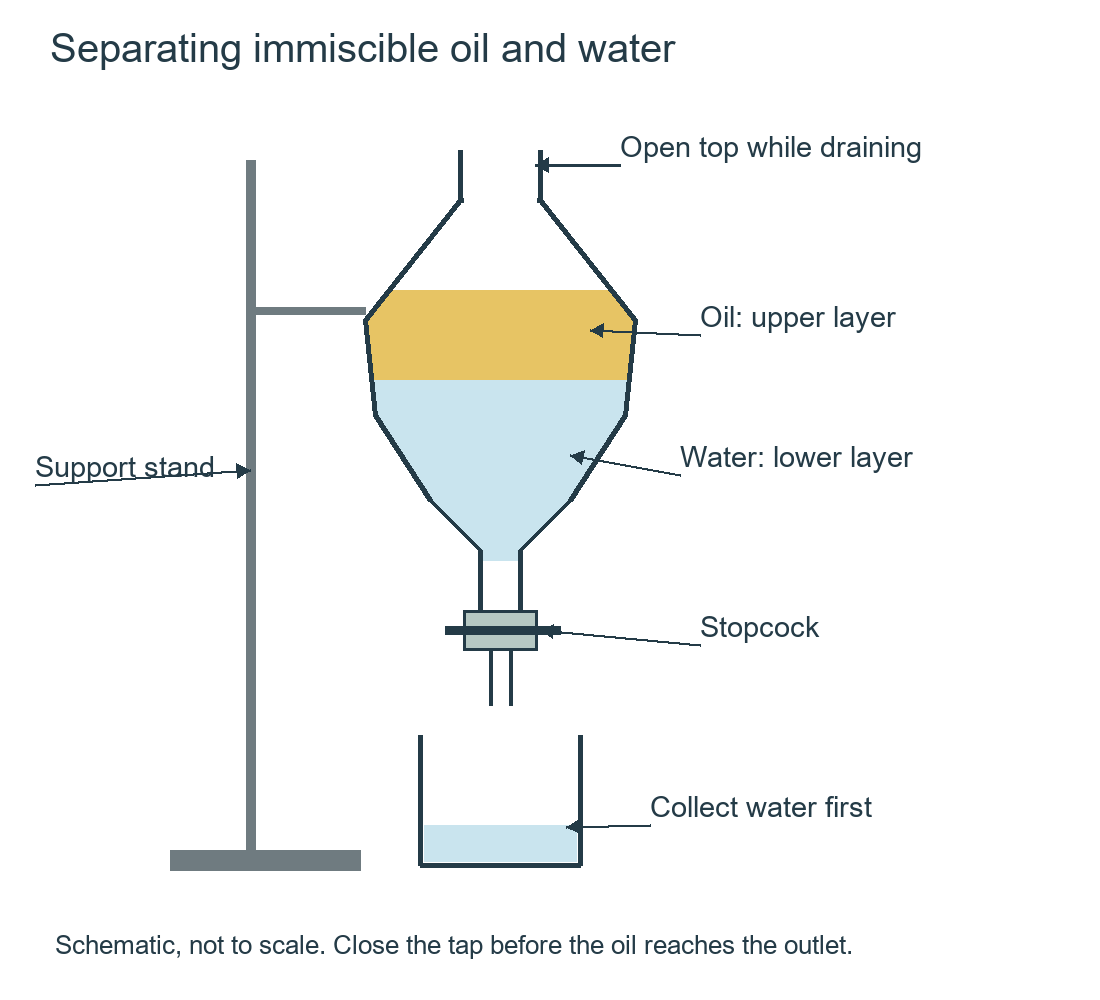
5. A cooking oil pack says one litre (910 g). If this oil is mixed with water, will it form a separate layer? If so, which substance will be on top? How will you separate the two layers? Draw the apparatus used.
Oil and water are immiscible. The stated oil density is:
This is less than water’s approximate density of 1 g mL−1, so oil forms the upper layer. Let the mixture settle in a supported separating funnel. Remove the stopper before draining, collect the lower water layer, and close the tap before the interface enters the outlet. Collect oil separately.
6. Assertion (A): Solutions do not exhibit the Tyndall effect. Reason (R): The particles in solutions are larger than 100 nm, so they cannot scatter light. Choose the correct option: (i) Both A and R are true, and R is the correct explanation of A. (ii) Both A and R are true, but R is not the correct explanation of A. (iii) A is true, but R is false. (iv) A is false, but R is true.
7. How would you separate the mixtures given in Table 5.3? Mention the reason for choosing your method.
| Mixture | Method | Reason |
|---|---|---|
| Mud from muddy water | Filtration (or sedimentation & decantation) | Mud is an insoluble solid in water; filtration retains the solid and lets water pass. |
| Plasma from other blood components | Centrifugation | Components have different densities; fast spinning settles the denser cells, leaving plasma on top. |
| Naphthalene and sand | Sublimation | Naphthalene sublimes on heating while sand does not, so the vapour can be collected separately. |
| Chalk powder and common salt | Dissolving + filtration + evaporation | Salt dissolves in water but chalk does not; filter out chalk, then evaporate the filtrate to recover salt. |
| Common salt and water | Evaporation | Water evaporates on heating, leaving the non-volatile salt behind. |
| Oil from water | Separating funnel | Oil and water are immiscible liquids of different densities; they form layers that can be drained off. |
| Pigments of the flower | Chromatography | Different pigments move different distances on the paper because of different solubility/adsorption. |
8. Two miscible liquids A and B are present in a mixture. The boiling point of A is 60 °C and of B is 90 °C. Suggest a method to separate them and draw a labelled diagram.
Simple distillation is the intended method because the boiling-point difference is 30 °C, exceeding the textbook’s approximate 25 °C guideline. Heating produces vapour enriched in lower-boiling A; it condenses in the cooled condenser and is collected. The residue becomes richer in B.
The thermometer bulb is at the vapour outlet. Cooling water enters the lower end of the condenser jacket and leaves the upper end. Keep the receiver vented; a teacher must select safe heating for the actual liquids.
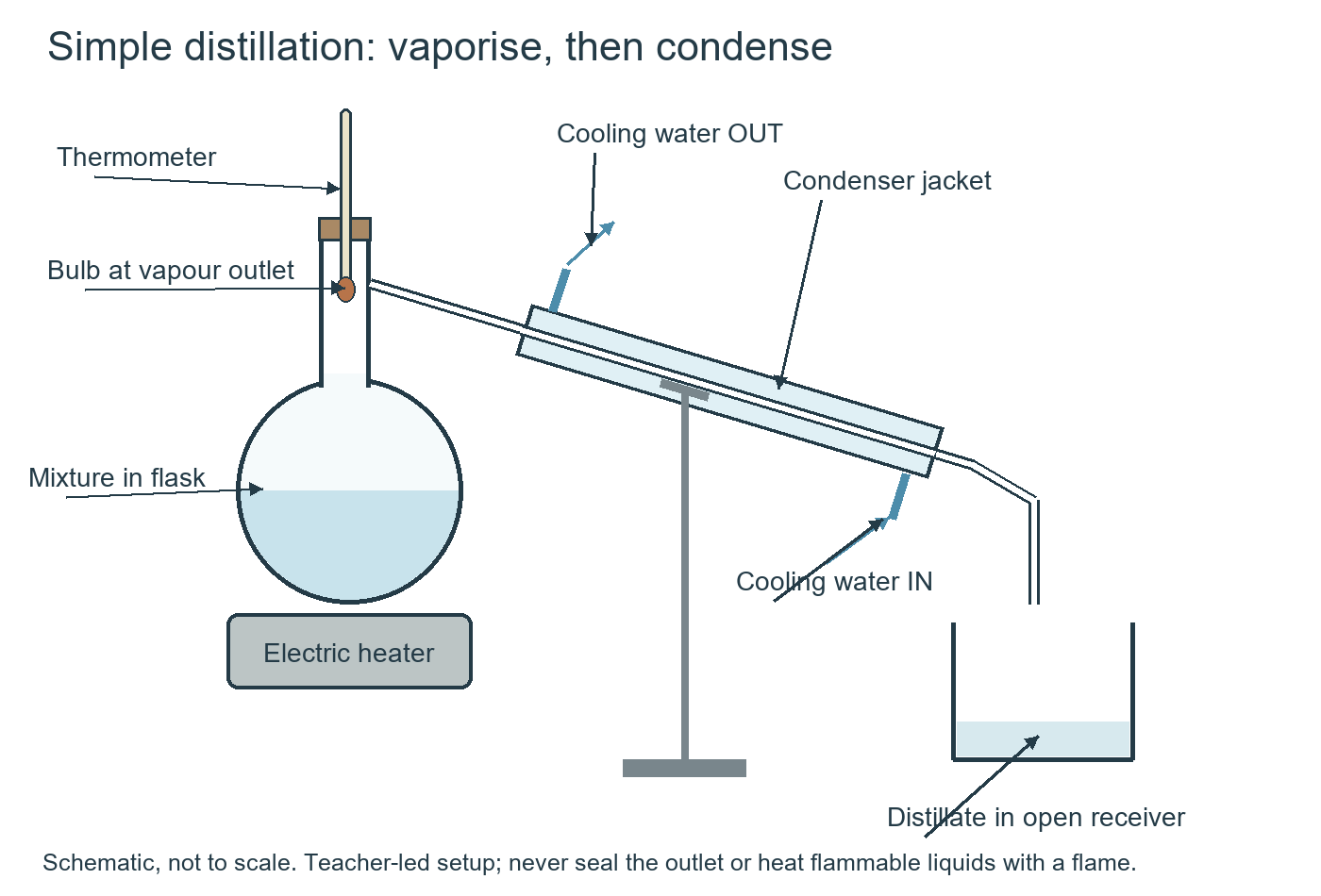
Limit: both volatile liquids can contribute to vapour; the first fraction is not automatically pure A. Real separation also depends on vapour–liquid behaviour and the purity required.
9. Compare evaporation, crystallization and distillation. In which situation would you prefer each over the others?
10. Blood is an example of a colloidal mixture. (i) What would happen if blood behaved like a true suspension inside the body? (ii) In a blood sample, identify the dispersed phase and the dispersion medium.
(i) In the textbook’s simplified model, rapid settling inside vessels would disrupt circulation and the transport of oxygen and other substances. However, real whole blood is a complex mixture: blood cells are already suspended in plasma and can sediment in a stationary sample. Circulation, interactions between cells and the fluid, and plasma proteins matter; blood is not simply a uniform colloid of tiny cells.
(ii) In a school-level whole-blood description, cells and platelets are dispersed components and plasma is the continuous liquid medium. More precisely, plasma’s proteins contribute colloidal behaviour, while the larger blood cells form a suspension. The premise “blood is a colloidal mixture” is an introductory simplification.
11. You are given a mixture of sand, common salt and naphthalene (Fig. 5.25a). Identify and write down the correct sequence of separation techniques shown in Fig. 5.25b.
12. Why is distillation an effective method for separating a mixture of water and acetone?
Acetone and water are miscible, with normal boiling points of about 56 °C and 100 °C. Distillation collects an acetone-enriched vapour as condensate while leaving a more water-rich residue. It uses their differing volatility.
The 44 °C boiling-point gap makes simple distillation a reasonable school-level choice, but a single pass does not guarantee perfectly pure components. Acetone is highly flammable, so this is a teacher-led laboratory demonstration with suitable controlled heating. See the NIOSH acetone reference.
13. Answer the following with the help of the solubility data in Table 5.4 (g per 100 g water): KNO3 21/32/45/62/106/167; NaCl 36/36/36.3/36.5/37/37; KCl 35/35/37.4/40/46/54; NH4Cl 24/37/41/41/55/66 at 10/20/30/40/60/80 °C. (i) What mass of potassium nitrate is needed to prepare its saturated solution in 50 g of water at 40 °C? (ii) A saturated solution of potassium chloride made at 80 °C is cooled to room temperature (25 °C). What would the student observe? Explain. (iii) What is the effect of temperature on the solubility of salts? Compare the four salts from 10 °C to 80 °C.
(i) The table gives 62 g potassium nitrate per 100 g water at 40 °C:
(ii) KCl crystals separate during cooling because its solubility decreases. At 25 °C the table has no measured entry. Linear interpolation between 20 °C and 30 °C estimates:
With 100 g water retained, the approximate mass crystallised is:
This is an estimate, assuming no water loss, not an exact 25 °C datum.
(iii) Over 10–80 °C, the supplied data increase by 146 g for KNO3, 42 g for NH4Cl, 19 g for KCl and only 1 g for NaCl, per 100 g water. Potassium nitrate changes most and sodium chloride least. These particular solid solutes show increasing overall solubility; the rule is not universal for every substance.
14. Three students prepare sugar solutions: A dissolves 20 g sugar in 80 g water; B dissolves 20 g sugar in 100 g water; C dissolves 30 g sugar in 80 g water. (i) Calculate the mass percentage (% m/m) of sugar in each solution. (ii) Whose solution is the most concentrated? Explain.
(ii) C is most concentrated because it contains the greatest sugar mass per unit total solution mass.
15. Examine Fig. 5.26. (i) Identify the separation technique marked ‘S’. (ii) Label the apparatus A, B and C. (iii) Which of the following mixtures can be separated by this technique (use boiling points in Table 5.5)?(a) water–acetone(b) water–salt(c) acetone–alcohol(d) sand–salt(e) alcohol–chloroform(f) alcohol–benzene
(i) S = simple distillation. Fig. 5.26 has a boiling flask connected directly to a condenser; it does not show a fractionating column.
(ii) A: distillation/round-bottom flask. B: condenser. C: receiving (conical) flask.
(iii) The appropriate choices for this setup are (a) water–acetone (boiling-point difference 44 °C) and (b) water–salt (collect water as distillate; salt remains in the flask).
For (c), (e) and (f), the listed boiling-point gaps are 22 °C, 17 °C and 2 °C respectively, so the textbook’s model prefers fractional distillation. Sand–salt, (d), instead needs selective dissolution, filtration and evaporation/crystallisation.
The 25 °C division is a classroom guideline. Some liquid pairs form azeotropes, and ordinary distillation cannot promise complete separation merely from their pure-component boiling points.
Common Mistakes to Avoid
Watch out for these
- Thinking milk and smoke are homogeneous — they are heterogeneous colloids.
- Saying solution particles are large — they are smaller than 1 nm, which is why solutions show no Tyndall effect.
- Confusing the three particle-size ranges: solution < 1 nm, colloid 1–1000 nm, suspension > 1000 nm.
- Using total water mass instead of total solution mass in % m/m (denominator = solute + solvent).
- Mixing up evaporation, crystallization and distillation, or choosing fractional distillation when boiling points are far apart (simple distillation is enough).
- Forgetting that solubility usually increases with temperature, so cooling a saturated solution gives crystals.
Extra Practice Questions
Very Short Answer Type Questions
Q1. Which type of mixture shows the Tyndall effect?
Q2. Name the method used to separate two immiscible liquids.
Q3. What is the particle size range of a colloid?
Short Answer Type Questions
Q1. Differentiate between a true solution and a colloid.
Q2. Why is fractional distillation used to separate liquids with close boiling points?
Long Answer Type Question
Q1. Describe how you would obtain pure copper sulfate crystals from an impure sample.
MCQs & Assertion–Reason
1. Which of the following is a homogeneous mixture?
(a) muddy water (b) milk (c) salt solution (d) smoke
2. The Tyndall effect is shown by:
(a) true solutions (b) colloids (c) pure water (d) sugar solution
3. Particle size in a true solution is:
(a) less than 1 nm (b) 1–1000 nm (c) more than 1000 nm (d) about 1 mm
4. Two immiscible liquids are best separated using:
(a) filtration (b) a separating funnel (c) evaporation (d) sublimation
5. Naphthalene can be separated from sand by:
(a) filtration (b) distillation (c) sublimation (d) centrifugation
6. The mass percentage of 20 g of salt in 80 g of water is:
(a) 20% (b) 25% (c) 16.7% (d) 80%
7. Components of blood are separated by:
(a) filtration (b) chromatography (c) centrifugation (d) evaporation
8. Fractional distillation is preferred when two miscible liquids have:
(a) the same boiling point (b) close boiling points (c) very different boiling points (d) no boiling point
9. On cooling a hot saturated solution, the solute:
(a) dissolves more (b) crystallises out (c) evaporates (d) sublimes
10. Which salt’s solubility changes the least with temperature?
(a) potassium nitrate (b) sodium chloride (c) potassium chloride (d) ammonium chloride
For each Assertion–Reason question, choose: (A) Both true and the Reason correctly explains the Assertion; (B) Both true but the Reason is not the correct explanation; (C) Assertion true, Reason false; (D) Assertion false, Reason true.
A-R 1. Assertion: Colloids show the Tyndall effect.
Reason: Colloidal particles are large enough to scatter a beam of light.
A-R 2. Assertion: A suspension settles down when left undisturbed.
Reason: The particles of a suspension are larger than 1000 nm.
A-R 3. Assertion: Distillation can separate common salt from water and recover the water.
Reason: Salt is volatile and evaporates before water.
A-R 4. Assertion: The solubility of most salts increases with temperature.
Reason: Cooling a hot saturated solution makes excess solute crystallise out.
A-R 5. Assertion: Milk is a heterogeneous mixture.
Reason: Milk is a colloid in which fat droplets are dispersed in water.
Quick Revision Summary
- Mixtures are homogeneous (uniform) or heterogeneous (non-uniform).
- Solution < 1 nm (no Tyndall); colloid 1–1000 nm (Tyndall, does not settle); suspension > 1000 nm (settles, filterable).
- Mass percentage uses component mass divided by total mixture mass, multiplied by 100%.
- Solubility = grams of solute per 100 g water in a saturated solution; usually rises with temperature.
- Separation: filtration, evaporation, crystallization, distillation, fractional distillation, sublimation, centrifugation, chromatography, separating funnel.
- Choose the method by the property that differs (solubility, boiling point, density, particle size, sublimation).
Real-life Applications
These ideas run our daily life and industry: obtaining salt from sea water (evaporation), purifying sugar (crystallization), separating petroleum into petrol, diesel and kerosene (fractional distillation), getting clean water (filtration and distillation), separating blood for medical tests (centrifugation), and identifying dyes and food colours (chromatography).
How to revise this chapter
Learn the three particle-size ranges and which mixture shows the Tyndall effect. For concentration sums, always divide by the total mass of the solution. Match each separation method to the property it uses, and remember: large boiling-point gap → simple distillation; small gap → fractional distillation.
Frequently Asked Questions
What is Class 9 Science Exploration Chapter 5 about?
Mixtures and their separation — homogeneous and heterogeneous mixtures, solutions, suspensions and colloids, the Tyndall effect, concentration, solubility, and separation methods.
What is the difference between a solution, a suspension and a colloid?
A solution has particles < 1 nm and no Tyndall effect; a suspension has particles > 1000 nm that settle and can be filtered; a colloid has particles 1–1000 nm that stay dispersed and scatter light.
What is the Tyndall effect?
The scattering of a beam of light by colloid or suspension particles, which makes the path of the light visible. True solutions do not show it.
Are these Class 9 Science Exploration Chapter 5 solutions free?
Yes. All solutions are free and follow the official NCERT Exploration textbook for 2026–27.