
Class 9 Science Chapter 9: Atomic Foundations of Matter — Solutions
These Class 9 Science Exploration Chapter 9 solutions cover Atomic Foundations of Matter from NCERT’s Exploration, first edition April 2026 (printed pages 162–183).
Class 9 Science Exploration Chapter 9 Solutions – Overview
Chapter 9 of Exploration, Atomic Foundations of Matter, explains how atoms combine to form compounds. It covers ions and valency, the formation of ionic bonds (transfer of electrons) and covalent bonds (sharing of electrons), how to write chemical formulae, how to calculate formula unit mass, and the law of conservation of mass and law of constant proportions. The worked answers include electron-dot models, balanced formulae and mass calculations, with notes where the textbook uses a simplified model.
Key Concepts & Definitions
Ion: a charged atom or group of atoms — a cation (positive, formed by losing electrons) or an anion (negative, formed by gaining electrons).
Valency: the combining capacity of an atom = the number of electrons it gains, loses or shares to complete its octet.
Ionic bond: electrostatic attraction between oppositely charged ions. Electron transfer helps describe ion formation; the bond is the resulting attraction in the ionic structure.
Covalent bond: formed by the sharing of electron pairs between non-metals (e.g., O2, H2O).
Formula unit mass: the sum of the atomic masses of all the atoms in a formula unit.
Law of conservation of mass: mass is neither created nor destroyed in a chemical reaction.
Valency & Formula-Writing Rules
Step 1: write the ions with their signed charges; use the magnitude of charge for ionic combining capacity.
Step 2: “cross over” — the numerical value of each ion’s charge becomes the subscript of the other ion.
Step 3: simplify the ratio; enclose polyatomic ions in brackets when more than one is needed.
Common ions: Na+, K+, NH4+; Ca2+, Mg2+, Cu2+; Al3+, Fe3+; Cl−, NO3−; O2−, SO42−, CO32−; PO43−.
Think It Over — Answers
Are water samples from different sources chemically identical?
The water compound is H2O with a fixed H:O atom ratio of 2:1 and approximately 1:8 mass ratio in the school model. Natural samples may contain different dissolved salts, gases and impurities; they must be purified before comparing the composition of water itself.
What is the difference between O and O2?
O is the element symbol or one oxygen atom, depending on context. O2 is a molecule containing two oxygen atoms; ordinary oxygen gas consists mainly of these molecules. O3 is ozone, another molecular form of oxygen.
Why does dissolved salt conduct electricity but sugar does not?
Dissolved sodium chloride supplies mobile ions. Sugar dissolves mainly as neutral molecules and does not supply appreciable mobile ions. Use distilled-water and apparatus controls; lack of bulb glow alone is not proof of exactly zero conductivity.
Activities and Pause and Ponder
Activities 9.1–9.3: Accounting for mass
For salt dissolving in water, the total mass is unchanged within measurement uncertainty if no material is lost. In the open vinegar/baking-soda setup, escaping CO2 lowers the mass retained on the balance. In the balloon setup, the gas remains part of the weighed system. Small changes in apparent readings can also arise from leaks, splashes and air buoyancy as the balloon expands; record observations rather than inventing identical readings.
The second reaction produces a white precipitate. Keep both vessels in the mass accounting; soluble barium salts require teacher-managed laboratory handling and disposal. A hydrogen-producing zinc/acid investigation also needs supervision, controlled quantities and gas capture without dangerous pressure buildup.
Activity 9.4: Solubility and conductivity
Record actual observations. Sodium chloride and copper sulfate form conducting aqueous solutions; sugar dissolves but remains mainly molecular. Camphor and naphthalene have low water solubility. Do not generalise that all covalent compounds are insoluble: sugar is a counterexample. Molecular substances that form ions in water can conduct too. Use an approved low-voltage tester under supervision; the textbook’s petrol/kerosene tests need laboratory controls, not unsupervised home trials.
Pause and Ponder: Answers 1–7
- No law is violated when ethanol leaves no residue: oxygen enters and gaseous products leave. Include the surroundings in the mass balance.
- 20 + 160 = 180 g water, with complete reaction and no loss.
- Oxygen mass:
- Oxygen needed:
- A specified pure compound has fixed composition; mixture proportions may vary.
- 4:1 and 8:2 simplify to the same 4:1 mass ratio, consistent with constant proportions for the same oxide.
- Option (iii): A is true; R is false because Dalton’s simple whole-number rule concerns numbers of atoms, not a universal whole-number mass ratio.
Pause and Ponder: Answers 8–18
- N2 has a triple bond and one lone pair on each N.
- Each F has seven valence electrons; sharing one pair forms F–F, with three lone pairs on each F.
- CO2: O=C=O with two lone pairs on each O. H2S: two S–H single bonds and two lone pairs on S. NH3: three N–H single bonds and one lone pair on N. These Lewis structures count valence electrons; they do not imply all these molecules are linear.
- Neon has the complete 2, 8 distribution and is largely unreactive under ordinary conditions.
- Oxygen gains two electrons to form O2−.
- Cl−; one Mg2+ and two Cl− ions give MgCl2.
- K (2, 8, 8, 1) loses one electron; Ca (2, 8, 8, 2) loses two. KCl has a 1:1 ion ratio; CaCl2 has a 1:2 ratio.
- Two Na atoms each lose one electron; sulfur gains both to form S2−. Two Na+ balance one S2− in Na2S.
- Carbon dioxide; nitrogen dioxide; sulfur hexafluoride; phosphorus trichloride.
- NaHCO3; SO2; FeCl3; Cu2O.
- Fe(OH)3; K2CO3.
Pause and Ponder: Answers 19–24
- The observation supports ionic bonding, with mobile ions in solution; some molecular substances also ionise in water, so conductivity alone does not uniquely prove solid-state bonding.
- M is magnesium: MgO, mainly ionic in this introductory model. The small dissolved/reacted fraction provides ions, so conductivity is limited by low solubility; do not claim the whole sample dissolves.
- Nitric acid:
- Methane:
- Potassium chloride:
- Magnesium hydroxide:
Journey Beyond: Sample approaches
For an atom/ion bar graph, use Na: 11→10 electrons, Mg: 12→10 and Cl: 17→18. For a charge-card game, combine two Al3+ and three SO42− cards into Al2(SO4)3. Compare the composition of purified water by teacher-led analysis or trustworthy supplied data; natural water samples contain impurities and do not justify a direct equality claim without purification.
Class 9 Science Exploration Chapter 9 Solutions — Revise, Reflect, Refine
1. Element A has one electron in its third shell; element B has six electrons in its second shell. (i) How many electrons does A tend to give or take to become stable? (ii) What kind of ion would it form? (iii) How many electrons does B tend to give or take to become stable? (iv) What kind of ion would it form? (v) If A and B combine, what kind of bond would form? (vi) What would be the formula of the compound?
2. Element X has six electrons in its outer shell and forms a diatomic molecule. (i) Why would that be so? (ii) What kind of bond would it form? (iii) Draw the structure of the molecule it would form. (iv) Another element Y has two electrons in its second shell. Draw the structure of the molecule X would form with Y.
(i)–(iii) In the chapter’s octet model, each X has six valence electrons and contributes two to shared pairs. Two X atoms share two pairs, giving a double covalent bond, X=X, with two lone pairs on each X.
(iv) Y has the distribution 2, 2 (beryllium). The expected introductory ion-counting model assigns Y2+ and X2−, so the neutral formula ratio is 1:1, YX.
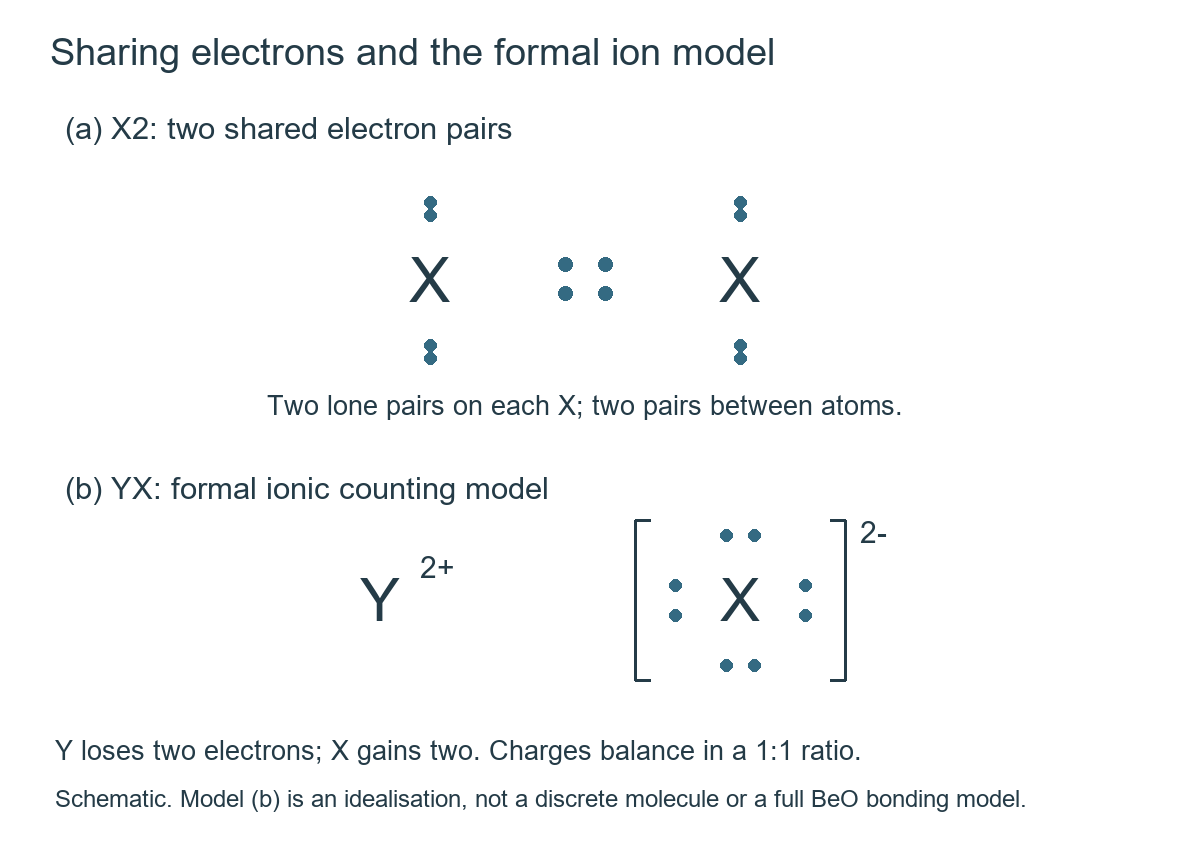
Model limitation: the question calls YX a molecule while expecting an ionic description. An ionic solid is an extended structure, not separate YX molecules. If X represents oxygen, the compound is BeO; the simple all-or-nothing electron-transfer picture is not a full description of its bonding. Do not infer that every metal/non-metal pair is purely ionic.
3. You want an ionic compound with total positive charge 6+ and total negative charge 6−. Which combination gives the correct number of ions? (i) 2 Al3+ and 3 Cl− (ii) 3 Mg2+ and 1 PO43− (iii) 2 Fe3+ and 3 O2− (iv) 3 Ca2+ and 2 SO42−
4. Choose the correct statement(s) and correct the false ones. (i) Elements are made up of molecules and compounds are made up of atoms. (ii) The molecule of a compound is always made up of two or more atoms of the same kind. (iii) One molecule of nitrogen gas contains three nitrogen atoms. (iv) Water is made of two hydrogen atoms covalently bonded with one oxygen atom.
5. Write the chemical formulae for: (i) Aluminium nitrate (ii) Calcium oxide (iii) Ferric oxide
6. Write the formulae of the compounds formed from these pairs of ions. (i) Ca2+ and Br− (ii) Al3+ and CO32− (iii) K+ and SO42− (iv) NH4+ and Cl−
7. Which option in Fig. 9.18 correctly represents the Cl− ion (atomic number of chlorine = 17)?
Option (ii) has 18 electrons arranged 2, 8, 8. Chlorine’s atomic number fixes its proton count at 17; gaining one electron gives chloride:
The nucleus is unchanged. A drawing of the nucleus as a dot does not itself display or count its protons.
8. Determine the formula unit mass of: (i) Ammonium nitrate (NH4NO3) (ii) Phosphoric acid (H3PO4) (iii) Sodium hydrogencarbonate (NaHCO3)
Using H = 1, C = 12, N = 14, O = 16, Na = 23 and P = 31, in u:
Terminology note: NH4NO3 and NaHCO3 are ionic formula units. H3PO4 is molecular, so 98 u is its molecular mass in this model, although the question groups all three under formula unit mass.
9. Write the formulae of the compounds formed by the reaction of: (i) Magnesium and nitrogen (ii) Lithium and nitrogen (iii) Sodium and sulfur (iv) Aluminium and oxygen
10. Complete Table 9.3 with the formulae of the compounds (LiNO3 is given as an example).
| Cation ↓ / Anion → | NO3− | SO42− | PO43− |
|---|---|---|---|
| NH4+ | NH4NO3 | (NH4)2SO4 | (NH4)3PO4 |
| Li+ | LiNO3 | Li2SO4 | Li3PO4 |
| Al3+ | Al(NO3)3 | Al2(SO4)3 | AlPO4 |
| Cu2+ | Cu(NO3)2 | CuSO4 | Cu3(PO4)2 |
11. 5.3 g of sodium carbonate and 6.0 g of acetic acid react to produce 2.2 g of carbon dioxide, 0.9 g of water and 8.2 g of sodium acetate. Verify the law of conservation of mass.
The supplied masses satisfy conservation of mass. Count all products, including carbon dioxide; if gas escapes an open vessel, the vessel’s remaining contents alone weigh less.
12. A species has 11 protons, 12 neutrons and 10 electrons. (i) What is its atomic number and mass number? (ii) Is it neutral, a cation or an anion? Explain. (iii) Write its electronic configuration. (iv) Name the species.
13. Two elements have configurations A: 2, 8, 5 and B: 2, 8, 7. (i) Which element is more reactive? (ii) Will A and B form ionic or covalent bonds? Explain using electron transfer or sharing. (iii) Predict the formula of the compound they form.
(i) The intended school-level answer is B (chlorine), which commonly gains one electron; A is phosphorus. However, “more reactive” is not a universal numerical ranking derived from electrons needed for an octet. Reactivity depends on the reaction partner and conditions.
(ii) Both are non-metals and form covalent bonds by sharing electron pairs.
(iii) With the introductory valencies A = 3 and B = 1:
Phosphorus also forms compounds with other valencies; the question’s simple octet model predicts AB3, not every possible compound of these elements.
14. Assertion (A): Copper sulfate conducts electricity in the molten state but not in the solid state. Reason (R): Copper and sulfate ions are fixed in the lattice in the molten state, while in the solid state they can move freely. Choose the correct option: (i) Both A and R are true, and R is the correct explanation of A. (ii) Both A and R are true, but R is not the correct explanation of A. (iii) A is true, but R is false. (iv) A is false, but R is true.
Intended answer: (iii), A true and R false, under the question’s ideal ionic-melt model. Ions are held at fixed average positions in a solid lattice and can move in a melt; R reverses these descriptions.
Material-specific caveat: copper(II) sulfate decomposes on strong heating, so it is a poor literal example of a stable ionic melt. Its aqueous solution conducts through mobile ions. A more suitable simple melting/conductivity example is sodium chloride. See PubChem’s copper-sulfate property record. Do not treat the wording as a recommendation to melt copper sulfate.
15. The species 27Al, 80Br− and 201Hg2+ have 13, 35 and 80 protons respectively. How many electrons and neutrons do they have?
For each species, neutrons equal mass number minus protons. Ion formation changes electron count, not the nucleus.
Common Mistakes to Avoid
Watch out for these
- Forgetting to balance the total positive and negative charges when writing a formula.
- Not using brackets for polyatomic ions when more than one is needed, e.g., Al(NO3)3, not AlNO33.
- Mixing up cation (loses electrons, positive) and anion (gains electrons, negative).
- Thinking metals share electrons — metals usually transfer electrons (ionic), non-metals share (covalent).
- Writing nitrogen or oxygen as single atoms — they are diatomic (N2, O2).
- Forgetting that an ionic solid conducts only when molten or dissolved (ions free to move), not as a solid.
Extra Practice Questions
Very Short Answer Type Questions
Q1. What is the valency of oxygen?
Q2. Name the bond formed by sharing of electrons.
Q3. Write the formula of magnesium chloride.
Short Answer Type Questions
Q1. Differentiate between an ionic bond and a covalent bond.
Q2. Calculate the formula unit mass of calcium carbonate (CaCO3). (Ca = 40)
Long Answer Type Question
Q1. Explain the formation of sodium chloride (NaCl) by the transfer of electrons.
MCQs & Assertion–Reason
1. A positively charged ion is called a(n):
(a) anion (b) cation (c) molecule (d) atom
2. The bond formed by transfer of electrons is:
(a) covalent (b) ionic (c) metallic (d) hydrogen
3. The formula of aluminium oxide is:
(a) AlO (b) Al2O3 (c) Al3O2 (d) AlO3
4. The formula unit mass of NaCl is (Na = 23, Cl = 35.5):
(a) 58.5 u (b) 48.5 u (c) 68.5 u (d) 35.5 u
5. Nitrogen gas exists as:
(a) N (b) N2 (c) N3 (d) N4
6. The valency of the ammonium ion (NH4+) is:
(a) 1 (b) 2 (c) 3 (d) 4
7. Which compound is held together by covalent bonds?
(a) NaCl (b) MgO (c) H2O (d) CaCl2
8. Ionic compounds conduct electricity when:
(a) solid (b) molten or dissolved (c) frozen (d) never
9. The number of electrons in a Cl− ion (Z = 17) is:
(a) 16 (b) 17 (c) 18 (d) 19
10. The law of conservation of mass was given by:
(a) Dalton (b) Lavoisier (c) Bohr (d) Rutherford
For each Assertion–Reason question, choose: (A) Both true and the Reason correctly explains the Assertion; (B) Both true but the Reason is not the correct explanation; (C) Assertion true, Reason false; (D) Assertion false, Reason true.
A-R 1. Assertion: Sodium forms a cation by losing one electron.
Reason: It then attains the stable configuration 2, 8.
A-R 2. Assertion: Ionic compounds conduct electricity in the molten state.
Reason: In the molten state the ions are free to move.
A-R 3. Assertion: The total mass is conserved in a chemical reaction.
Reason: Atoms are only rearranged, not created or destroyed.
A-R 4. Assertion: Oxygen gas is monatomic.
Reason: An ordinary oxygen molecule contains two oxygen atoms, O2.
A-R 5. Assertion: A covalent bond forms between two non-metals.
Reason: Non-metals complete their octets by sharing electrons.
Quick Revision Summary
- Atoms combine to complete their octets by losing, gaining or sharing electrons.
- Ionic bond = transfer of electrons (metal + non-metal); covalent bond = sharing (non-metal + non-metal).
- Valency = combining capacity; write formulae by balancing total charges (cross-over method).
- Formula unit mass = sum of atomic masses of all atoms in the formula.
- Cation = positive (lost electrons); anion = negative (gained electrons).
- Law of conservation of mass: mass of reactants = mass of products.
Real-life Applications
This chemistry is everywhere: common salt (NaCl) and washing soda are ionic compounds, while water, carbon dioxide and the gases we breathe are covalent; fertilisers such as ammonium nitrate and phosphoric-acid products are made using these formulae; molten and dissolved ionic compounds conduct electricity (used in electrolysis and batteries); and the law of conservation of mass is the basis of balancing every chemical equation.
How to revise this chapter
Always balance the charges when writing a formula and use brackets for polyatomic ions. Decide the bond type from the elements (metal + non-metal → ionic; non-metal + non-metal → covalent). For formula unit mass, list each atom with its mass and add carefully, and remember mass is conserved in every reaction.
Frequently Asked Questions
What is Class 9 Science Exploration Chapter 9 about?
Atomic foundations of matter — how atoms combine, ionic and covalent bonds, ions and valency, writing chemical formulae, formula unit mass, and the law of conservation of mass.
What is the difference between an ionic and a covalent bond?
An ionic bond forms by transfer of electrons (metal to non-metal); a covalent bond forms by sharing of electrons between non-metals.
How do you write a chemical formula?
Write the ions with their charges, cross over the numerical value of each charge to the other ion as a subscript, and simplify, using brackets for polyatomic ions.
Are these Class 9 Science Exploration Chapter 9 solutions free?
Yes. All solutions are free and follow the official NCERT Exploration textbook for 2026–27.