
Class 9 Science Chapter 10: Sound Waves — Solutions
These Class 9 Science Exploration Chapter 10 solutions cover Sound Waves: Characteristics and Applications from NCERT’s Exploration, first edition April 2026 (printed pages 184–207).
Class 9 Science Exploration Chapter 10 Solutions – Overview
Chapter 10 of Exploration, Sound Waves: Characteristics and Applications, explains how sound is produced by vibrating bodies and travels as a longitudinal mechanical wave through a medium as a series of compressions and rarefactions. It covers the characteristics of a sound wave — wavelength, frequency, time period, amplitude and speed — the key relation v = f × λ, the ideas of echo and reverberation, and important applications such as SONAR and ultrasound. The worked solutions include scaled density graphs, echo travel paths and calculations with consistent units.
Key Concepts & Definitions
Sound in air is a longitudinal mechanical wave — it needs a medium and the particles vibrate along the direction of travel.
Compression: a high-density, high-pressure region; rarefaction: a low-density, low-pressure region.
Wavelength (λ): distance between two consecutive compressions (or rarefactions). Frequency (f): number of waves passing a point per second (Hz). Time period (T): time for one wave = . Amplitude: the maximum change in density/pressure.
Echo: a distinct reflected sound heard when the gap is at least 0.1 s. Reverberation: persistence of sound by repeated reflections when the gap is less than 0.1 s.
SONAR & ultrasound: sonar uses sound echoes (often ultrasound) for ranging; ultrasound means sound above 20 kHz, which also has imaging and other applications.
Sound Wave Formulas
For a stationary source/receiver and reflector with a shared outward/return path:
The roughly 0.1 s separation used in school echo problems is an approximate hearing criterion, not a universal sharp boundary. Reverberation means persistence from repeated reflections; audibility also depends on source duration and reflected intensity.
“Think It Over” — Answers
Two astronauts standing close together in space cannot hear each other speak directly. Why?
How is sound produced, and how does it reach our ears?
Textbook Activities and Pause and Ponder
Think It Over: Astronauts and bats
Astronauts use radios to communicate across the near-vacuum; ordinary airborne speech and clanking do not cross that vacuum. Mechanical vibrations can travel along structures in contact. Most echolocating bats emit short high-frequency calls and detect reflected sound to locate prey.
Activities 10.1–10.8: What to observe
- A plucked rubber band vibrates. Changing tension, length and thickness can change frequency; compare only one factor at a time. A box can couple vibrations to more air and make the sound easier to hear.
- A gently struck tuning fork vibrates; touching water reveals ripples/splashes. Avoid striking hard surfaces or bringing a vibrating prong into contact with the ear.
- A desk can carry sound through a solid as well as through surrounding air.
- Tapping submerged spoons demonstrates that water transmits sound; real listening paths may also include the vessel and air.
- The slinky disturbance travels while a marked coil oscillates about its mean position. Longitudinal vibrations are parallel to propagation.
- Sound can transfer energy to the stretched membrane and grains. Mechanical contact or table vibration can confound the observation, so keep those paths separate.
- Measure actual musical-note frequencies and compare ratios to Sa. An octave has approximately double frequency; do not invent readings or assume every musical scale has equally spaced frequencies.
- At a comfortable level, increasing frequency usually raises perceived pitch. Hearing range varies among listeners; phone speakers and apps have limits and cannot diagnose hearing.
Pause and Ponder: Answers 1–9
- Samples: plucking strings, striking a membrane or metal object, and blowing across an air column; each starts vibrations.
- Sitar/guitar: strings; tabla/drum: membrane; flute: air column; cymbals: metal bodies. Some instruments couple several vibrating parts.
- Option (ii): A and R true, and R explains A in the bell-jar model. In a real apparatus some structure-borne sound may remain.
- Option (iii): the disturbance travels but particles oscillate; they do not continuously travel with the wave.
- Option (ii): energy carried by the wave.
- Mark dense regions C and sparse regions R; graph density on the vertical axis and distance on the horizontal. Density maxima align with compression centres, minima with rarefaction centres.
- With comparable material, length and tension, a thinner band generally has lower mass per length and higher frequency, hence shorter period. Report observations if tension also changes.
- 20 oscillations each second means 20 × 60 = 1200 oscillations per minute.
- In Fig. 10.19, one complete repeat spans 3.0 cm, so half a wavelength is 1.5 cm.
Pause and Ponder: Answers 10–13
(10) Using the supplied table:
(11) For a 340 m path:
The steel signal arrives first. The separation exceeds the textbook’s approximate 0.1 s criterion, so two sounds can be distinguished if both are sufficiently audible.
(12) Minimum reflector distance:
(13) Sonar depth:
Journey Beyond: Sample methods
Compare a paper cone with and without the same sound source at fixed positions and volume; a cone redirects and couples sound rather than creating energy. Curved reflectors can distribute sound but may also focus it and create uneven loudness; combine reflection control with absorption and diffusion. For the open-ground speed experiment, use actual measured distance and repeated light-to-sound delays:
Seeing the burst marks emission almost immediately; manual reaction time and distance measurement can be major errors. Do not present sample numbers as measured results. The hearing-health article should use current authoritative research and local scheme eligibility; an app test is not a clinical hearing assessment.
Class 9 Science Exploration Chapter 10 Solutions — Revise, Reflect, Refine
1. Which observation best supports the idea that sound is a mechanical wave? (i) Sound shows reflection (ii) Sound needs a medium to propagate (iii) Sound has frequency (iv) Sound carries energy
2. For a sound wave in a medium, increasing its frequency will increase its (i) wavelength (ii) speed (iii) number of compressions per second (iv) time period
3. If 20 compressions pass a point in 4 seconds, the frequency is (i) 80 Hz (ii) 5 Hz (iii) 10 Hz (iv) 0.2 Hz
Option (ii):
4. In a room, the reflected sound reaches the ear 0.05 s after its production. Will it produce an echo or reverberation? Justify.
5. Graphs of two sound waves are given in Fig. 10.30 (same scales on both axes). Which wave has (i) greater wavelength, and (ii) smaller amplitude?
6. The sound waves from three sources A, B and C are shown in Fig. 10.31. If the frequency of A is maximum and that of C is minimum, identify the curves and mark A, B and C.
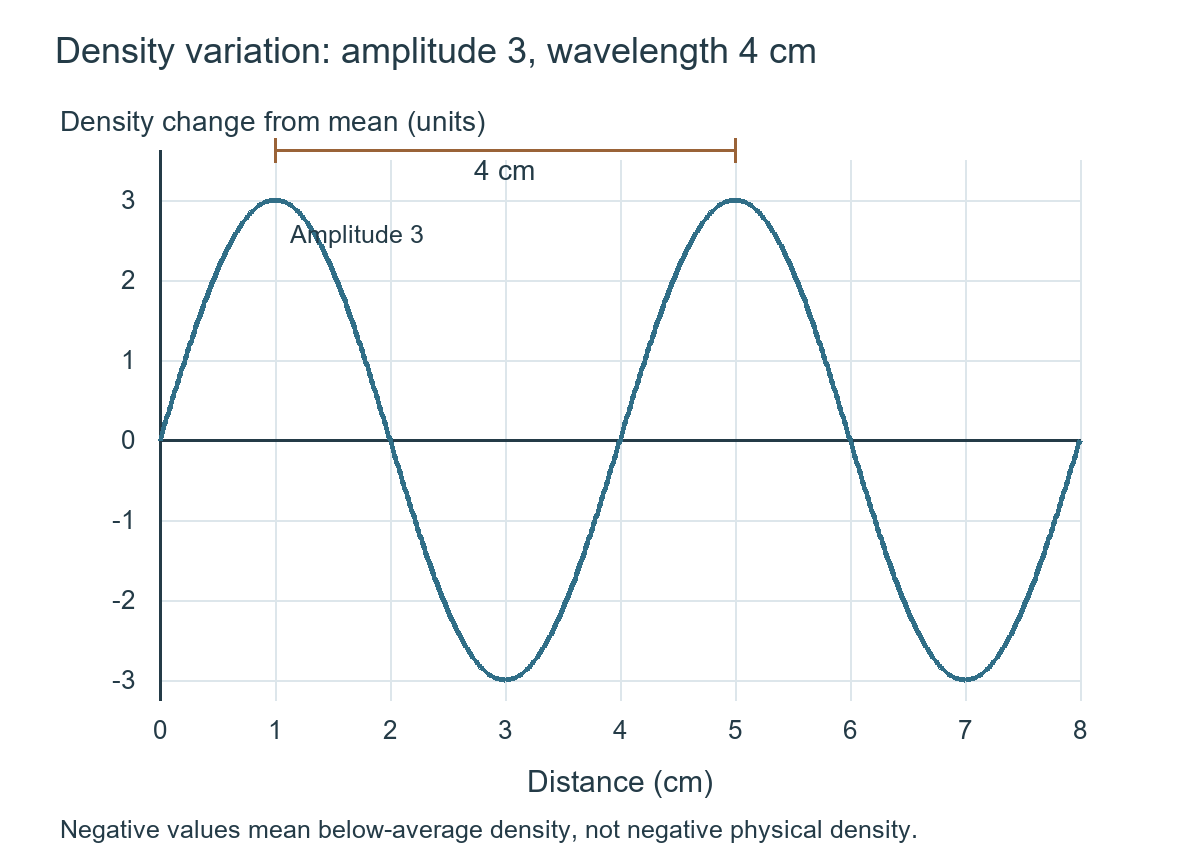
7. Draw a graph of a sound wave with density amplitude 3 units and wavelength 4 cm.
Plot density change from its mean against distance. One suitable curve is:
8. In a movie, the explosion of a spacecraft in space is shown with a flash of light and sound at the same time. What are the errors in this depiction?
A distant observer cannot hear an explosion through a vacuum because ordinary sound needs a medium; light can reach the observer. If both signals travel through a material medium over an appreciable distance, the light arrives much earlier. Near a source the delay can be too small to notice. Sound conducted through a spacecraft’s structure or heard inside its air-filled cabin is a different situation from sound crossing empty space.
9. A source produces a sound wave of wavelength 3.44 m travelling at 344 m s-1. Find its time period.
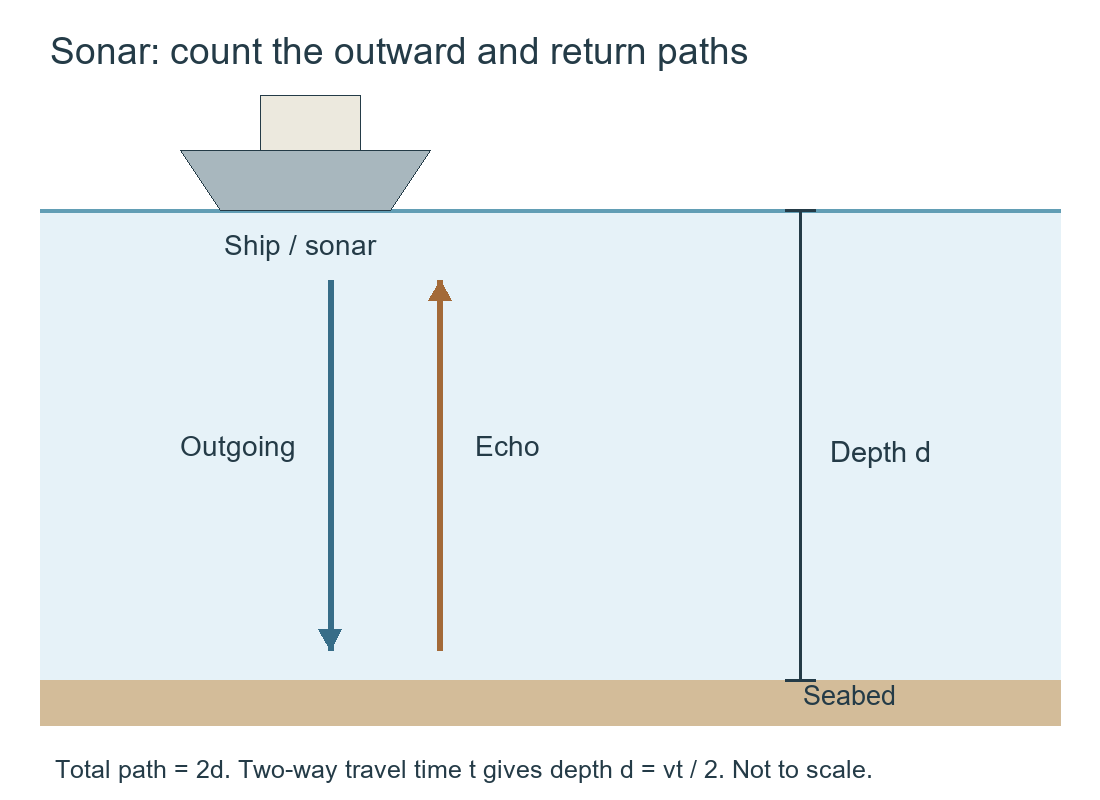
10. A ship sends a sonar signal and detects an echo after 5 s. If the ultrasonic wave travels at 1525 m s-1 in seawater, how far down is the sunken ship?
For a target directly below the ship, the measured 5 s is the two-way travel time.
11. A parking sensor emits an ultrasonic wave that reflects off an obstacle. When the beep starts at 1.2 m from the obstacle, how much time does the wave take to travel to the obstacle and back? (Speed in air = 345 m s-1.)
This is the acoustic round trip; an electronic warning system may add processing delay.
12. The speed of sound is about 331 m s-1 at 0 °C and 344 m s-1 at 22 °C. Roughly how much extra time will the sound of thunder take to travel 1720 m if the temperature changes from 22 °C to 0 °C?
Sound takes longer in the colder air under the question’s unchanged-other-conditions assumption.
13. The density variation of a sound wave travelling at 340 m s-1 is shown in Fig. 10.32. Calculate the wavelength and frequency.
The 8 cm arrow spans two compression-to-compression intervals (three compression centres), hence two wavelengths:
14. Two sound waves A and B (Fig. 10.33) travel at the same speed of 345 m s-1. Find the wavelength and frequency of each.
Read equal-phase points on the same distance axis. Wave A repeats every 2.5 cm, while B repeats every 5.0 cm:
15. Two identical sound sources at A (in air) and B (in water) send sound horizontally to a cliff and back (Fig. 10.34). If the time taken to return to A is 4.5 times that to B, what is the ratio of the speeds of sound in air and water?
Both sounds travel the same horizontal round-trip distance, so speed is inversely proportional to travel time:
Speed in air : speed in water = 2 : 9.
Common Mistakes to Avoid
Watch out for these
- Thinking sound can travel through vacuum — it cannot; it needs a medium.
- Mixing up frequency (waves per second) with wavelength (distance per wave) — they are inversely related at fixed speed.
- Forgetting the factor of 2 in echo/SONAR problems (the sound travels to the object and back).
- Not converting cm to m before using v = f × λ.
- Confusing echo (gap ≥ 0.1 s, distinct repeat) with reverberation (gap < 0.1 s, persistence).
- Assuming amplitude affects frequency — loudness depends on amplitude, pitch depends on frequency.
Extra Practice Questions
Very Short Answer Type Questions
Q1. What type of wave is a sound wave?
Q2. What is the SI unit of frequency?
Q3. On which property of a sound wave does its loudness depend?
Short Answer Type Questions
Q1. Distinguish between the pitch and the loudness of a sound.
Q2. A sound wave has a frequency of 500 Hz and a wavelength of 0.66 m. Calculate its speed.
Long Answer Type Question
Q1. Explain how sound propagates through air using the idea of compressions and rarefactions.
MCQs & Assertion–Reason
1. Sound waves are:
(a) transverse (b) longitudinal (c) electromagnetic (d) stationary
2. Sound cannot travel through:
(a) solids (b) liquids (c) gases (d) vacuum
3. The SI unit of frequency is:
(a) metre (b) second (c) hertz (d) decibel
4. The relation between speed, frequency and wavelength is:
(a) v = f / λ (b) v = f × λ (c) v = λ / f (d) v = f + λ
5. The minimum time gap to hear a distinct echo is:
(a) 0.01 s (b) 0.1 s (c) 1 s (d) 10 s
6. The pitch of a sound depends on its:
(a) amplitude (b) frequency (c) speed (d) wavelength only
7. SONAR is used to measure:
(a) air temperature (b) depth of the sea (c) light intensity (d) wind speed
8. The frequency of ultrasound is:
(a) below 20 Hz (b) 20 Hz to 20 000 Hz (c) above 20 000 Hz (d) exactly 20 Hz
9. If a sound wave has frequency 200 Hz, its time period is:
(a) 0.005 s (b) 0.05 s (c) 200 s (d) 5 s
10. The loudness of a sound depends on its:
(a) frequency (b) wavelength (c) amplitude (d) speed
For each Assertion–Reason question, choose: (A) Both true and the Reason correctly explains the Assertion; (B) Both true but the Reason is not the correct explanation; (C) Assertion true, Reason false; (D) Assertion false, Reason true.
A-R 1. Assertion: Sound cannot travel in a vacuum.
Reason: Sound is a mechanical wave that needs a medium to propagate.
A-R 2. Assertion: An echo is heard only if the reflecting surface is far enough away.
Reason: The reflected sound must reach the ear at least 0.1 s after the original.
A-R 3. Assertion: A higher-frequency sound has a higher pitch.
Reason: Pitch is determined by the amplitude of the wave.
A-R 4. Assertion: Sound travels faster in water than in air.
Reason: Speed depends on both elastic response and density; their combined effect gives a higher sound speed in water under the stated ordinary conditions.
A-R 5. Assertion: SONAR uses ultrasound to find the depth of the sea.
Reason: Ultrasound is reflected by the seabed and the echo time is measured.
Quick Revision Summary
- Sound is a longitudinal mechanical wave; it needs a medium and travels as compressions and rarefactions.
- v = f × λ and .
- Pitch depends on frequency; loudness depends on amplitude.
- Echo: gap ≥ 0.1 s (distinct); reverberation: gap < 0.1 s (persistence).
- In echo/SONAR problems use 2d = v × t (sound goes and returns).
- Sound travels faster in solids and liquids than in gases.
Real-life Applications
Sound science is everywhere: SONAR measures sea depth and locates shipwrecks and shoals of fish; ultrasound scans are used in medicine and to clean and detect flaws in metals; bats and dolphins use echolocation to navigate; parking sensors use ultrasonic echoes; and concert halls are designed to control reverberation for clear sound.
How to revise this chapter
Always write v = f × λ with consistent units (convert cm to m), and remember the factor of 2 for echoes and SONAR. Keep pitch (frequency) and loudness (amplitude) separate, and quote the 0.1 s rule when distinguishing an echo from reverberation.
Frequently Asked Questions
What is Class 9 Science Exploration Chapter 10 about?
Sound waves — how sound is produced and travels as a longitudinal wave, its characteristics (wavelength, frequency, amplitude, speed), v = f × λ, echo and reverberation, and applications such as SONAR and ultrasound.
What is the relation v = f × λ?
The speed of a wave equals its frequency multiplied by its wavelength; the time period is the reciprocal of the frequency ().
What is the difference between an echo and reverberation?
An echo is a distinct repeat heard when the reflected sound arrives at least 0.1 s later; reverberation is the persistence of sound from repeated reflections when the gap is shorter than 0.1 s.
Are these Class 9 Science Exploration Chapter 10 solutions free?
Yes. All solutions are free and follow the official NCERT Exploration textbook for 2026–27.