
Class 9 Science Chapter 12: Diversity and Classification — Solutions
These Class 9 Science Exploration Chapter 12 solutions cover Patterns in Life: Diversity and Classification from NCERT’s Exploration, first edition April 2026 (printed pages 228–251).
Class 9 Science Exploration Chapter 12 Solutions – Overview
Chapter 12 of Exploration, Patterns in Life: Diversity and Classification, explains the huge biodiversity of life and why we need to classify organisms. It covers the basis of classification (cellular organisation, number of cells and mode of nutrition), Whittaker’s five kingdom classification (Monera, Protista, Fungi, Plantae and Animalia), the main groups of plants and animals, the classification hierarchy, and why viruses are kept outside the system. The answers use the chapter’s five-kingdom framework, with comparison charts and notes on exceptions and modern classification.
Key Concepts & Definitions
Biodiversity: variation at genetic, species and ecosystem levels, not just a count of species.
Classification: arranging organisms into groups based on shared characteristics.
Basis of classification: cellular organisation (prokaryotic / eukaryotic), number of cells (unicellular / multicellular) and mode of nutrition (autotrophic / heterotrophic).
Five kingdoms (Whittaker): Monera (prokaryotes), Protista (unicellular eukaryotes), Fungi (heterotrophic, chitin cell wall), Plantae (autotrophic, cellulose cell wall) and Animalia (heterotrophic, no cell wall).
Classification hierarchy: Kingdom → Phylum → Class → Order → Family → Genus → Species (going down, fewer members but more shared features).
Viruses: acellular; active only inside a host — kept outside the five kingdoms.
“Think It Over” — Answers
What do you understand by biodiversity, and why is there such an enormous variety of life on Earth?
On what basis are organisms classified into groups?
Classification Charts and Textbook Activities
Compare multiple features
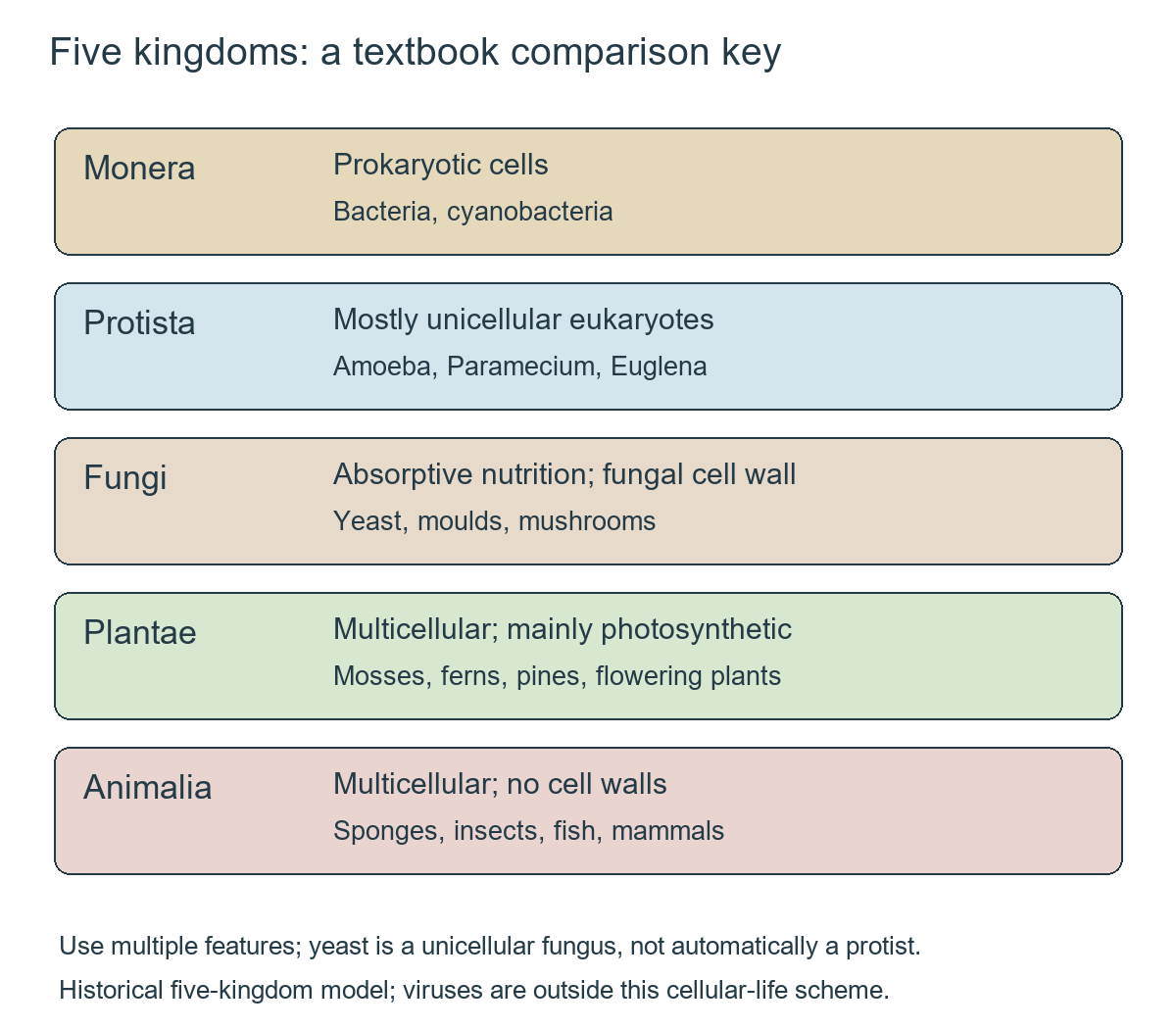
Whittaker’s five kingdoms are an introductory model, not the only modern classification. Monera groups prokaryotes that later molecular studies distinguish into Bacteria and Archaea. Protista is a diverse historical grouping. Biological evolution branches; present-day groups are not a ladder from inferior to superior organisms.
Ranks and scientific names
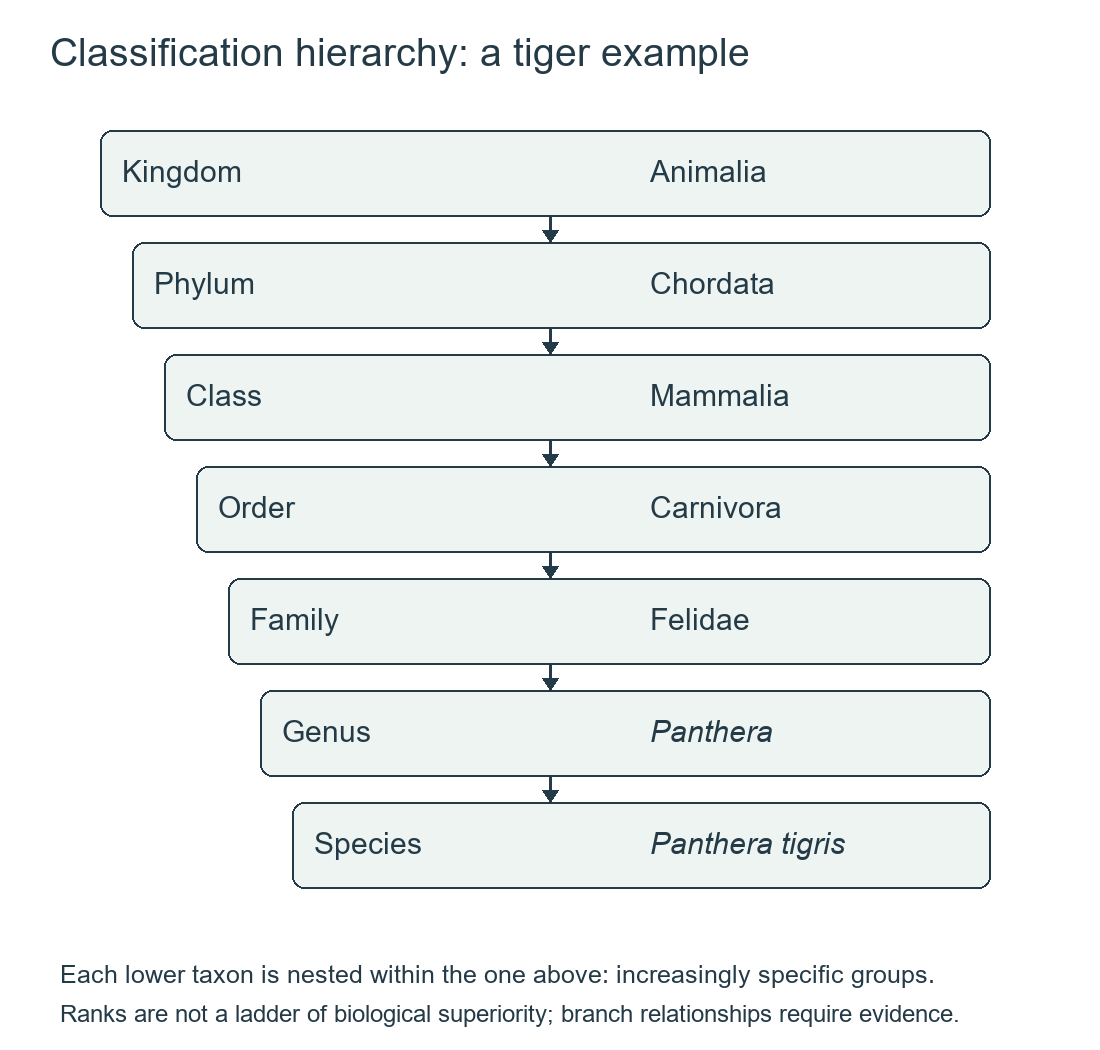
Write Panthera tigris and Mangifera indica: capitalise the genus and use a lower-case specific epithet, italicising both words in print or underlining them separately by hand. The second word alone is the specific epithet; the complete two-word name identifies the species. “Species can interbreed” is a useful biological-species model, but it has limits for fossils, asexual organisms and some hybridising groups.
The book associates the three-domain development with 1977. The formal proposal of the rank “domain” by Woese, Kandler and Wheelis was published in 1990; earlier molecular discoveries paved the way. See the original three-domain proposal.
Plant groups: Key distinctions
| Textbook group | Useful features | Benefits and limits |
|---|---|---|
| Thallophyta (algal forms) | Thallus; no true roots, stems or leaves | Direct exchange suits many aquatic forms; not all algae are restricted to open water. This is a traditional grouping, not one modern evolutionary lineage. |
| Bryophyta | No true xylem/phloem; rhizoids; spores | Can occupy moist land; swimming sperm need water for fertilisation and transport limits body size. |
| Pteridophyta | Vascular tissue and true roots, stems, leaves; no seeds | Transport supports larger bodies; fertilisation still generally needs free water. |
| Gymnosperms | Vascular seed plants; seeds not enclosed in an ovary/fruit | Pollen and seeds reduce dependence on external water for fertilisation, not all water needs. Needle leaves describe many conifers, not every gymnosperm. |
| Angiosperms | Flowers; seeds enclosed in fruits | Pollination and fruit dispersal support reproduction; depend on appropriate conditions and, in some species, animal partners. |
Animal groups and important exceptions
Porifera have pores and cellular organisation; Cnidaria have stinging cells and tissue organisation; flatworms have flattened bilateral bodies; roundworms generally have a complete gut; annelids show segmentation; arthropods have jointed appendages and an exoskeleton; molluscs have a generally unsegmented soft body and mantle, often with a shell; echinoderms have a calcareous internal skeleton and water-vascular system.
Chordates have a notochord at some stage; vertebrates are a subgroup. Therefore “invertebrate” is not exactly synonymous with “non-chordate”: some chordates have no vertebral column. Birds and mammals are diagnosed with several features, not simply flight or live birth; flightless birds and egg-laying mammals are exceptions to those shortcuts.
Activities 12.1–12.3: Comparing and choosing criteria
For the day/night picture, record organisms actually visible, their location, activity and visible features; the textbook supplies owl/tree/night/feathers as one example. An organism may fit a habitat group and a feeding group at the same time. Such practical groupings do not by themselves establish ancestry.
In the Pakke case study, organise dated records by species, identifying features, habitat and observation effort. Hornbill bill and casque shape, plumage, size and calls can distinguish species; verify with a field guide. Loss of large old cavity-bearing trees can reduce nesting opportunities and affect seed dispersal. Protect those trees and food plants, with local-community participation. The five-kingdom concept map uses cell type, organisation, wall features and nutrition; genetic evidence can refine relationships.
Activities 12.4–12.9: Slides and plant comparisons
Use prepared bacterial/cyanobacterial slides under teacher guidance; both lack a membrane-bound nucleus, but cyanobacteria are photosynthetic prokaryotes and should not all be labelled decomposers. In hay infusion, observe real shapes and movement; do not infer every moving speck is a protist. Follow the textbook’s teacher-managed handling and sterilisation procedure.
Bryophyte leaf-like parts differ from typical vascular leaves in their transport organisation. Both fern and sunflower stems have xylem and phloem, but bundle arrangement depends on the specimen; compare the labelled sections actually shown rather than inventing a single universal fern pattern. For leaf grouping, parallel venation suggests monocots and reticulate venation suggests many dicots, with exceptions; seed cotyledons and other traits provide stronger confirmation. The plant table above supplies reasoned benefit/challenge entries for Activity 12.9.
Pause and Ponder: Answers 1–10
- Shared inherited features can support common ancestry. Similar functions can also evolve independently, so combine evidence rather than relying on one resemblance.
- A single cell coordinates metabolism, exchange, movement and reproduction through its structures; multicellular organisms divide work among specialised cells.
- Cuticle, differentiated body parts and vascular transport reduce some dependence on surface moisture; bryophytes and ferns still need water for fertilisation. The question’s wording is broad, so name the feature and the plant group.
- Diffusion alone is too slow over large distances; xylem and phloem carry water, minerals and organic nutrients through taller plants.
- Seeds protect embryos and can allow dormancy and dispersal; fruits can protect and disperse seeds. Survival still depends on suitable conditions.
- A beetle’s exoskeleton provides support, protection and muscle attachment and reduces water loss. Moulting is a related challenge.
- Biodiversity includes genetic diversity within species, species diversity and ecosystem diversity.
- Observe cell type and number, wall, nutrition, locomotion and body structure, adding molecular evidence if needed. Pond habitat alone is insufficient.
- DNA and other molecular comparisons reveal inherited similarities and differences that outward appearance can hide, helping test ancestry.
- Temperature and rainfall shifts can alter ranges, breeding timing, food relationships and habitats; responses vary and rapid change can raise extinction risk.
Journey Beyond: Sample recording approach
For a ten-organism survey record name, visible features, proposed textbook kingdom, location, date and identification confidence; use actual observations and acknowledge uncertain identifications. Bird records can include scientific name, diagnostic plumage/bill, call, habitat and season. Local knowledge can guide investigation but must be checked: do not taste unidentified mushrooms or treat a photograph as proof of edibility. Stamp collections can be grouped by taxon or habitat, clearly stating the criterion.
Sample conservation suggestions: protect phumdi habitat and water quality, reduce damaging disturbance, monitor vegetation and Sangai populations, and work with local communities. Evidence of fossils supports historical change but does not imply every younger fossil is more complex or that living “simple” groups stopped evolving.
Class 9 Science Exploration Chapter 12 Solutions — Revise, Reflect, Refine
1. Meena and Hari observed an animal in their garden. Hari called it an insect while Meena said it was an earthworm. Choose the correct option that confirms it is an insect. (i) Bilateral symmetrical body (ii) Body with jointed legs (iii) Cylindrical body (iv) Body with little segmentation
Option (ii), jointed legs, distinguishes an arthropod from an earthworm among these choices. To confirm an insect rather than a spider or another arthropod, also check for three pairs of thoracic legs and a head, thorax and abdomen. Bilateral symmetry and segmentation alone do not distinguish them.
2. Sponges lack true tissues and organs. Which feature of sponge cells supports their classification under the animal kingdom? (i) Absence of mitochondria (ii) Ability to photosynthesise (iii) Presence of a cell membrane (iv) Presence of a cell wall
Best available option: (iii), presence of a cell membrane. However, this is not unique to animals: plant, fungal and bacterial cells also have membranes. Sponges belong to Animalia because they are multicellular, heterotrophic eukaryotes whose cells lack cell walls, among other evidence. They do possess mitochondria; (i), (ii) and (iv) do not describe typical sponge cells. The question’s single-feature wording is therefore incomplete.
3. Observe two different animals in your environment. What features help you distinguish between them, and how do these features help place them into different groups?
Sample observation, not a claimed field record: a sparrow has feathers, a beak and wings, placing it among birds; a cat has hair and mammary glands, placing it among mammals. Both have a backbone. Record the two animals you actually observe and use several structural features; egg-laying or live birth alone has exceptions.
4. How would a scientist justify choosing cellular organisation as a more fundamental characteristic for classification than the presence of xylem and phloem?
5. You find an unlabelled slide of a single-celled organism with a well-defined nucleus and multiple cilia. Which group would it most likely belong to? Give reasons.
6. How does the diversity of organisms contribute to the balance and stability of an ecosystem?
Producers capture energy, consumers transfer it through food webs, and decomposers return nutrients to the environment. Energy flows and is dissipated as heat; nutrients cycle. Different species can contribute pollination, decomposition and other functions.
Greater functional diversity can support resilience, but it does not guarantee immunity to disturbance, and another species cannot always replace a lost species’ role.
7. If all unicellular organisms were grouped into a single kingdom, what problems would arise?
8. Viruses were studied in earlier classes. Why are they not placed in any of the five kingdoms? Give reasons.
9. If you were asked to revise the five kingdom classification, would you create a separate category for viruses or keep them outside the system? Justify your answer and explain what this indicates about the evolving nature of classification.
Sample justified choice: keep viruses outside the five kingdoms because that scheme groups cellular organisms; describe and classify viruses in a separate framework. A reasoned proposal for a separate category is also acceptable if it explains the changed criteria.
Being outside Whittaker’s five kingdoms does not mean viruses have no taxonomy. The ICTV maintains a separate virus classification. Classification can be revised as evidence and purposes change.
10. Viruses contain genetic material like living organisms but lack cellular organisation. Which features prevent them from fitting into the five kingdom system, and what does this tell us about the limitations of classification systems?
11. Both pteridophytes and bryophytes lack flowers and seeds, yet they are placed in different groups. Explain this classification using their key features.
12. In the classification hierarchy, which group — class or genus — has fewer members but more features in common? Explain.
13. A scientist discovers a new organism that shows both locomotion and autotrophic nutrition. Which character(s) would help identify it as belonging to Protista?
14. A researcher identified a unicellular eukaryotic organism as fungi. What identification key would you suggest to keep a unicellular organism in the Kingdom Fungi?
Use several features: a eukaryotic cell, a fungal wall typically containing chitin and glucans, absence of chloroplast-based photosynthesis, and absorptive heterotrophic nutrition. A unicellular yeast can therefore belong to Fungi rather than being placed automatically in Protista.
Not all fungi feed on dead matter: some are parasites or mutualists. For an unknown organism, microscopic and molecular evidence can be needed; no one feature is an infallible identification key.
15. Students recorded only the features of organisms P–T (not their names):
| Organism | Key observations |
|---|---|
| P | Microscopic; no true nucleus; rigid cell covering; survives high salinity and temperature. |
| Q | Multicellular; filamentous body; cell wall present; no chlorophyll; grows on dead organic matter. |
| R | Unicellular; true nucleus; contractile vacuole; moves using flagella; photosynthesis in light but heterotrophic in the dark. |
| S | Multicellular; well-differentiated tissues; backbone present; aquatic respiration in early life stage. |
| T | Acellular; contains genetic material; remains inactive outside a host cell. |
Answer the following based on the case study: (i) Identify one organism that clearly belongs to Kingdom Fungi and give one supporting observation. (ii) Which organism would be placed in Kingdom Monera, and what characteristic justifies it? (iii) R and Q are both eukaryotic, yet are placed in different kingdoms. Analyse the criteria that separate them. (iv) Why can organism S not be classified using mode of nutrition alone? (v) Organism T does not fit any of the five kingdoms. Which fundamental characteristic does it lack, and what does this reveal? (vi) If classification were based only on habitat, which organisms might be incorrectly grouped, and what are the consequences? (vii) A new organism is multicellular, eukaryotic, lacks chlorophyll and absorbs nutrients from a host externally. Should it be placed under Fungi or Animalia? Justify.
Common Mistakes to Avoid
Watch out for these
- Mixing up the kingdoms — Monera (prokaryote), Protista (unicellular eukaryote), Fungi (chitin wall, absorptive), Plantae (autotroph), Animalia (heterotroph, no wall).
- Thinking all unicellular organisms are the same — the prokaryote vs eukaryote difference is fundamental.
- Classifying animals by nutrition alone — many groups are heterotrophic, so other features are needed.
- Confusing fungi (absorb nutrients) with animals (ingest food).
- Forgetting that going down the hierarchy means fewer members but more shared features.
- Trying to fit viruses into a kingdom — they are acellular and kept outside.
Extra Practice Questions
Very Short Answer Type Questions
Q1. Who proposed the five kingdom classification?
Q2. To which kingdom do bacteria belong?
Q3. What is the cell wall of fungi made of?
Short Answer Type Questions
Q1. Differentiate between Kingdom Monera and Kingdom Protista.
Q2. Why is classification necessary?
Long Answer Type Question
Q1. Describe the five kingdoms of Whittaker’s classification with one example each.
MCQs & Assertion–Reason
1. The five kingdom classification was given by:
(a) Linnaeus (b) Whittaker (c) Haeckel (d) Darwin
2. Organisms without a true nucleus belong to:
(a) Protista (b) Fungi (c) Monera (d) Plantae
3. The cell wall of fungi is made of:
(a) cellulose (b) chitin (c) protein (d) lipid
4. In this textbook’s simplified scheme, which kingdom mainly contains unicellular eukaryotes?
(a) Monera (b) Protista (c) Fungi (d) Animalia
5. Insects belong to the phylum:
(a) Annelida (b) Arthropoda (c) Mollusca (d) Porifera
6. Which of these is the smallest unit of classification?
(a) kingdom (b) class (c) genus (d) species
7. Plants with vascular tissue but no seeds are:
(a) bryophytes (b) pteridophytes (c) gymnosperms (d) angiosperms
8. Members of Animalia are:
(a) autotrophic (b) heterotrophic (c) prokaryotic (d) photosynthetic
9. Viruses are placed:
(a) in Monera (b) in Protista (c) outside the five kingdoms (d) in Fungi
10. Euglena shows characteristics of both plants and animals, so it is placed in:
(a) Plantae (b) Animalia (c) Protista (d) Monera
For each Assertion–Reason question, choose: (A) Both true and the Reason correctly explains the Assertion; (B) Both true but the Reason is not the correct explanation; (C) Assertion true, Reason false; (D) Assertion false, Reason true.
A-R 1. Assertion: Bacteria are placed in Kingdom Monera.
Reason: They are prokaryotes with no true nucleus.
A-R 2. Assertion: Viruses are not included in the five kingdoms.
Reason: They lack cellular organisation.
A-R 3. Assertion: Going down the classification hierarchy, the number of shared features increases.
Reason: Lower groups contain fewer, more closely related organisms.
A-R 4. Assertion: All members of Plantae are heterotrophic.
Reason: Most plants are photosynthetic and have cellulose-rich cell walls.
A-R 5. Assertion: Pteridophytes are placed in a different group from bryophytes.
Reason: Pteridophytes have true vascular tissue while bryophytes do not.
Quick Revision Summary
- Biodiversity is the variety of life; classification groups organisms by shared features.
- Basis of classification: cellular organisation, number of cells, mode of nutrition.
- Five kingdoms: Monera, Protista, Fungi, Plantae, Animalia.
- Hierarchy: Kingdom → Phylum → Class → Order → Family → Genus → Species (fewer members, more shared features going down).
- Bryophytes lack vascular tissue; pteridophytes have it.
- Viruses are acellular and kept outside the five kingdoms — classification is an evolving system.
Real-life Applications
Classification underpins much of biology and daily life: it helps scientists identify and name new species, understand evolutionary relationships, find useful organisms (medicinal plants, antibiotic-producing fungi), manage crops and pests, conserve biodiversity, and track disease-causing microbes — all by organising the enormous variety of life into meaningful groups.
How to revise this chapter
Learn the defining feature of each kingdom (nucleus, cell wall type, number of cells, nutrition) and use more than one feature when classifying. Remember the hierarchy order, the bryophyte vs pteridophyte difference, and always explain why viruses sit outside the five kingdoms.
Frequently Asked Questions
What is Class 9 Science Exploration Chapter 12 about?
Diversity and classification — biodiversity, the basis of classification, Whittaker’s five kingdoms, plant and animal groups, the classification hierarchy, and why viruses are kept outside the system.
What are the five kingdoms?
Monera, Protista, Fungi, Plantae and Animalia, based on cellular organisation, number of cells and mode of nutrition.
Why are viruses not placed in any kingdom?
Because they are acellular and become active only inside a host, so they do not fit the five kingdom system built on cellular organisms.
Are these Class 9 Science Exploration Chapter 12 solutions free?
Yes. All solutions are free and follow the official NCERT Exploration textbook for 2026–27.