
Ila Sachani: Embroidering Dreams with her Feet — Class 6 English Poorvi Questions and Answers
Ila Sachani questions and answers: study the Class 6 Poorvi biographical sketch through its paragraph ideas, family support, vocabulary, quantity words and Kathiawar embroidery listening key.
Source: NCERT Poorvi, Grade 6, Unit 5, printed pages 151–159; listening transcript 164; supplied reprint 2026–27. Open-ended and personal responses are examples to adapt. These explanations are study support, not an official NCERT answer key.
- About the chapter
- About the piece
- Summary
- Theme & message
- Word meanings
- Let us do these activities before we read
- Let us discuss
- Let us think and reflect
- Let us learn (vocabulary & grammar)
- Let us listen / speak / write / explore
- Extra questions
- MCQs & Assertion–Reason
- Exam tips & common mistakes
- FAQs
About the chapter
“Ila Sachani: Embroidering Dreams with her Feet” is an inspiring true story from Unit 5, ‘Culture and Tradition’. It tells of Ila Sachani, a woman born in a farmer’s family in Amreli, Gujarat, with her hands hanging loose by her sides so that she could not use them. With the loving support of her mother, grandmother and siblings, Ila learned the traditional craft of Kathiawar embroidery—using her feet. From stitching only for family, she went on to state and national exhibitions, won many awards and finally the President’s Medal. The chapter celebrates determination, family support and the power of art to rise above physical boundaries.
About the piece
This piece is a biographical sketch—a short, true life-story written to inspire young readers—included in the NCERT Class 6 English textbook Poorvi. It does not carry a named author byline; instead it draws on the real life of Ila Sachani of Moti Vavdi village, Bhavnagar, Gujarat, a celebrated artist who creates Kathiawar embroidery with her feet. The text fits the unit’s theme of ‘Culture and Tradition’ by linking a traditional Indian craft with a story of courage and self-belief. Through Ila’s journey, the piece shows how India’s rich folk arts can become a path to dignity, independence and national recognition.
Summary
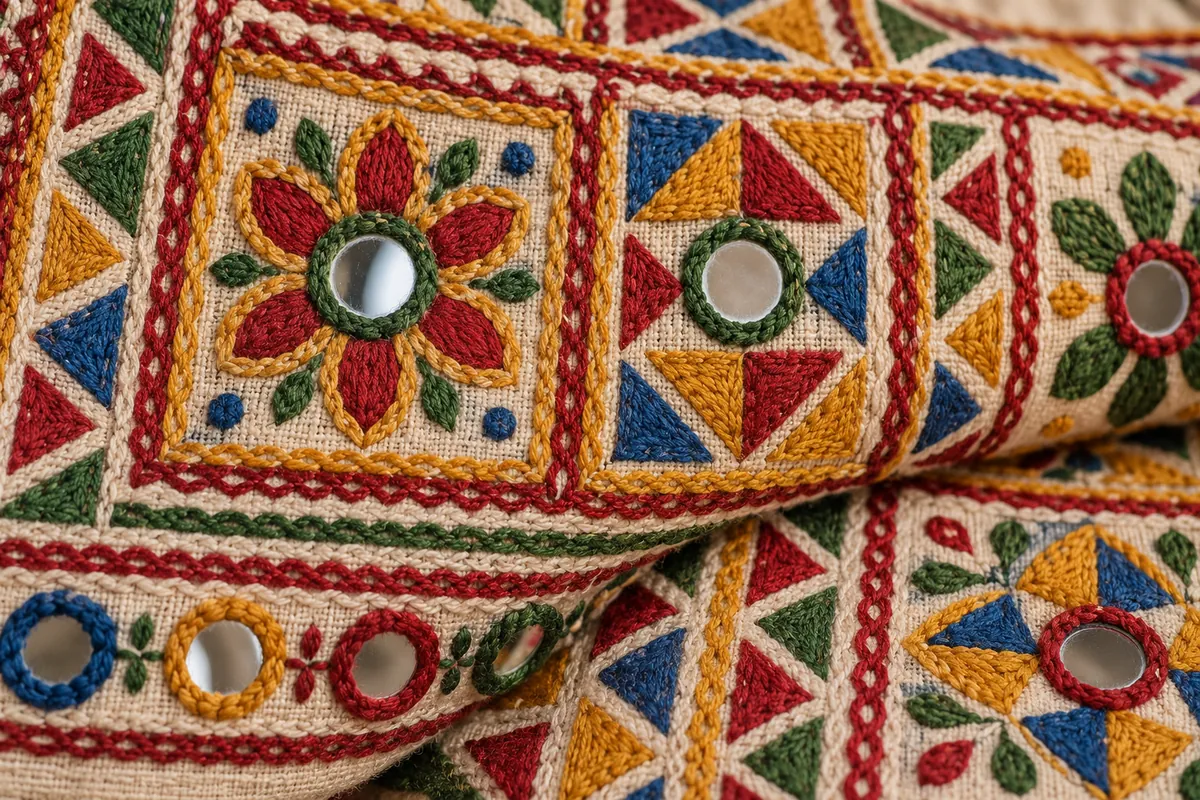
In a small room in Moti Vavdi village, Bhavnagar, Gujarat, there are bright cushions, bedcovers and pillows covered in beautiful designs. They are made by Ila Sachani, a cheerful woman who is an expert in Kathiawar embroidery—a craft that needs great skill. What makes her work truly remarkable is that she creates it all with her feet.
Ila was born into a farmer’s family in Amreli, Gujarat. From birth her hands hung loose by her sides and she could not use them like other children. While other children drew in the sand or plucked flowers, little Ila wondered why she could not join them; she too longed to hold a chalk and draw on a slate. Her mother and grandmother, both skilled in Kathiawar embroidery, were determined to help her. They patiently taught her to make beautiful patterns using her feet, and her parents helped her learn to eat and comb her hair with her legs.
Threading a needle was hard, but Ila never gave up. With help from her younger brother and sister, she became an expert at a young age and even learned styles from outside Gujarat—Kachhi, Kashmiri and Lucknawi. Soon her family and friends, amazed by her talent, spread the word, and her fame grew in the village. The government office in Surat displayed her work at a state exhibition, where people happily bought her creations. Ila then took part in national exhibitions, won many awards and received the President’s Medal. Most importantly, her skill gave her a regular income and a new independence. Her story reminds us that, with focus, hard work, opportunity and support, she developed a successful artistic practice, and that art can rise above physical boundaries to touch the soul.
Theme & message
The lesson celebrates Ila’s artistic skill, persistence, creative adaptation and supportive relationships. Her income and enjoyment give her greater independence. Encouragement, opportunities and accessible ways of working matter alongside effort. Her example is not a promise that every disability or difficulty disappears through willpower.
Word meanings
| Word | English meaning | Hindi meaning |
|---|---|---|
| embroidery | decorating cloth with designs sewn in thread | कढाई / जरी का काम |
| challenges | difficulties | चुनौतियाँ / कठिनाइयाँ |
| single-minded | focused on one purpose | एकाग्र / दृढ़संकल्प |
| determination | will power; firm decision | दृढ़ संकल्प / इच्छाशक्ति |
| awestruck | amazed and full of wonder | भौचक्कित / आश्चर्यचकित |
| admiration | respect and approval for something good | प्रशंसा / सराहना |
| popularity | fame; being liked by many people | लोकप्रियता / ख्याति |
| exhibition | a public show of objects or art | प्रदर्शनी |
| independence | freedom to do things on your own | स्वतंत्रता / आत्मनिर्भरता |
| celebrated | famous and much admired | प्रसिद्ध / विख्यात |
| traditional | following old customs handed down over time | पारंपरिक / रिवाजी से चला आया |
| patterns | repeated designs or shapes | नमूने / बूटे-बूटे |
| creations | things that are made or produced | रचनाएँ / निर्मितियाँ |
| encouraged | gave support and confidence | प्रोत्साहित किया |
| honours | special recognition or awards | सम्मान / आदर |
| boundaries | limits or edges | सीमाएँ |
| income | money earned regularly | आय / कमाई |
Let us do these activities before we read
I. Pranav — discussion samples
- His artistic and sporting skills require practice and adaptation. We should not assume the work is effortless from the finished result.
- I feel respect for his skill and would like to learn how he works. Personal feelings may differ.
- Possible qualities include patience, creativity and persistence. Support and opportunities may also help; the short introduction does not give his complete training history.
- The introduction reminds us to recognise people’s abilities and provide opportunities, rather than defining them only by physical differences.
II. Kathiawar embroidery — predictions
- Choose cloth, plan a pattern, prepare thread, make stitches and finish the design. Mirror work needs secure stitching.
- Ila’s story shows that she learned to use her feet for embroidery. This requires her own practised technique, not a method to impose on everyone.
- Patient practice, appropriate support and adapted ways of handling the materials would be important. Discuss possibilities without judging someone who needs a different approach.
Let us discuss
Read the paragraphs and write the main idea for each. Then, match the main idea with two supporting details. (Paragraph 1 → ‘Introduction to Ila Sachani’s colourful embroidery’, with details (i) Examples of embroidered things and (ii) Ila’s use of shiny needle. Paragraph 2 → ‘Early challenges and family support’. Paragraph 6 → ‘Recognition at a state exhibition’. Paragraphs 8–9 → details (i) Financial independence and joy, (ii) Challenges can be turned into victories.)
Let us think and reflect
I. Passage questions
- Choose different: in this context Ila could not use her hands in the usual way.
- She might have felt left out or frustrated when unable to join an activity she wanted to try. This is an inference about her feelings.
- She could not hold the chalk because she could not use her hands in the usual way.
II. Creative adaptations
Her mother and grandmother taught embroidery using her feet. Her parents helped her learn daily tasks such as eating and combing her hair using her legs; her younger siblings also supported her. Practice and family encouragement helped her develop skills.
III. New independence
She earned a regular income and found joy in work she loved. This increased her autonomy; the passage does not say that she never needed support again.
IV. The first state exhibition
The Surat government office displayed her work, making it visible to a wider audience. People bought her creations, opening opportunities for more exhibitions and recognition.
V. Power of art
Her embroidery reaches and moves people even though she creates it differently from many other artists. Art can express skill and feeling through varied methods.
VI. Helpful encouragement — sample
Ask what support the person wants, listen, provide useful adaptations, include them in activities and respect their choices. Appreciate their work without assuming helplessness.
VII. Learning from her story — sample
Her experience offers an example of adapting methods, practising skills and seeking support. Readers can value persistence while recognising that different challenges require different resources and opportunities.
Let us learn
I. Match the word to its correct synonym (Columns A, B and C)
Read the words in Column A, understand them through the sentences in Column B, then match each word to its correct synonym in Column C (synonyms given: silent, work, happy, small, difficult, fantastic, dangerous – two are extra).
II. Unscramble the antonyms of the words in Column A
Unscramble the antonyms. (Example: display – E D I H → HIDE.)
III. Words of quantity
1. The highlighted words (lots of, many) tell us about the quantity. Choose what the words show: (i) Unmentioned quantity (ii) Large quantity.
2. Fill in the blanks to complete an example for each word of quantity (hints in brackets).
Let us listen / speak / write / explore
Let us listen
You will listen to a talk about Kathiawar embroidery. As you listen, circle the correct option. (1. Form – old/new; 2. Colours – soft/bright; 3. Stitches – running stitch/chain stitch; 4. Seen on – children’s caps/pants; 5. Things used – small mirrors/shapes of buttons; 6. Designs – elephants and horses/squares and triangles.)
Note: This is a listening task. The answers above follow the official NCERT audio transcript printed on page 164 of Poorvi. In class, listen carefully and circle each correct option as you hear it.
Let us speak
In pairs, write down two questions you would like to ask Ila Sachani. (Note: Yes/No questions use a rising tone. Examples given: “Where were you born?” / “Did you go to school?”) Practise the questions aloud with the correct rising tone and ask a classmate.
Note: This is a speaking activity. Say each question aloud at least five times, raising your voice slightly at the end of Yes/No questions, then take turns asking a partner. Your own polite, clear questions are accepted.
Let us write
Collect four/five items (such as flowers, leaves, pins, waste paper, old cards, cardboard boxes, straws, twigs, etc.). Use these items to create any kind of artwork. Now, write a paragraph describing the artwork that you have created. Give a suitable title to your paragraph.
Note: This is a hands-on craft and writing task. Make your own artwork from suitable materials, then write your own paragraph with a suitable title. The paragraph above is only a model.
Let us explore
1. Does anyone in your family or neighbourhood do embroidery? Find out what type of embroidery they do and how they learnt it. 2. Try a simple stitch on cloth with the guidance of a family member. 3. Visit the given link to find out about embroidery types from different parts of India and share which one you liked the most and why. (https://indianculture.gov.in)
Note: This is a project and exploration activity to be done at home and shared in class. Your own findings, stitch and choice of embroidery are the expected answers.
Additional ClearStudy questions
This practice is separate from the printed textbook exercises.
Short answer (30–40 words)
1. Where does Ila Sachani live and work, and what kind of things does she make?
2. What difficulty did Ila have from birth?
3. Who taught Ila embroidery, and how?
4. How did Ila become famous?
5. Which honour does the textbook name, and what other styles did she learn?
Long answer (100–120 words)
6. Trace Ila Sachani’s journey from a child facing a challenge to a celebrated artist.
7. What qualities and support helped Ila succeed, and what message does her story give us?
ClearStudy MCQs and assertion–reason practice
1. In which village and district does Ila Sachani live and work?
(a) Amreli, Gujarat (b) Moti Vavdi, Bhavnagar (c) Surat (d) Palakkad, Kerala
2. Which traditional craft is Ila Sachani an expert in?
(a) Madhubani painting (b) Dhokra metal craft (c) Kathiawar embroidery (d) Coconut shell craft
3. Ila Sachani creates her embroidery using her …
(a) hands (b) feet (c) machine (d) mouth
4. Where was Ila Sachani born?
(a) Bhavnagar (b) Surat (c) Amreli, Gujarat (d) Kerala
5. Who first taught Ila the art of Kathiawar embroidery?
(a) her teacher (b) her mother and grandmother (c) the Surat office (d) her neighbours
6. Which of these styles did Ila NOT learn, according to the text?
(a) Kachhi (b) Kashmiri (c) Lucknawi (d) Madhubani
7. Which government office first displayed Ila’s embroidery at a state exhibition?
(a) the office in Surat (b) the office in Amreli (c) the office in Delhi (d) the office in Bhavnagar
8. What was the most important change that her skill brought for Ila?
(a) a new house (b) a new independence (c) a foreign trip (d) a new school
9. Which high honour did Ila Sachani receive?
(a) the Padma Shri (b) the President’s Medal (c) the Bharat Ratna (d) the Nobel Prize
10. What does Ila’s embroidery, made with her feet, remind us about art?
(a) that art is only for the rich (b) that art needs hands (c) that art can rise above physical boundaries and touch the soul (d) that art is easy
Assertion–Reason – choose: (a) A and R true, R explains A; (b) A and R true, R does not explain A; (c) A true, R false; (d) A false, R true.
1. Assertion (A): Ila Sachani learned to do embroidery with her feet.
Reason (R): She was born with her hands hanging loose by her sides and could not use them in the usual way.
2. Assertion (A): Ila’s mother and grandmother helped her overcome her challenge.
Reason (R): They were skilled in Kathiawar embroidery and taught Ila the art.
3. Assertion (A): Ila became famous beyond her village.
Reason (R): Her embroidery was displayed at a state exhibition and people readily purchased her creations.
4. Assertion (A): Threading a needle was easy for Ila from the very beginning.
Reason (R): Ila did not give up and became an expert at a young age.
5. Assertion (A): Ila’s skill gave her a new independence.
Reason (R): Through her embroidery she earned a regular income and found joy in doing what she loved.
Exam tips & common mistakes
Exam tips
• Remember key facts: Ila was born in Amreli, lives in Moti Vavdi, Bhavnagar, and does Kathiawar embroidery with her feet.
• In value-based answers, stress determination, family support, never giving up and turning challenges into victories.
• Quote the line “art has the power to rise above physical boundaries and touch the soul” in theme questions.
• Recall the honour named in the passage—the President’s Medal—and the styles she learned (Kachhi, Kashmiri, Lucknawi).
Common mistakes
• Do not write that Ila was born in Bhavnagar—she was born in Amreli and the passage introduces her in Moti Vavdi, Bhavnagar.
• Do not say she could not use her legs—it was her hands that she could not use; she works with her feet.
• Her first state exhibition was arranged by the Surat government office, not Delhi.
• Madhubani is mentioned elsewhere in the unit, not as a style Ila learned—do not list it among her embroidery styles.
FAQs
Who is Ila Sachani in the lesson?
The textbook presents an embroidery artist from Gujarat who learned to create designs with her feet with family encouragement and practice.
Where was she born?
The passage says Amreli, Gujarat. It introduces her work in Moti Vavdi village, Bhavnagar.
Who taught her embroidery?
Her mother and grandmother taught Kathiawar embroidery using her feet. Her parents and siblings also helped her develop skills.
What are the listening choices?
Old, bright, chain stitch, children’s caps, small mirrors, and squares/triangles; these follow the page-164 transcript.