
National War Memorial — Class 6 English Poorvi Questions and Answers
National War Memorial questions and answers: read Class 6 Poorvi’s tribute poem with meaning, vocabulary, recitation guidance and official information for the exploration task.
Source: NCERT Poorvi, Grade 6, Unit 5, printed pages 160–161; supplied reprint 2026–27. Open-ended and personal responses are examples to adapt. These explanations are study support, not an official NCERT answer key.
- Poem Overview
- About the Poem
- Central Idea & Stanza Summary
- Word Meanings
- Poetic Devices
- NCERT reading and exploration activities
- Extra Questions
- MCQs & Answer Key
- Assertion–Reason Questions
- FAQs
Poem Overview
“National War Memorial” is a short patriotic poem that pays loving tribute to the brave soldiers of Bharat who gave their lives for the nation. The poem is set at the National War Memorial in New Delhi (राष्ट्रीय समर स्मारक, नई दिल्ली), a national monument built by the Government of India in February 2019 to honour our martyred soldiers. The poem describes the grand and dignified memorial where the names of commemorated personnel are inscribed, and where the eternal flame (Amar Jawan Jyoti) glows in silence as a mark of respect. It reminds us that our soldiers fought for the country on land, in the sky and on the seas, and that their sacrifice must always be remembered with pride, gratitude and reverence.
About the Poem
The supplied text gives no poet byline. It introduces the National War Memorial in New Delhi, established in February 2019, then presents the tribute poem. Do not invent an author or assume that missing attribution proves it was composed specially for the textbook.
Central Idea & Stanza Summary
Central idea: The poem celebrates the courage and sacrifice of the soldiers of Bharat and the National War Memorial built in their honour. It teaches us to feel pride, gratitude and respect for those who protected the nation, and to keep their memory alive forever. The eternal flame and the etched names stand as a permanent reminder that the freedom and safety we enjoy were earned by the supreme sacrifice of our brave soldiers.
Lines 1–4 (The grand memorial): In the heart of Bharat stands a grand and impressive sight — the National War Memorial, which honours and retells the brave stories of our soldiers. The monument stands with dignity, respect and pride. Each soldier’s name is etched in stone, and every stone seems to hold and share a story of bravery.
Lines 5–8 (Soldiers everywhere and the eternal flame): Our soldiers fought for Bharat everywhere — on the battlefields, in the skies and across the wide oceans — always standing united, “side by side”. At the memorial, the eternal flame glows quietly, in silence, paying homage to the courage shown by these brave soldiers.
Lines 9–12 (Remembering forever): Their sacrifice will always remain in our minds and in our blessed memory; it will forever remind us of their bravery. The poem ends with a call to always remember them with pride and respect, honouring their everlasting sacrifice at the National War Memorial.
Word Meanings (शब्दार्थ)
| Word | English Meaning | हिंदी अर्थ |
|---|---|---|
| memorial | a monument built to remember a person or event | स्मारक |
| heartland | the central, most important part of a country | हृदयस्थल, केंद्रीय भाग |
| grand | large, impressive and magnificent | भव्य, शानदार |
| behold | to see or look at something | देखना, निहारना |
| honours | shows great respect to | सम्मान देना |
| retold | told again; repeated | फिर से सुनाई गई |
| grace | elegance and dignity | गरिमा, शालीनता |
| pride | a feeling of deep satisfaction and self-respect | गर्व, अभिमान |
| etched | carved or cut deeply into a surface | उत्कीर्ण, खोदकर अंकित |
| confide | to share or tell something with trust | विश्वास से कहना, साझा करना |
| battlefields | places where wars or battles are fought | युद्धभूमि, रणक्षेत्र |
| side by side | standing close together, in unity | कंधे से कंधा मिलाकर, एकजुट |
| eternal | lasting forever; never ending | शाश्वत, अनंत |
| flame | burning fire that gives light | ज्वाला, लौ |
| homage | special honour or respect shown publicly | श्रद्धांजलि |
| courage | bravery; the ability to face danger | साहस, वीरता |
| sacrifice | giving up something precious (here, one’s life) for others | बलिदान, त्याग |
| blessed | held sacred; deeply respected | पवित्र, धन्य |
Poetic Devices in the Poem
| Feature | Explanation |
|---|---|
| End rhyme | behold/retold, pride/confide, wide/side, glows/shows, mind/remind are clear rhyme pairs. Remember/forever has a shared ending but is an approximate rhyme, not an exact one in ordinary pronunciation. |
| Imagery | Etched names, stone and the glowing flame make the memorial vivid. |
| Personification — interpretation | The image of stones and stories that ‘confide’ suggests a human act of telling or sharing. Merely saying courage ‘shows’ is not itself a clear personification example. |
| Repetition | Repeated ‘each’ and references to pride, respect and sacrifice strengthen remembrance. |
| Alliteration | ‘Side by side’ repeats /s/; ‘stone’ and ‘story’ repeat the initial /st/ cluster. ‘Silence it glows’ does not have matching initial consonants. |
| Symbolism | The eternal flame represents continuing remembrance of sacrifice. |
NCERT reading and exploration activities
Let us do these activities — page 161
- Read aloud: read from the textbook with a clear, respectful voice. Pause where punctuation and meaning guide you.
- Recite together: practise with classmates and your teacher. One group can read lines 1–4, another 5–8 and another 9–12, or the whole class can recite together.
- Remember: learn a few lines at a time, check their sequence in the book and practise recalling them. Rhyme can help, but remember/forever is approximate.
The book does not give a separate written comprehension exercise for this poem. Questions below are identified as ClearStudy practice, rather than additional official textbook questions.
Let us explore 1 — official information
The official memorial website identifies its dedication on 25 February 2019 and describes its symbolic circles. It commemorates Armed Forces personnel who made the supreme sacrifice in the line of duty after Independence; avoid claiming it lists every soldier in all Indian history.
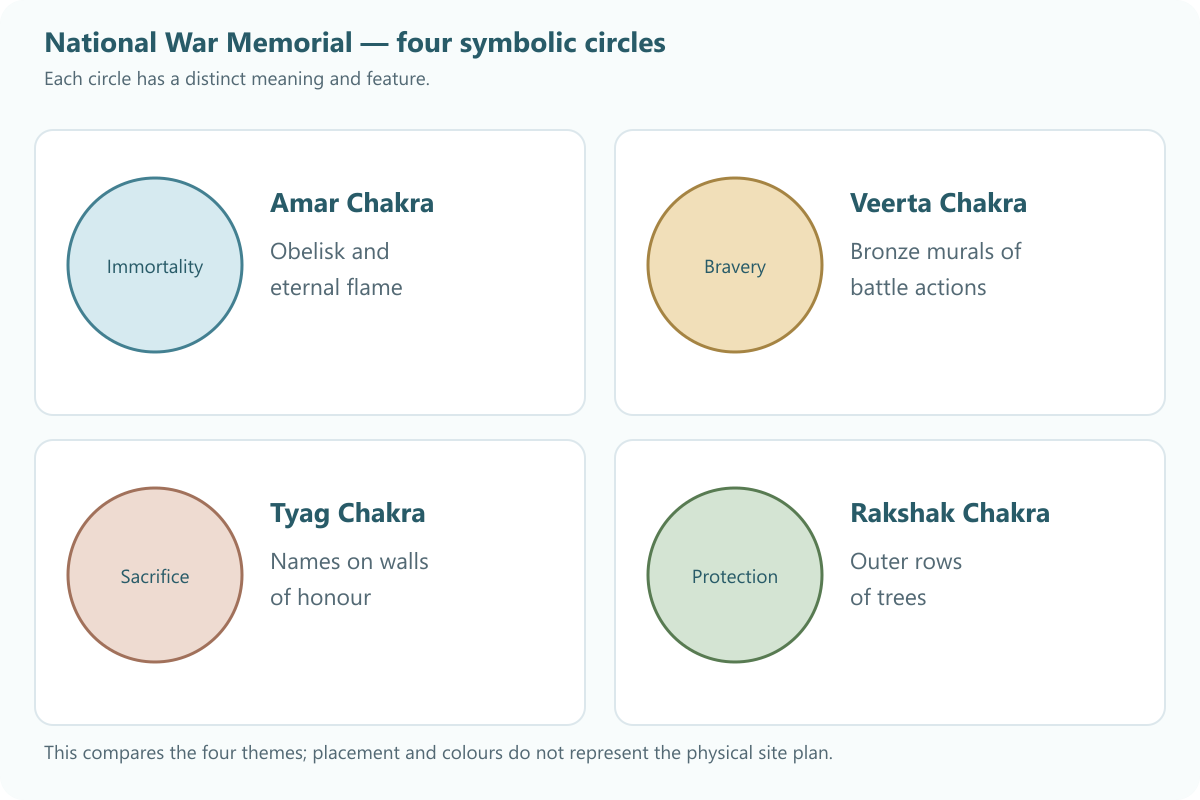
Open the circles diagram at full size to read its labels.
| Circle | Meaning and feature |
|---|---|
| Amar Chakra | Immortality; obelisk and eternal flame |
| Veerta Chakra | Bravery; bronze battle murals |
| Tyag Chakra | Sacrifice; inscribed walls of honour |
| Rakshak Chakra | Protection; outer rows of trees |
Choose a few facts, record your source and explain how they connect with the poem’s remembrance imagery.
Let us explore 2 — planning a visit
Plan with a teacher or parent. Check the official website for current visitor information before choosing a date and route. Agree on meeting points, follow site instructions and behave respectfully. Afterwards, describe what you actually observed. If a visit is not possible, use an official online exploration and identify it as such.
Additional ClearStudy questions
This practice is separate from the printed textbook exercises.
Short Answer Questions (30–40 words)
The National War Memorial is located in New Delhi, in the heartland of Bharat, near India Gate. It was established by the Government of India in February 2019 to honour our brave soldiers. Q2. Why are the names of soldiers etched on the memorial?
The names are etched in stone so that each fallen soldier is remembered forever. Each etched name keeps their story of courage and sacrifice alive, never to be forgotten by the nation. Q3. What does the eternal flame at the memorial stand for?
The eternal flame glows silently to pay homage to the soldiers’ courage. It symbolises that the memory of their bravery and sacrifice will live forever in our hearts. Q4. Where all did the soldiers fight for Bharat, according to the poem?
According to the poem, the soldiers stood for Bharat everywhere — on the battlefields, in the skies and across the wide oceans — always fighting together, side by side. Q5. What feelings does the poem ask us to have for our soldiers?
The poem asks us to remember our soldiers with deep pride, respect and gratitude. It urges us to honour their sacrifice forever and never forget the courage with which they served the nation.
Long Answer Questions (100–120 words)
In the poem, the National War Memorial stands in the heart of Bharat as a grand and impressive sight. It honours the brave stories of our soldiers, standing with dignity, grace and pride. The names of fallen soldiers are etched in its stones, so that each stone seems to hold and share a story of bravery. At its centre, the eternal flame glows quietly, paying silent homage to the soldiers’ courage. The memorial reminds visitors that the soldiers fought for the country on land, in the sky and on the seas. Above all, it is a place where the nation gathers to remember their sacrifice with pride and respect, forever. Q2. What message does the poem ‘National War Memorial’ give us?
The poem gives us a strong message of gratitude and remembrance. It reminds us that the safety and freedom we enjoy were earned by the supreme sacrifice of our soldiers, who gave up their lives for the nation. The poem teaches us to feel proud of these brave heroes and to honour them with respect. The eternal flame and the etched names show that their courage must never be forgotten. The poet urges every citizen to keep the soldiers’ sacrifice “always in our mind” and to remember them “forever”. The poem inspires patriotism, respect for the armed forces, and a determination to value the nation’s protectors. Q3. How does the poem make us feel proud of our soldiers?
The poem fills us with pride by showing the soldiers as selfless heroes who stood for Bharat “side by side” on battlefields, in the skies and on the oceans. By describing a grand memorial built specially to honour them, the poem makes us realise how greatly the nation values their bravery. The image of names “etched” in stone tells us their deeds are permanent and worthy of honour, while the eternal flame glowing in silence makes their sacrifice feel sacred. The repeated words “pride” and “respect”, and the call to “always remember”, stir patriotic feelings and make us proud to belong to a country defended by such courageous soldiers.
ClearStudy MCQ practice
1. Where is the National War Memorial located?
(a) Mumbai (b) New Delhi (c) Kolkata (d) Chennai
2. In which month and year was the National War Memorial established?
(a) August 1947 (b) January 2020 (c) February 2019 (d) October 2018
3. The memorial was built to honour —
(a) freedom fighters (b) brave soldiers (c) famous poets (d) great kings
4. According to the poem, the names of soldiers are —
(a) printed on paper (b) etched in stone (c) written in books (d) sung in songs
5. The eternal flame at the memorial —
(a) glows in silence (b) goes out at night (c) is lit only once a year (d) is made of gold
6. The soldiers fought for Bharat on the battlefields, in the skies and on the —
(a) mountains (b) rivers (c) oceans (d) deserts
7. The word ‘etched’ in the poem means —
(a) painted (b) carved deeply (c) erased (d) folded
8. The phrase ‘side by side’ shows that the soldiers stood —
(a) far apart (b) united together (c) alone (d) in fear
9. The eternal flame pays homage to the soldiers’ —
(a) wealth (b) courage (c) houses (d) families
10. The main feeling the poem wants us to have for the soldiers is —
(a) fear (b) pity (c) pride and respect (d) jealousy
ClearStudy assertion–reason practice
For each, choose: (a) Both A and R are true and R is the correct explanation of A. (b) Both A and R are true but R is NOT the correct explanation of A. (c) A is true but R is false. (d) A is false but R is true.
1. Assertion (A): The National War Memorial honours our brave soldiers.
Reason (R): It was built by the Government of India in February 2019 in honour of soldiers who sacrificed their lives.
Answer: (a) — R correctly explains why the memorial honours the soldiers.
2. Assertion (A): The names of the soldiers are etched in stone at the memorial.
Reason (R): Etching the names keeps the memory of their sacrifice alive forever.
Answer: (a) — R correctly explains the purpose of etching the names.
3. Assertion (A): The eternal flame glows in silence at the memorial.
Reason (R): The flame is lit only on special national days each year.
Answer: (c) — A is true, but R is false; the eternal flame burns continuously, not only on special days.
4. Assertion (A): The poem fills us with pride for our soldiers.
Reason (R): The soldiers stood for Bharat side by side on land, in the sky and on the oceans.
Answer: (a) — R correctly explains why the poem makes us proud.
5. Assertion (A): The poem asks us to forget the soldiers’ sacrifice.
Reason (R): It says their sacrifice should be “always in our mind” and remembered “forever”.
Answer: (d) — A is false (the poem asks us to remember, not forget); R is true.
📌 Exam Tips
• Remember two key facts: the memorial is in New Delhi and was established in February 2019.
• Learn the three places where the soldiers fought — battlefields, skies and oceans .
• Quote short phrases like “eternal flame, in silence it glows” and “Each name etched, each stone” to support your answers.
• For “message of the poem” questions, mention pride, respect, gratitude and remembrance.
⚠ Common Mistakes to Avoid
• Do not write that the memorial is at India Gate itself — it stands near India Gate in New Delhi.
• Do not confuse the year — the memorial was established in February 2019, not 1947.
• ‘Etched’ means carved/cut deeply, not painted or printed.
• ‘Homage’ means respect and honour, not “home”.
• Spell key words correctly: memorial, eternal, homage, courage, sacrifice.
Frequently Asked Questions (FAQs)
What is the National War Memorial poem about?
It honours the courage and sacrifice of India’s soldiers and asks readers to remember them with pride and respect.
Where is the memorial and when was it dedicated?
It is near India Gate in New Delhi and was dedicated on 25 February 2019, according to the official memorial website.
What does the eternal flame represent?
Continuing remembrance of the courage and sacrifice of the commemorated personnel.
Does the textbook give written questions for this poem?
No separate comprehension questions are printed. Page 161 asks for reading, recitation, memorisation, online exploration and planning a visit.