
Class 6 Maths Ganita Prakash Chapter 10 Solutions (NCERT 2026–27) – The Other Side of Zero
These Class 6 Maths Ganita Prakash Chapter 10 solutions cover The Other Side of Zero (Integers) from the new NCF-2023 textbook (Reprint 2026–27). Worked answers and original illustrations explain the chapter’s Figure it Out questions and selected in-text activities — with Bela’s Building of Fun, the number line, the token model, credits/debits and Brahmagupta’s rules — so you can master integers and revise them quickly.
- Chapter overview
- Key concepts & definitions
- Key rules & ideas
- Figure it Out (Building of Fun – addition, comparison, subtraction)
- Figure it Out (number line & larger numbers)
- Figure it Out (token model)
- Figure it Out (credits, debits, geography, temperature)
- Figure it Out (grids & explorations with integers)
- Math Talk & Try This (answered)
- Common mistakes to avoid
- Practice MCQs & Assertion–Reason
- Quick revision summary
- FAQs
Chapter 10 Overview
Chapter 10 of Ganita Prakash, The Other Side of Zero, introduces integers — the numbers … −3, −2, −1, 0, 1, 2, 3 … that extend the number ray to a full number line. Through Bela’s Building of Fun (floors above and below the ground floor) and a deep mineshaft, the chapter builds the meaning of positive and negative numbers, addition as Starting + Movement = Target, subtraction as Target − Starting = Movement, and the idea of an additive inverse. It then models the same operations with green/red tokens and zero pairs, links integers to credits and debits, geographical heights and Celsius temperature, explores border-sum grids, and closes with the history of zero and Brahmagupta’s rules. The Class 6 Maths Ganita Prakash Chapter 10 solutions below include worked calculations, number lines, token diagrams, completed grids and explanations of the chapter’s patterns.
Key Concepts & Definitions
Positive number: a number with a ‘+’ sign in front (e.g. +3); these lie to the right of 0 on the number line and are greater than 0.
Negative number: a number with a ‘−’ sign in front (e.g. −3); these lie to the left of 0 and are less than 0.
Zero (0): neither positive nor negative; we normally write it without a sign. Both +0 and −0 equal 0. It is the reference point (ground floor / sea level / freezing point).
Integers: the positive counting numbers, their negatives and zero together — … −4, −3, −2, −1, 0, 1, 2, 3, 4, … They go both ways from 0 without end.
Additive inverse: the number which, added to a given number, gives 0. The inverse of +4 is −4, and the inverse of −3 is +3; the inverse of 0 is 0.
Zero pair: one positive token and one negative token; together their value is 0, so they can be added or removed without changing the total.
Key Rules & Ideas (Chapter 10)
Addition (movement): Starting Position + Movement = Target Position.
Subtraction (missing movement): Target Position − Starting Position = Movement needed.
Subtraction → addition: subtracting a number is the same as adding its inverse, e.g. (+8) − (−2) = (+8) + (+2) = +10.
Brahmagupta — same signs: add the values; positive + positive is positive, negative + negative is negative (e.g. (−2) + (−3) = −5).
Brahmagupta — different signs: compare the distances from zero (absolute values), subtract the smaller distance from the larger, and keep the sign of the number with the larger distance; equal distances give 0 (e.g. −5 + 3 = −2).
Inverse & zero: n + (−n) = 0; n + 0 = n; 0 − (−n) = n.
Comparing integers: … −3 < −2 < −1 < 0 < +1 < +2 < +3 … (smaller numbers lie to the left).
Figure it Out — Building of Fun: Addition, Comparison & Subtraction
In-text (page 243–244)
What do you press to go four floors up? What do you press to go three floors down?
Number all the floors in the Building of Fun.
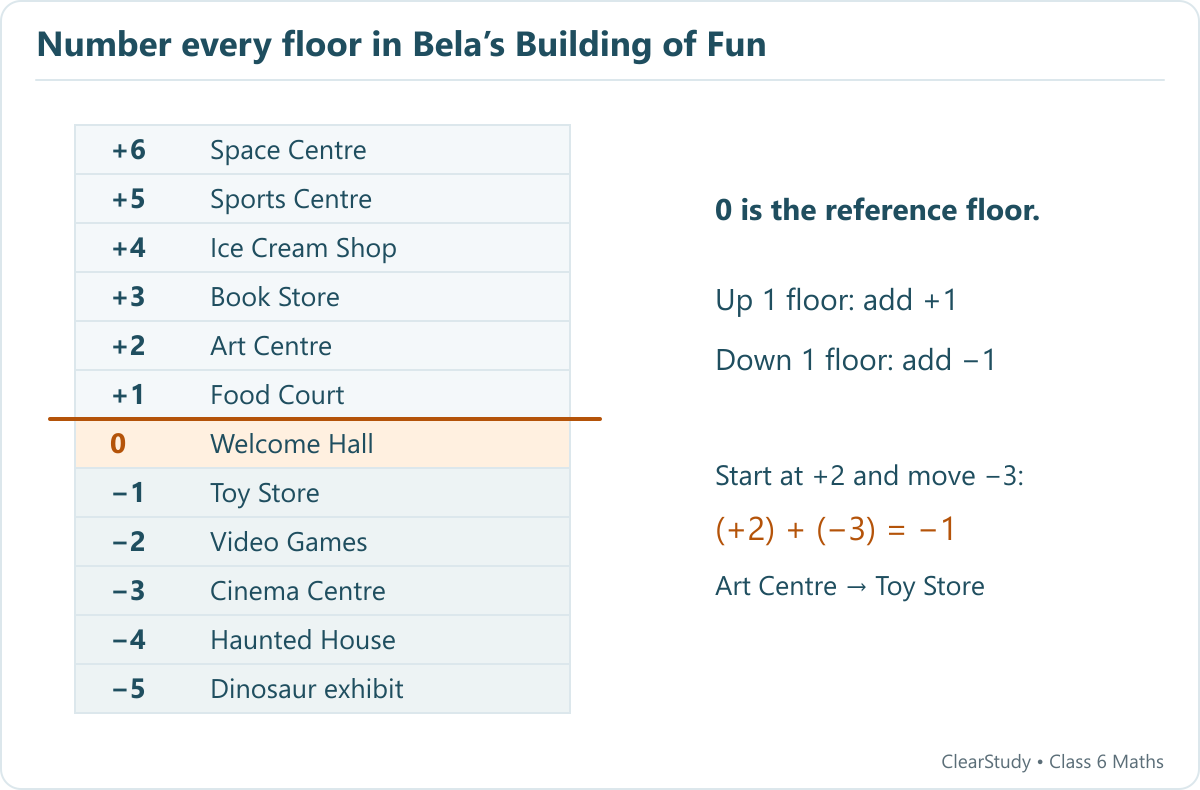
Figure it Out (page 245)
1. You start from Floor + 2 and press – 3 in the lift. Where will you reach? Write an expression for this movement.
2. Evaluate these expressions (you may think of them as Starting Floor + Movement by referring to the Building of Fun). a. (+ 1) + (+ 4) b. (+ 4) + (+ 1) c. (+ 4) + (– 3) d. (– 1) + (+ 2) e. (– 1) + (+ 1) f. 0 + (+ 2) g. 0 + (– 2)
3. Starting from different floors, find the movements required to reach Floor – 5. For example, if I start at Floor + 2, I must press – 7 to reach Floor – 5. The expression is (+ 2) + (– 7) = – 5. Find more such starting positions and the movements needed to reach Floor – 5 and write the expressions.
Figure it Out — combining button presses (page 246)
Evaluate these expressions by thinking of them as the resulting movement of combining button presses: a. (+ 1) + (+ 4) b. (+ 4) + (+ 1) c. (+ 4) + (– 3) + (– 2) d. (– 1) + (+ 2) + (– 3)
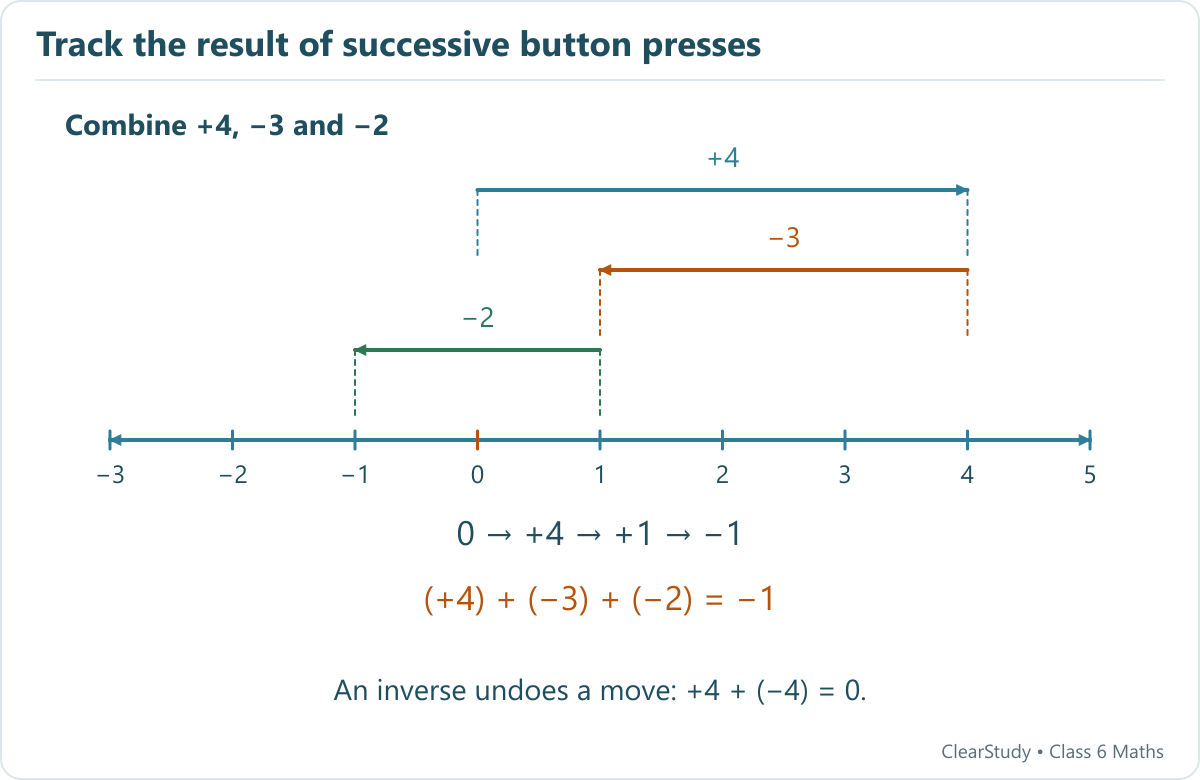
Write the inverses of these numbers: + 4, – 4, – 3, 0, + 2, – 1.
Connect the inverses by drawing lines: + 5, – 7, – 8, + 9 and – 9, + 8, – 5, + 7.
Who is on the lowest floor? 1. Jay is in the Art Centre. So, he is on Floor + 2. 2. Asin is in the Sports Centre. So, she is on Floor ___. 3. Binnu is in the Cinema Centre. So, she is on Floor ___. 4. Aman is in the Toys Store. So, he is on Floor ___.
Figure it Out — comparing numbers (page 247)
1. Compare the following numbers using the Building of Fun and fill in the boxes with < or >. a. – 2 __ + 5 b. – 5 __ + 4 c. – 5 __ – 3 d. + 6 __ – 6 e. 0 __ – 4 f. 0 __ + 4
2. Imagine the Building of Fun with more floors. Compare the numbers and fill in the boxes with < or >: a. – 10 __ – 12 b. + 17 __ – 10 c. 0 __ – 20 d. + 9 __ – 9 e. – 25 __ – 7 f. + 15 __ – 17
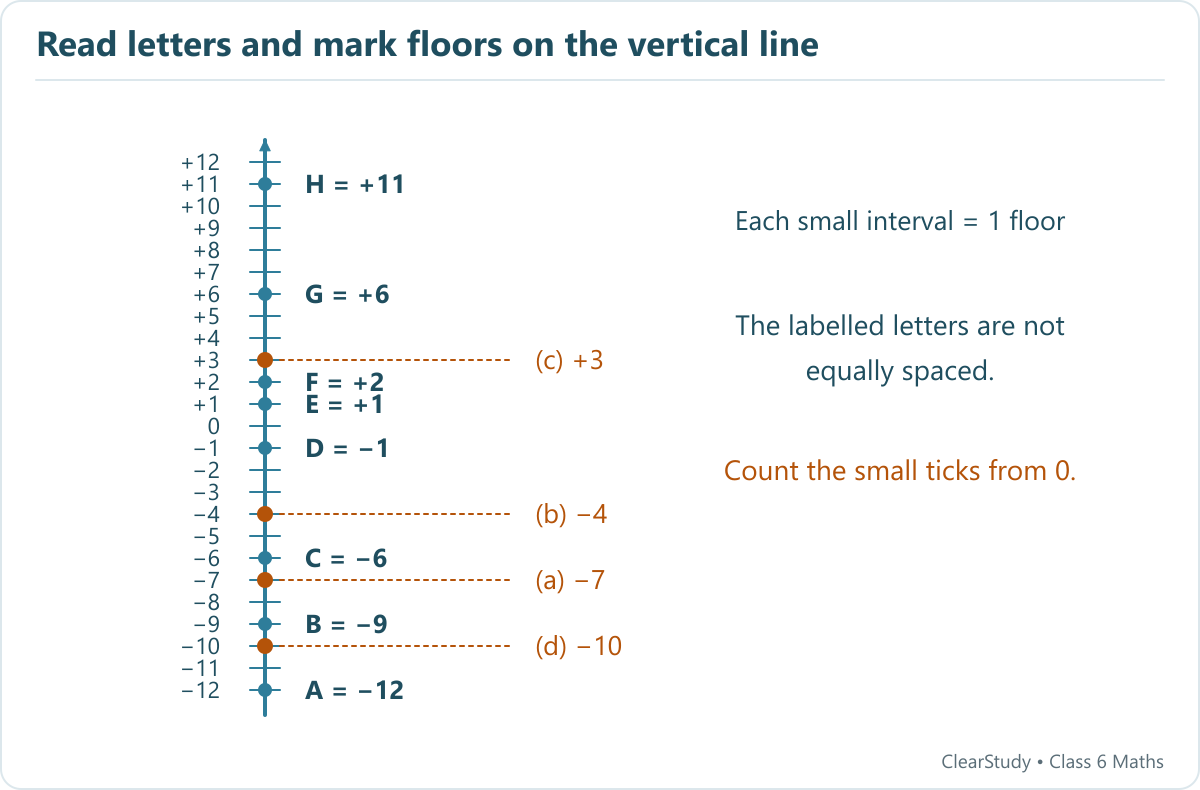
3. If Floor A = – 12, Floor D = – 1 and Floor E = + 1 in the building shown on the right as a line, find the numbers of Floors B, C, F, G and H.
4. Mark the following floors of the building shown on the right. a. – 7 b. – 4 c. + 3 d. – 10
In-text — subtraction as ‘making equal’ (page 248)
Evaluate 15 – 5, 100 – 10 and 74 – 34 from this perspective (finding the missing number to be added).
Figure it Out — subtraction to find the button (page 249)
Complete these expressions (the movement needed to reach the Target Floor from the Starting Floor). a. (+ 1) – (+ 4) b. (0) – (+ 2) c. (+ 4) – (+ 1) d. (0) – (– 2) e. (+ 4) – (– 3) f. (– 4) – (– 3) g. (– 1) – (+ 2) h. (– 2) – (– 2) i. (– 1) – (+ 1) j. (+ 3) – (– 3)
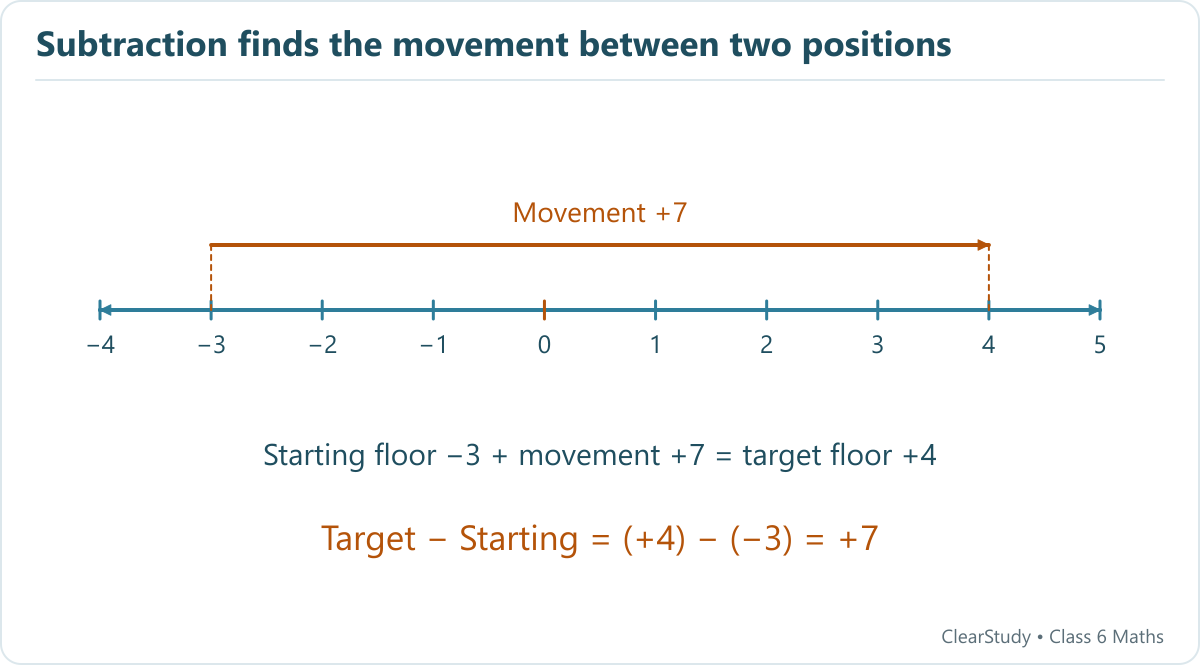
Figure it Out — Larger Numbers & the Number Line
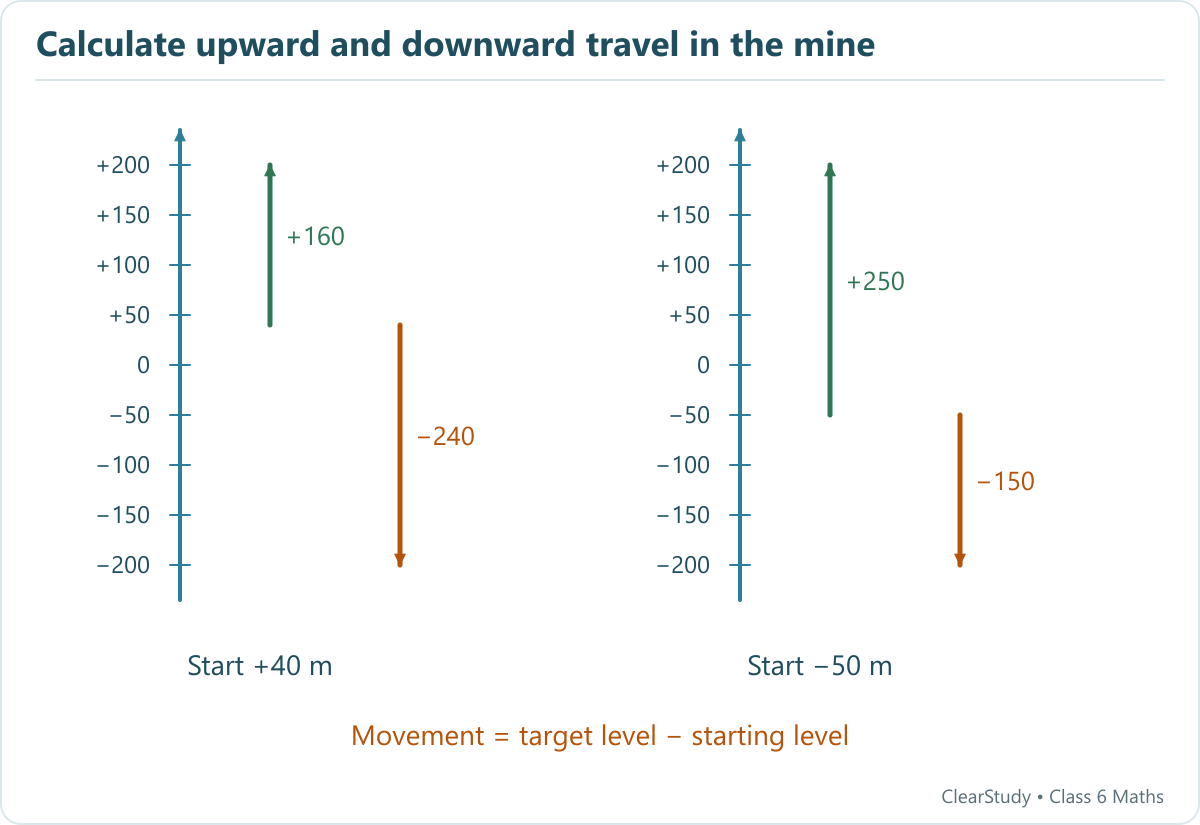
Figure it Out — the mine (page 251)
Complete these expressions. a. (+ 40) + ______ = + 200 b. (+ 40) + ______ = – 200 c. (– 50) + ______ = + 200 d. (– 50) + ______ = – 200 e. (– 200) – (– 40) f. (+ 200) – (+ 40) g. (– 200) – (+ 40)
Try This — the infinite lift (page 251)
Evaluate the eight larger-number expressions using a lift or number line.
In-text — walking on the number line (page 252)
If, from 5 you wish to go over to 9, how far must you travel? From 9 to 3? From 3 to – 2?
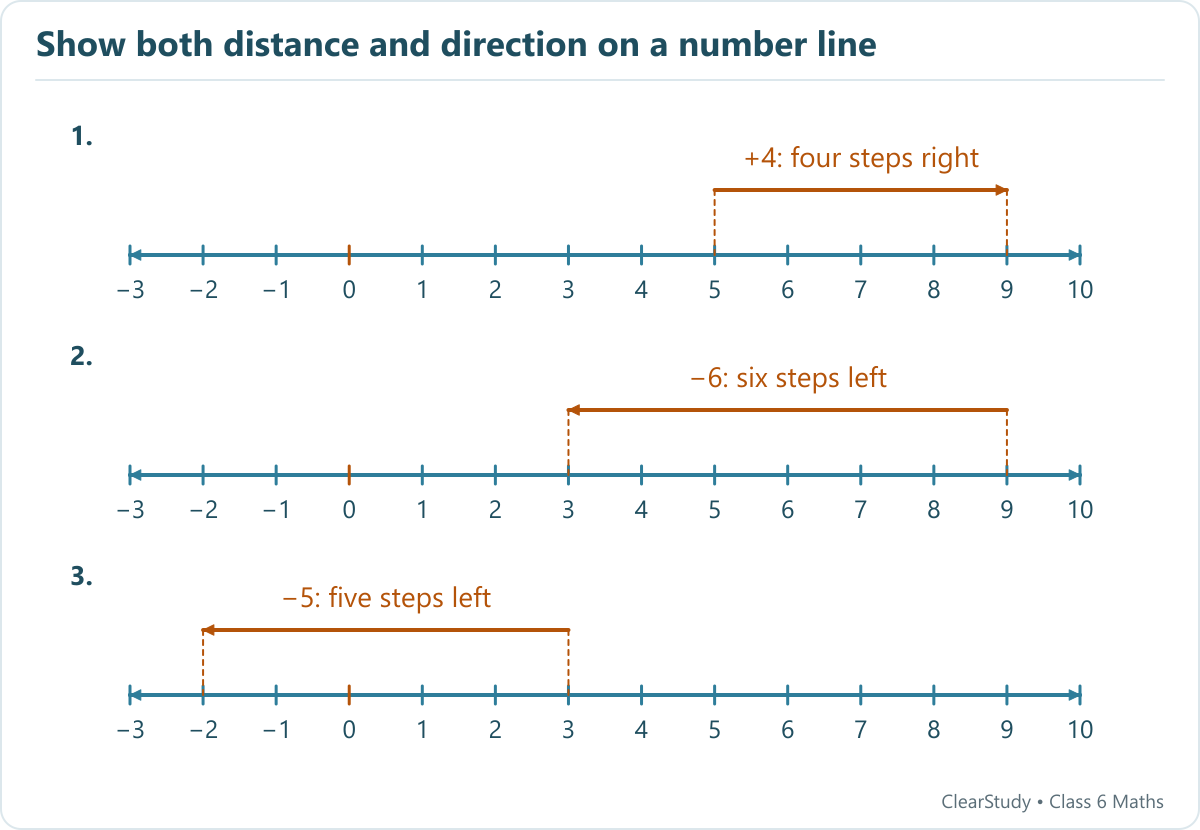
Figure it Out — number line (page 253)
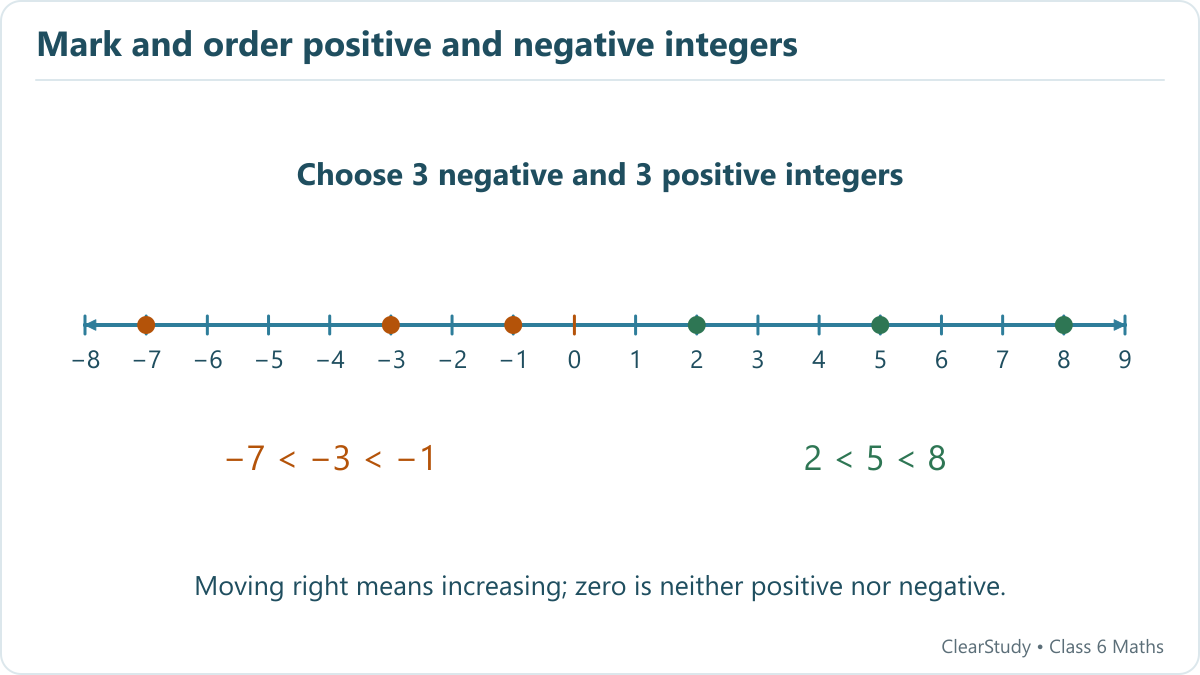
1. Mark 3 positive numbers and 3 negative numbers on the number line above.
2. Write down the above 3 marked negative numbers in the following boxes (in increasing order, joined by <).
3. Is 2 > – 3? Why? Is – 2 < 3? Why?
4. What are a. – 5 + 0 b. 7 + (– 7) c. – 10 + 20 d. 10 – 20 e. 7 – (– 7) f. – 8 – (– 10)?
Figure it Out — unmarked number line (page 255)
Use unmarked number lines to evaluate these expressions: a. – 125 + (– 30) b. + 105 – (– 55) c. + 80 – (– 150) d. – 99 – (– 200)
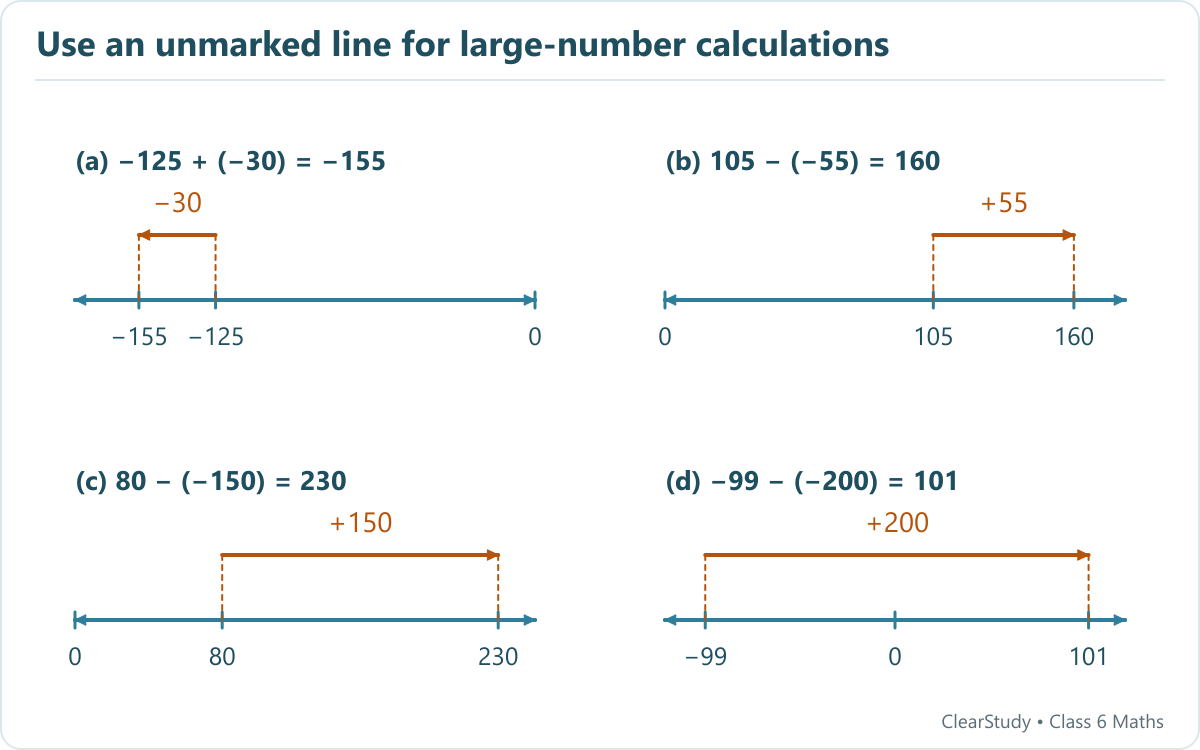
Figure it Out — The Token Model
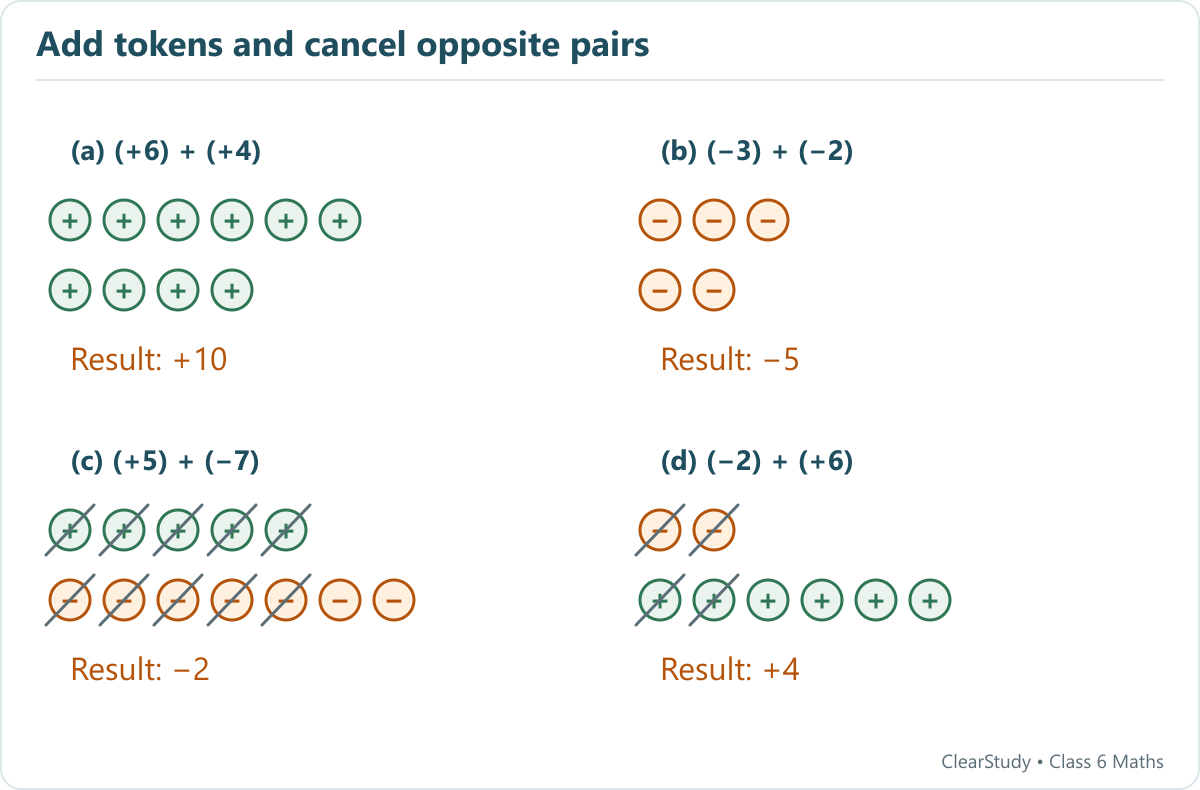
Figure it Out — addition with tokens (page 257)
1. Complete the additions using tokens. a. (+ 6) + (+ 4) b. (– 3) + (– 2) c. (+ 5) + (– 7) d. (– 2) + (+ 6)
2. Cancel the zero pairs in the following two sets of tokens. On what floor is the lift attendant in each case? What is the corresponding addition statement in each case?
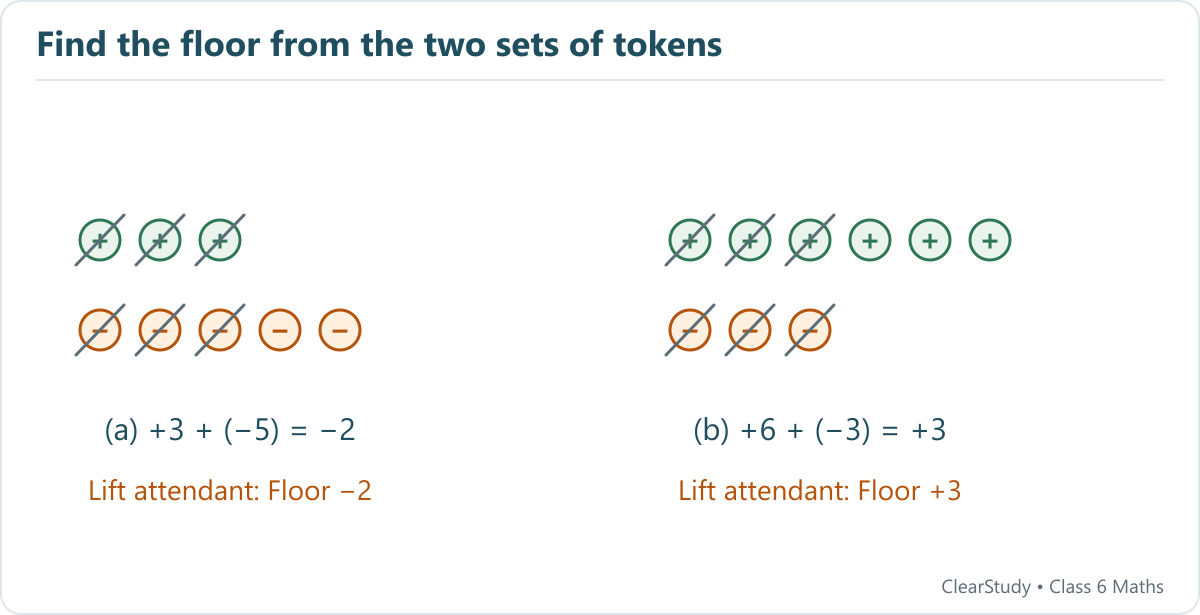
Figure it Out — subtraction with tokens (page 258)
1. Evaluate the following differences using tokens. Check that you get the same result as with other methods you now know: a. (+ 10) – (+ 7) b. (– 8) – (– 4) c. (– 9) – (– 4) d. (+ 9) – (+ 12) e. (– 5) – (– 7) f. (– 2) – (– 6)
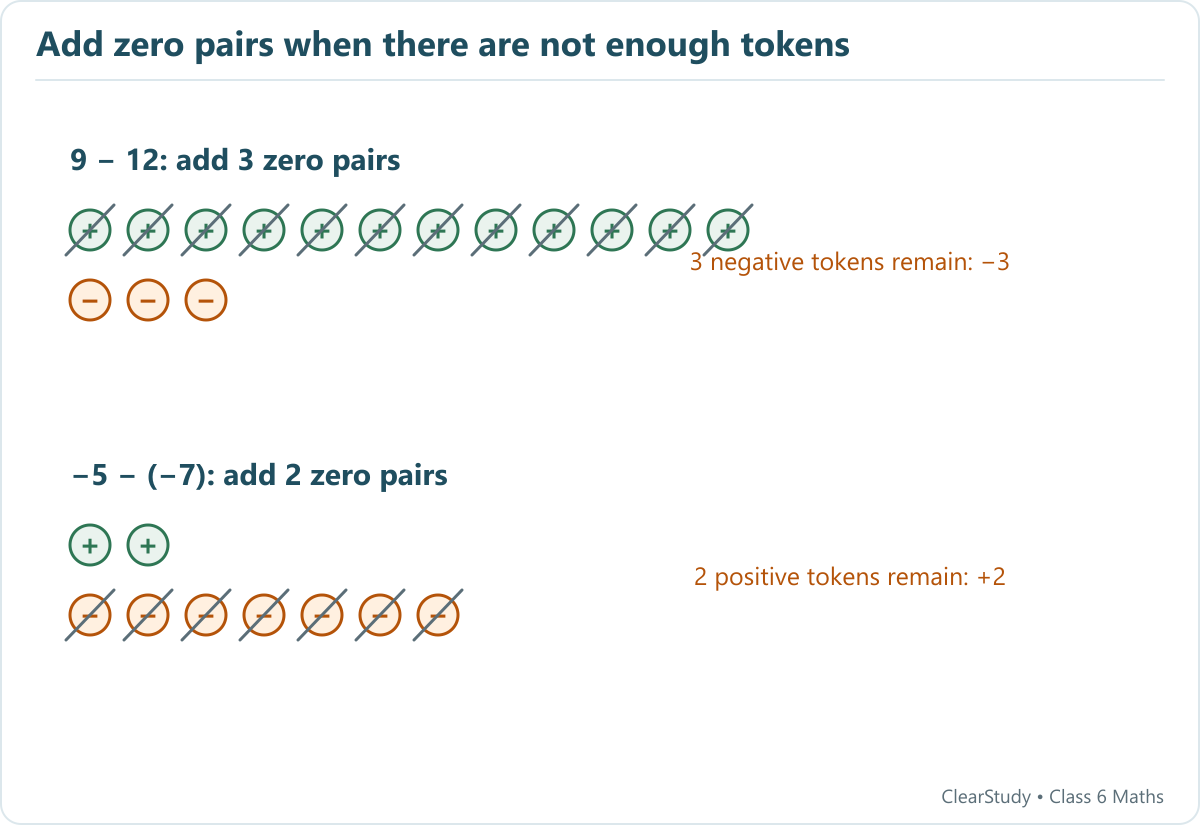
2. Complete the subtractions: a. (– 5) – (– 7) b. (+ 10) – (+ 13) c. (– 7) – (– 9) d. (+ 3) – (+ 8) e. (– 2) – (– 7) f. (+ 3) – (+ 15)
Figure it Out — subtracting across zero (page 259)
1. Try to subtract: – 3 – (+ 5). How many zero pairs will you have to put in? What is the result?
2. Evaluate the following using tokens. a. (– 3) – (+ 10) b. (+ 8) – (– 7) c. (– 5) – (+ 9) d. (– 9) – (+ 10) e. (+ 6) – (– 4) f. (– 2) – (+ 7)
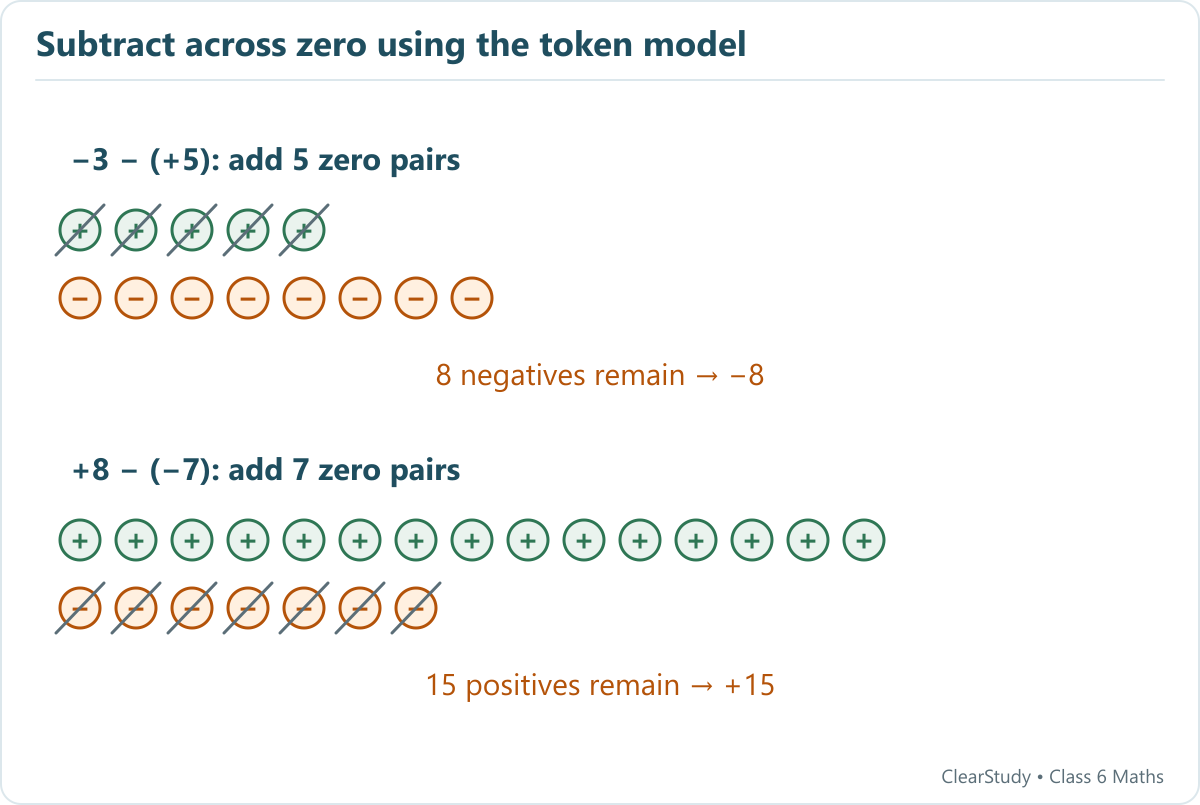
Figure it Out — Integers in Other Places
In-text — bank balance (page 259–260)
Your new bank balance after each credit/debit; what is your balance now? Is a negative balance possible?
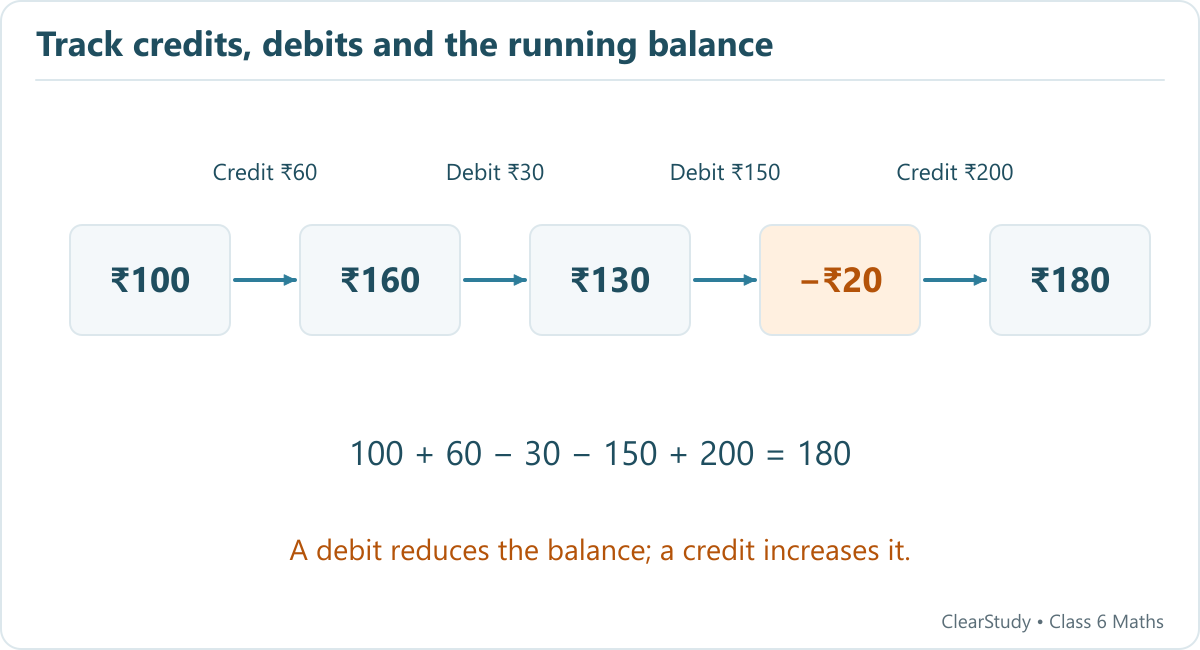
Figure it Out — credits & debits (page 260)
1. Suppose you start with ₹ 0 in your bank account, and then you have credits of ₹ 30, ₹ 40, and ₹ 50, and debits of ₹ 40, ₹ 50, and ₹ 60. What is your bank account balance now?
2. Suppose you start with ₹ 0 in your bank account, and then you have debits of ₹ 1, 2, 4, 8, 16, 32, 64, and 128, and then a single credit of ₹ 256. What is your bank account balance now?
3. Why is it generally better to try and maintain a positive balance in your bank account? What are circumstances under which it may be worthwhile to temporarily have a negative balance?
Figure it Out — geographical cross section (page 261)
1. Looking at the geographical cross section, fill in the respective heights for points A–G.
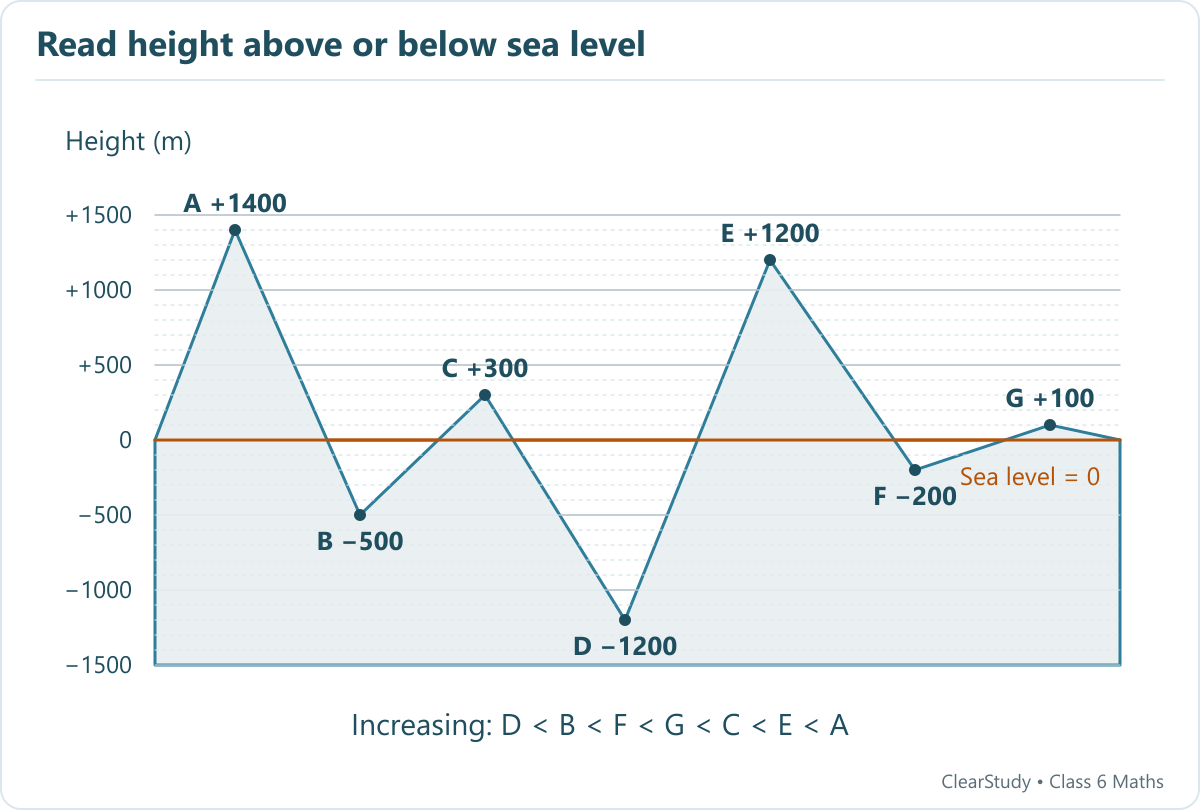
2. Which is the highest point in this geographical cross section? Which is the lowest point?
3. Can you write the points A, B, …, G in a sequence of decreasing order of heights? Can you write the points in a sequence of increasing order of heights?
4. What is the highest point above sea level on Earth? What is its height?
5. What is the lowest point with respect to sea level on land or on the ocean floor? What is its height? (This height should be negative.)
Figure it Out — temperature (page 262)
1. Do you know that there are some places in India where temperatures can go below 0°C? Find out the places in India where temperatures sometimes go below 0°C. What is common among these places? Why does it become colder there and not in other places?
2. Leh in Ladakh gets very cold during the winter. Match the temperature with the appropriate time of the day and night (14°C, 8°C, –2°C, –4°C with 02:00 a.m., 11:00 p.m., 02:00 p.m., 11:00 a.m.).
| Temperature | Time |
|---|---|
| 14°C | 02:00 p.m. |
| 8°C | 11:00 a.m. |
| −2°C | 11:00 p.m. |
| −4°C | 02:00 a.m. |
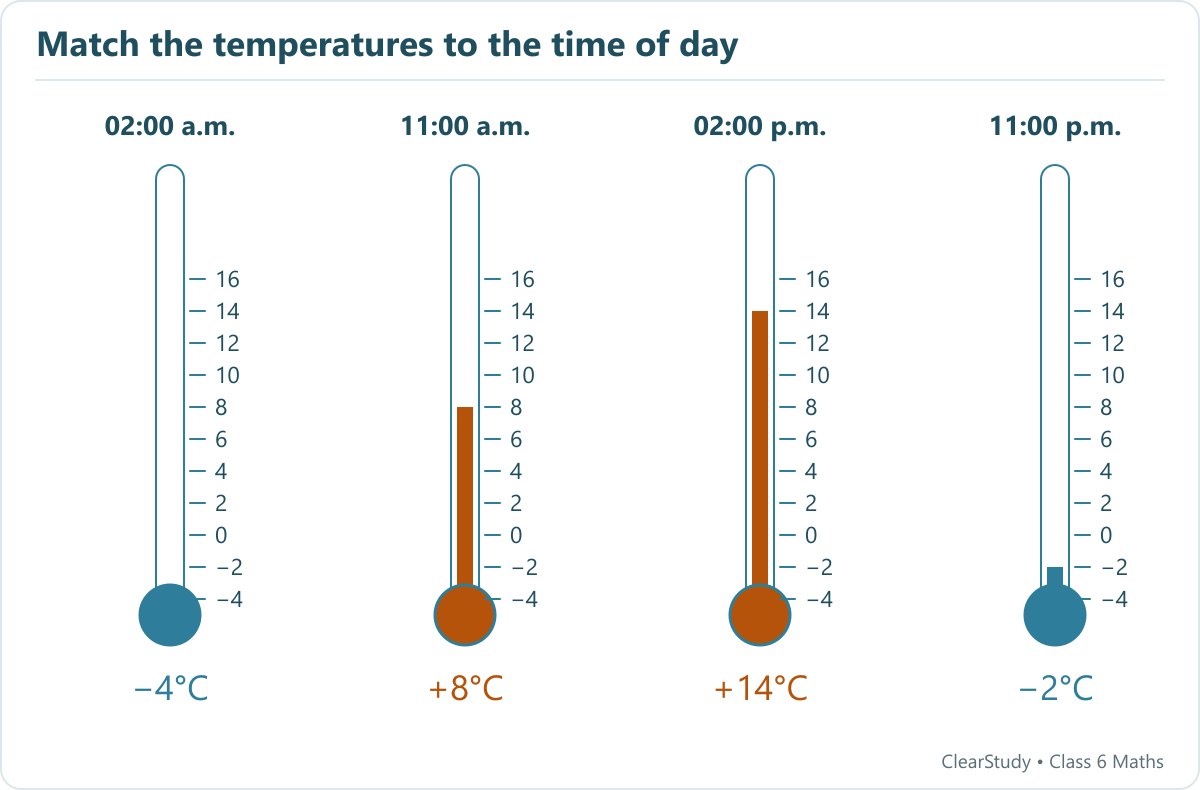
Figure it Out — Explorations with Integers
Figure it Out — border-sum grids (page 263)
1. Do the calculations for the second grid above and find the border sum.
2. Complete the grids to make the required border sum (+ 4, – 2 and – 4).
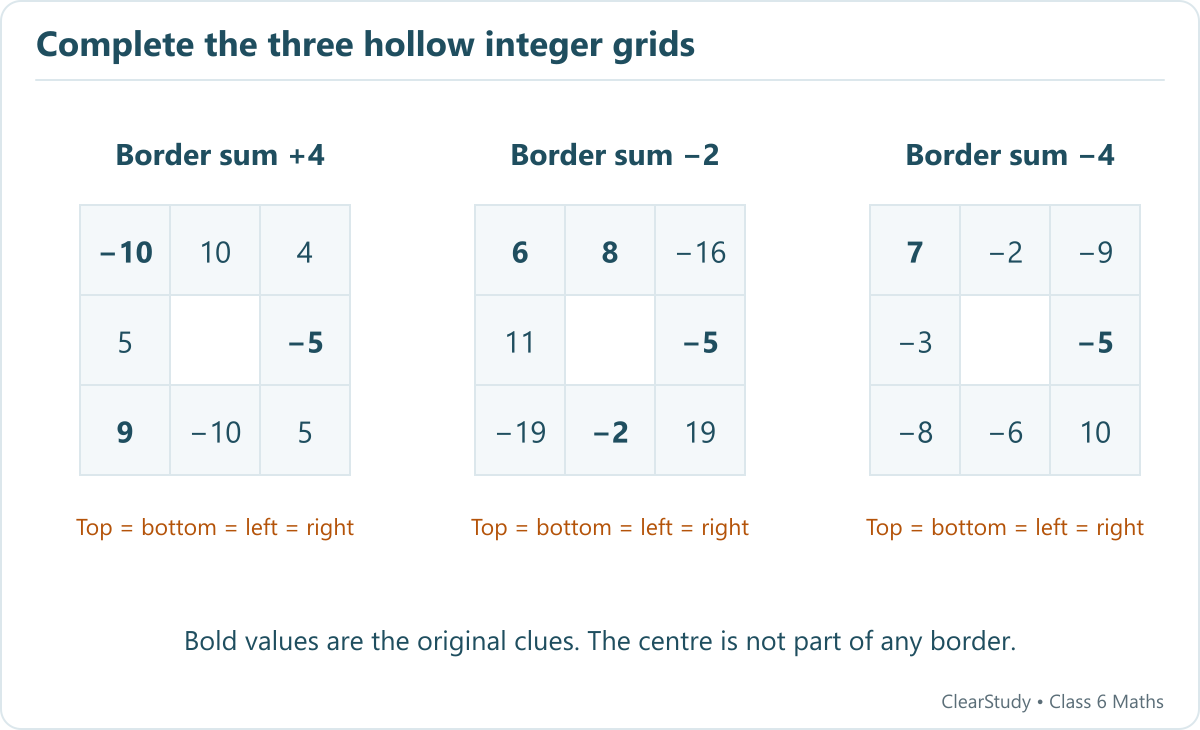
3. For the last grid above, find more than one way of filling the numbers to get border sum – 4.
4. Which other grids can be filled in multiple ways? What could be the reason?
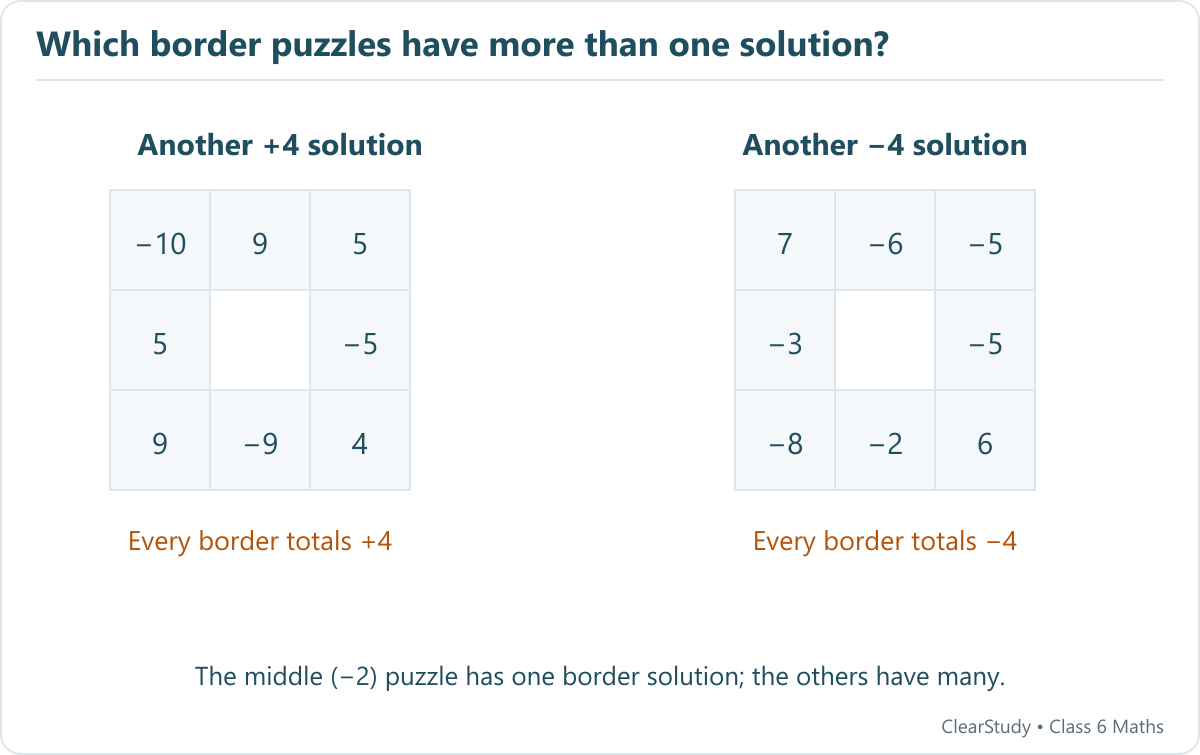
5. Make a border integer square puzzle and challenge your classmates.
Figure it Out — the amazing grid (page 265)
1. Try afresh, choose different numbers this time. What sum did you get? Was it different from the first time? Try a few more times!
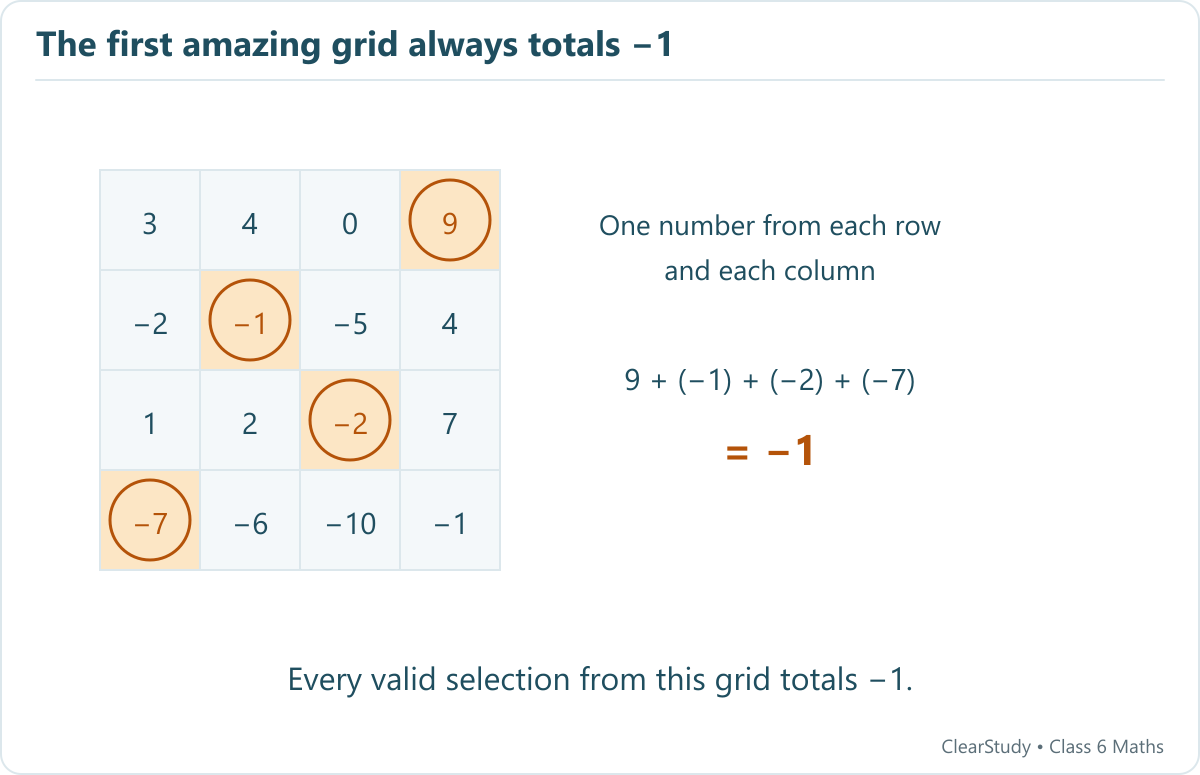
2. Play the same game with the grids below. What answer did you get?
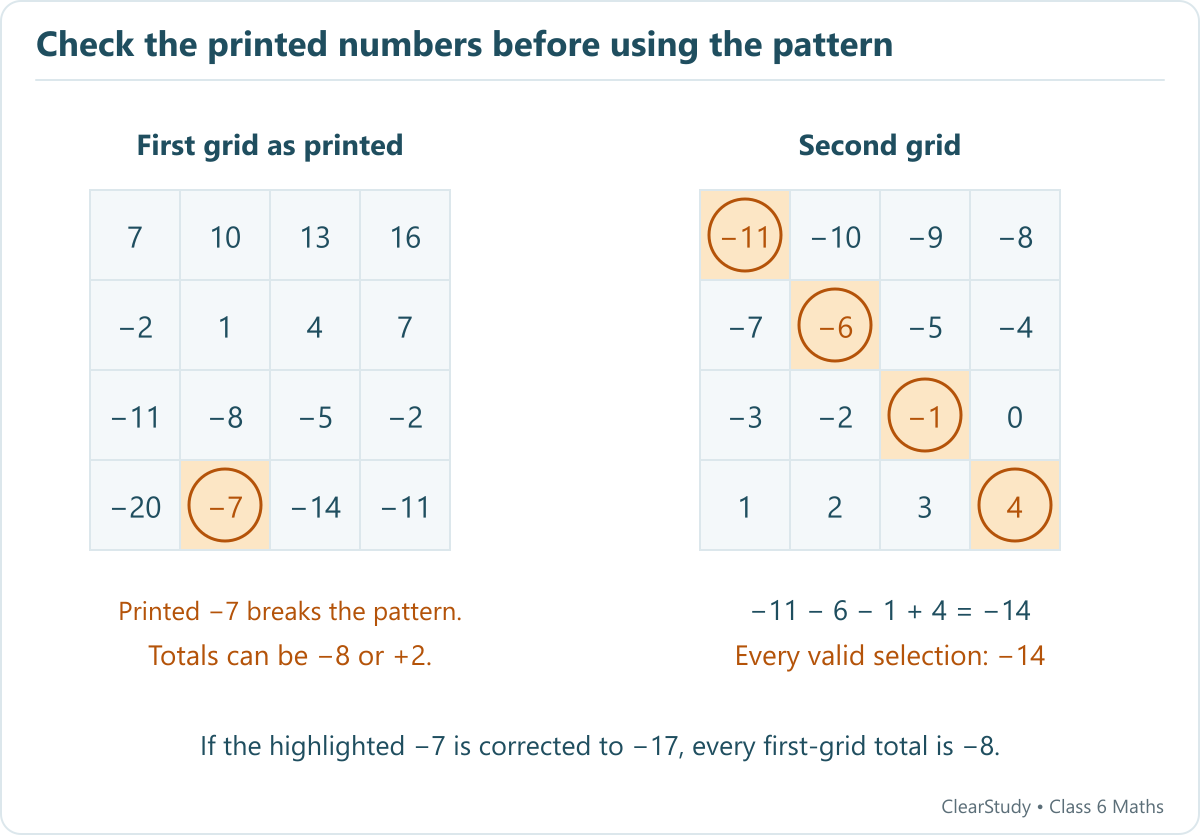
3. What could be so special about these grids? Is the magic in the numbers or the way they are arranged or both? Can you make more such grids?
Figure it Out — integers practice (page 265–266)
1. Write all the integers between the given pairs, in increasing order. a. 0 and – 7 b. – 4 and 4 c. – 8 and – 15 d. – 30 and – 23
2. Give three numbers such that their sum is – 8.
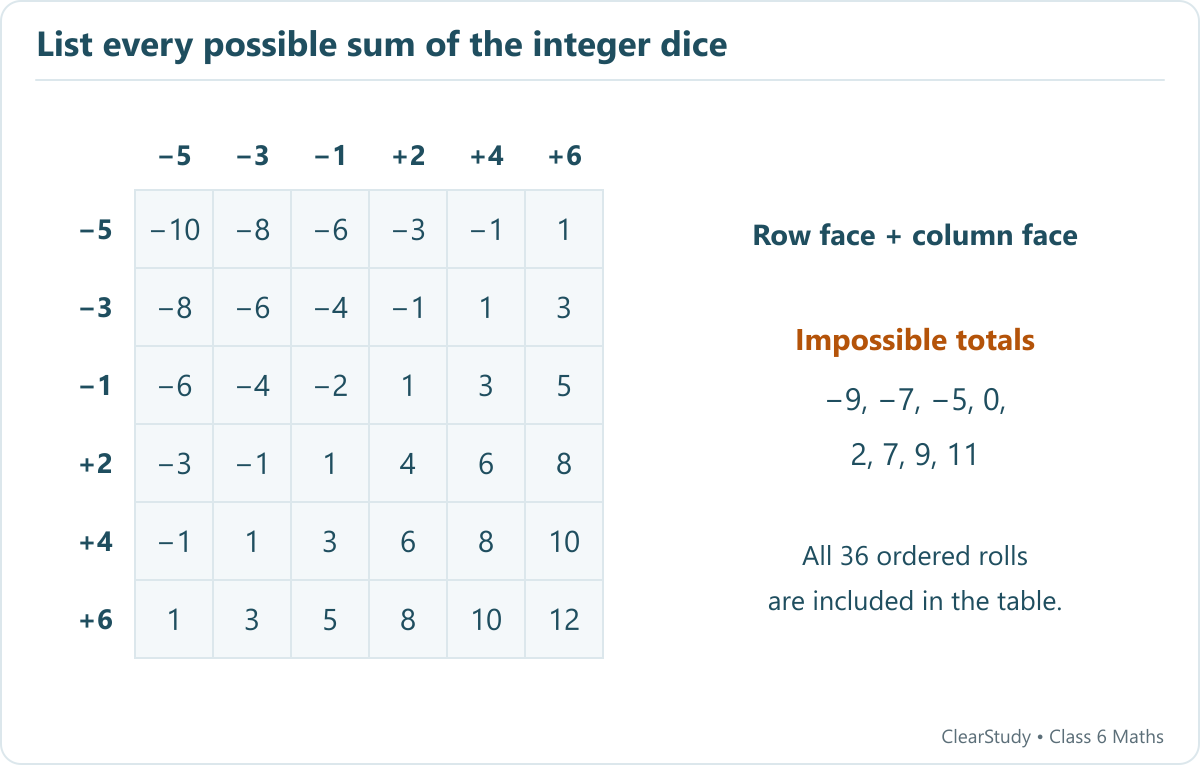
3. There are two dice whose faces have these numbers: – 1, 2, – 3, 4, – 5, 6. The smallest possible sum upon rolling these dice is – 10 = (– 5) + (– 5) and the largest possible sum is 12 = (6) + (6). Some numbers between (– 10) and (+ 12) are not possible to get by adding numbers on these two dice. Find those numbers.
4. Solve these: 8 – 13; (– 8) – (13); (– 13) – (– 8); (– 13) + (– 8); 8 + (– 13); (– 8) – (– 13); (13) – 8; 13 – (– 8).
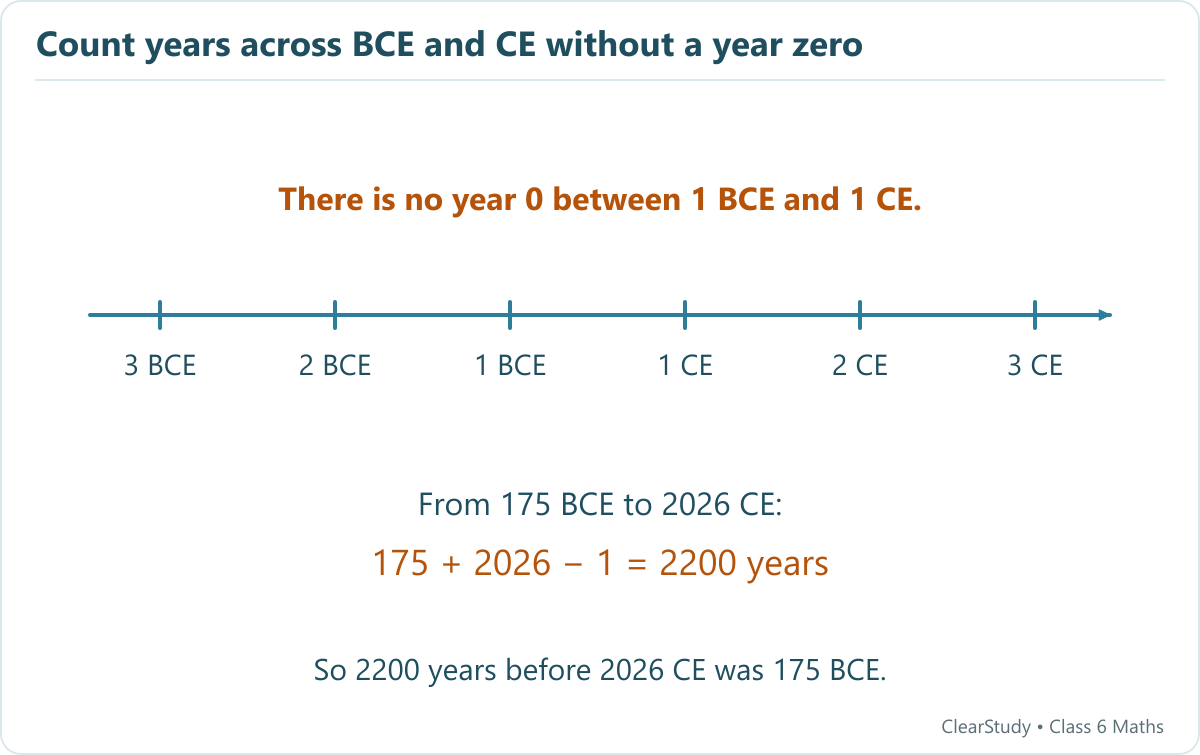
5. Find the years below. a. From the present year, which year was it 150 years ago? b. From the present year, which year was it 2200 years ago? (Hint: there was no year 0.) c. What will be the year 320 years after 680 BCE?
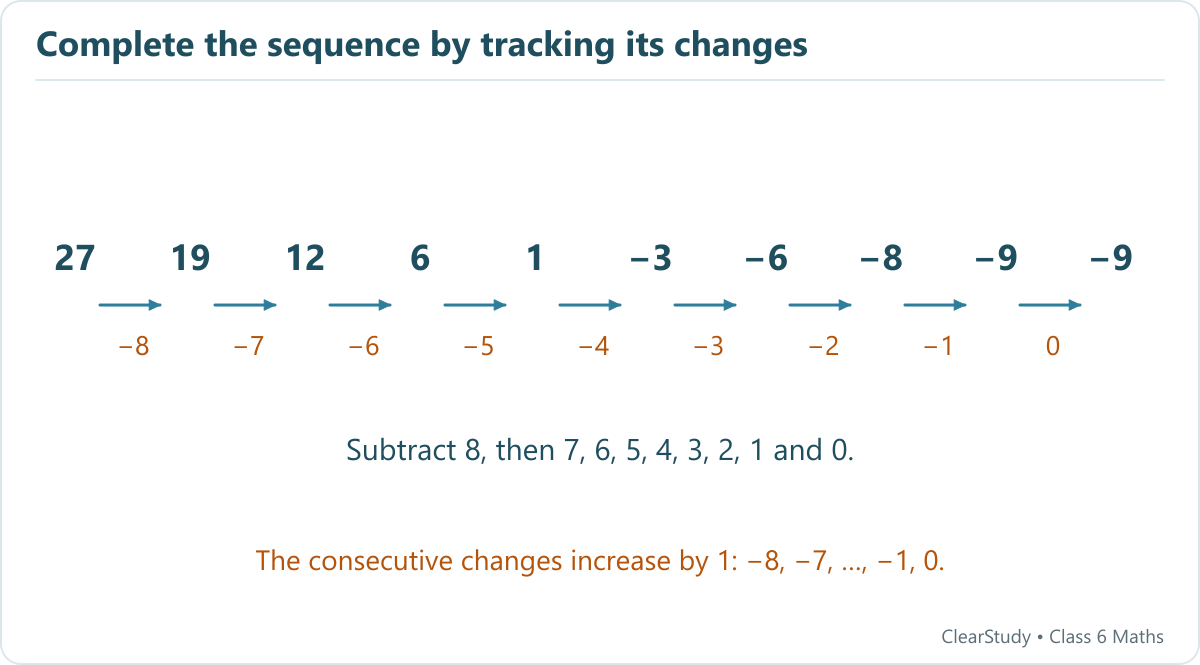
6. Complete the following sequences: a. (– 40), (– 34), (– 28), (– 22), ___, ___, ___ b. 3, 4, 2, 5, 1, 6, 0, 7, ___, ___, ___ c. ___, ___, 12, 6, 1, (– 3), (– 6), ___, ___, ___
7. Here are six integer cards: (+ 1), (+ 7), (+ 18), (– 5), (– 2), (– 9). You can pick any of these and make an expression using addition(s) and subtraction(s). Here is an expression: (+ 18) + (+ 1) – (+ 7) – (– 2) which gives a value (+ 14). Now, pick cards and make an expression such that its value is closer to (– 30).
8. The sum of two positive integers is always positive but a (positive integer) – (positive integer) can be positive, negative or zero. What about a. (positive) – (negative) b. (positive) + (negative) c. (negative) + (negative) d. (negative) – (negative) e. (negative) – (positive) f. (negative) + (positive)
9. This string has a total of 100 tokens arranged in a particular pattern. What is the value of the string?
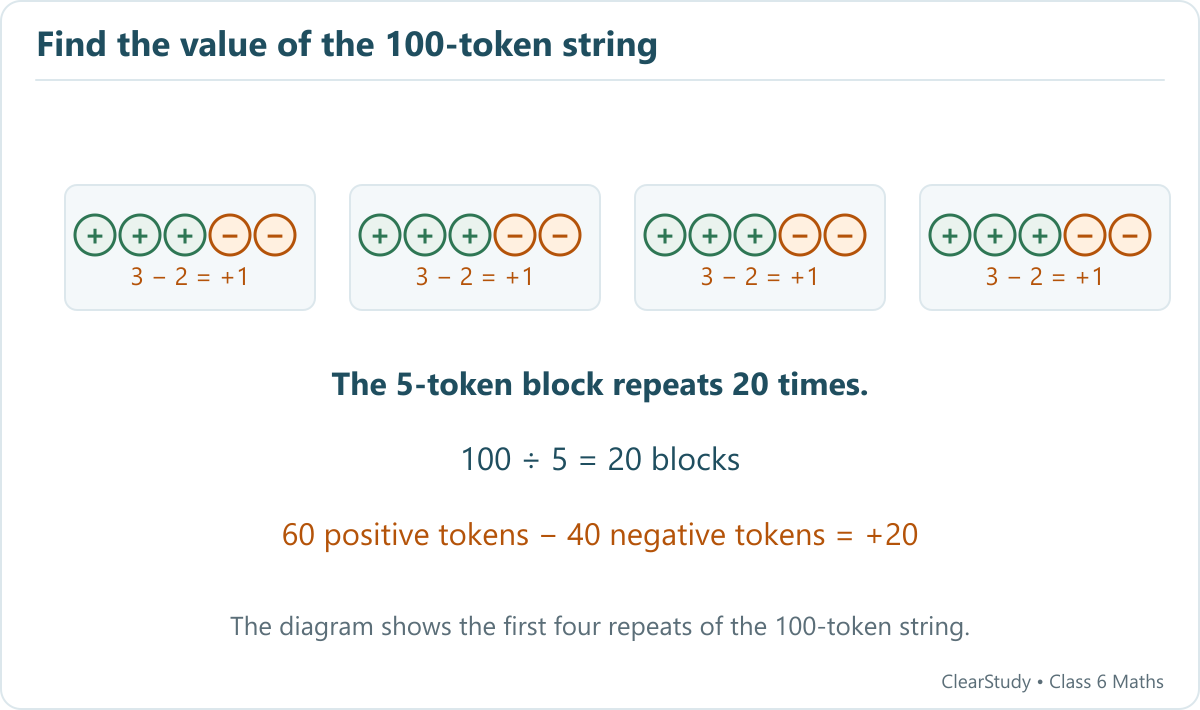
Figure it Out — Brahmagupta’s rules (page 268)
1. Can you explain each of Brahmagupta’s rules in terms of Bela’s Building of Fun, or in terms of a number line?
2. Give your own examples of each rule.
Math Talk & Try This — Answered
These are the in-text reflective tasks in the chapter; the determinate ones are answered and the open ones are guided.
Common Mistakes to Avoid
Watch out for these
- Thinking − 4 is greater than − 3 because “4 > 3”. On the number line − 4 is to the left of − 3, so − 4 < − 3.
- Forgetting that subtracting a negative adds a positive: 7 − (− 7) = 14, not 0.
- Counting the endpoints when listing integers “between” two numbers — the endpoints are excluded (e.g. between 0 and − 7 there are six integers, − 1 to − 6).
- Treating 0 as positive or negative — it is neither. The expressions +0 and −0 both mean 0.
- In year problems, skipping the “no year 0” step when crossing from CE to BCE.
- Counting a positive and a negative token as two units of value — a zero pair has value 0. You may cancel pairs or subtract the total negative count from the positive count.
Practice MCQs & Assertion–Reason
1. Which of the following is the smallest integer?
(a) − 5 (b) 0 (c) − 12 (d) 3
2. The additive inverse of − 9 is:
(a) 9 (b) − 9 (c) 0 (d) 1
3. (+ 4) − (− 3) equals:
(a) + 1 (b) + 7 (c) − 7 (d) − 1
4. Which symbol makes − 25 ___ − 7 true?
(a) > (b) < (c) = (d) none
5. Starting at Floor + 2 and pressing − 3, you reach Floor:
(a) + 5 (b) − 5 (c) − 1 (d) + 1
6. The value of (− 99) − (− 200) is:
(a) − 299 (b) + 101 (c) − 101 (d) + 299
7. How many integers lie strictly between − 4 and 4?
(a) 6 (b) 8 (c) 7 (d) 9
8. Credits of ₹ 30, ₹ 40, ₹ 50 and debits of ₹ 40, ₹ 50, ₹ 60 (starting from ₹ 0) leave a balance of:
(a) + ₹ 30 (b) − ₹ 30 (c) ₹ 0 (d) − ₹ 270
9. A positive and a negative token together make a:
(a) double pair (b) zero pair (c) unit pair (d) inverse floor
10. Who first gave clear rules for arithmetic with positive numbers, negative numbers and zero together?
(a) Aryabhata (b) Lazare Carnot (c) Brahmagupta (d) Kautilya
For each Assertion–Reason question, choose: (A) Both Assertion and Reason are true and the Reason is the correct explanation of the Assertion; (B) Both are true but the Reason is not the correct explanation; (C) Assertion is true but Reason is false; (D) Assertion is false but Reason is true.
A-R 1. Assertion: − 5 < − 3.
Reason: On the number line, the number lying further to the left is the smaller number.
A-R 2. Assertion: 8 − (− 6) = 14.
Reason: Subtracting a negative number is the same as adding the corresponding positive number.
A-R 3. Assertion: Zero is a positive integer.
Reason: Zero lies to the right of all negative numbers on the number line.
A-R 4. Assertion: The additive inverse of − 543 is 543.
Reason: A number added to its additive inverse gives 0.
A-R 5. Assertion: The sum of two negative integers is always negative.
Reason: The sum of a positive and a negative integer is always negative.
Quick Revision Summary
- Numbers less than 0 are negative (written with a ‘−’ sign); they lie to the left of 0 on the number line.
- Integers are … − 3, − 2, − 1, 0, 1, 2, 3 … ; positives are 1, 2, 3…, negatives are − 1, − 2, − 3…, and 0 is neither.
- The additive inverse of a number, added to it, gives 0 (inverse of 7 is − 7; of − 543 is 543).
- Addition: Starting Position + Movement = Target Position. Subtraction: Target − Starting = Movement needed.
- Subtracting an integer = adding its inverse, e.g. 8 − (− 6) = 8 + 6 = 14.
- Use Brahmagupta’s rules: same signs → add and keep the sign; different signs → subtract their distances from zero and keep the sign of the number farther from zero; equal distances give 0.
- Compare with the number line: … − 3 < − 2 < − 1 < 0 < + 1 < + 2 … ; smaller numbers are to the left.
- Integers model credits/debits, heights above/below sea level, and temperatures above/below 0°C.
How to score full marks in this chapter
Convert every subtraction into an addition of the inverse before you compute, and check sign rules with a quick number-line sketch. For comparison questions, remember that for negatives the number nearer 0 is larger. In word problems (banking, heights, temperature) write each quantity with its correct sign first, then add. For year problems, never forget the “no year 0” jump when crossing between CE and BCE. Show one clear step per line so each step earns its mark.
Frequently Asked Questions
What is Class 6 Maths Ganita Prakash Chapter 10 about?
Chapter 10, The Other Side of Zero, introduces integers — positive numbers, negative numbers and zero. Using Bela’s Building of Fun, the number line and a token model, it teaches addition, subtraction, comparison and additive inverses, and links integers to credits/debits, heights and temperature, ending with Brahmagupta’s rules and the history of zero.
What is an additive inverse in this chapter?
The additive inverse of a number is the number that, when added to it, gives zero. For example, the inverse of + 7 is − 7 and the inverse of − 543 is 543. Subtracting any integer is the same as adding its additive inverse.
Why is subtracting a negative number the same as adding a positive number?
On the number line, subtracting means finding the movement to the target. Removing a negative token (or pressing the inverse of a ‘down’ button) moves you up, exactly like adding the matching positive number — so, for example, 8 − (− 6) = 8 + 6 = 14.
Are these Class 6 Maths Ganita Prakash Chapter 10 solutions free?
Yes. All solutions are free and follow the official NCERT Ganita Prakash textbook for the 2026–27 session, with original worked explanations and illustrations based on the chapter.
Textbook reference: NCERT Ganita Prakash, Chapter 10 (official PDF). ClearStudy diagrams and worked explanations are original teaching aids.