
The Tunnel — Class 7 English Poorvi Questions and Answers
The Tunnel questions and answers for Class 7 Poorvi explain Suraj’s friendship with Sunder Singh, the leopard episode and the watchman’s duty. Use reading answers, sound-word practice, past habits, punctuation, museum directions and a sample train-journey paragraph.
Source: NCERT Poorvi, Grade 7, Unit 4, printed pages 139–156 (listening transcript 176); supplied reprint 2026–27. Open-ended and personal responses are examples to adapt. These explanations are study support, not an official NCERT answer key.
About the chapter
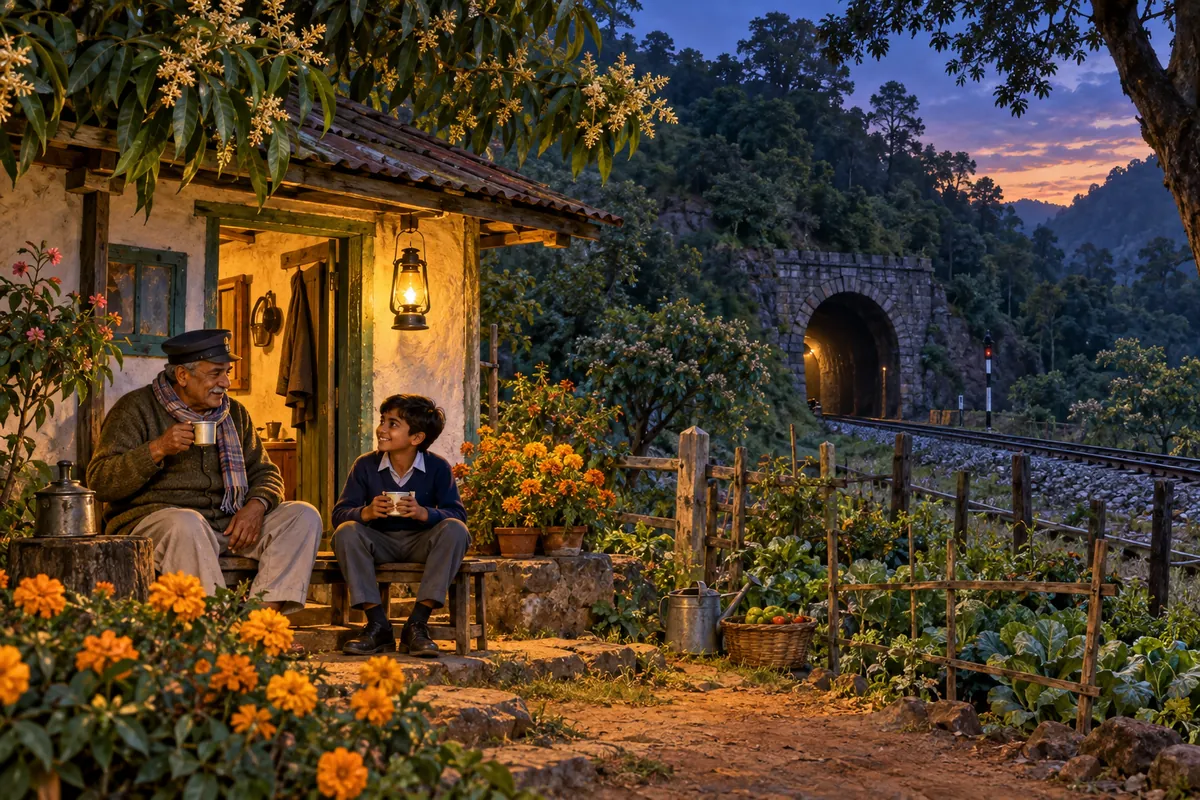
“The Tunnel” is a warm adventure story from Unit 4, ‘Travel and Adventure’, set in a still, sunlit jungle where a railway line cuts through a hillside tunnel. A curious town boy, Suraj, cycles out to watch the steam engine roar out of the tunnel and walks through the dark tunnel himself. There he befriends Sunder Singh, the lonely watchman, and together they brave a leopard one night to save it from being run over by the night mail. The story celebrates curiosity, courage, kindness towards animals and the quiet beauty of life close to nature.
About the author
NCERT credits The Tunnel to Ruskin Bond. Its setting joins a railway cutting with jungle life. The contrast between the noisy engine and the returning silence, along with the watchman’s lamp, helps express companionship and quiet responsibility.
The railway and wildlife encounters are story events, not instructions to enter tracks or approach wild animals.
Summary
It was almost noon, and the jungle was very still as Suraj stood near the cutting to watch the midday train. He had cycled out of town and walked over a scrub-covered hill to the tunnel exit. Soon the steam engine shot out of the tunnel like a green, black and gold dragon, showering sparks, before the silence returned. Curious to know what the inside of a tunnel was really like, Suraj walked right through the dark, damp tunnel, where a bat flew past and a lizard scuttled across the lines. As he came out into the glare, he glimpsed a flash of orange and gold – a leopard moving between the trees.
Near the entrance stood the watchman’s hut. The watchman, Sunder Singh, welcomed Suraj and explained his duty: every day and night he walked the length of the tunnel and, if there was danger, waved a red flag or lamp to warn the engine driver. He told Suraj the leopard was “his” – one that Sunder Singh believes minds its own business. He invited the boy to come back and watch the night mail at nine o’clock.
The next evening Suraj returned. They drank tea, and as the night mail drew near they heard a rhythmic sawing sound – the leopard was in the tunnel. To save it from being run over, Sunder Singh took his axe and, with Suraj close behind, entered the tunnel shouting. Their voices echoed, and the leopard turned and disappeared into the darkness. The night mail then thundered safely through. A week later Suraj travelled in that very train with his father; he could not see Sunder Singh, but he saw the lamp, and knew his friend was out there – a firefly lighting up the darkness for steam engines and leopards.
Theme & message
The central theme is curiosity, courage and harmony with nature. Suraj’s adventurous wish to explore the tunnel leads him to a true friendship with the watchman and a brave night-time rescue of a leopard. Sunder Singh personally feels safer in the familiar jungle than in town, and that real courage means acting kindly even when afraid. Its message is that we should respect and protect wildlife, value simple lonely lives lived close to nature, and let curiosity open the door to friendship and adventure.
Word meanings
| Word | English meaning | Hindi meaning |
|---|---|---|
| shimmered | shined with a light that appears to move | झिलमिलाया / टिमटिमाया |
| embankment | a raised wall built to carry the railway over low ground | रेल का चबूतरा / बांध |
| cutting | a narrow valley cut through a hill for a railway line | पहाड़ी को काटकर बनाया मार्ग |
| scrub-covered | covered with short trees and bushes | झाड़ियों से ढका हुआ |
| instinctively | without thought or plan | सहज स्वभाव से |
| flinch | make a quick movement (from fear or pain) | सहम उठना / सिहरना |
| plume of smoke | a long, thin cloud of smoke | धुएं की लंबी लट |
| contemplation | deep thought | गहरा चिंतन / मनन |
| reassure | to comfort or calm | आश्वस्त करना |
| scuttled | ran hurriedly | सरपट कर भागा |
| dazzled | blinded by bright light | चौंधिया हुआ / आंखें चुंधिया |
| obstacles | things that block the way | बाधाएँ / रुकावटें |
| porcupine | a large rodent with sharp spikes on its back | साही (जानवर) |
| swooped | moved quickly through the air, downwards | झपट्टा नीचे आया |
| quaint | unusual (in an interesting way) | अनोखा / विचित्र |
| lithe | thin and graceful | लचीला और फुर्तीला |
| sinewy | lean and muscular | गठीला और मज़बूत |
| snarling | growling (showing teeth) | गुर्राना / गरजना |
| defying | opposing or challenging | चुनौती देना / विरोध करना |
Let us discuss (Part I)
1. Suraj compares the train to a magical creature. Pick the phrases that convey the meaning.
2. Suraj knew that the train was close by because ____________________.
3. What did Suraj see inside the tunnel?
4. Select the correct option. What does Sunder Singh convey about the tunnel? He says that ____________________ (it is damp and sticky inside / he has lent it to the Government).
5. The watchman has created a system through which he informs the locomotive driver about any danger in the tunnel. The following flow chart shows this system. Refer to the text and complete the flow chart.
Let us discuss (Part II)
1. Sunder Singh knew that the leopard was in the tunnel because ____________.
2. Why do you think Suraj was unable to do any shouting in the tunnel in the beginning? (i) He was afraid of the leopard. (ii) He didn’t want to disturb the leopard. (iii) He was trying to listen for the leopard. (iv) He didn’t really believe Sunder Singh.
3. What made the leopard disappear into the darkness?
4. How did Suraj know Sunder Singh was at the tunnel?
5. Why did Suraj’s father take him along to Delhi?
Let us think and reflect
I. Read the lines and answer the questions that follow.
1. “Suraj had to turn and look back at the opening to reassure himself that there was still daylight outside… The tunnel was still full of smoke from the train… Suraj didn’t stop, because there was nothing to do in the tunnel and nothing to see.”
2. “‘The train will soon be here,’ said Suraj… ‘Not this leopard. It knows me well… It has a weakness for goats and stray dogs, but it will not harm us. Even so, I’ll take my axe with me. You stay here, Suraj.’”
II. Answer the following questions.
Let us learn
I. Complete the sentences using the suitable phrases from the text.
Phrases: drifting smoke · approaching engine · sawing sound · flickering lights
The “serpents” comparison describes the railway lines; the “dragon” and “monster” comparisons describe the engine.
II. Match the ‘sound words’ with their meanings, then fill in the blanks.
III. The use of ‘would’ and ‘used to’.
IV. Use semicolons and colons to punctuate the paragraph.
Listening, speaking, writing and exploration
Let us listen — pp. 153–154; transcript p. 176
Treasure route: Begin at the Entrance Hall and go straight to the Art Gallery. Take its third door on the right to the Weapons Room. Turn left to the Musical Instruments Section, then take its second room on the left to the Auditorium.
The Library is on the right of the Entrance Hall, but is not a required stop in the treasure route. Avoid the renovation room.
Let us speak — pp. 154–155
Sample directions from the pictured map: Leave the station along its access road. At the junction turn left, pass Lassi Corner and turn right at the top of that road. At the next junction turn left, following the road beside the school toward the roundabout. Take the right-hand branch toward the lake and bird sanctuary. The trekking-site symbol is farther to that side; its final connecting path is not drawn, so ask the tour manager to explain the last approach rather than inventing a road.
Let us write — p. 155: sample paragraph
I boarded the train with my family and found our seats beside a window. The whistle sounded, and the platform slowly slipped away. Soon the wheels made a steady rhythm while passengers talked and arranged their bags. Outside, green fields gave way to small villages and a river shining in the afternoon light. A child across the aisle pointed excitedly at grazing cattle. I felt curious about the places passing by and relaxed as I watched the changing landscape. The journey made me realise that travelling can be as memorable as arriving.
This is an invented example. Use your own journey and actual observations.
Let us explore — p. 156
I. The textbook describes the 9.02-km Atal Tunnel beneath Rohtang Pass. Research its construction and purpose from official sources. When discussing the record quoted by the book, retain its category “highway tunnel above 10,000 feet”; do not turn it into an unrestricted or current world-longest claim.
II. The book dates the first passenger service from Bori Bunder to Thane to 16 April 1853, over 34 km. Explore the National Rail Museum’s history resource linked by NCERT. Separate dated history from today’s railway network.
Additional ClearStudy questions
This practice is separate from the printed textbook exercises.
Short answer (30–40 words)
1. Why did Suraj come to the cutting near the tunnel?
2. How does the watchman describe his leopard?
3. What did Suraj and Sunder Singh do on the second evening before the night mail came?
4. Why did they enter the tunnel that night, and how did they drive the leopard out?
5. What sights and sounds of the jungle night does the story describe?
Long answer (100–120 words)
6. Describe Suraj’s first visit to the tunnel and his meeting with Sunder Singh.
7. How does ‘The Tunnel’ show the bond between humans and nature, and the value of courage and kindness?
ClearStudy MCQs and assertion–reason practice
1. Why did Suraj come to the cutting near the tunnel?
(a) to catch a train (b) to watch the steam engine come out of the tunnel (c) to meet the watchman (d) to hunt a leopard
2. What did the railway lines look like to Suraj?
(a) two ropes (b) two rivers (c) two straight black serpents (d) two silver ribbons
3. What did Suraj see between the trees when he came out of the tunnel?
(a) a deer (b) a flash of orange and gold (a leopard) (c) a bear (d) a porcupine
4. What is the name of the watchman?
(a) Suraj (b) Sunder Singh (c) Sohan Lal (d) Sardar Singh
5. How does the watchman warn the engine driver of danger during the day?
(a) by ringing a bell (b) by waving a red flag (c) by lighting a fire (d) by shouting
6. At about what time does the night mail come through the tunnel?
(a) seven o’clock (b) eight o’clock (c) nine o’clock (d) midnight
7. What sound told Sunder Singh that the leopard was in the tunnel?
(a) a hissing sound (b) a rhythmic sawing sound (c) a roaring sound (d) a barking sound
8. Why did Sunder Singh want to drive the leopard out of the tunnel?
(a) to hunt it (b) so it would not be run over and killed by the train (c) to capture it for the zoo (d) to scare Suraj
9. What made the leopard finally disappear into the darkness?
(a) the axe (b) the lamp went out (c) Suraj and Sunder Singh shouting together (d) the train’s whistle
10. At the end, Suraj thinks of Sunder Singh as a ____.
(a) dragon (b) firefly (c) serpent (d) shadow
Assertion–Reason – choose: (a) A and R true, R explains A; (b) A and R true, R does not explain A; (c) A true, R false; (d) A false, R true.
1. Assertion (A): Suraj walked through the dark tunnel even though there was nothing to see in it.
Reason (R): He simply wanted to know what the inside of a tunnel was really like.
2. Assertion (A): Sunder Singh and Suraj entered the tunnel to drive the leopard out.
Reason (R): If the leopard stayed in the tunnel, the night mail would run it over and kill it.
3. Assertion (A): Suraj was unable to shout when he first entered the tunnel with the watchman.
Reason (R): His throat was quite dry because he was afraid of the leopard.
4. Assertion (A): Sunder Singh believed the jungle was more dangerous than the town.
Reason (R): He was almost run over by a bus the last time he went into town.
5. Assertion (A): Suraj thought of Sunder Singh as a firefly in the darkness.
Reason (R): His glowing lamp was the only light Suraj could see by the cutting as the night mail passed.
Exam tips & common mistakes
Exam tips
• Remember the sequence: midday train → Suraj walks through the tunnel → meets Sunder Singh → returns at night → drives the leopard out → sees the lamp from the train.
• Name the author when relevant (Ruskin Bond) and the two main characters (Suraj and the watchman Sunder Singh) in long answers.
• For the ‘firefly’ question, link the glowing lamp in the darkness to the image of a firefly.
• Use the dragon/serpent imagery to answer questions on how the train is described.
Common mistakes
• Do not write that they entered the tunnel to hunt the leopard – they went to save it from the train.
• Sunder Singh thought the jungle was safer than the town, not more dangerous.
• The leopard was frightened away by their shouting, not by the axe.
• The danger signal by day is a red flag; by night it is the lamp – do not mix them up.
FAQs
Who wrote ‘The Tunnel’ and where is it set?
It was written by Ruskin Bond and is set in a quiet jungle where a railway line passes through a tunnel in a hillside, near a small village in the hills.
What is the main message of ‘The Tunnel’?
The story celebrates curiosity, courage and harmony with nature, and shows that true bravery means protecting wildlife and helping others, even when one is afraid.
Why is Sunder Singh called a ‘firefly’?
As the night mail passes, his small glowing lamp is the only light in the dark jungle, so he seems like a firefly lighting up the darkness for the trains and the leopard.
Textbook-based exercises and additional ClearStudy practice are identified separately. Use your textbook alongside these explanations.