
NCERT Solutions for Class 7 Science (Curiosity) Chapter 10: Life Processes in Plants (NCERT 2026–27)
These Class 7 Science Curiosity Chapter 10 solutions cover Life Processes in Plants from the new NCF-2023 textbook (2026–27). The chapter explains how plants make their own food by photosynthesis, how water, minerals and food are transported through the xylem and phloem, and how plants respire. Below you will find every “Let Us Enhance Our Learning” question reproduced verbatim and solved in clear, exam-ready language.
Class 7 Science Curiosity Chapter 10 Solutions – Overview
Chapter 10 of Curiosity, Life Processes in Plants, answers a simple question: if animals eat food to grow, how do plants get theirs? Through Activities 10.1 to 10.8 the chapter shows that plants need sunlight, water, carbon dioxide and chlorophyll to prepare their own food. Leaves are the ‘food factories’ of a plant, where the green pigment chlorophyll uses light energy to convert carbon dioxide and water into glucose, releasing oxygen — the process called photosynthesis. Tiny pores called stomata on the leaf surface allow the exchange of gases. The chapter then explains transport: water and minerals rise from the roots through the xylem, while food made in the leaves travels through the phloem. Finally it shows that plants, like all living things, respire — breaking down glucose using oxygen to release carbon dioxide, water and energy for growth.
Key Concepts & Definitions
Photosynthesis: the process by which green plants prepare their own food (glucose) using carbon dioxide and water in the presence of sunlight and chlorophyll, releasing oxygen.
Chlorophyll: the green pigment in leaves that captures sunlight efficiently and is essential for preparing starch.
Starch test: the iodine test; a leaf containing starch turns blue-black when iodine solution is added.
Stomata: tiny pores on the surface of leaves that help in the exchange of gases (carbon dioxide and oxygen).
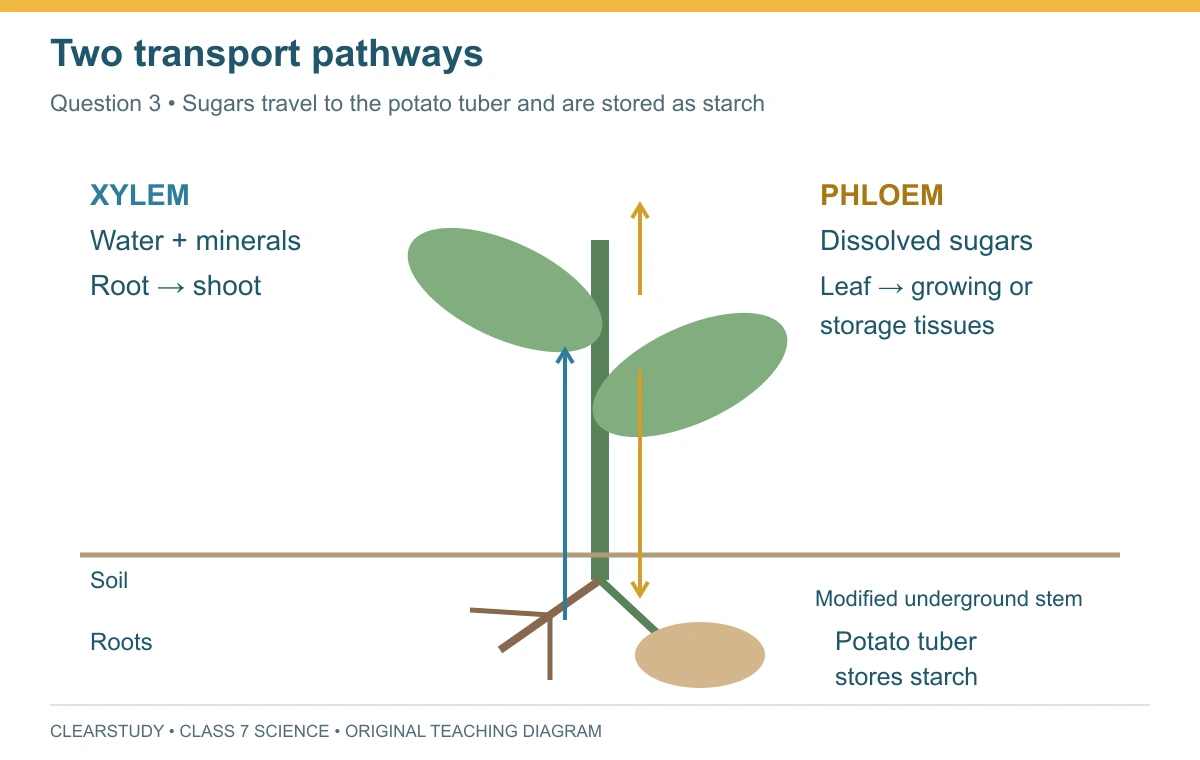
Xylem: thin tube-like structures that transport water and minerals upward from the roots to the leaves and other parts.
Phloem: thin tube-like structures that transport food prepared in the leaves to all parts of the plant.
Respiration: the process in which glucose is broken down in the presence of oxygen to release carbon dioxide, water and energy.
Word equations:
Photosynthesis: Carbon dioxide + Water →(sunlight, chlorophyll) Glucose + Oxygen
Respiration: Glucose + Oxygen → Carbon dioxide + Water + Energy
“Let Us Enhance Our Learning” — NCERT Solutions
All questions below are reproduced verbatim from the NCERT Curiosity textbook (Grade 7). Answers are original and written in exam-ready style.
1. Complete the following table.
| S.No. | Feature | Photosynthesis | Respiration |
|---|---|---|---|
| 1. | Raw materials | Carbon dioxide and water; sunlight and chlorophyll are required conditions, not raw materials | Glucose and oxygen |
| 2. | Products | Glucose (carbohydrate) and oxygen | Carbon dioxide, water and energy |
| 3. | Word equation | Carbon dioxide + Water →(sunlight, chlorophyll) Glucose + Oxygen | Glucose + Oxygen → Carbon dioxide + Water + Energy |
| 4. | Importance | Prepares food for the plant and releases oxygen into the air for other living beings. | Releases energy from food that the plant uses for its growth and development. |
2. Imagine a situation where all the organisms that carry out photosynthesis on the earth have disappeared. What would be the impact of this on living organisms?
3. A potato slice shows the presence of starch with iodine solution. Where does the starch in potatoes come from? Where is the food synthesised in the plant, and how does it reach the potato?
4. Does the broad and flat structure of leaves make plants more efficient for photosynthesis? Justify your answer.
5. X is broken down using Y to release carbon dioxide, Z, and energy.
X + Y → Carbon dioxide + Z + Energy
X, Y, and Z are three different components of the process. What do X, Y, and Z stand for?
6. Krishna set-up an experiment with two potted plants of same size and placed one of them in sunlight and the other in a dark room, as shown in Fig. 10.10. Answer the following questions —
(i) What idea might she be testing through this experiment?
(ii) What are the visible differences in plants in both the conditions?
(iii) According to you, leaves of which plants confirm the iodine test for the presence of starch?
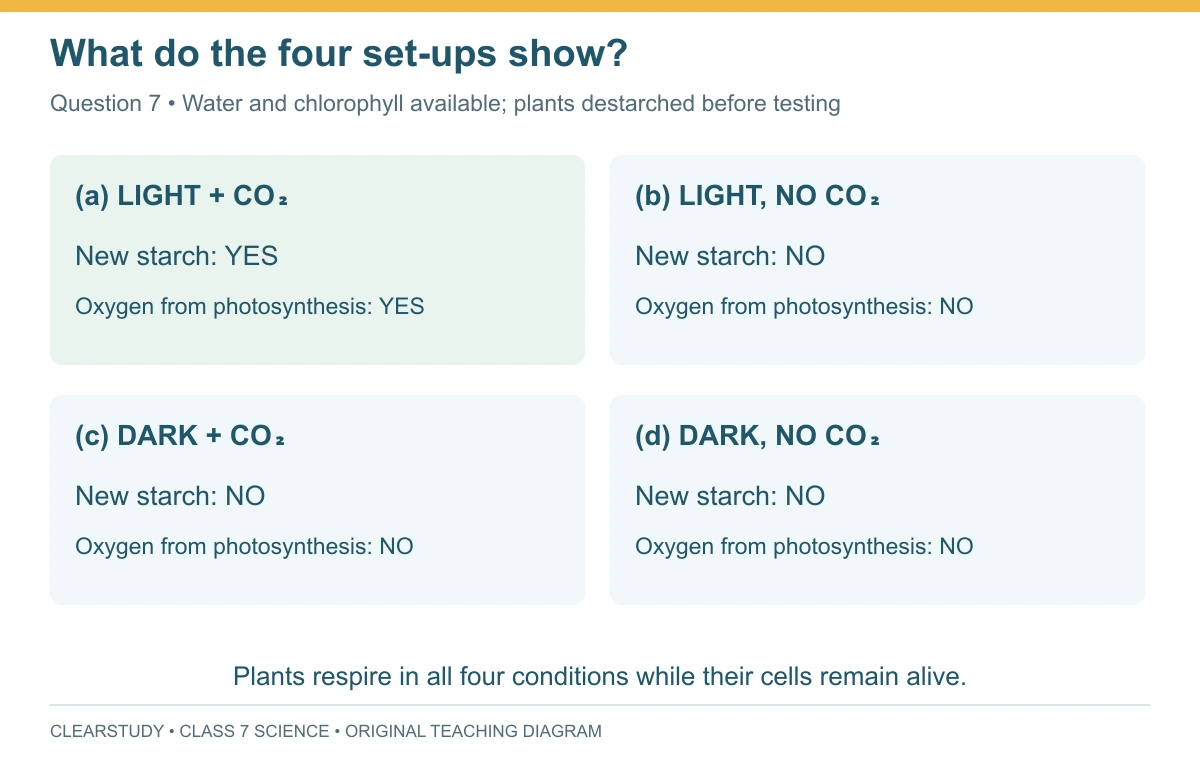
7. Vani believes that ‘carbon dioxide is essential for photosynthesis’. She puts an experimental set-up, as shown in Fig. 10.11, to collect evidence to support or reject her idea. Answer the following questions —
(i) In which plant(s) in the above set-up(s) will starch be formed?
(ii) In which plant(s) in the above set-up(s) will starch not be formed?
(iii) In which plant(s) in the above set-up(s) will oxygen be generated?
(iv) In which plant(s) in the above set-up(s) will oxygen not be generated?
8. Ananya took four test tubes and filled three-fourth of each test tube with water. She labelled them A, B, C, and D (Fig. 10.12). In test tube A, she kept a snail; in test tube B, she kept a water plant; in test tube C, she kept both a snail and a plant. In test tube D, she kept only water. Ananya added a carbon dioxide indicator to all the test tubes. She recorded the initial colour of water and observed if there are any colour changes in the test tubes after 2–3 hours. What do you think she wants to find out? How will she know if she is correct?
9. Design an experiment to observe if water transportation in plants is quicker in warm or cold conditions.
10. Photosynthesis and respiration are essential to maintain balance in nature. Discuss.
Extra Practice Questions
These questions and MCQs are ClearStudy practice, separate from the NCERT exercise.
Short Answer Type Questions
Q1. Why are leaves called the ‘food factories’ of plants?
Q2. What is the role of stomata in a leaf?
Q3. Why is a leaf decolourised (made colourless) before performing the starch test?
Q4. State the difference between the functions of xylem and phloem.
Q5. Why does lime water turn milky in the test tube connected to the flask containing germinating seeds?
Long Answer Type Questions
Q1. Describe the process of photosynthesis, naming the raw materials, products and conditions required.
Q2. How can you experimentally show that carbon dioxide is necessary for photosynthesis (Activity 10.4)?
Q3. Explain how water and food are transported in a plant, and how this can be shown by an experiment.
MCQs & Assertion–Reason
1. The green pigment in leaves that captures sunlight is called:
(a) starch (b) chlorophyll (c) glucose (d) iodine
2. The presence of starch in a leaf is shown when iodine solution turns it:
(a) red (b) green (c) blue-black (d) colourless
3. During photosynthesis, plants take in ______ and release ______.
(a) oxygen; carbon dioxide (b) carbon dioxide; oxygen (c) nitrogen; oxygen (d) water; nitrogen
4. The food prepared during photosynthesis is in the form of:
(a) protein (b) fat (c) glucose (d) vitamin
5. Tiny pores on the surface of leaves that help in the exchange of gases are called:
(a) xylem (b) phloem (c) stomata (d) chlorophyll
6. Water and minerals are transported in a plant through the:
(a) phloem (b) xylem (c) stomata (d) leaves
7. Food prepared in the leaves is transported to other parts through the:
(a) xylem (b) roots (c) phloem (d) stomata
8. In Activity 10.4, caustic soda is used because it:
(a) gives out oxygen (b) absorbs carbon dioxide from the air (c) adds water (d) provides sunlight
9. During respiration in plants, glucose is broken down to release:
(a) only oxygen (b) carbon dioxide, water and energy (c) only starch (d) chlorophyll
10. The gas that makes a lit matchstick burn with an intense flame (Activity 10.5) is:
(a) carbon dioxide (b) nitrogen (c) oxygen (d) water vapour
For each Assertion–Reason question, choose: (A) Both true and the Reason correctly explains the Assertion; (B) Both true but the Reason is not the correct explanation; (C) Assertion true, Reason false; (D) Assertion false, Reason true.
A-R 1. Assertion: Leaves are called the ‘food factories’ of plants.
Reason: Leaves contain chlorophyll, which prepares starch in the presence of sunlight.
A-R 2. Assertion: A destarched green plant kept in darkness cannot make new food by photosynthesis.
Reason: Sunlight is essential for the process of photosynthesis.
A-R 3. Assertion: Oxygen is released during photosynthesis.
Reason: Plants use oxygen to break down glucose during respiration.
A-R 4. Assertion: Water and minerals are carried up the plant through the phloem.
Reason: The phloem transports food prepared in the leaves to all parts of the plant.
A-R 5. Assertion: All living parts of a plant, green or non-green, carry out respiration.
Reason: Respiration releases energy that the plant uses for growth and development.
Quick Revision Summary
- Plants need sunlight and water for growth (Activity 10.1).
- Photosynthesis = Carbon dioxide + Water →(sunlight, chlorophyll) Glucose + Oxygen.
- Leaves are the ‘food factories’; chlorophyll is essential for making starch, shown blue-black by the iodine test.
- Carbon dioxide (Activity 10.4) and sunlight are both needed for starch formation; oxygen is released (Activity 10.5).
- Stomata on the leaf surface allow the exchange of gases.
- Xylem carries water and minerals up; phloem carries food from leaves to all parts.
- Respiration: Glucose + Oxygen → Carbon dioxide + Water + Energy; all living parts of the plant respire.
Common Mistakes to Avoid
Watch out for these
- Mixing up xylem (water and minerals, upward) with phloem (food, all directions).
- Thinking plants only photosynthesise and do not respire — plants respire all the time, day and night.
- Saying the iodine test colour is “blue” — the correct colour for starch is blue-black.
- Forgetting that both sunlight and carbon dioxide are needed for starch; one alone is not enough.
- Confusing the two word equations — photosynthesis makes glucose and oxygen; respiration uses them.
- Thinking only leaves can photosynthesise — any green part with chlorophyll can.
How to write a clear answer
Learn the two word equations exactly and be ready to write them. For activity-based questions, always state which factor is being tested, what is kept the same (fair test), and what the result shows. Remember the iodine test gives a blue-black colour for starch, that the xylem carries water up and the phloem carries food everywhere, and that stomata handle gas exchange. Use the chapter’s own examples — the destarched leaf, the red-ink twig, the germinating seeds and lime water — to show you have read the chapter.
Frequently Asked Questions
What is Class 7 Science Curiosity Chapter 10 about?
Chapter 10, Life Processes in Plants, explains how plants make their own food by photosynthesis using sunlight, water, carbon dioxide and chlorophyll, how water and food are transported through the xylem and phloem, and how plants respire to release energy.
What is the word equation for photosynthesis?
Carbon dioxide + Water, in the presence of sunlight and chlorophyll, gives Glucose + Oxygen. The glucose is later stored as starch and oxygen is released into the air.
What is the difference between xylem and phloem?
The xylem transports water and minerals upward from the roots to the leaves, while the phloem transports the food prepared in the leaves to all parts of the plant.
Are these Class 7 Science Curiosity Chapter 10 solutions free?
Yes. All solutions are free and follow the official NCERT Curiosity textbook for 2026–27.