
NCERT Solutions for Class 7 Science (Curiosity) Chapter 11: Light: Shadows and Reflections (NCERT 2026–27)
These Class 7 Science Curiosity Chapter 11 solutions cover Light: Shadows and Reflections from the new NCF-2023 textbook (2026–27). The chapter explains why light is so special: it travels in straight lines through a uniform medium, until it meets a boundary or obstacle. From this single idea grow shadows, reflection in a mirror, the upside-down image of a pinhole camera, and clever devices like the periscope and kaleidoscope. Every textbook question from Let Us Enhance Our Learning is reproduced verbatim below and answered in clear, exam-ready steps.
Class 7 Science Curiosity Chapter 11 Solutions – Overview
Chapter 11 of Curiosity, Light: Shadows and Reflections, begins with the difference between luminous objects (which emit their own light, like the Sun, stars and fireflies) and non-luminous objects (like the Moon, which only reflect light). The chapter then establishes its central idea through simple activities — the matchbox holes and the bent pipe — that light travels in a straight line. Because of this, opaque objects block light to form shadows, while transparent materials let light pass and translucent ones pass it partly. A shiny surface or mirror changes the direction of light, which is called reflection. A plane mirror forms an image that is erect, the same size as the object, laterally inverted, and cannot be caught on a screen. The straight-line nature of light also explains the inverted image of a pinhole camera, and reflection is used to build a periscope and a kaleidoscope.
Key Concepts & Definitions
Luminous object: an object that emits its own light, such as the Sun, stars, lightning, fire and certain animals (fireflies).
Non-luminous object: an object that does not emit its own light and is seen only because it reflects light, e.g. the Moon.
Rectilinear propagation of light: light travels in a straight line. This is shown by the matchbox-hole activity and by being unable to see a candle flame through a bent pipe.
Transparent, translucent, opaque: light passes almost completely through transparent materials, partially through translucent materials, and not at all through opaque materials.
Shadow: the dark patch formed when an opaque object blocks the straight path of light. We need a source of light, an opaque object and a screen to see a shadow. Changing the colour of the object does not change the colour of the shadow.
Reflection of light: light returning from a surface. Smooth surfaces give regular reflection; rough surfaces also reflect light, but in many directions.
Image in a plane mirror: erect, the same size as the object, laterally inverted (left–right reversed), and cannot be obtained on a screen (a virtual image).
Lateral inversion: the apparent left–right reversal in a mirror image — your left hand appears as the right hand of the image.
Pinhole camera: a device in which light from an object passes through a tiny hole to form an inverted (upside-down) image on a screen.
Periscope & kaleidoscope: useful devices made using two and three plane mirrors respectively, working on the reflection of light.
Let Us Enhance Our Learning – NCERT Solutions
All questions below are reproduced verbatim from the NCERT Curiosity (Class 7) end-of-chapter exercise “Let Us Enhance Our Learning”. Answers are original and exam-ready.
1. Which of the following are luminous objects?Mars, Moon, Pole Star, Sun, Venus, Mirror
2. Match the items in Column A with those in Column B.
| Column A | Column B (correct match) |
|---|---|
| Pinhole camera | Forms an inverted image |
| Opaque object | Blocks light completely |
| Transparent object | Light passes almost completely through it |
| Shadow | The dark region formed behind the object |
3. Sahil, Rekha, Patrick, and Qasima are trying to observe the candle flame through the pipe as shown in Fig. 11.16. Who can see the flame?
4. Look at the images shown in Fig. 11.17 and select the correct image showing the shadow formation of the boy.
5. The shadow of a ball is formed on a wall by placing the ball in front of a fixed torch as shown in Fig. 11.18. In scenario (i) the ball is closer to the torch, while in scenario (ii) the ball is closer to the wall. Choose the most accurate representation of the shadows formed in both scenarios from the options provided (a and b).
6. Based on Fig. 11.18, match the position of the torch in Column A with the characteristics of the ball’s shadow in Column B.
| Column A | Column B (correct match) |
|---|---|
| If the torch is close to the ball | The shadow would be larger |
| If the torch is far away | The shadow would be smaller |
| If the ball is removed from the set-up | A bright spot would appear on the screen |
| If two torches are present in the set-up on the left side of the ball | Two shadows would appear on the screen |
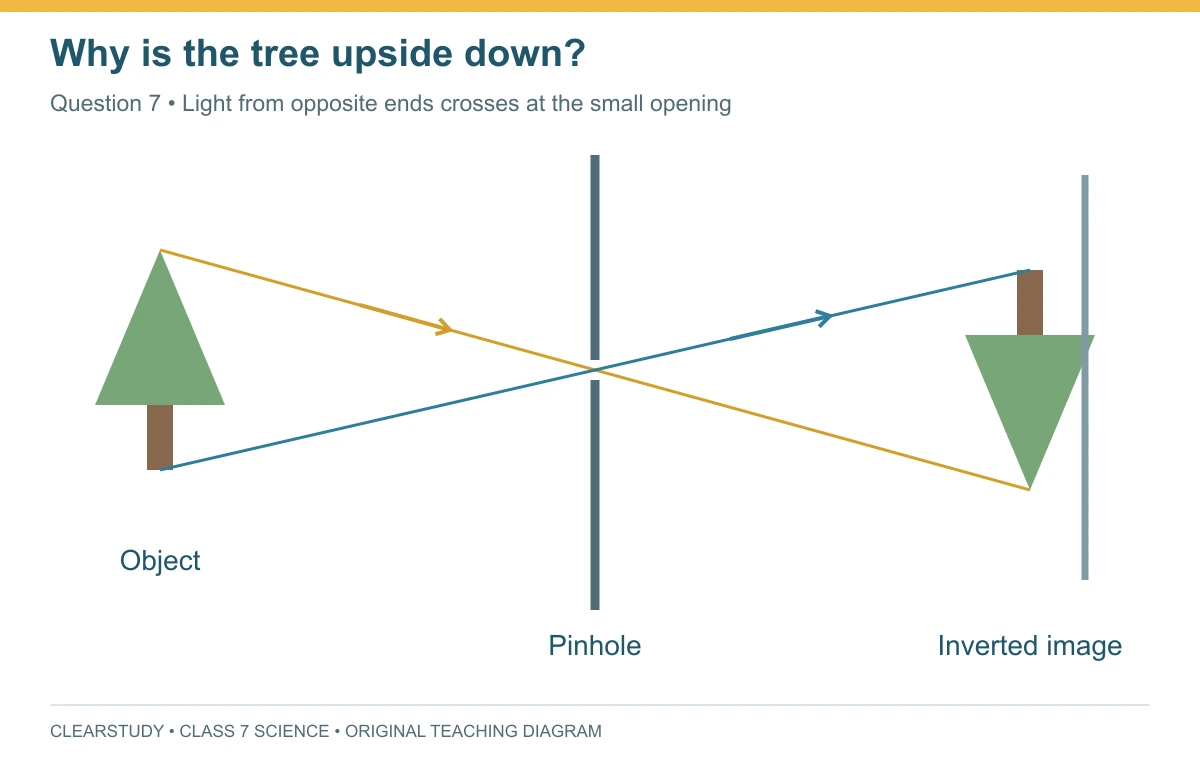
7. Suppose you view the tree shown in Fig. 11.19 through a pinhole camera. Sketch the outline of the image of the tree formed in the pinhole camera.
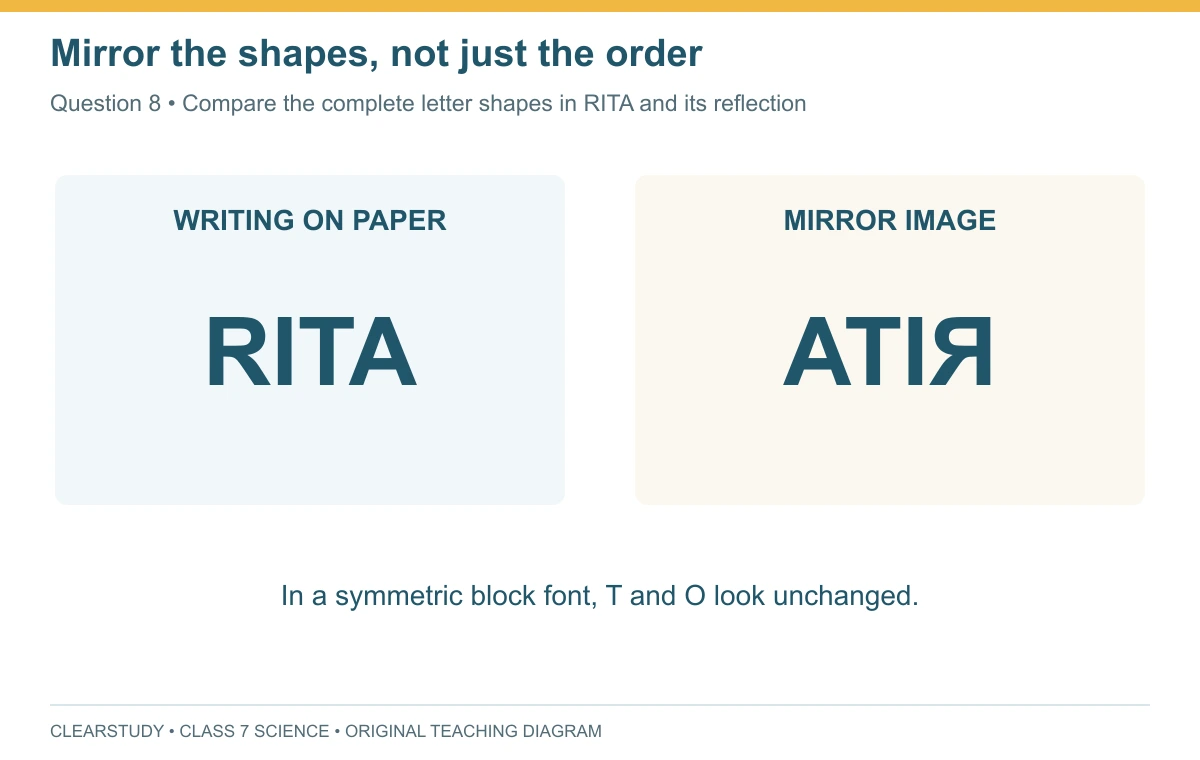
8. Write your name on a piece of paper and hold it in front of a plane mirror such that the paper is parallel to the mirror. Sketch the image. What difference do you notice? Explain the reason for the difference.
9. Measure the length of your shadow at 9 AM, 12 PM, and 4 PM with the help of your friend. Write down your observations:(i) At which of the given times is your shadow the shortest?(ii) Why do you think this happens?
10. On the basis of following statements, choose the correct option.Statement A: Image formed by a plane mirror is laterally inverted.Statement B: Images of alphabets T and O appear identical to themselves in a plane mirror.(i) Both statements are true(ii) Both statements are false(iii) Statement A is true, but statement B is false(iv) Statement A is false, but statement B is true
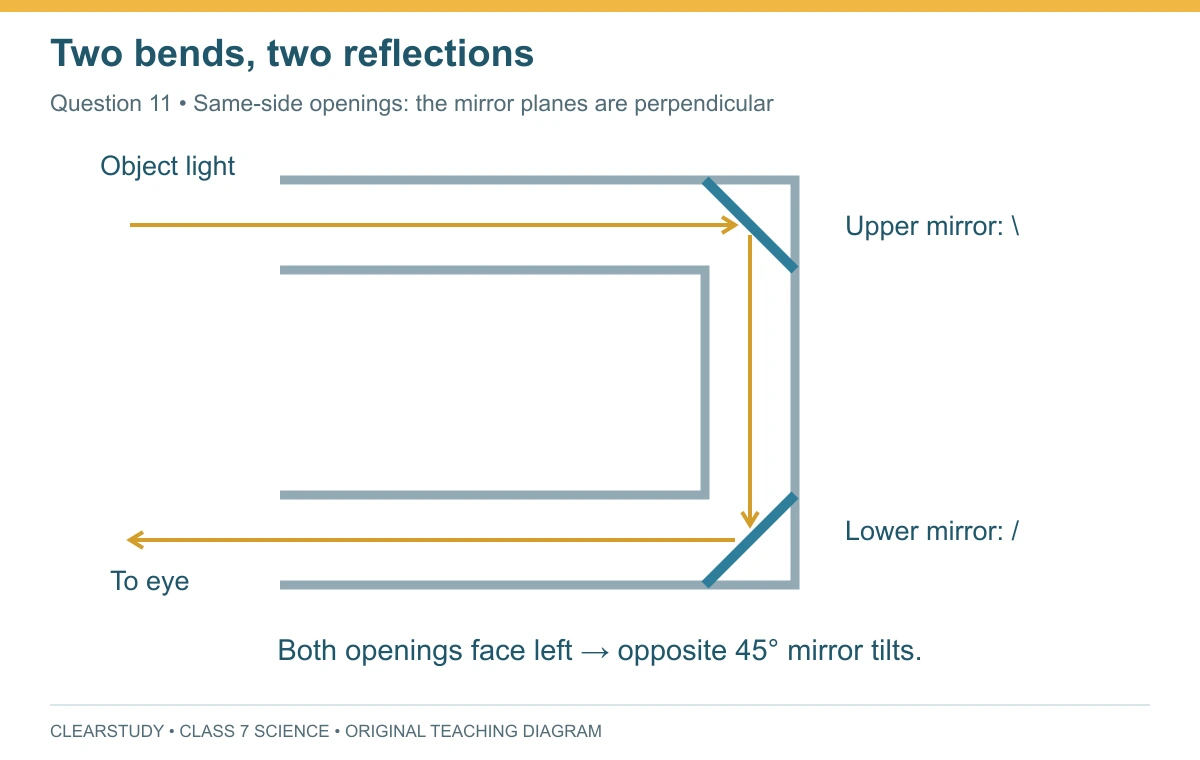
11. Suppose you are given a tube of the shape shown in the Fig. 11.20 and two plane mirrors smaller than the diameter of the tube. Can this tube be used to make a periscope? If yes, mark where you will fix the plane mirrors.
12. We do not see the shadow on the ground of a bird flying high in the sky. However, the shadow is seen on the ground when the bird swoops near the ground. Think and explain why it is so.
Extra Practice Questions
These questions and MCQs are ClearStudy practice, separate from the NCERT exercise.
Short Answer Type Questions
Q1. Why is the Moon called a non-luminous object?
Q2. State two activities from the chapter that show light travels in a straight line.
Q3. What three things are needed to obtain a shadow?
Q4. List any three properties of the image formed by a plane mirror.
Q5. How does a shiny steel plate produce a bright spot on the opposite wall?
Long Answer Type Questions
Q1. Classify materials as transparent, translucent and opaque with respect to how light passes through them, giving one example of each and stating the kind of shadow each forms.
Q2. Explain how a pinhole camera forms an image. Why is the image inverted?
Q3. With the help of the reflection of light, explain how a periscope helps us see objects that are not directly visible.
MCQs & Assertion–Reason
1. Which of the following is a luminous object?
(a) Moon (b) Mirror (c) Sun (d) Venus
2. The matchbox-hole activity shows that light:
(a) bends around corners (b) travels in a straight line (c) needs water to travel (d) cannot pass through holes
3. Light passes partially through a material that is:
(a) transparent (b) opaque (c) translucent (d) luminous
4. To observe a shadow we need a source of light, a screen and:
(a) a transparent object (b) an opaque object (c) a mirror (d) water
5. Changing the colour of an opaque object changes the colour of its shadow:
(a) always (b) never (c) only in sunlight (d) only for red objects
6. The change in the direction of light when it falls on a mirror is called:
(a) refraction (b) shadow (c) reflection (d) absorption
7. The image formed by a plane mirror is:
(a) inverted and smaller (b) erect and the same size (c) inverted and larger (d) erect and smaller
8. The left–right reversal in a mirror image is called:
(a) refraction (b) lateral inversion (c) reflection (d) dispersion
9. The image formed by a pinhole camera is:
(a) erect (b) laterally inverted only (c) upside down (inverted) (d) not formed at all
10. A periscope and a kaleidoscope are made using:
(a) lenses (b) plane mirrors (c) prisms (d) coloured glass only
For each Assertion–Reason question, choose: (A) Both true and the Reason correctly explains the Assertion; (B) Both true but the Reason is not the correct explanation; (C) Assertion true, Reason false; (D) Assertion false, Reason true.
A-R 1. Assertion: The Moon is a non-luminous object.
Reason: The Moon does not emit its own light and is seen only by reflecting sunlight.
A-R 2. Assertion: A shadow is formed behind an opaque object.
Reason: Light travels in a straight line and is blocked by the opaque object.
A-R 3. Assertion: The word ‘AMBULANCE’ is written reversed on the front of an ambulance.
Reason: A plane mirror laterally inverts the image, so a driver ahead reads it correctly in the rear-view mirror.
A-R 4. Assertion: A candle flame can be seen through a bent pipe.
Reason: Light travels in a straight line.
A-R 5. Assertion: A shadow becomes smaller and sharper when the object is moved closer to the screen.
Reason: The image formed by a plane mirror is virtual and laterally inverted.
Quick Revision Summary
- Luminous objects emit their own light (Sun, stars, fire, fireflies); non-luminous objects only reflect light (Moon, mirror).
- Light travels in a straight line — shown by the matchbox-hole and bent-pipe activities.
- Light passes fully through transparent, partly through translucent, and not at all through opaque materials.
- A shadow needs a light source, an opaque object and a screen; the colour of the object does not change the colour of the shadow.
- Reflection is the change in direction of light by a mirror or shiny surface.
- A plane-mirror image is erect, same size, laterally inverted, and cannot be caught on a screen.
- A pinhole camera forms an inverted image; periscopes (2 mirrors) and kaleidoscopes (3 mirrors) use reflection.
Common Mistakes to Avoid
- Calling the Moon or a mirror “luminous” — they only reflect light, so they are non-luminous.
- Mixing up lateral inversion (left–right reversal in a mirror) with the upside-down image of a pinhole camera.
- Saying a shadow takes the colour of the object — a shadow is always dark, whatever the object’s colour.
- Thinking the shadow is largest when the object is near the wall — it is largest when the object is near the light source.
- Believing the plane-mirror image can be caught on a screen — it is a virtual image and cannot be obtained on a screen.
- Copying one mirror arrangement into every tube — use the ray path: Z-shaped and same-side U-shaped tubes need different relative mirror tilts.
How to write a clear answer
Always link your answers to the rule that light travels in a straight line — it explains shadows, the bent pipe and the pinhole camera. When describing a plane-mirror image, give all four properties (erect, same size, laterally inverted, not on a screen). For numerical or activity-based questions on shadow size, remember: object near the light → bigger shadow; object near the screen → smaller, sharper shadow. Use the textbook devices — periscope and kaleidoscope — as examples of reflection to show you have read the chapter.
Frequently Asked Questions
What is Class 7 Science Curiosity Chapter 11 about?
Chapter 11, Light: Shadows and Reflections, explains that light travels in a straight line and uses this idea to teach luminous and non-luminous objects, transparent/translucent/opaque materials, how shadows form, reflection in a plane mirror, the inverted image of a pinhole camera, and devices like the periscope and kaleidoscope.
Why does a plane mirror show your writing reversed?
A plane mirror produces a laterally inverted image — left and right are swapped. So writing held in front of a mirror appears reversed left-to-right, which is also why ‘AMBULANCE’ is printed reversed on vehicles so drivers ahead read it correctly in the rear-view mirror.
Why is the image in a pinhole camera upside down?
Because light travels in straight lines, rays from the top of the object pass through the tiny hole and land on the lower part of the screen, while rays from the bottom land on the upper part. This crossing flips the picture, so the image is inverted.
Are these Class 7 Science Curiosity Chapter 11 solutions free?
Yes. All solutions are free and follow the official NCERT Curiosity textbook for the 2026–27 session.