
NCERT Solutions for Class 7 Science (Curiosity) Chapter 12: Earth, Moon, and the Sun (NCERT 2026–27)
These Class 7 Science Curiosity Chapter 12 solutions cover Earth, Moon, and the Sun from the new NCF-2023 textbook (2026–27). The chapter explains why the Sun, Moon and stars appear to move across the sky, how the Earth’s rotation gives us day and night, how its axial tilt, as it revolves around the Sun, produces seasons, and how solar and lunar eclipses occur. Every textbook question from the “Let Us Enhance Our Learning” exercise is reproduced verbatim and solved below with clear, exam-ready answers.
Class 7 Science Curiosity Chapter 12 Solutions – Overview
Chapter 12 of Curiosity, Earth, Moon, and the Sun, answers a puzzle many of us have wondered about: does the Sun really travel across the sky, or is it the Earth that moves? Using the everyday example of a spinning merry-go-round, the chapter shows that the Earth rotates on its own axis from West to East once in about 24 hours, which makes the Sun, Moon and stars appear to rise in the East and set in the West, and which causes the cycle of day and night. The Earth also revolves around the Sun once in about 365 days and 6 hours along a nearly circular orbit. Because the Earth’s axis is tilted and its surface is spherical, different parts receive sunlight of different intensity and for different lengths of time during the year — this gives rise to seasons. Finally, the chapter explains eclipses: a solar eclipse when the Moon blocks the Sun’s light from reaching the Earth, and a lunar eclipse when the Earth blocks sunlight from reaching the Moon.
Key Concepts & Definitions
Rotation: the motion of an object in which all its parts move in circles around an imaginary line (the axis of rotation) passing through it. The Earth completes one rotation in about 24 hours.
Axis of rotation: the imaginary line through the Earth’s geographic North Pole and South Pole about which the Earth spins.
Day and night: caused by the Earth’s rotation from West to East — the half facing the Sun has day, the other half has night.
Revolution: the motion of one object around another. The Earth revolves around the Sun once in about 365 days and 6 hours.
Orbit: the path an object takes while revolving around another object; the Earth’s orbit around the Sun is nearly circular.
Tilt of the axis: the Earth’s axis is tilted about 23.5° from the perpendicular to its orbital plane. As Earth revolves around the Sun, this tilt changes the angle and duration of sunlight in each hemisphere, producing seasons.
Solstice & equinox: in the Northern Hemisphere the longest day (summer solstice) is around 21 June and the shortest day (winter solstice) around 22 December; around 20–21 March and 22–23 September, day and night are approximately equal (equinoxes). Exact dates vary slightly by year.
Solar eclipse: occurs when the Moon comes between the Sun and the Earth and blocks the Sun’s light from reaching the Earth.
Lunar eclipse: occurs when the Earth comes between the Sun and the Moon and blocks sunlight from reaching the Moon.
“Let Us Enhance Our Learning” — NCERT Solutions
All questions below are reproduced exactly as printed in the NCERT Curiosity textbook (Grade 7); the answers are original and written in exam-ready style.
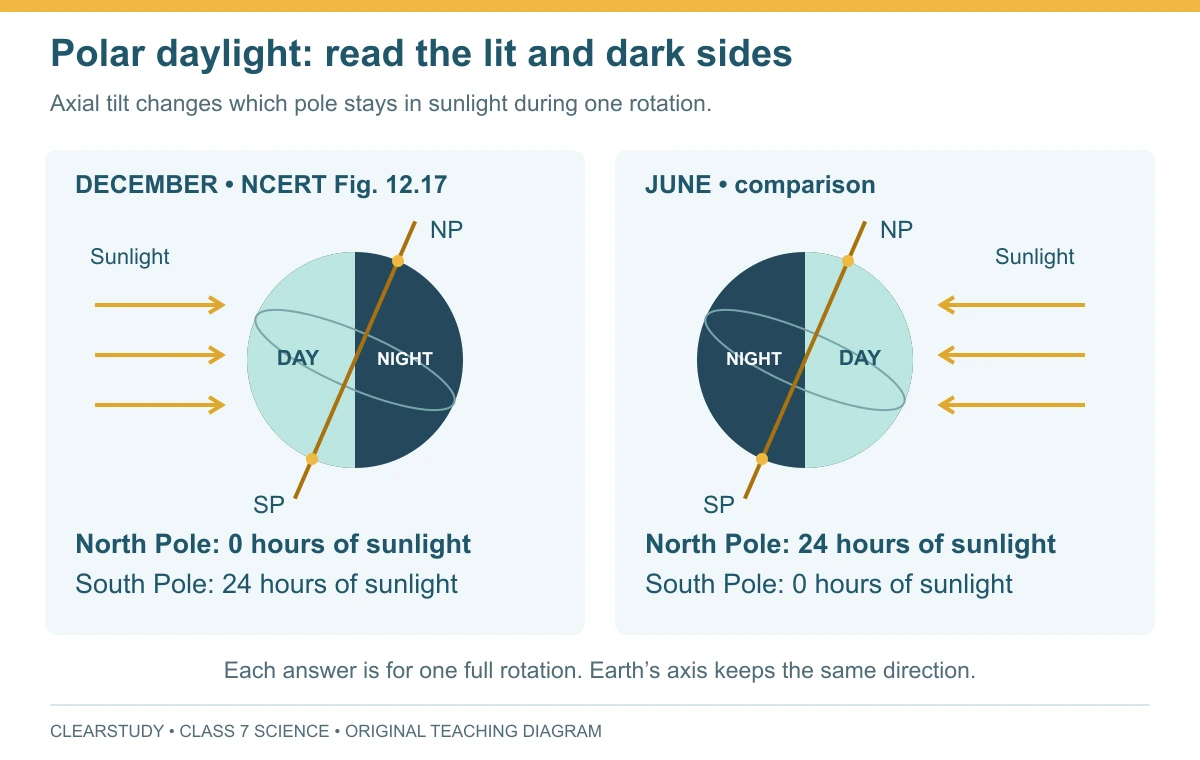
1. In Fig. 12.17, how many hours of sunlight do the North Pole and the South Pole receive during one rotation of the Earth?
2. Fill in the blanks
(i) Stars rise in the _________ and set in the ___________.
The expected fill-ins are East and West. Stars close enough to the celestial pole can remain above the horizon all night at a given location; these are called circumpolar stars.
(ii) Day and night are caused by the Earth’s __________________.
(iii) When the Moon fully covers the Sun from our view, it is called a _____________ solar eclipse.
3. State whether True or False
(i) Lunar eclipse occurs when the Sun comes between the Earth and the Moon.
(ii) Sunrise happens earlier in Gujarat than in Jharkhand.
(iii) In Chennai, the longest day occurs on the summer solstice.
(iv) We should watch the solar eclipse directly with our naked eye.
(v) Seasons occur due to the tilt of Earth’s axis of rotation and its spherical shape.
(vi) The Earth’s revolution around the Sun causes day and night.
4. Padmashree saw the Orion constellation nearly overhead at 8 pm yesterday. When will she see Orion overhead today?
More precisely, Earth turns once relative to distant stars in about 23 hours 56 minutes. The average solar day is 24 hours, so a star returns to nearly the same position about 4 minutes earlier each night.
5. Nandhini saw a group of stars rising at midnight on 21 June. When will she see the same group of stars rising at midnight next year?
6. Abhay noticed that when it was daytime in India, his uncle who was in the USA was generally sleeping as it was night-time there. What is the reason behind this difference?
7. Four friends used the following ways to see the solar eclipse. Who among them was being careless?
(i) Ravikiran used a solar eclipse goggle.
(ii) Jyothi used a mirror to project the Sun’s image.
(iii) Adithya saw the Sun directly with his eyes.
(iv) Aruna attended a programme arranged by a planetarium.
Safe solar-eclipse observation
Whenever any bright part of the Sun is visible, use undamaged solar viewers meeting ISO 12312-2 from a reputable supplier, with adult supervision. Ordinary sunglasses are unsuitable. Never combine eclipse glasses with binoculars, a telescope or a camera; optical devices require correctly fitted front-mounted solar filters and expert guidance. For projection, look only at the image on a screen, never through the hole or into a reflected beam. Lunar eclipses are safe to watch without solar filters.
Further guidance: NASA eclipse eye-safety advice.
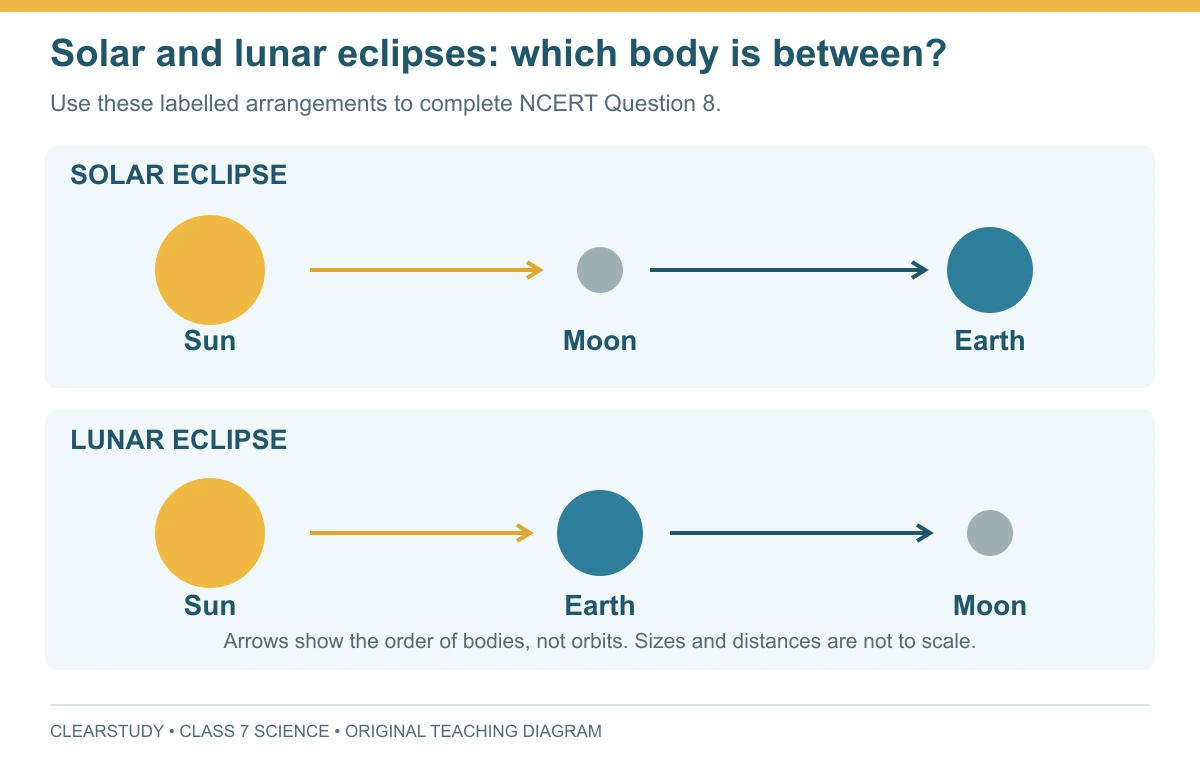
8. Fill in the circles in Fig. 12.18 appropriately with one of the following: Sun, Moon, Earth.
| Arrangement | First | Middle | Last |
|---|---|---|---|
| Solar eclipse | Sun | Moon | Earth |
| Lunar eclipse | Sun | Earth | Moon |
9. The Moon is much smaller than the Sun, yet it can block the Sun completely from our view during a total solar eclipse. Why is it possible?
10. The Indian cricket team matches in Australia are often held in December. Should they pack winter or summer clothes for their trip?
11. Why do you think lunar eclipses can be seen from a large part of the Earth when they happen, but total solar eclipse can be seen by only a small part of the Earth?
12. If the Earth’s axis were not tilted with respect to the axis of revolution, explain what would be the effect on seasons?
Extra Practice Questions
These questions and MCQs are ClearStudy practice, separate from the NCERT exercise.
Short Answer Type Questions
Q1. Define rotation of the Earth and state how long it takes.
Q2. In which direction does the Earth rotate, and what does this make the Sun appear to do?
Q3. Why does the Pole Star appear almost stationary in the night sky?
Q4. State the difference between rotation and revolution of the Earth.
Q5. Why can we safely watch a total lunar eclipse with the naked eye but not a solar eclipse?
Long Answer Type Questions
Q1. Explain how the Earth’s rotation causes the cycle of day and night.
Q2. How do the tilt of the Earth’s axis and its spherical shape produce seasons? Use the example of June and December.
Q3. Describe how a solar eclipse and a lunar eclipse occur, and explain why a total solar eclipse is visible from only a small region.
MCQs & Answer Key
1. The Earth completes one rotation on its axis in about:
(a) 1 hour (b) 24 hours (c) 365 days (d) 1 month
2. The Earth rotates in which direction?
(a) East to West (b) North to South (c) West to East (d) South to North
3. Day and night on the Earth are caused by its:
(a) revolution (b) rotation (c) tilt (d) spherical shape
4. The Earth completes one revolution around the Sun in about:
(a) 24 hours (b) 30 days (c) 365 days and 6 hours (d) 100 years
5. Seasons on the Earth occur mainly because of:
(a) the Earth’s rotation (b) changing distance from the Sun (c) the tilt of the axis and the spherical shape (d) the Moon
6. In the Northern Hemisphere, the longest day (summer solstice) occurs around:
(a) 22 December (b) 21 June (c) 21 March (d) 23 September
7. A solar eclipse occurs when:
(a) the Earth is between the Sun and the Moon (b) the Moon is between the Sun and the Earth (c) the Sun is between the Earth and the Moon (d) the stars block the Sun
8. A lunar eclipse occurs when:
(a) the Moon is between the Sun and the Earth (b) the Earth is between the Sun and the Moon (c) the Sun is between the Earth and the Moon (d) Venus blocks the Sun
9. The Pole Star appears almost stationary because:
(a) it does not exist (b) the Earth’s axis points very close to it (c) it is the brightest star (d) it is the closest star
10. The Moon can cover the Sun during a total solar eclipse because:
(a) the Moon is larger than the Sun (b) the Moon is hotter (c) the Moon is closer, so its apparent size is similar to the Sun’s (d) the Sun shrinks
Assertion–Reason Questions
For each Assertion–Reason question, choose: (A) Both true and the Reason correctly explains the Assertion; (B) Both true but the Reason is not the correct explanation; (C) Assertion true, Reason false; (D) Assertion false, Reason true.
A-R 1. Assertion: The Sun appears to move across the sky from East to West.
Reason: The Earth rotates on its axis from West to East.
A-R 2. Assertion: Day and night are caused by the revolution of the Earth around the Sun.
Reason: Only the half of the Earth facing the Sun receives sunlight at a time.
A-R 3. Assertion: When it is summer in India, it is winter in Australia.
Reason: The two hemispheres are tilted towards or away from the Sun in opposite ways, so their seasons are reversed.
A-R 4. Assertion: A total solar eclipse is visible from only a small part of the Earth.
Reason: The Moon’s shadow falls on only a small area of the Earth’s surface.
A-R 5. Assertion: We can safely watch a total lunar eclipse with the naked eye.
Reason: During a lunar eclipse we view the dimly lit Moon and not the intense Sun.
Common Mistakes to Avoid
Watch out for these
- Confusing rotation (spinning on its axis — causes day/night) with revolution (moving around the Sun — together with axial tilt, produces seasons and changes which stars are visible at night).
- Thinking seasons happen because the Earth is closer to the Sun in summer — they are caused by the tilt of the axis; in fact the Earth is closest to the Sun in January.
- Writing that a lunar eclipse is when the Sun comes between Earth and Moon — it is the Earth that comes between the Sun and the Moon.
- Saying sunrise happens earlier in the western parts of India — it happens earlier in the eastern parts, because the Earth turns from West to East.
- Believing the Moon is bigger than the Sun because it can cover it — the Moon only has a similar apparent size because it is much closer.
- Thinking it is safe to view a solar eclipse directly or through sunglasses/binoculars — it can cause blindness and must be avoided.
How to write a clear answer
Always link the right motion to the right effect: rotation → day & night and the apparent movement of Sun, Moon and stars; revolution + axial tilt → seasons and the changing night sky. In eclipse answers, name the middle body clearly (Moon in the middle for a solar eclipse, Earth in the middle for a lunar eclipse) and use the words “blocks the light from reaching”. Remember the approximate Northern Hemisphere dates (around 21 June summer solstice, 21–22 December winter solstice, 20–21 March and 22–23 September equinoxes) and that the Southern Hemisphere has reversed seasons.
Frequently Asked Questions
What is Class 7 Science Curiosity Chapter 12 about?
Chapter 12, Earth, Moon, and the Sun, explains why the Sun, Moon and stars appear to move across the sky, how the Earth’s rotation causes day and night, how its axial tilt, as it revolves around the Sun, produces seasons, and how solar and lunar eclipses occur.
Why does the Earth’s rotation cause day and night?
The Earth spins on its axis from West to East once in about 24 hours. Only the half facing the Sun gets sunlight (day), while the other half is dark (night). As Earth turns, most places move between the lit and dark sides. Polar regions can have continuous daylight or darkness during parts of the year because of axial tilt.
Why is there no eclipse every month even though the Moon orbits the Earth?
Eclipses occur only when the Sun, Earth and Moon line up closely. The Moon’s orbit is slightly tilted, so usually the Moon passes a little above or below this line, and its shadow (or the Earth’s shadow) misses. Eclipses happen only on the occasions when they line up well enough.
Are these Class 7 Science Curiosity Chapter 12 solutions free?
Yes. All solutions are free and follow the official NCERT Curiosity textbook for 2026–27.