
NCERT Solutions for Class 7 Social Science (Exploring Society) Chapter 1: Geographical Diversity of India (NCERT 2026–27)
These Class 7 Social Science Exploring Society Chapter 1 solutions cover Geographical Diversity of India from Exploring Society: India and Beyond (Part 1), the NCF-2023 textbook (2026–27 reprint). The chapter belongs to the theme India and the World: Land and the People and takes us on a bird’s-eye journey across India’s five major physical zones — the great mountain wall of the Himalayas, the fertile Gangetic Plains, the arid Thar Desert and Aravalli Hills, the ancient Peninsular Plateau with its Western and Eastern Ghats, and India’s long coastlines and islands. Below you get step-by-step answers to every question in the “Questions and activities” exercise, clear notes on key terms, extra practice, MCQs, Assertion–Reason and FAQs.
Class 7 Social Science Exploring Society Chapter 1 – Overview
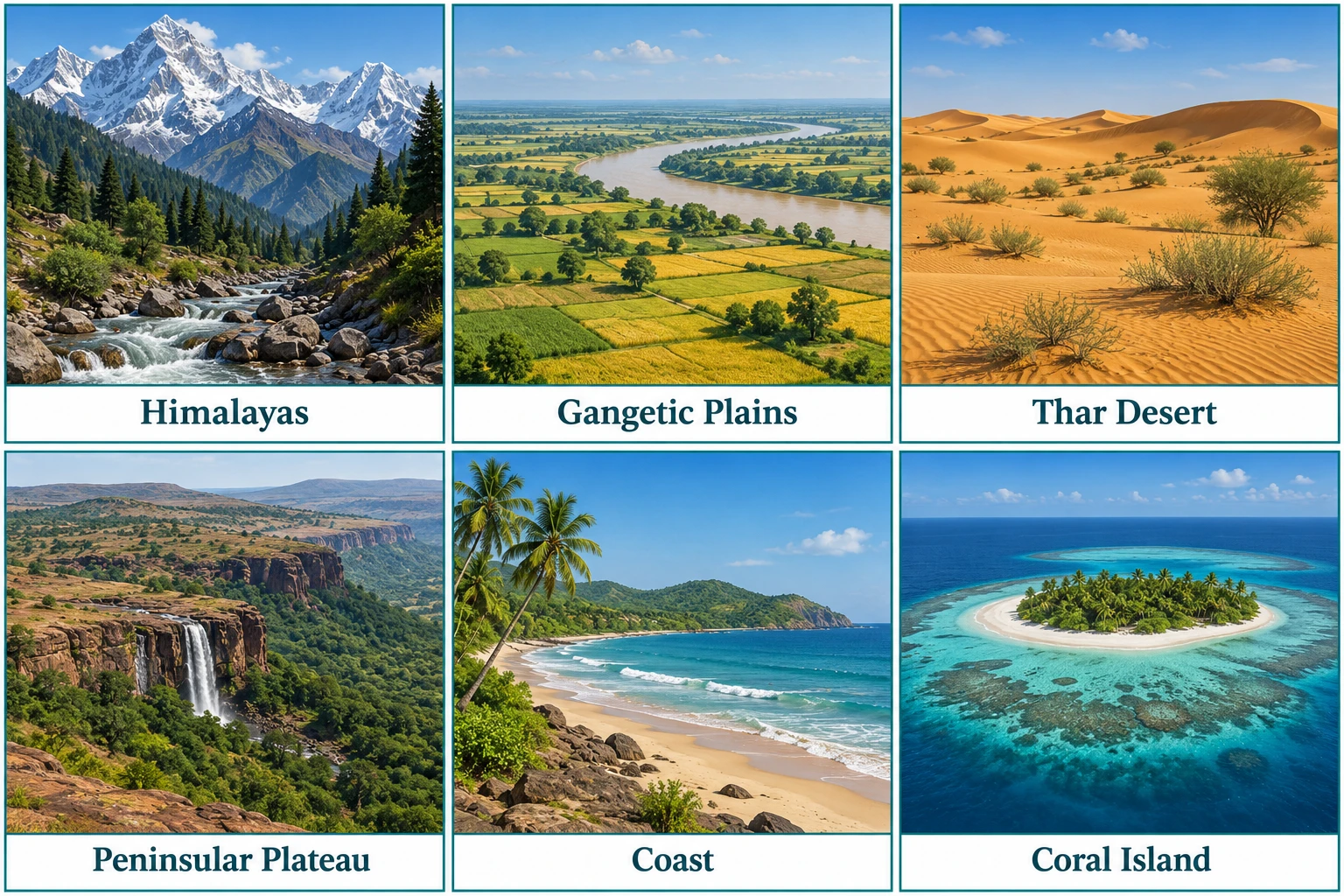
Chapter 1, Geographical Diversity of India, explains that India is the seventh-largest country in the world and the heart of the Indian Subcontinent (along with Pakistan, Bangladesh, Nepal, Bhutan, Sri Lanka and Myanmar). For study, India’s land is divided into five regions: the great mountain zone, the plains of the Ganga and the Indus, the desert region, the southern peninsula, and the islands. The chapter ‘flies’ over each of these. The Himalayas — the ‘abode of snow’ — form a natural barrier in the north, feed great rivers and are called the ‘Water Tower of Asia’; Ladakh is shown as a striking cold desert. The fertile Gangetic Plains support a huge population and intensive farming. The hot Thar Desert and the ancient Aravalli Hills show life adapting to harsh conditions. The triangular Peninsular Plateau, bordered by the Western and Eastern Ghats, is rich in minerals and forests. India’s long coastline, the Lakshadweep and Andaman & Nicobar islands, the Sundarbans delta and the rain-soaked hills of the Northeast complete this picture of a land so varied it is often called a ‘mini-continent’.
Textbook and current measurement: the chapter says the coastline is over 7,500 km. A later official reassessment gives 11,098.81 km, reflecting a changed measurement methodology. For textbook-based questions, identify which figure is being asked for. Government clarification, 4 December 2025.
Key Concepts & Terms
Indian Subcontinent: the region formed by India together with its neighbours — Pakistan, Bangladesh, Nepal, Bhutan, Sri Lanka and Myanmar. It is called a subcontinent because it is a large, distinct part of the continent of Asia.
Himalayas: the world’s highest mountain range in the north; the name combines the Sanskrit words hima (‘snow’) and ālaya (‘abode’), so it means ‘abode of snow’. It has three parallel ranges — the Himadri (Greater Himalayas), the Himachal (Lower Himalayas) and the Shivalik Hills (Outer Himalayas).
Water Tower of Asia: a name for the Himalayas, because melting snow feeds great rivers like the Ganga, Indus and Brahmaputra, supplying water to hundreds of millions of people.
Cold desert: a desert that is dry but very cold rather than hot — in India, Ladakh, where winter temperatures fall below −30°C; its moon-like terrain is called ‘moonland’.
Northern and Gangetic Plains: the broader Northern Plains are formed by the Indus, Ganga and Brahmaputra river systems. More specifically, the Gangetic Plains refer to the Ganga basin. Their flat land and fertile alluvial soil support farming, settlements and transport.
Thar Desert (Great Indian Desert): a vast hot, arid region spanning Rajasthan, Gujarat, Punjab and Haryana, with golden sand dunes that can rise up to 150 metres; people use clever water-saving methods like taanka and kunds.
Aravalli Hills: among the oldest mountains in the world (about 2.5 billion years old); their hills and vegetation help check the eastward spread of desert conditions and are rich in minerals like marble, granite, zinc and copper.
Peninsula & Peninsular Plateau: a peninsula is land surrounded by water on three sides; India’s triangular southern plateau is bordered by the Arabian Sea, the Bay of Bengal and the Indian Ocean, so it is called a peninsular plateau. It is flanked by the Western Ghats and Eastern Ghats, with the Deccan Plateau in between.
Delta & lagoon: a delta is a triangular landform built up where a river deposits sediment as it meets a larger water body; a lagoon (like Pulicat Lake) is a body of water separated from the sea by a natural barrier.
Archipelago: a group of islands; India has two main island groups — the coral Lakshadweep islands in the Arabian Sea and the Andaman and Nicobar islands in the Bay of Bengal (home to India’s only active volcano, Barren Island).
Sundarbans: the mangrove delta of the Ganga and Brahmaputra, shared by India and Bangladesh, a UNESCO Heritage site and home of the Royal Bengal Tiger.
“Questions and activities” — Full Solutions
The nine end-of-chapter questions follow NCERT, pp. 24–25. These are ClearStudy model answers, not an official NCERT answer key. Open-ended activities allow other well-supported responses. Use the textbook maps for location work; the original illustration below is a learning aid.
1. What, in your opinion, are two important geographical features of India? Why do you think they are important?
2. What do you think India might have looked like if the Himalayas did not exist? Write a short note or sketch a drawing to express your imagination.
3. India has been called a ‘mini-continent’. Based on what you’ve read, why do you think this is so?
4. Follow one of India’s big rivers from where it starts to where it meets the ocean. What are the different ways in which people might utilise this river along its journey? Discuss in groups in your class.
5. Why is the southern part of India referred to as a peninsular plateau?
6. Which UNESCO Heritage Site mentioned in this chapter did you find more interesting? Write a short paragraph to describe what about it is interesting.
7. Look at the two maps of India, physical as well as political, given at the end of this book. Identify the place you are at now. Which physical feature of India would you use to describe its location?
This answer depends on the physical and political maps at the end of the textbook; fill in your own state, town and region.
8. Food preservation techniques differ from place to place across India. They are adapted to local conditions. Do a class project. Gather different methods of preserving food. Hint: Drying vegetables when they are in season for use during the off-season.
- Drying: vegetables, chillies or apricots lose moisture, slowing spoilage. Dry, sunny weather helps; food needs protection from dust, insects and rain.
- Pickling: mangoes or lemons may be preserved with salt, acid and/or oil according to a suitable recipe.
- Salting, drying or smoking: used for some fish and meat preparations in coastal and northeastern communities.
- Fermentation: some vegetables are preserved through controlled fermentation. Curd and fermented batter remain perishable and should not be described as long-term storage foods.
- Cooling: low temperatures slow spoilage; cold outdoor weather alone does not guarantee safe storage.
9. Despite having such different regions (mountains, deserts, plains, coasts), India remains one country. How do you think our geography has helped unite people?
Extra Practice Questions
These questions and MCQs are ClearStudy practice, separate from the NCERT exercise.
Short Answer Type Questions
Q1. What is the meaning of the word ‘Himalaya’?
Q2. Why are the Himalayas called the ‘Water Tower of Asia’?
Q3. What are the three main ranges of the Himalayas?
Q4. How were the Himalayas formed?
Q5. Why is Ladakh called a cold desert?
Long Answer Type Questions
Q1. Describe the five major physical regions into which India is divided.
Q2. Explain the importance of the Peninsular Plateau for India.
Q3. Describe India’s coastlines and islands, and explain why they are important.
MCQs & Assertion–Reason
1. India is the ____ largest country in the world.
(a) fourth (b) fifth (c) sixth (d) seventh
2. The word ‘Himalaya’ means:
(a) abode of snow (b) water tower (c) high wall (d) abode of gods
3. Which of these is India’s cold desert?
(a) Thar (b) Ladakh (c) Aravalli (d) Deccan
4. The highest range of the Himalayas is the:
(a) Shivalik (b) Himachal (c) Himadri (d) Aravalli
5. The Aravalli Hills act as a natural barrier that prevents the eastward spread of the:
(a) Gangetic Plains (b) Thar Desert (c) Deccan Plateau (d) Western Ghats
6. A piece of land surrounded by water on three sides is called a:
(a) plateau (b) delta (c) peninsula (d) lagoon
7. The Lakshadweep islands are located in the:
(a) Bay of Bengal (b) Arabian Sea (c) Indian Ocean (d) Pacific Ocean
8. India’s only active volcano, Barren Island, is part of the:
(a) Lakshadweep islands (b) Andaman and Nicobar islands (c) Sundarbans (d) Western Ghats
9. The Sundarbans mangrove delta is home to the:
(a) snow leopard (b) lion-tailed macaque (c) Royal Bengal Tiger (d) Tibetan antelope
10. Which approximate coastline figure is used in this NCERT chapter?
(a) 2,500 km (b) 5,000 km (c) 7,500 km (d) 10,000 km
For each Assertion–Reason question, choose: (A) Both true and the Reason correctly explains the Assertion; (B) Both true but the Reason is not the correct explanation; (C) Assertion true, Reason false; (D) Assertion false, Reason true.
A-R 1. Assertion: The Himalayas are sometimes called the ‘Water Tower of Asia’.
Reason: Melting snow from the Himalayas feeds major rivers such as the Ganga, Indus and Brahmaputra.
A-R 2. Assertion: Ladakh is described as a cold desert.
Reason: Ladakh receives very heavy rainfall throughout the year.
A-R 3. Assertion: The southern part of India is called a peninsular plateau.
Reason: It is a raised, flat highland surrounded by water on three sides.
A-R 4. Assertion: A large proportion of India’s population lives in the Gangetic Plains.
Reason: The plains have fertile, river-enriched soil and easy transport, making them ideal for farming and settlement.
A-R 5. Assertion: The Aravallis are among the oldest mountains in the world.
Reason: The Aravallis were formed only about 50 million years ago when India collided with Eurasia.
In-text activities: hints for observation
Maps (pp. 2–3, 6, 15–17): read the legend before interpreting colour. Compare the same place on physical and political maps. Identify the Himalayas, Thar, Aravallis, plateau, coasts and islands; then match each with the state or union territory shown. Colours show height ranges, not necessarily vegetation.
Night lights (p. 11): concentrated lighting suggests many settlements, roads and economic activities in the plains. Brightness is not an exact population count.
Sand dunes (pp. 12–13): wind deposits and reshapes loose sand into ridges and hills. Dunes can move and change shape; rocky mountains change much more slowly through weathering and erosion.
Coasts and rivers (p. 19): Ganga, Mahanadi, Godavari, Krishna and Kaveri reach the Bay of Bengal. Branches that leave a main river near its mouth are distributaries. A delta is the sediment-built landform, not the name for the branches themselves. Compare the generally narrow western coastal plain with the broader eastern plain and its large deltas.
Exam Tips & Common Mistakes
How to write a clear answer
Memorise the five major physical regions (mountain zone, Ganga–Indus plains, desert, peninsula, islands) and be able to name a key feature of each. Learn the three ranges of the Himalayas (Himadri, Himachal, Shivalik) in order from highest to lowest, and remember the meaning of ‘Himalaya’ (hima + ālaya = abode of snow). Keep clear definitions of peninsula, plateau, delta, lagoon and archipelago ready, with one example each. For map activities, always name the nearest physical feature and the correct sea or river. Use the textbook’s own facts — India is the seventh-largest country, coastline over 7,500 km, Aravallis ~2.5 billion years old, Ladakh below −30°C — to show you have studied the chapter.
Common mistakes to avoid
- Confusing the cold desert (Ladakh) with the hot Thar Desert — remember Ladakh is cold and rocky, the Thar is hot and sandy.
- Mixing up the Himadri, Himachal and Shivalik ranges, or their order from north to south.
- Thinking a peninsula and a plateau mean the same thing — one is about water on three sides, the other about a raised flat land.
- Placing Lakshadweep in the Bay of Bengal — it is in the Arabian Sea; the Andaman & Nicobar islands are in the Bay of Bengal.
- Calling the Aravallis young mountains — they are among the oldest in the world, unlike the much younger Himalayas.
- Leaving map and activity questions (Q4, Q7, Q8) blank — write your own observations and examples.
Frequently Asked Questions
What is Chapter 1 of Class 7 Social Science Exploring Society about?
Chapter 1, Geographical Diversity of India, takes a bird’s-eye journey across India’s five major physical regions — the Himalayas, the Gangetic Plains, the Thar Desert and Aravalli Hills, the Peninsular Plateau with its Western and Eastern Ghats, and India’s coastlines and islands — and explains how this diversity has shaped the country’s climate, culture and history.
Why is India called a ‘mini-continent’?
India is called a ‘mini-continent’ because, within one country, it contains almost every kind of landform and climate a continent might have — snowy Himalayas, hot and cold deserts, fertile plains, an ancient plateau, long coastlines, tropical islands and rainy northeastern hills — along with great diversity of plants, animals, languages and cultures.
What is the exercise heading for Chapter 1 of Exploring Society Class 7?
The end-of-chapter exercise in Exploring Society: India and Beyond (Part 1) Chapter 1 is headed Questions and activities and contains 9 numbered questions, all answered step by step on this page.
Reviewed 10 October 2026 against NCERT Exploring Society: India and Beyond, Grade 7 Part 1, Chapter 1, pp. 1–25 (2026–27 reprint). Related learning: Climates of India.