
The Wit that Won Hearts — Class 8 English Poorvi Questions and Answers
The Wit that Won Hearts questions and answers for Class 8 Poorvi explain Tenali Rama’s tactful solution to a royal misunderstanding. Check comprehension, sound words, compounds, conditionals and the listening sequence, then adapt the speaking and writing examples.
Source: NCERT Poorvi, Grade 8, Unit 1, printed pages 1–16 (listening transcript 46–47); supplied reprint 2026–27. Open-ended and personal responses are examples to adapt. These explanations are study support, not an official NCERT answer key.
About the chapter
“The Wit that Won Hearts” is set in the royal court of King Krishnadeva Raya of the Vijayanagara Empire, whose reign is called the Golden Era for its flourishing art and literature. The story celebrates the quick wit and wisdom of the famous court poet Tenali Ramakrishna (Tenali Rama), who cleverly resolves a misunderstanding between the king and his queen. It belongs to Unit 1, ‘Wit and Wisdom’, and encourages critical thinking, humour and good communication.
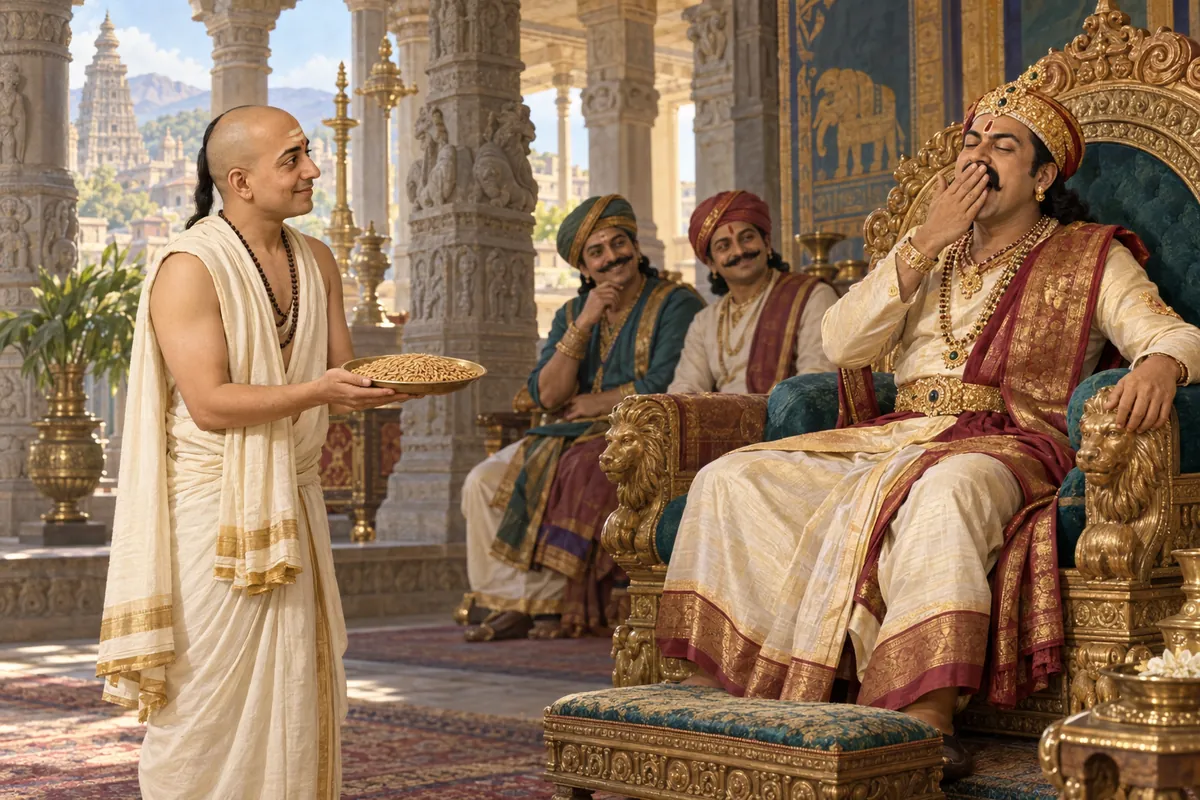
This tale uses a historical court as its setting. Treat its dialogue and seed trick as the narrative’s events, rather than a verified transcript of history or a scientific claim that particular seeds triple crop yield.
Summary
King Krishnadeva Raya, a wise ruler and gifted poet, once quarrelled with his queen Thirumalambal over a trivial matter. The king had recited a poem to her, but tired after a long day, the queen yawned several times. The king took this as disrespect, stopped speaking to her and stopped visiting her. His absence cast a gloom over the whole palace.
Distressed, the queen sought the help of the witty court poet Tenali Rama. Rama listened patiently and promised to help, but said he needed time to plan the right strategy. The next day, in the royal court (where ministers were discussing how to improve paddy cultivation), Rama presented a plate of ‘special’ paddy seeds, claiming they would triple the yield. The courtiers mocked him, and the king dismissed the idea as absurd.
Rama then said the real problem was not the seeds but the sower – what if the person sowing them kept yawning, scattering the seeds unevenly? The court laughed, and the king himself yawned. Rama gently pointed out that yawning is as natural as breathing. The king suddenly realised he had wrongly blamed the queen for yawning. That evening he apologised to her, she forgave him, and the palace was filled with joy again. Rama, who had quietly engineered this reconciliation, was rewarded for his service.
Theme & message
The story shows that wit, wisdom and empathy can solve problems that anger and pride cannot. Instead of confronting the king directly, Tenali Rama uses a clever, humorous analogy to make the king realise his own mistake. The chapter teaches the value of patience, good communication, humility (admitting one’s error) and forgiveness.
Word meanings
| Word | Meaning |
|---|---|
| renowned | well known, famous |
| illustrious | respected and famous |
| patron | supporter (of art/learning) |
| eminent | famous, distinguished |
| insurmountable | that cannot be overcome; undefeatable |
| trivial | unimportant |
| forlorn | lonely and sad |
| distraught | extremely upset |
| vague | unclear |
| strategy | a careful plan |
| profusely | in large amounts |
| bustling | busy and lively |
| ornate | highly decorated |
| gnawed | (here) kept bothering |
| yield | (here) harvest, produce |
| sarcasm | mocking remark |
| snickers | suppressed laughter |
| absurd | illogical, ridiculous |
| unfazed | not worried or disturbed |
| sceptical | doubtful |
| orchestrated | arranged/planned cleverly |
| brimmed | overflowed (with joy) |
Before you read
I. Select qualities of a person who uses wit from the box. Then discuss reasons for your choice.
II. Answer the riddles.
Discuss in pairs.
Let us discuss
I. Rectify the following false statements from the text.
Let us think and reflect
I.1. Extract – “…The king thought I was disrespecting his poem and stormed off… Only you can help the king understand.” / Rama nodded thoughtfully…
I.2. Extract – “…I let my pride blind me. I’m so sorry.” / The queen… “If you like, we can leave this quarrel behind us…”
II. Answer the following questions.
Let us learn
I. Fill in the blanks with suitable expressions from the box.
II. Fill in the blanks with suitable sound words.
III. Compound words
| Column 1 | Match | Compound word |
|---|---|---|
| (i) quick | G. witted | quick-witted |
| (ii) soft | C. spoken | soft-spoken |
| (iii) common | F. sense | common sense |
| (iv) house | H. hold | household |
| (v) book | E. store | bookstore |
| (vi) ill | B. tempered | ill-tempered |
| (vii) sky | D. blue | sky blue |
| (viii) dance | A. hall | dance hall |
Use sky-blue before the noun in “a sky-blue book”. A colour name standing alone can be written “sky blue”. Common sense remains an open compound; “quick-witted” and “soft-spoken” are hyphenated.
IV. Conditional (‘if’) clauses
| Column 1 (if clause) | Column 2 (main clause) |
|---|---|
| (i) If I had a magic wand, | C. I would give myself wings. |
| (ii) If it rains tomorrow, | E. We will stay indoors and play board games. |
| (iii) If you had listened carefully, | F. You would have solved the puzzle. |
| (iv) If you finish your homework, | A. We will go to the theatre. |
| (v) If I were invisible, | B. I would sneak into the secret room. |
| (vi) If the alarm had rung, | D. The boys would have woken up on time. |
V. Complete the sentences (sample answers)
VI. Complete the sentences (sample answers)
Let us listen
(The narrated story is about Tenali Rama defeating an arrogant visiting scholar with the phrase ‘tila-kashta-mahisha-bandhana’ – which actually meant a bundle of sesame sticks tied with a buffalo-rope.)
Let us speak
I. Intonation — pp. 13–14
This is the textbook’s neutral-question practice pattern: yes/no questions generally rise and wh-questions generally fall. Actual conversational intonation can change with emphasis and purpose.
II. Sample trip questions
Where are we going? Why have we chosen that place? How will we travel? When will we return? Who will come with us? What will we do there? Take turns giving your own answers.
Witty-character questions — sample
Who is the witty character? Why is their wit important? What clever idea do they use? When is the story set? How do they solve the problem? Where does it happen? For this lesson: Tenali Rama; wit restores understanding; he uses the seed-and-yawning analogy; the narrative is set at Krishnadeva Raya’s court in Vijayanagara. Identify the setting without claiming the anecdote’s exact date is verified.
Let us write
I. Features of A Lesson in Responsibility — pp. 15–16
The listed features are present. The opening establishes the narrator’s organised morning; the surprise quiz supplies the challenge; the disappointing result and teacher’s advice form the turning point; the conclusion explains regular preparation. First-person thoughts, chronological events and descriptive details support the narrative.
Original model: The Day I Learnt the Value of Teamwork
Our class was preparing a display about saving water. I wanted our group’s poster to look perfect, so I began drawing every picture myself. By lunchtime, I had finished only the title and one tap. My friends were waiting with their unused ideas, and the deadline was getting closer.
Then Meera suggested that we divide the work. I agreed, although I worried that our different styles would not match. She wrote the short explanations, Arjun drew the rainwater tank, and I completed the main picture. Another friend checked the spelling and arranged the pieces. We listened when someone suggested a change and helped whoever finished last.
Before the bell, our display was ready. It looked more interesting than the poster I had imagined alone. Our teacher praised the clear message and asked how we had worked together. I realised that teamwork means trusting others, sharing responsibility and combining different strengths. The next time we received a group task, I asked for everyone’s ideas before picking up my pencil.
This is an invented sample narrative. Adapt it to one of the two textbook topics and organise your own introduction, events and reflection; the supplied task does not specify a fixed word limit.
Let us explore
I. Original sample limerick
Kept losing his pencils each day.
He looked in his shoe
And discovered just two,
While the rest in his schoolbag still lay.
The five-line model has AABBA rhymes: bay/day/lay and shoe/two. Write a new playful poem with a surprise at the end.
II–III. Reading and chart projects
Choose a library story you actually read, record its title and source, summarise its theme, and explain the clever moment. For a class chart, list a Tenali Rama tale, an Akbar–Birbal tale, a Mulla Nasruddin tale or a Panchatantra/Aesop fable you know. Distinguish traditional anecdotes from verified history and let each student choose a new story to read.
Additional ClearStudy questions
This practice is separate from the printed textbook exercises.
Short answer
1. Who was Thirumalambal?
2. Who were the Ashtadiggajas?
3. Why did the queen yawn while the king recited his poem?
Long answer
4. Write a character sketch of Tenali Rama based on the story.
ClearStudy MCQs and assertion–reason practice
1. King Krishnadeva Raya ruled which empire?
(a) Maurya (b) Vijayanagara (c) Mughal (d) Chola
2. The eight celebrated poets of the court were collectively called:
(a) Navaratnas (b) Ashtadiggajas (c) Panchtantra (d) Tirukkural
3. What did Tenali Rama bring before the king in the court?
(a) A poem (b) A plate of ‘special’ paddy seeds (c) Gold coins (d) A letter
4. The main lesson of the story is that problems are best solved by:
(a) anger and pride (b) wealth (c) wit, empathy and communication (d) force
Assertion–Reason – choose: (a) A and R true, R explains A; (b) A and R true, R does not explain A; (c) A true, R false; (d) A false, R true.
1. Assertion (A): The king stopped speaking to the queen.
Reason (R): He mistakenly believed her yawning showed disrespect for his poem.
2. Assertion (A): Tenali Rama really wanted to improve paddy farming with special seeds.
Reason (R): The seed talk was only a clever trick to make the king realise yawning is natural.
3. Assertion (A): The king apologised to the queen.
Reason (R): He realised that yawning is natural and that he had judged her unfairly.
FAQs
Who is the main character of ‘The Wit that Won Hearts’?
The witty court poet Tenali Rama (Tenali Ramakrishna) of King Krishnadeva Raya’s court is the central character.
Why did the king quarrel with the queen?
The queen yawned while he recited his poem; he wrongly thought she was disrespecting it and stopped speaking to her.
How did Tenali Rama solve the problem?
He used a clever analogy about a person yawning while sowing seeds, which made the king realise that yawning is natural and that he had blamed the queen unfairly.
What is the moral of the story?
Wit, empathy and good communication can resolve misunderstandings far better than anger or pride.
Textbook-based exercises and additional ClearStudy practice are identified separately. Use your textbook alongside these explanations.