
Wisdom Paves the Way — Class 8 English Poorvi Questions and Answers
Wisdom Paves the Way questions and answers for Class 8 Poorvi follow the two-scene play about four travellers and a missing camel. Check the observation clues, event order, vocabulary and modals, with listening matches, sentence-stress meanings and a sample complaint letter.
Source: NCERT Poorvi, Grade 8, Unit 1, printed pages 27–45 (listening transcript 48); supplied reprint 2026–27. Open-ended and personal responses are examples to adapt. These explanations are study support, not an official NCERT answer key.
- About the chapter
- Characters
- Summary
- Summary in Hindi (सार)
- Theme & message
- Word meanings
- Before you read
- Let us discuss (Scene I)
- Let us discuss (Scene II)
- Let us think and reflect
- Let us learn (grammar & vocabulary)
- Listening, stress and complaint letter
- Extra questions
- MCQs & Assertion–Reason
- Exam tips & common mistakes
- FAQs
About the chapter
“Wisdom Paves the Way” is a short play (drama) in two scenes, part of Unit 1 ‘Wit and Wisdom’ of the Class 8 English textbook Poorvi. It tells the story of four young men – Ram Datt, Shiv Datt, Har Datt and Dev Datt – travelling to Ujjain in search of work. On the way they read a camel’s tracks so closely that they describe an animal they have never seen. When a merchant who has lost his camel accuses them of theft, the King of Ujjain tests their reasoning, recognises their wisdom and appoints all four as his advisers. The play celebrates careful observation, logical deduction and the difference between knowledge and wisdom.
Characters
As listed in the play’s opening:
- The King of Ujjain – a young King.
- Four Young Men – Ram Datt, Shiv Datt, Har Datt and Dev Datt.
- The Merchant – owner of the lost camel.
- Two Sentries – palace guards.
Setting: A road leading to Ujjain (Scene I), then the King’s court adorned with rich tapestries, tall pillars and regal decor (Scene II). The time is midday.
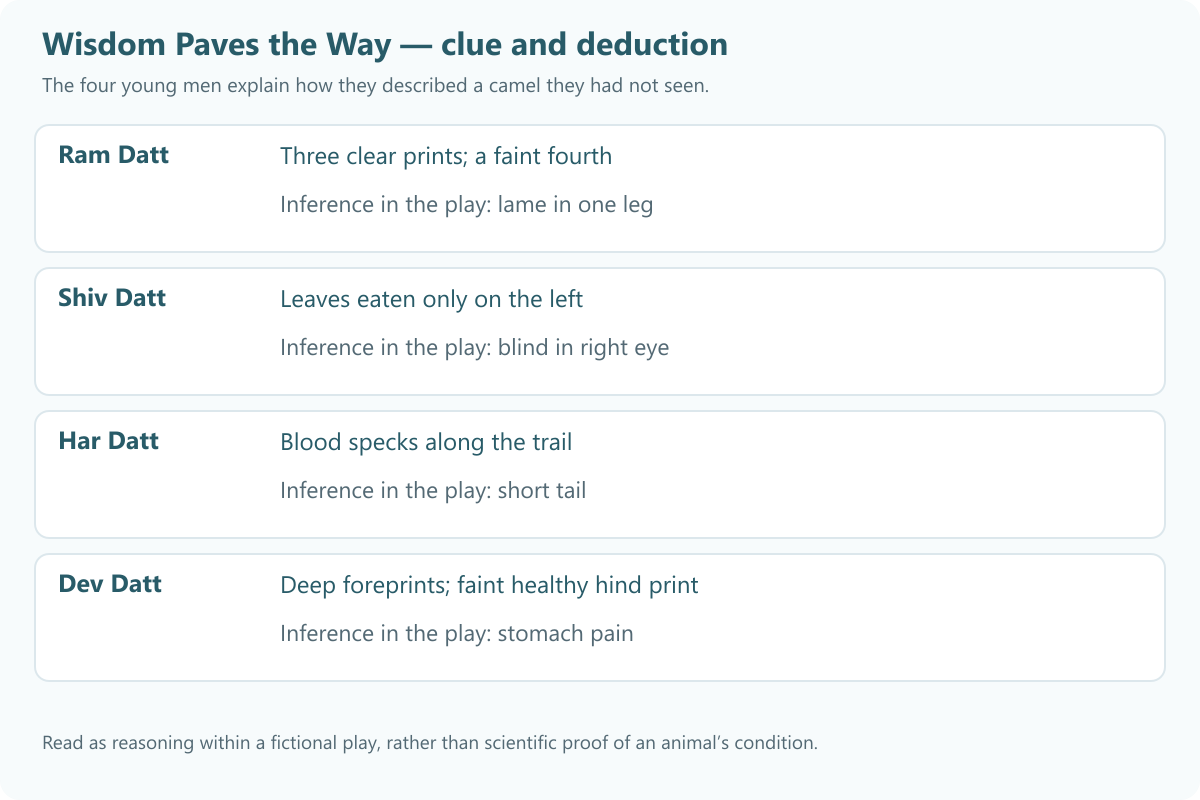
Open the clue chart at full size. Ram uses footprint differences; Shiv uses grazing on the left; Har uses blood specks; Dev compares foreprints with the sound hind-foot print.
In the play, the King accepts these explanations. The story illustrates observation and inference; the clues do not establish a real animal’s diagnosis with certainty. The p. 32 exercise attributes the fresh-track quotation to Har, while p. 30 assigns the spoken line to Shiv; the reason is the same in either case.
Summary
Four friends – Ram Datt, Shiv Datt, Har Datt and Dev Datt – have left their village and travelled for ten days, hoping to find work fit for all four of them. They dream of an audience with the King of Ujjain, certain that he will recognise their talents. As they walk the dusty road, Ram Datt spots fresh camel tracks. The four observe the trail closely, each noticing a different, peculiar detail about the animal.
Soon a distressed merchant rushes up, searching for his lost camel. Without ever having seen it, Ram Datt says it is lame in one leg, Shiv Datt says it is blind in the right eye, Har Datt says it has a short tail, and Dev Datt says it has been suffering from stomach pain. The astonished merchant assumes they must have stolen the camel and drags them before the King.
In the King’s court the merchant repeats his accusation. The King questions each young man in turn. Ram Datt explains the limp from the faint fourth footprint; Shiv Datt explains the blindness from leaves eaten only on the left side of the road; Har Datt explains the short tail from blood-spots of mosquito bites the animal could not swat away; and Dev Datt explains the belly-pain from the unevenly drawn-up hind legs. The King realises these are men of true wisdom, not thieves. He dismisses the merchant’s baseless charge, advising him to be careful whom he accuses, and offers the four men the honour of becoming his advisers. They accept gratefully, and the court erupts in applause – their journey rewarded in a way they had never imagined.
Summary in Hindi (सार)
“Wisdom Paves the Way” एक दो दृश्यों वाला नाटक (नाटिका) है। राम दत्त, शिव दत्त, हर दत्त और देव दत्त – ये चार युवक काम की तलाश में उज्जैन की ओर जा रहे हैं। रास्ते में वे ऊंट के ताज़े पदचिह्न देखते हैं और ध्यान से उसके बारे में कई बातें पता लगा लेते हैं – बिना ऊंट को देखे। तभी एक व्याकुल व्यापारी आता है जिसका ऊंट खो गया है। चारों की सटीक भविष्यवाणियां सुनकर व्यापारी उन्हें चोर समझकर राजा के दरबार ले जाता है। राजा हर युवक से प्रश्न पूछता है और उनके तर्कसंगत उत्तरों से प्रभावित होकर समझ जाता है कि ये चोर नहीं, बल्कि बुद्धिमान लोग हैं। वह व्यापारी को मुक्त कर देता है और चारों को अपना सलाहकार (अभिशासक) बना लेता है। कहानी सिखाती है कि सच्ची बुद्धि और सूक्ष्म निरीक्षण मुश्किल समस्याओं का हल निकाल सकते हैं।
Theme & message
The play’s central message is that true wisdom lies in careful observation and logical reasoning, not merely in knowing facts. The four young men “see beyond the obvious”: from ordinary tracks and tiny clues they reconstruct the whole truth about the camel. The play also teaches us not to jump to conclusions or accuse people without proof (as the merchant wrongly does), and that a wise ruler judges by evidence and reason. As the title says, it is wisdom – not luck or force – that ‘paves the way’ to success.
Word meanings
| Word | Meaning |
|---|---|
| adorned | beautified, decorated |
| tapestries | heavy decorative woven fabrics |
| resolute | determined |
| bustling | busy and lively |
| eludes | is difficult to obtain |
| devise | (here) to think of, to plan |
| deliberate | to think carefully |
| scrutinise | to look carefully at |
| in haste | in a hurry |
| pursued | (here) chased |
| countenance | facial expression |
| distressed | worried, troubled |
| astray | away from the correct path |
| indignant | angry (at unfair treatment) |
| yonder | over there |
| grievance | complaint |
| accusations | claims that someone has done wrong |
| deduce | to determine by reasoning |
| discern | to see or notice something |
| insight | a clear, deep understanding |
| flawless | perfect, without faults |
| chastened | felt sorry, humbled |
| counsel | advice |
| beacon | guiding light |
Before you read
I. Advice from elders — sample
Experience can help elders offer perspective and suggest possible consequences. Listen thoughtfully and consider the reasons for the advice; age alone does not make every judgement correct.
II. Knowledge and wisdom — p. 27
III. Picture observation — sample
The picture shows a village house, a monkey on its roof, a cat in a tree, broken pot pieces and people looking concerned. The monkey may have caused a disturbance or knocked a pot down, but a still picture does not establish the exact cause. It does not show four travellers examining camel tracks.
Let us discuss (Scene I)
I. Complete the following sentences with suitable reasons. (Example 1 done in the book.)
Let us discuss (Scene II)
Sequence of the numbered events: 3 → 8 → 2 → 5 → 7 → 6 → 4 → 1.
The sentry initially introduces the grievance. For the numbered event about the merchant’s detailed accusation, the King first asks him to state it clearly (3), and the merchant then says the men know details of his camel (8). Ram, Shiv, Har and Dev explain their observations, the King dismisses the charge, and he appoints them advisers.
Let us think and reflect
I.1. Extract – “Ten days are but a short span… We need to devise a strategy.”
I.2. Extract – “You have demonstrated remarkable intelligence… it is an honour we had not dared to dream of.”
II. Answer the following questions.
Let us learn
I. Fill in the noun form of the words in brackets.
II. Match the expressions with their meanings.
| Expression | Meaning |
|---|---|
| 1. with all our hearts | (vi) complete sincerity |
| 2. to be precise | (iv) exact and accurate |
| 3. gain an audience with | (v) meeting or hearing someone |
| 4. catch his breath | (vii) to pause or rest for some time |
| 5. erupts in applause | (ii) starts cheering together |
| 6. grand scheme of things | (viii) overall plan of life in a larger context |
| 7. taken aback | (i) surprised |
| 8. more than meets the eye | (iii) hidden information that is not obvious |
III. Different meanings of ‘face’ and ‘bear’.
| Word & meaning | Correct sentence |
|---|---|
| face 1 (n.) front of the head | (iii) She has a smiling face. |
| face 2 (v.) to be positioned towards | (i) Ravi turned to face his father. |
| face 3 (v.) to deal with a difficult situation | (iv) We should be ready to face life’s challenges. |
| face 4 (n.) front surface of a thing | (ii) The face of the clock was painted red and blue. |
| bear 1 (v.) tolerate | (iv) I can’t bear the sound of vehicles honking. |
| bear 2 (v.) accept (a responsibility) | (iii) Riya agreed to bear the heavy responsibilities with confidence. |
| bear 3 (n.) a large mammal | (ii) I spotted a bear on a wildlife safari. |
| bear 4 (v.) produce / give birth | (i) The trees I planted took a long time to bear fruit. |
IV. Match the highlighted words with the functions they express.
V. Complete the story with modal verbs.
VI. Rewrite the sentences using appropriate modal verbs.
Listening, speaking, writing and exploration
Let us listen — p. 42; transcript p. 48
Statement 2 also fits speaker (iv), who explicitly mentions making learning fun. The instructions do not give a unique choice between statements 2 and 3 for that speaker. The key above follows the “reader engaged” wording of 3; discuss the alternative with your teacher rather than calling 2 false. Statement 5 adds “extraordinary deeds”, which is not the speaker’s description of ordinary moments.
Let us speak — p. 43
| Stressed word or group | Suggested contrast |
|---|---|
| I | I do it, rather than someone else. |
| take | I take the dog out, rather than merely watching it. |
| my dog | My own dog, rather than another animal. |
| walk | A walk, rather than another activity. |
| in the evening | That time, rather than morning or afternoon. |
II. Practise the greetings, statements and exclamations with the falling end tone shown in the book. Stress the words that convey your intended meaning; actual conversation may use different tones.
Let us write — p. 44: original model complaint
12, Sample Colony
Sample City
10 August 20XX
The Commissioner
Municipal Corporation
Sample City
Subject: Request to repair the damaged colony road
Dear Madam/Sir,
I am writing to draw your attention to the poor condition of the kutcha road leading to Sample Colony after heavy rain.
Several potholes contain stagnant water. They make walking and travelling difficult, can cause accidents, and may become mosquito-breeding sites. Children and other residents face inconvenience while using the road.
Please arrange an inspection, fill the potholes and improve drainage. A suitable durable road surface would help prevent repeated damage. Residents would appreciate prompt action and information about the planned repairs.
Yours faithfully,
Sample Resident
Replace all placeholder details. The textbook also permits addressing the Sarpanch of the Gram Panchayat where that is the relevant authority. This is a model letter, not a submitted complaint.
Let us explore — pp. 44–45
I. Enactment plan: use the two scenes; assign the King, four men, merchant and sentries; choose a director and organisers for props, costume, sound and lighting; read the script, plan entrances and movements, rehearse, check the set, hold a dress rehearsal, prepare a notice/poster and present. A cloth backdrop and simple track-mark cards can establish the road scene; chairs and drapes can establish the court.
II. Library reading: choose a tale about Vikramaditya and Betal, Tenali Rama, Gopal the Jester or a Panchatantra character. Record its source and explain the moment of wit or wisdom. A traditional tale should not automatically be presented as verified history.
Additional ClearStudy questions
This practice is separate from the printed textbook exercises.
Short answer
1. Where were the four young men going, and why?
2. What four things did the young men deduce about the camel?
3. Why did the merchant come running to the four men?
4. How did Shiv Datt know the camel was blind in the right eye?
5. What reward did the King give the four young men?
Long answer
6. ‘Wisdom paves the way.’ How does the play justify its title?
7. Write a character sketch of the King of Ujjain.
ClearStudy MCQs and assertion–reason practice
1. “Wisdom Paves the Way” is a:
(a) poem (b) play (c) short story (d) biography
2. The four young men were travelling to:
(a) Vijayanagara (b) Ujjain (c) Delhi (d) Hampi
3. Which of these did the friends NOT deduce about the camel?
(a) Lame in one leg (b) Blind in the right eye (c) Carrying gold (d) Short tail
4. Ram Datt concluded the camel was lame because:
(a) it had a short tail (b) only three feet left distinct prints (c) it was blind (d) it ate one side
5. Har Datt deduced the short tail from:
(a) hoof marks (b) half-eaten leaves (c) blood-spots from mosquito bites (d) the smell
6. The merchant accused the four men of:
(a) lying to the King (b) stealing his camel (c) blocking the road (d) harming the camel
7. Dev Datt’s special observation was that the camel:
(a) was very old (b) had a stomach pain (c) was thirsty (d) was tall
8. How did the King finally treat the four young men?
(a) Jailed them (b) Fined them (c) Made them his advisers (d) Sent them away
9. The phrase ‘see beyond the obvious’ means the ability to:
(a) predict the future (b) notice details others overlook (c) read minds (d) see far away
10. The main message of the play is that:
(a) wealth brings respect (b) wisdom and reasoning lead to success (c) travel is dangerous (d) kings are unjust
Assertion–Reason – choose: (a) A and R true, R explains A; (b) A and R true, R does not explain A; (c) A true, R false; (d) A false, R true.
1. Assertion (A): The four young men could describe the camel though they had never seen it.
Reason (R): They studied the camel’s tracks and surroundings with great care and reasoned from the clues.
2. Assertion (A): The merchant accused the four men of stealing his camel.
Reason (R): The men had openly confessed to taking the camel.
3. Assertion (A): The King appointed the four young men as his advisers.
Reason (R): He was impressed by their sharp observation and flawless reasoning.
4. Assertion (A): The merchant left the court feeling ashamed.
Reason (R): His accusation was proved baseless and the men were shown to be wise, not thieves.
5. Assertion (A): Shiv Datt said the camel was blind in its right eye.
Reason (R): The camel had eaten leaves only on the left side of the road, leaving the right untouched.
Exam tips
- Remember this piece is a play – mention the two scenes (the road, then the King’s court) and use the characters’ names correctly.
- Learn the four clue–deduction pairs (footprint→lame, leaves on one side→blind eye, blood-spots→short tail, uneven hind prints→belly pain). Use these pairs to support your reading answers.
- Link the title to the theme: wisdom – observation + reasoning – leads to success.
Common mistakes
- Do not confuse the four similar names – Ram, Shiv, Har and Dev Datt each made a different observation.
- The men did not see or steal the camel – they only reasoned from clues; never write that they had met the camel.
- Do not call this chapter a story or poem – it is a drama/play.
FAQs
Is ‘Wisdom Paves the Way’ a story or a play?
It is a play (drama) in two scenes – Scene I on the road to Ujjain and Scene II in the King’s court.
Who are the four young men in the play?
Ram Datt, Shiv Datt, Har Datt and Dev Datt – four friends travelling to Ujjain in search of work.
How could the men describe a camel they had never seen?
They observed the camel’s tracks and surroundings closely – a faint footprint, leaves eaten on one side, blood-spots and uneven hind prints – and reasoned out its condition.
What is the moral of ‘Wisdom Paves the Way’?
True wisdom lies in careful observation and logical reasoning; such wisdom, not luck or force, leads to success and respect.
Textbook-based exercises and additional ClearStudy practice are identified separately. Use your textbook alongside these explanations.