
A Tale of Valour: Major Somnath Sharma — Class 8 Poorvi Questions and Answers
Major Somnath Sharma questions and answers for Class 8 Poorvi explain A Tale of Valour and the Battle of Badgam. Study the checked timeline, comprehension, vocabulary and agreement tasks, with exact listening answers and a sample memorial enquiry.
Source: NCERT Poorvi, Grade 8, Unit 2, printed pages 49–69 (listening transcript 98); supplied reprint 2026–27. Open-ended and personal responses are examples to adapt. These explanations are study support, not an official NCERT answer key.
- About the chapter
- Summary (English)
- Summary (Hindi)
- About Major Somnath Sharma
- Theme & message
- Word meanings
- Before you read
- Let us discuss
- Let us think and reflect
- Let us learn (grammar & vocabulary)
- Let us listen
- Let us speak
- Let us write
- Let us explore
- Extra questions
- MCQs & Assertion–Reason
- Exam tips & common mistakes
- FAQs
About the chapter
“A Tale of Valour” is a non-fiction tribute to Major Somnath Sharma, the first soldier to be awarded India’s highest wartime gallantry honour, the Param Vir Chakra (PVC). The piece narrates the Battle of Badgam (3 November 1947), fought near the Srinagar airport during the Indo–Pakistan War of 1947–1948. It belongs to Unit 2, ‘Values and Dispositions’, and celebrates the values of courage, duty, leadership and self-sacrifice.
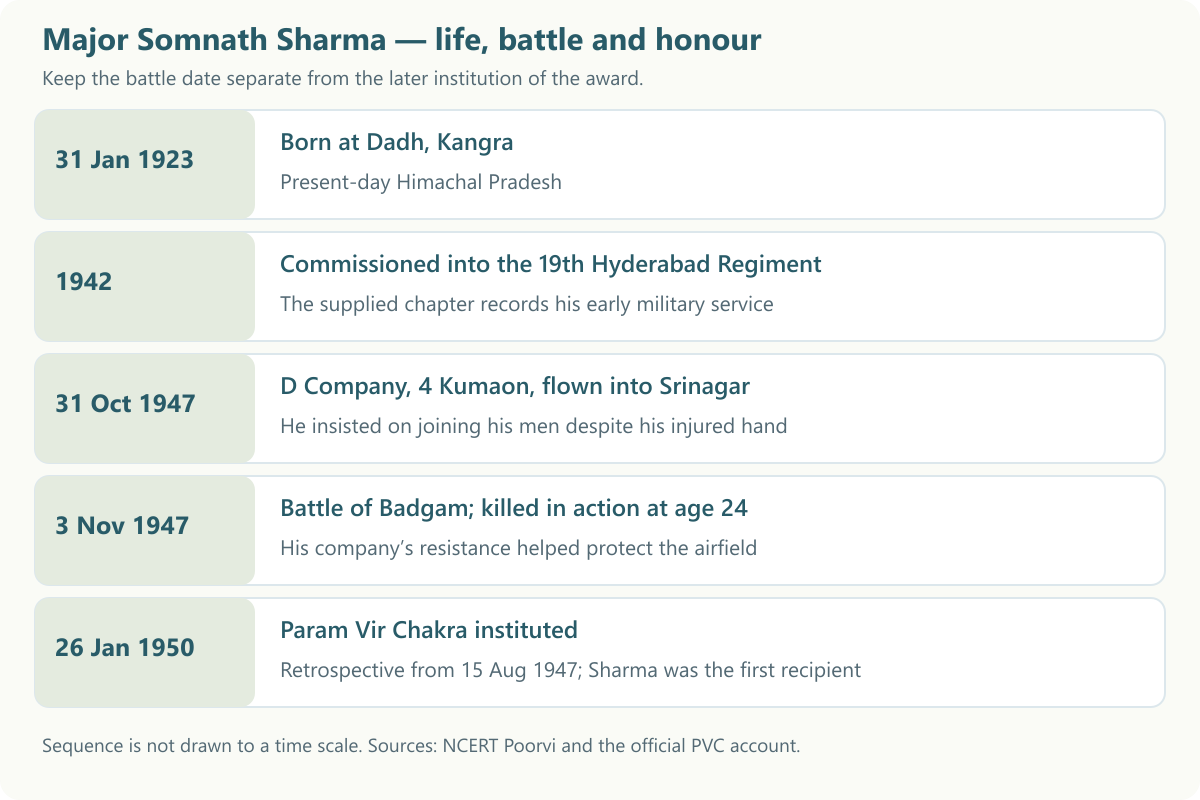
Open the checked timeline at full size. Birth: 31 January 1923; commission: 1942; D Company flown to Srinagar: 31 October 1947; Battle of Badgam: 3 November 1947; PVC instituted: 26 January 1950.
Source differences: p. 54’s prose says the men fought for over six more hours after his death; the Ministry of Defence citation reproduced on p. 57 says six hours overall, including one hour after his death. Use “according to the prose” for its specific exercise and do not present the two timings as identical. The chapter’s 90-versus-500 estimate is also not exactly seven to one. The historical core is the determined resistance that bought time for reinforcements.
Read the official Somnath Sharma account alongside the textbook. The action took place on 3 November 1947; his PVC was posthumous, and the award’s institution date was in 1950.
Summary (English)
This chapter honours Major Somnath Sharma, India’s first recipient of the Param Vir Chakra. After independence, Pakistan launched Operation Gulmarg in 1947 and sent around a thousand trained invaders into the Kashmir Valley to seize Srinagar and its airport. In response, India airlifted troops to defend Kashmir, and on 31 October 1947 the D Company of the 4th Battalion, Kumaon Regiment, led by Major Somnath Sharma, was flown into Srinagar. Although his left hand was in plaster, he refused to stay behind, insisting that he knew his men best and would not let them go into action without him.
On 3 November 1947, several companies were sent to patrol the village of Badgam, less than five kilometres from the airfield. As the other companies returned, Major Somnath Sharma’s 90 soldiers were left behind. The enemy, who had quietly gathered in the area, attacked. Sharma rightly judged that the first attack was only a distraction; soon a larger assault came, leaving his 90 men facing about 500 invaders. He called for air strikes, laid out ground panels to guide the aircraft, and moved fearlessly across the battlefield directing fire and filling magazines for his gunners.
When his company began running out of ammunition and was asked to withdraw, he refused, declaring that he would not retreat an inch but would fight to the last man and the last round. Minutes later, a mortar shell struck his position and killed him instantly. He was only 24. Inspired by his sacrifice, the prose reports his men continuing to hold their ground for over six hours after his death, buying precious time for reinforcements to arrive. Their resistance saved Srinagar for India and inflicted heavy losses on the enemy. For this act of conspicuous bravery, Major Somnath Sharma was awarded the Param Vir Chakra posthumously, and his name is etched on the Honour Wall of the National War Memorial.
Summary (Hindi) – ‘A Tale of Valour’ का सार
यह पाठ भारत के पहले परमवीर चक्र विजेता मेजर सोमनाथ शर्मा को समर्पित श्रद्धांजलि है। स्वतंत्रता के बाद 1947 में पाकिस्तान ने ऑपरेशन गुलमर्ग चलाकर लगभग एक हज़ार प्रशिक्षित हमलावरों को कश्मीर घाटी में भेजा, ताकि श्रीनगर और उसके हवाई अड्डे पर कब्ज़ा किया जा सके। इसके जवाब में भारत ने अपनी सेना श्रीनगर पहुँचाई। 31 अक्टूबर 1947 को मेजर सोमनाथ शर्मा के नेतृत्व में कुमाऊँ रेजिमेंट की चौथी बटालियन की डी कंपनी श्रीनगर भेजी गई। उनका बायाँ हाथ प्लास्टर में था, फिर भी उन्होंने अपने सैनिकों के साथ युद्ध-क्षेत्र में रहने पर ज़ोर दिया।
3 नवंबर 1947 को बडगाम गाँव में गश्त के दौरान दुश्मन ने हमला कर दिया। मेजर शर्मा के केवल 90 सैनिक लगभग 500 हमलावरों का सामना कर रहे थे। उन्होंने हवाई हमलों की माँग की और साहसपूर्वक मोर्चे पर डटे रहे। गोला-बारूद खत्म होने पर भी उन्होंने पीछे हटने से इनकार कर दिया और कहा कि वे एक इंच भी पीछे नहीं हटेंगे, बल्कि आखिरी सैनिक और आखिरी गोली तक लड़ेंगे। कुछ ही देर में एक मोर्टार के गोले से उनकी मृत्यु हो गई; तब उनकी आयु केवल 24 वर्ष थी। उनके बलिदान से प्रेरित पाठ की गद्य-कथा के अनुसार उनके सैनिकों ने छह घंटे से अधिक समय तक मोर्चा संभाले रखा, जिससे श्रीनगर भारत के लिए सुरक्षित रहा। इस अद्वितीय वीरता के लिए उन्हें मरणोपरांत परमवीर चक्र प्रदान किया गया।
About Major Somnath Sharma
Major Somnath Sharma was born on 31 January 1923 at Dadh in Kangra, Himachal Pradesh, into a family with a rich military tradition. His father, Major General Amar Nath Sharma, served the nation with distinction, and as a boy Somnath was inspired by the valorous tales of the Mahabharata told to him by his grandfather. He studied at Sherwood College, Nainital, and trained at the Royal Military College, Sandhurst. Commissioned into the 8th Battalion, 19th Hyderabad Regiment in 1942, he served with distinction in World War II during the Arakan Campaign in Burma. His finest moment came in the Battle of Badgam in 1947, where he laid down his life at the age of 24 and became India’s first Param Vir Chakra awardee.
Theme & message
The chapter celebrates the highest ideals of duty, honour, patriotism and self-sacrifice. Major Somnath Sharma’s refusal to withdraw, his insistence on leading his men despite an injured hand, and his courage against overwhelming odds show that true leadership means putting the nation and one’s comrades before one’s own safety. The story reminds us of the price of freedom and the profound sense of duty that inspires soldiers.
Word meanings
| Word | Meaning |
|---|---|
| valour | great courage, especially in battle |
| etched | permanently fixed in someone’s memory |
| beacon | a source of inspiration |
| infiltrators | people who secretly invade |
| annex | to take possession of (territory) |
| combat | a battle, fighting |
| unfounded | not based on reason or facts |
| eerily | in a strange, frightening way |
| outnumbered | were greater in number |
| resolute | determined |
| tenacity | determination, firmness |
| unparalleled | unmatched |
| magazines | containers that hold cartridges to feed a gun |
| ammunition | a supply of bullets, shells and explosives |
| crouched | sat with knees bent |
| conspicuous | noticeable, easily seen |
| posthumously | after death |
| legacy | values and traditions passed down generations |
| testament | strong evidence or proof |
| despatches | official reports on military affairs |
| forged | shaped or strengthened through hardship |
| poignant | emotional and sad |
Before you read
I. Republic Day — sample discussion
The parade marks the Constitution coming into force on 26 January 1950 and presents ceremonial service contingents and cultural displays. Highlights can include marching, tableaux and a fly-past. Exact programmes and award presentations vary by year; gallantry-award announcements should not be confused with every award being presented during the parade. Use the relevant year’s official programme for current details.
II. Soldier qualities and message — samples
Courage, discipline, teamwork, alertness, responsibility and care for others are reasonable choices. Explain why each matters. A sample message is: “Thank you for your service and dedication; I wish you and your family well.” Adapt it to your own thoughts.
Let us discuss
I. Arrange the following events in chronological order. (The first event is marked 1 and the last is marked 8.)
Let us think and reflect
I.1. Extract – “Vastly outnumbered and facing devastating fire, Major Somnath Sharma and his men stood resolute… encouraging his men to hold their ground.”
I.2. Extract – “Born on 31 January 1923, in the picturesque town of Dadh in Kangra… imparted to him by his grandfather.”
II. Answer the following questions.
Let us learn
I. Match the expressions in Column 1 with the situations in Column 2.
| Column 1 | Column 2 (situation) |
|---|---|
| 1. Fight to the last man | (ii) The soldiers fought valiantly until each one laid down his life for the nation. |
| 2. Foil the plan | (iv) A spy disrupts the enemy’s efforts to invade a country by intercepting their communications. |
| 3. Deliver a blow | (i) A sports team scores a last-minute goal, giving them the lead and shaking the opponent’s confidence. |
| 4. Hold their ground | (iii) Soldiers stay in their position and fight back, even though the enemy is stronger. |
II. Collective nouns – match Column 1 to Column 2.
| Column 1 | Column 2 (meaning) |
|---|---|
| 1. regiment | (ii) a permanent unit of an army, typically commanded by a lieutenant colonel/colonel and divided into several companies |
| 2. squadron | (iii) a small unit, typically 12–24 aircraft and their crews, used in air force, naval or army aviation |
| 3. fleet | (iv) a group of ships sailing together, engaged in the same activity or under the same ownership |
| 4. battalion | (i) a large body of troops ready for battle, especially an infantry unit |
The collective-noun matches use the textbook’s simplified definitions. Actual military organisation varies by service and country; do not treat the table as a universal regiment/battalion structure.
III. Fill in the blanks with the correct ‘over-’ verbs.
IV. Related spellings — fill in correctly.
The practice/practise distinction follows British English; American English uses “practice” for both. “Counsel” can be a noun or a verb, so the book’s c-noun/s-verb pattern is not universal.
V. Subject–verb agreement – choose the correct verb.
VI. Correct the verbs in the passage.
Let us listen
Checked against p. 98:
- Brave
- enemy
- President — the transcript identifies Dr. Rajendra Prasad
- Vedic rishi
- lotus flowers
Item 3’s wording “introduced … in 1947” is misleading. The award was instituted on 26 January 1950, with retrospective effect from 15 August 1947. The answers above record the supplied listening text; they do not turn its wording into a precise description of the medal’s two faces. See the official Param Vir Chakra account.
Let us speak
This is a speaking activity. In groups of 4–5, speak about how you propose to serve the nation, choosing a theme such as saving the environment, health and well-being, helping others, or righteous conduct.
Let us write
Original model letter: the task asks about a memorial in the school’s own state or region.
Sample School
12, Sample Road
Sample City, Sample State
10 August 20XX
The In-charge
Regional Memorial
Sample City, Sample State
Subject: Enquiry about a School Visit to a Memorial
Dear Sir/Madam,
This is to enquire about arrangements for a guided visit by our Grade 8 students to your memorial.
Could you please share the dates available next month and the expected duration of a tour? We would also appreciate details of any entry fees, guide charges and advance-booking requirements. Please explain the guidelines for student groups, including group size, teacher supervision, photography and accessibility arrangements.
An early reply will help the school plan transport and obtain permission from parents. We look forward to your guidance in making the visit meaningful.
Yours sincerely,
Sample Student
On behalf of Grade 8
All institution, address and date details are placeholders. Name a real memorial in your region and confirm arrangements before planning an actual visit.
Let us explore
I. The chapter recounts Captain Vikram Batra’s leadership at Points 5140 and 4875 during the 1999 Kargil War and his posthumous PVC. “Shershah” and the success signal are used in the reading. Do not infer that “last recipient” means no future award is possible; identify him as one of the 1999 PVC awardees.
II. Param Vir Chakra, Maha Vir Chakra and Vir Chakra recognise gallantry in the presence of the enemy. Distinguish them from Ashoka Chakra, Kirti Chakra and Shaurya Chakra. Check the official criteria when preparing an awards chart rather than mixing civilian honours and wartime awards.
III. Examples of documented Army roles for women include engineering, signals, medical services and nursing. The Ministry of Defence account provides a source for research. For a current-policy presentation, consult its latest update; entry rules and totals can change.
IV. Birsa Munda belonged to the Munda community and is remembered for resistance to British colonial rule and defence of tribal rights. The textbook explains the name Dharti Aaba, “Father of the Land”. Describe the commemorative stamp as a tribute rather than as a photograph of a particular speech.
V. List patriotic songs in your own language or another language, name their writer/composer where verified, and explain one song’s message. Vande Mataram and Saare Jahan Se Achha are possible choices; this is an open activity, not a single fixed list.
Additional ClearStudy questions
This practice is separate from the printed textbook exercises.
Short answer
1. Which regiment did Major Somnath Sharma command at Badgam?
2. What was Operation Gulmarg?
3. Why did Major Somnath Sharma refuse to stay back even with a plastered hand?
Long answer
4. Describe the courage and leadership shown by Major Somnath Sharma in the Battle of Badgam.
ClearStudy MCQs and assertion–reason practice
1. Major Somnath Sharma was the first recipient of which award?
(a) Maha Vir Chakra (b) Param Vir Chakra (c) Ashoka Chakra (d) Vir Chakra
2. The Battle of Badgam was fought near which place?
(a) The Srinagar airport (b) Jammu (c) Pathankot (d) Leh
3. Which regiment did Major Somnath Sharma lead at Badgam?
(a) Punjab Regiment (b) Hyderabad Regiment (c) Kumaon Regiment (d) Gorkha Regiment
4. About how many soldiers did Major Somnath Sharma have at Badgam?
(a) 500 (b) 1000 (c) 90 (d) 300
5. What was Pakistan’s plan to annex Kashmir called?
(a) Operation Vijay (b) Operation Gulmarg (c) Operation Polo (d) Operation Meghdoot
6. How did Major Somnath Sharma guide the aircraft to their target?
(a) By radio only (b) By laying out ground panels (c) By lighting fires (d) By waving flags
7. At what age did Major Somnath Sharma lay down his life?
(a) 18 (b) 24 (c) 30 (d) 42
8. Where was Major Somnath Sharma born?
(a) Nainital (b) Srinagar (c) Dadh, Kangra (Himachal Pradesh) (d) Anand, Gujarat
9. What killed Major Somnath Sharma?
(a) A bullet (b) A mortar shell (c) A grenade (d) An air strike
10. According to the prose on p. 54, after his death his men held their position for more than:
(a) one hour (b) two hours (c) six hours (d) twelve hours
Assertion–Reason – choose: (a) A and R true, R explains A; (b) A and R true, R does not explain A; (c) A true, R false; (d) A false, R true.
1. Assertion (A): Major Somnath Sharma insisted on joining his company despite an injured hand.
Reason (R): He believed he knew his men best and would not let them go into action without him.
2. Assertion (A): Major Somnath Sharma requested air strikes during the battle.
Reason (R): His company was vastly outnumbered and needed support to defend the airfield.
3. Assertion (A): Major Somnath Sharma withdrew his men when the ammunition began to run low.
Reason (R): He had vowed to fight to the last man and the last round.
4. Assertion (A): Major Somnath Sharma was awarded the Param Vir Chakra posthumously.
Reason (R): He showed conspicuous bravery and made the supreme sacrifice at the Battle of Badgam.
5. Assertion (A): The resistance of D Company helped save Srinagar for India.
Reason (R): Their stand bought time for reinforcements to be flown in.
Exam tips & common mistakes
Exam tips
Remember the key dates and facts: born 31 January 1923; Battle of Badgam on 3 November 1947; 90 men vs about 500 invaders; first Param Vir Chakra awardee; died aged 24. Quote his famous last line accurately – “I shall not withdraw an inch but will fight to the last man and the last round” – in value-based answers about courage and duty.
Common mistakes
Do not confuse the Kumaon Regiment (his command at Badgam) with the 19th Hyderabad Regiment (his 1942 commission). Do not say he was awarded the PVC during his lifetime – it was posthumous. Spell ‘Param Vir Chakra’ and ‘Badgam’ correctly, and mind subject–verb agreement with collective nouns (a battalion stands, not stand).
FAQs
Who was Major Somnath Sharma?
He was an Indian Army officer of the Kumaon Regiment who led D Company at the Battle of Badgam in 1947 and became the first recipient of the Param Vir Chakra, India’s highest wartime gallantry award.
What were Major Somnath Sharma’s last words?
“I shall not withdraw an inch but will fight to the last man and the last round,” spoken when he was asked to pull back as his company ran low on ammunition.
What was the result of the Battle of Badgam?
Though Major Somnath Sharma was killed, the company’s resistance delayed the enemy and enabled reinforcements to arrive and helped protect Srinagar and its airfield.
Textbook-based exercises and additional ClearStudy practice are identified separately. Use your textbook alongside these explanations.