
Feathered Friend — Class 8 English Poorvi Questions and Answers
Feathered Friend by Arthur C. Clarke combines a space-station emergency with gentle humour. This Class 8 English Poorvi guide explains Claribel’s role, textbook answers, future-time grammar, silent letters and the Monika–Toby listening exercise.
Source: NCERT Poorvi, Grade 8, Unit 5, printed pages 205–221; listening transcript 249; supplied reprint 2026–27. Open-ended and personal responses are examples to adapt. These explanations are study support, not an official NCERT answer key.
About the story
This science-fiction story follows a construction crew on a space station and a yellow canary named Claribel. Her collapse prompts the narrator to investigate an air-quality emergency after the station’s alarm system fails. The final joke about birds on every station belongs to the imagined story world.
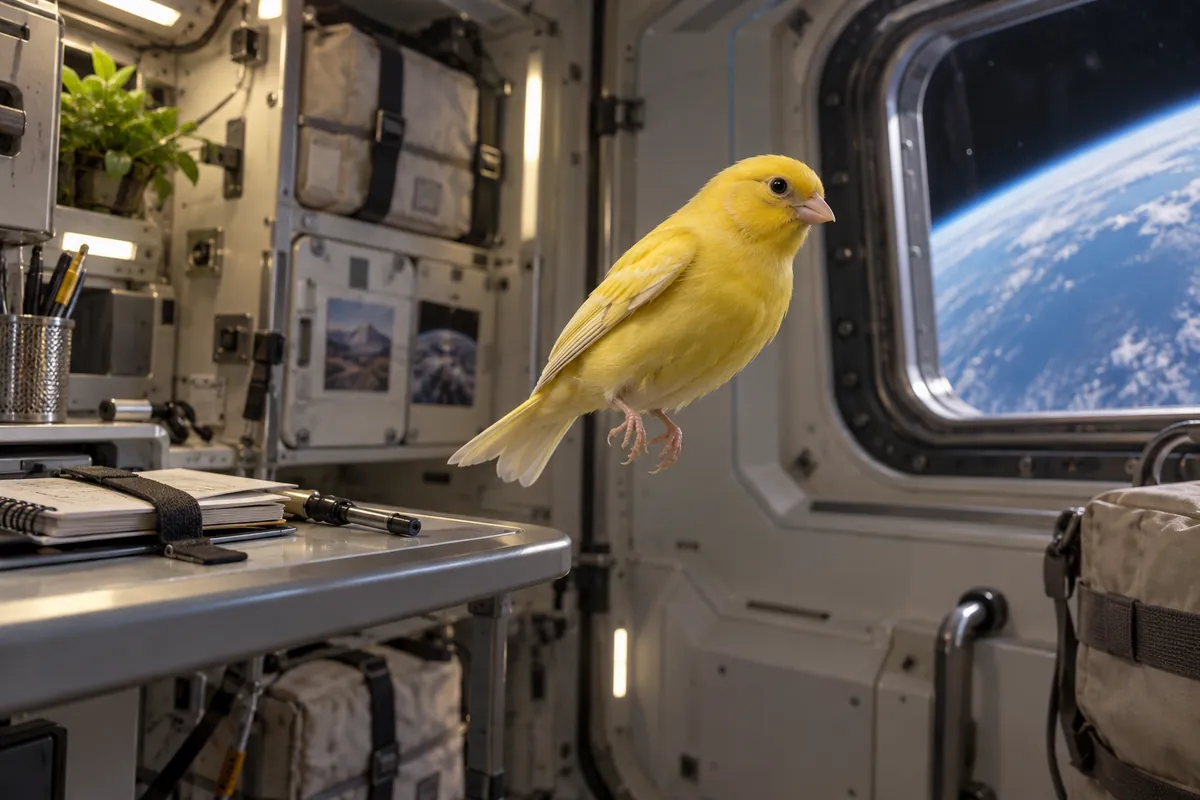
Science distinction: The story uses “absence of gravity” for apparent weightlessness. In actual Earth orbit, gravity remains present: spacecraft and occupants are in continuous free fall. See NASA’s explanation of microgravity. Claribel’s fictional role is not a recommendation to replace air monitors with animals.
Summary
On a manned space station, there is no rule against keeping pets, so when the wiry construction worker Sven Olsen secretly brings a yellow canary called Claribel up on a ferry from Earth, no one stops him. The narrator first meets Claribel when he hears her musical whistle near his ear and looks up to see the tiny bird hanging motionless in the air, perfectly at home in the absence of gravity. She even performs a backward loop no earthbound canary could manage. Claribel soon becomes a general favourite, and the crew cleverly hides her whenever VIPs visit from Earth.
One ‘morning’ the narrator wakes with a nagging headache after disturbed sleep. At breakfast Sven walks in holding Claribel’s limp body. Jock Duncan, the cook-doctor-dietitian, cannot detect a heartbeat, so the crew gives her oxygen. Claribel revives at once, sings, then collapses again. Something stirs in the narrator’s sluggish memory and suddenly it strikes him: just as miners once carried canaries down mines to warn them of gas, Claribel is warning them that something is wrong with the air. The duty engineer, Jim, dismisses this until his assistant admits the second alarm circuit is not yet connected.
Jim returns sheepishly: a rare eclipse by Earth’s shadow had frozen part of the air purifier, and the single working alarm had failed. Costly engineering had let them down completely, and without Claribel the whole crew would soon have died. The narrator ends by saying that an unexplained snatch of birdsong on a space station is nothing to fear – it means a feathered friend is keeping everyone doubly safe.
Theme, characters & message
Theme: The story shows that nature can succeed where advanced technology fails, and that curiosity and small living creatures can prove unexpectedly valuable. Characters: the unnamed narrator (an observant storekeeper-type crew member); Sven Olsen, a skilled, curious construction worker who loves his pet; Claribel, the spirited little canary; Jim, the duty engineer; and Jock Duncan, the cook-doctor-dietitian. Message: we must never over-rely on machines alone; a humble, sensitive creature like a canary can save lives, and human curiosity often leads to useful discoveries. The story also reminds us how fragile and uncertain life can be in the hostile environment of space.
About the author
Arthur C. Clarke is the author credited by the textbook. This story illustrates his use of an imagined technological setting, a practical problem and an unexpected, humorous solution.
Word meanings
| Word | Meaning (English) | Hindi meaning |
|---|---|---|
| regulation | official rule | नियम |
| forbids | does not allow | मना करना |
| wiry | thin but strong | दुबला पर मजबूत |
| assorted | of various types mixed together | विविध प्रकार के |
| girders | thick steel/concrete beams that support a structure | मजबूत शहतीरें |
| dovetailed | fitted together exactly | ठीक से जुड़े हुए |
| garbs | clothing of a special kind | विशेष पोशाक |
| abruptly | suddenly, unexpectedly | अचानक |
| cubbyhole | a small enclosed space or room | छोटी सी कोठरी |
| ceased | stopped | रुक गया |
| canary | a small yellow songbird kept as a pet | कनेरी (पीली चिड़िया) |
| wits | ability to think quickly | सूझबूझ, बुद्धि |
| concealing | hiding | छिपाना |
| bulkheads | dividing walls between compartments | विभाजक दीवारें |
| nagging | persistently painful or worrying | लगातार परेशान करने वाला |
| retort | to answer back sharply | तुरंत जवाब देना |
| clenched | pressed together tightly | कसकर बंद किए हुए |
| keeled (over) | collapsed, fainted | ञेहराकर गिर पड़ना |
| sluggish | slow, inactive | सुस्त, मंद |
| sheepish | embarrassed | शर्मिंदा |
| inexplicable | that cannot be explained | अस्पष्ट, अव्याख्य |
| safeguarded | protected | सुरक्षित |
Before you read
I. Work in pairs and discuss the questions given below.
II. Complete the words given below by inserting vowels. Refer to their meanings given alongside.
Let us discuss
I. (After Part I) Answer the following questions briefly.
I. (After Part II) Identify whether the following statements from parts I and II are true or false.
Let us think and reflect
I.1. Extract – “Sven was one of our best construction men… for a space suit is not the most convenient of garbs in which to work.”
I.2. Extract – “‘Jim!’ There’s something wrong with the air!… we stood arguing and passing the oxygen bottle around like a pipe of peace.”
II. Answer the following questions.
Let us learn
I. Choose the appropriate adjectives from the box to match the words 1–8.
II. Combine the words in Column 1 with Column 2 to make merged words.
| Column 1 + Column 2 | Merged word | Meaning |
|---|---|---|
| breakfast + lunch | (i) brunch | meal eaten between breakfast and lunch hours |
| motor + hotel | (ii) motel | a roadside hotel for motorists/travellers with cars |
| smoke + fog | (iii) smog | fog mixed with smoke and pollution |
| situation + comedy | (iv) sitcom | a comedy TV series based on everyday situations |
| video + log | (v) vlog | a personal diary or blog kept in video form |
| spoon + fork | (vi) spork | an eating utensil that is part spoon, part fork |
| web + seminar | (vii) webinar | a seminar or talk conducted online over the internet |
III. ‘will’ denotes which time?
IV. Fill in the blanks with the correct form (Simple Present, Present Progressive, ‘will’, or ‘going to’) to indicate future time.
V. Fill in the blanks with suitable forms of verbs to express future time reference.
Grammar alternatives: In Learn IV, “will rain” is also possible in 3, “is going” is natural in 6, and scheduled events may use Simple Present. In V, future perfect in 1 and 3 stresses completion by the stated deadlines; simple “will revolutionise/transform” is also possible as a prediction. These are grammar examples, not guarantees about future AI capabilities. For adjective items 4 and 8, “delighted look/sheepish expression” and “sheepish look/delighted expression” are both natural.
Let us listen
Use the printed transcript on page 249. Toby is a fictional Martian; the dialogue is imaginative listening practice.
I. Tick or cross
- False: he says he misses his people and home, not his school.
- True: Monika is happy to have him as a friend.
- True: she asks about his single eye.
- False: he mentions an apple, not a banana.
- False on a strict reading: Toby says he can see even with his eye closed; he does not say that closing it makes his vision clearer. The wording “much clearer” adds a comparison absent from the transcript.
II. Exact missing words
1 people; 2 Martians, energy; 3 chocolates; 4 one; 5 clouds, metals.
The question prints “woods” whereas the transcript has “wood”. This does not change the two missing words in item 5. Do not substitute “valleys” or “oceans”.
Let us speak
I. Silent letters
| Word | Silent letter(s) in the textbook pronunciation |
|---|---|
| ballet | t |
| whistle | t |
| alarm | r in the given non-rhotic pronunciation; pronounced in many other accents |
| psychologist | p; ch together represent the /k/ sound |
| receipt | p |
| debris | final s; b is pronounced |
| pneumonia | p |
| almond | l in common pronunciations; some accents pronounce it |
| foreign | g |
| island | s; l is pronounced |
| wreck | w |
| aisle | s |
| campaign | g, not p |
| fasten | t |
Compare audio for debris, alarm and almond. Accent differences are not necessarily errors.
II. Asking for and giving advice — sample dialogues
A: What materials should I use for a solar-system model?
B: Try reused cardboard circles, paper balls and a sturdy base.
A: How can I keep it accurate?
B: Check the planet order, label each planet, and say clearly that the sizes and distances are not to scale.
A: How can I prepare for the Chandrayaan-3 quiz?
B: Begin with the ISRO mission page. Make notes on the launch, landing, objectives and instruments.
A: What should I do next?
B: Practise questions with a partner and check dates against the source.
Let us write
I. Complete the social-media web with uses of the internet, then write an article titled ‘The Importance of Internet’.
Let us explore
I. A canary in the coal mine
The phrase means an early warning of danger. In the story, Claribel’s collapse alerts the crew when their alarms do not. Discuss how a warning signal can be useful without being a complete safety system.
II. Routine tasks in space
Use NASA educational material to investigate how astronauts secure objects for writing and eating, exercise with resistance equipment, and use sleeping restraints. Record your source and distinguish actual practice from the story’s jokes. Weightlessness does not mean people need no sleep, and “permanent sunlight” describes this fictional setting rather than every station’s orbit.
III. Can animals predict disasters?
Qualified response: Animals may respond to environmental changes, but anecdotes do not establish a reliable earthquake-prediction method. The USGS explains that a reproducible link between a particular behaviour and an impending earthquake has not been established. Treat the textbook’s proposed electromagnetic explanation as a hypothesis, not a settled fact. Discuss what observations, comparison groups and repeatable evidence would be needed.
IV. Salim Ali
The textbook introduces the ornithologist Salim Ali as the “Birdman of India”. Make a brief profile covering his bird surveys, books and contribution to conservation. The awards listed in the supplied text are Padma Bhushan (1958) and Padma Vibhushan (1976).
V. Bird-feeder group task
- Plan a small sheltered feeder using clean reused material with no sharp edges; ask an adult to help with cutting.
- Provide a stable perch and suitable seed for local birds. Keep food dry and remove spoiled material.
- Place it where birds can approach safely and observe without disturbing them.
- Keep the feeder clean and record visitors in a bird diary. Watching wild birds does not require capturing them.
Additional ClearStudy questions
This practice is separate from the printed textbook exercises.
Short answer (30–40 words)
1. Who was Claribel and who brought her to the space station?
2. Why was Sven able to qualify easily for the 150-pound bonus?
3. How did the crew first try to revive Claribel?
4. What had actually gone wrong with the air on the station?
5. Why does the narrator say a snatch of birdsong on a space station is nothing to fear?
Long answer (100–120 words)
6. How does ‘Feathered Friend’ show that nature can succeed where advanced technology fails?
7. Describe Claribel and explain why she becomes so important to the crew.
ClearStudy MCQs and assertion–reason practice
1. Who is the author of ‘Feathered Friend’?
(a) Walter de la Mare (b) Arthur C. Clarke (c) Ruskin Bond (d) Salim Ali
2. What kind of bird was Claribel?
(a) A parrot (b) A pigeon (c) A yellow canary (d) A sparrow
3. Why did Sven bring Claribel to the space station?
(a) For an official experiment (b) Out of personal/scientific curiosity (c) To detect gas (d) On the captain’s orders
4. How did Claribel behave in the absence of gravity?
(a) She could not fly (b) She fell ill at once (c) She floated and did a backward loop (d) She refused to eat
5. What made the air on the station turn bad?
(a) A meteor strike (b) An eclipse froze part of the air purifier (c) A fire (d) Too many people
6. Who was Jock Duncan?
(a) The duty engineer (b) The captain (c) The cook-doctor-dietitian (d) Claribel’s owner
7. How was Claribel first revived after she fainted?
(a) With water (b) With food (c) With a shot of oxygen in a face mask (d) By warming her
8. What gave the narrator the clue about the bad air?
(a) A loud alarm (b) The memory of miners carrying canaries to warn of gas (c) A message from Earth (d) A flashing light
9. Why did Jim first dismiss the warning about the air?
(a) He disliked Sven (b) He trusted the duplicate alarm circuits (c) He was asleep (d) He was joking
10. The phrase ‘we should soon have been slightly dead’ is an example of the author’s:
(a) anger (b) humour/understatement (c) sadness (d) fear
Assertion–Reason – choose: (a) A and R true, R explains A; (b) A and R true, R does not explain A; (c) A true, R false; (d) A false, R true.
1. Assertion (A): Claribel was not disturbed by the absence of gravity.
Reason (R): She weighed practically nothing and had tiny food requirements.
2. Assertion (A): Claribel’s fainting warned the crew that the air had gone bad.
Reason (R): Canaries are very sensitive to a lack of fresh air and react before humans do.
3. Assertion (A): The station’s alarm failed to warn the crew.
Reason (R): A rare eclipse froze part of the purifier, the single alarm did not go off, and the second circuit was not connected.
4. Assertion (A): Sven brought Claribel aboard for an official animal-behaviour experiment.
Reason (R): He smuggled her up secretly on the last ferry, partly out of his own curiosity.
5. Assertion (A): The crew kept Claribel hidden when VIPs visited from Earth.
Reason (R): There was an official regulation forbidding pets on the space station.
Exam tips & common mistakes
Exam tips
Always name the author Arthur C. Clarke and the bird Claribel correctly. Remember the chain of cause and effect: eclipse → air purifier froze → single alarm failed → second circuit not connected → bad air → Claribel fainted → crew warned. Link the title to the theme – a feathered creature proves a true friend. When asked about humour, quote phrases like ‘slightly dead’, ‘cubbyhole’ and ‘pipe of peace’.
Common mistakes to avoid
Do not write that Sven brought Claribel for an official experiment – he brought her privately, out of curiosity. Do not say the alarms were perfect; the purifier froze during the eclipse, the connected alarm failed for an unspecified reason, and the backup was unconnected. Do not confuse the canary with a parrot, and do not forget that miners (not sailors) used canaries to detect gas. Avoid spelling errors in ‘canary’, ‘Claribel’ and ‘dietitian’.
FAQs
Who wrote ‘Feathered Friend’ and what type of story is it?
It was written by Arthur C. Clarke and is a science-fiction story set on a space station in zero gravity.
Why is Claribel called a ‘feathered friend’?
Because she is a bird (feathered) who proves to be a true friend – by fainting she warns the crew that the air has turned bad and saves all their lives.
How did a canary end up saving the crew?
Canaries are extremely sensitive to a lack of fresh air. When the air purifier froze and the alarms failed, Claribel collapsed first, which made the narrator realise the air was dangerous – just as miners once used canaries to detect gas.
Textbook-based exercises and additional ClearStudy practice are identified separately. Use your textbook alongside these explanations.