
Class 8 Maths Ganita Prakash Chapter 12 Solutions (NCERT 2026–27) – Tales by Dots and Lines
These Class 8 Maths Ganita Prakash Chapter 12 solutions cover Tales by Dots and Lines from the new NCF-2023 textbook (2026–27). This is Chapter 5 of Ganita Prakash Part II (the 12th chapter of the Class 8 course). The worked solutions use original dot plots, line graphs and checked calculations. Values estimated from a printed graph are labelled approximate; they are not exact measurements or current statistics.
- Chapter overview
- Key concepts & definitions
- Important formulas
- Figure it Out (page 113–116)
- Figure it Out (page 122–123 – line graphs)
- Figure it Out (page 127–132)
- Math Talk & Try This (in-text)
- Further in-text activities
- Common mistakes to avoid
- Practice MCQs & Assertion–Reason
- Quick revision summary
- FAQs
Chapter 12 Overview
Chapter 12, Tales by Dots and Lines, revisits the arithmetic mean (average) and the median from a fresh, visual point of view. Using dot plots, you see that the mean is the “balancing point” of the data — the total distance of the values on its left equals the total distance on its right. The chapter then explores how the mean and median change when values are added, removed, increased by a fixed amount or multiplied, and how to compute the mean and median from a frequency table and from a spreadsheet. The second half, Visualising and Interpreting Data, introduces the line graph as the best tool for showing how a quantity changes over time, and shows how to read trends, peaks and lows from temperature, rainfall, sleep and other real data. The Class 8 Maths Ganita Prakash Chapter 12 solutions below work through every “Figure it Out” set step by step.
Key Concepts & Definitions
Arithmetic mean (average): the sum of all the values divided by the number of values.
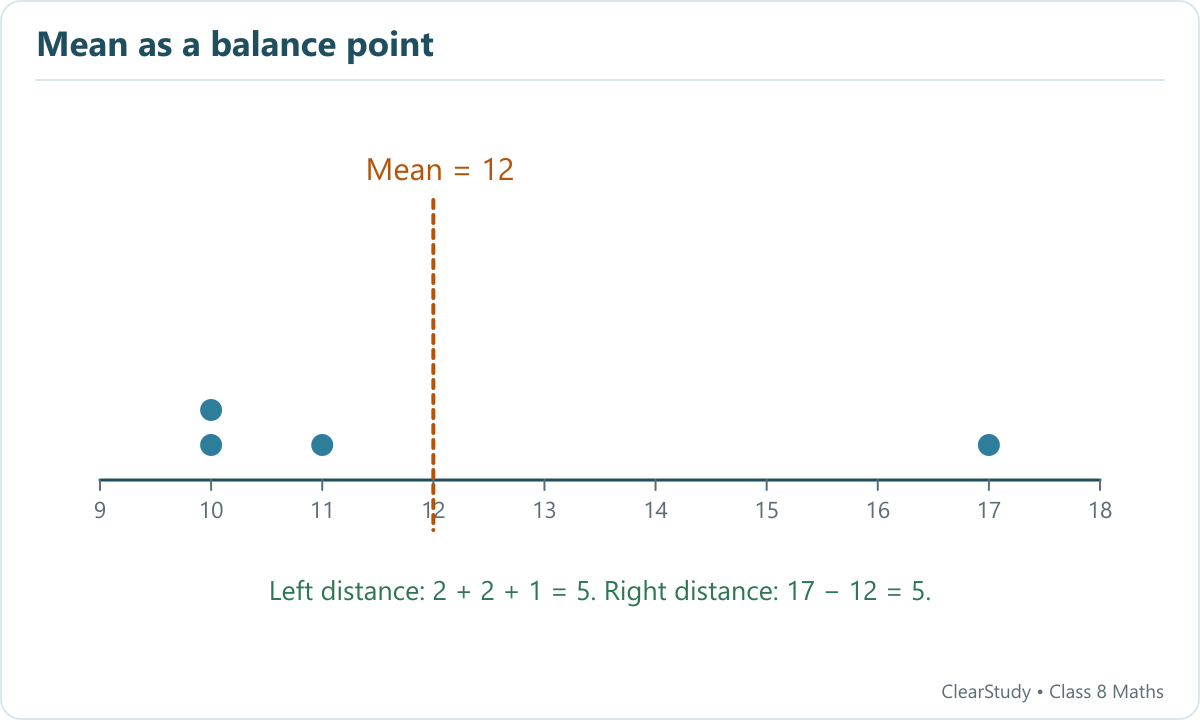
Mean as a balance point: the total distance of the data values to the left of the mean equals the total distance to the right. There is exactly one such centre.
Median: the middle value of the data when it is sorted; for an even number of values it is the average of the two middle values.
Effect of changing data: inserting a value greater than the mean raises the mean; a value less than the mean lowers it; a value equal to the mean leaves it unchanged.
Adding / multiplying a constant: if every value increases by k, the mean increases by k; if every value is multiplied by k, the mean is multiplied by k.
Line graph: data points joined by line segments, used to visualise how a quantity changes over time; a steeper segment means a faster change.
Important Formulas (Chapter 12)
Mean = (sum of all the observations) ÷ (number of observations) = (x1 + x2 + … + xn) / n
Sum of observations = Mean × (number of observations)
Mean from a frequency table = Σ(value × frequency) / Σ(frequency)
Add a constant: new mean = old mean + k. • Multiply by a constant: new mean = k × old mean.
Median = middle value of sorted data (for n even, the average of the (n/2)th and (n/2 + 1)th values).
Figure it Out — Mean & Median (page 113–116)
1. Find the mean of the following data and share your observations: (i) The first 50 natural numbers. (ii) The first 50 odd numbers. (iii) The first 50 multiples of 4.
2. The dot plot below shows a collection of data and its average; but one dot is missing. Mark the missing value so that the mean is 9 (as shown below).
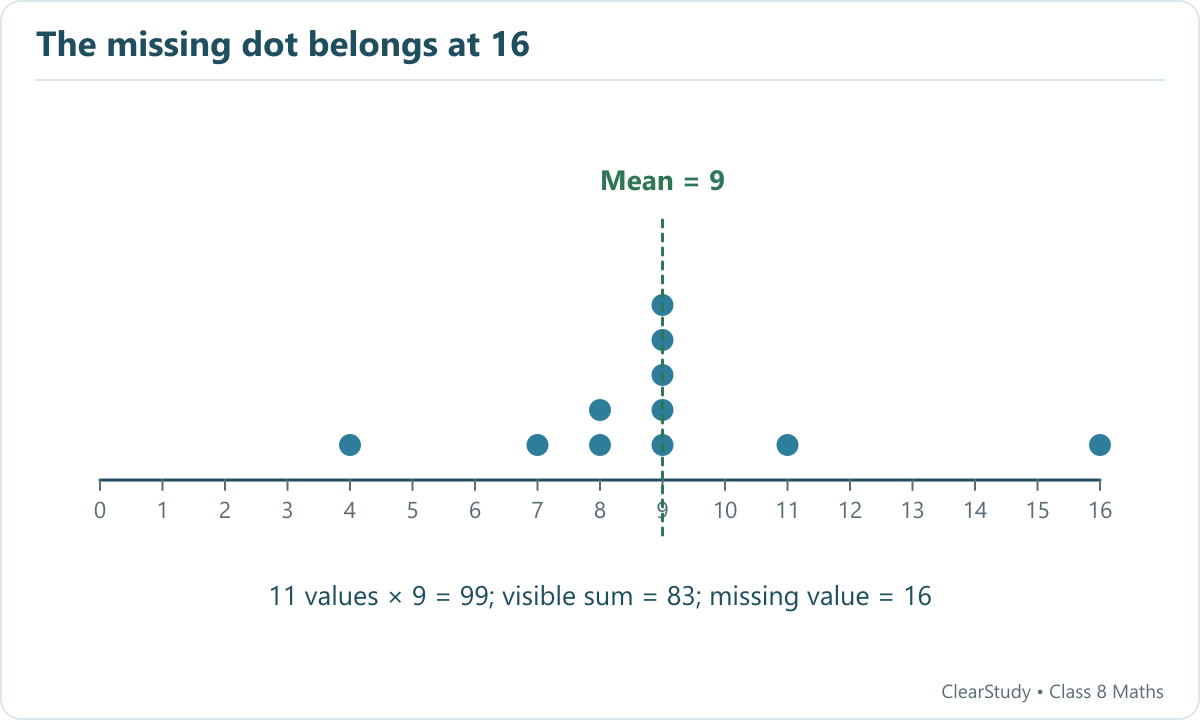
3. Sudhakar, the class teacher, asks Shreyas to measure the heights of all 24 students in his class and calculate the average height. Shreyas informs the teacher that the average height is 150.2 cm. Sudhakar discovers that the students were wearing uniform shoes when the measurements were taken and the shoes add 1 cm to the height. (i) Should the teacher get all the heights measured again without the shoes to find the correct average height? Or is there a simpler way? (ii) What is the correct average height of the class? (a) 174.2 cm (b) 126.2 cm (c) 150.2 cm (d) 149.2 cm (e) 151.2 cm (f) None of the above (g) Insufficient information
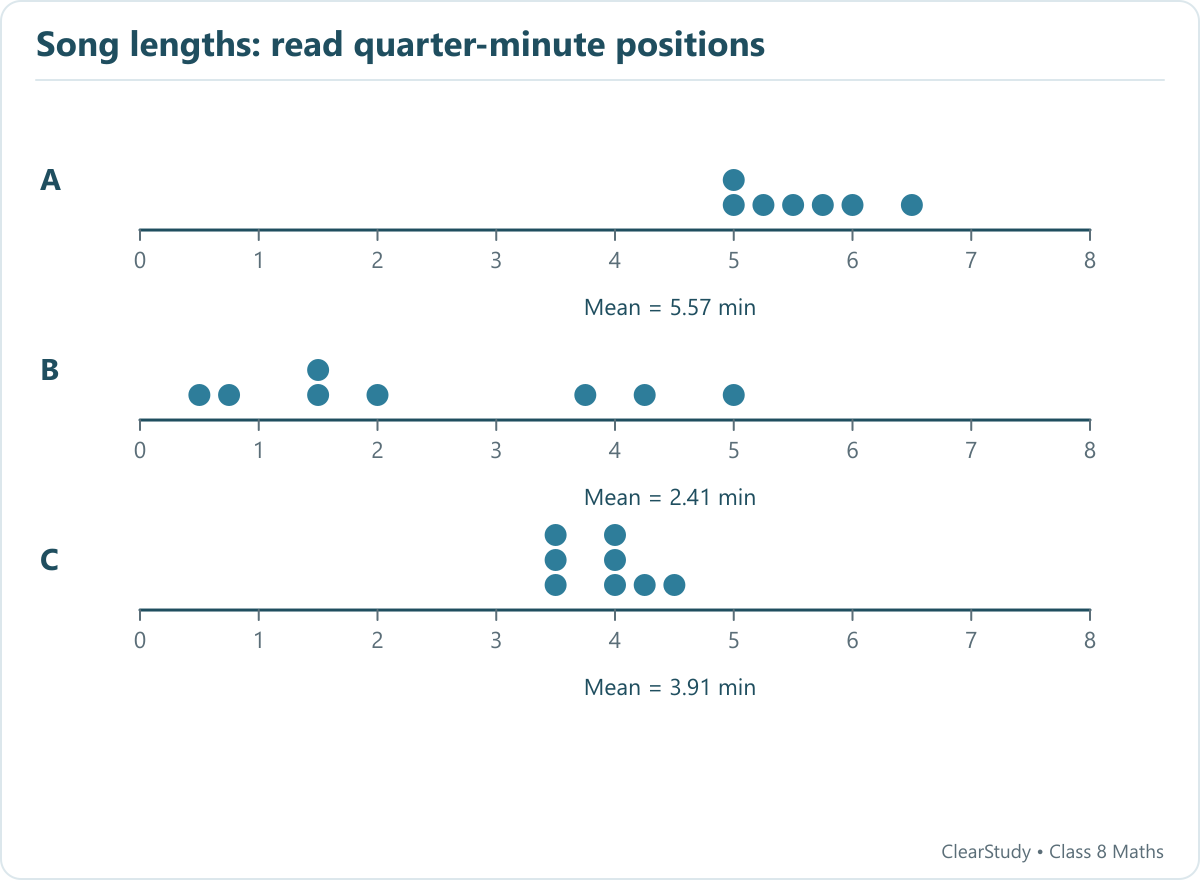
4. The three dot plots below show the lengths, in minutes, of songs of different albums. Which of these has a mean of 5.57 minutes? Explain how you arrived at the answer.
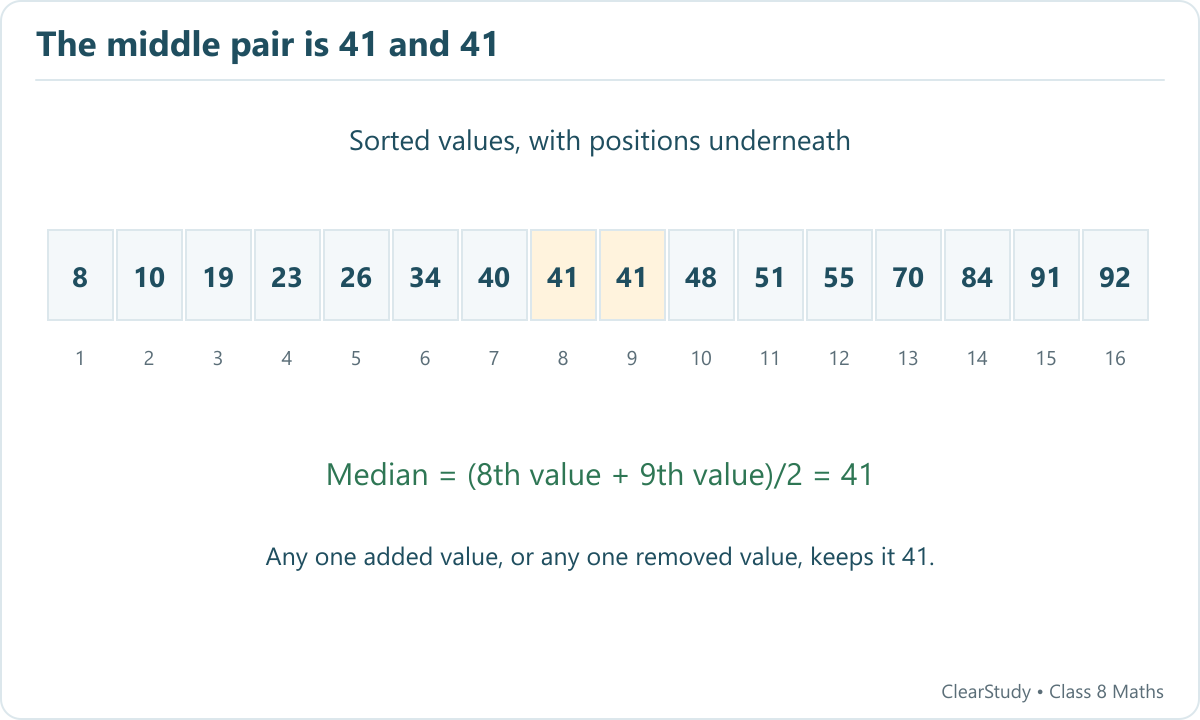
5. Find the median of 8, 10, 19, 23, 26, 34, 40, 41, 41, 48, 51, 55, 70, 84, 91, 92. (i) If we include one value to the data (in the given list) without affecting the median, what could that value be? (ii) If we include two values to the data without affecting the median what could the two values be? (iii) If we remove one value from the data without affecting the median what could the value be?
6. Examine the statements below and justify if the statement is always true, sometimes true, or never true. (i) Removing a value less than the median will decrease the median. (ii) Including a value less than the mean will decrease the mean. (iii) Including any 4 values will not affect the median. (iv) Including 4 values less than the median will increase the median.
7. The mean of the numbers 8, 13, 10, 4, 5, 20, y, 10 is 10.375. Find the value of y.
8. The mean of a set of data with 15 values is 134. Find the sum of the data.
9. Consider the data: 12, 47, 8, 73, 18, 35, 39, 8, 29, 25, p. Which of the following number(s) could be p if the median of this data is 29? (i) 10 (ii) 25 (iii) 40 (iv) 100 (v) 29 (vi) 47 (vii) 30
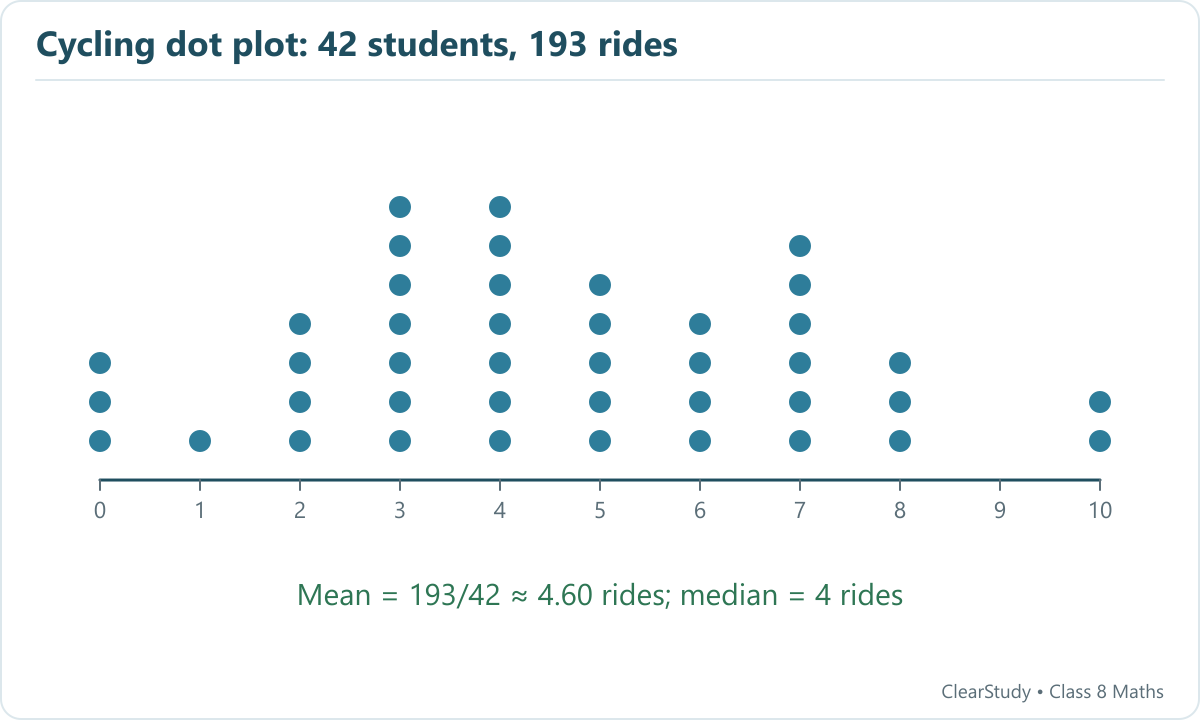
10. The number of times students rode their cycles in a week is shown in the dot plot below. Four students rode their cycles twice in that week. (i) Find the average number of times students rode their cycles. (ii) Find the median number of times students rode their cycles. (iii) Which of the following statements are valid? Why? (a) Everyone used their cycle at least once. (b) Almost everyone used their cycle a few times. (c) There are some students who cycled more than once on some days. (d) Exactly 5 students have used their cycles more than once on some days. (e) The following week, if all of them cycled 1 more time than they did the previous week, what would be the average and median of the next week’s data?
| Weekly rides | 0 | 1 | 2 | 3 | 4 | 5 | 6 | 7 | 8 | 9 | 10 |
|---|---|---|---|---|---|---|---|---|---|---|---|
| Students | 3 | 1 | 4 | 7 | 7 | 5 | 4 | 6 | 3 | 0 | 2 |
11. A dart-throwing competition was organised in a school. The number of throws participants took to hit the bull’s eye (the centre circle) is given in the table below. Describe the data using its minimum, maximum, mean and median.
| No. of trials | 1 | 2 | 3 | 4 | 5 | 6 | 7 | 8 | 9 | 10 |
|---|---|---|---|---|---|---|---|---|---|---|
| No. of students | 1 | 0 | 0 | 1 | 4 | 9 | 12 | 15 | 10 | 10 |
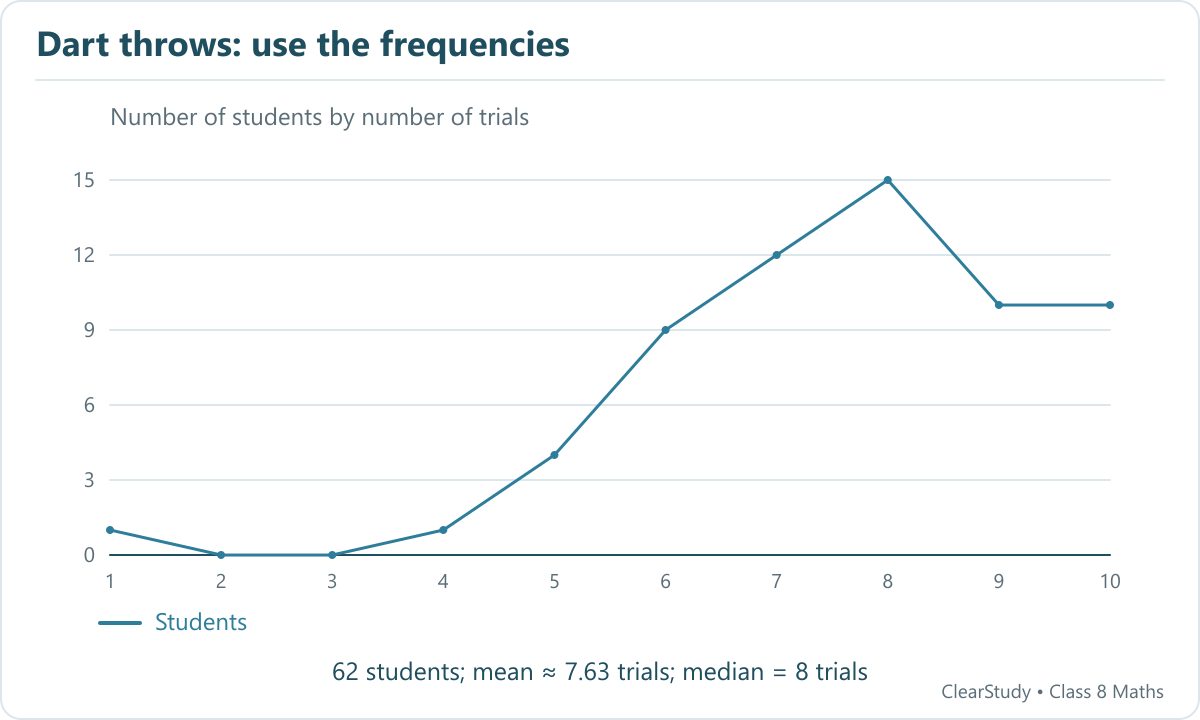
Figure it Out — Line Graphs (page 122–123)
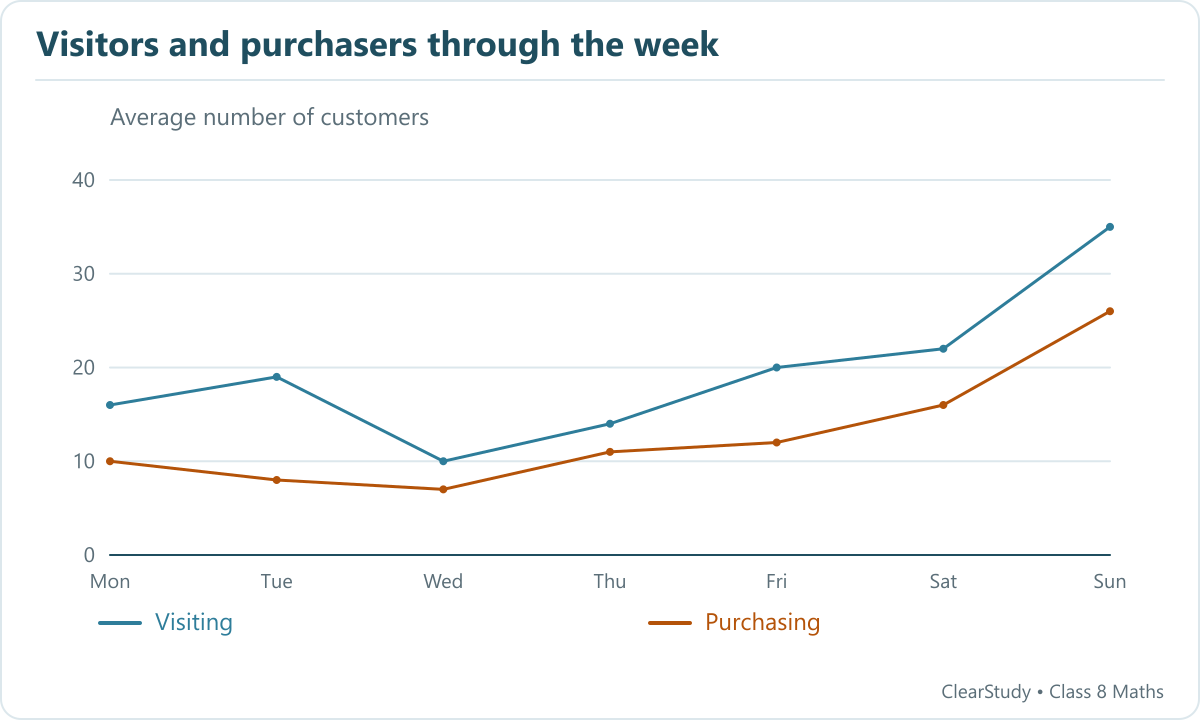
1. The average number of customers visiting a shop and the average number of customers actually purchasing items over different days of the week is shown in the table below. Visualise this data on a line graph.
| Day | Mon | Tue | Wed | Thu | Fri | Sat | Sun |
|---|---|---|---|---|---|---|---|
| Visiting | 16 | 19 | 10 | 14 | 20 | 22 | 35 |
| Purchasing | 10 | 8 | 7 | 11 | 12 | 16 | 26 |
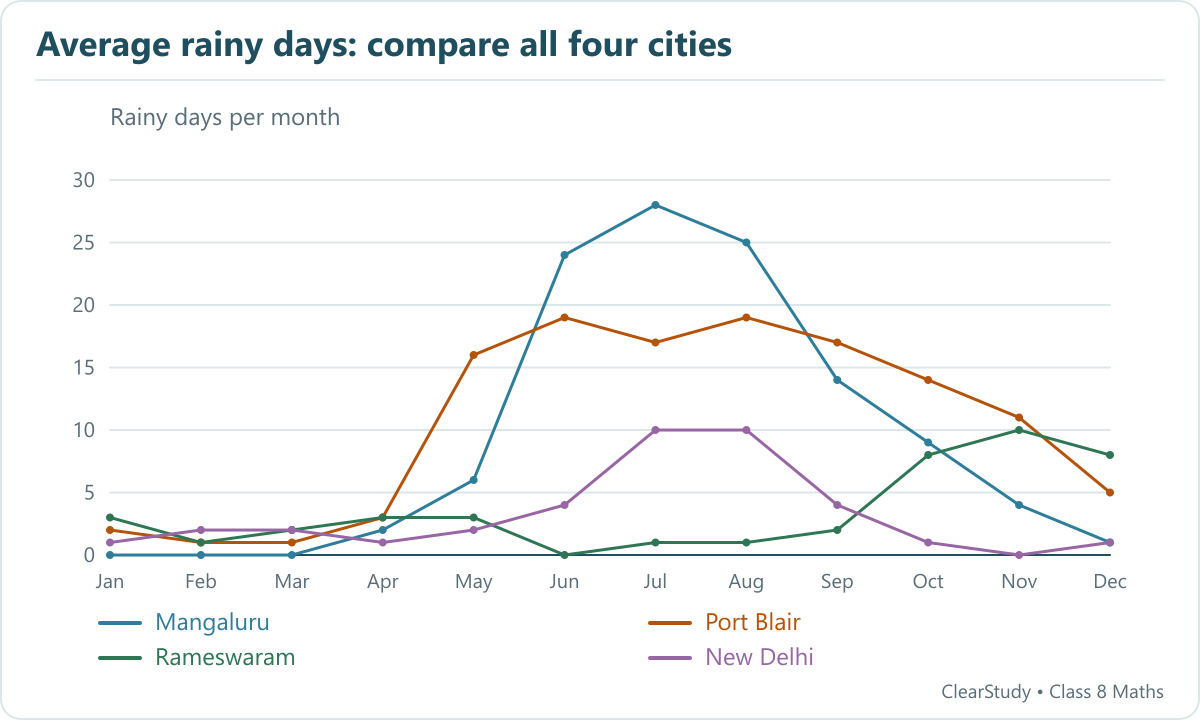
2. The average number of days of rainfall in each month for a few cities is shown in the table below: (i) What could be the possible method to compile this data? (ii) Mark the data for Mangaluru, Port Blair, and Rameswaram in the line graph shown below. You can round off the values to the nearest integer. (iii) Based on the line for New Delhi in the graph fill the data in the table. (iv) Which city among these receives the most number of days of rainfall per year? Which city gets the least number of days of rainfall per year? (v) Looking at the table, when is the rainy season in New Delhi and Rameswaram?
| City | Jan | Feb | Mar | Apr | May | Jun | Jul | Aug | Sep | Oct | Nov | Dec |
|---|---|---|---|---|---|---|---|---|---|---|---|---|
| Mangaluru | 0 | 0 | 0 | 2 | 6 | 24 | 28 | 25 | 14 | 9 | 4 | 1 |
| Port Blair | 2 | 1 | 1 | 3 | 16 | 19 | 17 | 19 | 17 | 14 | 11 | 5 |
| Rameswaram | 3 | 1 | 2 | 3 | 3 | 0 | 1 | 1 | 2 | 8 | 10 | 8 |
| New Delhi | 1 | 2 | 2 | 1 | 2 | 4 | 10 | 10 | 4 | 1 | 0 | 1 |
2 (births graph). The following line graph shows the number of births in every month in India over a time period: (i) What are your observations? (ii) What was the approximate number of births in July 2017? (iii) What time period does the graph capture? (iv) Compare the number of births in the month of January in the years 2018, 2019, and 2020. (v) Estimate the number of births in the year 2019.
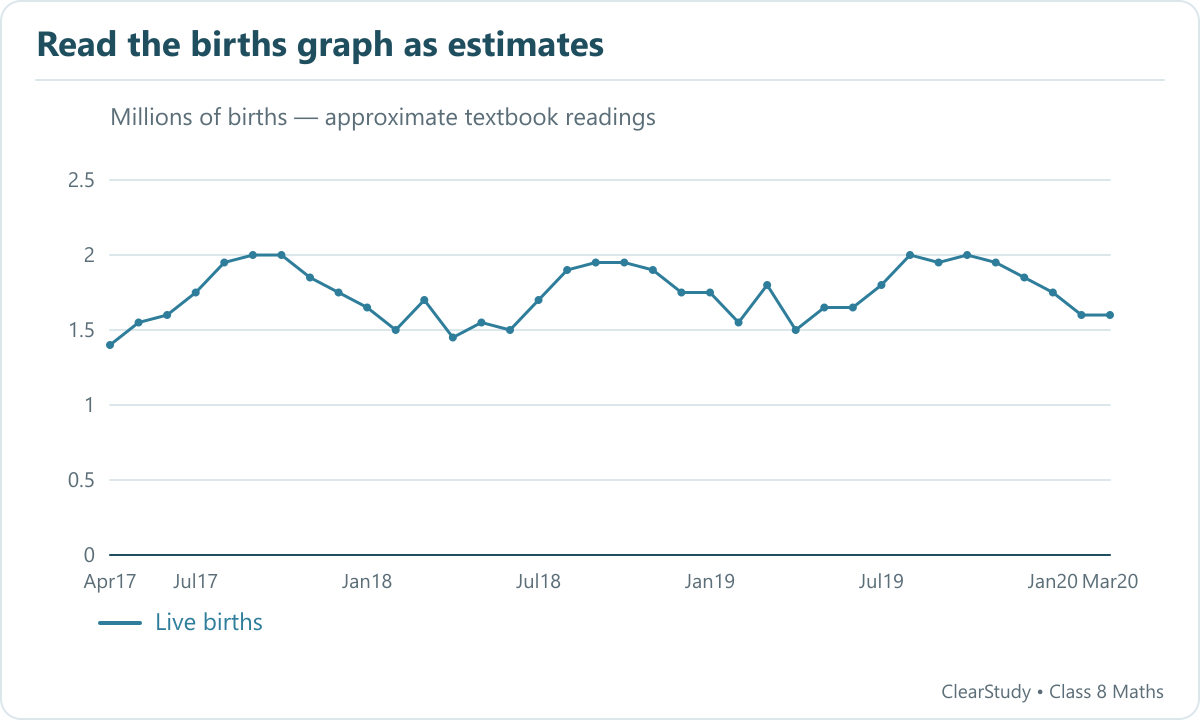
Figure it Out — Means, Medians & More Graphs (page 127–132)
1. Mean Grids: (i) Fill the grid with 9 distinct numbers such that the average along each row, column, and diagonal is 10. (ii) Can we fill the grid by changing a few numbers and still get 10 as the average in all directions?
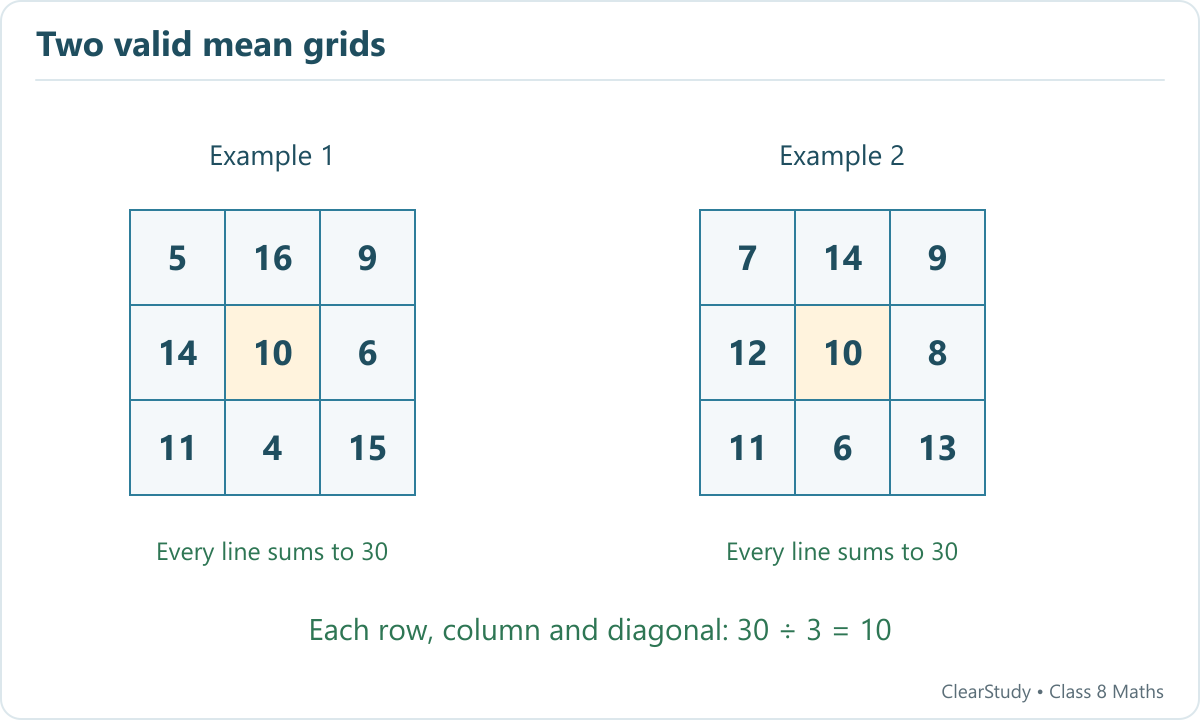
2. Give two examples of data that satisfy each of the following conditions: (i) 3 numbers whose mean is 8. (ii) 4 numbers whose median is 15.5. (iii) 5 numbers whose mean is 13.6. (iv) 6 numbers whose mean = median. (v) 6 numbers whose mean > median.
3. Fill in the blanks such that the median of the collection is 13: 5, 21, 14, _____, ______, ______. How many possibilities exist if only counting numbers are allowed?
4. Fill in the blanks such that the mean of the collection is 6.5: 3, 11, ____, _____, 15, 6. How many possibilities exist if only counting numbers are allowed?
5. Check whether each of the statements below is true. Justify your reasoning. Use algebra, if necessary, to justify. (i) The average of two even numbers is even. (ii) The average of any two multiples of 5 will be a multiple of 5. (iii) The average of any 5 multiples of 5 will also be a multiple of 5.
6. There were 2 new admissions to Sudhakar’s class just a couple of days after the class average height was found to be 150.2 cm. (i) Which of the following statements are correct? Why? (a) The average height of the class will increase as there are 2 new values. (b) The average height of the class will remain the same. (c) The heights of the new students have to be measured to find out the new average height. (d) The heights of everyone in the class has to be measured again to calculate the new average height. (ii) The heights of the two new joinees are 149 cm and 152 cm. Which of the following statements about the class’ average height are correct? Why? (a) remain the same (b) increase (c) decrease (d) information not sufficient. (iii) Which of the following statements about the new class average height are correct? Why? (about the median: remain / increase / decrease / not sufficient)
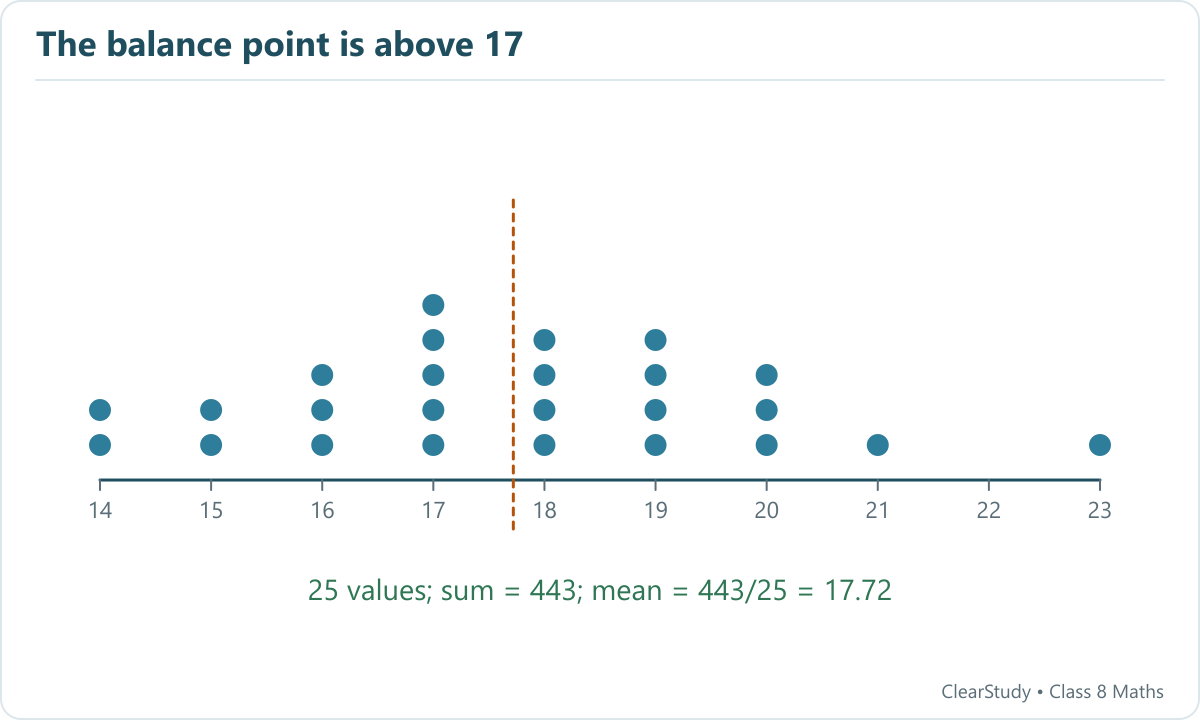
7. Is 17 the average of the data shown in the dot plot below? Share the method you used to answer this question.
| Value | 14 | 15 | 16 | 17 | 18 | 19 | 20 | 21 | 22 | 23 |
|---|---|---|---|---|---|---|---|---|---|---|
| Frequency | 2 | 2 | 3 | 5 | 4 | 4 | 3 | 1 | 0 | 1 |
8. The weights of people in a group were measured every month. The average weight for the previous month was 65.3 kg and the median weight was 67 kg. The data for this month showed that one person has lost 2 kg and two have gained 1 kg. What can we say about the change in mean weight and median weight this month?
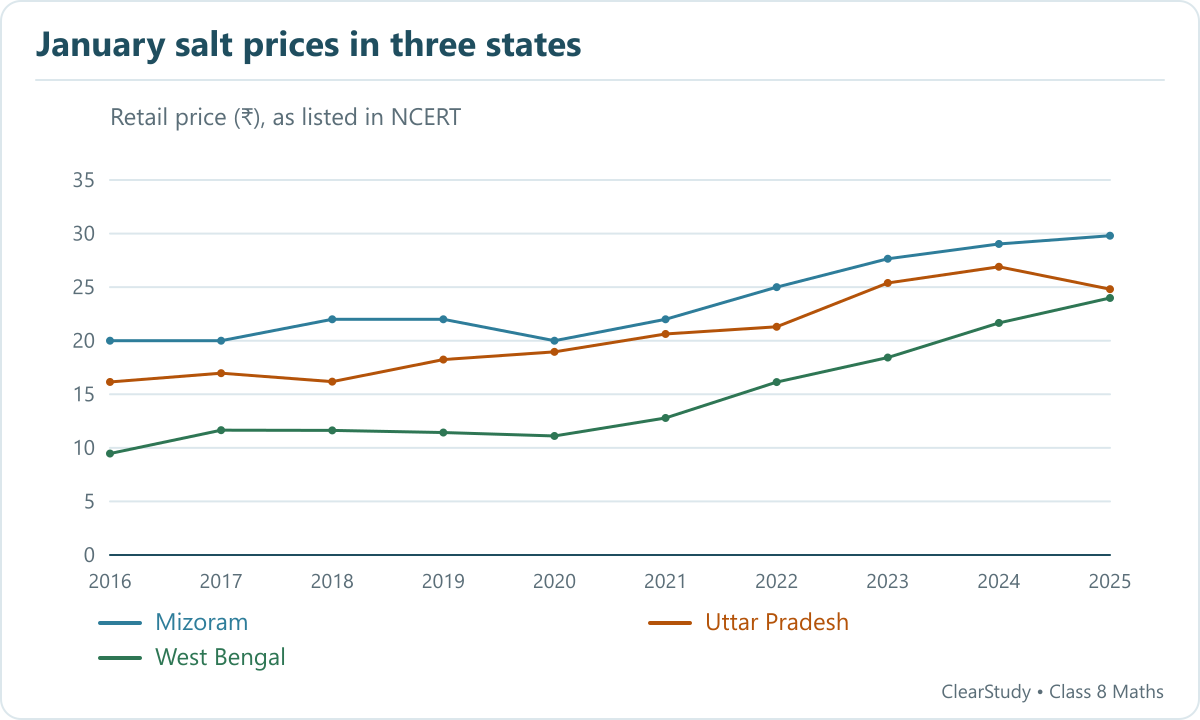
9. The following table shows the retail price (in ₹) of iodised salt in the month of January in a few states over 10 years. (i) Choose data from any 3 states you find interesting and present it through a line graph using an appropriate scale. (ii) What do you find interesting in this data? Share your observations. (iii) Compare the price variation in Gujarat and Uttar Pradesh. (iv) In which state has the price increased the most from 2016 to 2025? (v) What are you curious to explore further?
10. Referring to the graph below (primary source of energy for household lighting over time), which of the following statements are valid? Why? (i) In 1983, the majority in rural areas used kerosene as a primary lighting source while the majority in urban areas used electricity. (ii) The use of kerosene as a primary lighting source has decreased over time in both rural and urban areas. (iii) In the year 2000, 10% of the urban households used electricity as a primary lighting source. (iv) In 2023, there were no power cuts.
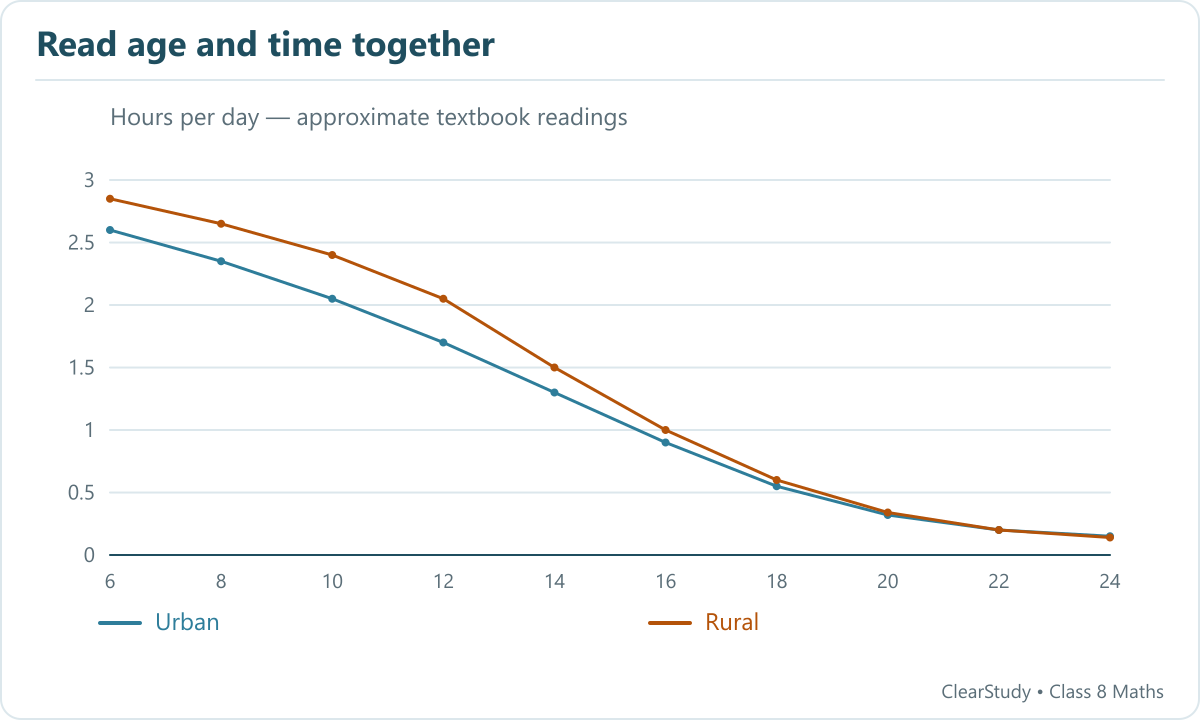
11. Answer the following questions based on the line graph (average daily time spent on hobbies and games). (i) How long do children aged 10 in urban areas spend each day on hobbies and games? (ii) At what age is the average time spent daily on hobbies and games by rural kids 1.5 hours? (a) 8 (b) 10 (c) 12 (d) 14 (e) 18 years (iii) Are the following statements correct? (a) The average time spent daily on hobbies and games by kids aged 15 is twice that of kids aged 10. (b) All rural kids aged 15 spend at least 1 hour on hobbies and games everyday.
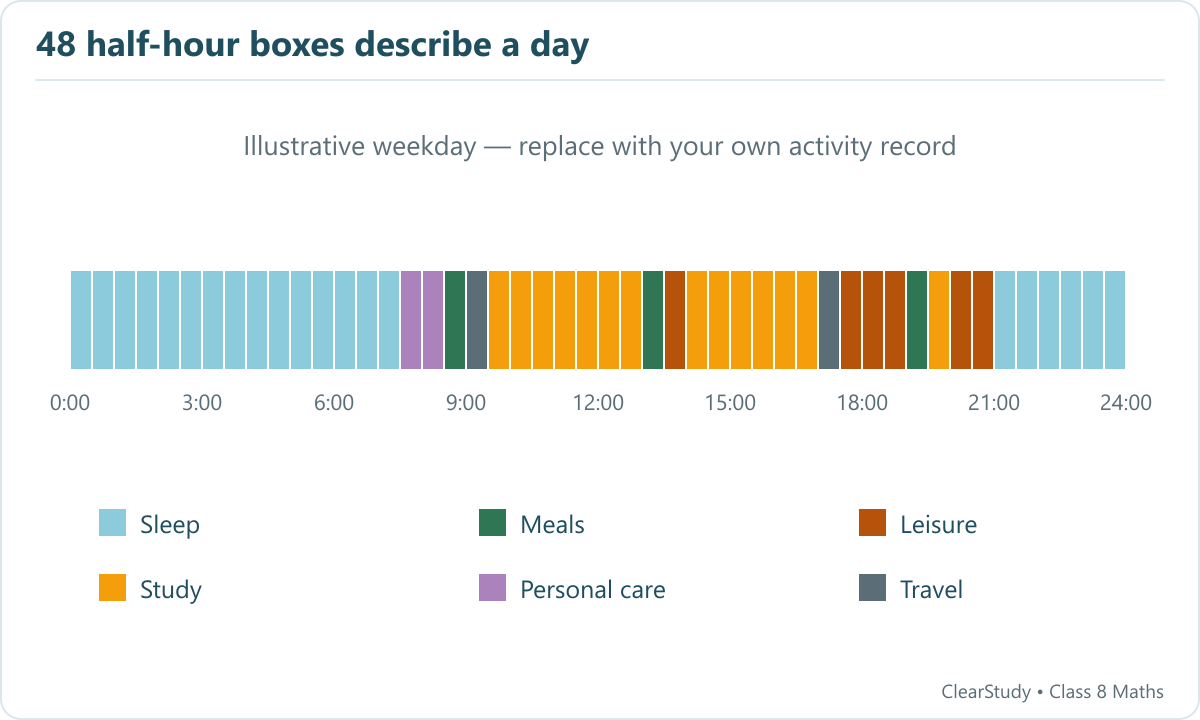
12. Individual project: your activity strips
Record your own week in half-hour blocks, using 48 blocks per day. For each activity, add its total hours over seven days and divide by 7. The category means should sum to 24 hours if every interval is counted once. Compare regularity of meals, sleep and outdoor time. The example below is illustrative, not a record of your day.
13. Group projects: collect and compare data
For the sleep project, record night sleep and naps consistently for seven days. For each age group, clearly choose whether your observations are daily person-records or each person’s seven-day average; then calculate the mean and median of that chosen list. Do not treat a small convenience sample as representative of everyone.
For school timings, record start, end, breaks and total daily duration for each school. For Manoj, 09:30–16:30 is 7 hours including breaks. Compare like-for-like daily totals; subtract breaks separately only when reporting teaching time.
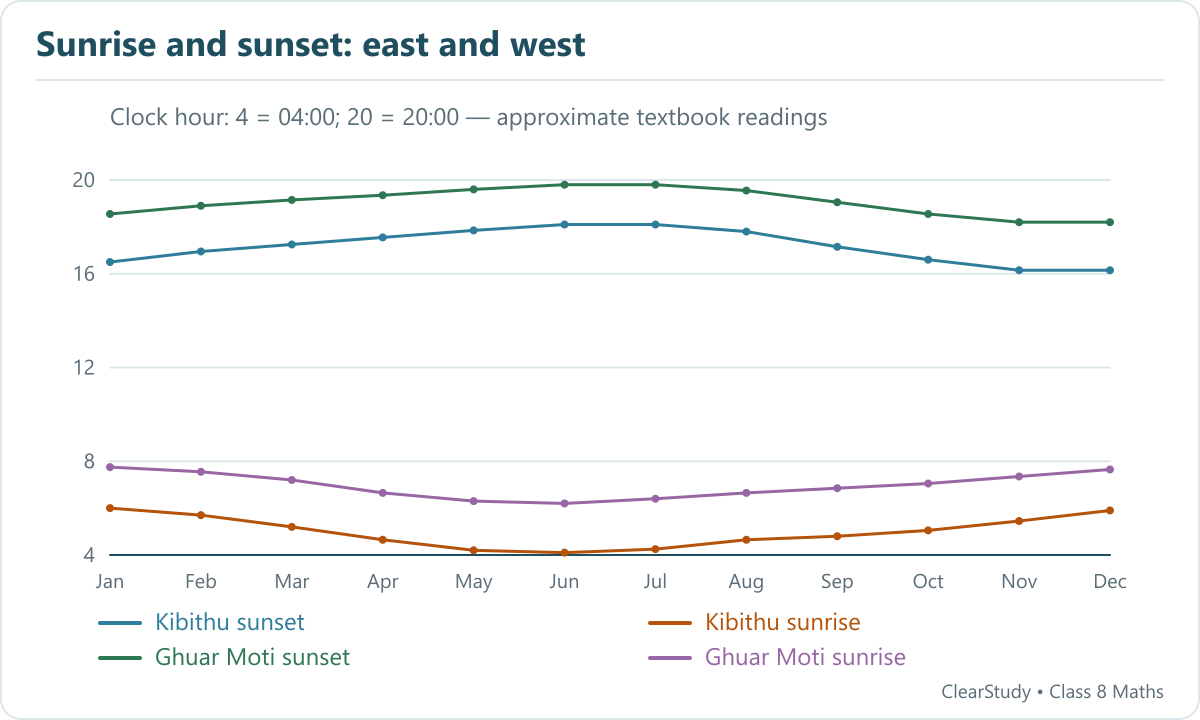
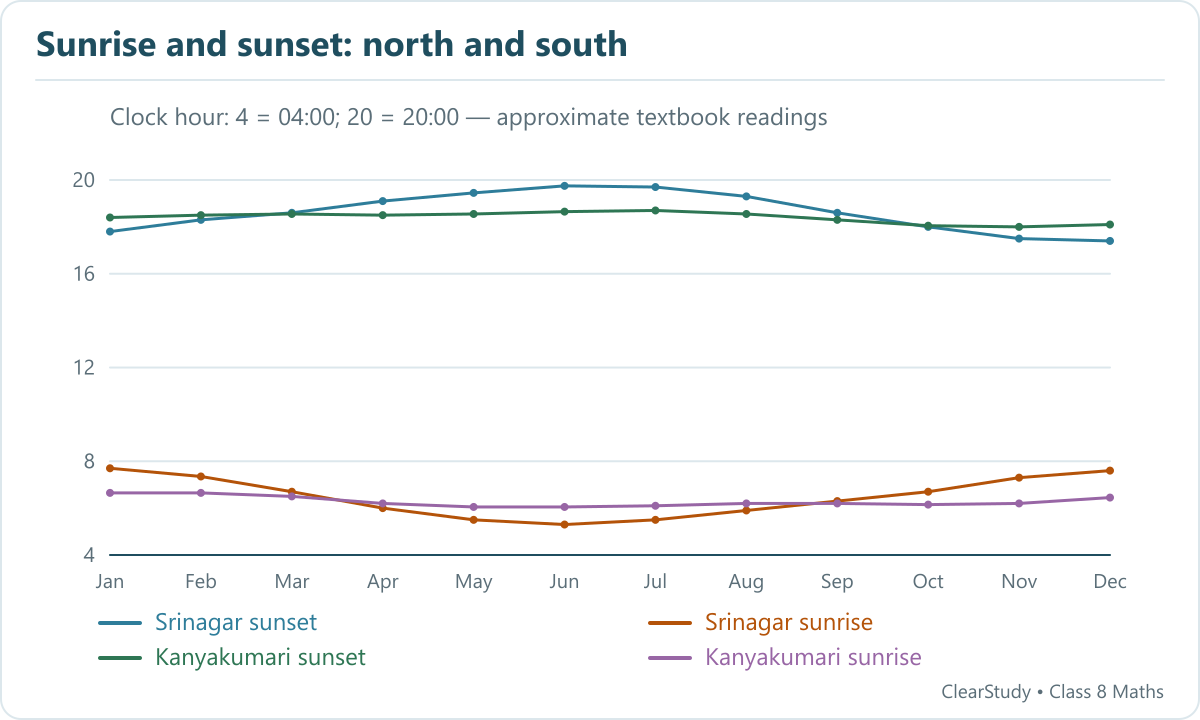
14. The following graphs show the sunrise and sunset times across the year at 4 locations in India. (i) At which place does the sun rise the earliest in January? What is the approximate day length at this place in January? (ii) Which place has the longest day length over the year? (iii) Share your observations.
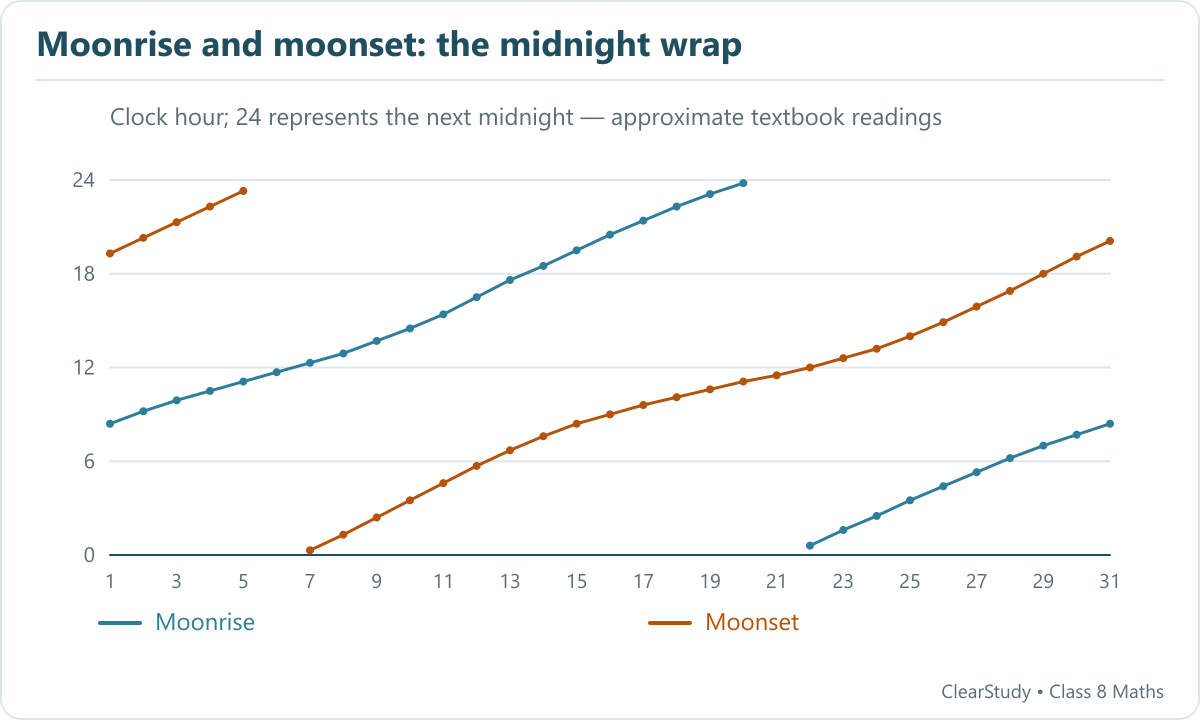
15. The following graph shows the moonrise and moonset time over a month. (i) Find out on what dates amavasya (new moon) and purnima (full moon) were in this month. (ii) What do you notice? What do you wonder?
Math Talk & Try This (in-text questions)
Further in-text activities
Spreadsheet calculations (pages 111–113)
With the textbook headers in row 1 and the 22 students in rows 2–23: Farooq’s Maths mark is E5 = 42; B7 = 27 is Gowri’s Odia mark. Ashwin scored above 30 in Telugu (31), English (33) and Maths (34).
Use =SUM(B2:G2) for Ratna’s total and copy down. Use =AVERAGE(G2:G23) for Science; use the corresponding B–F ranges for the other subjects.
| Subject | Class average (rounded) |
|---|---|
| Odia | 31.23 |
| Telugu | 33.59 |
| English | 32.64 |
| Maths | 34.14 |
| Social Science | 31.36 |
| Science | 33.14 |
Odia’s mean (31.23) is less than Telugu’s (33.59).
| Student | Total marks |
|---|---|
| Ratna | 200 |
| Nagesh | 250 |
| Ashwin | 185 |
| Farooq | 266 |
| Mrinal | 194 |
| Gowri | 183 |
| Pankaj | 112 |
| Jaya | 248 |
| Ganesh | 225 |
| Shravan | 102 |
| Aishwarya | 273 |
| Hari | 147 |
| Trupti | 188 |
| Veeresh | 148 |
| Vidhya | 213 |
| Sanskruti | 242 |
| Shanker | 232 |
| Vyshnavi | 197 |
| Govind | 103 |
| Shiva | 177 |
| Tarun | 246 |
| Jyothi | 183 |
Keep the mean unchanged (pages 105–108)
To add k observations without changing a current mean m, their sum must be km. For example, at mean 12 add 10 and 14, or 10, 11 and 15, or 13, 14 and 9. Removing a group preserves the mean only if that group also has mean m and some observations remain. For the eleven-number list on page 106, sum = 79 and mean = 79/11 ≈ 7.18; adding 10 to each value makes it 189/11 ≈ 17.18, and doubling each value makes it 158/11 ≈ 14.36.
Rice and wheat infographic (page 124)
Read this as a historical preference index from the textbook’s 2011–12 survey data, not a current percentage. Karnataka’s colour suggests a positive value, roughly +80; the exact hidden number cannot be recovered from the shade alone. The five highest rice indices are Manipur +100, Nagaland +99, Mizoram +97, Tripura +96, Meghalaya +95.
Among states, the five strongest wheat preferences are Rajasthan −93, Haryana −81, Punjab −78, Madhya Pradesh −60, Gujarat −37. Delhi (a union territory) is −45 and would rank ahead of Gujarat if states and union territories are considered together. Bihar +3 is closest to balance; Maharashtra −15, Uttarakhand −18 and Himachal Pradesh −19 are also relatively close. +100 does not mean zero wheat consumption.
Manoj’s activity strips (page 125)
From the long overnight band and the repeated school block, a reasonable colour key is: blue = sleep; green = meals; orange = leisure; yellow = study/classes; purple = personal care/exercise; grey = travel. The middle strip fits Friday, the right strip a possible Saturday, and the left a possible Sunday; swapping the two weekend labels cannot be ruled out from colours alone.
The long leisure block on the left strip, about 13:30–16:30, with travel on either side, plausibly represents the movie outing. The Friday strip indicates lunch around 12:30–13:00. Activity identities and weekend ordering are inferences from the pattern, not uniquely encoded labels.
Common Mistakes to Avoid
Watch out for these
- Finding the mean of values without their frequencies — multiply each value by how many times it occurs before adding.
- Confusing the mean (balance point / sum ÷ count) with the midpoint of the smallest and largest values — they are not the same.
- For an even number of values, forgetting that the median is the average of the two middle values, not just the lower one.
- When every value changes by a constant, recomputing from scratch instead of using “new mean = old mean ± k” or “× k”.
- Reading a line graph at the wrong axis — always match a point to both its horizontal (time) and vertical (value) coordinates.
- Drawing conclusions about individuals from a graph of averages — an average tells you nothing certain about any single person.
Practice MCQs & Assertion–Reason
1. The arithmetic mean of a set of values is:
(a) the largest value (b) the middle value (c) the sum ÷ the number of values (d) the most frequent value
2. The mean of the first 10 natural numbers is:
(a) 5 (b) 5.5 (c) 10 (d) 55
3. If the mean of 6 values is 12, the sum of the values is:
(a) 2 (b) 18 (c) 72 (d) 6
4. If every value of a data set is increased by 5, the mean:
(a) stays the same (b) increases by 5 (c) is multiplied by 5 (d) decreases by 5
5. If every value of a data set is doubled, the mean is:
(a) halved (b) unchanged (c) doubled (d) increased by 2
6. The median of 4, 7, 9, 11, 15 is:
(a) 7 (b) 9 (c) 11 (d) 9.2
7. The median of 6, 8, 10, 12 is:
(a) 8 (b) 9 (c) 10 (d) 12
8. Including a value equal to the mean in a data set will make the mean:
(a) increase (b) decrease (c) stay the same (d) double
9. A line graph is most suitable for showing:
(a) parts of a whole (b) how a quantity changes over time (c) exact frequencies (d) a single value
10. On a line graph, a steeper line segment between two points indicates:
(a) no change (b) a smaller change (c) a greater (faster) change (d) an error
For each Assertion–Reason question, choose: (A) Both Assertion and Reason are true and the Reason is the correct explanation of the Assertion; (B) Both are true but the Reason is not the correct explanation; (C) Assertion is true but Reason is false; (D) Assertion is false but Reason is true.
A-R 1. Assertion: The mean of 2 and 8 is 5.
Reason: The mean of two numbers is their sum divided by 2.
A-R 2. Assertion: If every value of a data set is increased by 10, the mean increases by 10.
Reason: Adding a constant k to every value adds k to the sum for each value, so the mean rises by k.
A-R 3. Assertion: The mean is always one of the values in the data.
Reason: The mean is the balance point of the data.
A-R 4. Assertion: Including a value greater than the mean increases the mean.
Reason: The new value pulls the balance point towards itself.
A-R 5. Assertion: A line graph is a suitable choice for showing a numerical trend over time.
Reason: Joining data points by line segments makes trends easy to see.
Quick Revision Summary
- Mean = sum of all values ÷ number of values; it is the balance point where left-side and right-side distances are equal.
- There is exactly one mean (one centre) for a data set.
- Adding a value above the mean raises it; below the mean lowers it; equal to the mean leaves it unchanged.
- Add a constant k to every value → mean rises by k; multiply every value by k → mean is multiplied by k.
- With frequencies, mean = Σ(value × frequency) ÷ Σ(frequency); the median is found using running totals of the frequencies.
- The median is the middle value (or the average of the two middle values) of the sorted data.
- Line graphs visualise change over time; steeper segments mean faster change. Always read both axes before concluding.
How to score full marks in this chapter
Show the formula “sum = mean × count” for every “find the missing value” question, and write the running totals when finding a median from a frequency table. For line-graph questions, state the value you read and the axis you read it from, and never claim something about an individual from a graph of averages. Keep fractions exact (e.g. 39/7) before rounding to a decimal.
Frequently Asked Questions
What is Class 8 Maths Ganita Prakash Chapter 12 about?
Chapter 12, Tales by Dots and Lines (Chapter 5 of Ganita Prakash Part II), is about the arithmetic mean and median seen as balance points on dot plots, how these change when data changes, the mean from frequency tables and spreadsheets, and reading and drawing line graphs to interpret data over time.
What is the formula for the arithmetic mean?
The mean (average) equals the sum of all the observations divided by the number of observations: mean = (x1 + x2 + … + xn) / n. You can also write sum = mean times the number of values.
How do you find a missing value when the mean is given?
Multiply the mean by the number of values to get the required total, then subtract the sum of the known values. For example, if the mean of 10 numbers is 39.2, the total is 392, so a missing value is 392 minus the sum of the other nine numbers.
Are these Class 8 Maths Ganita Prakash Chapter 12 solutions free?
Yes. All ClearStudy NCERT solutions for Class 8 Maths Ganita Prakash Chapter 12 are free and follow the official NCERT Ganita Prakash textbook for 2026-27.
Textbook reference: NCERT Ganita Prakash, Chapter 12 (official PDF). ClearStudy diagrams and worked explanations are original teaching aids.