These Class 8 Maths Ganita Prakash Chapter 4 solutions cover Quadrilaterals from the new NCF-2023 textbook (2026–27). Use the page-wise worked answers, labelled diagrams and construction steps below, with the angle sum, congruence and diagonal properties of rectangles, squares, parallelograms, rhombuses, kites and trapeziums explained clearly for exams.
Class: 8Subject: MathematicsBook: Ganita Prakash (Part I)Chapter: 4Exercises: Figure it Out (4 sets) + Math Talk / Try ThisSession: 2026–27
Chapter 4 of Ganita Prakash, Quadrilaterals, studies four-sided figures and their special types. Starting from the carpenter’s problem of joining two wooden strips, the chapter uses congruence and geometric reasoning to deduce the properties of rectangles, squares, parallelograms, rhombuses, kites and trapeziums. It proves that the diagonals of a rectangle are equal and bisect each other, that the diagonals of a square also meet at 90° and bisect the angles, that the opposite sides and angles of a parallelogram are equal, and that the diagonals of a rhombus are perpendicular. A key general result — the sum of the angles of any quadrilateral is 360° — is established by splitting the figure into two triangles. The Class 8 Maths Ganita Prakash Chapter 4 solutions below work through every exercise step by step.
Key Concepts & Definitions
Quadrilateral: a closed figure with four sides; the word comes from Latin quadri (four) and latus (sides).
Rectangle: a quadrilateral in which all the angles are 90°. (Equivalently, its diagonals are equal and bisect each other.)
Square: a quadrilateral in which all the angles are 90° and all the sides are equal. Every square is a rectangle (and a rhombus), but not every rectangle is a square.
Parallelogram: a quadrilateral in which both pairs of opposite sides are parallel.
Rhombus: a quadrilateral in which all four sides have the same length. Every rhombus is a parallelogram.
Kite: a quadrilateral that can be labelled ABCD with AB = BC and CD = DA (two pairs of equal adjacent sides).
Trapezium: a quadrilateral with at least one pair of parallel opposite sides; if the non-parallel sides are equal it is an isosceles trapezium.
Important Formulas & Properties (Chapter 4)
Angle sum of a quadrilateral: ∠A + ∠B + ∠C + ∠D = 360° (split into two triangles of 180° each).
Rectangle: all angles 90°; opposite sides equal and parallel; diagonals equal and bisect each other.
Square: all sides equal; all angles 90°; diagonals equal, bisect each other at 90°, and bisect the angles (into 45° each).
Parallelogram: opposite sides equal and parallel; opposite angles equal; adjacent angles add to 180°; diagonals bisect each other.
Rhombus: all sides equal; opposite angles equal; diagonals bisect each other at right angles and bisect the angles.
Kite: one diagonal bisects the other at 90° and bisects the two angles it joins.
Trapezium (PQ∥SR): ∠S + ∠P = 180° and ∠R + ∠Q = 180°; in an isosceles trapezium the base angles are equal.
Figure it Out — Page 94
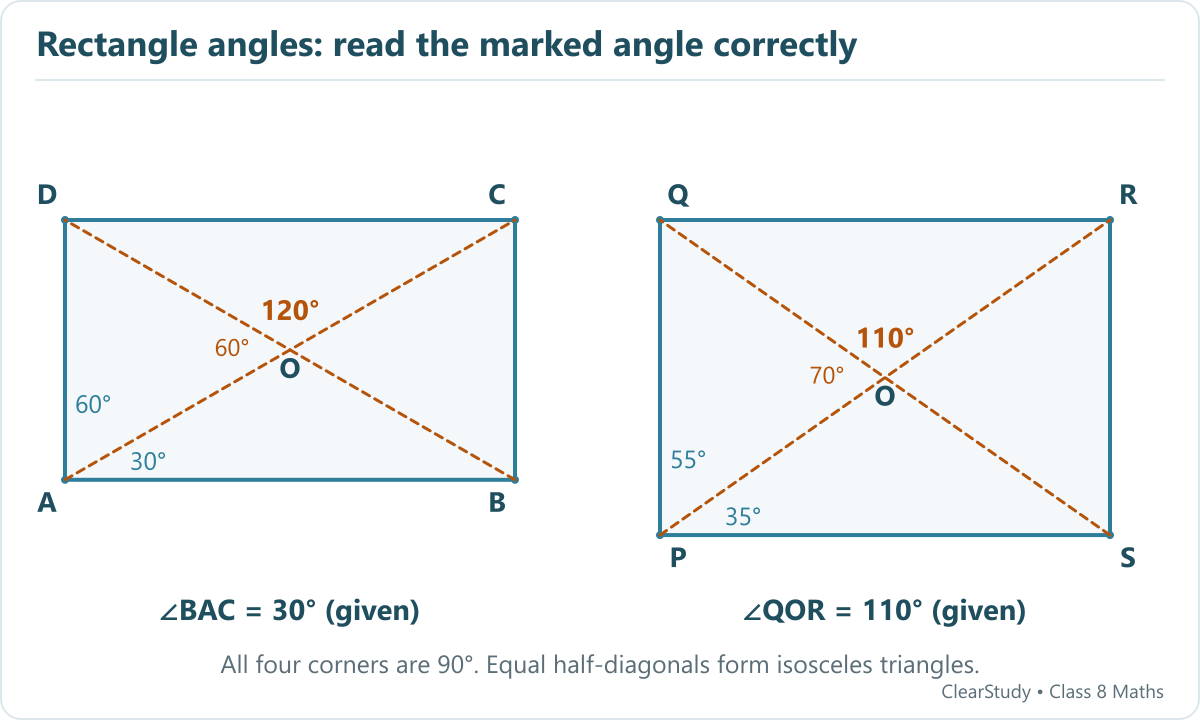
1. Find all the other angles inside the following rectangles.
(i) Rectangle ABCD (with D, C on top and A, B on the bottom): the angle ∠BAC at vertex A between side AB and diagonal AC is 30°.(ii) Rectangle PQRS (with Q, R on top and P, S on the bottom): the angle ∠QOR at the centre O between the diagonals (the angle facing QR) is 110°.
SOLUTION(i) The given angle is ∠BAC = 30°. Since ∠DAB = 90°, ∠DAC = 60°. Rectangle diagonals are equal and bisect each other, so OA = OB = OC = OD.In isosceles △AOB, ∠ABO = ∠BAO = 30°, hence ∠ABD = 30° and ∠DBC = 60°. Using parallel opposite sides gives ∠ACD = 30°, ∠ACB = 60°, ∠BDC = 30° and ∠ADB = 60°.The four central angles are ∠AOB = ∠COD = 120° and ∠AOD = ∠BOC = 60°. For example, ∠AOB = 180° − 30° − 30° = 120°.(ii) ∠QOR = 110° implies ∠POS = 110° and ∠QOP = ∠ROS = 70° by vertically opposite angles and linear pairs.In △OQR, OQ = OR, so ∠OQR = ∠ORQ = (180° − 110°)/2 = 35°. Likewise, ∠OPS = ∠OSP = 35°.The remaining corner parts are ∠OQP = ∠OPQ = ∠ORS = ∠OSR = 55°, because 90° − 35° = 55°. Each corner is 35° + 55° = 90°.
Page 94, Question 1: the first given angle is between AB and AC, so it is BAC, not DAC.
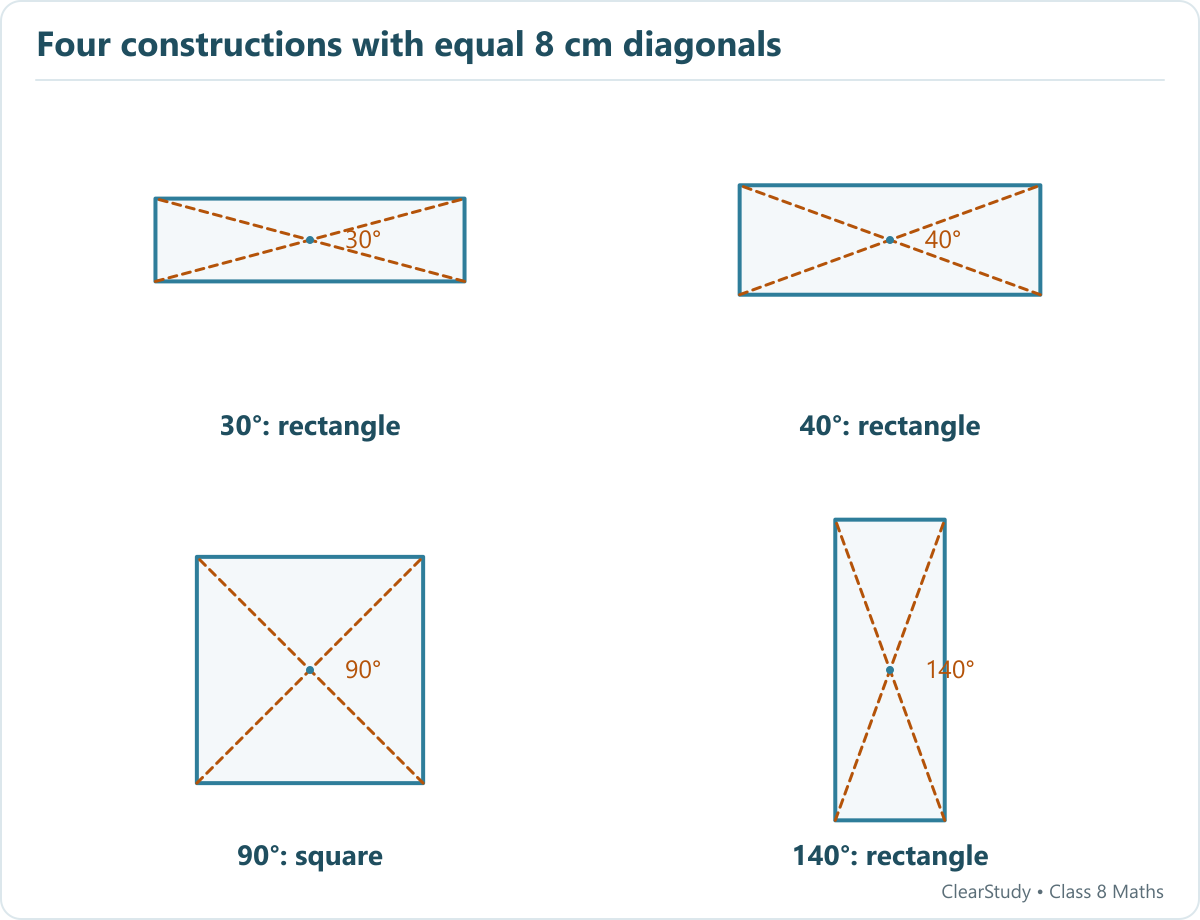
2. Draw a quadrilateral whose diagonals have equal lengths of 8 cm that bisect each other, and intersect at an angle of
(i) 30° (ii) 40° (iii) 90° (iv) 140°
SOLUTIONFor each case, draw AB = 8 cm and mark its midpoint O. Then OA = OB = 4 cm.Draw a ray OC making the required angle with OB: 30°, 40°, 90° or 140°. Extend the line through O in the opposite direction, and mark C and D so that OC = OD = 4 cm.Join A–C–B–D–A in boundary order. Its diagonals AB and CD are equal and bisect each other, so ACBD is a rectangle.The 90° case is a square. The other cases are non-square rectangles with different proportions. Changing the angle between the diagonals does not remove the right angles at the corners.
Every centre-to-vertex distance is 4 cm. Draw with a ruler and protractor; the screen drawing is not a measuring template.
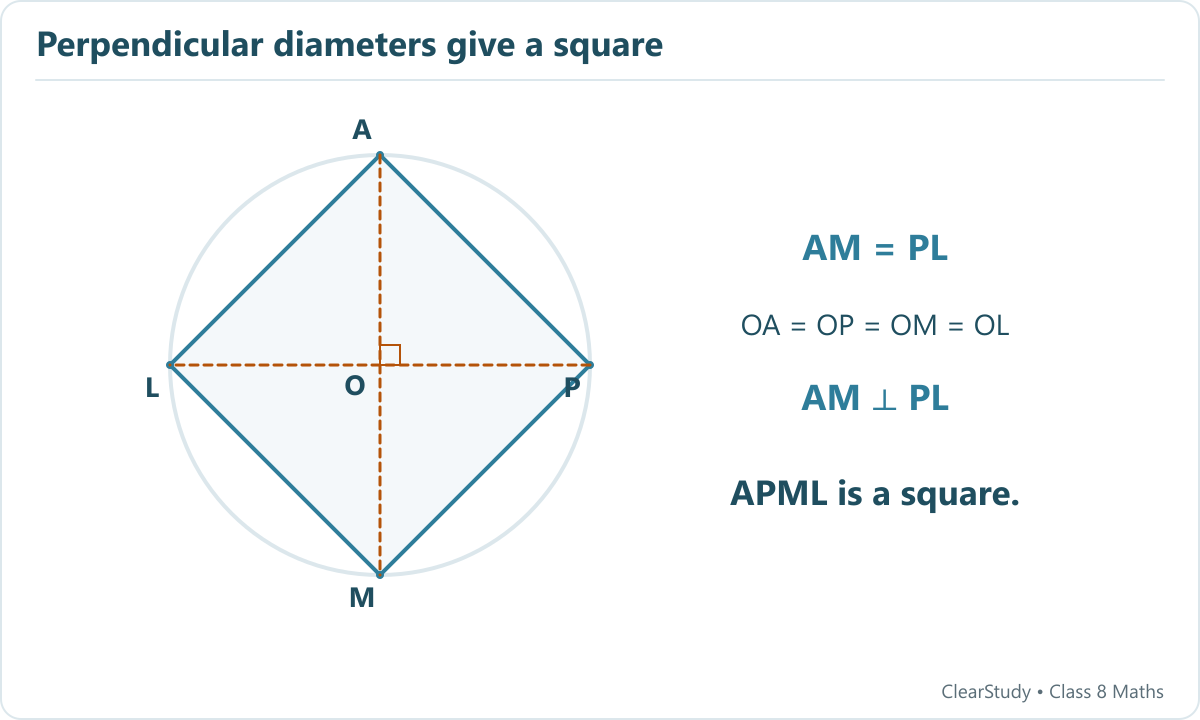
3. Consider a circle with centre O. Line segments PL and AM are two perpendicular diameters of the circle. What is the figure APML? Reason and/or experiment to figure this out.
SOLUTIONPL and AM are diameters, so they are equal in length and meet at the centre O, which is the midpoint of each — the diagonals AM and PL of quadrilateral APML are equal and bisect each other.They are also perpendicular (given). Equal diagonals + bisecting each other ⇒ rectangle; perpendicular diagonals as well ⇒ APML is a square.
Equal, perpendicular diagonals bisecting each other are a test for a square.
4. We have seen how to get 90° using paper folding. Now, suppose we do not have any paper but two sticks of equal length, and a thread. How do we make an exact 90° using these?
SOLUTIONLet the two equal sticks be AB and CD. Place them so that their midpoints coincide at one point O (each stick is bisected at O).Use the thread to join the four endpoints A, C, B, D in order. Because the two “diagonals” AB and CD are equal and bisect each other, ACBD is a rectangle, so every corner is 90° — for example ∠C = 90°. This gives an exact right angle.(Another way uses the properties of an isosceles triangle.)
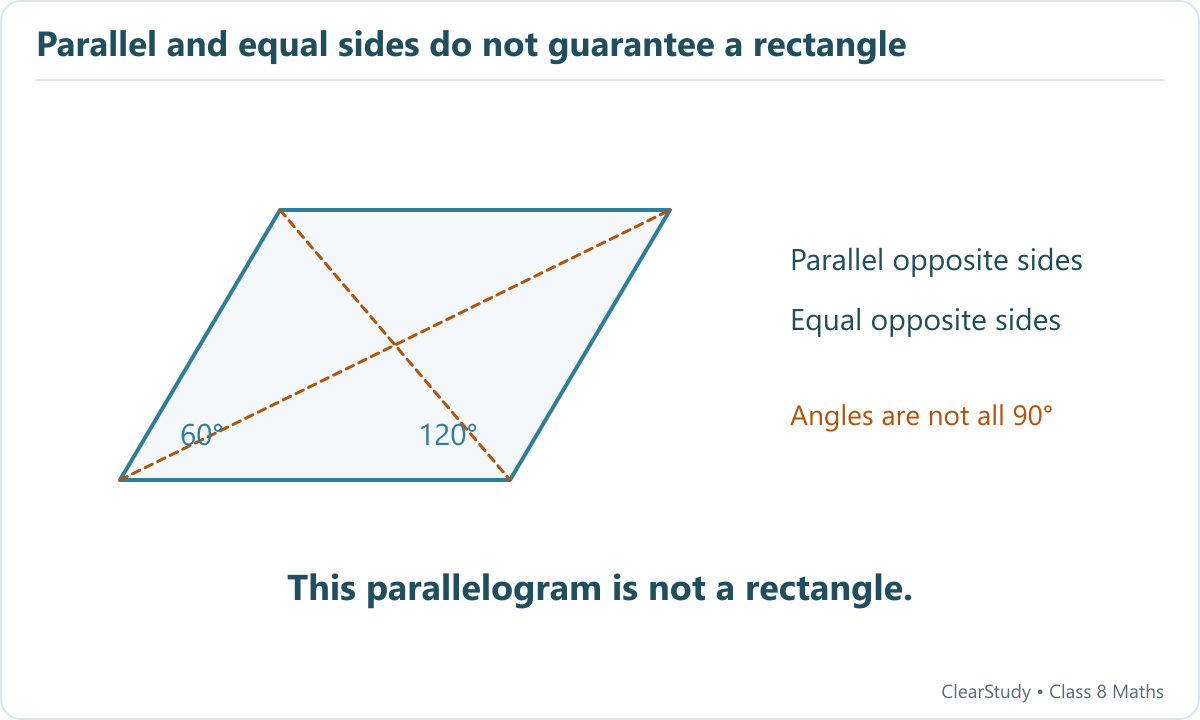
5. We saw that one of the properties of a rectangle is that its opposite sides are parallel. Can this be chosen as a definition of a rectangle? In other words, is every quadrilateral that has opposite sides parallel and equal, a rectangle?
SOLUTIONNo, this cannot be taken as a definition of a rectangle.A quadrilateral with opposite sides parallel (and equal) is a parallelogram, but its angles need not be 90° — a slanted parallelogram (e.g. a rhombus drawn at 50°) has parallel opposite sides yet is not a rectangle. A rectangle needs the extra condition that the angles are all 90°.
Page 94, Question 5: a single valid counterexample disproves an “every quadrilateral” claim.
Figure it Out — Page 102
1. Find the remaining angles in the following quadrilaterals.
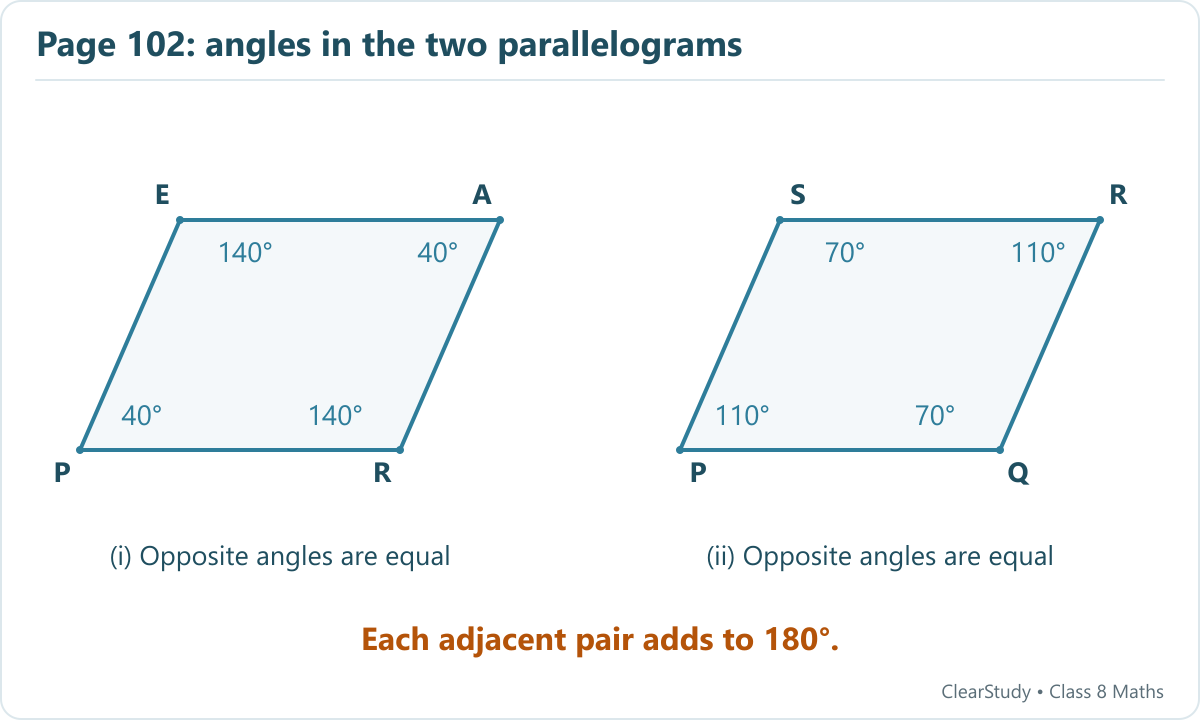
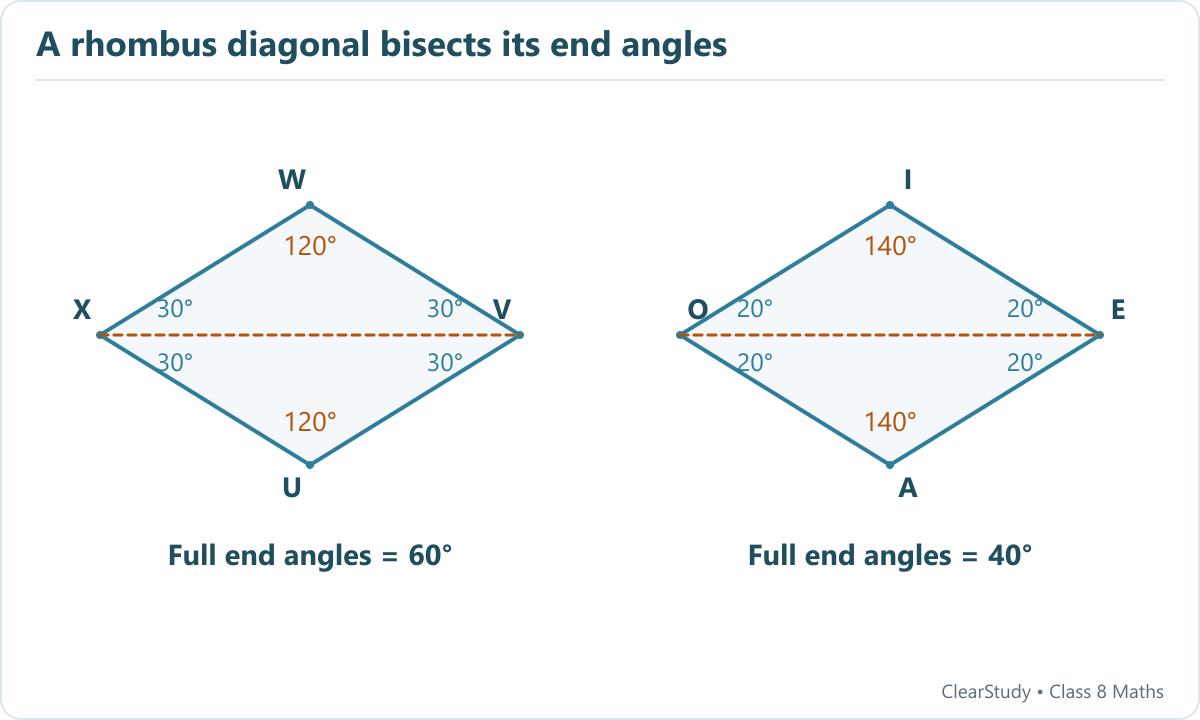
(i) Parallelogram PRAE (PR ∥ EA, PE ∥ RA) with ∠P = 40°.(ii) Parallelogram PQRS (SR ∥ PQ, SP ∥ RQ) with ∠P = 110°.(iii) Rhombus XWVU with diagonal XV drawn, and ∠XVU = 30° at vertex V.(iv) Rhombus OIEA with diagonal OE drawn, and ∠IEA-part ∠OEA = 20° at vertex E.
SOLUTION(i) In parallelogram PRAE, opposite angles are equal and adjacent angles add to 180°. ∠P = 40° ⇒ ∠E = 140°, ∠R = ∠E = 140°, and ∠A = ∠P = 40°.(ii) ∠P = 110° ⇒ ∠Q = 180° − 110° = 70°; ∠S = ∠Q = 70° and ∠R = ∠P = 110°.(iii) In a rhombus a diagonal bisects the vertex angles and the four part-angles a diagonal makes are equal. With ∠XVU = 30°, by symmetry ∠XVW = 30°, so the full angle ∠UVW = 60°. Therefore ∠WXU = ∠UVW = 60°, and ∠UXV = ∠WXV = 30°. The adjacent angle ∠U = 180° − 60° = 120°, and ∠W = ∠U = 120°.(iv) Similarly, with the part-angle 20° at E: ∠OEI = 20°, ∠AOE = 20°, ∠EOI = 20°, the equal vertex angles give ∠A = 180° − 40° = 140° and ∠I = 140°.
Angle values are determined by the given angle and parallel sides. The diagrams are schematic.Page 102, Question 1(iii–iv). Figures are schematic; use angle bisection and supplementary adjacent angles.
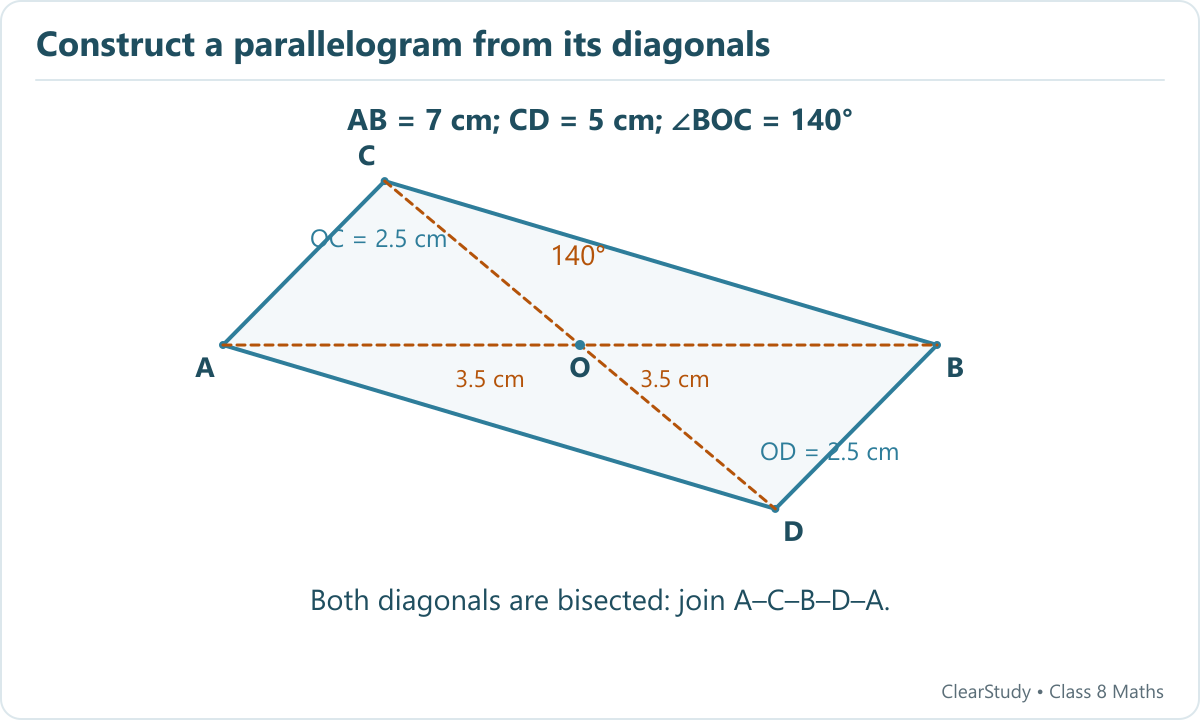
2. Using the diagonal properties, construct a parallelogram whose diagonals are of lengths 7 cm and 5 cm, and intersect at an angle of 140°.
SOLUTIONDraw AB = 7 cm. Mark midpoint O, so OA = OB = 3.5 cm.Draw ray OC with ∠BOC = 140°. Extend CO through O to the opposite side. Mark C and D with OC = OD = 2.5 cm.Join A–C–B–D–A. The diagonals AB = 7 cm and CD = 5 cm bisect each other, so ACBD is a parallelogram.The adjacent angle AOC is 40°. Both 140° and 40° occur where the diagonal lines cross.
Page 102, Question 2: halve 7 cm and 5 cm to obtain 3.5 cm and 2.5 cm.
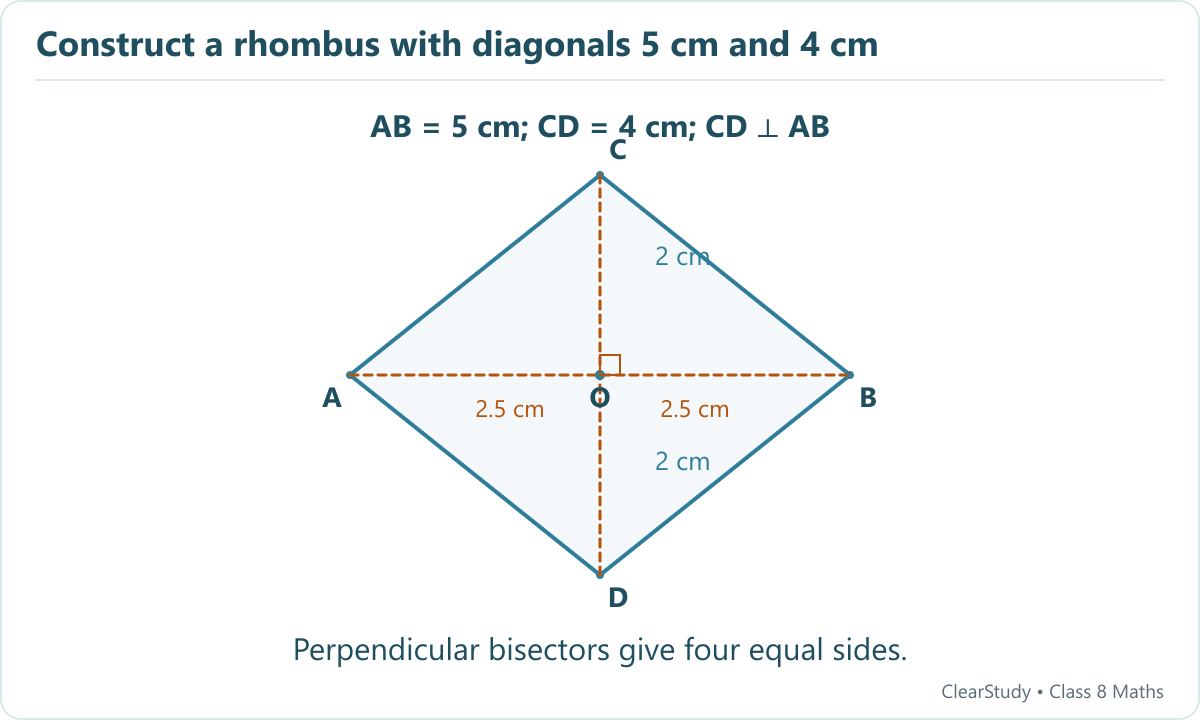
3. Using the diagonal properties, construct a rhombus whose diagonals are of lengths 4 cm and 5 cm.
SOLUTIONThe diagonals of a rhombus bisect each other at right angles. Draw a segment AB = 5 cm and mark its midpoint O, so OA = OB = 2.5 cm.At O draw a perpendicular (90°) to AB. On it mark C and D on opposite sides with OC = OD = 2 cm (half of the 4 cm diagonal).Join AC, CB, BD, DA. ACBD is the required rhombus (all four sides come out equal because the diagonals are perpendicular bisectors of each other).
Page 102, Question 3: the four small right triangles are congruent, so the outside sides are equal.
Figure it Out — Page 107
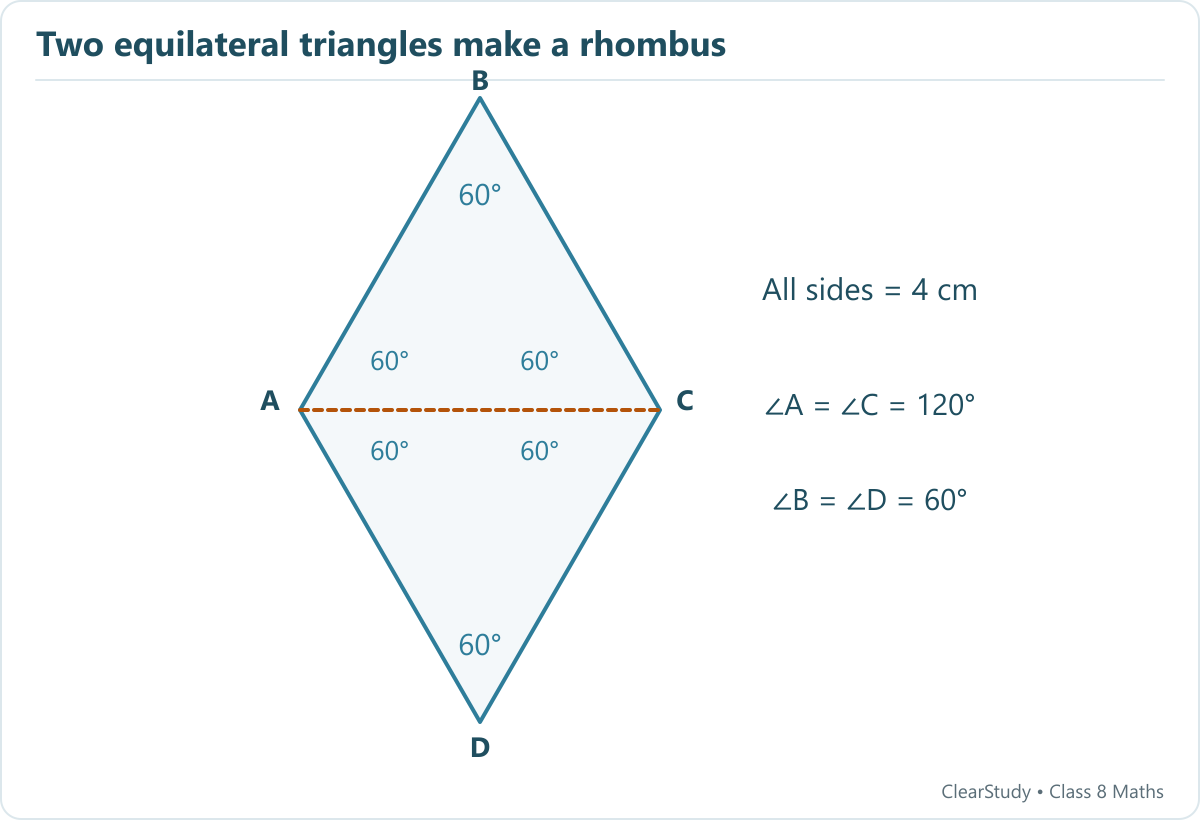
1. Find all the sides and the angles of the quadrilateral obtained by joining two equilateral triangles with sides 4 cm.
SOLUTIONEach angle of an equilateral triangle is 60° and each side is 4 cm. Joining two such triangles along a common 4 cm side gives a rhombus ABCD.All four sides = 4 cm. The angles at the two vertices on the common edge are 60° + 60° = 120° each, and the other two angles are 60° each.So the quadrilateral is a rhombus with sides 4 cm, 4 cm, 4 cm, 4 cm and angles 60°, 120°, 60°, 120° (sum = 360°. ✓).
Page 107, Question 1: the shared side is inside the rhombus and is not an outside edge.
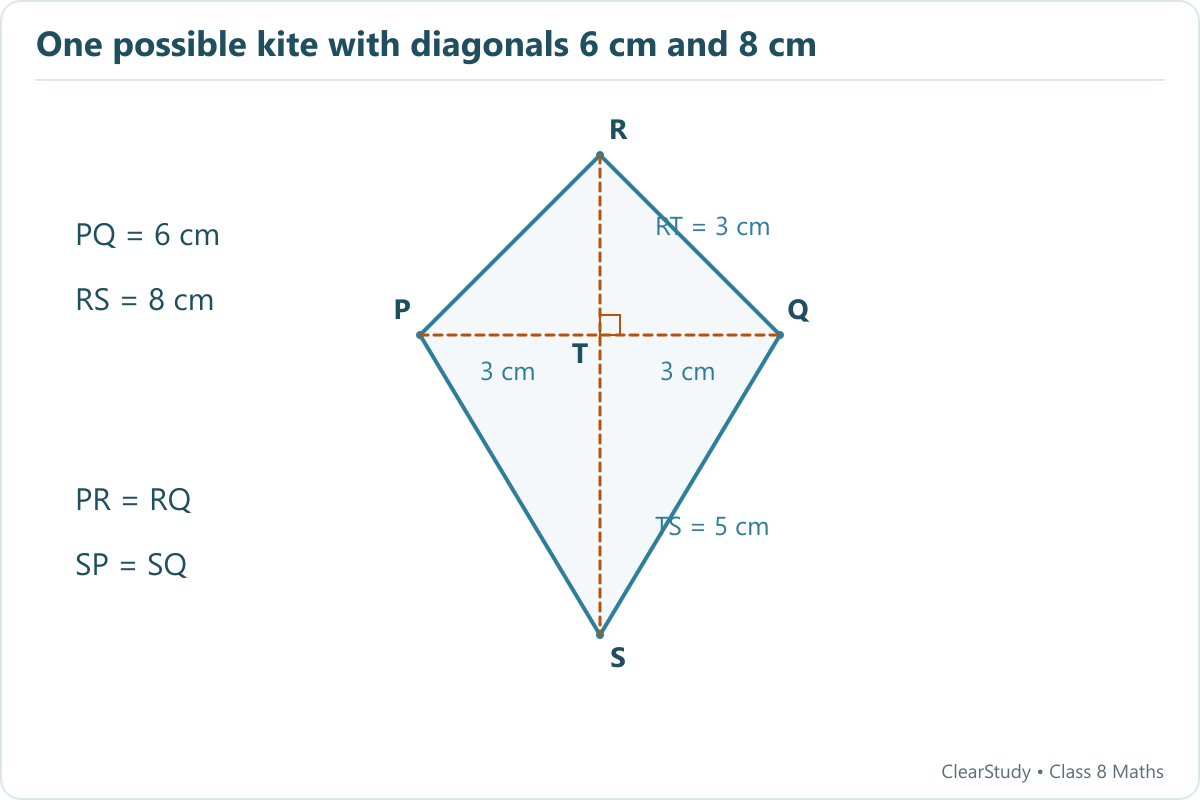
2. Construct a kite whose diagonals are of lengths 6 cm and 8 cm.
SOLUTIONDraw PQ = 6 cm and construct its perpendicular bisector through midpoint T. Thus PT = TQ = 3 cm.On the perpendicular, choose RT = 3 cm above T and TS = 5 cm below T. Then RS = 8 cm.Join P–R–Q–S–P. Triangles PRT and QRT are congruent by SAS, so PR = RQ. Similarly, triangles PST and QST are congruent, so SP = SQ. Hence PRQS is a kite.This is one valid construction. Other positive choices RT + TS = 8 cm also work. Taking RT = TS = 4 cm gives the special kite that is a rhombus.
Page 107, Question 2: RS bisects PQ; PQ does not bisect RS in this example.
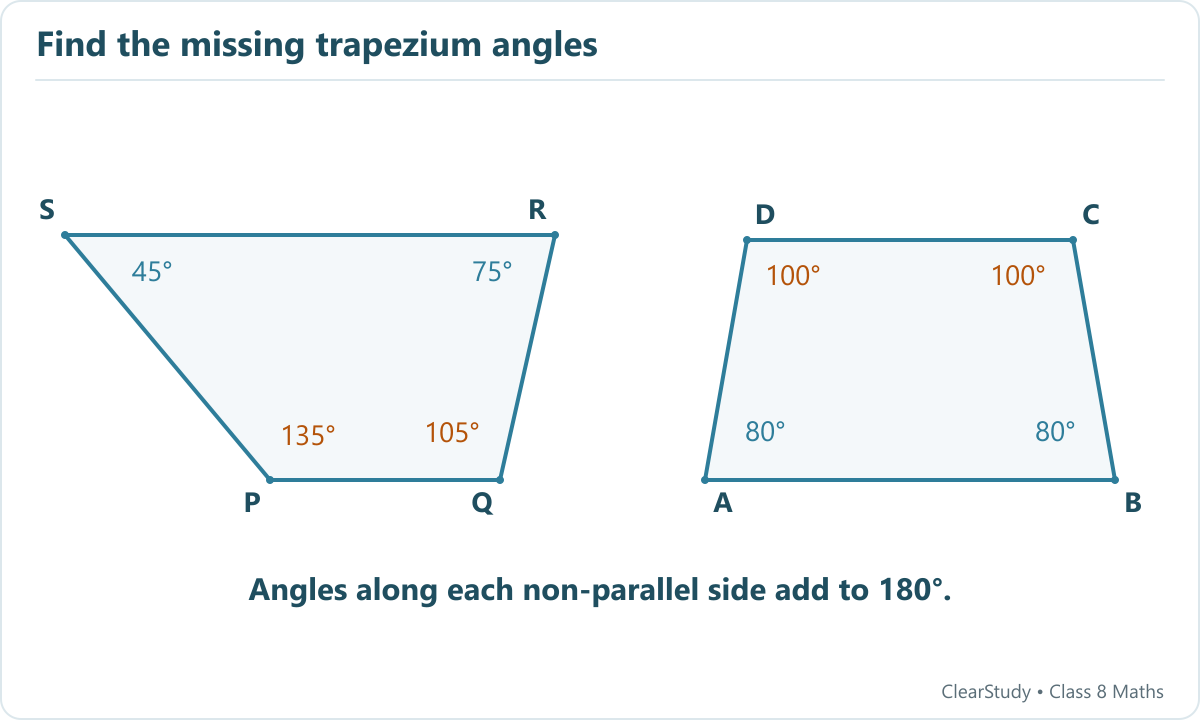
3. Find the remaining angles in the following trapeziums.
(i) Trapezium with the two bottom base angles marked 135° and 105° and the top side parallel to the base.(ii) Trapezium ABCD with one pair of parallel sides, equal slant sides marked, and one angle 100°.
SOLUTION(i) Let the trapezium be PQRS with PQ ∥ SR, and base angles ∠P = 135°, ∠Q = 105°. The internal angles on the same side of a transversal between parallel lines add to 180°.∠S + ∠P = 180° ⇒ ∠S = 180° − 135° = 45°; ∠R + ∠Q = 180° ⇒ ∠R = 180° − 105° = 75°. (Check: 135 + 105 + 45 + 75 = 360°. ✓)(ii) This is an isosceles trapezium ABCD (the non-parallel sides are equal, AD = BC), with the given angle ∠D = 100°. In an isosceles trapezium the angles at each parallel base are equal, and co-interior angles add to 180°.∠A = 180° − 100° = 80°; since AD = BC, ∠B = ∠A = 80°, and ∠C = ∠D = 100°. (Check: 80 + 80 + 100 + 100 = 360°. ✓)
Page 107, Question 3: for (ii), the figure is rotated for clarity and the equal legs give equal base angles.
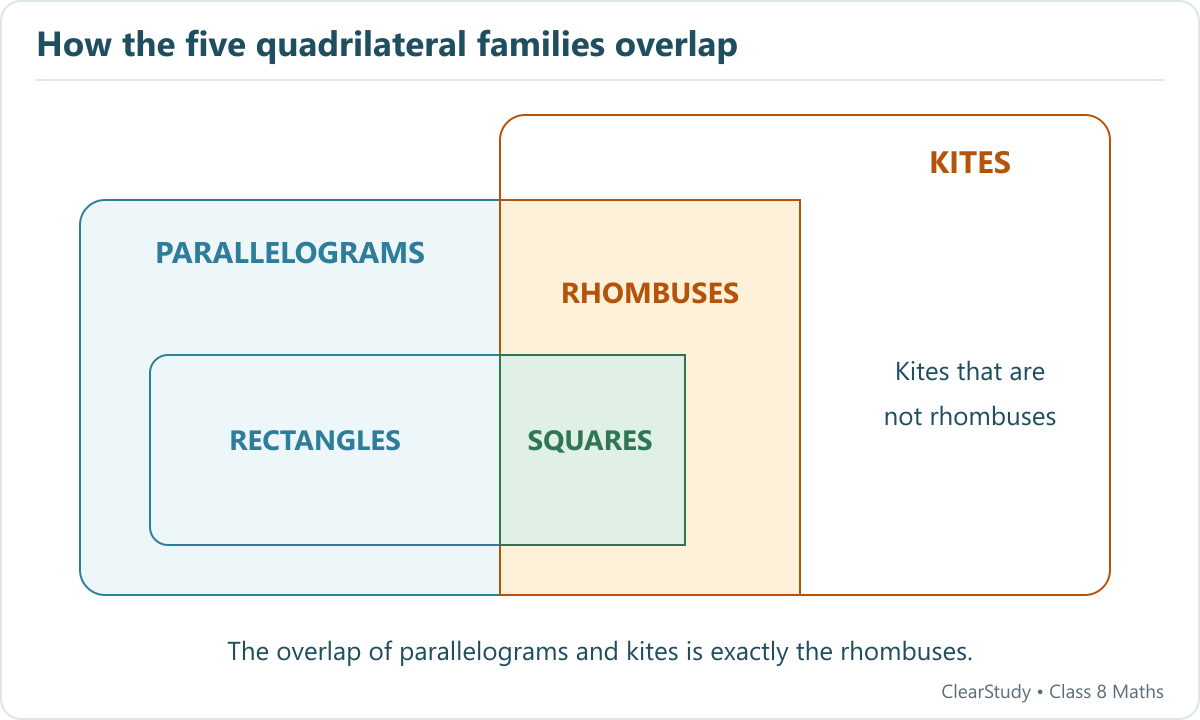
4. Draw a Venn diagram showing the set of parallelograms, kites, rhombuses, rectangles, and squares. Then, answer the following questions—
(i) What is the quadrilateral that is both a kite and a parallelogram?(ii) Can there be a quadrilateral that is both a kite and a rectangle?(iii) Is every kite a rhombus? If not, what is the correct relationship between these two types of quadrilaterals?
SOLUTIONDraw overlapping regions for parallelograms and kites. Their entire overlap is the set of rhombuses. Place the rectangle region inside the parallelogram region; its overlap with rhombuses is the set of squares.(i) A quadrilateral that is both a kite and a parallelogram is a rhombus, including a square as a special case.(ii) Yes: a square. It has four right angles and two pairs of equal adjacent sides, so it meets both definitions. This follows directly from the inclusive kite definition used in the chapter.(iii) No. Every rhombus is a kite, but a kite need not have all four sides equal. The constructed 6 cm by 8 cm kite above provides an example.
Page 107, Question 4: under the textbook’s inclusive definition, every square is both a rectangle and a kite.
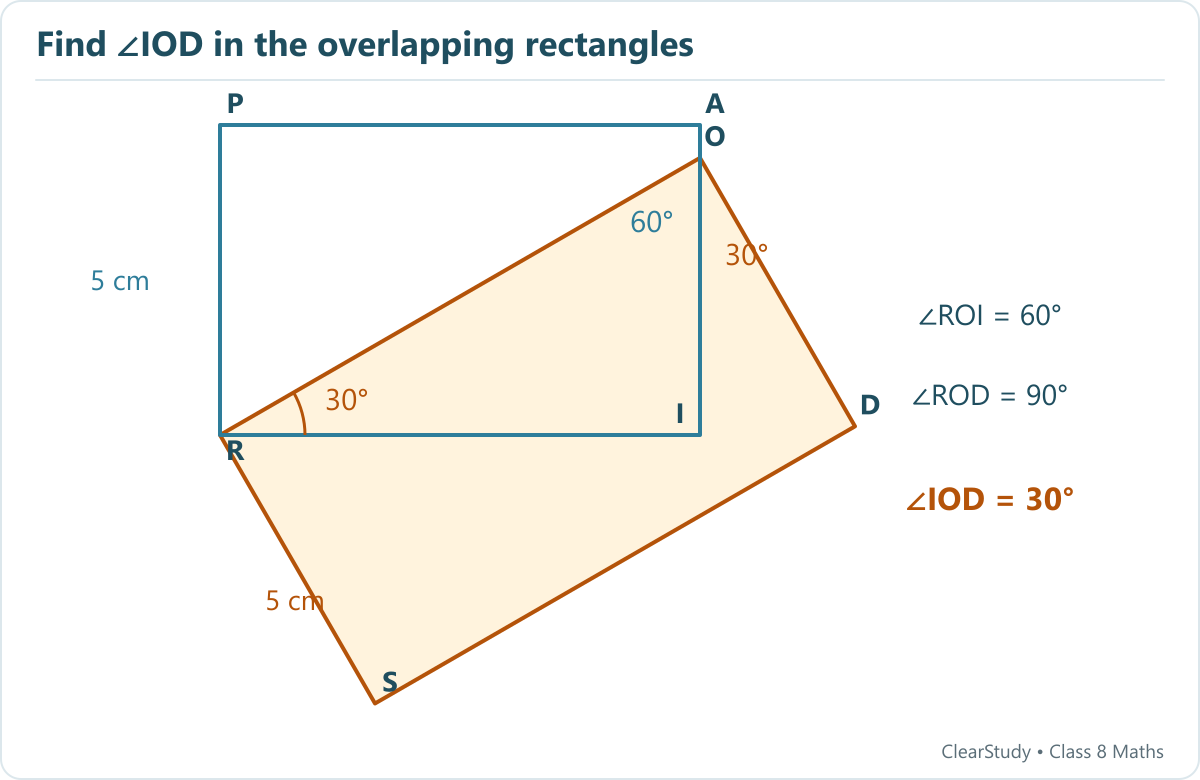
5. If PAIR and RODS are two rectangles, find ∠IOD. (In the figure, O lies on AI, ∠ORI = 30°, and PR = RS = 5 cm.)
SOLUTIONBecause PAIR is a rectangle and O lies on AI, ∠RIO = 90°.In △RIO, ∠ROI = 180° − 90° − 30° = 60°.Because RODS is a rectangle, ∠ROD = 90°. Ray OI lies inside this angle, so ∠IOD = ∠ROD − ∠ROI = 90° − 60° = 30°.The two 5 cm labels are not needed for this angle calculation.
Page 107, Question 5: RO is a side of rectangle RODS, and O lies on AI; RO is not the diagonal RA.
Figure it Out — Page 108–109
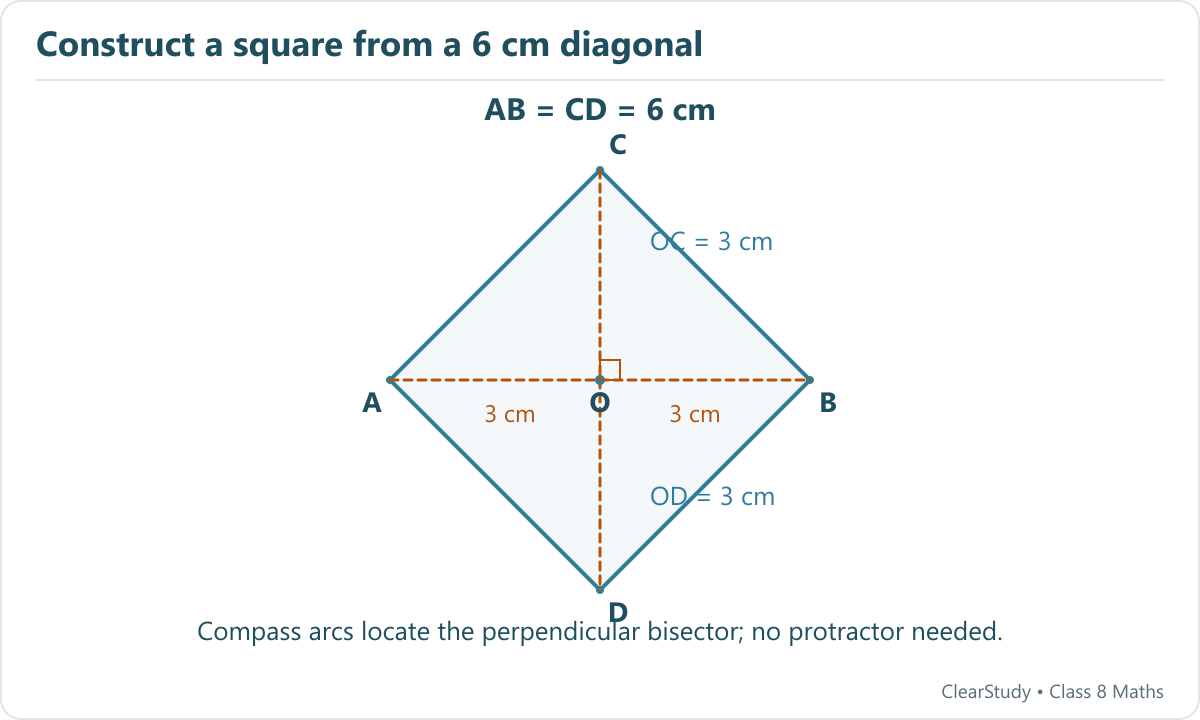
6. Construct a square with diagonal 6 cm without using a protractor.
SOLUTIONDraw segment AB = 6 cm (one diagonal). Using a compass, construct the perpendicular bisector of AB, meeting AB at its midpoint O.On this perpendicular mark C and D on opposite sides of O with OC = OD = 3 cm (half of AB), so both diagonals are 6 cm, perpendicular, and bisect each other.Join AC, CB, BD, DA. ACBD is the required square — no protractor is needed because the compass gives the exact perpendicular and equal halves.
Use equal compass radii greater than 3 cm from A and B to locate the perpendicular bisector, then mark OC = OD = 3 cm.
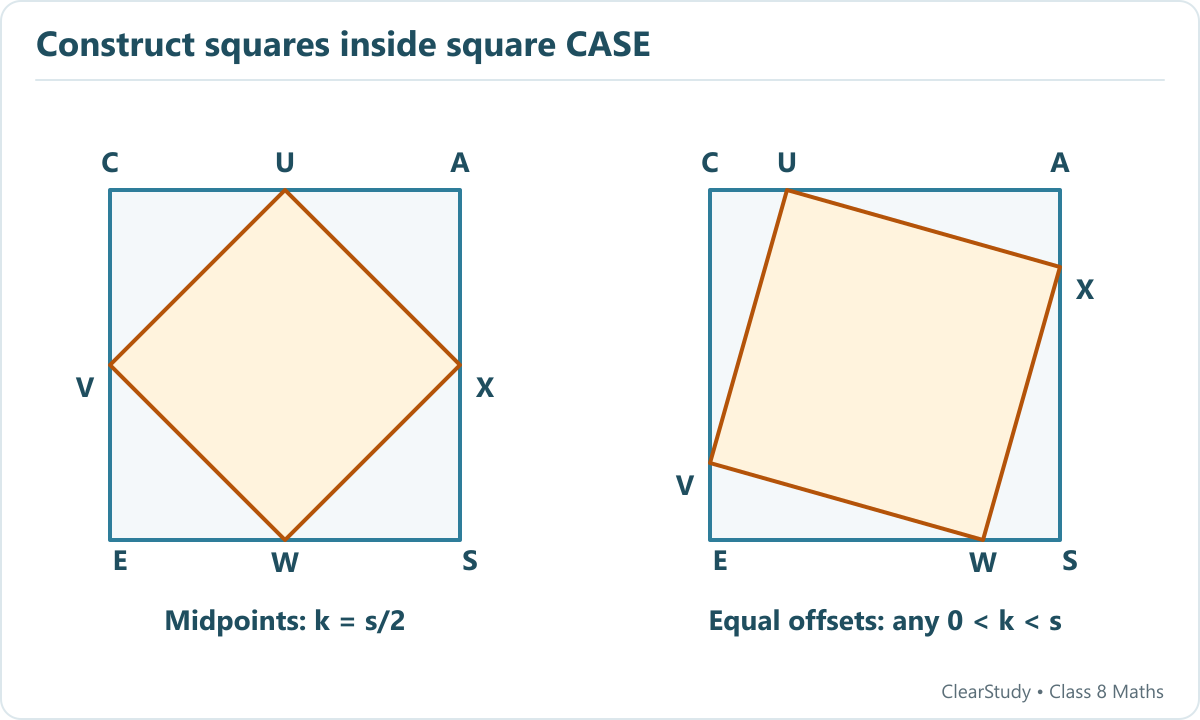
7. CASE is a square. The points U, V, W and X are the midpoints of the sides of the square. What type of quadrilateral is UVWX? Find this by using geometric reasoning, as well as by construction and measurement. Find other ways of constructing a square within a square such that the vertices of the inner square lie on the sides of the outer square, as shown in Figure (b).
SOLUTIONLet the side length of CASE be s. Each corner triangle, such as △CUV, has two legs s/2 and an included right angle. Thus all four corner triangles are congruent by SAS, so their hypotenuses UV, VW, WX and XU are equal.Each corner triangle is also isosceles, with acute angles 45° and 45°. At U, the inner angle VUX is 180° − 45° − 45° = 90°. The same holds at V, W and X. Therefore UVWX is a square.Another construction: choose 0 < k < s and mark CU = AX = SW = EV = k, moving clockwise. Each corner triangle now has legs k and s − k and a right angle, so they are again congruent. Their acute angles add to 90°, giving right angles in the inner figure. This gives another square.Optional length check after learning Pythagoras: the midpoint square has side s/√2. Congruence alone is enough to prove the shape here.
Page 108, Question 7: follow the vertices U–V–W–X around the boundary. Congruence proves the result without needing Pythagoras.
8. If a quadrilateral has four equal sides and one angle of 90°, will it be a square? Find the answer using geometric reasoning as well as by construction and measurement.
SOLUTIONYes, it will be a square. A quadrilateral with four equal sides is a rhombus, which is a parallelogram.In a parallelogram opposite angles are equal and adjacent angles are supplementary. If one angle is 90°, its adjacent angle = 180° − 90° = 90°, and the opposite angle is also 90°. So all four angles are 90°.A figure with all sides equal and all angles 90° is a square.
9. What type of a quadrilateral is one in which the opposite sides are equal? Justify your answer. (Hint: Draw a diagonal and check for congruent triangles.)
SOLUTIONSuch a quadrilateral is a parallelogram. Take quadrilateral ABCD with AB = CD and BC = AD, and draw the diagonal AC.In ▵ABC and ▵CDA: AB = CD, BC = DA, and AC = CA (common). So ▵ABC ≅ ▵CDA by the SSS condition.Hence the alternate angles are equal: this makes AB ∥ CD and BC ∥ AD. Both pairs of opposite sides are parallel, so ABCD is a parallelogram.
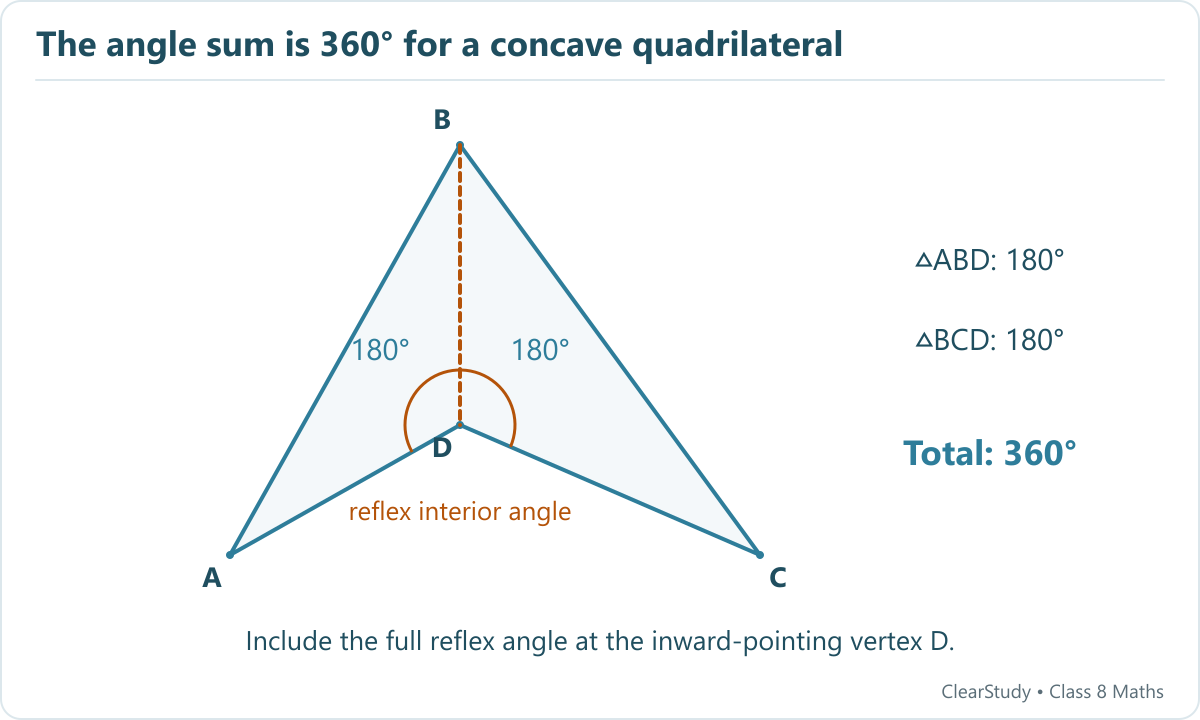
10. Will the sum of the angles in a quadrilateral such as the following one (a non-convex/concave quadrilateral ABCD with a reflex-looking dent at D) also be 360°? Find the answer using geometric reasoning as well as by constructing this figure and measuring.
SOLUTIONYes. Draw the internal diagonal BD from B to the inward-pointing vertex D. It splits the quadrilateral into △ABD and △BCD.Each triangle has angle sum 180°. Together their angles make exactly the four interior angles of the quadrilateral. At D, the two triangle angles combine to form the reflex interior angle, greater than 180°.Hence ∠A + ∠B + ∠C + reflex ∠D = 180° + 180° = 360°. Measuring the small exterior angle at the dent instead would give the wrong total.
Page 108, Question 10: use an internal diagonal and count the reflex angle, not the small outside angle.
11. State whether the following statements are true or false. Justify your answers.
(i) A quadrilateral whose diagonals are equal and bisect each other must be a square.(ii) A quadrilateral having three right angles must be a rectangle.(iii) A quadrilateral whose diagonals bisect each other must be a parallelogram.(iv) A quadrilateral whose diagonals are perpendicular to each other must be a rhombus.(v) A quadrilateral in which the opposite angles are equal must be a parallelogram.(vi) A quadrilateral in which all the angles are equal is a rectangle.(vii) Isosceles trapeziums are parallelograms.
SOLUTION(i) False. Equal diagonals that bisect each other give a rectangle; a square needs the diagonals to also be perpendicular, so it need not be a square.(ii) True. The fourth angle = 360° − (90° + 90° + 90°) = 90°, so all angles are 90° ⇒ rectangle.(iii) True. If the diagonals bisect each other, the resulting triangles are congruent (SAS), making opposite sides parallel — a parallelogram.(iv) False. Perpendicular diagonals alone are not enough; the figure could be a kite (whose diagonals are also perpendicular but which need not have all sides equal).(v) True. If both pairs of opposite angles are equal, the angle sum forces adjacent angles to add to 180°, so opposite sides are parallel — a parallelogram.(vi) True. All angles equal ⇒ each is 360°/4 = 90°, which is the definition of a rectangle.(vii) False. The isosceles trapezium illustrated in this chapter has equal non-parallel legs, so it provides a counterexample. A trapezium in general is defined here inclusively (at least one parallel pair), so parallelograms are trapeziums; the reverse implication does not hold.
Math Talk & Try This Boxes (Solved)
Math Talk — Angle between the diagonals (Page 85–87)If the equal diagonals of a rectangle bisect each other and make an angle of 60° (and in general an angle x) at O, find all the angles.Answer. For 60°: the four central angles are 60°, 60°, 120°, 120°. In isosceles ▵AOB, a + a + 60° = 180° ⇒ a = 60°; the other base angles are 30°, so each corner = 30° + 60° = 90°. In general, with angle x: base angles are a = 90° − x/2 and b = x/2, so each corner = a + b = 90°. Thus, whatever x is, all four angles of the quadrilateral are 90° — it is always a rectangle.
Math Talk — Square’s angle bisection (Page 93)In square ABCD with diagonal AC, what are ∠1, ∠2, ∠3, ∠4?Answer. In ▵ADC, ∠1 + ∠3 + 90° = 180°, and since AD = DC the base angles are equal: ∠1 = ∠3 = 45°. Similarly ∠2 = ∠4 = 45°. So a diagonal of a square bisects each right angle into two 45° halves.
Try This — Geoboard Activity (Page 103)Place two rubber bands perpendicular to each other forming diagonals of equal length and join the ends. What quadrilateral do you get? Now extend one diagonal on both sides by 2 cm — what do you get?Answer. Equal diagonals that bisect each other at 90° give a square. After extending one diagonal equally on both sides by 2 cm, the diagonals are still perpendicular and still bisect each other, but they are now unequal — perpendicular bisecting diagonals of unequal length give a rhombus.
Try This — Joining Triangles (Page 104–105)Join two congruent triangles along an equal side. What quadrilaterals are formed?Answer.Equilateral triangles (8, 8, 8): joining along an edge gives a rhombus with four sides of 8 cm. Isosceles triangles (8, 8, 6): joining along the 6 cm bases also gives a rhombus, which is a special kite. Joining along an 8 cm side can give a parallelogram or a kite, depending on how the triangles are oriented. Scalene triangles (6, 9, 12): a half-turn arrangement along a shared equal side gives a parallelogram; reflecting across the shared 12 cm side gives a convex kite with adjacent pairs 6, 6 and 9, 9. State the shared edge and orientation when naming the result.
Which Quad? — Paper folding (Page 111)Fold a sheet into a quarter, make a triangular crease at the inner corner, then open the sheet. What shape do the creases form?Answer. Because the inner corner is the centre of the sheet, the triangular crease reflects symmetrically into all four quarters, and the creases form a rhombus (a square if the triangular fold is made at 45°).
Further reasoning checks from the chapter
SOLUTIONPage 85: the listed equalities AO = CO, ∠AOB = ∠COD and AD = CB do not directly establish △AOD ≅ △COB: the named angles belong to different triangles, and a general side-side-angle claim is not a congruence test. Instead use AO = CO, DO = BO and vertically opposite ∠AOD = ∠COB to apply SAS.Corresponding vertex order (Pages 90, 98–99): △BAD ≅ △DCB, △ABD ≅ △CDB and △AOE ≅ △YOS preserve the matching vertices in their respective figures. Reordering only one side of a congruence statement can pair unequal sides or angles.Parallelogram of sides 4 cm and 5 cm with included angle 30° (Pages 96–98): the opposite sides are 4 cm and 5 cm; the remaining angles are 150°, 30° and 150°.Why a kite’s diagonal is perpendicular (Page 105): in ABCD with AB = BC and AD = CD, △ABD ≅ △CBD by SSS. Thus BD bisects the angles at B and D. With O on AC and BD, △ABO ≅ △CBO by SAS, giving AO = CO and equal supplementary angles AOB and COB; each is 90°.Isosceles trapezium (Pages 106–107): drop perpendiculars XY and WZ to the other base. The two right triangles UXY and VWZ have equal hypotenuses UX = VW and equal heights XY = WZ, so they are congruent by RHS. Their base angles U and V are equal.
Common Mistakes to Avoid
Watch out for these
Thinking equal diagonals make a figure a square — equal + bisecting gives only a rectangle; you also need them perpendicular for a square.
Confusing a kite with a rhombus — a kite has two pairs of equal adjacent sides; only when all four are equal is it a rhombus.
Assuming the diagonals of a parallelogram (or rectangle) are perpendicular — they bisect each other but are not perpendicular unless it is a rhombus/square.
Forgetting that adjacent angles of a parallelogram add to 180° while opposite angles are equal — mixing these up flips the answer.
Using 180° instead of 360° for the angle sum of a quadrilateral.
In a trapezium, only the angles on the same leg (co-interior to the parallel sides) add to 180° — not every pair.
Practice MCQs & Assertion–Reason
1. The sum of all the angles of a quadrilateral is:
(a) 180° (b) 270° (c) 360° (d) 540°
2. A quadrilateral in which all the angles are 90° is a:
(a) rhombus (b) rectangle (c) kite (d) pentagon
3. The diagonals of a rhombus always intersect at an angle of:
(a) 45° (b) 60° (c) 90° (d) 120°
4. What is the most specific name for a quadrilateral whose diagonals are equal and bisect each other at 90°?
For each Assertion–Reason question, choose: (A) Both Assertion and Reason are true and the Reason is the correct explanation of the Assertion; (B) Both are true but the Reason is not the correct explanation; (C) Assertion is true but Reason is false; (D) Assertion is false but Reason is true.
A-R 1. Assertion: A quadrilateral having three right angles must be a rectangle.
Reason: The angle sum of a quadrilateral is 360°, so the fourth angle is also 90°.
A-R 2. Assertion: The diagonals of a square are perpendicular to each other.
Reason: A square is a special rhombus, and the diagonals of a rhombus meet at 90°.
A-R 3. Assertion: Every rhombus is a square.
Reason: All four sides of a rhombus are equal in length.
A-R 4. Assertion: The diagonals of a parallelogram bisect each other.
Reason: The opposite triangles formed by the diagonals are congruent (ASA).
A-R 5. Assertion: An isosceles trapezium is a parallelogram.
Reason: A trapezium has at least one pair of parallel opposite sides.
Answer key: 1-(A), 2-(A), 3-(D), 4-(A), 5-(D).
Quick Revision Summary
Rectangle: all angles 90°; opposite sides equal & parallel; diagonals equal and bisect each other.
Square: all sides equal, all angles 90°; diagonals equal, bisect each other at 90°, and bisect the angles.
Parallelogram: opposite sides equal & parallel; opposite angles equal; adjacent angles add to 180°; diagonals bisect each other.
Rhombus: all sides equal; opposite angles equal; diagonals bisect each other at right angles and bisect the angles.
Kite: two pairs of equal adjacent sides; one diagonal bisects the other at 90° and bisects the angles it joins.
Trapezium: at least one pair of parallel sides; isosceles trapezium has equal base angles.
Angle sum of any quadrilateral = 360° (two triangles of 180° each).
State the test before you use it (“diagonals equal and bisecting ⇒ rectangle”) and quote the reason — congruence condition (SSS/SAS/ASA/AAS), alternate angles, or co-interior angles add to 180°. For construction questions, write each step and always start the diagonals from a marked midpoint. Verify every angle calculation adds back to 360° for the whole quadrilateral.
Frequently Asked Questions
What is Class 8 Maths Ganita Prakash Chapter 4 about?
Chapter 4, Quadrilaterals, studies four-sided figures and their special types — rectangles, squares, parallelograms, rhombuses, kites and trapeziums — deducing their side, angle and diagonal properties using congruence, and proving that the angle sum of any quadrilateral is 360°.
What is the sum of the angles of a quadrilateral?
The sum of all four interior angles of any quadrilateral is 360°. This is found by drawing one diagonal, which splits the figure into two triangles of 180° each.
How are a square, rectangle and rhombus related?
A square is both a rectangle (all angles 90°) and a rhombus (all sides equal), so it sits in the overlap of the two. Every rectangle and every rhombus is a parallelogram, but the reverse is not true.
Are these Class 8 Maths Ganita Prakash Chapter 4 solutions free?
Yes. All solutions are free and follow the official NCERT Ganita Prakash (Part I) textbook for 2026–27, with every Figure it Out exercise solved step by step.