
Kalakritiyon ka Bharat — Class 6 English Poorvi Questions and Answers
Kalakritiyon ka Bharat questions and answers: explore Class 6 Poorvi’s four regional crafts with the child–state table, sequencing words, present-tense sentences and Gakkad Bharta listening key.
Source: NCERT Poorvi, Grade 6, Unit 5, printed pages 132–140; listening transcript 162; supplied reprint 2026–27. Open-ended and personal responses are examples to adapt. These explanations are study support, not an official NCERT answer key.
About the chapter
“Kalakritiyon ka Bharat” (‘A Bharat of Art Works’) is an informational piece from Unit 5, ‘Culture and Tradition’. It is set during an Ek Bharat, Shreshtha Bharat programme, where students watch a video of children from different states sharing the folk art and craft of their region. Through four young speakers – Aakansha from Uttarakhand (Aipan), Priyaranjan from Odisha (Dhokra metal craft), Chitra from Kerala (coconut shell craft) and Balamurali from Andhra Pradesh (Kondapalli toys) – the chapter celebrates India’s rich diversity of art forms and its underlying spirit of unity in diversity.
About the piece
This companion section follows Hamara Bharat — Incredible India! within Unit 5; it has no separate author byline. The programme setting connects children’s craft introductions with unity in diversity. Craft ages such as 4000 years are estimates stated in the textbook, not precise dates for every surviving object.
Summary
A teacher gathers students in a big hall for the Ek Bharat, Shreshtha Bharat programme. When she asks what it is about, a student named Renu explains that it reminds everyone that all Indians belong to one nation, and that our unity in diversity makes us a wonderful country. A video then begins, showing little windows, each with a smiling child ready to share something special from their state.
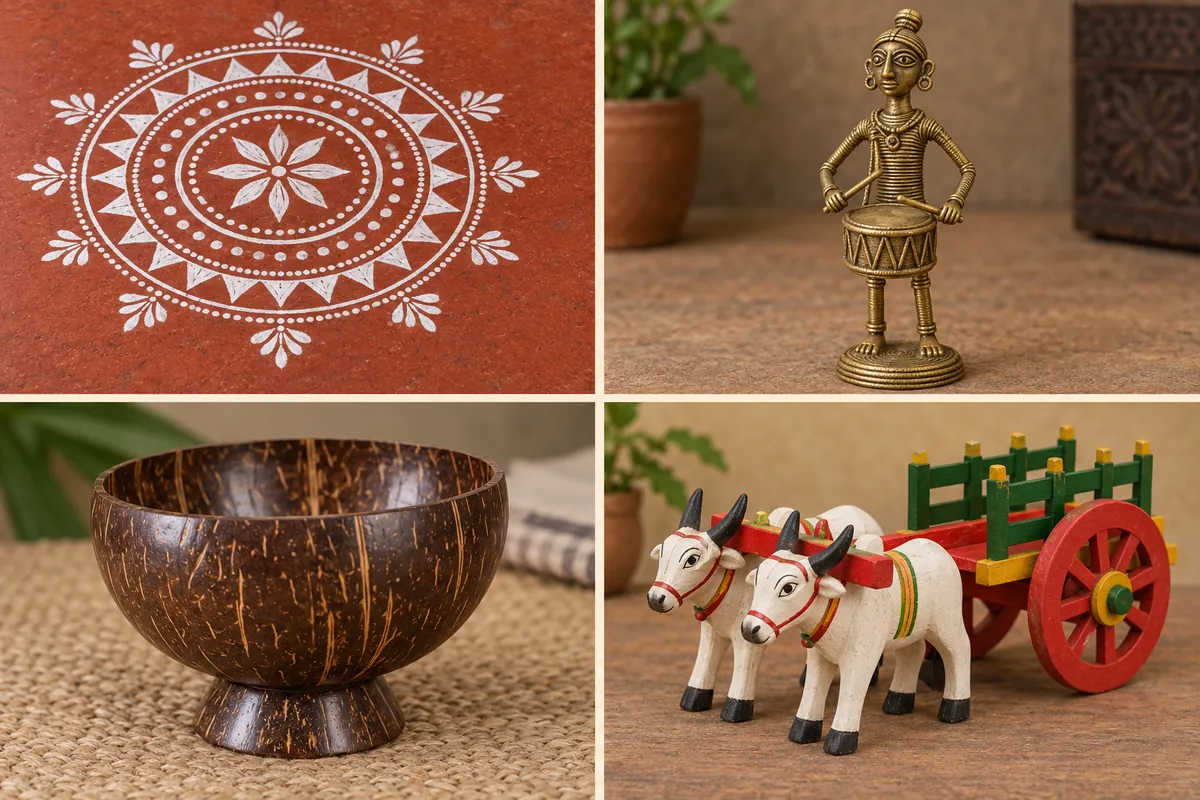
Aakansha from Uttarakhand describes Aipan, a folk art drawn with white rice-flour paste on brick-red walls coloured with geru. It is made by the women of the family on the floors and walls of puja rooms and outside the main door, with beautiful, mathematical designs based on tradition and nature. Priyaranjan from Odisha explains Dhokra, a 4000-year-old metal craft: a clay figure is covered with wax, fine details are carved, the figure is coated with clay and fired so the wax melts out, and molten brass is poured into the empty space to take the same shape.
Chitra from Kerala talks about coconut shell craft, in which a brown shell is cleaned, smoothed, shaped, fixed on a base and polished to make biodegradable bowls and jewellery. Balamurali from Andhra Pradesh shares the 400-year-old art of making Kondapalli toys from soft wood, joined with makku (a tamarind-seed and sawdust paste) and coloured with natural dyes and enamel paints. Through these four crafts, the chapter shows how India’s many traditions together form one rich, shared culture.
Word meanings
| Word | English meaning | Hindi meaning |
|---|---|---|
| unison | together, in agreement as one | एकसाथ / एकस्वर में |
| diversity | variety; being made of many kinds | विविधता / अनेकता |
| folk art | traditional art made by common people | लोक कला |
| geru | red clay used as a colour | गेरू (लाल मिट्टी) |
| craft | skilled work made by hand | दस्तकारी / शिल्प |
| carve | to make a design with a sharp tool | नक्काशी / तराशना |
| scrap | small unwanted pieces | टुकड़े-टुकड़े / कचरा |
| biodegradable | able to be broken down by biological processes; not automatically harmless in every setting | प्राकृतिक रूप से नष्ट होने योग्य |
| stable | not able to move; steady | स्थिर / मजबूत |
| sandpaper | rough paper used to smooth surfaces | रेगमार / सैंडपेपर |
| tamarind | an edible sour fruit | इमली |
| sawdust | fine dust of wood | लकड़ी का बुरादा |
| dyes | colours used to colour things | रंग / रंजक |
| enamel | paint that forms a protective layer | एनामेल / चमकीला रंग |
| admiration | respect and warm approval | प्रशंसा / सराहना |
| tribe | a group of people with shared customs | जनजाति / कबीला |
| unity in diversity | being one nation despite many differences | अनेकता में एकता |
Let us do these activities before we read
Complete these words with the correct vowels (A, E, I, O, U).
Let us discuss
I. After Renu’s answer
1. What is the Ek Bharat, Shreshtha Bharat programme all about?
2. Why is this programme being conducted?
II. Complete the table (about the four art forms)
On the basis of what the speakers said about the art forms, complete the table given below.
| Name of the child | State | Art form | Things needed |
|---|---|---|---|
| Aakansha | Uttarakhand | Aipan | white rice flour paste, geru (red clay) |
| Priyaranjan | Odisha | Dhokra | clay, brass scrap, wax, fire |
| Chitra | Kerala | Coconut shell craft | coconut shell, sandpaper/machine, a base, wood polish |
| Balamurali | Andhra Pradesh | Kondapalli toys | soft wood, makku (tamarind-seed powder & sawdust paste), oil, water-colours/vegetable dyes, enamel paints |
Let us think and reflect
I. Fill in the blanks to complete the following sentences.
II. Why does Akanksha’s family make Aipan?
III. In Dhokra, why does wax come out of the small openings?
IV. What is common in the toys made in Balamurali’s village and coconut shell craft in Kerala?
Let us learn
I. Sequencing words — one suitable model
In blank order: First; After that; Then; Next; Finally. Each expression is used once. Other sequences are possible if the order is sensible and the expressions are not repeated.
II. Five present-tense sentences — samples
- We ask questions to understand.
- You draw beautiful flowers.
- He tells a story every day.
- She makes paintings in free periods.
- They practise spellings on Friday.
With he, she or it, use the appropriate -s/-es form. With I, you, we or they, use the base form. ‘It makes very loudly’ and ‘They speak spellings’ are not suitable combinations. The textbook’s two given examples are ‘I know how to dance’ and ‘He speaks very loudly’.
Let us listen, speak, write & explore
Let us listen – Gakkad Bharta
I. Listen to the description of gakkad bharta and complete the notes.
II. Complete the flowchart on how to make gakkad bharta.
Let us speak
Speak about a local art form of your region (painting, rangoli, metal craft, embroidery, music, dance or drama). Include its name, what things are needed, and how it is made/presented.
Let us write
Write a paragraph with five sentences giving your reasons for liking your favourite art form (from the ones in the lesson).
Let us explore
1. Madhubani painting is a traditional art form from Bihar. Artists use natural colours (yellow from haldi, green from leaves, red from red flowers/geru/sindoor, orange from flowers, blue from neel/indigo powder). Colour the given Madhubani painting with natural or other colours.
2. Read about the Ek Bharat, Shreshtha Bharat Programme (it aims to enhance interaction and mutual understanding between people of different states/UTs through state/UT pairing, celebrating unity in diversity).
Note: The Let us speak, Let us write and the colouring part of Let us explore are speaking and activity tasks meant to be done in class or in your notebook; the answers above are guided samples, not fixed answers. Use your own region’s art form and your own ideas where asked.
The supplied text spells the Aipan speaker’s name Aakansha in her introduction and Akanksha in the table/questions. Both refer to the same child; preserve the form used by your exercise.
Additional ClearStudy questions
This practice is separate from the printed textbook exercises.
Short answer (30–40 words)
1. On which paste and surface is Aipan drawn, and who makes it?
2. How old is the Dhokra metal craft, and where is it practised?
3. Why is coconut shell craft called a biodegradable craft?
4. What is ‘makku’ and how is it used in Kondapalli toys?
5. According to Renu, what makes India the most wonderful country in the world?
Long answer (100–120 words)
6. Describe the steps involved in making a Dhokra metal figure.
7. How does ‘Kalakritiyon ka Bharat’ show India’s unity in diversity?
ClearStudy MCQs and assertion–reason practice
1. The programme in which the children share their art forms is called…
(a) Make in India (b) Ek Bharat, Shreshtha Bharat (c) Swachh Bharat (d) Digital India
2. Aakansha’s folk art, Aipan, belongs to which state?
(a) Odisha (b) Kerala (c) Uttarakhand (d) Andhra Pradesh
3. Aipan is drawn with a paste made of…
(a) white rice flour (b) sawdust (c) tamarind seeds (d) brass scrap
4. What age does the textbook give for Dhokra metal craft?
(a) 400 years (b) 1000 years (c) 4000 years (d) 100 years
5. In Dhokra, what is poured into the empty space left by the melted wax?
(a) clay (b) molten brass (c) wax (d) rice paste
6. Chitra from Kerala talks about a craft made from…
(a) clay (b) wood (c) coconut shells (d) metal
7. The Kondapalli toys are made in which state?
(a) Andhra Pradesh (b) Odisha (c) Kerala (d) Uttarakhand
8. ‘Makku’, used to join parts of Kondapalli toys, is a paste of…
(a) rice flour and water (b) tamarind-seed powder and sawdust (c) clay and wax (d) geru and oil
9. Which craft in the lesson is described as biodegradable?
(a) Aipan (b) Dhokra (c) coconut shell craft (d) Kondapalli toys
10. According to Renu, what makes India the most wonderful country?
(a) its size (b) its unity in diversity (c) its rivers (d) its festivals only
Assertion–Reason – choose: (a) A and R true, R explains A; (b) A and R true, R does not explain A; (c) A true, R false; (d) A false, R true.
1. Assertion (A): Aipan is made by the women of the family.
Reason (R): Aipan is a folk art drawn on family functions and festivals with white rice-flour paste.
2. Assertion (A): In Dhokra, the wax melts and flows out of the clay-covered figure.
Reason (R): The clay-covered figure is put into the fire.
3. Assertion (A): A base is fixed under a coconut shell article.
Reason (R): The base makes the article stable so it does not move.
4. Assertion (A): Kondapalli toys are coloured using natural dyes and enamel paints.
Reason (R): The toys are based on folk stories, animals, birds and rural life.
5. Assertion (A): The Ek Bharat, Shreshtha Bharat programme celebrates unity in diversity.
Reason (R): The programme pairs different states/UTs to promote mutual understanding among their people.
Exam tips & common mistakes
Exam tips
• Learn the four child–state–art pairs by heart: Aakansha – Uttarakhand – Aipan; Priyaranjan – Odisha – Dhokra; Chitra – Kerala – coconut shell craft; Balamurali – Andhra Pradesh – Kondapalli toys.
• For ‘steps’ questions, use sequencing words like first, then, after that, next, finally.
• Remember the two key ages: Dhokra is 4000 years old; Kondapalli toy-making is 400 years old.
• In value-based answers, mention unity in diversity and the Ek Bharat, Shreshtha Bharat programme.
Common mistakes
• Do not mix up the ages – Dhokra = 4000 years, Kondapalli toys = 400 years.
• Aipan uses white rice-flour paste on geru (red clay) walls – do not write it is painted with brass or wax.
• The craft explicitly described as biodegradable in the passage is coconut shell craft; this does not mean wood can never biodegrade.
• ‘Makku’ is made of tamarind-seed powder and sawdust, used only to join the toy parts, not to colour them.
FAQs
Which crafts are described in Kalakritiyon ka Bharat?
Aipan from Uttarakhand, Dhokra presented by Priyaranjan from Odisha, coconut-shell craft from Kerala and Kondapalli toys from Andhra Pradesh.
What is makku?
The textbook describes it as a paste of tamarind-seed powder and sawdust used to join the carved parts of Kondapalli toys.
What are the Gakkad Bharta listening answers?
Sushil, Jabalpur, Madhya Pradesh, Gakkad Bharta, and brinjals/tomatoes. The flowchart blanks are wheat, roast, roast, chopped and bharta.
Is this separately numbered in the book contents?
It is a companion section following Hamara Bharat within Unit 5, with its own craft and language activities. ClearStudy maintains a separate linked guide for it.