
Yoga – A Way of Life — Class 6 English Poorvi Questions and Answers
Yoga – A Way of Life questions and answers: study Class 6 Poorvi’s explanation of unity, awareness, practice/practise, vocabulary and the listening exercise.
Source: NCERT Poorvi, Grade 6, Unit 4, printed pages 122–127; listening transcript 129; supplied reprint 2026–27. Open-ended and personal responses are examples to adapt. These explanations are study support, not an official NCERT answer key.
About the chapter
“Yoga – A Way of Life” is an informative prose piece from Unit 4, ‘Sports and Wellness’. It explains that yoga is a physical, mental and spiritual practice that began in ancient India. The word ‘Yoga’ comes from the Sanskrit root yuj, meaning ‘to join’ or ‘to unite’ – the union of mind and body, thought and action, and the harmony between human beings and nature. The lesson describes the many health benefits of yoga, mentions Sage Patanjali and his Yoga Sutras, and tells how the World Health Organisation and the United Nations have helped spread yoga around the world.
About the piece
This informative text has no separate author byline in the supplied textbook. It introduces yoga through Patanjali, the Yoga Sutras, a verse from Haṭha Yoga Pradipikā and modern international initiatives.
Summary
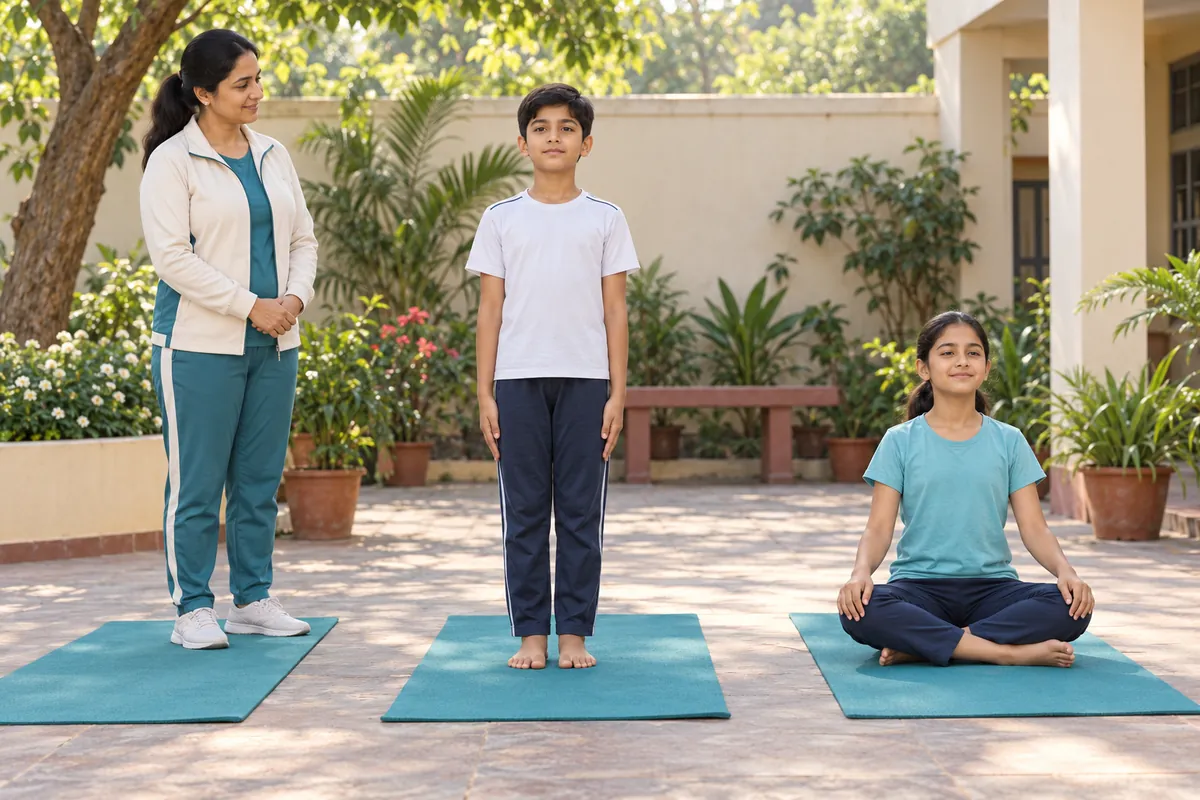
The passage traces yoga to ancient India and explains yuj as ‘to join’ or ‘to unite’. It emphasises unity of mind and body, thought and action, and harmony with nature. Patanjali presents the tradition systematically in the Yoga Sutras.
It describes postures, breathing and meditation, discusses possible physical and mental benefits, and mentions WHO mYoga. Its final point is that the mind should remain attentive to the body: yoga is more than stretching alone.
Benefits vary with the person and practice; the passage’s broad claims do not guarantee disease prevention, immunity or weight loss. For practical sessions, use a qualified instructor and suitable adaptations. See NIH information about yoga and safety.
Word meanings
| Word | English meaning | Hindi meaning |
|---|---|---|
| spiritual | relating to the mind and inner self | आध्यात्मिक |
| originated | started; began | उत्पन्न हुआ / शुरू हुआ |
| unite | to join together | एकजुट करना / जोड़ना |
| symbolises | stands for; represents | प्रतीक है |
| harmony | balance; agreement | संतुलन / मेल |
| holistic | treating the whole, not just parts | समग्र / समग्रतावादी |
| well-being | the state of being healthy and happy | कुशलता / भलाई |
| systematic | done in an orderly, planned way | व्यवस्थित / क्रमबद्ध |
| distractions | things that disturb attention | ध्यानभंग / विछ्छेप |
| asanas | yoga postures | आसन |
| flexibility | the ability to bend easily | लचीलापन |
| endurance | capacity to continue without giving up | सहनशक्ति / सहनशीलता |
| meditation | focusing the mind in calm thought | ध्यान |
| anxiety | worry; uneasy feeling | चिंता / बेचैनी |
| immune system | the body’s defence against illness | रोग प्रतिरोधक तंत्र |
| circulation | flow of blood through the body | रक्त संचार |
| boost | to increase or strengthen | ब୪ाना / बल देना |
| recognised | accepted and respected | मान्यता प्राप्त |
| coordinated | matched together smoothly | तालमेल में / समन्वित |
Let us do these activities before we read
1. What do you know about yoga? Discuss in pairs and share with the whole class.
2. What is 21st June known for? What do we do on this day?
3. List as many words you know related to yoga. Share them with your classmates.
4. Let us play the game of Antakshari. The first word is ‘yoga’. The next word must then begin with the letter ‘a’. This activity will go on and the whole class will participate and write the words on the blackboard. How many new words have you learnt?
Note: This is an oral group game; the chain of words will be different in every class. Build it together on the blackboard.
Let us discuss
Read the passage again and fill in the blanks with words from the box. (Box: sleep, lifestyle, health, strength, calm, stress, balance)
Yoga is a practise that not only improves physical flexibility but also improves mental 1. ______, and leads to a healthier 2. ______. It involves a series of asanas, which increase muscular 3. ______. Practising yoga also leads to a better body and mind 4. ______ and reduces body pain such as the lower back. Moreover, the focus on breathing techniques and meditation makes the mind 5. ______, lessens 6. ______, and improves the quality of 7. ______. This helps to adopt a more positive lifestyle.
Let us think and reflect
1. Aim: according to the passage, yoga seeks a quiet, attentive mind and harmony between mind and body.
2. Unity: yuj means to join/unite. Movement, breath and awareness work together; the lesson also connects thought with action and people with nature.
3. WHO mYoga: the app shows an international effort to make guided yoga information accessible. It is not proof that every claimed benefit is guaranteed. WHO’s 2021 information describes its learning and practice material and intended healthy age group of 12–65.
4. Long-term quality — sample: regular attentive practice may help a person develop patience and concentration. This is a possible effect, not a certainty for every individual.
Let us learn
I.1. Practice and practise
In the British-English distinction used here, practice is a noun and practise a verb. Answers: (i) practice; (ii) practise; (iii) practice; (iv) practise; (v) practise; (vi) practice.
I.2. Advice and advise — two sentences each
- Your advice helped me solve the problem.
- I asked my teacher for advice.
- Teachers advise us to read carefully.
- I would advise you to check your answers.
II. Words from A, Y, E, G, O, N, R
Use A in every word. Suitable examples without repeating a letter: age, ago, are, ear, era, oar, ray, nay, gear, year, near, rage, yarn, anger, range, organ, orange. These are examples, not an exhaustive list. ‘Gone’ has no A and is invalid. ‘Orange’ uses six of the seven letters, not all seven.
Let us listen / speak / write / explore
Let us listen — transcript 129
The four true statements are 1, 3, 4 and 6. Full row sequence: True, False, True, True, False, True, False.
- He began at age 16, not sixteen years ago.
- He eats a balanced diet regularly, not at untimely hours.
- She plans to learn asanas during summer vacations, not over the weekend.
The narrator attributes her grandfather’s strength to several good habits. Her ‘hundred per cent’ wording is a personal claim in the audio, not a clinical guarantee.
Let us speak — personal samples
If you have tried yoga: ‘I enjoy attentive, gentle movement. I feel calm after a session. I want to improve my balance with my instructor’s help.’
If you have not: ‘I would like to try a suitable beginner session with a teacher. I hope to learn how movement and awareness work together.’ Take turns in your group of four and use your own experience.
Let us write — model paragraph
The Benefits of Yoga
Yoga is important because it brings attention to the body and mind together. One benefit that interests me is practising balance and flexibility. Suitable yoga practice may help people manage stress and develop calm attention. A familiar posture is Tadasana, an upright standing pose. Yoga includes more than physical movement; it also involves awareness and breathing. Finally, learning with a qualified instructor can make practice appropriate to the individual.
Let us explore
1. History and international recognition: the textbook discusses ancient seals as suggestive evidence. Archaeological interpretations are not a precise starting date for every modern yoga practice. The United Nations proclaimed 21 June as International Day of Yoga on 11 December 2014. The resolution had 175 endorsing member states; do not confuse this with the General Assembly’s membership of 193 or claim that 193 voted for it.
2. Two asanas — research examples: Tadasana focuses on upright posture and steadiness; Vrikshasana practises balance and concentration. Research with your teacher and the textbook’s official resources. A qualified instructor should teach the movements and any modifications. Surya Namaskar is a sequence, not one individual pose.
Additional ClearStudy questions
This practice is separate from the printed textbook exercises.
1. What is yuj?
The Sanskrit root connected with yoga, meaning join or unite.
2. What did Patanjali do?
The passage identifies him with the systematic presentation of yoga in the Yoga Sutras.
3. What benefits does the lesson describe?
It describes flexibility, strength, balance, calmness, sleep and attention. These should be reported as the passage’s descriptions, with individual variation in actual results.
4. When was WHO mYoga launched?
The supplied textbook gives 20 June 2021, consistent with WHO’s June-20 launch announcement. The Indian ceremonial launch was associated with International Yoga Day on June 21. Keep the textbook answer and event context distinct.
5. Why more than stretching?
The lesson says that breath and awareness should accompany bodily movement.
ClearStudy MCQs and assertion–reason practice
1. Where did yoga originate?
(a) ancient China (b) ancient India (c) ancient Greece (d) ancient Egypt
2. The word ‘Yoga’ comes from the Sanskrit root ‘yuj’, which means…
(a) to rest (b) to breathe (c) to join or to unite (d) to think
3. Who presented the tradition of yoga systematically in the ‘Yoga Sutras’?
(a) Sage Vyasa (b) Sage Patanjali (c) Sage Valmiki (d) Sage Vishwamitra
4. What are yoga postures called?
(a) sutras (b) mantras (c) asanas (d) mudras
5. Which of these is NOT a benefit of yoga mentioned in the lesson?
(a) it increases flexibility (b) it reduces stress (c) it improves eyesight overnight (d) it boosts the immune system
6. When did the WHO launch the WHO mYoga app?
(a) 20 June 2021 (b) 21 June 2014 (c) 11 December 2014 (d) 20 June 2020
7. On which date is International Yoga Day celebrated?
(a) 11 December (b) 21 June (c) 20 June (d) 5 September
8. Yoga improves heart health by…
(a) raising blood pressure (b) lowering blood pressure and improving circulation (c) increasing stress (d) reducing sleep
9. According to the lesson, while doing asanas, the…
(a) mind must wander freely (b) body must stay still and the mind sleep (c) mind has to be with the body (d) eyes must always be closed
10. What UN General Assembly membership figure is given in the textbook?
(a) 100 (b) 150 (c) 193 (d) 200
Assertion–Reason – choose: (a) A and R true, R explains A; (b) A and R true, R does not explain A; (c) A true, R false; (d) A false, R true.
1. Assertion (A): Yoga is called a holistic approach to health.
Reason (R): It cares for the body, the mind and the spirit together.
2. Assertion (A): The word ‘Yoga’ means ‘to unite’.
Reason (R): It comes from the Sanskrit root ‘yuj’.
3. Assertion (A): Yoga can help to calm the mind and reduce stress.
Reason (R): Yoga involves breathing techniques and meditation.
4. Assertion (A): Yoga is a very recent invention with no ancient roots.
Reason (R): Seals of the Sindhu-Sarasvati Civilisation, dating back to about 2700 BC, suggest yoga was practised in ancient India.
5. Assertion (A): When we do asanas, we do not just stretch the body.
Reason (R): The mind must be with the body, so each stretch is coordinated with the breath and awareness.
Exam tips & common mistakes
Study reminders
- Yuj means join/unite; the passage names Patanjali and the Yoga Sutras.
- The summary blanks are health, lifestyle, strength, balance, calm, stress, sleep.
- Use practice as a noun and practise as a verb in this exercise.
- The listening true rows are 1, 3, 4 and 6.
- Distinguish June-20 WHO announcement, June-21 observance and December-11 UN proclamation.
- 193 is the Assembly membership; 175 states endorsed the yoga-day resolution.
- Learn practical movements with qualified guidance, rather than treating the illustration as a tutorial.
FAQs
What does Yoga mean?
The Sanskrit root yuj means join or unite. The lesson connects it with unity of mind and body and harmony with nature.
What are the summary blanks?
Health, lifestyle, strength, balance, calm, stress and sleep.
What are the listening answers?
True statements are 1, 3, 4 and 6. The grandfather started at age 16 and the girl plans to learn asanas during summer vacations.
When is International Day of Yoga?
It is observed on 21 June. The UN proclaimed it on 11 December 2014; the resolution was endorsed by 175 member states.