
NCERT Solutions for Class 6 Science (Curiosity) Chapter 1: The Wonderful World of Science
These Class 6 Science Curiosity Chapter 1 solutions cover The Wonderful World of Science from the new NCF-2023 textbook (2026–27). Chapter 1 is the very first chapter of the Middle Stage: it welcomes you to the subject Science, explains what science really is, and shows how the scientific method — observe, question, guess, test and analyse — helps us find answers, rather than teaching a single science topic.
Note: Chapter 1 of Curiosity is an introductory chapter and does not have an end-of-chapter “Let Us Enhance Our Learning” exercise. Its questions are the in-text “Let us think and write” activities (1.1, 1.2, 1.3) and the page-margin “wonder” prompts, discussed below with model responses.
Class 6 Science Curiosity Chapter 1 Solutions – Overview
Chapter 1 of Curiosity, The Wonderful World of Science, opens the Middle Stage of school and introduces a brand-new subject: Science. It tells us that science is a way of thinking, observing and doing things to understand the world and uncover the secrets of the universe. The most important quality a young scientist needs is curiosity — which is exactly where the name of the book comes from. The chapter compares science to a giant, never-ending jigsaw puzzle in which every discovery adds a new piece and raises fresh questions. It previews the journey ahead — life on Earth, food, water, heat and cold, materials, separation, and even things beyond Earth like the Sun, Moon and stars — and shows, through the simple example of a pen that stops writing, how we all already use the scientific method in daily life.
Key Concepts & Definitions
Science: a way of thinking, observing and doing things to understand the world we live in and to uncover the secrets of the universe.
Curiosity: the eagerness to know how and why things happen; it is the spark that makes us ask questions and explore — and it gives the book its name.
Scientific method: a step-by-step process for finding answers — observe, wonder/question, guess a possible answer, test the guess, and analyse the results.
Observation: noticing something interesting or puzzling around us carefully and keenly.
Guess (hypothesis): a possible answer to a question that we then check by experiment or further observation.
Scientist: a person who follows the scientific method to solve problems or discover new things — and anyone who follows this method, like a cook, an electrician or a cycle-repair person, is working like a scientist.
Activities & In-text Questions — Answers
Activities 1.1–1.3 below follow the NCERT prompts on pages 5–7. Some prompts are combined for readability. The answers are examples: write your own observations and reasoning rather than memorising one model response.
Activity 1.1: Let us think and write
Write about a similar problem that you tried to solve. What steps did you take?
Activity 1.2: Let us think and write
Describe a daily life situation where you think someone was following a scientific method.
Activity 1.3: Let us think and write
If you have to ask “Why?” about something, what would you ask about?
Try to write down how you would attempt to find an answer to your question.
“Wonder” Prompts from the Chapter
These are the curiosity-sparking questions printed in the page margins and the running text. The answers below are model explanations a Grade 6 student could give.
Q. What is Science?
Q. Why do the stars shine, and how does a flower know when to open?
Q. What will we explore with the help of this book?
Q. How can we try to find answers to our questions on our own?
The Scientific Method — Step by Step
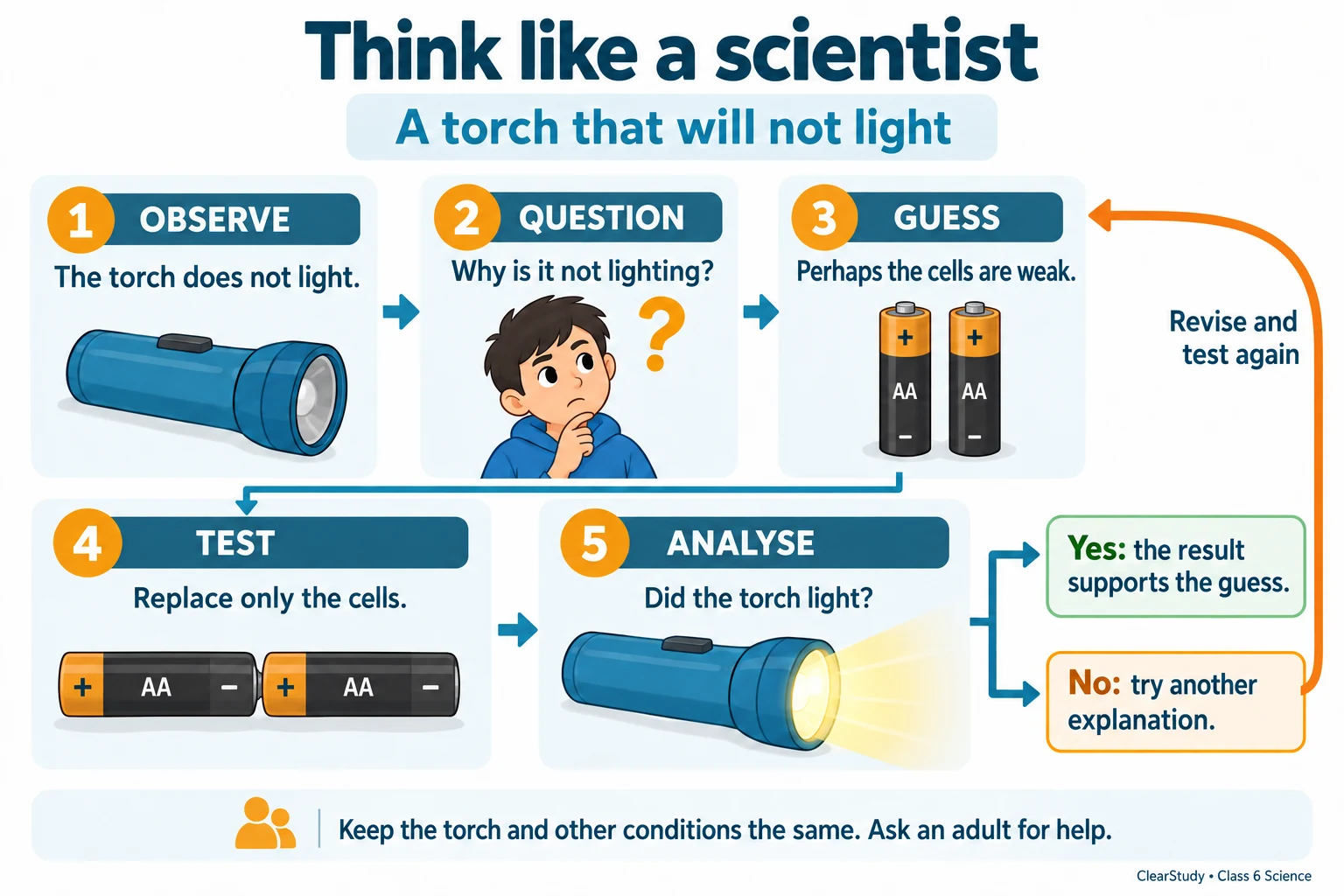
The chapter explains that science is not just memorising facts or doing experiments; it is a step-by-step process. The chapter introduces the following five steps. Investigations can return to an earlier step when new evidence or questions arise:
- Observe — we notice something interesting or something we do not understand.
- Wonder / question — this makes us think of a question about it.
- Guess — we guess a possible answer to that question.
- Test — we test this guess through experiments or more observations.
- Analyse — we look at the results to see if they actually answer our question.
Example: pen stops writing → “Why?” → guess “ink finished” → open pen and check refill → if not empty, guess again (“ink dried up”) and test once more.
Common Misconceptions to Avoid
Watch out for these
- Thinking science only happens in a laboratory — science is everywhere, from the kitchen to the playground to outer space.
- Believing science is only memorising facts and figures — it is mainly a step-by-step way of finding answers.
- Thinking only “scientists” do science — anyone who follows the scientific method, like a cook or an electrician, is working like a scientist.
- Expecting to find every answer in Grade 6 — this is a journey of five years and beyond; new questions keep arising.
- Skipping the “test” step — a guess is not an answer until we check it by experiment or observation.
- Thinking science must be done alone — scientists work together in teams, and so can you.
Extra Practice Questions
The practice questions, MCQs and Assertion–Reason items below are ClearStudy learning aids, not an NCERT end-of-chapter exercise.
Very Short Answer Type Questions
Q1. What is science, in one line?
Q2. From which quality does the book get its name “Curiosity”?
Q3. Name the first step of the scientific method.
Short Answer Type Questions
Q1. Why is science compared to a giant, never-ending jigsaw puzzle?
Q2. How does the example of a pen that stops writing show the scientific method?
Long Answer Type Question
Q1. “Anyone who follows the scientific method is working like a scientist.” Explain this statement with examples.
MCQs & Assertion–Reason
1. Science is best described as:
(a) only memorising facts (b) a way of thinking, observing and doing things to understand the world (c) reading without questions (d) copying answers
2. The book is named “Curiosity” because the most important quality for science is:
(a) memory (b) speed (c) curiosity (d) strength
3. Which is the correct order of the scientific method?
(a) guess → observe → test (b) observe → question → guess → test → analyse (c) test → analyse → observe (d) analyse → guess → observe
4. In the pen example, the first guess for why the pen stopped writing was that:
(a) the nib broke (b) the ink finished (c) the paper was wet (d) the cap was lost
5. Which planet does the book say we will start exploring first?
(a) Mars (b) the Moon (c) Earth (d) Jupiter
6. Science is compared in the chapter to a:
(a) closed box (b) giant never-ending jigsaw puzzle (c) finished painting (d) short story
7. According to the chapter, who is working like a scientist?
(a) only a person in a lab coat (b) anyone who follows the scientific method (c) someone who never asks questions (d) a person who only reads books
8. To test a guess, we should:
(a) ignore it (b) do experiments or make more observations (c) change the question (d) stop working
9. The chapter says science is rarely done:
(a) in teams (b) alone (c) with curiosity (d) by observation
10. “To be a wise person, you must be a ___ person.”
(a) “whys” (b) “quiet” (c) “fast” (d) “strong”
For each Assertion–Reason question, choose: (A) Both true and the Reason correctly explains the Assertion; (B) Both true but the Reason is not the correct explanation; (C) Assertion true, Reason false; (D) Assertion false, Reason true.
A-R 1. Assertion: Curiosity is the most important quality for learning science.
Reason: Curiosity makes us observe our surroundings keenly and start asking how and why.
A-R 2. Assertion: Science can be seen everywhere around us.
Reason: Some groundbreaking discoveries have come from unexpected places, from the kitchen to outer space.
A-R 3. Assertion: A guess by itself is the final answer to a scientific question.
Reason: We must test a guess through experiments or observations before accepting it.
A-R 4. Assertion: Only people called scientists can follow the scientific method.
Reason: A cook, an electrician or a cycle-repair person also asks questions and tests answers.
A-R 5. Assertion: We may not find answers to all our questions in Grade 6.
Reason: Learning science is a journey of the next five years or even beyond.
Quick Revision Summary
- Chapter 1 welcomes us to a new subject, Science, at the Middle Stage of school.
- Science = a way of thinking, observing and doing things to understand the world and uncover the secrets of the universe.
- Curiosity — asking how and why — is the most important quality, and it gives the book its name.
- Science is like a giant never-ending jigsaw puzzle; every discovery adds a piece and raises new questions.
- The scientific method has five steps: observe → question → guess → test → analyse (shown by the pen-that-stops-writing example).
- Anyone who follows this method — a cook, electrician or repair person — is working like a scientist; science is rarely done alone.
Real-life Applications
The scientific method works far beyond the classroom. A doctor observes symptoms, asks questions, guesses a cause and tests it before deciding treatment; a farmer who notices a crop wilting guesses the soil needs water and checks by watering one part; and a student investigating a dim torch tests the cells before the bulb. The same five steps — observe, question, guess, test, analyse — are how engineers improve machines, how cooks perfect recipes and how astronomers study the stars. Learning to be curious and observant in Chapter 1 prepares you to investigate every topic that follows in Curiosity — life, food, water, heat, materials and even things beyond Earth.
How to write a clear answer
Explain the meaning of science in your own accurate words, and remember the five steps of the scientific method in order (observe, question, guess, test, analyse). For any “daily-life example” question, pick a simple situation (pen, torch, milk, flat tyre) and clearly show all five steps. Use the textbook’s own ideas — curiosity, the jigsaw-puzzle picture, “anyone who follows the method is a scientist” and “a wise person is a whys person” — to show you have read and understood the chapter.
Frequently Asked Questions
What is Class 6 Science Curiosity Chapter 1 about?
Chapter 1, The Wonderful World of Science, welcomes you to the subject Science. It explains that science is a way of thinking, observing and doing things to understand the world, that curiosity is the most important quality, and that the scientific method — observe, question, guess, test and analyse — helps us find answers, shown through the example of a pen that stops writing.
Does Chapter 1 of Curiosity have an exercise?
No. It is an introductory chapter, so instead of an end-of-chapter exercise it has three in-text “Let us think and write” activities (1.1, 1.2, 1.3) and several “wonder” prompts, all answered on this page.
What are the steps of the scientific method?
The five steps, in order, are: observe something interesting, wonder and frame a question about it, guess a possible answer, test the guess through experiments or observations, and analyse the results to see if they answer the question.
Are these Class 6 Science Curiosity Chapter 1 solutions free?
Yes. All solutions are free and follow the official NCERT Curiosity textbook for 2026–27.
Checked against NCERT Curiosity, Chapter 1: The Wonderful World of Science (official PDF), reprint 2026–27. Activities 1.1–1.3 appear on pages 5–7. The teaching illustration and worked explanations are ClearStudy additions.