
NCERT Solutions for Class 6 Science (Curiosity) Chapter 3: Mindful Eating: A Path to a Healthy Body (NCERT 2026–27)
These Class 6 Science Curiosity Chapter 3 solutions cover Mindful Eating: A Path to a Healthy Body from the new NCF-2023 textbook (2026–27). The chapter explores the diversity of food across India, how cooking practices have changed, the components of food (carbohydrates, fats, proteins, vitamins and minerals), simple food tests, the idea of a balanced diet, the goodness of millets, and the journey of food from farm to plate. All 13 “Let us enhance our learning” questions are answered below with explanations, teaching diagrams and clear distinctions between observations and conclusions.
Class 6 Science Curiosity Chapter 3 Solutions – Overview
Chapter 3 of Curiosity, Mindful Eating: A Path to a Healthy Body, begins with the Sanskrit saying annena jātāni jivanti — “food gives life to living beings.” It shows that people across India eat a wonderful variety of food, shaped by the crops grown locally and by culture, taste and tradition. We learn how cooking practices have changed from the chulha and sil-batta to the gas stove and electric grinder. The heart of the chapter is the study of food components — carbohydrates and fats (energy-giving), proteins (body-building), and vitamins and minerals (protective) — along with roughage and water. We test foods for starch, fat and protein, understand a balanced diet, see why junk foods are unhealthy, why millets are nutri-cereals, and finally trace food miles from farm to plate, learning to respect food and never waste it.
Key Concepts & Definitions
Nutrients: food components that provide energy, support growth, help repair and protect our body, and maintain bodily functions. The major nutrients are carbohydrates, proteins, fats, vitamins and minerals.
Carbohydrates: the main source of energy in our diet (e.g. wheat, rice, maize, potato, sugar). Starch is a type of carbohydrate.
Fats: a source of stored energy (e.g. ghee, oils, nuts, seeds, butter). Along with carbohydrates they are energy-giving foods.
Proteins: body-building foods that help in growth and repair (e.g. pulses, beans, milk, paneer, egg, fish, meat).
Vitamins and minerals: protective nutrients needed in small amounts that protect the body from diseases and keep us healthy.
Roughage (dietary fibre): the parts of plant foods that our digestive enzymes do not break down; fibre helps bowel movements and supports digestive health.
Balanced diet: a diet with all essential nutrients, roughage and water in the right amounts for proper growth and development.
Deficiency diseases: diseases caused when one or more nutrients are missing from the diet for a long time (e.g. scurvy, goitre, rickets, anaemia, beriberi).
Millets (nutri-cereals): small-sized native grains such as jowar, bajra, ragi and sanwa, rich in vitamins, minerals and fibre, easily grown in different climates.
Food miles: the total distance a food item travels from the producer to the consumer; reducing food miles cuts cost and pollution and supports local farmers.
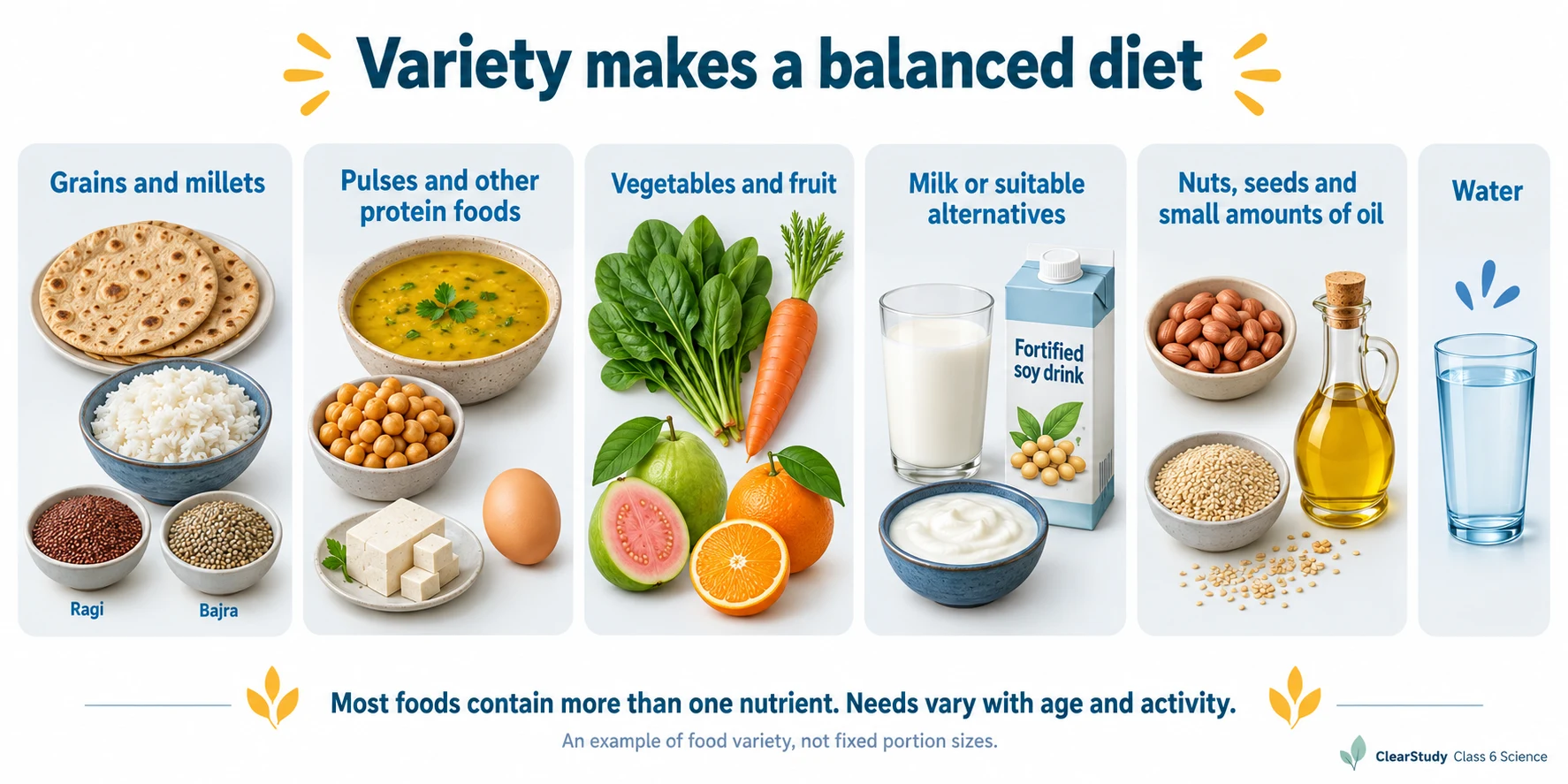
Food Components at a Glance
This summary (based on Fig. 3.5 of the textbook) helps you remember the protective vitamins and minerals, their functions, sources and deficiency diseases.
| Component | Function | Some sources | Possible effect of deficiency |
|---|---|---|---|
| Vitamin A | Keeps eyes and skin healthy | Papaya, carrot, mango, milk | Loss of vision (night blindness) |
| Vitamin B1 | Keeps heart healthy; supports body functions | Legumes, nuts, whole grains, seeds, milk products | Beriberi |
| Vitamin C | Helps body fight diseases | Amla, guava, green chilli, orange, lemon | Scurvy |
| Vitamin D | Helps body absorb calcium for bones and teeth | Fatty fish, egg yolk and vitamin-D-fortified foods; skin also makes vitamin D in sunlight | Rickets |
| Calcium | Keeps bones and teeth healthy | Milk, curd, paneer and calcium-fortified soya drinks | Poor bone mineralisation or weakened bones; tooth decay is not simply a calcium-deficiency disease |
| Iodine | Needed to make thyroid hormones for growth and body functions | Iodised salt; some dairy foods and seafood | Goitre |
| Iron | Needed for haemoglobin, which carries oxygen in blood | Pulses, leafy greens, fortified cereals and meat; vitamin C helps absorption from plant foods | Iron-deficiency anaemia; anaemia can also have other causes |
“Let us enhance our learning” — Solutions
Questions 1–13 follow the NCERT Curiosity exercise on pages 56–58. The explanations and diagrams are ClearStudy teaching aids; the nutrition table adds clarifications to the textbook summary.
1. Pick the odd one out and give reasons: (i) Jowar, Bajra, Ragi, Chana (ii) Kidney beans, Green gram, Soya bean, Rice
2. Discuss traditional versus modern culinary practices in India.
3. A teacher says that good food may act as medicine. Ravi is curious about this statement and has some questions for his teacher. List at least two questions that he can ask.
4. Not all delicious foods are necessarily healthy, while not all nutritious foods are always enjoyable. Share your thoughts along with a few examples.
5. Medu does not eat vegetables but enjoys biscuits, noodles and white bread. He often has stomach ache and constipation. What changes should he make in his diet to get rid of these problems? Explain your answer.
6. Reshma had trouble seeing things in dim light. The doctor tested her eyesight and prescribed a particular vitamin supplement. He also advised her to include a few food items in her diet. (i) Which deficiency disease is she suffering from? (ii) Which food component may be lacking in her diet? (iii) Suggest some food items that she should include in her diet to overcome this problem (any four).
7. You are provided the following: (i) Canned fruit juice (ii) Fresh fruit juice (iii) Fresh fruit Which one would you prefer and why?
8. Gourav got a fracture in his leg. His doctor aligned the bones and put on a plaster. The doctor also gave him calcium tablets. On the second visit, the doctor gave him Vitamin D syrup along with calcium tablets. Refer to Fig. 3.5 and answer the following questions: (i) Why did the doctor give calcium tablets to Gourav? (ii) On the second visit, why did the doctor give Vitamin D syrup along with calcium tablets? (iii) What question arises in your mind about the choices made by the doctor in giving the medicines?
9. Sugar is an example of carbohydrates. Sugar is tested with iodine solution but it does not change to blue-black colour. What can be a possible reason?
10. What do you think of Raman’s statement, “All starches are carbohydrates but not all carbohydrates are starches.” Describe the design of an activity to test your answer.
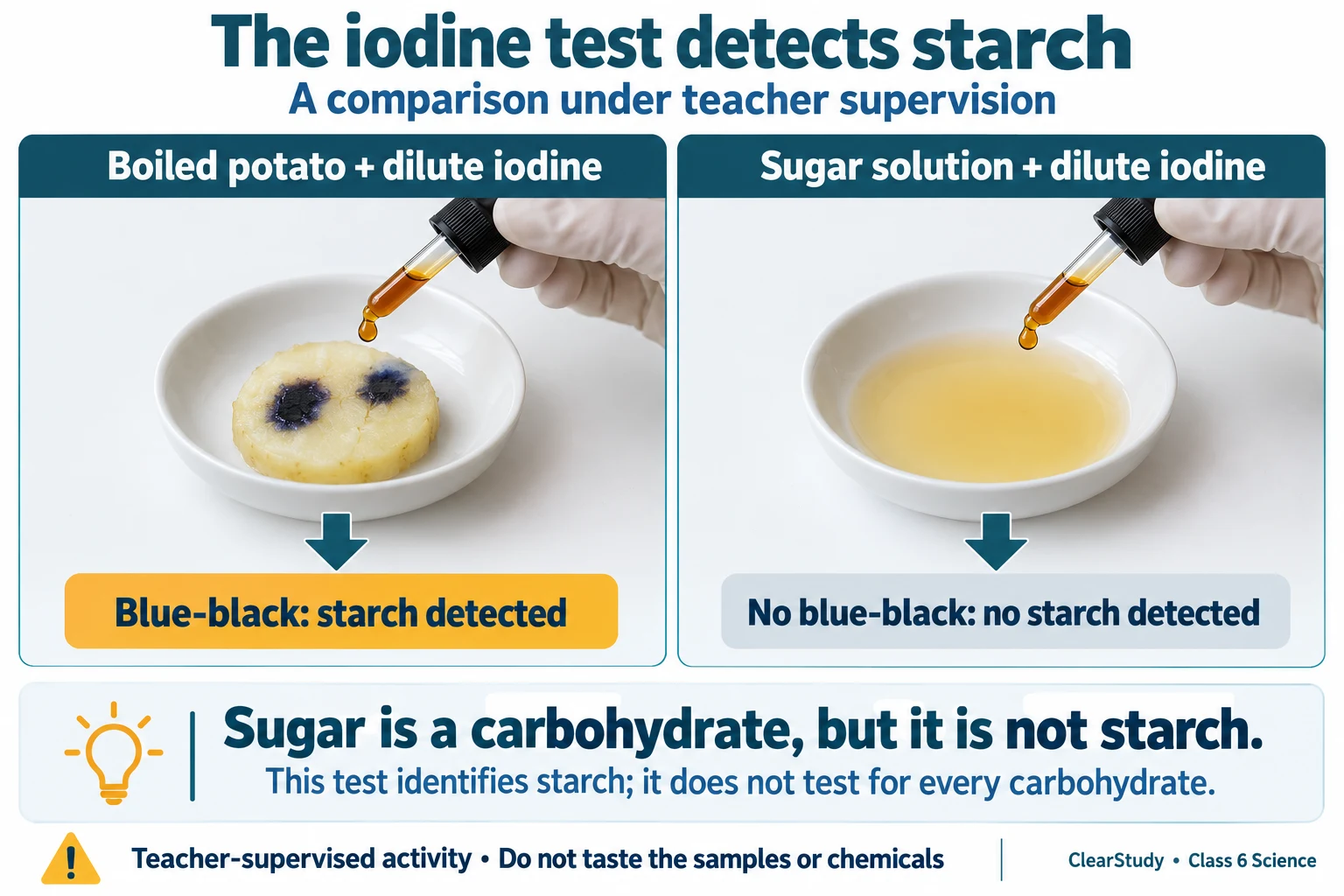
11. While using iodine in the laboratory, a few drops of iodine fell on Mishti’s socks and a few fell on her teacher’s saree. The drops of iodine on the saree turned blue-black while the colour on the socks did not change. What can be a possible reason?
12. Why are millets considered a healthy choice of food? Can eating just millets suffice for the nutritional requirements of the body? Discuss.
13. You are given a sample of a solution. How would you check the possibility of it being an iodine solution?
Common Mistakes to Avoid
Watch out for these
- Thinking all carbohydrates turn blue-black with iodine — only starch does, not sugar.
- Confusing energy-giving foods (carbohydrates, fats) with body-building foods (proteins) and protective foods (vitamins, minerals).
- Forgetting roughage and water when describing a balanced diet. Both are essential parts of the chapter’s food discussion.
- Calling chana (gram) or rice a millet — chana is a pulse and rice is a cereal; millets are jowar, bajra, ragi, sanwa.
- Mixing up deficiency diseases — remember Vitamin A→night blindness, Vitamin C→scurvy, Vitamin D→rickets, iodine→goitre, iron→anaemia.
- Believing junk food is fine because it tastes good — it is high in sugar/fat but low in protective nutrients and fibre.
Extra Practice Questions
The questions and MCQs in this section are ClearStudy practice, separate from the NCERT exercise.
Short Answer Type Questions
Q1. Why are carbohydrates and fats called energy-giving foods?
Q2. What is a balanced diet?
Q3. Why is iodised salt important for our health?
Q4. How is the colour test for proteins carried out, and what does a violet colour show?
Q5. What are food miles and why should we try to reduce them?
Long Answer Type Questions
Q1. Explain the major nutrients present in our food and their main functions, with one example of each.
Q2. Why are vitamins and minerals called protective nutrients? Support your answer with two examples of deficiency diseases.
Q3. Describe how a young scientist can test a few food items to find out whether they contain starch, fat and protein.
MCQs & Assertion–Reason
1. Which of the following is a source of stored energy?
(a) Protein (b) Fat (c) Vitamin C (d) Roughage
2. The blue-black colour with iodine solution shows the presence of:
(a) protein (b) fat (c) starch (d) sugar
3. Proteins are called body-building foods because they help in:
(a) giving instant energy (b) growth and repair of the body (c) removing waste (d) absorbing sunlight
4. Which deficiency disease is caused by the lack of iodine?
(a) Scurvy (b) Rickets (c) Goitre (d) Anaemia
5. Which of the following is a millet (nutri-cereal)?
(a) Chana (b) Rice (c) Ragi (d) Kidney beans
6. Roughage (dietary fibre) is important because it:
(a) provides energy (b) helps remove undigested food (c) builds muscles (d) cures scurvy
7. A violet colour in the food test indicates the presence of:
(a) starch (b) fat (c) protein (d) water
8. Which vitamin’s deficiency causes poor vision in dim light (night blindness)?
(a) Vitamin A (b) Vitamin B1 (c) Vitamin C (d) Vitamin D
9. Foods like potato wafers and candy bars that are high in sugar and fat but low in other nutrients are called:
(a) balanced foods (b) fortified foods (c) junk foods (d) protective foods
10. The total distance travelled by a food item from the producer to the consumer is called:
(a) food chain (b) food miles (c) food web (d) food festival
For each Assertion–Reason question, choose: (A) Both true and the Reason correctly explains the Assertion; (B) Both true but the Reason is not the correct explanation; (C) Assertion true, Reason false; (D) Assertion false, Reason true.
A-R 1. Assertion: Carbohydrates and fats are called energy-giving foods.
Reason: They provide the body with energy to perform various activities.
A-R 2. Assertion: Sugar turns blue-black when tested with iodine solution.
Reason: Iodine gives a blue-black colour only with starch, not with all carbohydrates.
A-R 3. Assertion: Vitamins and minerals are called protective nutrients.
Reason: They protect the body from diseases and keep us healthy.
A-R 4. Assertion: Eating only millets can fully meet all the nutritional needs of the body.
Reason: A balanced diet needs all nutrients along with roughage and water in the right amounts.
A-R 5. Assertion: We should try to reduce the food miles of the food we eat.
Reason: Reducing food miles cuts cost and pollution, supports local farmers and keeps food fresh.
Quick Revision Summary
- People across India eat diverse foods shaped by locally grown crops, taste, culture and tradition.
- Culinary practices have changed from the chulha and sil-batta to gas stoves and electric grinders.
- The major nutrients are carbohydrates, proteins, fats, vitamins and minerals; food also has roughage and water.
- Carbohydrates and fats are energy-giving; proteins are body-building; vitamins and minerals are protective nutrients.
- Iodine (blue-black) tests for starch, an oily patch tests for fat, and a violet colour tests for protein.
- A balanced diet has all nutrients, roughage and water in the right amounts; junk foods are unhealthy.
- Millets are nutri-cereals; eat local, plant-based food, reduce food miles, and never waste food.
Real-life Applications
Understanding food components helps us plan healthier meals every day. We can read the nutritional information printed on packets to compare foods — for example, choosing roasted chana over potato wafers because it has more protein and fibre and less fat. The simple iodine test explains why a starched cotton cloth turns blue-black, while the idea of protective nutrients tells us why doctors advise lemons for scurvy or iodised salt to prevent goitre. Choosing millets and locally grown, plant-based foods keeps us healthy, supports local farmers and is good for the planet by lowering food miles. Most importantly, taking only as much food as we can eat helps us respect the effort of farmers and reduce food wastage.
How to write a clear answer
Learn the three groups of foods by heart — energy-giving (carbohydrates, fats), body-building (proteins) and protective (vitamins, minerals) — and memorise the vitamin/mineral → deficiency-disease table (Fig. 3.5). For the food tests, always state the reagent, the colour change and the conclusion (iodine→blue-black→starch; oily patch→fat; violet→protein). Remember that only starch, not all carbohydrates, gives the iodine test — this idea appears in several questions. Use textbook examples like millets, iodised salt and food miles to make your answers complete.
Frequently Asked Questions
What is Class 6 Science Curiosity Chapter 3 about?
Chapter 3, Mindful Eating: A Path to a Healthy Body, is about the diversity of food in India, changing cooking practices, the components of food (carbohydrates, fats, proteins, vitamins and minerals), simple food tests, a balanced diet, junk food, millets and food miles from farm to plate.
What is the exercise in Class 6 Science Curiosity Chapter 3 called?
The end-of-chapter exercise is titled “Let us enhance our learning” and has 13 questions. Every question is reproduced verbatim and solved with step-by-step answers on this page.
Why does sugar not turn blue-black with iodine solution?
Because the iodine test detects only starch, which is one type of carbohydrate. Sugar is a different type of carbohydrate and does not contain starch, so it does not turn blue-black.
Are these Class 6 Science Curiosity Chapter 3 solutions free?
Yes. All solutions are free and follow the official NCERT Curiosity textbook for 2026–27.
Sources: NCERT Curiosity Chapter 3 (official PDF); NIH vitamin D information; NIH iron information; WHO healthy-diet guidance. These are school learning explanations, not a personal treatment plan.