
NCERT Solutions for Class 6 Social Science (Exploring Society) Chapter 1: Locating Places on the Earth (NCERT 2026–27)
These Class 6 Social Science Exploring Society Chapter 1 solutions cover Locating Places on the Earth from Exploring Society: India and Beyond, the NCERT textbook (2026–27 reprint). The chapter belongs to the theme India and the World: Land and the People and explains what a map is and its components, how latitude and longitude form a grid to locate any place, and how longitude is linked to time, time zones, standard time and the International Date Line. Below you get step-by-step answers to every question in the Questions, activities and projects section, clear notes on key terms, extra practice, MCQs, Assertion–Reason and FAQs.
Class 6 Social Science Exploring Society Chapter 1 – Overview
Chapter 1, Locating Places on the Earth, begins with a simple city map to show that a map is a drawing of an area seen from the top, and that its three main components are distance (shown by the scale), direction (the cardinal and intermediate directions) and symbols (small signs that stand for buildings, roads and natural features). Because the Earth is nearly a sphere, a flat map cannot show it perfectly, so we use a globe. On the globe, imaginary lines form a grid: parallels of latitude run east–west and measure angular distance from the Equator (0° to 90°N/S), while meridians of longitude run pole to pole and measure angular distance from the Prime Meridian (Greenwich, 0°) up to 180°E/W. Together, latitude and longitude give the two coordinates of any place. Since the Earth turns 360° in 24 hours (15° per hour), longitude also tells the local time; countries adopt one or more zones of standard time (India uses IST, GMT + 5½ hours) organised into time zones, and the International Date Line near 180° marks where the date changes.
Key Concepts & Terms
Map: a representation or drawing of an area — a village, a district, a country or the whole world — seen as if you are looking at the surface from the top. A book or collection of maps is called an atlas.
Kinds of maps: physical maps show natural features (mountains, oceans, rivers); political maps show countries, states, boundaries and cities; thematic maps show one specific kind of information.
Three components of a map: distance (handled by the scale), direction (the cardinal and intermediate directions) and symbols.
Scale: the relation between a distance on the map and the real distance on the ground, e.g. 1 cm = 500 m. The scale lets a huge area fit on a small piece of paper.
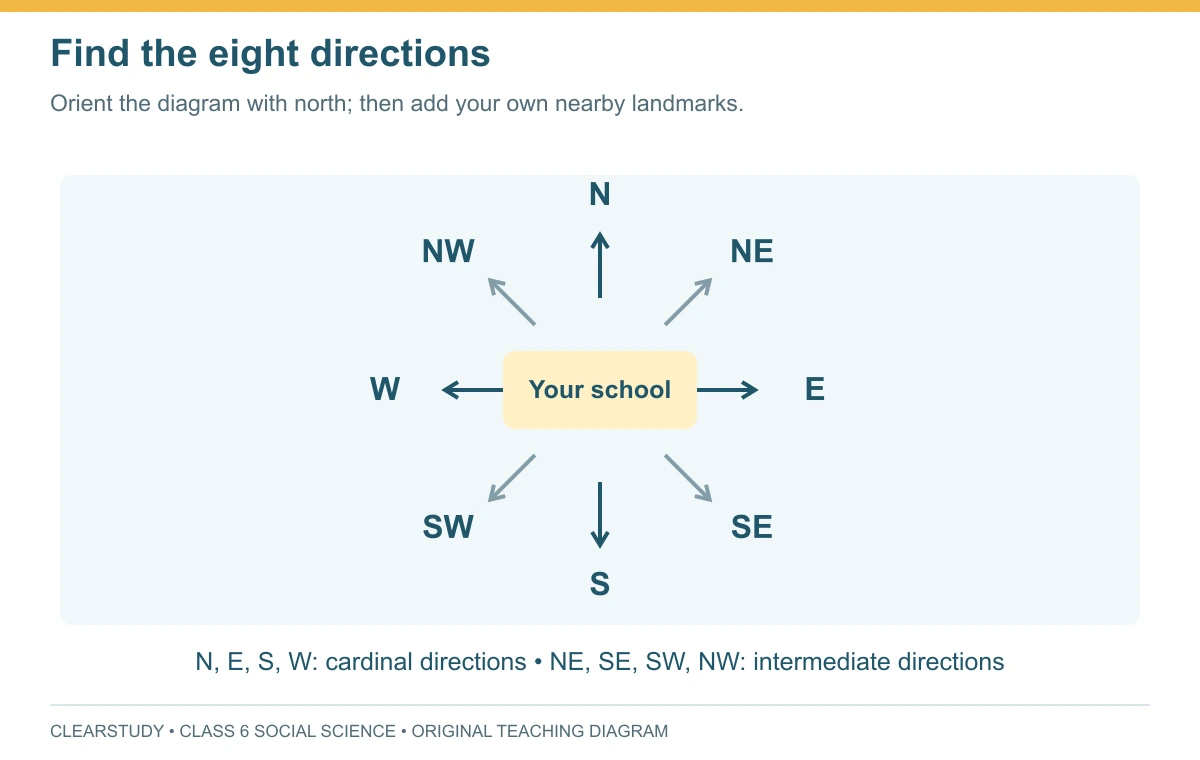
Cardinal & intermediate directions: the four cardinal directions are north, east, south and west; the four intermediate directions are northeast (NE), southeast (SE), southwest (SW) and northwest (NW).
Symbols: small standard signs that stand for features such as a railway station, post office, river or forest. The Survey of India has fixed a set of symbols for maps of India.
Globe: a sphere on which a map is drawn; because it has the same spherical shape as the Earth, it represents the Earth’s geography better than a flat map.
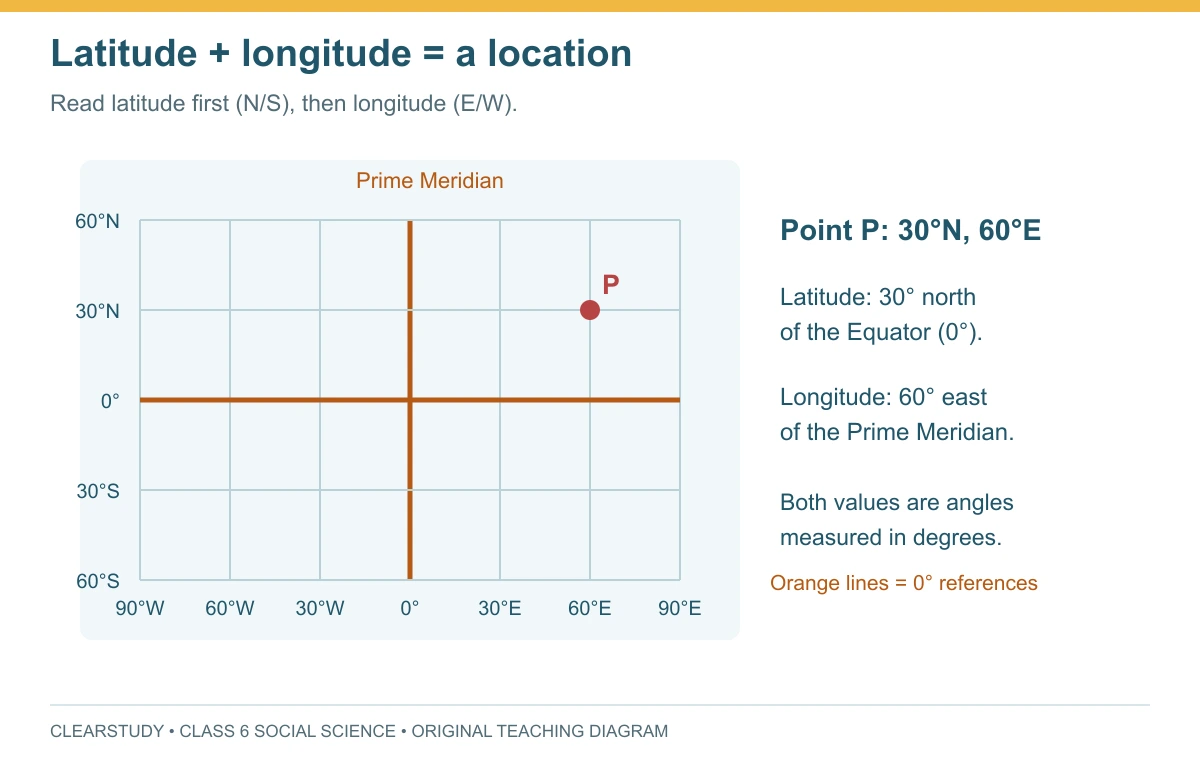
Latitude & parallels: latitude measures angular distance from the Equator; a parallel of latitude runs east–west, parallel to the Equator, and forms a circle. The Equator is 0° (the longest parallel) and the poles are 90°N and 90°S. Parallels grow smaller towards the poles.
Longitude & meridians: longitude measures angular distance from the Prime Meridian; a meridian of longitude is a half-circle running from pole to pole. Longitude runs 0° to 180° East or West.
Prime Meridian: the reference line of 0° longitude, fixed in 1884 through Greenwich (London). Long before, India used its own prime meridian, the madhya rekhā through Ujjayinī (Ujjain).
Coordinates & grid: latitude and longitude together are the two coordinates that locate any place, e.g. Delhi at about 29°N, 77°E. All the lines together form the grid (grid lines).
Hemispheres: the Equator divides the Earth into the Northern and Southern Hemispheres; the Prime Meridian (0°) and the 180° meridian together divide it into the Eastern and Western Hemispheres.
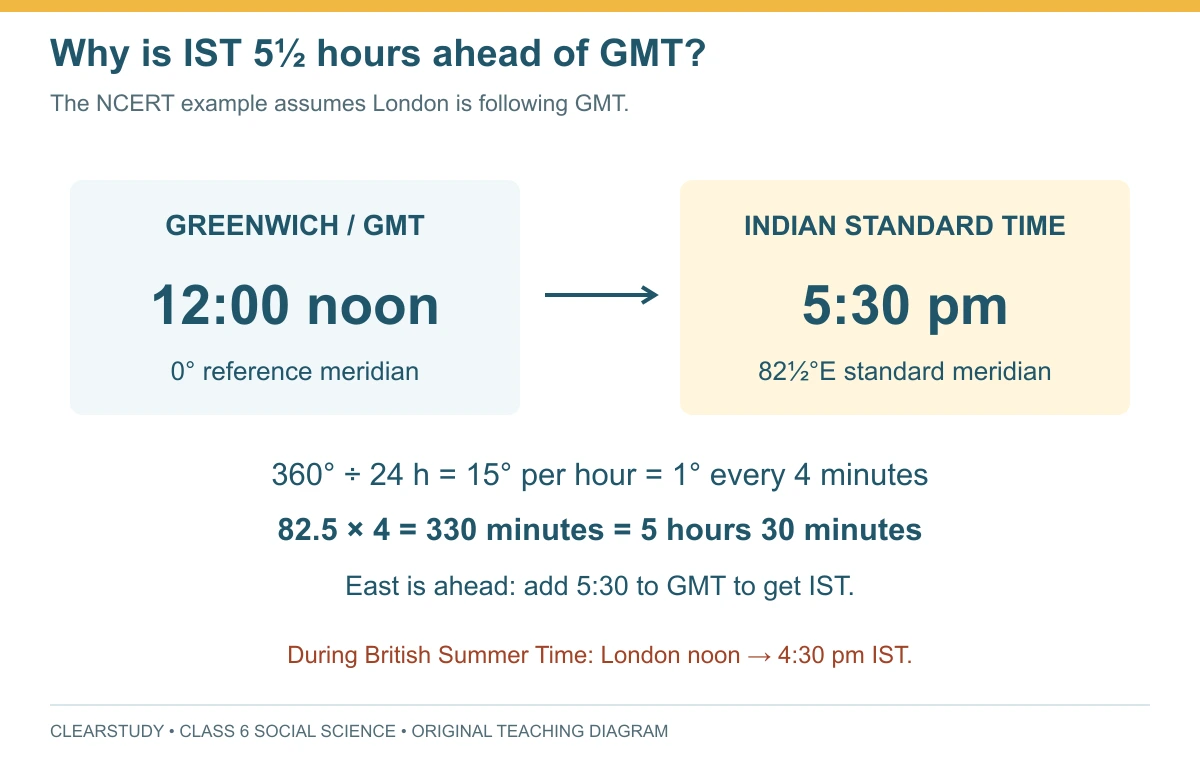
Time, standard time & time zones: the Earth turns 360° in 24 hours, i.e. 15° per hour, so longitude also marks local time. A country or region adopts a standard time based on a chosen reference meridian; some large countries use several time zones. Indian Standard Time (IST) is GMT + 5½ hours. Standard times are grouped into time zones.
International Date Line: the line near 180° longitude, opposite the Prime Meridian, where the date changes — subtract a day crossing eastward, add a day crossing westward.
Estuary: the place where a river meets the sea.
“Questions, activities and projects” — Full Solutions
These solutions follow the eight questions in NCERT’s Questions, activities and projects (pp. 24–25). Answers and teaching diagrams are ClearStudy explanations; personal activities use sample responses.
1. Returning to page 10 and to Fig. 5.2 in Chapter 5 of this textbook, taking the scale to be 2.5 cm = 500 km, calculate the real distance from the estuary of the Narmada River to the estuary of the Ganga river. (Hint: round off your measurement on the map to an easy number.)
Note: This is a map-measurement activity; the value above uses the textbook’s scale and a rounded map distance. Measure on your own printed map and apply the scale 1 cm = 200 km.
2. Why is it 5:30 pm in India when it is 12 pm or noon in London?
3. Why do we need symbols and colours in the map?
4. Find out what you have in the eight directions from your home or school.
5. What is the difference between local time and standard time? Discuss it in groups, with each group writing an answer in 100 to 150 words. Compare the answers.
6. Delhi’s and Bengaluru’s latitudes are 29°N and 13°N; their longitudes are almost the same, 77°E. How much will be the difference in local time between the two cities?
7. Mark the following statements as true or false; explain your answers with a sentence or two.
• All parallels of latitude have the same length.
• The length of a meridian of longitude is half of that of the Equator.
• The South Pole has a latitude of 90°S.
• In Assam, the local time and the IST are identical.
• Lines separating the time zones are identical with meridians of longitude.
• The Equator is also a parallel of latitude.
8. Solve the crossword below.
| Clue | Hint given | Answer |
|---|---|---|
| Across 1 | Lets you squeeze a huge area into your map | SCALE |
| Across 4 | A convenient sphere | GLOBE |
| Across 5 | The longest parallel of latitude | EQUATOR |
| Across 6 | The place the Prime Meridian is attached to | GREENWICH |
| Across 8 | So convenient to find your way | MAP |
| Across 10 | A measure of the distance from the Equator | LATITUDE |
| Down 2 | A measure of the distance from the Prime Meridian | LONGITUDE |
| Down 3 | These two together allow us to locate a place | COORDINATES |
| Down 6 | What latitudes and longitudes together create | GRID |
| Down 7 | The time we all follow in India | IST |
| Down 9 | On top of the world | POLE (four squares; P crosses MAP and L crosses LATITUDE) |
| Down 11 | An abbreviation for a line across which the day and date change | IDL (International Date Line) |
Extra Practice Questions
These questions and MCQs are ClearStudy practice, separate from the NCERT exercise.
Short Answer Type Questions
Q1. What is a map, and what is an atlas?
Q2. Name the three important components of a map.
Q3. What is the Prime Meridian, and where does it pass?
Q4. Why is a globe a better representation of the Earth than a flat map?
Q5. What is the International Date Line, and what happens when you cross it?
Long Answer Type Questions
Q1. Explain the difference between parallels of latitude and meridians of longitude.
Q2. How is longitude connected with time and time zones?
Q3. Describe the three important components of a map with examples.
MCQs & Assertion–Reason
1. A book or collection of maps is called:
(a) a globe (b) an atlas (c) a scale (d) a grid
2. Which of the following is NOT one of the three components of a map?
(a) Distance (b) Direction (c) Symbols (d) Climate
3. The longest parallel of latitude is:
(a) the Prime Meridian (b) the Tropic of Cancer (c) the Equator (d) 90°N
4. The latitude of the North Pole is:
(a) 0° (b) 45°N (c) 90°N (d) 180°
5. The Prime Meridian (0° longitude) passes through:
(a) Ujjain (b) Greenwich (c) New York (d) Tokyo
6. The Earth turns through how many degrees in one hour?
(a) 15° (b) 24° (c) 30° (d) 360°
7. Indian Standard Time (IST) is ahead of GMT by:
(a) 5 hours (b) 5 hours 30 minutes (c) 6 hours (d) 4 hours 30 minutes
8. Meridians of longitude run:
(a) east to west, parallel to the Equator (b) from pole to pole (c) only around the Equator (d) in circles of equal size
9. The line near 180° longitude where the date changes is the:
(a) Prime Meridian (b) Equator (c) International Date Line (d) Tropic of Capricorn
10. The ancient Indian prime meridian (madhya rekhā) passed through the city of:
(a) Delhi (b) Ujjayinī (Ujjain) (c) Kanyakumari (d) Kolkata
For each Assertion–Reason question, choose: (A) Both true and the Reason correctly explains the Assertion; (B) Both true but the Reason is not the correct explanation; (C) Assertion true, Reason false; (D) Assertion false, Reason true.
A-R 1. Assertion: Latitude and longitude together can locate any place on the Earth.
Reason: Latitude and longitude are the two coordinates of a place, forming a grid on the globe.
A-R 2. Assertion: All parallels of latitude have the same length.
Reason: The Equator is the longest parallel, and the parallels grow smaller towards the poles.
A-R 3. Assertion: When London follows GMT, it is 5:30 pm in India when it is 12 noon in London.
Reason: Indian Standard Time is fixed at 5 hours 30 minutes ahead of Greenwich Mean Time.
A-R 4. Assertion: A globe represents the Earth’s geography better than a flat map.
Reason: The globe is a sphere and has the same shape as the nearly spherical Earth.
A-R 5. Assertion: Local time depends on the latitude of a place.
Reason: As the Earth spins, the Sun’s position over a place changes with its longitude, deciding the local time.
Exam Tips & Common Mistakes
How to write a clear answer
Memorise the three components of a map (distance, direction, symbols) and the kinds of maps (physical, political, thematic). Be very clear that latitude is measured from the Equator (0° to 90°N/S, parallels run east–west) while longitude is measured from the Prime Meridian (0° to 180°E/W, meridians run pole to pole). Remember the key numbers: 360° in 24 hours = 15° per hour, and IST = GMT + 5½ hours. For time questions, first find the difference in longitude, convert at 15° per hour, then add (going east) or subtract (going west). When asked about Indian astronomical traditions, mention the historical prime meridian through Ujjayinī.
Common mistakes to avoid
- Saying all parallels of latitude are equal in length — only the Equator is the longest; parallels shrink towards the poles.
- Mixing up latitude (angular distance from the Equator, east–west lines) with longitude (angular distance from the Prime Meridian, pole-to-pole lines).
- Thinking local time depends on latitude — it depends on longitude.
- Forgetting that IST is GMT + 5 hours 30 minutes, not 5 hours.
- Assuming time-zone lines are perfectly straight — they bend to follow country borders.
- Leaving activity/observation questions (Q4) blank — write your own examples of nearby landmarks in each direction.
Frequently Asked Questions
What is Chapter 1 of Class 6 Social Science Exploring Society about?
Chapter 1, Locating Places on the Earth, explains what a map is and its components (distance, direction, symbols), how the globe uses latitude and longitude as a grid to locate any place, and how longitude is linked to local time, standard time, time zones and the International Date Line.
What is the difference between latitude and longitude?
Latitude measures the angular distance of a place north or south of the Equator (0° to 90°N/S), shown by parallels that run east–west. Longitude measures the angular distance east or west of the Prime Meridian (0° to 180°E/W), shown by meridians that run from pole to pole. Together they give the coordinates of any place.
What is the exercise heading for Chapter 1 of Exploring Society Class 6?
The end-of-chapter exercise in Exploring Society: India and Beyond Class 6 Chapter 1 is headed Questions, activities and projects and contains 8 questions (including a true/false set and a crossword), all answered step by step on this page.
Reviewed against NCERT, Exploring Society: India and Beyond, Chapter 1 (2026–27 reprint), and Fig. 5.2 in Chapter 5. Time references: CSIR-NPL: Indian Standard Time; UK Parliament: British Summer Time. Content reviewed 9 October 2026.