
NCERT Solutions for Class 6 Social Science (Exploring Society) Chapter 14: Economic Activities Around Us
These Class 6 Social Science Exploring Society Chapter 14 solutions cover Economic Activities Around Us from Exploring Society: India and Beyond, the NCERT textbook (2026–27 reprint). The chapter belongs to the theme Economic Life Around Us and explains how economic activities are classified into the primary, secondary and tertiary sectors, what differentiates them, and how the three sectors are interconnected — illustrated through the inspiring story of the AMUL dairy cooperative. Below you get step-by-step answers to all Questions, activities and projects, clear notes on key terms, extra practice, MCQs, Assertion–Reason and FAQs.
Class 6 Social Science Exploring Society Chapter 14 – Overview
Chapter 14, Economic Activities Around Us, builds on the idea from Chapter 13 that activities which create monetary value are called economic activities. As societies progressed, the number of such activities grew enormously, so we group those that share similar characteristics into broad economic sectors. The chapter explains the three main sectors: the primary sector (people depend directly on Nature to produce goods — agriculture, mining, fishing, raising livestock, forestry); the secondary sector (people process the outputs of the primary sector into new goods — construction, manufacturing, utilities like water and electricity); and the tertiary or service sector (people provide services that support the other two — transport, trade, banking, communication, healthcare). It then shows how the three sectors are interconnected through the famous story of AMUL (Anand Milk Union Limited), a dairy cooperative set up in 1946 that freed farmers from middlemen and brought them prosperity by handling milk collection, processing and sale together.
Key Concepts & Terms
Economic activity: any activity that creates monetary value, that is, value that can be measured in terms of money (such as farming, manufacturing or running a shop).
Economic sectors: broad groups that bring together various activities sharing similar characteristics; these activities help with the economic prosperity of a nation. The three sectors are primary, secondary and tertiary.
Primary sector: the group of activities that involves the extraction of raw materials directly from Nature — farming, mining, fishing, forestry, raising livestock, poultry, etc. Here people depend directly on Nature to produce goods.
Secondary sector: the group of activities that involves the processing of raw materials derived from the primary sector into products for sale or consumption — manufacturing in factories, construction, and utilities like water, electricity and gas.
Tertiary (service) sector: the group of activities that provides services to people and businesses, including support for the primary and secondary sectors — transportation, trade, banking, communication, software, healthcare, education and management of business.
Cooperative: a group of people who voluntarily come together to meet their economic and social needs in a formal way; they own the cooperative and take decisions collectively.
Middlemen: intermediaries who connect producers and buyers, for example by buying and reselling goods. They may earn a trading margin or a service fee.
AMUL: the dairy cooperative story in this chapter begins with the Kaira District Co-operative Milk Producers’ Union, established in Anand in 1946 under Tribhuvandas Patel. Sardar Vallabhbhai Patel inspired the cooperative movement; Dr. Verghese Kurien joined its development later. NCERT uses the expansion “Anand Milk Union Limited”.
Other key terms: Pasteurisation (heating milk to a specified temperature for a specified time to destroy harmful bacteria, followed by cooling; it is not the same as sterilisation), Warehouses (large buildings used for storing products), Retail (the sale of goods in small quantities to the end consumer), and Export (goods and services produced in one country and sold to buyers in another country).
“Questions, activities and projects” — Full Solutions
These solutions follow NCERT’s end-of-chapter questions. Answers and teaching illustrations are ClearStudy explanations; personal and group activities use model responses to adapt.
1. What is the primary sector? How is it different from the secondary sector? Give two examples.
2. How does the secondary sector depend on the tertiary sector? Illustrate with a few examples.
3. Give an example of interdependence between primary, secondary and tertiary sectors. Show it using a flow diagram.
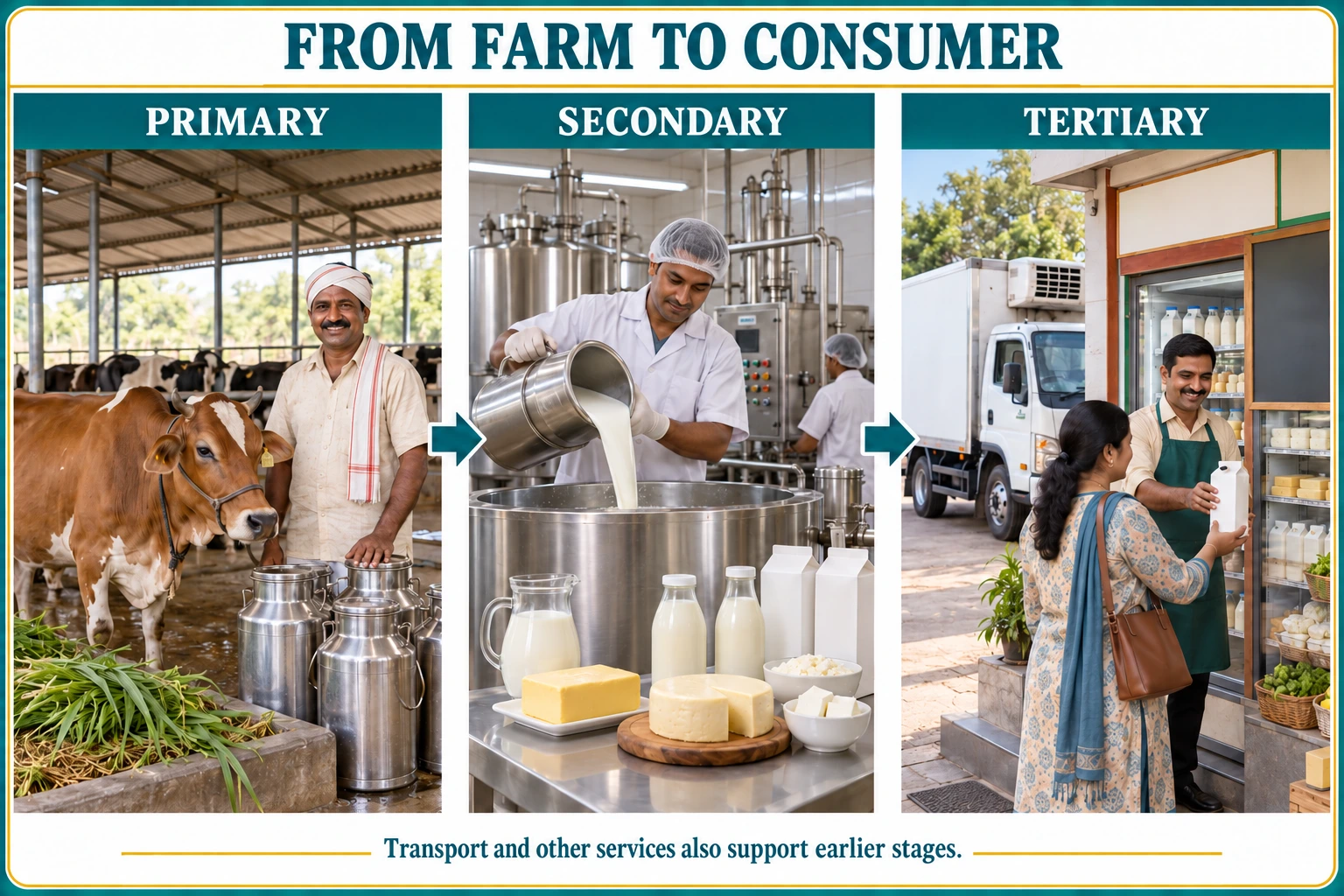
Note: The textbook also includes in-chapter activities — Think About It (recalling primary activities you have seen and the natural resources used), two Let’s Explore prompts (naming two more secondary-sector activities, and labelling the paper-to-textbook stages in Fig. 14.1 as primary, secondary and tertiary), and a neighbourhood project. Model responses appear in the in-chapter activities and extra-practice sections below; adapt personal observations to your own surroundings.
In-chapter activities: model answers
Primary and secondary activities (pages 199–200)
Primary: a farmer grows vegetables using soil, water and sunlight; fishers obtain fish from rivers or the sea. Replace these with activities you have actually observed. Two more secondary examples: a bakery turns flour into bread; a brick-making unit processes clay into bricks.
Paper to textbook: Fig. 14.1 (pages 206–207)
Follow the arrows in the textbook: top row left to right, then middle row right to left, then bottom row left to right. Label the activity shown, not merely the machine.
- Cutting trees to obtain timber: primary (forestry).
- Gathering and stacking harvested logs: primary when treated as part of forestry. A separate loading service is tertiary.
- Loading logs for transport: tertiary (handling/logistics).
- Carrying logs by truck: tertiary (transport).
- Making paper in a mill: secondary (manufacturing).
- Moving or storing paper packages: tertiary when shown as a logistics/warehousing service.
- Printing textbooks: secondary.
- Selling books in a bookshop: tertiary (retail).
Some pictures combine tasks. Explain your classification: moving materials within a factory can be part of manufacturing operations, while an independent transport or storage service is tertiary.
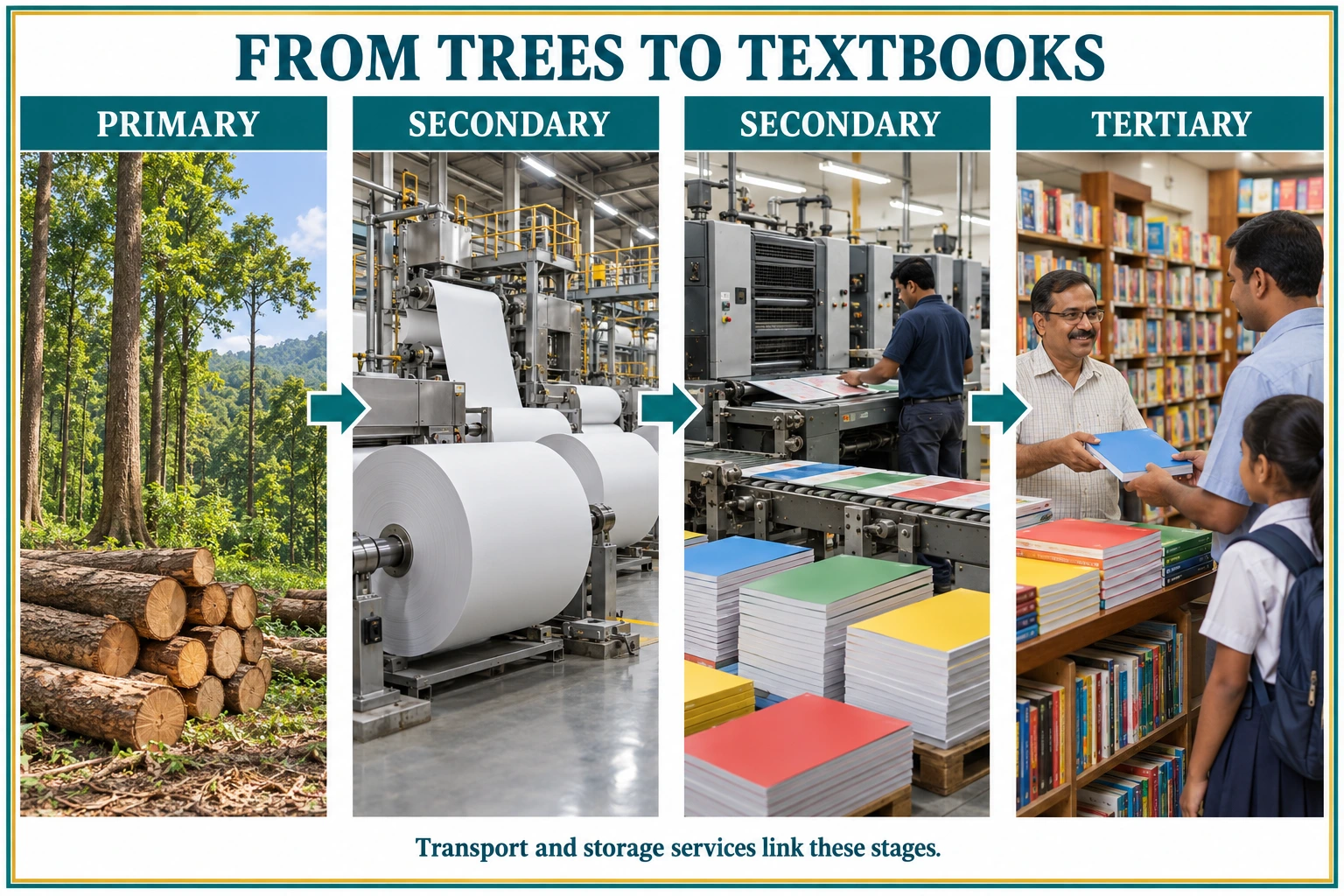
Using paper carefully (page 207)
Use both sides of a sheet, check work before printing, reuse suitable blank pages for rough work, share books where appropriate, and collect clean used paper for recycling. Recycling reduces the need for fresh materials; exact savings vary with the paper and production process.
Extra Practice Questions
These questions and MCQs are ClearStudy practice, separate from the NCERT exercise.
Short Answer Type Questions
Q1. What is an economic activity?
Q2. Name the three main economic sectors.
Q3. Why is the tertiary sector also called the service sector?
Q4. What is a cooperative? Name one milk cooperative other than AMUL.
Q5. Who set up AMUL, and when?
Long Answer Type Questions
Q1. Explain the three economic sectors with one example each.
Q2. Describe the story of AMUL and how it helped the farmers of Anand.
Q3. Make a list of economic activities you might find in your neighbourhood and label them as primary, secondary or tertiary, explaining how they depend on one another.
MCQs & Assertion–Reason
1. Activities that create monetary value are called:
(a) non-economic activities (b) economic activities (c) leisure activities (d) cultural activities
2. How many main economic sectors are there?
(a) two (b) three (c) four (d) five
3. Which of the following is a primary sector activity?
(a) Manufacturing cars (b) Banking (c) Fishing (d) Software development
4. The sector that processes raw materials into new products in factories is the:
(a) primary sector (b) secondary sector (c) tertiary sector (d) natural sector
5. Transportation, banking and communication are examples of the:
(a) primary sector (b) secondary sector (c) tertiary sector (d) raw-material sector
6. The tertiary sector is also known as the:
(a) farming sector (b) service sector (c) factory sector (d) mining sector
7. AMUL was set up in the year:
(a) 1940 (b) 1946 (c) 1956 (d) 1966
8. Who advised the farmers of Anand to form a cooperative?
(a) Dr. Verghese Kurien (b) Tribhuvandas Patel (c) Sardar Vallabhbhai Patel (d) Jawaharlal Nehru
9. Persons who buy goods from producers and sell them to consumers for a fee are called:
(a) cooperatives (b) middlemen (c) farmers (d) engineers
10. Converting milk into butter and milk powder in a factory is an example of a:
(a) primary sector activity (b) secondary sector activity (c) tertiary sector activity (d) non-economic activity
For each Assertion–Reason question, choose: (A) Both true and the Reason correctly explains the Assertion; (B) Both true but the Reason is not the correct explanation; (C) Assertion true, Reason false; (D) Assertion false, Reason true.
A-R 1. Assertion: Farming and fishing belong to the primary sector.
Reason: In primary sector activities, people are directly dependent on Nature to produce goods by extracting raw materials.
A-R 2. Assertion: The secondary sector depends on the primary sector.
Reason: The secondary sector processes the raw materials produced by the primary sector into new goods.
A-R 3. Assertion: The tertiary sector produces raw materials directly from Nature.
Reason: The tertiary sector provides services such as transport, trade and banking that support the other two sectors.
A-R 4. Assertion: AMUL helped the farmers of Anand become independent of middlemen.
Reason: As a cooperative, the farmers handled the collection, processing and sale of milk themselves and took decisions collectively.
A-R 5. Assertion: The three economic sectors work in isolation from one another.
Reason: The three sectors together convert natural raw materials into finished products for the final consumer.
Exam Tips & Common Mistakes
How to write a clear answer
Memorise the clear definition of each sector — primary (extracts raw materials directly from Nature), secondary (processes those raw materials into new goods), tertiary (provides supporting services) — and keep two examples of each ready. For interdependence questions, the textbook’s AMUL example is useful and draw a simple flow diagram from farmer → factory → shop → consumer. Remember the key facts about AMUL: founded in 1946, in Anand (Gujarat), advised by Sardar Vallabhbhai Patel, founded under Tribhuvandas Patel, with Dr. Verghese Kurien contributing later.
Common mistakes to avoid
- Confusing the sectors — remember primary produces, secondary processes, tertiary serves.
- Calling manufacturing or factory work a primary activity — it is a secondary activity.
- Thinking the sectors work separately — they are interconnected and depend on one another.
- Mixing up the dates: Sardar Patel inspired the cooperative; Tribhuvandas Patel led its establishment in 1946; Dr. Verghese Kurien arrived in Anand in 1949.
- Forgetting that the tertiary sector is also called the service sector.
- Leaving activity/project questions blank — write your own examples from your neighbourhood.
Frequently Asked Questions
What is Chapter 14 of Class 6 Social Science Exploring Society about?
Chapter 14, Economic Activities Around Us, explains how economic activities are classified into the primary, secondary and tertiary sectors, what differentiates them, and how the three sectors are interconnected — illustrated through the story of the AMUL dairy cooperative.
What is the difference between the primary, secondary and tertiary sectors?
The primary sector extracts raw materials directly from Nature (farming, fishing, mining). The secondary sector processes those raw materials into new goods in factories (manufacturing, construction). The tertiary or service sector provides supporting services such as transport, trade, banking and communication.
What is the exercise heading for Chapter 14 of Exploring Society?
The end-of-chapter exercise in Exploring Society: India and Beyond Chapter 14 is headed Questions, activities and projects and contains 3 numbered questions, all answered step by step on this page.
Reviewed against NCERT, Exploring Society: India and Beyond, Chapter 14 (2026–27 reprint). Content reviewed 9 October 2026.