
NCERT Solutions for Class 6 Social Science (Exploring Society) Chapter 4: Timeline and Sources of History (NCERT 2026–27)
These Class 6 Social Science Exploring Society Chapter 4 solutions cover Timeline and Sources of History from Exploring Society: India and Beyond, the NCERT textbook (2026–27 reprint). This is the first history chapter of the book and answers three Big Questions — how we measure historical time, how different sources help us understand history, and how early humans lived. Below you get step-by-step answers to every part of the Questions, activities and projects exercise, clear notes on key terms (BCE, CE, century, millennium, sources of history), extra practice, MCQs, Assertion–Reason and FAQs.
Class 6 Social Science Exploring Society Chapter 4 – Overview
Chapter 4, Timeline and Sources of History, introduces history as the study of the human past. It explains that the Earth has a very long history of which humans occupy only a tiny, most recent part, and that scholars such as geologists, palaeontologists, anthropologists and archaeologists help us uncover it. The chapter teaches how time is measured using a calendar (mainly the Gregorian calendar), how years are counted as BCE (Before Common Era) and CE (Common Era) with no ‘year zero’, and how longer durations are described as decades, centuries and millenniums. A timeline is shown to be a convenient tool for arranging events in order. The chapter then describes the main sources of history — archaeological, literary, oral, artistic and scientific — and ends with the story of early humans, who lived in bands as hunter-gatherers, used fire and tools, made rock art, and later began farming, domesticating animals and forming villages.
Key Concepts & Terms
History: the study of the human past. We humans occupy only a tiny, most recent part of the Earth’s very long history.
Source of history: a place, person, text or object from which we gather information about some past event or period.
Calendar: a system for measuring time. The Gregorian calendar is used worldwide today; it has 12 months adding up to 365 days, with a leap year every four years (century years are leap years only if divisible by 400). Hindu, Muslim, Jewish, Chinese and other calendars are also used.
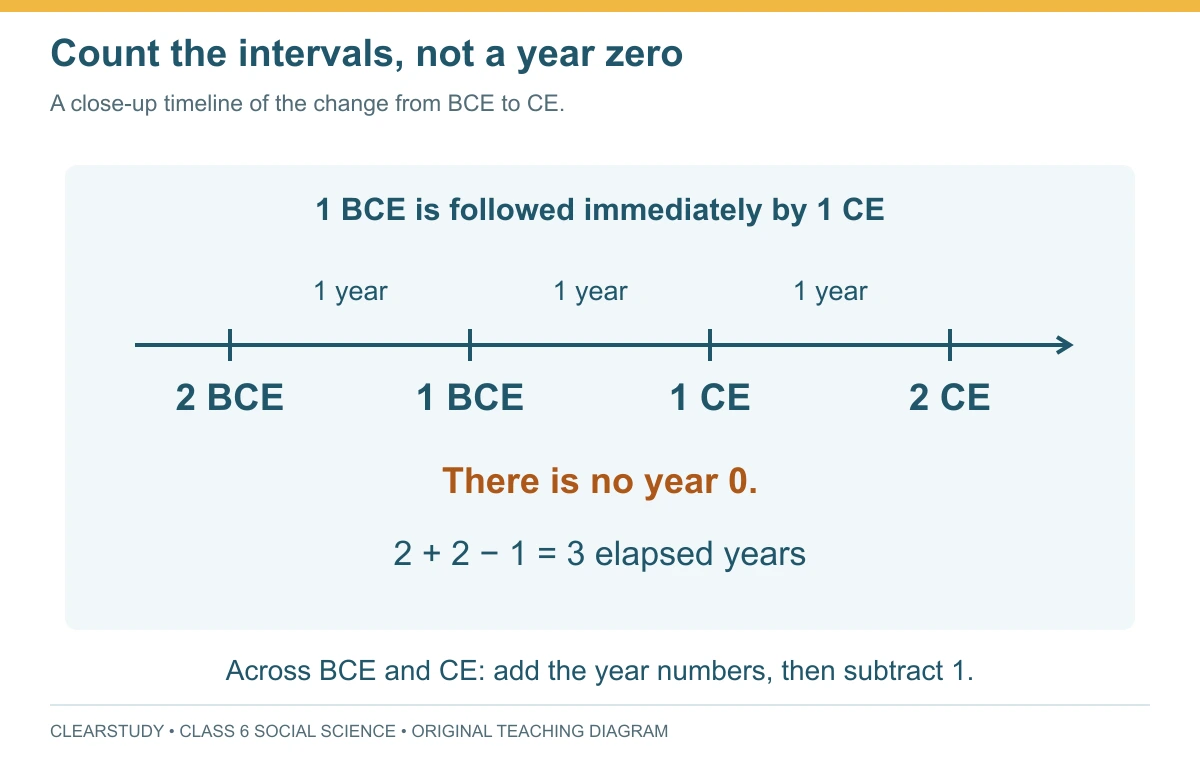
CE and BCE: years counted forward from the conventional date of Jesus Christ’s birth are marked CE (Common Era, formerly AD); years counted backward from that point are marked BCE (Before Common Era, formerly BC). There is no ‘year zero’ — 1 CE follows immediately after 1 BCE.
Era: a distinct period of time, often beginning with a major event like the birth of an important person or the start of a ruler’s reign.
Century & millennium: a century is any period of 100 years (the 21st century CE runs from 2001 to 2100); a millennium is any period of 1,000 years (the 3rd millennium CE began in 2001 and ends in 3000). Centuries and millenniums BCE are counted backward from 1 BCE.
Timeline: a tool that shows a sequence of dates and events over a period; it helps us understand the order in which historical events took place (for example, the Buddha was born before Jesus).
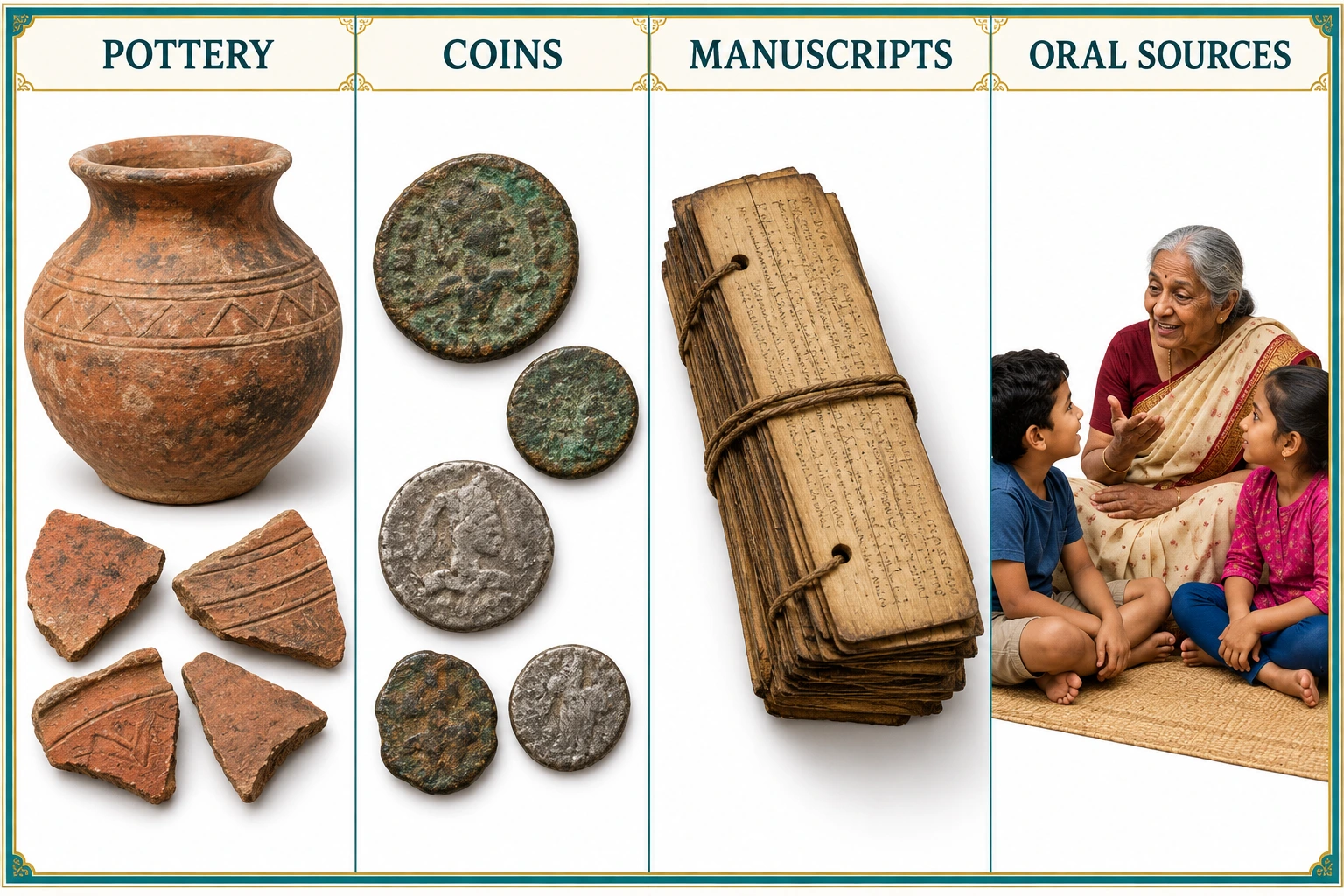
Main sources of history: archaeological (monuments, tools, pottery, coins, ornaments, burials, human/animal/plant remains), literary (manuscripts, inscriptions, the Vedas and Itihasas, poems, plays, travelogues, chronicles), oral (folklore, genealogies, stories passed by word of mouth), artistic (paintings, sculptures, panels) and scientific (studies of ancient climates, chemistry and genetics).
Specialists of the past: geologists study the physical features of the Earth; palaeontologists study fossils of ancient plants, animals and humans; anthropologists study human societies and cultures; archaeologists investigate material remains and their context through surveys, careful excavation and analysis; epigraphists study inscriptions; and a historian studies and writes about the past.
Fossils: impressions of footprints, or parts of plants or animals, that are found preserved within layers of soil or rock.
Early humans: modern humans (Homo sapiens) have lived for about 300,000 years. They lived in bands, were hunter-gatherers, used fire and stone tools, made rock paintings and simple ornaments, and after the last Ice Age (ended around 12,000 years ago) began farming, domesticating animals and settling in villages near rivers.
“Questions, activities and projects” — Full Solutions
These solutions follow NCERT’s end-of-chapter questions. Answers and teaching illustrations are ClearStudy explanations; personal and group activities use model responses to adapt.
1. As a project, write the history of your family (or village if you live in one), using sources of history at your disposal. Ask your teacher to guide you.
2. Can we compare historians to detectives? Give reasons for your answers.
Early-human scenes are reconstructions. As NCERT explains on p. 72, the work shown for men and women is not proof that those roles were fixed everywhere. Farming and settlement also developed at different times in different regions.
3. A few exercises with dates:
• Place these dates chronologically on the timeline: 323 CE, 323 BCE, 100 CE, 100 BCE, 1900 BCE, 1090 CE, 2024 CE.
| Order | Date | Side of timeline |
|---|---|---|
| 1 (oldest) | 1900 BCE | Before Common Era |
| 2 | 323 BCE | Before Common Era |
| 3 | 100 BCE | Before Common Era |
| 4 | 100 CE | Common Era |
| 5 | 323 CE | Common Era |
| 6 | 1090 CE | Common Era |
| 7 (latest) | 2024 CE | Common Era |
• If King Chandragupta was born in 320 CE, which century did he belong to? And how many years was that after the Buddha’s birth?
• Rani of Jhansi was born in 1828. Which century did she belong to? How many years was that before India’s Independence?
• Turn ‘12,000 years ago’ into a date.
4. Plan a visit to a nearby museum: the visit should be prepared with some prior research on the kind of exhibits the museum holds. Keep notes during the visit. Write a brief report afterwards, highlighting what was unexpected / interesting / fun about the visit and the exhibits.
5. Invite to your school an archaeologist or a historian and ask them to speak on the history of your region and why it’s important to know it.
Extra Practice Questions
These questions and MCQs are ClearStudy practice, separate from the NCERT exercise.
Short Answer Type Questions
Q1. What is history?
Q2. What is a source of history? Give two examples.
Q3. What is the difference between BCE and CE?
Q4. Name the four kinds of specialists shown in the chapter who study the past.
Q5. How did early humans get their food before farming began?
Long Answer Type Questions
Q1. What is a timeline, and how is it useful in the study of history?
Q2. Describe the main sources of history with examples.
Q3. How did the lives of early humans change after the last Ice Age?
MCQs & Assertion–Reason
1. History is the study of:
(a) the human past (b) plants only (c) the future (d) maps
2. The calendar most commonly used worldwide today is the:
(a) Hindu calendar (b) Chinese calendar (c) Gregorian calendar (d) Jewish calendar
3. In the Gregorian calendar, the year 1 CE follows immediately after:
(a) the year 0 (b) the year 1 BCE (c) the year 2 CE (d) the year 100 BCE
4. A period of 100 years is called a:
(a) decade (b) millennium (c) century (d) era
5. A period of 1,000 years is called a:
(a) century (b) millennium (c) decade (d) generation
6. Scientists who study fossils of ancient plants, animals and humans are called:
(a) geologists (b) anthropologists (c) palaeontologists (d) historians
7. Which of the following is an archaeological source of history?
(a) folklore (b) an ancient coin (c) a travelogue (d) a genealogy
8. The 3rd century BCE includes the years:
(a) 300 BCE to 201 BCE (b) 201 BCE to 100 BCE (c) 300 CE to 201 CE (d) 1 BCE to 100 BCE
9. Approximately how long have modern humans (Homo sapiens) walked the Earth?
(a) 12,000 years (b) 50,000 years (c) 300,000 years (d) 4.54 billion years
10. Before farming began, early humans survived mainly as:
(a) traders (b) hunter-gatherers (c) factory workers (d) city dwellers
For each Assertion–Reason question, choose: (A) Both true and the Reason correctly explains the Assertion; (B) Both true but the Reason is not the correct explanation; (C) Assertion true, Reason false; (D) Assertion false, Reason true.
A-R 1. Assertion: To find the number of years between a BCE date and a CE date, we add them and subtract 1.
Reason: There is no ‘year zero’ in the Gregorian calendar, as 1 CE follows immediately after 1 BCE.
A-R 2. Assertion: A timeline helps us understand the order in which historical events took place.
Reason: A timeline shows a sequence of dates and events covering a particular period.
A-R 3. Assertion: Historians rely on only one source while studying the past.
Reason: Historians compare several sources, which may agree or contradict one another.
A-R 4. Assertion: After the last Ice Age, many humans began farming and settling down.
Reason: When the climate warmed up, living conditions improved and humans could grow cereals and domesticate animals.
A-R 5. Assertion: Modern humans occupy only a tiny part of the Earth’s history.
Reason: The Earth is about 4.54 billion years old, while modern humans have lived for only about 300,000 years.
Exam Tips & Common Mistakes
How to write a clear answer
Master the date rules first: BCE numbers grow as you go back in time, and to find the gap between a BCE date and a CE date you add them and subtract 1 (no year zero). Remember the century rule — the nth century CE runs from 100 × (n − 1) + 1 to 100 × n, so 1828 is the 19th century. Learn archaeological, literary, oral and artistic sources with examples, and how scientific studies help analyse evidence, and the four specialists (geologist, palaeontologist, anthropologist, archaeologist). For activity/project questions (1, 4 and 5), do not leave them blank — write a clear, step-by-step plan even if the actual work is done in class. Use the textbook’s own facts (the Buddha around 560 BCE, the Ice Age ending around 12,000 years ago, Homo sapiens for about 300,000 years) to show you have studied the chapter.
Common mistakes to avoid
- Forgetting that there is no year zero — this changes BCE-to-CE calculations (add, then subtract 1).
- Thinking a larger BCE number is more recent — in BCE, the larger the number, the older the date.
- Getting the century wrong — 1828 belongs to the 19th century, not the 18th.
- Confusing century (100 years) with millennium (1,000 years).
- Mixing up the specialists — palaeontologists study fossils, archaeologists dig up human-made remains.
- Leaving project/activity questions (1, 4, 5) unanswered instead of writing a planned response.
Frequently Asked Questions
What is Chapter 4 of Class 6 Social Science Exploring Society about?
Chapter 4, Timeline and Sources of History, explains how we measure historical time using calendars, BCE and CE, centuries and millenniums; how a timeline arranges events in order; the main sources of history (archaeological, literary, oral, artistic and scientific); and how early humans lived as hunter-gatherers before farming and villages began.
What is the difference between BCE and CE?
CE (Common Era, formerly AD) counts the years forward from the conventional date of Jesus Christ’s birth, while BCE (Before Common Era, formerly BC) counts the years backward from that point. There is no ‘year zero’, so 1 CE follows immediately after 1 BCE, and to find the gap between a BCE and a CE date you add them and subtract 1.
What is the exercise heading for Chapter 4 of Exploring Society?
The end-of-chapter exercise in Exploring Society: India and Beyond Chapter 4 is headed Questions, activities and projects and contains 5 numbered items, including a set of date exercises in Question 3, all answered step by step on this page.
Reviewed against NCERT, Exploring Society: India and Beyond, Chapter 4 (2026–27 reprint). Content reviewed 9 October 2026.