
The Day the River Spoke — Class 7 English Poorvi Questions and Answers
The Day the River Spoke questions and answers for Class 7 Poorvi explain Jahnavi’s dream, the personified River and the textbook’s reading, language and activity tasks. Compare the suggested answers with your reading and adapt personal responses.
Source: NCERT Poorvi, Grade 7, Unit 1, printed pages 1–15 (listening transcript 39–40); supplied reprint 2026–27. Open-ended and personal responses are examples to adapt. These explanations are study support, not an official NCERT answer key.
About the chapter
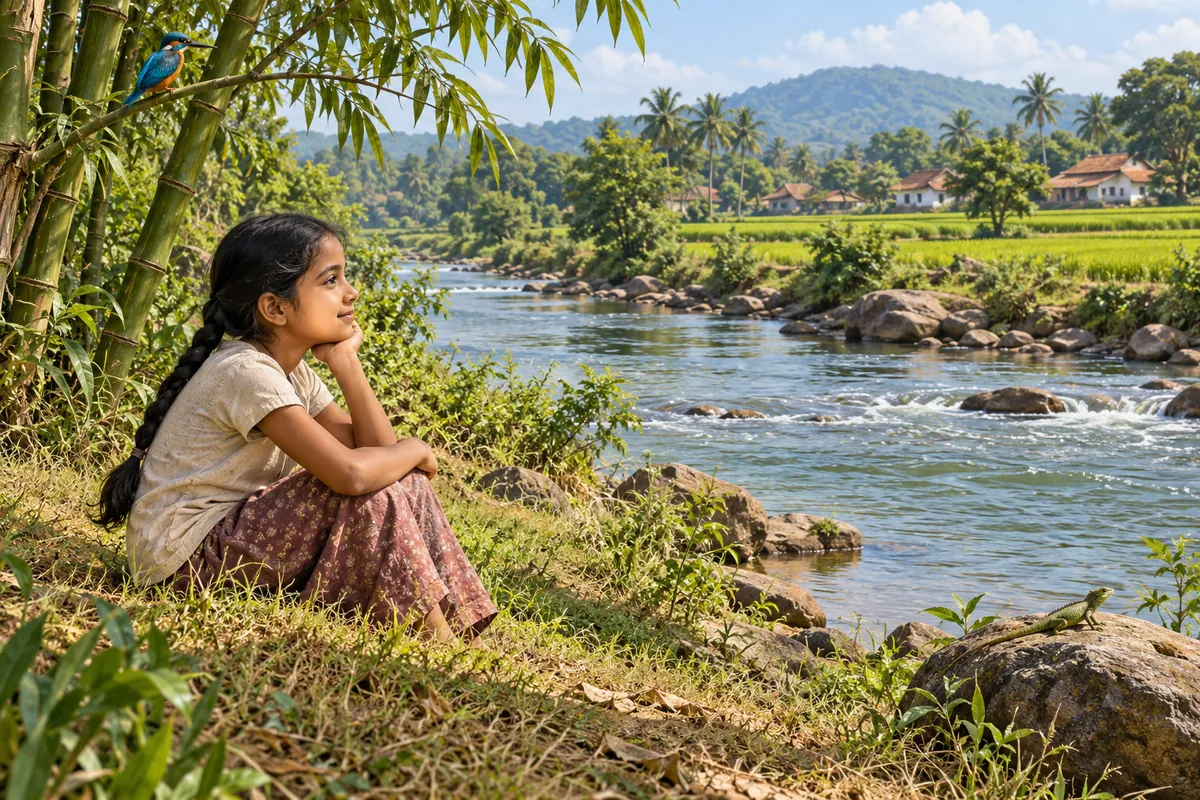
“The Day the River Spoke” is the opening prose piece of Unit 1, ‘Learning Together’. It tells the story of Jahnavi, a bright nearly ten-year-old girl from a coastal village in India who longs to go to school like Gopi (Ettan) and Meena. While crying by the riverside, she is surprised to hear the River itself speak to her in a sleepy, kindly voice. The River listens to her worries, gently encourages her to be brave and try, and gives her the courage to walk into school on her own. The story celebrates a girl’s right to education, the value of courage, and the wonder of nature that quietly supports us.
About the author
This story is an extract adapted from The Day the River Spoke by Kamala Nair. The narrative is set in a small Indian coastal village near the sea, where families farm the land and children play among the bamboo clumps, kingfishers and rice fields. The writer uses simple, gentle language and the device of a talking river to highlight a child’s desire to learn and the social barriers that once kept many girls out of school. Through warm dialogue between Jahnavi and the River, the author conveys an inspiring message about courage, curiosity and the importance of education for every child, especially girls.
Summary
Jahnavi is a curious nearly ten-year-old girl who lives with her parents and three brothers in a coastal village. Her parents work on the farm, and Jahnavi spends much of her day minding her youngest brother, little Appu. She has a deep dream: she wants to go to school and learn to read like Gopi, her elder brother whom she calls ‘Ettan’, and Meena. Each time she asked her mother, she was told she was too small, or to wait for ‘next year’, or to look after her little brothers. Now she feels she is too old and that her family does not want her to study.
One day, while sitting by the river and crying, Jahnavi hears a sleepy, murmuring voice asking what the matter is. To her surprise, it is the River itself. The River, who must hurry to reach the sea, listens kindly as Jahnavi pours out her wish to go to school and her many curious questions about the world – why spiders are yellow in yellow flowers, why bamboo trees rustle, why the moon comes from behind the hills, and why the creatures she mistakes for baby fish become frogs. The River gently advises her that little girls can do as much as little boys, and that she should simply slip along to school one morning, sit quietly and listen. It tells her to be brave, reminding her that she is not afraid of lizards, snakes or trains, so a school should not scare her either.
Gathering courage, Jahnavi reaches the school, listens at the door, and creeps into the back row with little Appu asleep on her shoulder. The kind teacher notices her, learns she is Gopi’s sister, and promises to speak to her father. The next evening the teacher visits her home, and her parents agree to let her study. Her mother says she too had once wished to go to school. Jahnavi is overjoyed and dreams of becoming a teacher herself one day, so she can bring all the village girls to school. The next morning she runs to tell the River, “I did it!”, and the River chuckles and promises to tell her about the great ships that sail the sea.
Theme & message
The central theme is a girl’s right to education and the courage to follow one’s dream. Jahnavi’s longing to learn, and the River’s gentle insistence that “little girls can do as much as little boys,” together challenge the old idea that girls should stay at home. The story also celebrates curiosity and the bond between humans and nature: the talking River represents a wise, encouraging friend who listens patiently and pushes Jahnavi to act. Its message is that with a little courage and self-belief – “it’s up to you” – every child, especially every girl, can claim the chance to learn and grow.
Word meanings
| Word | English meaning | Hindi meaning |
|---|---|---|
| splashed | fell in drops, making a sound | छींटे पड़ना / छपाका मारना |
| slithered | moved by sliding from side to side | रेंगते हुए सरकना |
| murmuring | speaking in a low voice | धीमे स्वर में बोलना / फुसफुसाना |
| startled | surprised | चौंक जाना / हड़बड़ाना |
| thicket | a dense group of bushes and trees | झाड़ी / घनी झाड़ियाँ |
| shrieked | made a high-pitched sound | चीख़ पड़ना / चिल्लाना |
| rustle | light sound made by leaves rubbing together | पत्तों की सरसराहट |
| conspiratorially | secretly | गुप्त ढंग से / रहस्यमय तरीके से |
| clump | a small group of trees growing together | पेड़ों का झुंड |
| rattling | noise made by shaking things | खड़खड़ाहट / खटखटाहट |
| catamaran | a kind of boat | एक प्रकार की नाव (कटमरान) |
| wailed | complained in a loud voice | रोते हुए शिकायत करना / विलाप करना |
| gasped | took a short, quick breath due to surprise or shock | चकित होकर अचानक साँस खींचना |
| panting | breathing quickly with short breaths | हाँफते हुए |
| crept | moved slowly and quietly | धीरे से रेंगते हुए बढ़ना |
| squatting | sitting on the heels with knees bent | उकड़ू बैठना |
| chuckle | a quiet, gentle laugh | धीमे से हंसना / मुस्कुराना |
| bask | to lie or sit enjoying warmth (of the sun) | धूप सेंकना / धूप का आनंद लेना |
| soul | (here) a single person | एक भी व्यक्ति / प्राणी |
Let us discuss
I. (after Part I)
1. What was Jahnavi’s dream? Was it important to her? Why?
2. Do you think the river can help her in fulfilling her dream? How?
II. (after the full story)
Complete the table given below with Jahnavi’s questions in Column 1 and the River’s answers in Column 2.
| Column 1 – Jahnavi’s question | Column 2 – The River’s answer |
|---|---|
| …why the moon always comes from behind the hills…? | It goes down towards the sea. The River had seen that it always takes the same way – over the mountains and down to the sea, like the River itself. |
| Can I do something? (Can a girl go to school?) | …little girls can do as much as little boys. (She should slip along, sit in school and listen.) |
| What are ships? | Big boats, so big that they can take hundreds of people, and they sail along the sea with lights that shine all night. |
| Will they come here? | I’m afraid not. Too large, you know. Chandu’s catamaran is good enough for me; Chandu can take you to see a ship someday. |
Let us think and reflect
I.1. Extract – “You shouldn’t cry, you know,” the voice went on… “I’ve got to hurry to reach the sea, you know.”
I.2. Extract – “Can I do something?” asked Jahnavi… “I couldn’t! They’d scare me! They’d chase me out.”
II. Answer the following questions.
Let us learn
I. Why is ‘River’ capitalised?
You have learnt that naming words are called nouns and only proper nouns begin with a capital letter. Why has the author used a capital letter for the ‘River’ even when it is a common noun?
II. Words related to sound
Pick the words from the text and write them next to the correct definition.
III. Words borrowed from Indian languages
The word ‘catamaran’ comes from Tamil ‘kattu maram’ (‘tied wood’). Find out the meanings of these words and the Indian language they were borrowed from. (Example: karma – Sanskrit)
Etymology references: Merriam-Webster: veranda and palanquin. Meanings and borrowing routes are different questions.
IV. Boats of India
Given below are some boats used in different parts of our country: 1. canoe 2. catamaran 3. coracle 4. shikara. (i) Which one would you like to travel in? (ii) Make a colourful drawing of a boat that you would like to travel in.
Note: Activity IV(ii) is a drawing task to be done in your notebook.
V. Crossword (water transport)
Solve the crossword puzzle based on words related to water transport.
VI. Prepositions
Fill in the blanks with suitable prepositions given within the brackets.
VII. Prepositions and adverbs
Fill in the blanks with prepositions or adverbs.
Let us listen — pp. 12, 39–40
Use the five printed speaker transcripts, then check these answers.
II. Matching: 1 → (v), 3 → (i), 4 → (iv), 6 → (ii), 7 → (iii); statements 2 and 5 are unused. For 6, the grandmother’s recollection is the closest intended match, though she does not explicitly persuade a parent in the printed transcript.
Let us speak — p. 13
I. Practise the same reassuring sentence with happy, surprised, angry, scared, sad and worried voices. Change pace, volume and expression; keep the words clear.
II. Sample advice: (i) Ask the sports teacher about equal opportunities to play football, including mixed practice or a girls’ team. (ii) Practise short timed Mathematics tasks and slow breathing; discuss anxiety with the teacher. (iii) Make a short daily music practice schedule. (iv) Tell the teacher you cannot see clearly, request a nearer seat and arrange an eye check with a parent. Partners should take turns asking and advising.
Let us write — p. 14
Observing Nature: sample paragraph
Sunlight slipped between the leaves and lit the drops of dew on the grass. A yellow butterfly moved from one pink flower to another. The tree bark felt rough, while a fallen leaf was smooth and cool. Above me, a small bird hopped along a branch, tilting its head before calling. A light breeze stirred the leaves and carried the scent of damp soil. Watching these tiny movements made me feel calm and curious. Even a familiar garden holds new details when we pause to notice them.
This is an invented example, not a record of your observations. Make notes about your own colours, shapes, textures, light and movement before writing.
Let us explore — pp. 14–15
I. Rivers: They support water supplies, farming and settlements; religious traditions associate many with deities and purification. Many are addressed as mothers, but not all: the textbook gives Brahmaputra and Sone as male examples. Explain this as a cultural tradition, not a biological fact.
II. Class language chart: Ask classmates which languages they speak; tally the real responses. State your own preferred reading language and why. Do not assume everyone’s language from their name.
III. Poster — suggested responses: 1. Several smiling girls are reading or writing with pencils and notebooks; the message links a nation’s happiness to daughters’ dignity. 2. They appear happy because they can learn together and feel valued; this is an interpretation of the picture. 3. Respect and equal opportunity can strengthen self-respect and happiness. 4. Educated, respected girls can develop their abilities and contribute to their communities.
IV. Education schemes: The textbook names Beti Bachao Beti Padhao, Balika Samridhi Yojana and Samagra Shiksha–Kasturba Gandhi Balika Vidyalayas. For this research activity, check official government information or ask your teacher about current local eligibility before making an awareness poster. Record source, date and purpose; do not treat a textbook mention as proof that every scheme is currently available everywhere.
Additional ClearStudy questions
This practice is separate from the printed textbook exercises.
Short answer (30–40 words)
1. Where did Jahnavi live and what did her parents do?
2. Why was Jahnavi crying by the river?
3. What were some of the questions Jahnavi wanted answers to?
4. What advice did the River give Jahnavi about going to school?
5. How did the teacher help Jahnavi join school?
Long answer (100–120 words)
6. Describe how Jahnavi’s dream of going to school finally came true.
7. How does ‘The Day the River Spoke’ convey the importance of education, especially for girls?
ClearStudy MCQs and assertion–reason practice
1. Where did Jahnavi live?
(a) a hill town (b) a coastal village (c) a big city (d) a desert village
2. What was Jahnavi’s dream?
(a) to sail on a ship (b) to go to school and learn to read (c) to work on the farm (d) to swim in the sea
3. Who spoke to Jahnavi in a sleepy, murmuring voice?
(a) the kingfisher (b) the green lizard (c) the parrots (d) the River
4. What does ‘Ettan’ mean?
(a) elder brother (b) friend (c) teacher (d) little boy
5. According to the River, little girls can do as much as little boys – they can even…
(a) run as fast (b) swim as fast (c) climb as high (d) sing as well
6. What did the River advise Jahnavi to do at school?
(a) argue with the teacher (b) slip along, sit and listen (c) bring a letter (d) wait one more year
7. Whose catamaran did the River say was ‘good enough’?
(a) Gopi’s (b) the teacher’s (c) Chandu’s (d) Appu’s
8. Who came to Jahnavi’s home to talk to her father?
(a) the River (b) the principal (c) the teacher (d) Chandu
9. What did Jahnavi dream of becoming when she grew up?
(a) a farmer (b) a teacher (c) a sailor (d) a doctor
10. Who is the author of ‘The Day the River Spoke’?
(a) Ruskin Bond (b) Kamala Nair (c) Helen Keller (d) Eliza Cook
Assertion–Reason – choose: (a) A and R true, R explains A; (b) A and R true, R does not explain A; (c) A true, R false; (d) A false, R true.
1. Assertion (A): Jahnavi was startled when she heard a voice by the river.
Reason (R): She was sure she had been quite alone, with not a soul in sight.
2. Assertion (A): The River knew a great deal about Jahnavi’s life and surroundings.
Reason (R): Jahnavi came to see the River almost every day.
3. Assertion (A): The River laughed when Jahnavi said she would be scared at school.
Reason (R): Jahnavi was not afraid of the green lizard, the snake or the rattling trains.
4. Assertion (A): Jahnavi was sent to school cheerfully as soon as she was five years old.
Reason (R): Her mother kept telling her to wait and to mind her little brothers.
5. Assertion (A): Jahnavi dreamed of becoming a teacher when she grew up.
Reason (R): She wanted to go from house to house and bring all the village girls to her school.
Exam tips & common mistakes
Exam tips
• Remember the order of events: crying by the river → the River speaks → advice to ‘slip along’ → listening at school → teacher visits home → parents agree.
• Mention the author when relevant (Kamala Nair) and the setting (a coastal Indian village) in long answers.
• Note that the River is personified – mention this for the capital-letter question and for theme questions.
• For value-based questions, stress girls’ education, courage and self-belief (‘it’s up to you’).
Common mistakes
• Do not say Jahnavi’s grandfather or a friend spoke to her – it was the River itself.
• ‘Ettan’ is not a name; it means elder brother. Her brother’s real name is Gopi.
• The River did not take Jahnavi to school – it only advised her; she went on her own.
• The boat the River preferred is a catamaran (Chandu’s), not a ship – ships were too large for the river.
FAQs
Who wrote ‘The Day the River Spoke’ and what is it about?
It is an extract adapted from The Day the River Spoke by Kamala Nair. It is about a village girl named Jahnavi who longs to go to school and is encouraged by a talking river to be brave and follow her dream.
Why is the word ‘River’ written with a capital letter?
Because the river is personified – it is given human qualities such as speaking, laughing and giving advice – so the author treats it like a character with a name and capitalises it.
What is the main message of the story?
The story conveys that every child, especially every girl, has the right to education, and that courage and self-belief help us achieve our dreams – ‘it’s up to you’.
Textbook-based exercises and additional ClearStudy practice are identified separately. Use your textbook alongside these explanations.