
Conquering the Summit — Class 7 English Poorvi Questions and Answers
Conquering the Summit questions and answers for Class 7 Poorvi explain Arunima Sinha’s resilience, preparation and achievements as described in NCERT. Check vocabulary, articles, listening matches and sample formal-letter tasks with the supplied textbook.
Source: NCERT Poorvi, Grade 7, Unit 4, printed pages 166–175 (listening transcript 177–178); supplied reprint 2026–27. Open-ended and personal responses are examples to adapt. These explanations are study support, not an official NCERT answer key.
About the chapter
“Conquering the Summit” is an inspiring biographical piece from Unit 4, ‘Travel and Adventure’. It narrates the real-life story of Arunima Sinha, a national-level volleyball player who lost a leg in a train accident in 2011, yet went on to become the first Indian female amputee to climb Mount Everest in 2013. The chapter traces her journey from a devastating accident to scaling the world’s highest peak and finally completing the Seven Summits. It celebrates willpower, courage, determination and dedication, presenting Arunima as “a beacon of hope and resilience” whose message is simply: never give up, work hard and always remember your goal.
About the piece
This chapter is an informative, biographical prose piece included in the NCERT Poorvi textbook; it does not carry an individual author byline. It is written as a factual profile of the mountaineer Dr. Arunima Sinha, drawing on details of her life, accident, training and achievements, and quotes the encouraging words of Bachendri Pal (the first Indian woman to summit Everest) who mentored her. The accompanying photograph is credited to the Hindustan Times. The piece refers readers to Arunima’s own autobiography, Born Again on the Mountain: A Story of Losing Everything and Finding It Back, for the complete account of her remarkable journey.
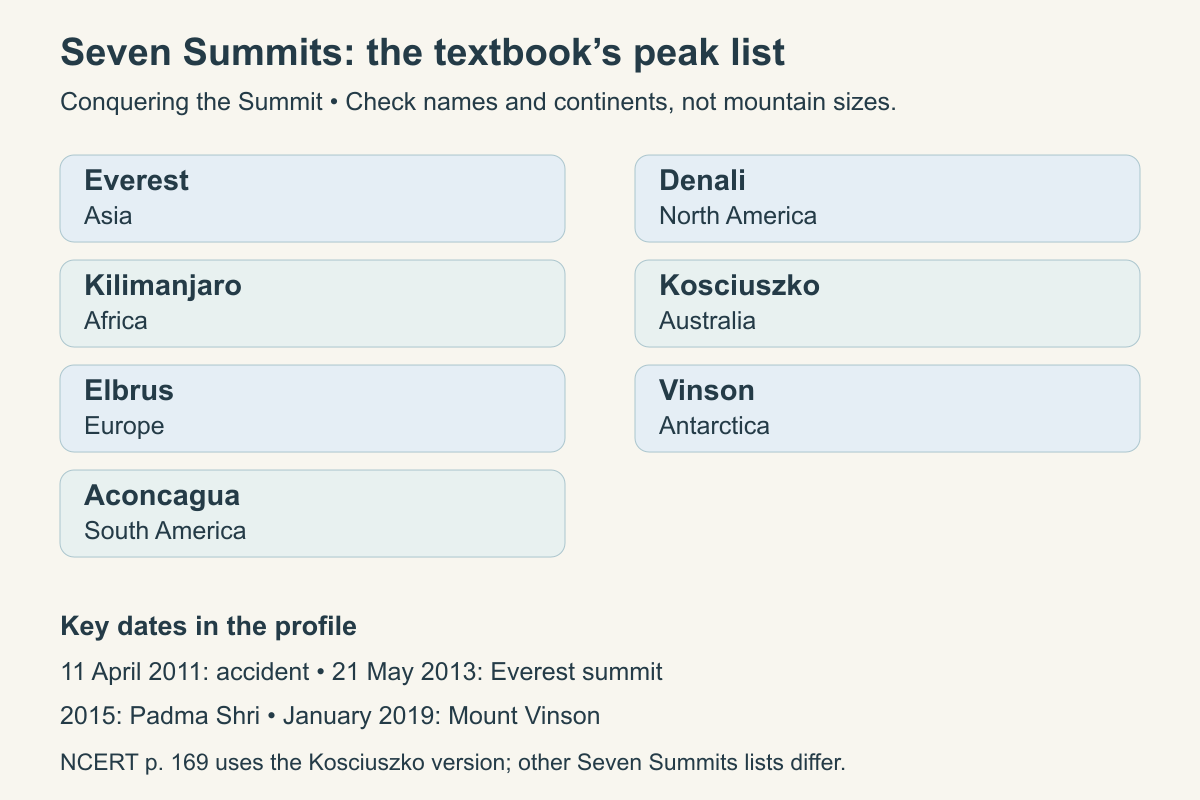
Open the peak list at full size. NCERT’s diagram pairs Everest–Asia, Kilimanjaro–Africa, Elbrus–Europe, Aconcagua–South America, Denali–North America, Kosciuszko–Australia and Vinson–Antarctica.
The book’s p. 168 count before the Antarctica climb is inconsistent with its later completion statement. Follow the clear completion date of January 2019 rather than claiming the Seven Summits were already complete in 2016.
Summary
The story of Arunima Sinha is a triumph of will, courage, determination and dedication. Arunima hails from Ambedkar Nagar, a small district in Uttar Pradesh; her father was an army engineer and her mother a health supervisor, and sports were always central to her life. After her post-graduation and a law degree, she planned to join the paramilitary forces so that she could continue playing sports while earning a regular income.
On the fateful night of 11 April 2011, when she was twenty-four and a national-level volleyball player, she met with a train accident. The hours that followed were harrowing, and one of her legs had to be amputated. Showing an extraordinary will to live, she survived. While recovering with a prosthetic leg and undergoing physiotherapy, she read an article about Mount Everest and made a profound vow that many thought impossible – not only to walk again, but to climb the highest peak in the world.
To achieve this, Arunima completed a basic mountaineering course at the Nehru Institute of Mountaineering in Uttarkashi and trained rigorously for eighteen months under the guidance of Bachendri Pal. On 21 May 2013, after 52 exhausting days, she reached the summit of Everest, planting the Indian flag and leaving a photograph of her idol, Swami Vivekananda. She became the first Indian female amputee to do so and was later honoured with the Padma Shri, the Tenzing Norgay National Adventure Award and an honorary doctorate. By January 2019 she had completed the Seven Summits. Her story is one of physical endurance, mental fortitude and a positive mindset, summed up in her words: “Never give up and work hard.”
Theme & message
The central theme is the triumph of the human spirit over adversity. Arunima’s journey shows that determination, rehabilitation, training and support can help a person pursue demanding goals despite disability, and that real strength lies in willpower, hard work and a clear goal. The piece highlights resilience, courage, perseverance and self-belief, supported by good mentorship. Its message is direct and motivating: failure is not falling short of a goal but failing to set a goal worthy enough – so we must respect our goals, work hard and never give up, for everyone has an inner ‘Everest’ to conquer.
Word meanings
| Word | English meaning | Hindi meaning |
|---|---|---|
| beacon | source of inspiration; guiding light | प्रेरणा / मार्गदर्शक |
| resilience | ability to recover quickly from difficulty | लचीलापन / संभलने की शक्ति |
| amputated | cut off a part of the body (here, the leg) | शरीर का अंग शल्यक्रिया से हटाया गया |
| prosthetic leg | an artificial leg that helps a person move | कृत्रिम / कृत्रिम पैर |
| feat | a great achievement | कारनामा / उपलब्धि |
| harrowing | extremely disturbing and painful | दिल दहला देने वाला |
| miraculously | in an almost unbelievable way | चमत्कारिक ढंग से |
| profound | very deep and meaningful | गहरा / गूढ़ |
| resolved | firmly decided | दृढ़ संकल्प लिया |
| rigorous | very strict, severe and demanding | कठोर / कड़ा |
| endeavour | an attempt to do something | प्रयास / उद्यम |
| instilled | gradually filled in (a feeling or idea) | मन में भरना / जगाना |
| surge | a sudden and great increase | उमड़ / आवेग |
| overwhelming | very strong; hard to control | अभिभूत / अति प्रबल |
| endurance | ability to keep doing something difficult for long | सहनशक्ति / धीरज |
| fortitude | courage maintained over a long period | धैर्य / मनोबल |
| adversity | a difficult or unfortunate situation | विपत्ति / कठिनाई |
| testament | proof or evidence of something | प्रमाण / साक्ष्य |
| conferred | given (an official title or honour) | प्रदान किया / सम्मानित किया |
| summit | the highest point of a mountain; peak | शिखर / चोटी |
Let us discuss
I. Read the statements given below and explain each statement in your words.
1. Arunima Sinha is considered a beacon of hope and resilience.
2. Arunima decided to climb Mount Everest despite losing her leg.
3. Bachendri Pal’s guidance was crucial in Arunima’s journey to the summit of Mount Everest.
4. Arunima’s achievements go beyond just physical endurance.
5. Arunima’s autobiography inspires readers around the world.
Let us think and reflect
I. Read the extract given below and answer the questions that follow. Bachendri Pal instilled confidence in Arunima and said, “My child, you decided to climb Mount Everest in these situations with a prosthetic leg—you have conquered the Everest within you; the world will realise it later.” On 21 May 2013, after 52 exhausting days, Arunima Sinha reached the summit of Mount Everest. Standing at the top of the world, she felt a surge of emotions—pride, relief, and an overwhelming sense of achievement.
1. Complete the sentence with a suitable reason. Bachendri Pal said that Arunima had conquered the Everest within her because ___________________.
2. How might Arunima have felt after what Bachendri Pal told her?
3. Choose a phrase from the extract which shows that reaching the summit of Mount Everest was tiring.
4. Select the correct option to complete the sentence. After her success when Arunima felt ‘an overwhelming sense of achievement’, she would have most likely said, “___________________.” (i) I am confident of my abilities (ii) I will accomplish this soon (iii) I am excited to begin this climb (iv) I finally realised my dream
II. Answer the following questions.
1. What did Arunima do in order to fulfill her ambition of conquering Mount Everest?
2. Arunima is a beacon of hope and resilience. Support this statement with evidence from the text.
3. Arunima’s autobiography is titled Born Again on the Mountain: A Story of Losing Everything and Finding It Back. Why do you think this title is appropriate?
4. Arunima says, “Failure is when we don’t have goals worthy enough.” What would be the most likely impact of this statement on readers?
Let us learn
I. Match the underlined phrases with their meanings
Read the underlined phrases in sentences (i)–(v) and match them with their appropriate meanings given in the box below. Meanings: 1. genuine, sincere efforts 2. strength of mind 3. periods of time filled with tiring and demanding activities 4. an incident or experience that significantly changes a person’s life 5. a source of inspiration or encouragement
II. Complete the parts-of-speech table
Complete the following table by filling in the gaps with correct parts of speech mentioned. An example has been done for you.
| Nouns | Adjectives | Verbs (present) | Adverbs |
|---|---|---|---|
| determination | determined | determine | determinedly (given) |
| relief | relieved | relieve | relievedly |
| inspiration | inspiring | inspire | inspiringly |
| resistance | resistant | resist | resistantly |
| success | successful | succeed | successfully |
III. Articles (a, an, the)
1. Fill in the blanks with ‘a’, ‘an’, ‘the’. Put an ‘x’ where no article is required. We planned (i) ___ adventurous trip to (ii) ___ remote island. (iii) ___ island was known for its beautiful landscapes and (iv) ___ diverse wildlife. On (v) ___ first day, we set out to explore (vi) ___ island’s dense jungle. (vii) ___ guide led us through (viii) ___ thick foliage and showed us (ix) ___ hidden waterfall. In (x) ___ evening, we gathered around (xi) ___ campfire to share stories and enjoy (xii) ___ meal we cooked. (xiii) ___ experience was truly unforgettable, and we felt (xiv) ___ connection with (xv) ___ nature.
2. There is an error in each sentence that has been underlined. Correct the error in the following sentences.
Before reading, listening, speaking and writing
Before reading — p. 166
I. Icons from left to right: hang-gliding, mountain biking, rock climbing and river rafting. The first shows a rigid triangular hang-glider, not a parachute canopy.
II. Sample discussion: People may seek challenge, fitness, teamwork and new experiences. Preparation includes appropriate training, checking equipment and following qualified supervision. State your own favourite activity with a reason.
III. Word web: determination, courage, patience, fitness, teamwork and careful preparation.
Let us listen — p. 173; transcript pp. 177–178
Let us speak — pp. 173–174
Student: “I support Physical Education because it develops fitness and teamwork.” Parent: “I support participation, but I want suitable supervision and inclusive activities.” PE teacher: “We can adapt tasks so students develop skills at an appropriate pace.” Camp organiser: “We check equipment and provide trained supervision.” These are sample viewpoints. Use respectful agreement or disagreement and take turns.
Let us write — pp. 174–175
1. Letter components: sender’s address → date → receiver’s address → subject → salutation (Madam/Sir) → introduction (name and grade) → expression of interest (activities and wish to join) → statement of request (permission) → complimentary close (Yours sincerely) → signature line (Sreelakshmi).
12, Sample Street
Sample City, Sample State
10 August 20XX
The Principal
Sample School
Sample City
Subject: Request for a Grade 7 excursion
Dear Madam/Sir,
I am a student of Grade 7. I request you to organise an educational excursion to a nearby hill station for our grade. The visit could help us observe mountain landscapes and learn about local plants and communities. Please consider suitable transport, teacher supervision and permission from parents. We would follow instructions and complete a report after the visit. I would be grateful if you could consider our request.
Yours sincerely,
Sample Student
Grade 7, Section A
This is a sample request, not a confirmed school trip. Adapt the details.
Let us explore — p. 175
I. Suggested research framework: The season depends on the specific location, weather and operator; the textbook’s “all year round” rafting prompt is not valid for every river.
| Activity | Area and seasonal condition | Basic equipment examples |
|---|---|---|
| Snow skiing | Snow-covered slopes; when suitable snow and operating facilities are available. | Skis, boots, poles, warm ski clothing, helmet. |
| Trekking | Permitted marked trails; suitable weather for that route, often spring/autumn in mountain areas. | Suitable footwear, clothing, water, pole and route information. |
| Camping | Permitted sites; mild conditions without hazardous storms or flooding. | Tent, sleeping bag, torch and weather-appropriate supplies. |
| River rafting | Approved river stretches during their operating season. | Raft, paddle, life jacket, helmet and trained guide. |
| Scuba diving | Approved dive sites with suitable sea conditions and visibility. | Mask, fins, buoyancy equipment, regulator and cylinder under certified instruction. |
II. Mountaineer fact sheets: Use five separate sheets with name, source-approved photograph, birthplace, profession, training and accomplishments. A source-based starter from this chapter is Arunima Sinha: Ambedkar Nagar, Uttar Pradesh; national-level volleyball player and mountaineer; basic course at the Nehru Institute of Mountaineering, Uttarkashi; Everest summit on 21 May 2013 and Padma Shri in 2015. Research four further Indian mountaineers from reliable profiles; do not invent their birthplace, training or awards, and distinguish the book’s hometown wording from a verified birthplace.
Additional ClearStudy questions
This practice is separate from the printed textbook exercises.
Short answer (30–40 words)
1. Where does Arunima Sinha come from, and what was her family background?
2. What happened to Arunima on the night of 11 April 2011?
3. What inspired Arunima to climb Mount Everest?
4. What did Arunima do at the summit of Mount Everest?
5. Name two honours Arunima Sinha received for her achievements.
Long answer (100–120 words)
6. Trace Arunima Sinha’s journey from the train accident to becoming a record-breaking mountaineer.
7. What qualities of Arunima Sinha make her an inspiration, and what is the message of her story?
ClearStudy MCQs and assertion–reason practice
1. Which sport did Arunima Sinha play at the national level?
(a) hockey (b) volleyball (c) basketball (d) cricket
2. On which date did Arunima meet with the train accident?
(a) 21 May 2013 (b) 11 April 2011 (c) 15 February 2019 (d) 16 April 2015
3. Where did Arunima complete her basic mountaineering course?
(a) Uttarkashi (Nehru Institute of Mountaineering) (b) Darjeeling (c) Manali (d) Shimla
4. Who mentored and guided Arunima for her Everest climb?
(a) Junko Tabei (b) Bachendri Pal (c) Santosh Yadav (d) Premlata Agarwal
5. On which date did Arunima reach the summit of Mount Everest?
(a) 11 April 2011 (b) 21 May 2013 (c) 2 September 2024 (d) 15 February 2019
6. Whose photograph did Arunima leave behind at the summit of Everest?
(a) Bachendri Pal (b) her father (c) Swami Vivekananda (d) Mahatma Gandhi
7. Which civilian award was conferred on Arunima in 2015?
(a) Bharat Ratna (b) Padma Vibhushan (c) Padma Shri (d) Param Vir Chakra
8. Which goal did Arunima achieve by January 2019?
(a) running a marathon (b) completing the Seven Summits (c) swimming the English Channel (d) winning an Olympic medal
9. What is the title of Arunima’s autobiography?
(a) Touching the Sky (b) Born Again on the Mountain (c) The Highest Peak (d) Conquering Everest
10. According to Arunima, what is ‘failure’?
(a) falling short of a goal (b) not trying at all (c) when we don’t have goals worthy enough (d) giving up too early
Assertion–Reason – choose: (a) A and R true, R explains A; (b) A and R true, R does not explain A; (c) A true, R false; (d) A false, R true.
1. Assertion (A): Arunima Sinha is called the first Indian female amputee to climb Mount Everest.
Reason (R): She reached the summit of Everest on 21 May 2013 after losing one leg in an accident.
2. Assertion (A): Arunima trained rigorously for eighteen months before attempting Everest.
Reason (R): She wanted to prepare both physically and mentally for the extremely difficult climb.
3. Assertion (A): Bachendri Pal told Arunima that she had already conquered the Everest within her.
Reason (R): Arunima had refused to climb the mountain because of her prosthetic leg.
4. Assertion (A): Arunima’s story is about mental strength as well as physical endurance.
Reason (R): Her success required fortitude, a positive mindset and an unshakeable goal, not only bodily strength.
5. Assertion (A): Arunima completed the goal of climbing the Seven Summits.
Reason (R): In January 2019 she climbed Mount Vinson in Antarctica, her seventh peak.
Exam tips & common mistakes
Exam tips
• Remember the key dates: accident on 11 April 2011, Everest summit on 21 May 2013, Seven Summits completed by January 2019.
• Quote Bachendri Pal’s line about “the Everest within you” and Arunima’s line “Never give up and work hard” to add value to long answers.
• In theme questions, stress both physical endurance and mental fortitude – explain how training and resolve work together.
• For value-based questions, mention resilience, courage, determination and setting worthy goals.
Common mistakes
• Do not write that Arunima was a cricketer – she was a national-level volleyball player.
• Do not confuse the dates: the accident was in 2011, the Everest summit in 2013.
• Her mentor was Bachendri Pal (first Indian woman on Everest), the mountaineer who guided her preparation.
• The piece has no individual author byline – it is an NCERT biographical profile, so do not invent an author’s name in answers.
FAQs
Who is ‘Conquering the Summit’ about?
It is a biographical prose piece about Arunima Sinha, a national-level volleyball player who lost a leg in a train accident in 2011 and became the first Indian female amputee to climb Mount Everest in 2013.
What is the main message of ‘Conquering the Summit’?
The story teaches that willpower, courage and determination can help people face adversity. Its message is to never give up, work hard, and always remember and respect your goal.
Who guided Arunima Sinha in her Everest journey?
She was guided and mentored by Bachendri Pal, the first Indian woman to summit Mount Everest, who trained her and instilled confidence in her.
Textbook-based exercises and additional ClearStudy practice are identified separately. Use your textbook alongside these explanations.