Class 7 Maths Ganita Prakash Chapter 13 Solutions (NCERT 2026–27) – Connecting the Dots
These Class 7 Maths Ganita Prakash Chapter 13 solutions cover Connecting the Dots — the data-handling chapter on statistical questions, the mean, the median, outliers, dot plots and clustered bar graphs. This is Chapter 5 of Ganita Prakash Part II (site Chapter 13). Use the worked exercises, original charts and project guidance below to practise calculation and careful interpretation of data.
Class: 7Subject: MathematicsBook: Ganita Prakash (Part II)Chapter: 13 (Part II, Ch 5)Exercises: Four sets: pp. 101, 112–113, 122–125 and 129–134Session: 2026–27
Chapter 13 of Ganita Prakash (Part II, Chapter 5), Connecting the Dots, is all about making sense of data. It begins with statistical questions and statistical statements, then introduces representative values: the arithmetic mean (average) understood both as “balancing highs and lows” and as “fair share”, and the median as the middle value of sorted data. It shows how outliers pull the mean away from the median, how to handle “zero vs. no value” in data, and how to read and draw dot plots and clustered (double) bar graphs. The solutions below combine worked calculations with guidance for the open-ended data-collection tasks.
Key Concepts & Definitions
Statistical question: a question that can be answered only by collecting and analysing data, where the answer is expected to vary (e.g. “How tall are Grade 7 students in our school?”).
Statistical statement: a claim or summary about a phenomenon expressed using numbers, proportions, probabilities or predictions.
Arithmetic mean (average): the sum of all values divided by the number of values. It can be read as a “fair share” — the amount each item would get if the total were shared equally.
Median: the middle value of the data after it is sorted. With an even number of values, it is the average of the two middle values. Half the data lies at or below the median.
Outlier: a value that deviates significantly from the rest of the data. An outlier can shift the mean a lot but usually affects the median very little.
Measures of central tendency: mean and median — numbers that represent the “centre” around which the data piles up.
Dot plot: a graph that shows each data value as a dot above a number line; it reveals clustering, spread and extremes.
Clustered / double bar graph: a bar graph with two (or more) bars side by side in each group, used to compare categories or compare data over time.
Important Formulas & Ideas (Chapter 13)
Mean: Mean = (Sum of all the values in the data) ÷ (Number of values in the data).
Median (odd count of n values): sort the data; the median is the value at position (n + 1) ÷ 2.
Median (even count): sort the data; the median is the average of the two middle values, i.e. the values at positions n÷2 and n÷2 + 1.
Range: Range = Maximum value − Minimum value.
Outliers: a low extreme value pulls the mean down and a high extreme value pulls it up. The relationship between mean and median depends on all the data. Equal or close centres do not prove a small spread or absence of outliers.
Bound: the mean and the median always lie between the minimum and the maximum value of the data.
Zero vs. no value: a recorded 0 is counted as a data value; a “—” (did not play / no value) is not counted in the number of values.
Figure it Out — Mean & Averages (Page 101)
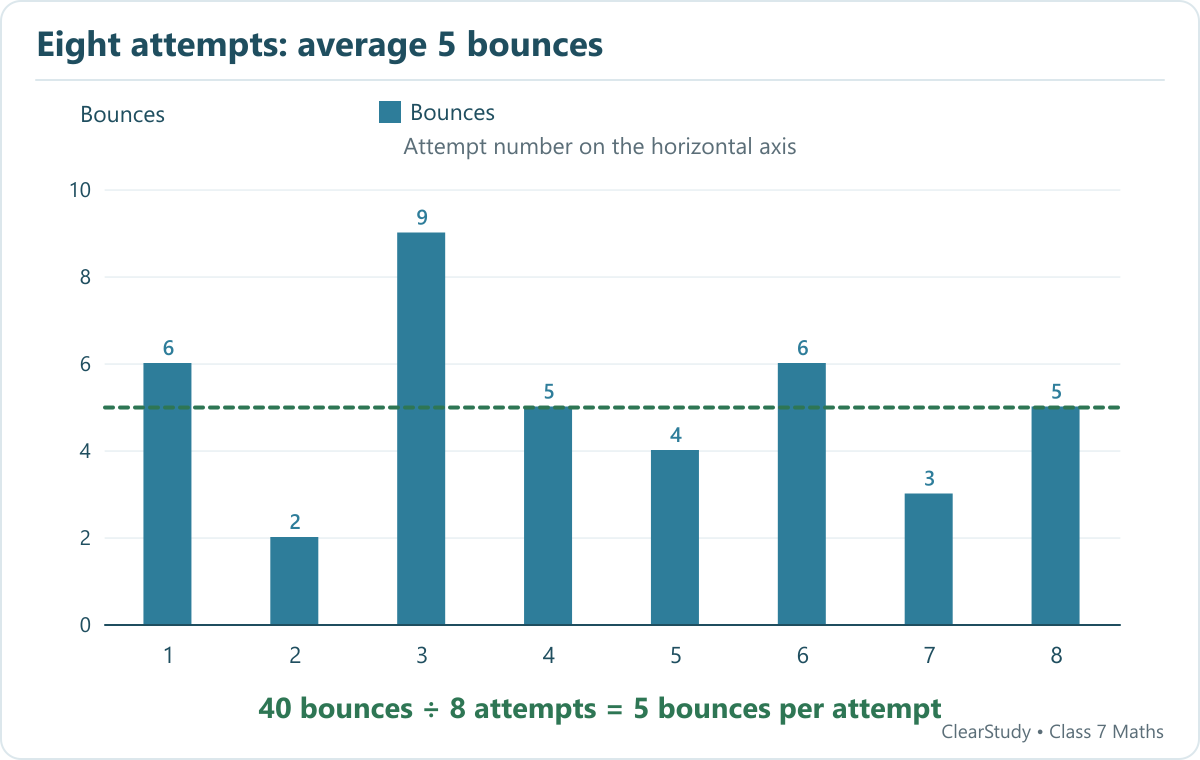
1. Shreyas is playing with a bat and a ball — but not cricket. He counts the number of times he can bounce the ball on the bat before it falls to the ground. The data for 8 attempts is 6, 2, 9, 5, 4, 6, 3, 5. Calculate the average number of bounces of the ball that Shreyas is able to make with his bat.
Eight bars show 6, 2, 9, 5, 4, 6, 3 and 5 bounces. The dashed line is the mean, 5.
2. Try the activity above on your own. Collect data for 7 or more attempts and find the average.
SOLUTION (sample working)This is a hands-on activity, so values will vary. Suppose your 7 attempts give 4, 7, 3, 6, 5, 8, 5.Sum = 4 + 7 + 3 + 6 + 5 + 8 + 5 = 38; number of attempts = 7.Average = 38 ÷ 7 ≈ 5.4 bounces. (Always: add all your bounce counts, then divide by how many attempts you made.)
3. Identify a flowering plant in your neighbourhood. Track the number of flowers that bloom every day over a week during its flowering season. What is the average number of flowers that bloomed per day?
SOLUTION (sample working)Record one count each day for 7 days. Suppose the counts are 3, 5, 4, 6, 2, 7, 5.Sum = 3 + 5 + 4 + 6 + 2 + 7 + 5 = 32; number of days = 7.Average = 32 ÷ 7 ≈ 4.6 flowers per day. (Method: total flowers over the week ÷ number of days.)
4. Two friends are training to run a 100 m race. Their running times over the past week are given in seconds — Nikhil: 17, 18, 17, 16, 19, 17, 18; Sunil: 20, 18, 18, 17, 16, 16, 17. Who on average ran quicker?
SOLUTIONNikhil’s total = 17 + 18 + 17 + 16 + 19 + 17 + 18 = 122 s over 7 runs → mean = 122 ÷ 7 ≈ 17.43 s.Sunil’s total = 20 + 18 + 18 + 17 + 16 + 16 + 17 = 122 s over 7 runs → mean = 122 ÷ 7 ≈ 17.43 s.Both totals are equal (122 s) over the same 7 runs, so their average times are equal. On average they ran equally quick — neither was faster.
5. The enrolment in a school during six consecutive years was as follows: 1555, 1670, 1750, 2013, 2040, 2126. Find the mean enrolment in the school during this period.
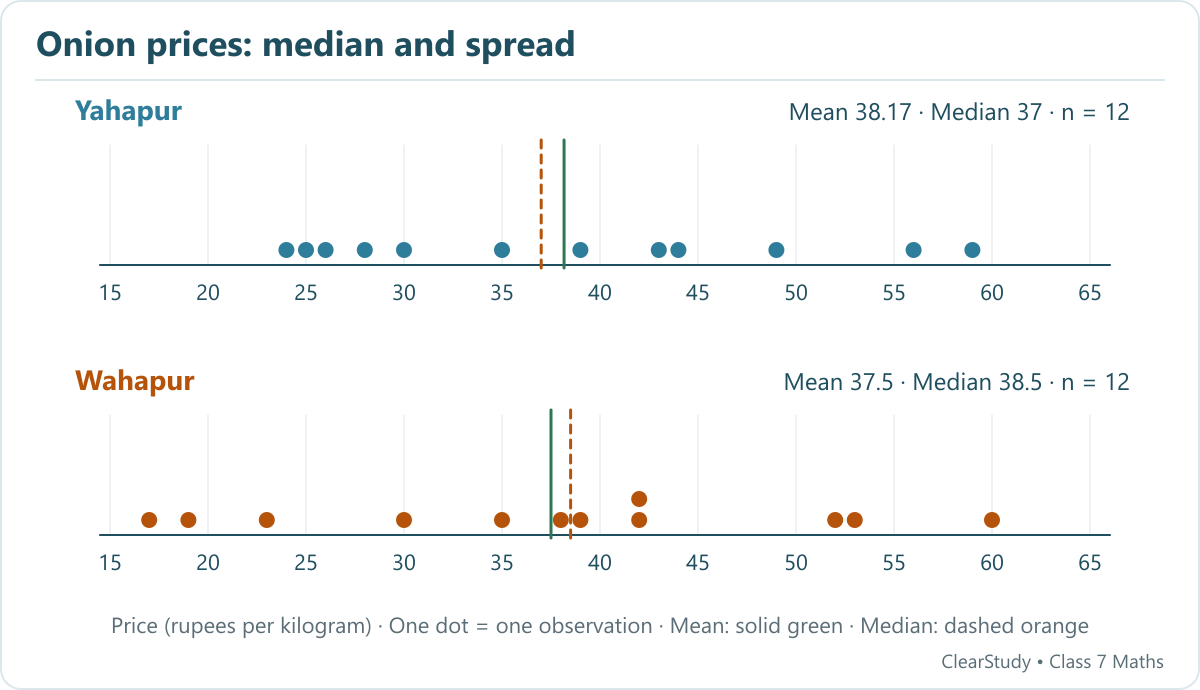
1. Find the median of onion prices in Yahapur and Wahapur.
SOLUTIONThe monthly prices (₹ per kg) used earlier in the chapter are:
Yahapur has mean 38.17 and median 37 rupees per kg; Wahapur has mean 37.5 and median 38.5. Each town has 12 monthly observations.
Town
Monthly prices (₹/kg)
Yahapur
25, 24, 26, 28, 30, 35, 39, 43, 49, 56, 59, 44
Wahapur
19, 17, 23, 30, 38, 35, 42, 39, 53, 60, 52, 42
SOLUTION (continued)There are 12 values for each town, so the median is the average of the 6th and 7th values after sorting.Yahapur sorted: 24, 25, 26, 28, 30, 35, 39, 43, 44, 49, 56, 59. Median = (35 + 39) ÷ 2 = ₹37.Wahapur sorted: 17, 19, 23, 30, 35, 38, 39, 42, 42, 52, 53, 60. Median = (38 + 39) ÷ 2 = ₹38.5.
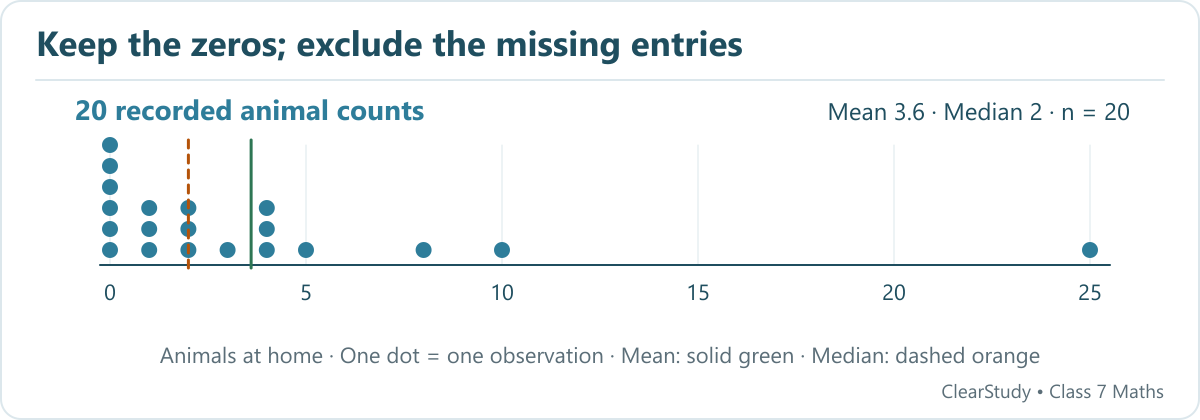
2. Sanskruti asked her class how many domestic animals and pets each had at home. Some of the students were absent. The data values are 0, 1, 0, 4, 8, 0, 0, 2, 1, 1, 5, 3, 4, 0, 0, —, 10, 25, 2, —, 2, 4. Find the mean and median. How would you describe this data?
SOLUTIONThe two “—” entries are absent students (no value), so they are not counted. The actual data values are: 0, 1, 0, 4, 8, 0, 0, 2, 1, 1, 5, 3, 4, 0, 0, 10, 25, 2, 2, 4 — that is 20 values.Sum = 0+1+0+4+8+0+0+2+1+1+5+3+4+0+0+10+25+2+2+4 = 72. Mean = 72 ÷ 20 = 3.6.Sorted: 0, 0, 0, 0, 0, 0, 1, 1, 1, 2, 2, 2, 3, 4, 4, 4, 5, 8, 10, 25. With 20 values the median is the average of the 10th and 11th values = (2 + 2) ÷ 2 = 2.Description: most students have very few pets (lots of 0s and 1s), but 25 is a high outlier. The outlier pulls the mean (3.6) well above the median (2), so the median better represents a typical student here.
Six recorded zeros count. The 20 observations sum to 72, so the mean is 3.6; the median is 2. The value 25 is a high outlier.
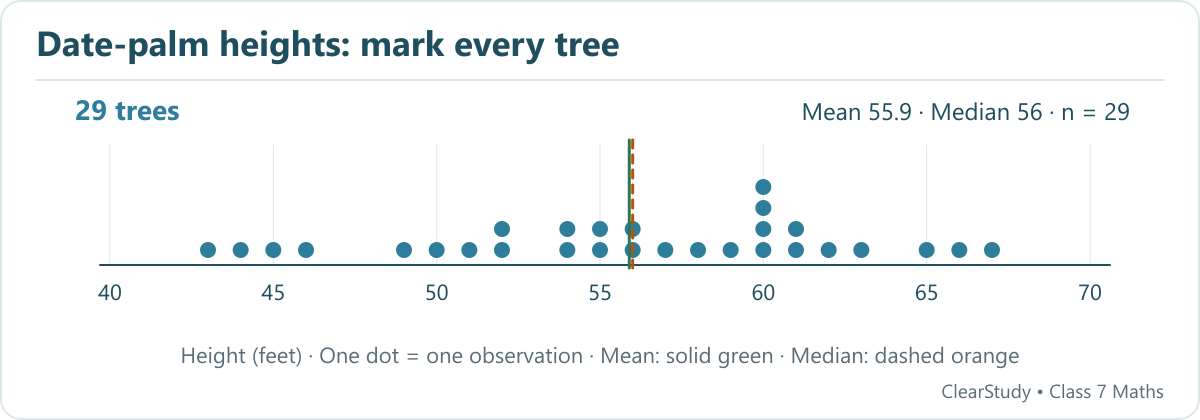
3. Rintu takes care of a date-palm tree farm in Habra. The heights of the trees (in feet) in his farm are given as: 50, 45, 43, 52, 61, 63, 46, 55, 60, 55, 59, 56, 56, 49, 54, 65, 66, 51, 44, 58, 60, 54, 52, 57, 61, 62, 60, 60, 67. Fill the dot plot, and mark the mean and median. How would you describe the heights of these palm trees? Can you think of quicker ways to find the mean? How many trees are shorter than the average height?
SOLUTIONThere are 29 values. Sum = 1621, so mean = 1621 ÷ 29 ≈ 55.9 ft.Sorted: 43, 44, 45, 46, 49, 50, 51, 52, 52, 54, 54, 55, 55, 56, 56, 57, 58, 59, 60, 60, 60, 60, 61, 61, 62, 63, 65, 66, 67. With 29 values the median is the 15th value = 56 ft.Dot plot: on a number line from about 40 to 70 (one unit per foot), place one dot above each height; stack repeated values (e.g. four dots above 60). The dots cluster mostly between 50 and 62, with a few smaller values trailing down to 43.Description: the heights are fairly bunched in the 50s and low 60s; mean (55.9) and median (56) are very close, showing no strong outlier — the data is fairly balanced.Quicker way: pick a convenient “assumed mean” such as 55, add up only the small differences from 55 (some positive, some negative), find their average, and add it to 55. This avoids adding large numbers.Trees shorter than the average (55.9 ft): 43, 44, 45, 46, 49, 50, 51, 52, 52, 54, 54, 55, 55 — that is 13 trees.
The 29 tree heights total 1621 feet. Mean is about 55.90 feet and median is 56 feet; 13 trees are shorter than the mean.
4. The daily water usage from a tap was measured. The usage in liters for the first few days are: 5.6, 8, 3.09, 12.9, 6.5, 12.1, 11.3, 20.5, 7.4.
(a) Can the mean or median daily usage lie between 25 and 30? Justify your claim using the meaning of mean and median.(b) Can the mean or median be lesser than the minimum value or greater than the maximum value in a data?
SOLUTIONThe data has 9 values; minimum = 3.09 L, maximum = 20.5 L. Sum = 5.6 + 8 + 3.09 + 12.9 + 6.5 + 12.1 + 11.3 + 20.5 + 7.4 = 87.39, so mean = 87.39 ÷ 9 ≈ 9.71 L. Sorted: 3.09, 5.6, 6.5, 7.4, 8, 11.3, 12.1, 12.9, 20.5 → median = 8 L.(a) No. Both the mean (≈ 9.71 L) and the median (8 L) lie between the smallest and largest readings, and the largest reading is only 20.5 L. A value between 25 and 30 is bigger than every reading, so neither the mean nor the median can fall there.(b) No. The mean and the median always lie between the minimum and the maximum value of the data — they can never be smaller than the least value or larger than the greatest value.
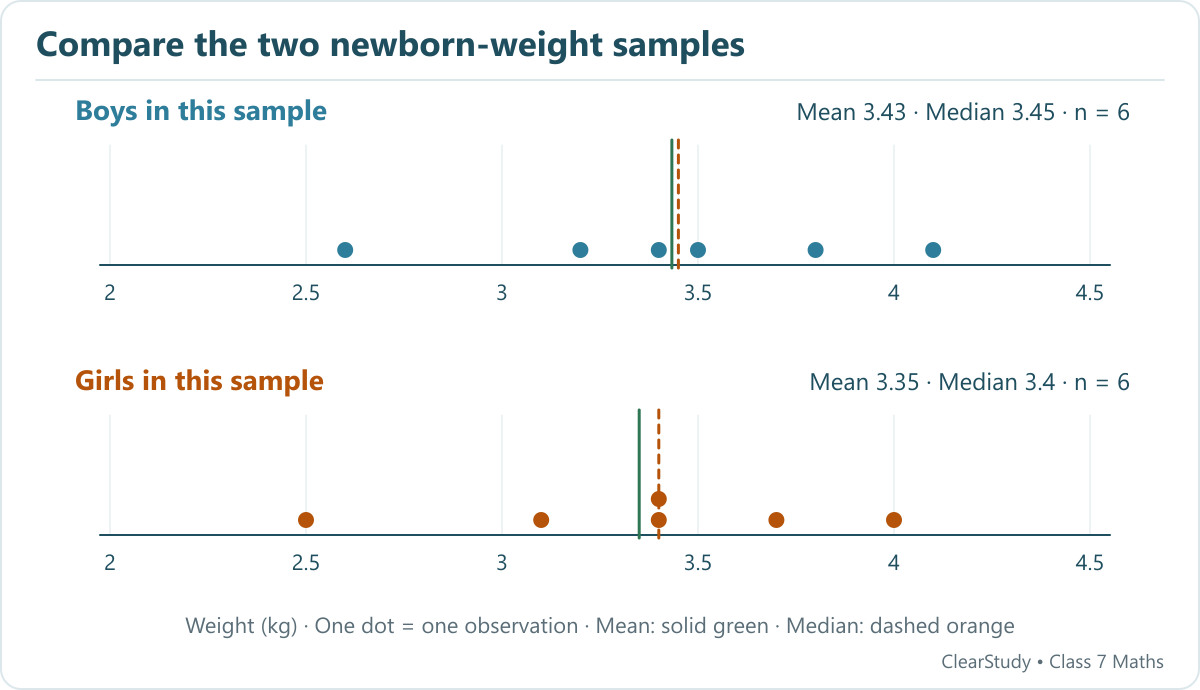
5. The weights of a few newborn babies are given in kgs. Fill the dot plot provided below. Analyse and compare this data.
Boys: 3.5, 4.1, 2.6, 3.2, 3.4, 3.8 • Girls: 4.0, 3.1, 3.4, 3.7, 2.5, 3.4
SOLUTION
Boys: mean about 3.43 kg, median 3.45 kg. Girls: mean 3.35 kg, median 3.4 kg. Each sample has six babies; this is not a claim about all newborns.
Group
Sorted weights (kg)
Mean
Median
Boys
2.6, 3.2, 3.4, 3.5, 3.8, 4.1
(2.6+3.2+3.4+3.5+3.8+4.1)÷6 = 20.6÷6 ≈ 3.43 kg
(3.4+3.5)÷2 = 3.45 kg
Girls
2.5, 3.1, 3.4, 3.4, 3.7, 4.0
(2.5+3.1+3.4+3.4+3.7+4.0)÷6 = 20.1÷6 = 3.35 kg
(3.4+3.4)÷2 = 3.4 kg
SOLUTION (continued)Dot plot: on a number line from 0 to 4.5 kg (each small unit 0.5 kg), place a dot above each weight, stacking repeats (e.g. two dots above 3.4 for the girls).Comparison: the boys’ mean (≈ 3.43 kg) and median (3.45 kg) are slightly higher than the girls’ mean (3.35 kg) and median (3.4 kg). Both groups have weights spread between about 2.5 kg and 4.1 kg, so the typical newborn weight here is roughly 3.4 kg, with boys a touch heavier on average.
6. The dot plots of heights of another section of Grade 5 students of the same school are shown below. Can you share your observations? What can we infer from the dot plots and the central tendency measures? (Whole class: Mean = 141.21, Median = 142.5; Boys: Mean = 142.05, Median = 143; Girls: Mean = 140.14, Median = 140.) Compare the heights of the two sections. Share your observations.
SOLUTIONFor this section, the boys are slightly taller on average than the girls (boys’ mean 142.05 vs girls’ mean 140.14; boys’ median 143 vs girls’ median 140), and the whole-class mean is 141.21 with median 142.5.The reported mean and median are close in each group, but that alone does not establish the spread or rule out outliers. In the printed group plots, the boys extend roughly from 130 to 148 cm and the girls from 126 to 158 cm; the girls have the greater range. The supplied whole-class plot appears inconsistent with these group plots, so do not reconstruct individual heights from its summary alone.Comparison with the earlier section (from “How Tall is Your Class?”, where girls were taller than boys): the relationship is reversed here — in this section boys are taller on average. This shows that a height pattern seen in one class cannot be generalised; different sections of the same school can have opposite results.
7. The weights of some sumo wrestlers and ballet dancers are: Sumo wrestlers: 295.2 kg, 250.7 kg, 234.1 kg, 221.0 kg, 200.9 kg. Ballet dancers: 40.3 kg, 37.6 kg, 38.8 kg, 45.5 kg, 44.1 kg, 48.2 kg. Approximately how many times heavier is a sumo wrestler compared to a ballet dancer?
SOLUTIONMean weight of a sumo wrestler = (295.2 + 250.7 + 234.1 + 221.0 + 200.9) ÷ 5 = 1201.9 ÷ 5 = 240.38 kg.Mean weight of a ballet dancer = (40.3 + 37.6 + 38.8 + 45.5 + 44.1 + 48.2) ÷ 6 = 254.5 ÷ 6 ≈ 42.42 kg.Ratio = 240.38 ÷ 42.42 ≈ 5.67, so a sumo wrestler is about 6 times heavier than a ballet dancer.
Figure it Out — Visualising Data (Pages 122–125)
1. Animal speeds (pp. 122–123)
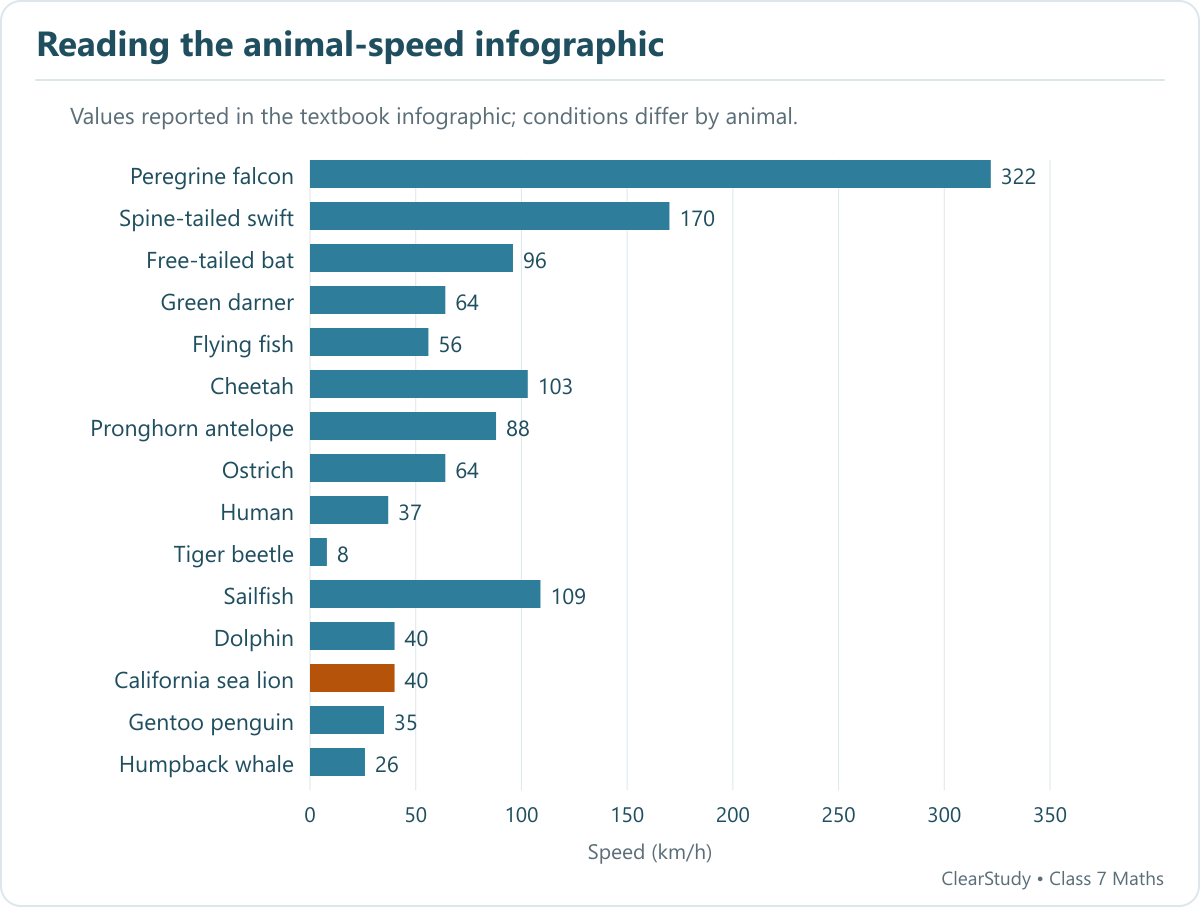
The infographic is a horizontal bar graph decorated with animal pictures. Each bar length represents speed. The printed intervals are about 16 km/h; labels vary by about 16–17 because of rounding. Our redrawing below uses a clearly labelled 50 km/h scale.One approximate double-speed pair is the spine-tailed swift (170) and pronghorn antelope (88): 170/88 ≈ 1.93. Sailfish/humpback whale = 109/26 ≈ 4.19, so “about four times as fast” is reasonable for these listed figures.The chart shows only selected animals and different movement conditions. It cannot alone establish which aquatic animal is fastest in the world. An interesting follow-up is how diving, flying and swimming speeds are measured.
A ClearStudy redrawing of the textbook speed figures. Sailfish 109 km/h is about 4.19 times humpback whale 26; these displayed animals cannot establish a worldwide record.
2. Superpower preferences (p. 124)
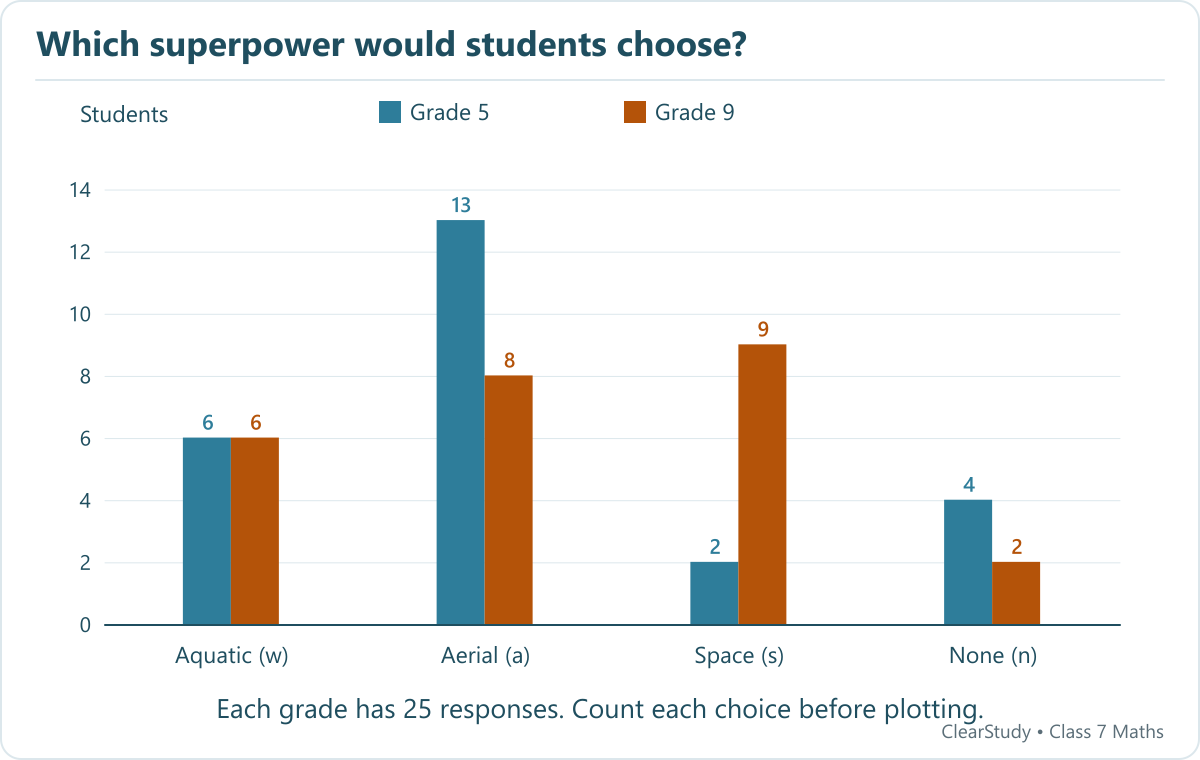
Tally each response. Grade 5: aquatic 6, aerial 13, space 2, none 4 (total 25). Grade 9: aquatic 6, aerial 8, space 9, none 2 (total 25).Use a main interval of 2 students. Aerial is Grade 5’s most popular choice; space is Grade 9’s. Aquatic choices are equal.
Grade 5 counts: water 6, air 13, space 2, none 4. Grade 9 counts: water 6, air 8, space 9, none 2.
3. Jodhpur temperatures (p. 124)
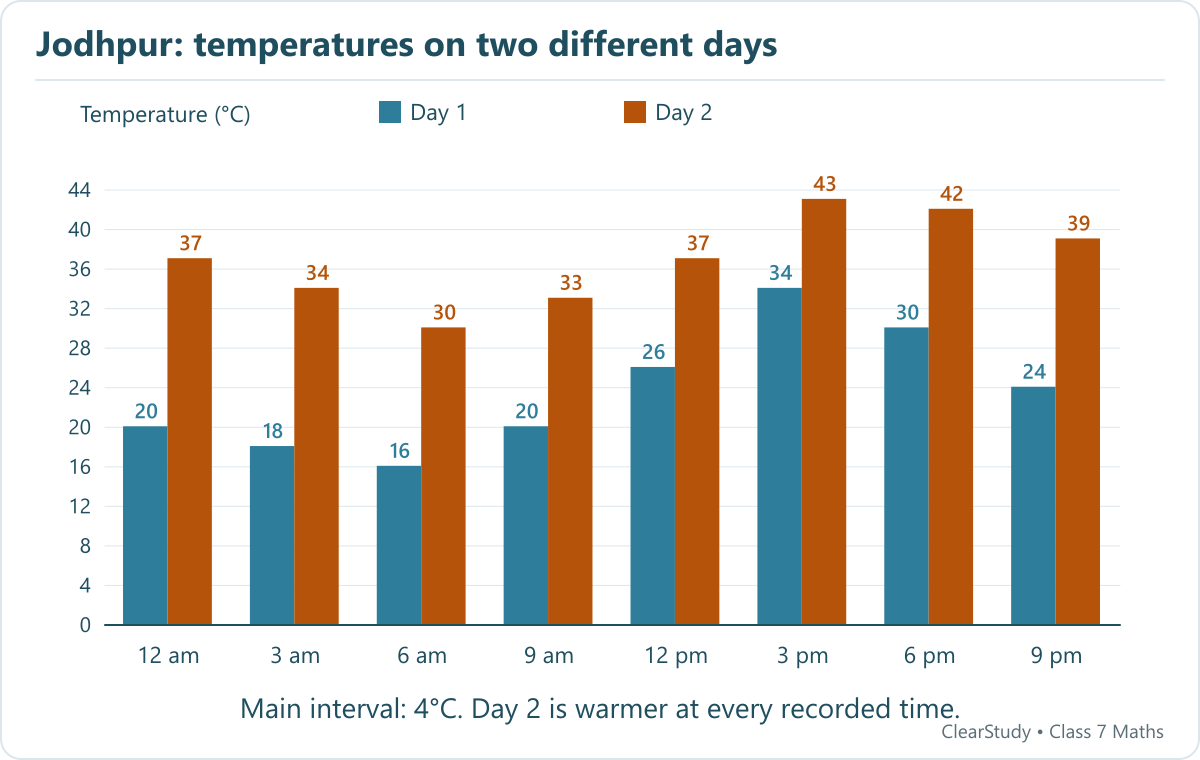
Plot eight pairs in chronological order, with the requested scale 1 main interval = 4°C. Both days have their recorded minimum at 6 am and maximum at 3 pm.Day 1 ranges from 16 to 34°C (range 18°C); Day 2 from 30 to 43°C (range 13°C). Day 2 is hotter throughout. A cooler-season or transition month for Day 1 and a hot pre-monsoon month for Day 2 are plausible guesses; these two days do not identify unique months.
Double-bar graph of all eight temperature readings on each day, using the requested 4 degrees Celsius scale.
4. Electric-vehicle registrations (pp. 124–125)
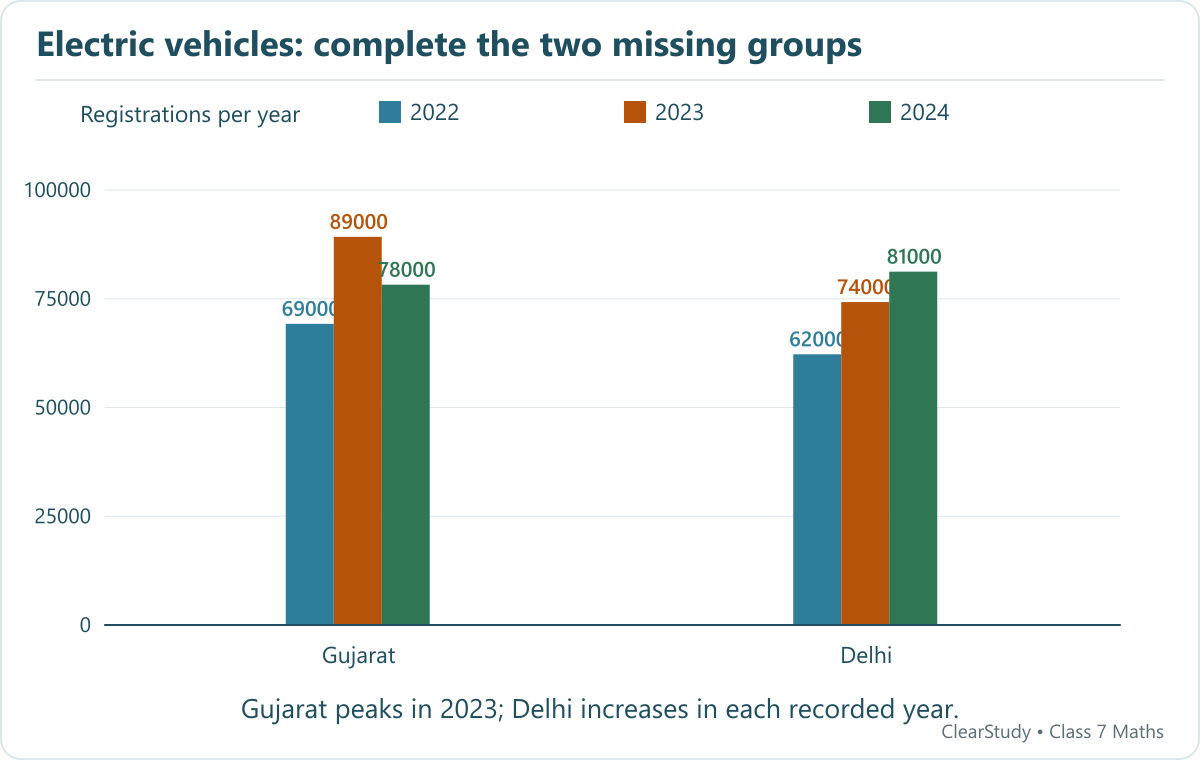
(a) Complete Gujarat’s bars at 69,000, 89,000, 78,000 and Delhi’s at 62,000, 74,000, 81,000 for 2022, 2023 and 2024.(b) The original graph groups three annual bars per state. Main labelled intervals represent 25,000 registrations and smaller grid intervals about 5,000.(c) All displayed states have more registrations in 2024 than in 2022. Gujarat rises in 2023 then falls in 2024; the other displayed state groups rise in both intervals.(d) Assam rises from about 40,000 to 60,000: approximately 20,000 more. (e) West Bengal rises from about 10,000 to about 43,000: roughly four times as many (about 4.3 times by these estimates).(f) Incorrect. Small differences between annual bars mean slow growth in registrations, not few new registrations. Uttarakhand still records roughly 16,000 and 19,000 in 2023 and 2024.
The six missing bars are Gujarat 69000, 89000, 78000 and Delhi 62000, 74000, 81000 for 2022, 2023 and 2024.
Figure it Out — Data Detective (Pages 129–134)
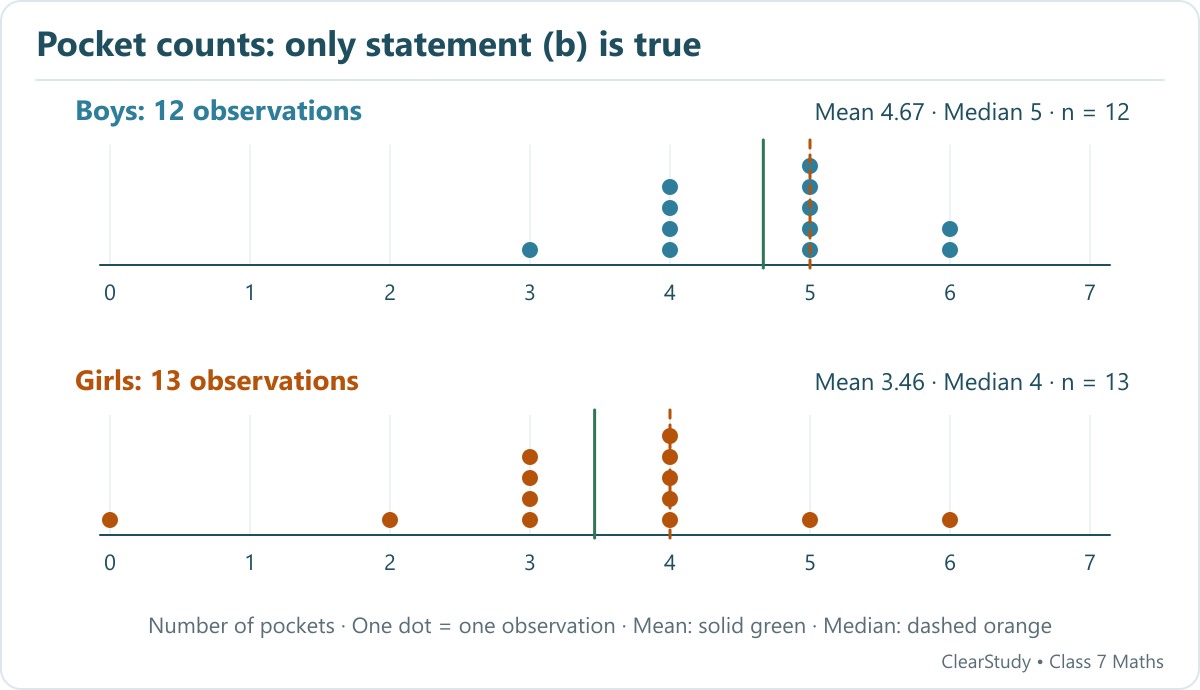
1. The dot plots below show the distribution of the number of pockets on clothing for a group of boys and for a group of girls. Based on the dot plots, which of the following statements are true?
(a) The data varies more for the boys than for the girls.(b) The median number of pockets for the boys is more than that for the girls.(c) The mean number of pockets for the girls is more than that for the boys.(d) The maximum number of pockets for boys is greater than that for the girls.
SOLUTIONCount the dots in the original plots. Boys: 3, 4, 4, 4, 4, 5, 5, 5, 5, 5, 6, 6. Girls: 0, 2, 3, 3, 3, 3, 4, 4, 4, 4, 4, 5, 6.(a) False: boys’ range = 6 − 3 = 3; girls’ range = 6 − 0 = 6. The girls’ data has the greater range.(b) True: boys’ median = (5 + 5)/2 = 5; girls’ median = the seventh value = 4.(c) False: boys’ mean = 56/12 ≈ 4.67; girls’ mean = 45/13 ≈ 3.46.(d) False: both maxima equal 6. Therefore only (b) is true.
Boys have range 3, median 5 and mean 56/12. Girls have range 6, median 4 and mean 45/13. Both maximum counts are 6.
2. The following table shows the points scored by each player in four games:
Player
Game 1
Game 2
Game 3
Game 4
A
14
16
10
10
B
0
8
6
4
C
8
11
Did not play
13
Now answer the following questions:
(a) Find the average number of points scored per game by A.(b) To find the mean number of points scored per game by C, would you divide the total points by 3 or by 4? Why? What about B?(c) Who is the best performer?
SOLUTION(a) A’s total = 14 + 16 + 10 + 10 = 50 over 4 games. Average = 50 ÷ 4 = 12.5 points per game.(b) C did not play Game 3, so C has no value for that game — divide C’s total by 3, the number of games actually played: C’s mean = (8 + 11 + 13) ÷ 3 = 32 ÷ 3 ≈ 10.67. For B, the 0 in Game 1 is a real score (B played and scored 0), so divide by 4: B’s mean = (0 + 8 + 6 + 4) ÷ 4 = 18 ÷ 4 = 4.5.(c) Comparing averages: A = 12.5, B = 4.5, C ≈ 10.67. The highest average is A’s, so A is the best performer (highest points per game).
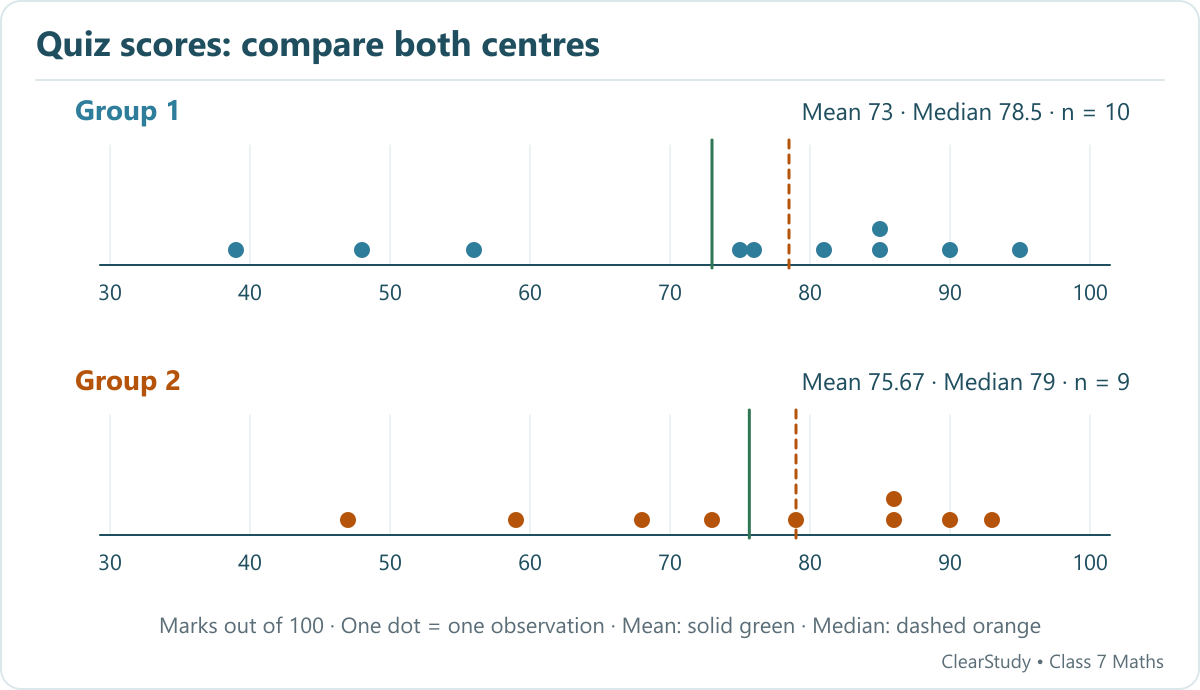
3. The marks (out of 100) obtained by a group of students in a General Knowledge quiz are 85, 76, 90, 85, 39, 48, 56, 95, 81 and 75. Another group’s scores in the same quiz are 68, 59, 73, 86, 47, 79, 90, 93 and 86. Compare and describe both the groups performance using, mean and median.
SOLUTIONGroup 1 (10 scores): sum = 85+76+90+85+39+48+56+95+81+75 = 730 → mean = 730 ÷ 10 = 73. Sorted: 39, 48, 56, 75, 76, 81, 85, 85, 90, 95 → median = (76 + 81) ÷ 2 = 78.5.Group 2 (9 scores): sum = 68+59+73+86+47+79+90+93+86 = 681 → mean = 681 ÷ 9 ≈ 75.67. Sorted: 47, 59, 68, 73, 79, 86, 86, 90, 93 → median = 79.Comparison: Group 2 has a higher mean (75.67 vs 73) and a slightly higher median (79 vs 78.5), so Group 2 performed marginally better overall. In Group 1 the mean (73) is well below the median (78.5) because of the low scores 39 and 48 pulling the average down — the typical student (median 78.5) did better than the mean suggests.
Group 1 has mean 73 and median 78.5. Group 2 has mean about 75.67 and median 79. Group 2 has slightly higher values by both measures.
4. Consider this data collected from a survey of a colony.
Favourite Sport
Cricket
Basket Ball
Swimming
Hockey
Athletics
Watching
1240
470
510
430
250
Participating
620
320
320
250
105
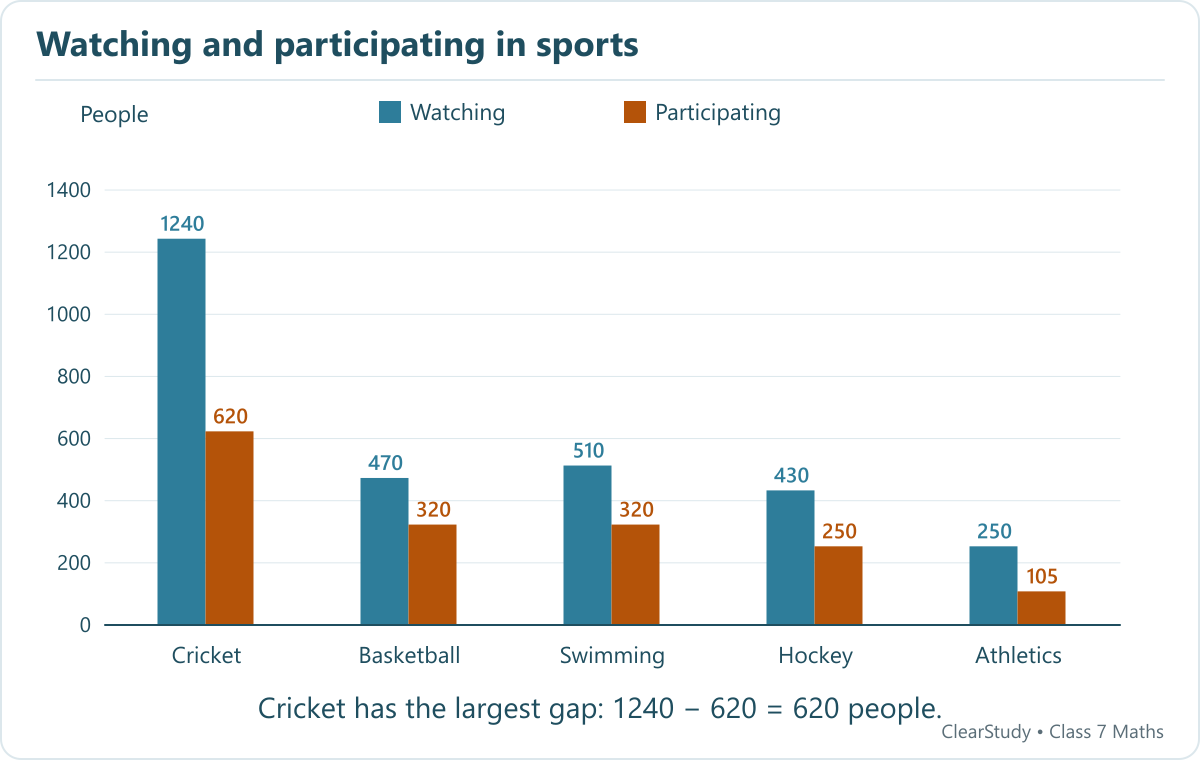
Choose an appropriate scale and draw a double-bar graph. Write down your observations.
SOLUTIONScale: since the largest value is 1240, use 1 unit = 200 people (so the tallest bar is just over 6 units). On the horizontal axis put the five sports; for each sport draw two bars side by side — one for “Watching” and one for “Participating” — using two different colours.Bar heights (people): Cricket → 1240 / 620; Basket Ball → 470 / 320; Swimming → 510 / 320; Hockey → 430 / 250; Athletics → 250 / 105.Observations: Cricket is by far the most popular for both watching and participating; for every sport, more people watch than participate; the watching-vs-participating gap is largest for cricket (1240 vs 620). Athletics is the least popular in both categories.
The double-bar graph uses 200 people per main interval. Watching exceeds participation in all five sports.
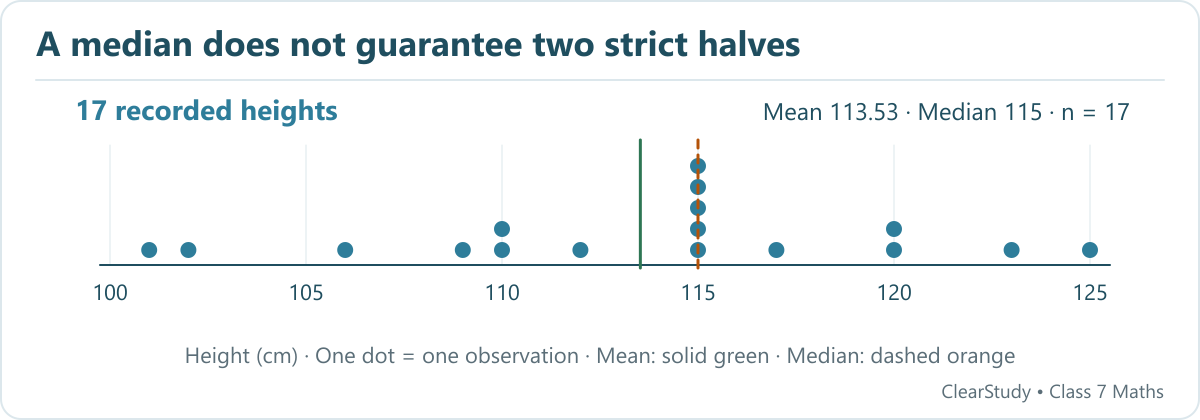
5. Consider a group of 17 students with the following heights (in cm): 106, 110, 123, 125, 117, 120, 112, 115, 110, 120, 115, 102, 115, 115, 109, 115, 101. The sports teacher wants to divide the class into two groups so that each group has an equal number of students: one group has students with height less than a particular height and the other group has students with heights greater than the particular height. Suggest a way to do this. Can you guess the age of these students based on the tabular data in the ‘Telling Tall Tales’ section?
SOLUTIONSorted heights: 101, 102, 106, 109, 110, 110, 112, 115, 115, 115, 115, 115, 117, 120, 120, 123, 125. Median = ninth value = 115 cm.The stated conditions cannot all be satisfied: 17 is odd, and there are 7 below 115, 5 equal to 115 and 5 above 115. A median need not put exactly half strictly on either side.One practical modification: make two groups of 8 and choose one of the 115 cm pupils as a rotating helper. Add one 115 cm pupil to the 7 shorter pupils; add three 115 cm pupils to the 5 taller pupils. These are lower and upper groups with ties, not groups strictly below and above 115. Alternatively, include everyone in groups of 8 and 9.A rough comparison with the textbook averages suggests primary-school children around 6–7 years, but height alone does not determine an individual’s age.
The median is 115 cm. Seven heights are below it, five equal it and five exceed it. An odd class cannot be split into two equally sized groups using every student.
6. Describe the mean and median of heights of your class. You can visualise the heights on a dot plot.
SOLUTION (method)Measure each classmate’s height in cm and list the values. Mean = (sum of all heights) ÷ (number of students). For the median, sort the heights and take the middle value (or the average of the two middle values if the count is even).Make a dot plot by placing one dot above each height on a number line (e.g. 120–170 cm), stacking repeats. Then describe: where the dots cluster, the range (tallest − shortest), and whether the mean and median are close (balanced data) or far apart (an outlier such as one very tall or very short student).
7. There are two 7th grade sections at a school. Each section has 15 boys and 15 girls. In one section, the mean height of students is 154.2 cm. From this information, what must be true about the mean height of students in the other section?
(a) The mean height of students in the other section is 154.2 cm.(b) The mean height of students in the other section is less than 154.2 cm.(c) The mean height of students in the other section is more than 154.2 cm.(d) The mean height of students in the other section cannot be determined.
SOLUTIONKnowing one section’s mean tells us nothing about the actual heights in the other section — those students could be shorter, equal, or taller on average. Having the same number of boys and girls does not force the means to match.∴ the correct option is (d) the mean height of students in the other section cannot be determined.
8. Standing tall in the storm.
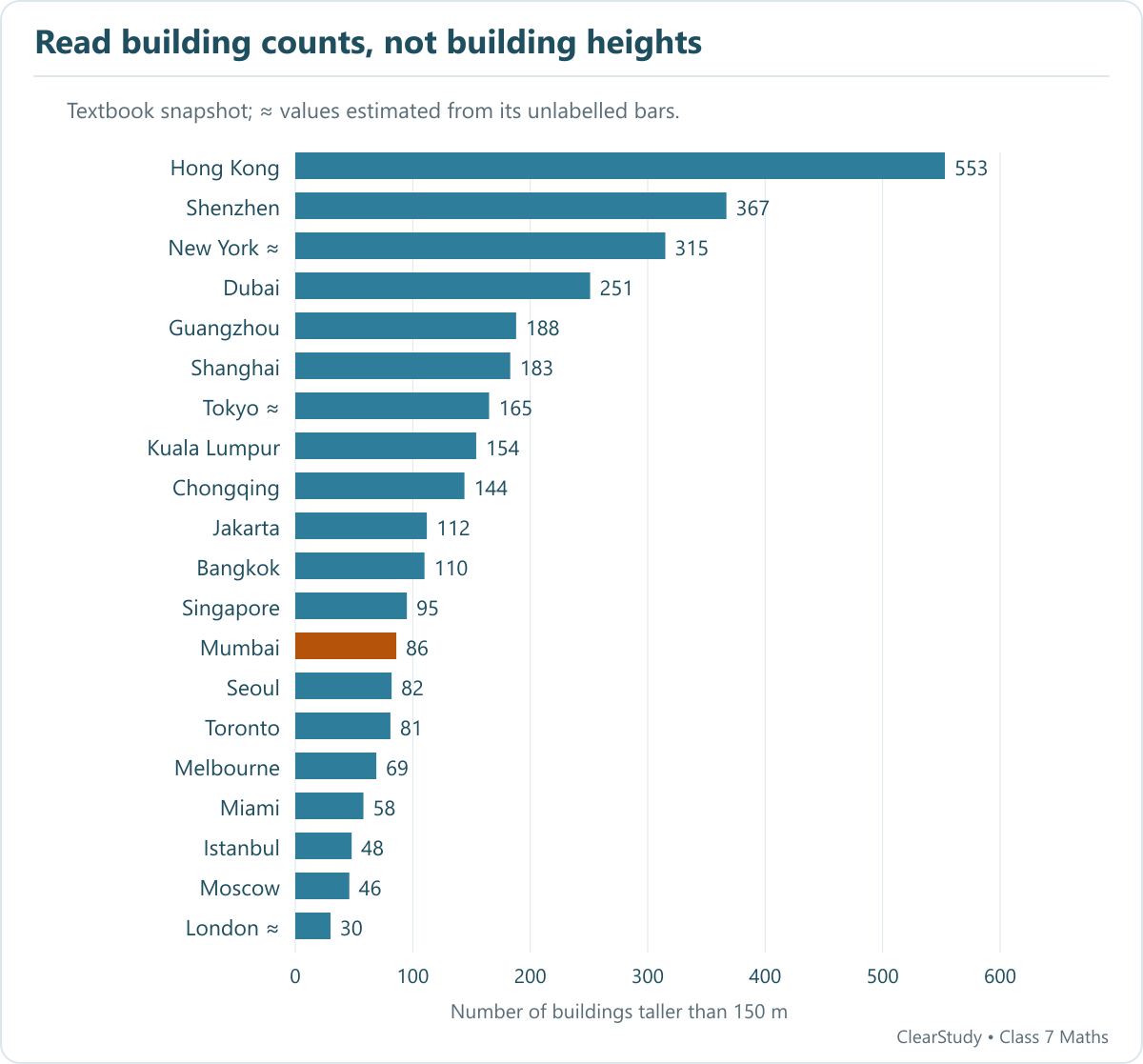
(a) Write estimated values for the number of skyscrapers in New York, Tokyo, and London.(b) Are the following statements valid? (i) Only 12 cities have more skyscrapers than Mumbai. (ii) Only 7 cities have fewer skyscrapers than Mumbai. (iii) The tallest building in the world is in Hong Kong.
SOLUTION(a) Comparing the unlabelled bars with nearby labelled bars gives New York ≈ 315, Tokyo ≈ 165 and London ≈ 30 skyscrapers. These are estimates from the textbook snapshot, not current city statistics.(b)(i) True among the 20 listed cities: 12 are above Mumbai (86). (ii) True within this chart: 7 listed cities are below Mumbai. The chart is not a list of every city in the world, so “only 7 worldwide” does not follow.(iii) Cannot be concluded: the bars count buildings taller than 150 m; they do not show the height of any individual building.
The textbook chart places Mumbai thirteenth among 20 cities: 12 listed cities above it and 7 below it. Estimated counts are New York about 315, Tokyo about 165 and London about 30.
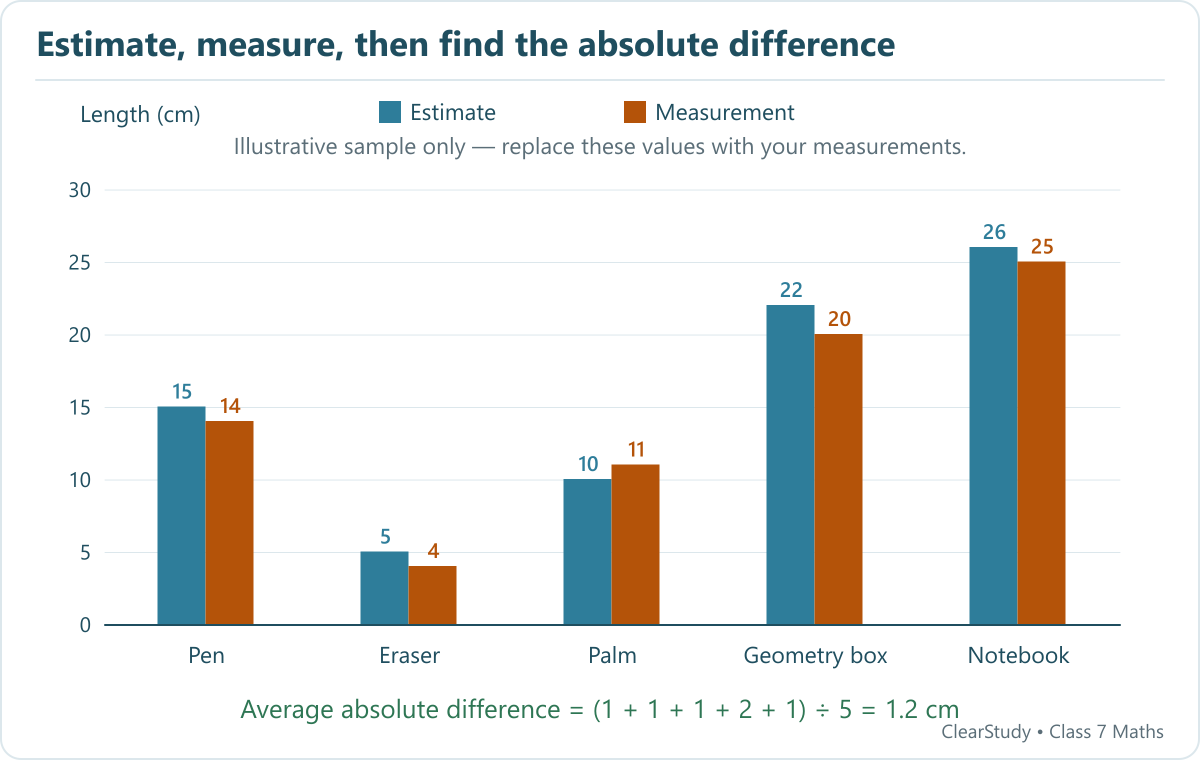
9. Estimate and then measure the objects listed in the following table. Draw a double bar graph based on the data. How accurate were your estimates? Find the average difference between the estimated and measured values.
Object
Estimate (cm)
Measure (cm)
Positive Difference
Length of a pen
—
—
—
Length of an eraser
—
—
—
Length of your palm
—
—
—
Length of your geometry box
—
—
—
Length of your math notebook
—
—
—
SOLUTION (sample working)First estimate each length by eye, then measure with a ruler, and record the positive difference (the absolute value |estimate − measurement|, which can also be zero). Example readings: pen 15 / 14 (diff 1); eraser 5 / 4 (diff 1); palm 10 / 11 (diff 1); geometry box 22 / 20 (diff 2); notebook 26 / 25 (diff 1).Double bar graph: for each object draw two bars side by side — one for the estimate, one for the measurement — using two colours; scale 1 unit = 5 cm works well.Average difference = (1 + 1 + 1 + 2 + 1) ÷ 5 = 6 ÷ 5 = 1.2 cm for this sample. A small average difference means your estimates were quite accurate. (Use your own measured numbers.)
A worked sample compares estimated and measured lengths of five objects. Absolute differences total 6 cm, giving a mean difference of 1.2 cm.
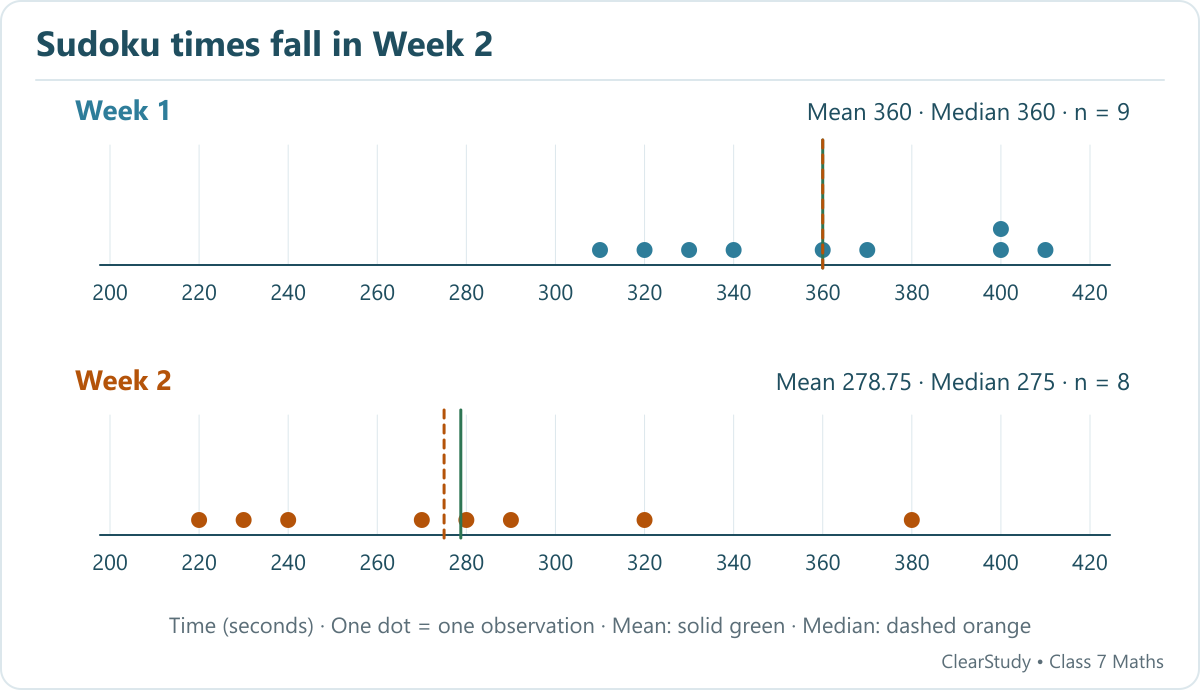
10. Aditi likes solving puzzles. She recently started attempting the ‘Easy’ level Sudoku puzzles. The time she took (in seconds) to solve these puzzles are — 410, 400, 370, 340, 360, 400, 320, 330, 310, 320, 290, 380, 280, 270, 230, 220, 240. The first nine values correspond to Week 1 and the rest to Week 2.
(a) Construct a dot plot below showing the data for both weeks.(b) Describe the mean, median, and any observations you may have about the data.
SOLUTIONWeek 1 (9 values): 410, 400, 370, 340, 360, 400, 320, 330, 310. Sum = 3240 → mean = 3240 ÷ 9 = 360 s. Sorted: 310, 320, 330, 340, 360, 370, 400, 400, 410 → median = 360 s.Week 2 (8 values): 320, 290, 380, 280, 270, 230, 220, 240. Sum = 2230 → mean = 2230 ÷ 8 = 278.75 s. Sorted: 220, 230, 240, 270, 280, 290, 320, 380 → median = (270 + 280) ÷ 2 = 275 s.(a) Dot plot: on a number line from 200 to 420 s (each unit 20 s), plot Week 1 times in one colour and Week 2 times in another, stacking any repeats (e.g. two dots above 400 in Week 1).(b) Observations: Aditi got faster — both her mean (360 → 278.75 s) and median (360 → 275 s) dropped from Week 1 to Week 2 by roughly 80–85 seconds, showing clear improvement with practice. Week 1 has range 410 − 310 = 100 s; Week 2 has range 380 − 220 = 160 s. Thus Week 2 is faster on average but has the larger range. Close mean and median alone cannot prove there are no outliers.
Week 1: mean and median 360 seconds, range 100. Week 2: mean 278.75, median 275, range 160. The second week is faster on average but more spread out.
11. Individual Project: Pick at least one of the following: (a) How Long is a Sentence? Pick any two textbooks from different subjects… (b) What is in a Name? Write down the names of all of your classmates…
SOLUTION (method)(a) How Long is a Sentence? On the chosen page count the words in each sentence. Make a dot plot of sentence lengths for each book, then compute the mean (total words ÷ number of sentences) and the median (middle sentence-length when sorted). Compare the two books: a higher mean/median means longer sentences on that page.(b) What is in a Name? Count the letters in each classmate’s name. Find the mean and median name length, draw a dot plot, see which starting letters are most/least common, find the median starting letter (it tells you whether more names fall in A–M or N–Z), and plot a double-bar graph of boys’ vs girls’ names by vowel/consonant start-and-end. (Answers depend on your own class; use your own collected data with this method.)
12. Individual project (long term): This requires collecting data over 2 weeks or more. In and Out: Track how many times you step out of your house in a day. Do this for a month. (i) Describe the variability and central tendency of this data. Make a dot plot. (ii) Do you find anything interesting about this data? Share your observations. (iii) You can ask any of your family members or friends to do this as well.
SOLUTION (method)Record one count per day for a month (about 30 values). (i) Compute the mean (total trips ÷ number of days) and the median (middle value of the sorted counts), and note the range; draw a dot plot of daily counts to see the spread.(ii) Look for patterns — for example weekends may show higher counts (an outlier cluster), which would pull the mean above the median. (iii) Collecting a family member’s data lets you draw a comparison and discuss differences in routine. (Real numbers come from your own month-long log.)
13. Small-group project: Pick at least one of the following. Make groups of 8 to 10. Collect data individually as needed. Put together everyone’s data and do the appropriate analysis and visualisation. (a) Our heights vs. our family’s heights… (b) Estimating time…
SOLUTION (method)(a) Our heights vs. family heights: each student collects their family members’ heights, makes a dot plot for their own family (describing spread and central tendency), then the group draws a double-bar graph of each student’s height against their family’s mean height and shares observations.(b) Estimating time: with eyes closed (no counting), note after how many seconds you think 1 minute (and then 3 minutes) has passed; collect this for yourself and your family. Make dot plots for the 1-minute and 3-minute estimates, mark each one, describe variability and central tendency, and draw a double bar graph of each family’s mean 1-minute and 3-minute estimates. (This is a data-collection project; the steps above are the method to follow.)
Math Talk & Try This — Answered
These are the in-text Math Talk and Try This prompts in the chapter; the determinate ones are answered, the open/discussion ones are guided.
Math Talk — Which are statistical questions? (p. 98)(a) What is the price of a tennis ball in India? (b) How old are the dogs that live on this street? (c) What fraction of the students in your class like walking up a hill? (d) Do you like reading? (e) Approximately how many bricks are in this wall? (f) Who was the best bowler in the match yesterday? (g) What was the rainfall pattern in Barmer last year?Answer.Statistical: (a) tennis-ball prices across India vary by brand, shop and place; (b) the dogs have different ages; (c) responses from classmates vary; (g) rainfall varies across days or months.Not statistical as phrased: (d) asks one person’s preference; (e) asks for the number of bricks in one fixed wall (an estimate does not by itself make a question statistical).(f) Depends on the intended comparison: to judge the best bowler, collect and compare varying figures such as wickets, runs conceded and overs. Under that interpretation it is statistical; the criterion for “best” must be stated. Simply asking who received a named award would be a factual question.
Math Talk — Can one number represent a group? (p. 99)Can a single number act as a representative of a group of numbers? For example, can we represent Shubman’s or Yashasvi’s batting in this series with one number? Discuss.Answer. Yes — a representative value such as the average (mean) can summarise a group. The total alone is unfair when the groups have different sizes, so we use the mean: Shubman 110 ÷ 5 = 22 runs/match, Yashasvi 96 ÷ 4 = 24 runs/match. By this measure Yashasvi did better in this series.
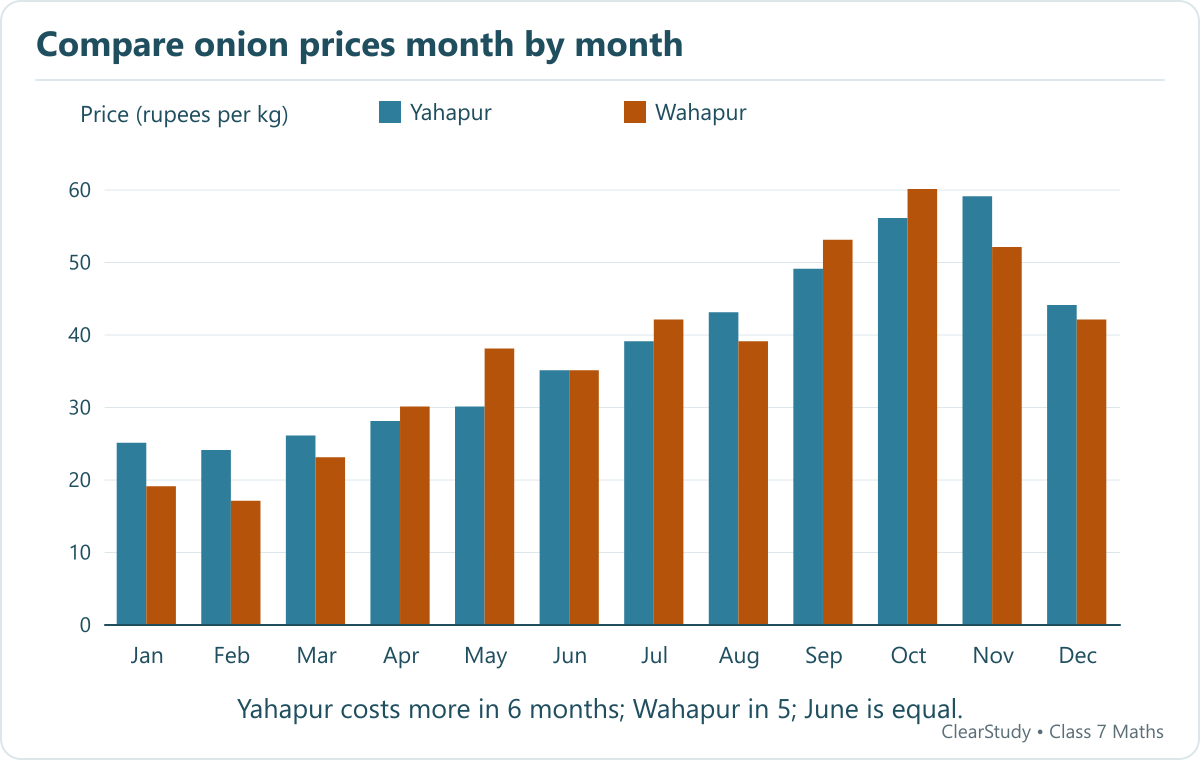
Math Talk — Know Your Onions! (p. 101–103)The table shows the monthly price of onions, in rupees per kilogram, at two towns. Where are onions costlier, according to you?Answer. The answer depends on the measure used. Total: Yahapur 458 > Wahapur 450, so Yahapur is slightly costlier overall. Means: Yahapur 458 ÷ 12 ≈ ₹38.2 vs Wahapur 450 ÷ 12 = ₹37.5 — again Yahapur edges ahead. But Wahapur has the single highest price (₹60) and is more spread out. So “costlier” depends on whether you look at the average (Yahapur) or the peak price (Wahapur).
The double-bar graph preserves January-to-December order. Both towns charge 35 rupees per kg in June.
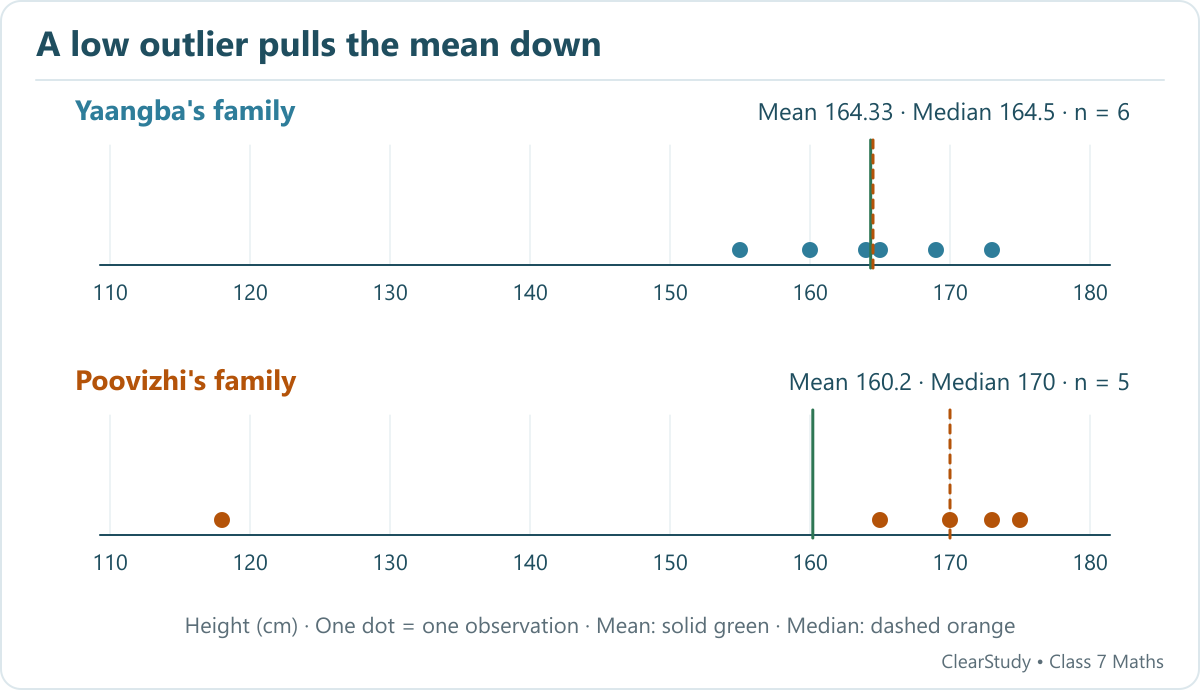
Math Talk — Heights of two families (p. 105)Find the average height of each family. Can we say that Yaangba’s family is taller than Poovizhi’s family?Answer. Yaangba’s mean = (169 + 173 + 155 + 165 + 160 + 164) ÷ 6 = 986 ÷ 6 ≈ 164.3 cm. Poovizhi’s mean = (170 + 173 + 165 + 118 + 175) ÷ 5 = 801 ÷ 5 = 160.2 cm. Although Yaangba’s average is higher, we should not simply say his family is taller: 4 of Poovizhi’s 5 members have heights from 165 to 175 cm, but one very short child (118 cm, an outlier) drags their average down. The median represents Poovizhi’s family better here.
Yaangba: mean about 164.33 cm, median 164.5. Poovizhi: mean 160.2 cm, median 170. The 118 cm height lowers the second family mean.
Try This / Math Talk — Poovizhi without the outlier (p. 107)Find the mean and median in Poovizhi’s data without the outlier value 118. What change do you notice?Answer. Without 118 the heights are 165, 170, 173, 175. Mean = (165 + 170 + 173 + 175) ÷ 4 = 683 ÷ 4 = 170.75 cm; median = (170 + 173) ÷ 2 = 171.5 cm. Removing the low outlier raises the mean sharply (from 160.2 to 170.75) but barely changes the median — showing the mean is sensitive to outliers while the median is robust.
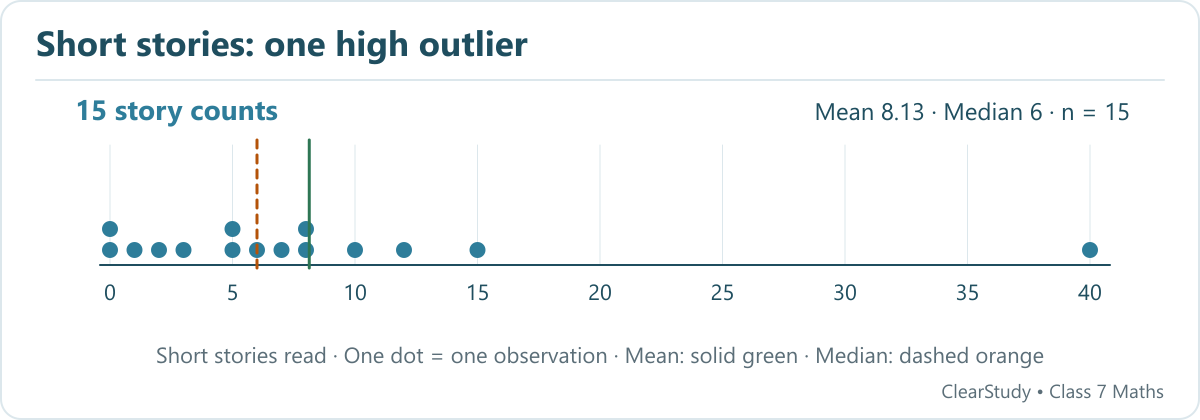
Are you a bookworm? — mean, median & outlier (p. 107)Find the mean and median number of short stories read. Which value would you consider an outlier? Find the mean and median in the absence of the outlier. What change do you notice?Answer.The slips show 6, 8, 5, 15, 3, 0, 2, 7, 12, 40, 0, 8, 10, 5, 1: 15 values with total 122. Mean = 122/15 ≈ 8.13 stories.Sorted: 0, 0, 1, 2, 3, 5, 5, 6, 7, 8, 8, 10, 12, 15, 40. The eighth value is the median, 6.The high outlier is 40. Excluding it leaves 14 values totalling 82: mean = 82/14 ≈ 5.86; median = (5 + 6)/2 = 5.5. The mean drops by about 2.28; the median drops by only 0.5.
Fifteen values total 122 stories: mean 122/15, about 8.13, median 6. Without 40, mean 82/14, about 5.86, and median 5.5.
Math Talk — Variability, mean vs median (p. 108)In the three examples — heights, short-stories and newspaper pages — observe the variability when (a) mean and median are close, (b) far apart with mean < median, (c) far apart with mean > median. Also discuss the effect when outliers are present on both sides.Answer. (a) When data is balanced and evenly spread, the mean and median sit close together. (b) A low-end outlier drags the mean down, giving mean < median. (c) A high-end outlier pulls the mean up, giving mean > median. If outliers occur on both sides, their opposite pulls can partly cancel, so the mean may again end up close to the median even though the data is very spread out.
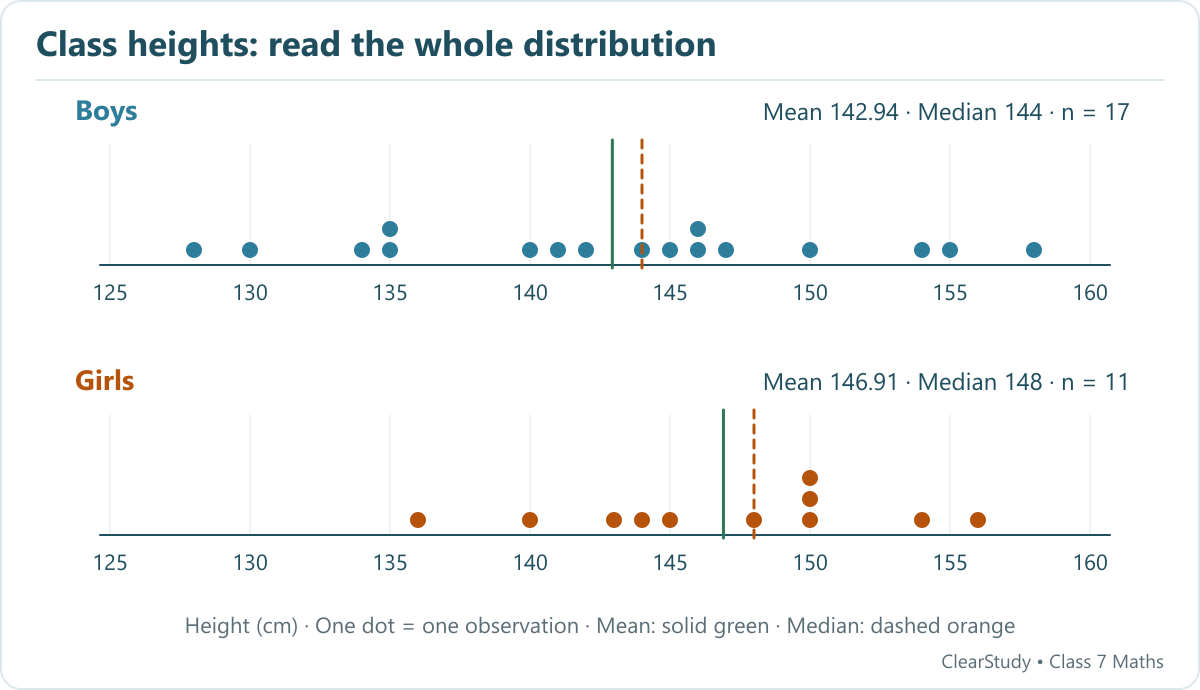
Math Talk / questions — How Tall is Your Class? (p. 109)How many students are taller than the class’ average height? How many boys are taller than the class’ average height?Answer.The 17 boys’ heights total 2430 cm; the 11 girls’ heights total 1616 cm. Thus the whole-class mean is (2430 + 1616)/28 = 144.5 cm. The printed 144.4 does not match the supplied table.There are 15 students above 144.5 cm: 8 boys (145, 146, 146, 147, 150, 154, 155, 158) and 7 girls (145, 148, 150, 150, 150, 154, 156). The class median is 145 cm.The boys’ range is 30 cm and the girls’ range 20 cm. Girls have the higher mean in this particular class; this does not imply every girl is taller than every boy.
Boys have mean about 142.94 cm and median 144; girls have mean about 146.91 and median 148. The combined mean is 4046/28 = 144.5 cm.
Math Talk — How long is a minute? (p. 110)Discuss how well both the groups fared at this activity. Describe and compare the variability in data and their central tendency.Answer.Group A: mean 58.21 s, median 60 s; Group B: mean 59.28 s, median 59.5 s. B’s mean is closer to 60; A’s median equals 60.Read spread from the dots: A extends approximately 42–68 s (range 26 s), and B approximately 47–71 s (range 24 s). B has a slightly smaller range, but its close mean and median alone would not establish that. Both groups include overestimates and underestimates.
Math Talk — Reading the heights table (p. 127–128)Which statements can be justified using the data? (1) heights of boys and girls at every age increased 1989–2019; (2) 13-yr girls 1989 > 14-yr girls 2009; (3) 15-yr boys 2019 > 16-yr boys 1989; (4) all girls aged 13 are taller than all girls aged 11; (5) average boy’s height > average girl’s height for ages 5–19; (6) boys keep growing beyond 19.Answer. (1) True — in the table each age’s height rises from 1989 to 2019 for both boys and girls. (2) 13-yr girls 1989 = 143.2 vs 14-yr girls 2009 = 148 → 143.2 < 148, so false. (3) 15-yr boys 2019 = 159 vs 16-yr boys 1989 = 158.9 → 159 > 158.9, so true. (4) Cannot be justified — the table gives only average heights, not every individual, so we can’t claim every 13-year-old is taller than every 11-year-old. (5) Checking the table, boys’ average exceeds girls’ at most ages but not at ages 11–12 (where girls are slightly taller), so as a blanket statement it is false. (6) The data stops at age 19, so growth beyond 19 cannot be justified from this table.
Math Talk — Largest growth between successive ages (p. 128)In 2019, between which two successive ages from 5 to 19 did boys grow the most? Between which two did girls grow most? Estimate average heights of children aged 1 to 4 (given a newborn is 50 cm), and estimate 2029 heights.Answer.For boys in 2019, the largest adjacent-age difference is 12 to 13 years: 148.4 − 142.2 = 6.2 cm. For girls it is 5 to 6 years: 112.9 − 107.2 = 5.7 cm. Compare every adjacent pair, not just the adolescent years.These are differences between age-group averages, not measurements of the same children as they grow. Ages 1–4 and the year 2029 are outside the table. An illustrative linear interpolation from 50 cm at birth to about 107 cm at age 5 gives about 61, 73, 84 and 96 cm at ages 1–4; it is a mathematical model, not a growth standard.For a clearly labelled 2029 estimate, one possible model is: 2019 value + (2019 value − 2009 value). For example, age-10 boys: 132.6 + (132.6 − 129.4) = 135.8 cm. This extrapolation assumes the last decade’s change repeats and is not a known future fact.
Try This / projects (p. 132–133)In and Out (track stepping out for a month); small-group projects on family heights and estimating time.Answer. These are data-collection activities. For each, gather the values, compute the mean and median, draw a dot plot to show variability, and (for comparisons) a double bar graph. Then describe central tendency and any outliers you spot. The detailed methods are given in Figure-it-Out questions 12 and 13 above.
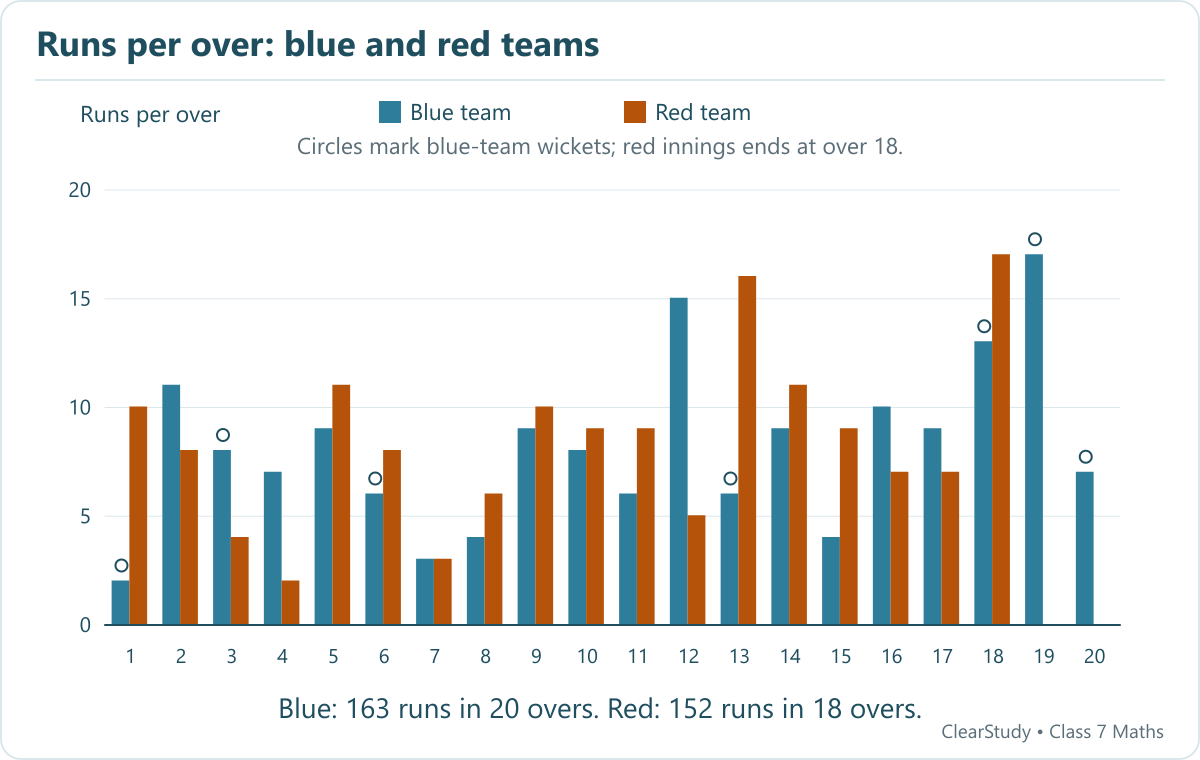
In-text questions — reading the “runs per over” graph (p. 122)1. Can we tell who batted first? Who won the match? 2. How many runs did the blue team score in over 12? 3. In which over did the red team score the least runs? 4. Is it easy to tell the target set by the team batting first?Answer.1. The axes do not explicitly label who batted first; wicket markers alone do not establish that. Adding the plotted bars gives blue 163, red 152. Assuming these are the complete innings in an ordinary match with no adjusted target, blue has the winning total.2. Blue scored 15 runs in over 12. 3. Among the red innings’ plotted overs, the minimum is 2 runs in over 4. Missing red bars after over 18 are not zero-run overs.4. The target is not directly shown because these are per-over scores. If blue batted first, red’s target would be 163 + 1 = 164.
Original redrawing of the textbook per-over data. Blue scores 15 in over 12. Red scores its lowest completed-over total of 2 in over 4. Red has no bars in overs 19–20.
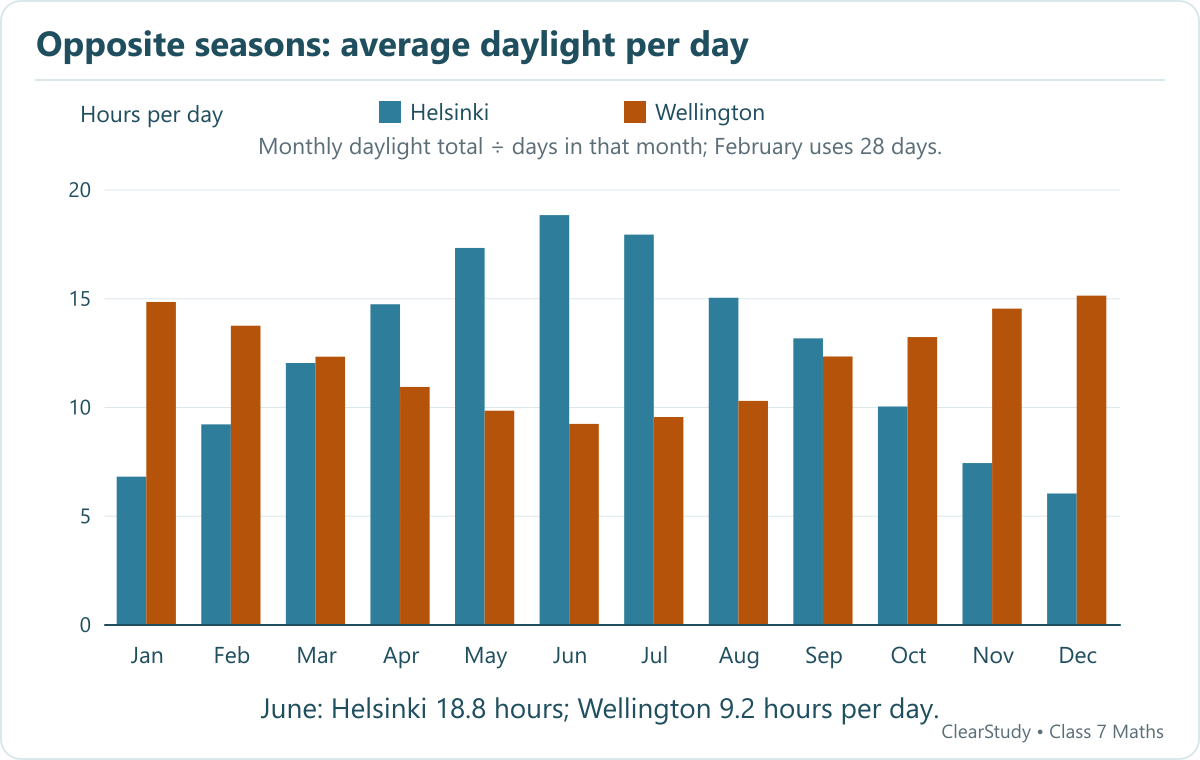
Monthly daylight: divide by the number of days (pp. 118–120)
City 1 is Helsinki; City 2 is Wellington. June averages from the table are 564/30 = 18.8 hours and 276/30 = 9.2 hours. The textbook’s “17–18 hours” description understates the first table value.The graph uses 28 days for February; a leap-year calculation would use 29. These are daylight hours, not necessarily hours of unclouded sunshine. Opposite seasonal patterns reflect the two cities’ locations in opposite hemispheres.
Calculated from the textbook monthly totals. Helsinki peaks at 18.8 daily daylight hours in June; Wellington reaches about 15.10 in December.
Rocket launches: interpret the textbook snapshot (pp. 116–118)
The graph compares organisations in 2021–2023, with a main horizontal interval of 20 launches. Read small bars approximately; this is historical textbook data.Statements: (a) false — Arianespace declines. (b) true in this chart — only SpaceX exceeds 50 in a year. (c) supported — Arianespace’s three bars total about 24, below 40. (d) reasonable — CASC’s approximately 48, 35 and 45 average about 43, near 40. (e) supported — ISRO’s roughly 2 + 5 + 7 exceeds Galactic Energy’s roughly 1 + 2 + 7. (f) not supported — Roscosmos totals about 16 + 21 + 18 = 55, below 60.SpaceX, ISRO and Galactic Energy show increases each year. Rocket Lab and Expace have approximately equal first two bars, so do not claim a strict increase from this graph. Adding the 2023 bars gives roughly 220 launches, selecting (b) 200–400. These are chart estimates, not a fresh audit of national launch statistics.
A recorded zero still carries information (pp. 111–112)
For scores 57, 13, 0, 84, —, 51, 27, count six actual innings, including zero: mean = 232/6 ≈ 38.67.For the twelve monthly mango counts 0, 0, 8, 24, 41, 16, 5, 0, 0, 0, 0, 0, the whole-year mean is 94/12 ≈ 7.83 and median 0. If the question explicitly concerns only the five fruiting months, their mean is 94/5 = 18.8 and median 16. State which months are included; do not automatically discard zeros.
Common Mistakes to Avoid
Watch out for these
Counting a “—” (did not play / absent) as a data value — only a recorded 0 counts; exclude missing entries from the count used as the divisor.
Forgetting to sort the data first before reading off the median.
With an even number of values, taking just one middle number — you must average the two middle values.
Trusting the mean blindly when there is an outlier — a single very high or very low value can make the mean unrepresentative; check the median too.
Thinking the mean or median can lie outside the data — both always sit between the minimum and maximum.
Reading a count graph (e.g. number of skyscrapers) as if it showed size or height — only answer what the axis actually measures.
On a clustered/double bar graph, mixing up which colour is which category — always check the legend and the scale.
Practice MCQs & Assertion–Reason
1. Which of these is a statistical question?
(a) What is your name? (b) How old are the dogs on this street? (c) Is 7 a prime number? (d) What is 12 × 5?
2. The mean of 6, 2, 9, 5, 4, 6, 3, 5 is:
(a) 4 (b) 5 (c) 6 (d) 40
3. The median of the sorted data 17, 19, 23, 30 is:
(a) 19 (b) 23 (c) 26 (d) 21
4. The mean of 1555, 1670, 1750, 2013, 2040, 2126 is:
(a) 1750 (b) 1859 (c) 1900 (d) 11154
5. A player scored 57, 13, 0, 84, —, 51, 27 in a series (— means did not play). The number of values used to find the mean is:
(a) 5 (b) 6 (c) 7 (d) 4
6. A very high outlier in a data set will usually make the:
(a) mean greater than the median (b) mean less than the median (c) mean equal to the median (d) median greater than the maximum
7. For any data set, the mean and the median always lie:
(a) below the minimum (b) above the maximum (c) between the minimum and maximum (d) exactly at the maximum
8. Which measure identifies the middle position(s) after the observations are sorted?
(a) mean (b) median (c) maximum (d) range
9. A graph that shows two bars side by side for each category is called a:
(a) dot plot (b) pie chart (c) clustered (double) bar graph (d) line graph
10. The median of 47, 59, 68, 73, 79, 86, 86, 90, 93 is:
For each Assertion–Reason question, choose: (A) Both Assertion and Reason are true and the Reason is the correct explanation of the Assertion; (B) Both are true but the Reason is not the correct explanation; (C) Assertion is true but Reason is false; (D) Assertion is false but Reason is true.
A-R 1. Assertion: The mean of a data set can be very different from its median.
Reason: An outlier can shift the mean while affecting the median only a little.
A-R 2. Assertion: When a player did not play a match (shown by —), that match is not counted while finding the mean.
Reason: A match with a recorded score of 0 is also not counted while finding the mean.
A-R 3. Assertion: The median of 24, 25, 26, 28, 30, 35, 39, 43, 44, 49, 56, 59 is 37.
Reason: For an even number of sorted values, the median is the average of the two middle values.
A-R 4. Assertion: The mean of a data set can be smaller than the smallest value in the data.
Reason: The mean is the sum of all values divided by the number of values.
A-R 5. Assertion: For nine sorted observations, the median is the fifth observation.
Reason: With an odd count n, the middle position is (n + 1)/2.
Answer key: 1-(A), 2-(C), 3-(A), 4-(D), 5-(A).
Quick Revision Summary
A statistical question is answered by collecting data; a statistical statement summarises data with numbers.
Mean = (sum of values) ÷ (number of values); it can be read as a “fair share”.
Median = the middle value of sorted data; for an even count, average the two middle values. Half the data lies at or below it.
An outlier strongly affects the mean but barely affects the median: low outlier → mean < median; high outlier → mean > median.
The mean and median always lie between the minimum and maximum values.
A recorded 0 counts as a value; a “—” (no value) is not counted.
Dot plots show spread and clustering; clustered (double) bar graphs compare categories or compare data over time.
How to score full marks in this chapter
Always state the formula before computing (mean = sum ÷ count). For the median, sort first and clearly show the middle value(s). When a data set has an outlier, mention it and say whether the mean or median represents the data better. Count only real values — treat “—” as no value but a recorded 0 as a value. For graph questions, name the scale and answer strictly from what the axis measures.
Frequently Asked Questions
What is Class 7 Maths Ganita Prakash Chapter 13 about?
Chapter 13, Connecting the Dots (Ganita Prakash Part II, Chapter 5), is the data-handling chapter. It covers statistical questions and statements, the arithmetic mean and median, outliers, and reading and drawing dot plots and clustered (double) bar graphs.
How many Figure it Out exercises are there in Chapter 13?
There are four Figure it Out sets: page 101, pages 112–113, pages 122–125 and pages 129–134. They include worked calculations, graph questions and projects requiring your own data.
What is the difference between mean and median?
The mean is the sum of all values divided by how many there are. The median is the middle value once the data is sorted. The mean is pulled by outliers, while the median stays near the centre, so the median often represents data with an extreme value better.
Are these Class 7 Maths Ganita Prakash Chapter 13 solutions free?
Yes. All solutions are free and follow the official NCERT Ganita Prakash (Part II) textbook for the 2026–27 session, with every mean and median verified.