Class 7 Maths Ganita Prakash Chapter 15 Solutions (NCERT 2026–27) – Finding the Unknown
These Class 7 Maths Ganita Prakash Chapter 15 solutions cover Finding the Unknown — the algebra chapter on framing and solving simple equations from the new NCF-2023 textbook (Reprint 2026–27). This is Chapter 7 of Ganita Prakash Part II (site Chapter 15). Use the worked equations, textbook-based diagrams and substitution checks to understand the balancing method, solve word problems and correct common algebra mistakes.
Class: 7Subject: MathematicsBook: Ganita Prakash (Part II)Chapter: 15 (Part II, Ch 7)Exercises: Figure it Out (p. 172), (p. 181), (pp. 185–189)Session: 2026–27
Chapter 15 of Ganita Prakash, Finding the Unknown (Part II, Chapter 7), introduces algebraic equations through the picture of a balanced weighing scale. Just as removing equal weights from both pans keeps the scale balanced, performing the same operation on both sides of an equation keeps the LHS equal to the RHS. The chapter moves from a matchstick pattern (2n + 1) to framing equations, then from the slow trial-and-error method to the efficient systematic (balancing) method. You learn to bring unknown terms to one side, use additive and multiplicative inverses, model real-life situations (savings, snacks, taxis, marbles) as equations, generate equations from a given solution, spot and mend errors in worked solutions, and finally meet Brahmagupta’s elegant formula x = (D − B)/(A − C) for Ax + B = Cx + D. The solutions below cover the three Figure it Out sets, the mistake-correction tasks and the main in-text activities.
Key Concepts & Definitions
Equation: a statement of equality between two algebraic expressions, written with an “=” sign, e.g. 2n + 1 = 99 or 6y + 7 = 4y + 21.
LHS and RHS: the Left Hand Side and Right Hand Side of an equation — the two expressions on either side of the equal sign.
Solving an equation: finding the value(s) of the letter−number for which the LHS becomes equal to the RHS. That value is called the solution (or root) of the equation.
Balancing property: add or subtract the same quantity on both sides, or multiply or divide both sides by the same nonzero number, to obtain an equivalent equation. Division by zero is undefined. Multiplication by zero keeps a true equality true but loses the original solution information.
Trial-and-error method: substituting different values for the unknown until LHS = RHS. It works but is slow and inefficient.
Systematic (balancing) method: using inverse operations on both sides to isolate the unknown — the efficient method used throughout the chapter.
Bījagaṇita (algebra): the branch of mathematics that uses letter symbols to represent unknowns and solve problems; bīja means “seed”, the answer hidden inside the unknown.
Important Formulas & Methods (Chapter 15)
Matchstick pattern: the arrangement at position n has 2n + 1 matchsticks; Ranjana’s tile pattern at step k uses 3k + 1 tiles.
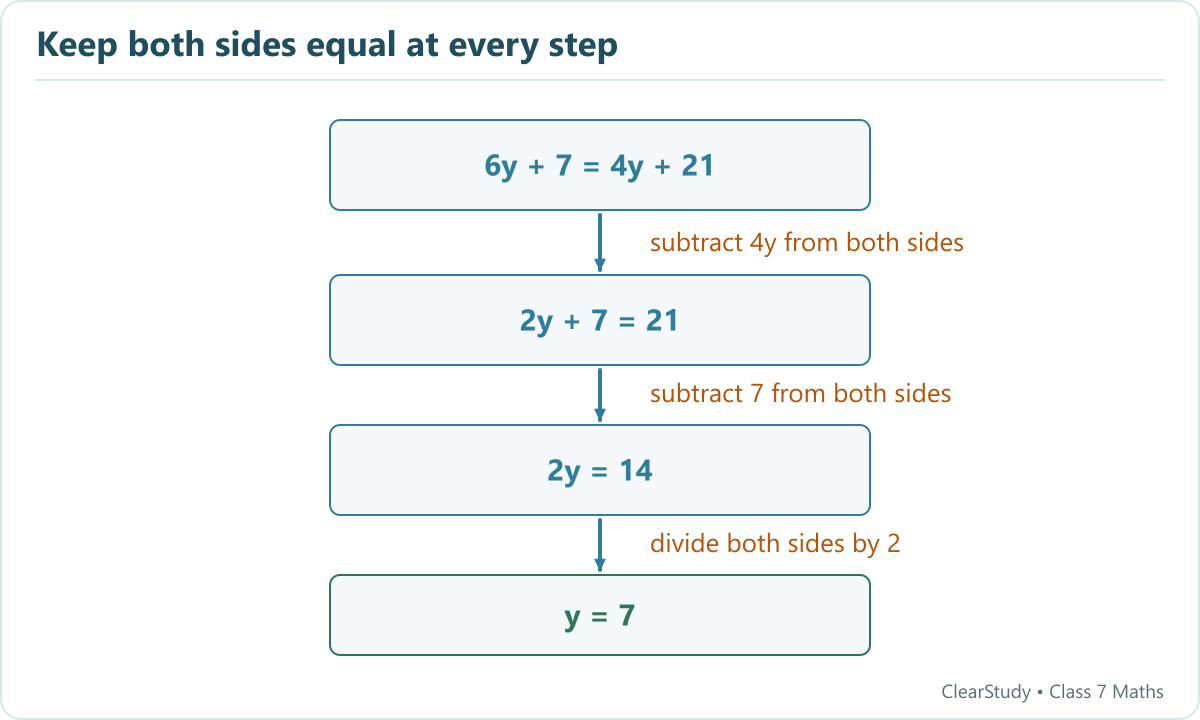
Move a term: when a term added/subtracted on one side is removed, it appears with its additive inverse (opposite sign) on the other side. Example: 2y + 7 = 21 → 2y = 21 − 7.
Remove a factor: if one side is a product and you remove a nonzero factor, divide the other side by it. Example: 2y = 14 → y = 14 ÷ 2.
Remove a divisor: if one side is a quotient and you remove the divisor, multiply the other side by it. Example: u/15 = 6 → u = 6 × 15.
Always check: substitute the answer back into the original equation and confirm LHS = RHS.
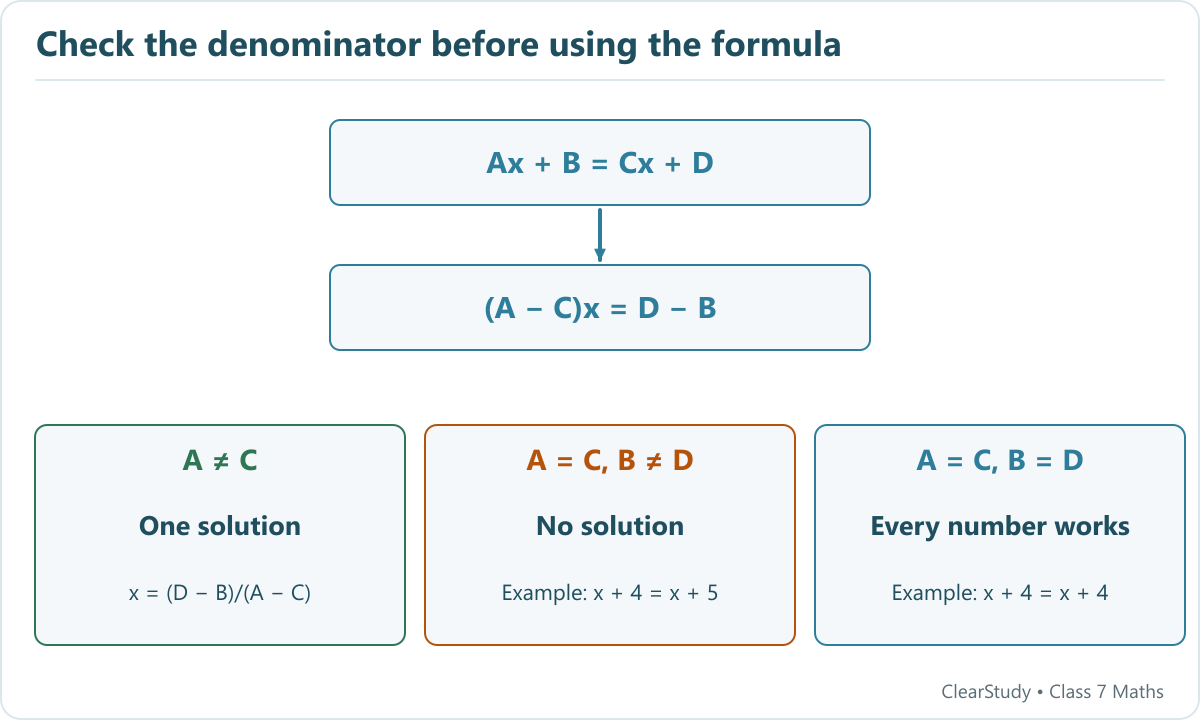
Brahmagupta’s formula: for Ax + B = Cx + D with A ≠ C, the unique solution is x = (D − B) / (A − C). If A = C, unequal B and D give no solution; equal B and D make the equation true for every value of x.
The formula x = (D − B)/(A − C) applies only if A is not equal to C. If A equals C, unequal constants give no solution and equal constants give infinitely many solutions.Solve 6y + 7 = 4y + 21 by subtracting 4y, subtracting 7, then dividing by 2 on both sides. Substituting y = 7 gives 49 on each side.
SOLUTIONUse the hint: 4 more than a number can never equal 5 more than the same number. So write x + 4 = x + 5.Subtracting x from both sides gives 4 = 5, which is false. Since no value of x can make 4 = 5, the equation x + 4 = x + 5 has no solution. (Any equation of the form x + a = x + b with a ≠ b works, e.g. 2x + 3 = 2x + 7.)
Figure it Out — Finding Unknowns (Page 181)
1. Write 5 equations whose solution is x = −2.
SOLUTIONStart from x = −2 and build outwards by doing the same thing to both sides. Five valid equations are:(i) x + 5 = 3 (ii) 3x = −6 (iii) 2x + 7 = 3 (iv) x/2 = −1 (v) 5x + 4 = 2x − 2.Each gives x = −2 (e.g. for (v): 5x − 2x = −2 − 4 → 3x = −6 → x = −2). (Many other correct answers are possible.)
2. Find the value of each unknown:
(a) 2y = 60 (b) −8 = 5x − 3(c) −53w = −15 (d) 13 − z = 8(e) k + 8 = 12 − k (f) 7m = m − 3(g) 3n = 10 + n
SOLUTION(a) 2y = 60 → y = 60 ÷ 2 = 30.(b) −8 = 5x − 3 → 5x = −8 + 3 = −5 → x = −1.(c) −53w = −15 → w = (−15) ÷ (−53) = 15/53.(d) 13 − z = 8 → −z = 8 − 13 = −5 → z = 5.(e) k + 8 = 12 − k → k + k = 12 − 8 → 2k = 4 → k = 2.(f) 7m = m − 3 → 7m − m = −3 → 6m = −3 → m = −1/2.(g) 3n = 10 + n → 3n − n = 10 → 2n = 10 → n = 5.
3. I am a 3-digit number. My hundred’s digit is 3 less than my ten’s digit. My ten’s digit is 3 less than my unit’s digit. The sum of all the three digits is 15. Who am I?
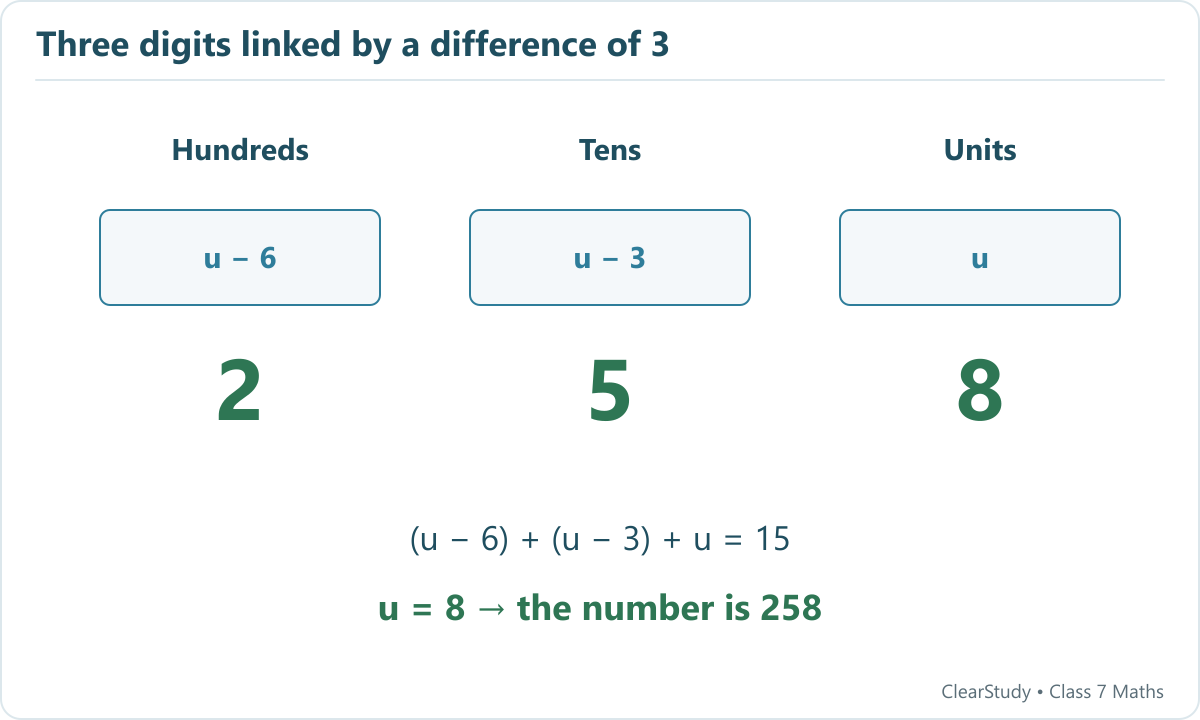
SOLUTIONLet the units digit be u. Then ten’s digit = u − 3 and hundred’s digit = (u − 3) − 3 = u − 6.Sum of digits: (u − 6) + (u − 3) + u = 15 → 3u − 9 = 15 → 3u = 24 → u = 8.So units = 8, tens = 5, hundreds = 2 → the number is 258. Check: 2 + 5 + 8 = 15. ✓
The hundreds, tens and units digits are u minus 6, u minus 3 and u. Their sum is 15, so the digits are 2, 5 and 8.
4. The weight of a brick is 1 kg more than half its weight. What is the weight of the brick?
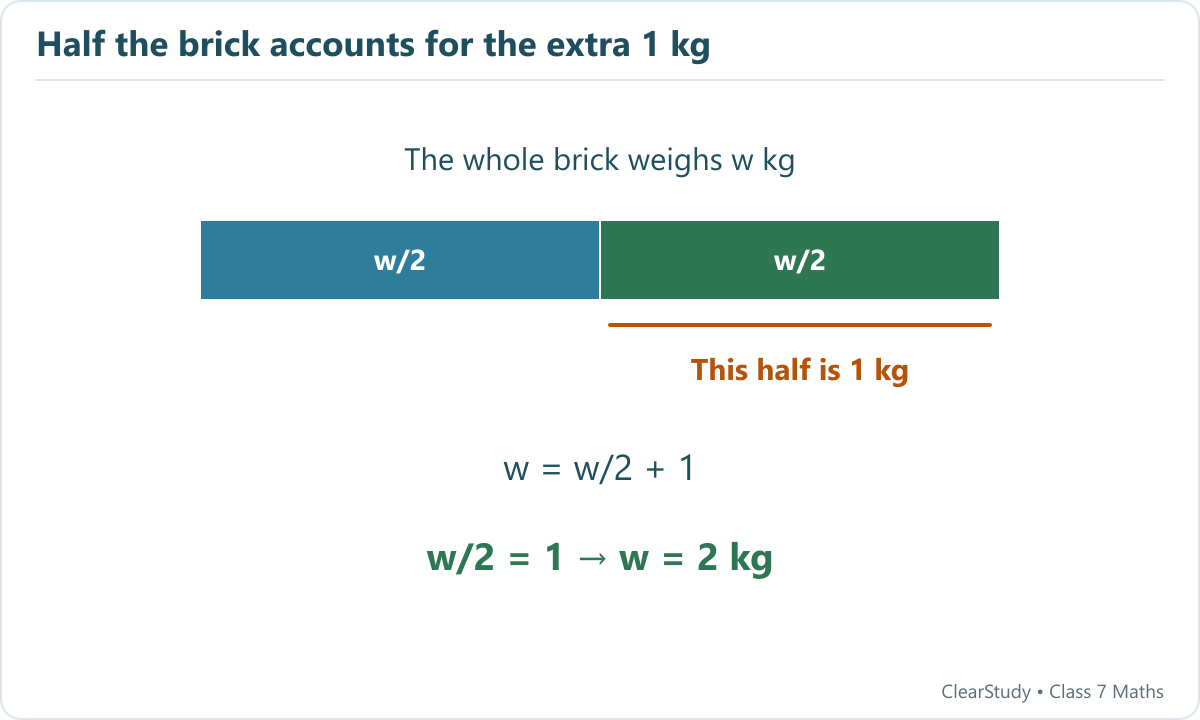
SOLUTIONLet the brick weigh w kg. Then w = 1 + w/2.Subtract w/2 from both sides: w − w/2 = 1 → w/2 = 1 → w = 2 kg. Check: half of 2 is 1, and 1 + 1 = 2. ✓
A bar split into two equal halves shows why w = w/2 + 1 implies w/2 = 1 and the whole brick weighs 2 kg.
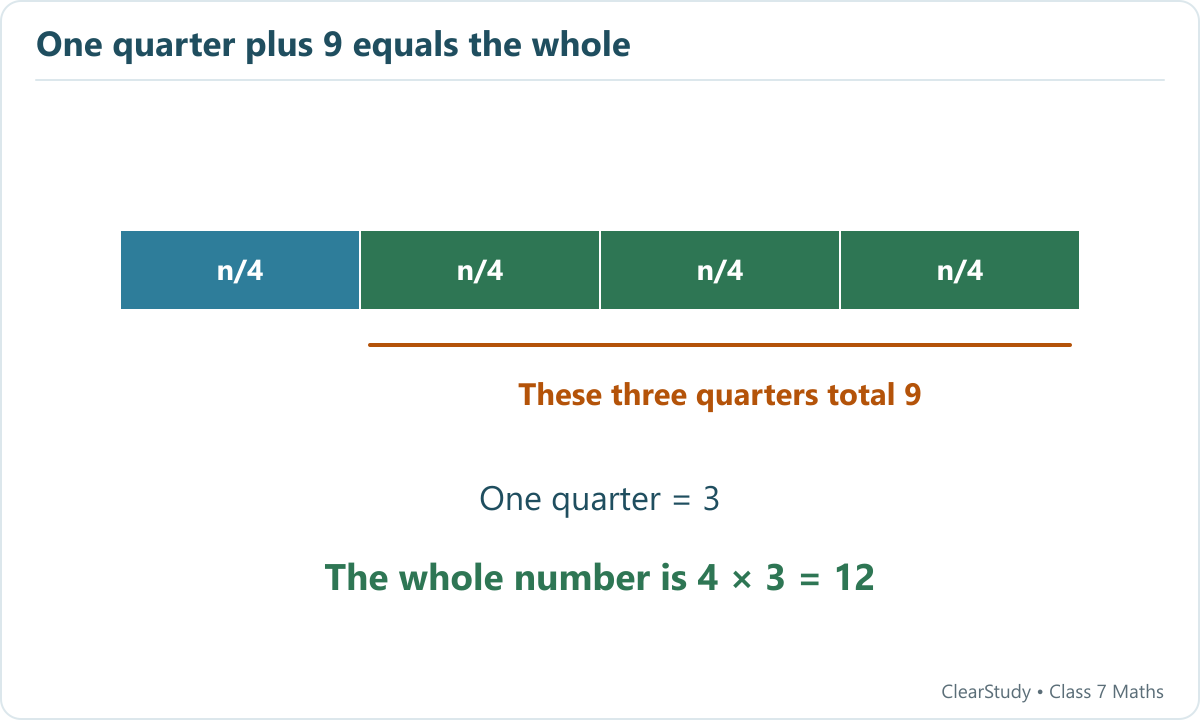
5. One quarter of a number increased by 9 gives the same number. What is the number?
SOLUTIONLet the number be n. Then n/4 + 9 = n.Subtract n/4 from both sides: 9 = n − n/4 = 3n/4 → 3n = 36 → n = 12. Check: 12/4 + 9 = 3 + 9 = 12. ✓
The difference between the whole number and one quarter is three quarters. These equal 9, so one quarter is 3 and the number is 12.
6. Given 4k + 1 = 13, find the values of:
(a) 8k + 2 (b) 4k (c) k (d) 4k − 1 (e) −k − 2
Figure it Out — Word Problems & Equations (Pages 185–189)
1. Fill in the blanks with integers.
(a) 5 × ___ − 8 = 37(b) 37 − (33 − ___ ) = 35(c) −3 × (−11 + ___ ) = 45
SOLUTION(a) 5 × a − 8 = 37 → 5a = 45 → a = 9.(b) 37 − (33 − b) = 35 → 37 − 33 + b = 35 → 4 + b = 35 → b = 31.(c) −3 × (−11 + c) = 45 → −11 + c = 45 ÷ (−3) = −15 → c = −15 + 11 = −4.
2. Ranju is a daily wage labourer. She earns ₹750 a day. Her employer pays her in 50 and 100 rupee notes. If Ranju gets an equal number of 50 and 100 rupee notes, how many notes of each does she have?
SOLUTIONLet the number of notes of each kind be n. Value = 50n + 100n = 150n.150n = 750 → n = 750 ÷ 150 = 5. So Ranju has 5 notes of ₹50 and 5 notes of ₹100 (5×50 + 5×100 = 250 + 500 = 750). ✓
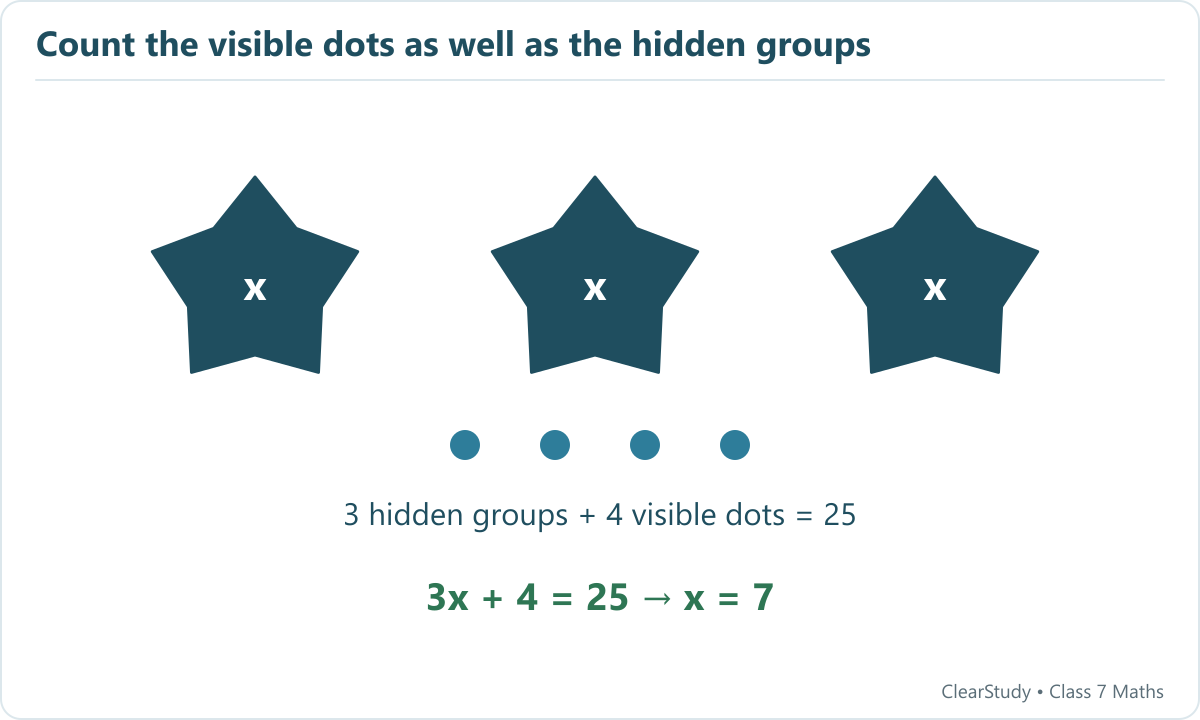
3. In the given picture, each black blob hides an equal number of blue dots. If there are 25 dots in total, how many dots are covered by one blob? Write an equation to describe this problem.
SOLUTIONThe picture contains 3 blobs and 4 visible blue dots. Let each blob hide x dots.Equation: 3x + 4 = 25. Subtract 4: 3x = 21. Divide by 3: x = 7.Check: 3 × 7 + 4 = 25. Each blob hides seven dots.
The textbook picture has three blobs and four visible blue dots. Thus 3x + 4 = 25, and each blob hides seven dots.
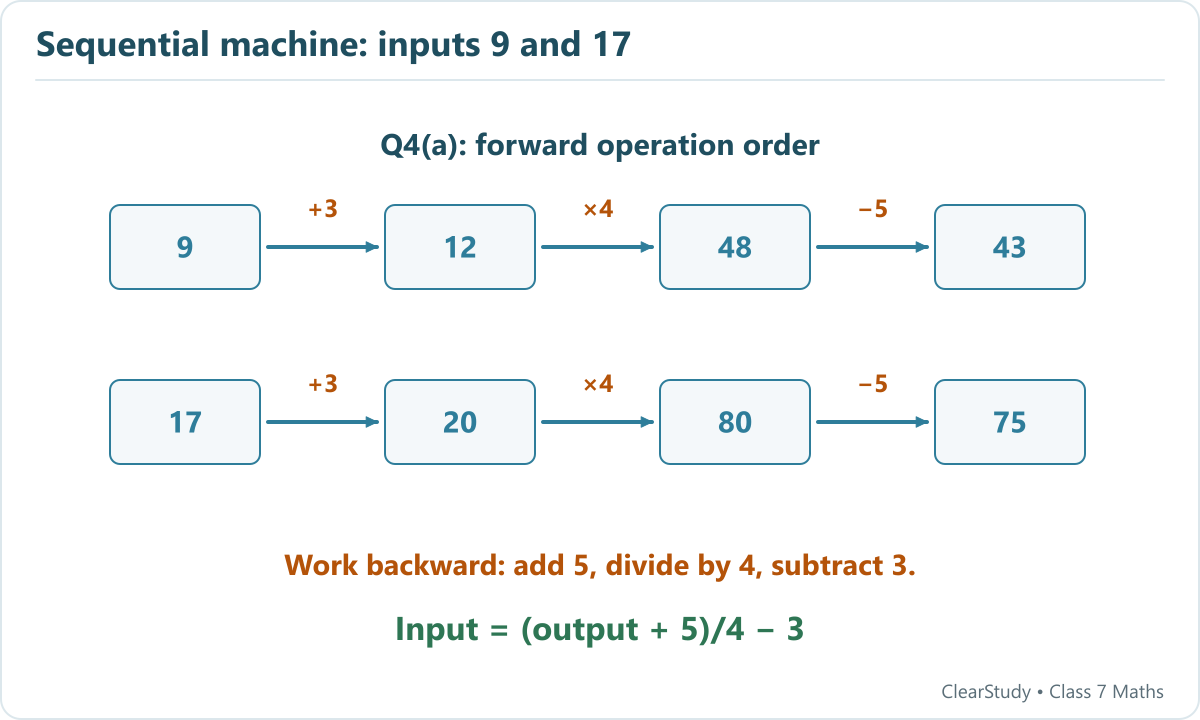
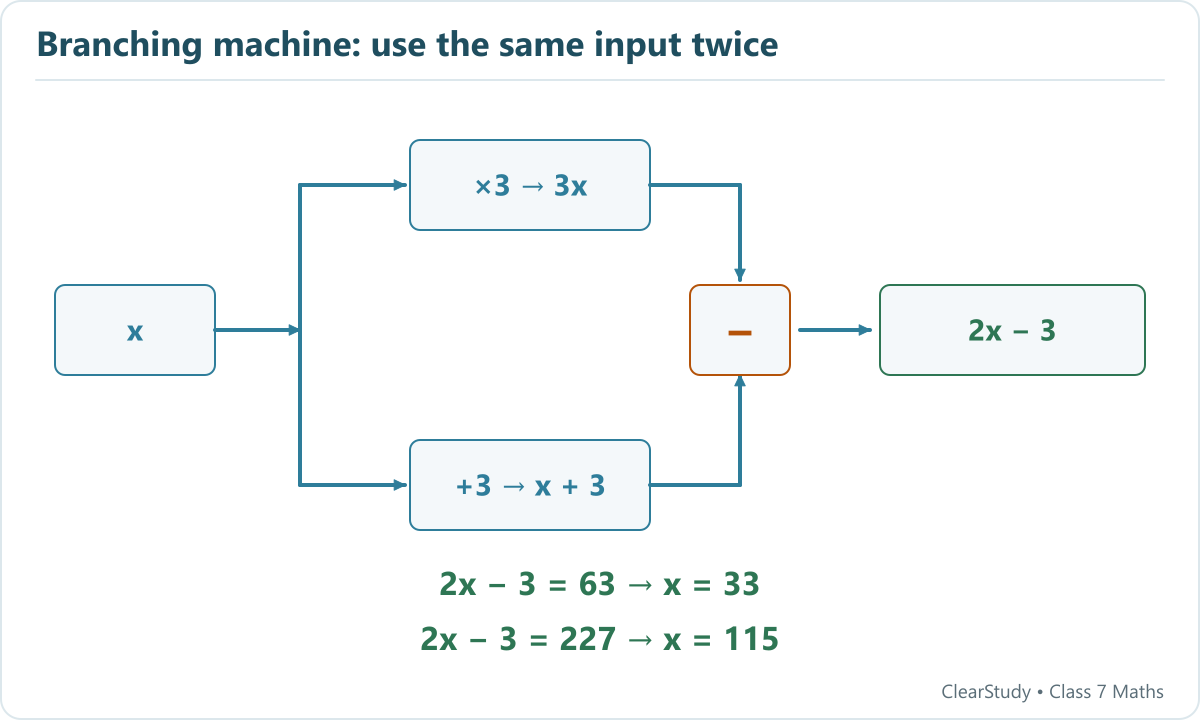
4. Here are machines that take an input, perform an operation on it and send out the result as an output. Find the inputs in the following cases.
SOLUTION(a) The operations are +3, then ×4, then −5. For input x, output = 4(x + 3) − 5.Output 43: 4(x + 3) − 5 = 43 → x + 3 = 48/4 = 12 → x = 9. Check: 9 → 12 → 48 → 43.Output 75: 4(x + 3) − 5 = 75 → x + 3 = 80/4 = 20 → x = 17. Check: 17 → 20 → 80 → 75.(b) The same input goes down two branches: the upper gives 3x and the lower gives x + 3. The output subtracts the lower from the upper: 3x − (x + 3) = 2x − 3.Output 63: 2x − 3 = 63 → 2x = 66 → x = 33. Check: 99 − 36 = 63.Output 227: 2x − 3 = 227 → 2x = 230 → x = 115. Check: 345 − 118 = 227.
The machine adds 3, multiplies by 4, then subtracts 5. Outputs 43 and 75 require inputs 9 and 17 respectively.The upper branch gives 3x and the lower branch gives x + 3. Subtracting the lower result from the upper gives 2x minus 3. Outputs 63 and 227 require 33 and 115.
5. What are the inputs to these machines?
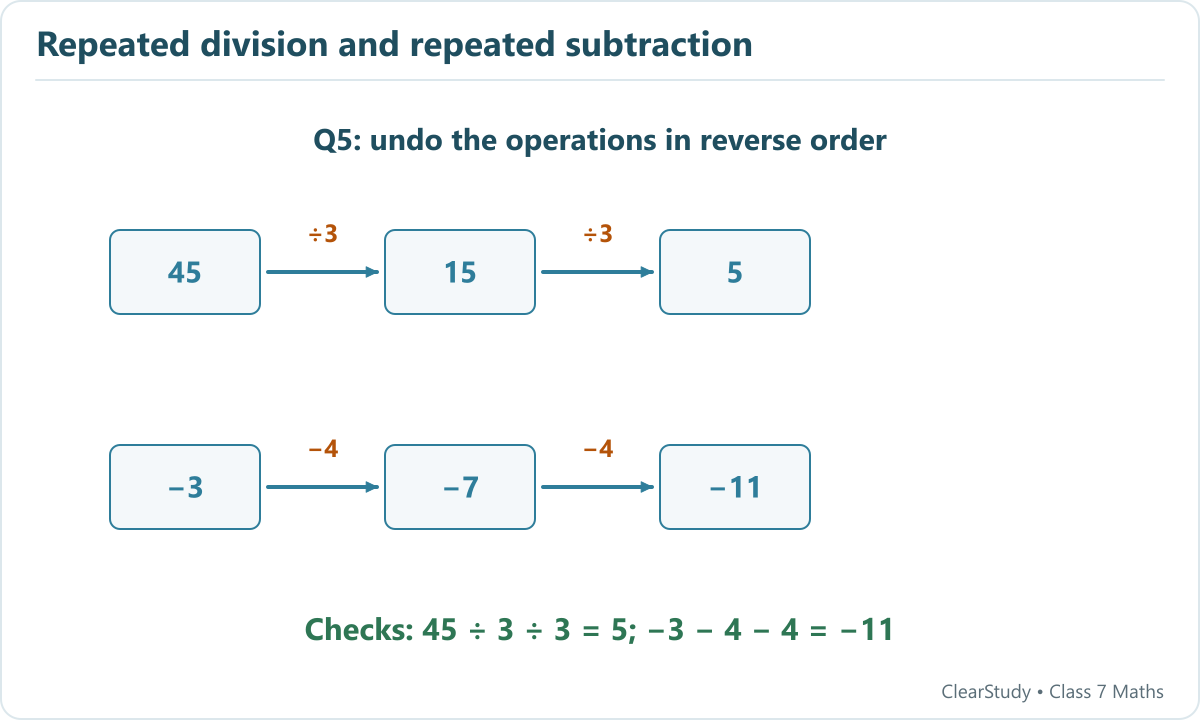
SOLUTIONFirst machine: x ÷ 3 ÷ 3 = 5 → x/9 = 5 → x = 45. Check: 45 ÷ 3 = 15, then 15 ÷ 3 = 5.Second machine: x − 4 − 4 = −11 → x − 8 = −11 → x = −3. Check: −3 − 4 = −7, then −7 − 4 = −11.
The first input is 45 because dividing by 3 twice gives 5. The second input is negative 3 because subtracting 4 twice gives negative 11.
6. A taxi driver charges a fixed fee of ₹800 per day plus ₹20 for each kilometer traveled. If the total cost for a taxi ride is ₹2200, determine the number of kilometres traveled.
SOLUTIONLet the distance be k km. Cost = 800 + 20k.800 + 20k = 2200 → 20k = 2200 − 800 = 1400 → k = 1400 ÷ 20 = 70 km. Check: 800 + 20×70 = 800 + 1400 = 2200. ✓
7. The sum of two numbers is 76. One number is three times the other number. What are the numbers?
SOLUTIONLet the smaller number be x; the other is 3x. Then x + 3x = 76 → 4x = 76 → x = 19.So the numbers are 19 and 57 (3 × 19 = 57). Check: 19 + 57 = 76. ✓
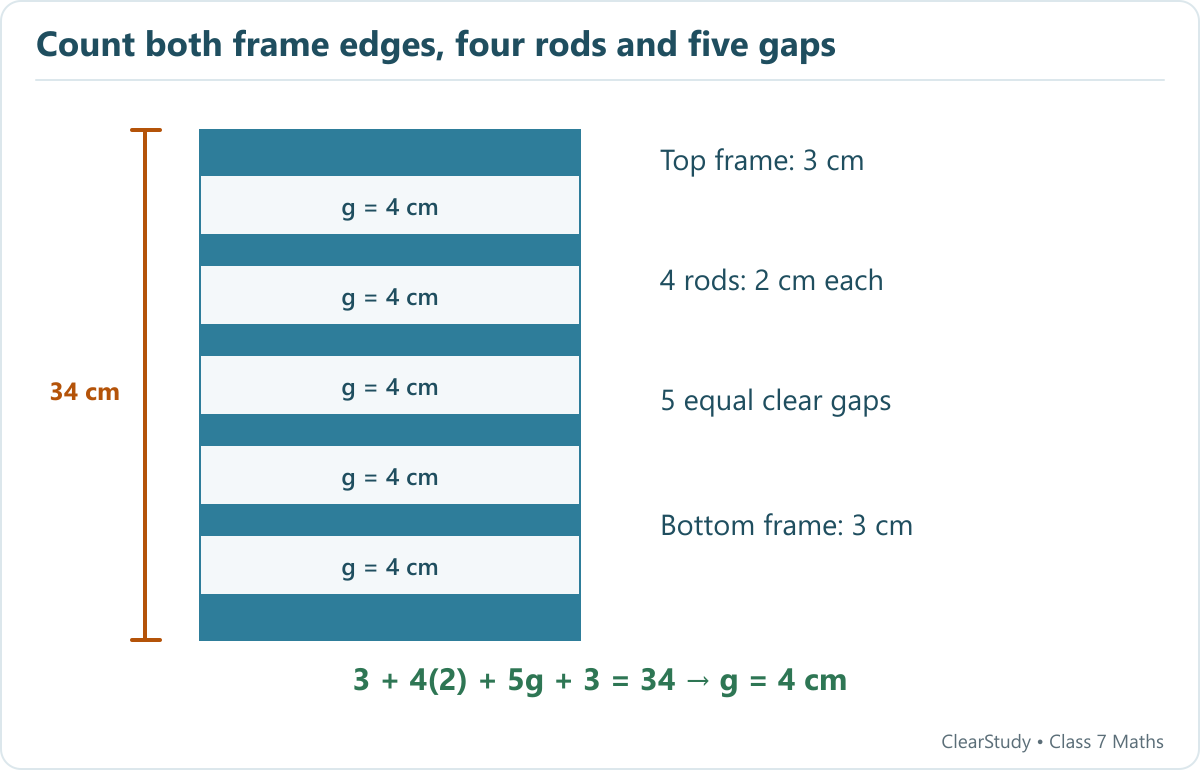
8. The figure shows the diagram for a window with a grill. What is the gap between two rods in the grill?
SOLUTIONCount four inner rods, each 2 cm thick, and five equal clear gaps. The top and bottom frame edges are each 3 cm thick.If each gap is g cm, the full height is 3 + 4 × 2 + 5g + 3 = 34. Thus 14 + 5g = 34, so 5g = 20 and g = 4 cm.Check: 3 + 8 + 20 + 3 = 34 cm. The 2 cm label gives rod thickness, not the bottom margin.
The 34 cm height includes two 3 cm frame edges, four 2 cm rods and five equal gaps. The gaps occupy 20 cm in total, so each clear gap is 4 cm.
9. In a restaurant, a fruit juice costs ₹15 less than a chocolate milkshake. If 4 fruit juices and 7 chocolate milkshakes cost ₹600, find the cost of the fruit juice and milkshake.
SOLUTIONLet the milkshake cost ₹m. Then a fruit juice costs ₹(m − 15).4(m − 15) + 7m = 600 → 4m − 60 + 7m = 600 → 11m = 660 → m = 60.So the milkshake costs ₹60 and the fruit juice costs ₹45. Check: 4×45 + 7×60 = 180 + 420 = 600. ✓
10. Given 28p − 36 = 98, find the value of 14p − 19 and 28p − 38.
11. The steps to solve three equations are shown below. Identify and correct any mistakes.
(a) 6x + 9 = 66 → x + 9 = 11 → x = 11 − 9 → x = 2(b) 14y + 24 = 36 → 7y + 12 = 18 → 7y = 6 → y = 6/7(c) 4x − 5 = 9x + 8 → 4x = 9x + 8 − 5 → 4x = 9x + 3 → 4x − 9x = 3 → −5x = 3 → x = −5/3
SOLUTION(a) Mistake. Going from 6x + 9 = 66 to “x + 9 = 11” divided 6x by 6 but left the +9 unchanged. Correct: 6x = 66 − 9 = 57 → x = 57/6 = 19/2 = 9.5.(b) Correct. 14y + 24 = 36 → 14y = 12 → y = 12/14 = 6/7. The shown steps and answer y = 6/7 are right.(c) Mistake. Moving −5 to the RHS it should change sign to +5, not stay −5. The printed final step also reverses the quotient: even from −5x = 3, x would be −3/5, not −5/3. Correct: 4x = 9x + 8 + 5 → 4x − 9x = 13 → −5x = 13 → x = −13/5.
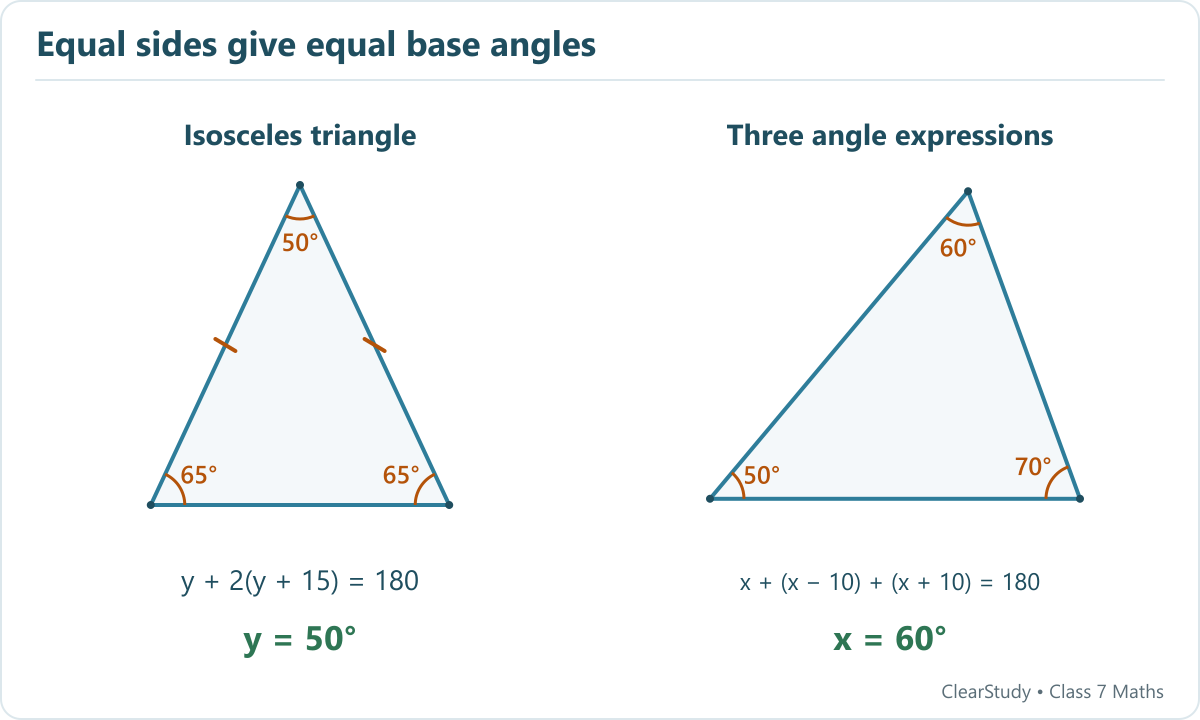
12. Find the measures of the angles of these triangles. (The first triangle has equal sloping sides, apex angle y and base angles y + 15; the second has angles x, x − 10 and x + 10.)
SOLUTIONThe interior angles of a triangle sum to 180°.Triangle 1: equal sloping sides give equal base angles. Both are y + 15, while the apex is y. So y + 2(y + 15) = 180 → 3y + 30 = 180 → y = 50°. The angles are 50°, 65° and 65°.Triangle 2: x + (x − 10) + (x + 10) = 180 → 3x = 180 → x = 60°. The angles are 60°, 50° and 70°.Checks: 50 + 65 + 65 = 180, and 60 + 50 + 70 = 180.
In the first triangle the apex is y and both base angles are y + 15, giving 50, 65 and 65 degrees. The second triangle has angles 60, 50 and 70 degrees.
13. Write 4 equations whose solution is u = 6.
SOLUTIONBuild from u = 6 using the same operation on both sides. Four valid equations:(i) u + 4 = 10 (ii) 2u = 12 (iii) 3u − 5 = 13 (iv) u/2 + 1 = 4. Each gives u = 6. (Many other correct answers possible.)
14. The Bakhśhali Manuscript (300 CE) mentions the following problem. The amount given to the first person is not known. The second person is given twice as much as the first. The third person is given thrice as much as the second; and the fourth person four times as much as the third. The total amount distributed is 132. What is the amount given to the first person?
SOLUTIONLet the first person get a. Then: second = 2a, third = 3 × 2a = 6a, fourth = 4 × 6a = 24a.Total: a + 2a + 6a + 24a = 132 → 33a = 132 → a = 132 ÷ 33 = 4. So the first person gets 4 (others get 8, 24 and 96; 4 + 8 + 24 + 96 = 132). ✓
15. The height of a giraffe is two and a half metres more than half its height. How tall is the giraffe?
SOLUTIONLet the height be h metres. Then h = 2.5 + h/2.Subtract h/2 from both sides: h − h/2 = 2.5 → h/2 = 2.5 → h = 5 m. Check: half of 5 is 2.5, and 2.5 + 2.5 = 5. ✓
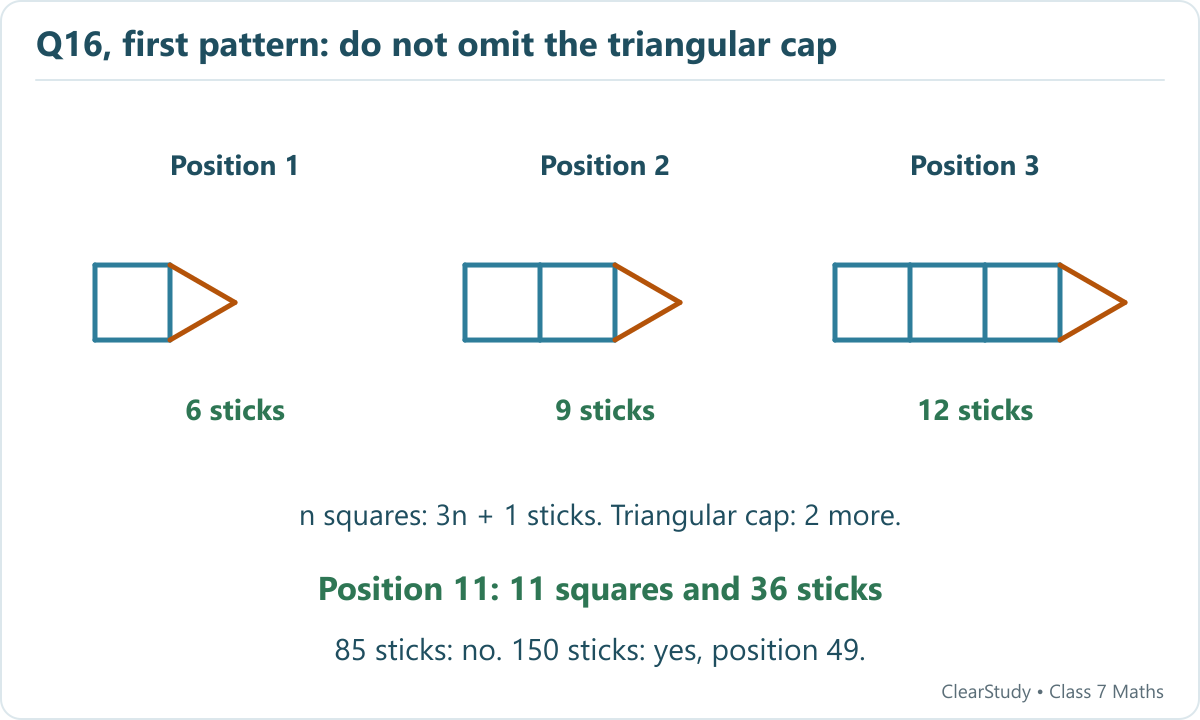
16. Two separate figures are given below. Each figure shows the first few positions in a sequence of arrangements made with sticks. Identify the pattern and answer the following questions for each figure:
(a) How many squares are in position number 11 of the sequence?(b) How many sticks are needed to make the arrangement in position number 11 of the sequence?(c) Can an arrangement in this sequence be made using exactly 85 sticks? If yes, which position number will it correspond to?(d) Can an arrangement in this sequence be made using exactly 150 sticks? If yes, which position number will it correspond to?
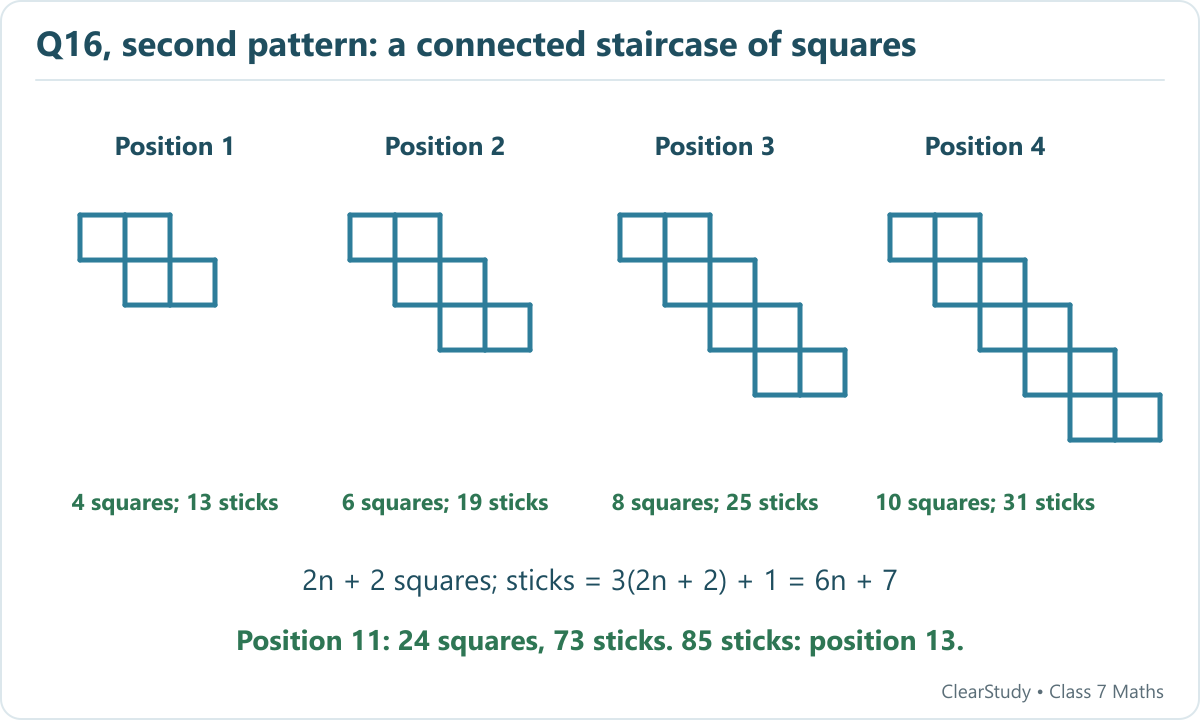
SOLUTIONFirst figure: a row of n squares with a triangular cap. The row uses 3n + 1 sticks; the cap adds two. Total = 3n + 3.(a) Position 11 contains 11 squares. (b) It uses 3(11) + 3 = 36 sticks.(c) 3n + 3 = 85 gives n = 82/3, not a whole number: no. (d) 3n + 3 = 150 gives n = 49: yes, position 49.Second figure: the staircase. Positions 1, 2, 3 and 4 have 4, 6, 8 and 10 squares. Position n has 2n + 2 squares. Each next square in the connected chain shares one side and adds three sticks, so the count is 4 + 3[(2n + 2) − 1] = 6n + 7.(a) Position 11 has 2(11) + 2 = 24 squares. (b) It uses 6(11) + 7 = 73 sticks.(c) 6n + 7 = 85 gives n = 13: yes, position 13. (d) 6n + 7 = 150 gives n = 143/6, not a whole number: no.
The first pattern contains n squares in a row plus a triangular cap using two extra sticks, so it needs 3n + 3 sticks. At position 11 it has 11 squares and 36 sticks.The staircase has 4, 6, 8 and 10 squares at positions 1 to 4, using 13, 19, 25 and 31 sticks. At position n it has 2n + 2 squares and 6n + 7 sticks; 150 sticks is impossible.
17. A number increased by 36 is equal to ten times itself. What is the number?
SOLUTIONLet the number be n. Then n + 36 = 10n.36 = 10n − n = 9n → n = 36 ÷ 9 = 4. Check: 4 + 36 = 40 = 10 × 4. ✓
19. Solve the equations to find a path from Start to the End. Show your work in the given boxes provided and colour your path as you proceed.
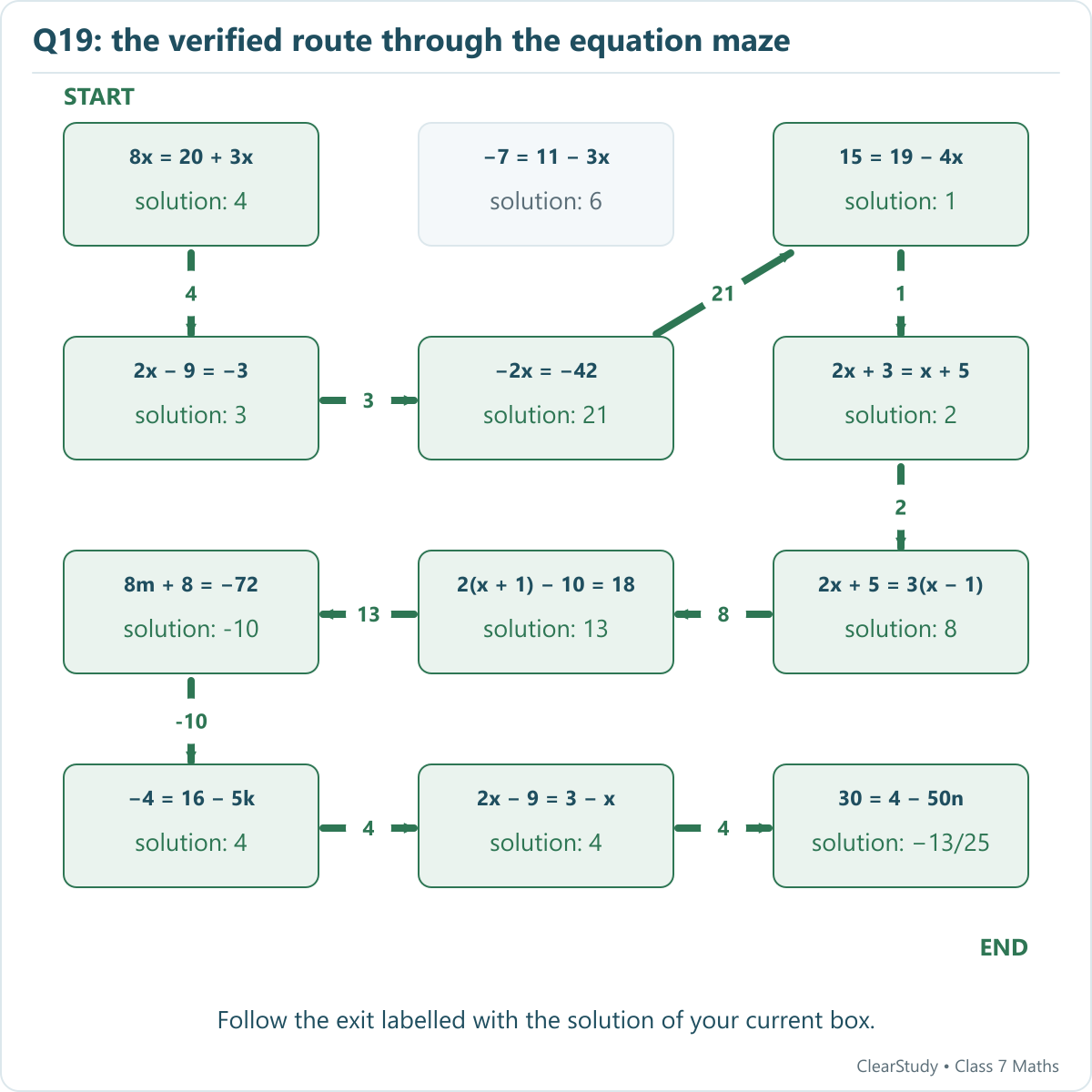
SOLUTIONAt each box, solve its equation and follow the connecting arrow labelled with that solution. The diagram below preserves the textbook box positions and highlights only the correct route.Start: 8x = 20 + 3x → x = 4. Go down to 2x − 9 = −3 → x = 3.Go right to −2x = −42 → x = 21, then diagonally up-right to 15 = 19 − 4x → x = 1.Go down to 2x + 3 = x + 5 → x = 2; down again to 2x + 5 = 3(x − 1) → x = 8.Go left to 2(x + 1) − 10 = 18 → x = 13; left again to 8m + 8 = −72 → m = −10.Go down to −4 = 16 − 5k → k = 4; right to 2x − 9 = 3 − x → x = 4; right again to End.The outgoing route labels are 4 → 3 → 21 → 1 → 2 → 8 → 13 → −10 → 4 → 4. The final box has 30 = 4 − 50n → n = −26/50 = −13/25.The unused top-middle box, −7 = 11 − 3x, has x = 6. Its solution is correct but it is not part of the Start-to-End route.
The route leaves boxes with values 4, 3, 21, 1, 2, 8, 13, negative 10, 4 and 4 before reaching End. The top-middle box is not on this route. The final equation gives n = negative 13/25.
Mind the Mistake, Mend the Mistake (Pages 181–182)
Each item below shows a worked solution; we point out the mistake (if any), correct it, and give the right answer.
1. 4x + 6 = 10 → 4x = 10 + 6 → 4x = 16 → x = 4
SOLUTIONMistake: moving +6 across the “=” it should become −6, not +6.Correct: 4x = 10 − 6 = 4 → x = 1.
2. 7 − 8z = 5 → 8z = 7 − 5 → 8z = 2 → z = 4
SOLUTIONMistake: in the last step 8z = 2 was wrongly turned into z = 4 by reversing the quotient. The correct division is 2 ÷ 8, not 8 ÷ 2.Correct: z = 2 ÷ 8 = 1/4.
3. 2v − 4 = 6 → v − 4 = 6 − 2 → v − 4 = 4 → v = 8
SOLUTIONMistake: the factor 2 in 2v was treated as a term that could be subtracted. It cannot be removed by writing v − 4 = 6 − 2.Correct: 2v − 4 = 6 → 2v = 10 → v = 5. Alternatively divide the whole original equation by 2: v − 2 = 3 → v = 5.
SOLUTIONMistake: moving 3z to the left it should become −3z, and moving +2 to the right it should become −2.Correct: 5z − 3z = −4 − 2 → 2z = −6 → z = −3.
SOLUTIONThe first rearrangement is valid: adding 4w to both sides gives 15w = 26 + 4w. The error is the next step, replacing 26 + 4w by 30; unlike terms cannot be combined that way.The simpler correct route is 15w − 4w = 11w, so 11w = 26 and w = 26/11. Check: (15 − 4)(26/11) = 26.
6. 3x + 1 = −12 → x + 1 = −12/3 → x + 1 = −4 → x = −5
SOLUTIONMistake: dividing by 3 was applied to 3x only (giving x), not to the whole LHS; 3x + 1 is not 3(x + 1).Correct: 3x + 1 = −12 → 3x = −13 → x = −13/3.
SOLUTIONMistake: “50 − 2” is wrong — the 2 is inside the bracket and is multiplied by 4, giving 8, so the whole bracket must be expanded properly.Correct: 4(4q + 2) = 16q + 8 = 50 → 16q = 42 → q = 42/16 = 21/8.
SOLUTIONMistake: dividing the RHS “9 + 5y” by 3, only the 9 was divided; the 5y was left as 5y instead of becoming 5y/3. Later, the step 2y + 4 = 3 should also give 2y = 3 − 4, not 4 − 3.Correct (expand instead): 3(7y + 4) = 21y + 12 = 9 + 5y → 21y − 5y = 9 − 12 → 16y = −3 → y = −3/16.
Opening weight puzzles (pp. 164–165)
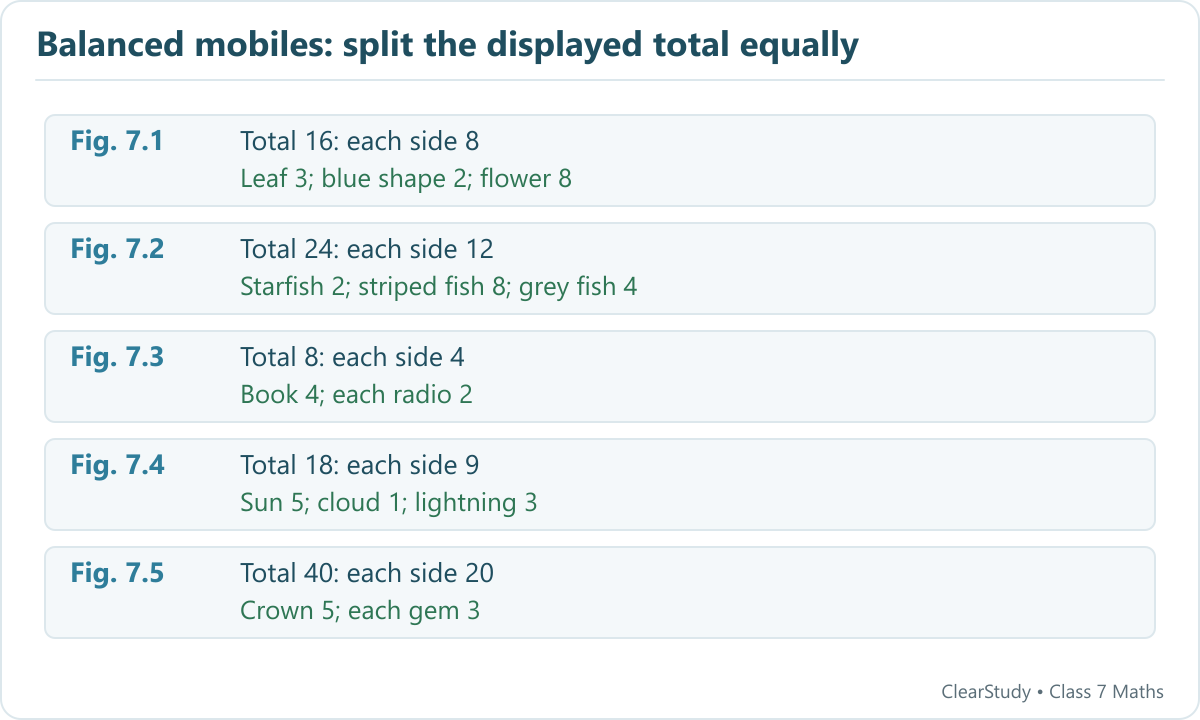
The number above each of the first five level mobiles gives its total weight. Divide it equally between the two sides, then use the known object weights.
Fig. 7.1: each side is 8; the flower is 8 and the blue shape is 8 − 2(3) = 2.
Fig. 7.2: each side is 12; the striped fish is 12 − 2(2) = 8 and the grey fish is 12 − 8 = 4.
Fig. 7.3: the book is 4 and each radio is 2.
Fig. 7.4: each side is 9; four clouds total 9 − 5 = 4, so each cloud is 1. Three lightning bolts total 9, so each is 3.
Fig. 7.5: four crowns total 20, so a crown is 5. Five gems total 20 − 5 = 15, so each gem is 3.
For Figs. 7.1 to 7.5, the top number gives the combined weight of both sides. A level bar divides that weight equally. Object weights are in the common units used in the puzzle.
Math Talk & Try This — Answered
These are the in-text reflective and short tasks in the chapter; the determinate ones are answered, the open ones are guided.
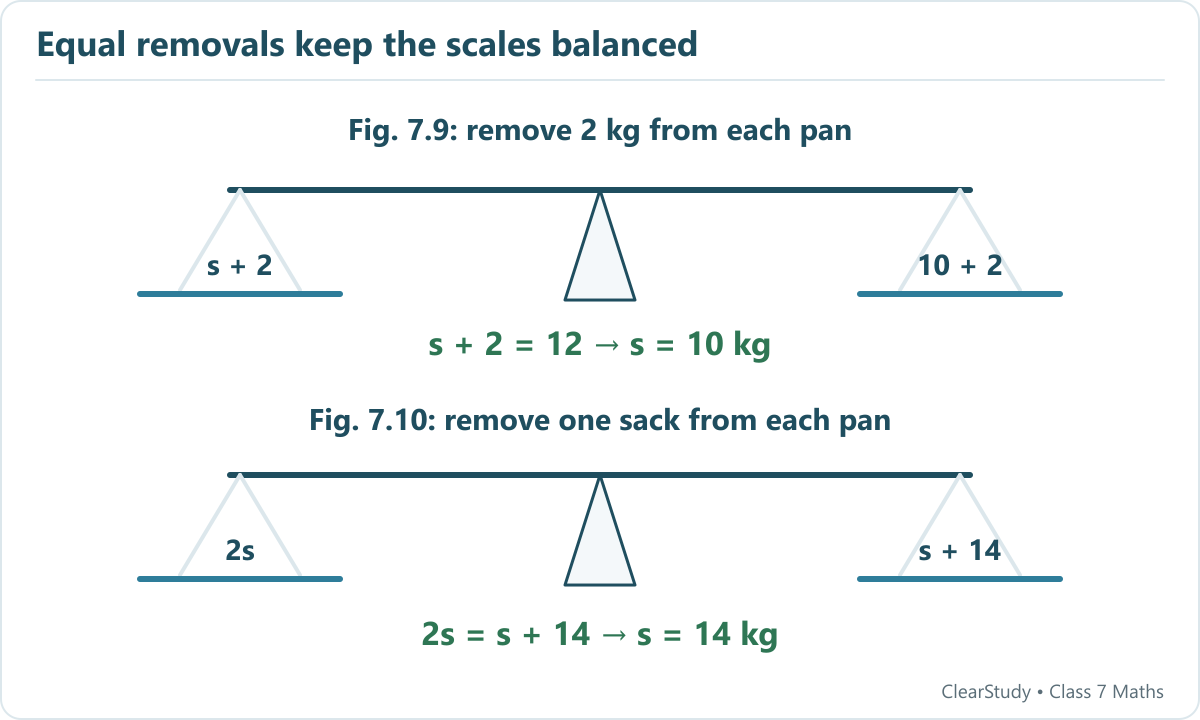
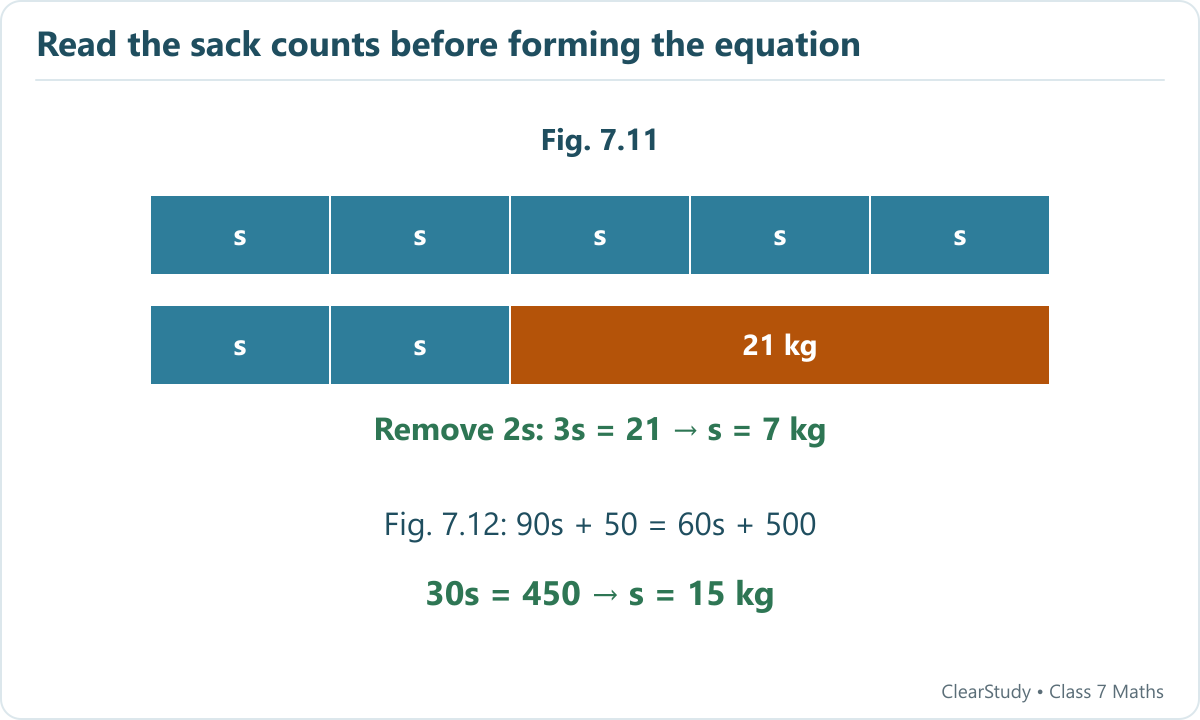
Math Talk — Unknown weights (Fig. 7.9, 7.10)Find the unknown weight of the sack. In Fig. 7.10 all sacks have the same weight. [Hint: remove equal weights from both plates.]Answer.Fig. 7.9: s + 2 = 10 + 2. Subtract 2 kg from both sides: s = 10 kg.Fig. 7.10: 2s = s + 10 + 4. Remove one sack from each pan: s = 14 kg.Fig. 7.11: five sacks balance two sacks and 21 kg. Thus 5s = 2s + 21 → 3s = 21 → s = 7 kg.Fig. 7.12: the labels mean 90 sacks and 60 sacks. Equation: 90s + 50 = 60s + 500 → 30s = 450 → s = 15 kg.Each figure is a separate situation; its sack need not have the same weight as a sack in another figure.
The sack in Fig. 7.9 weighs 10 kg. In the separate Fig. 7.10, two sacks balance one sack and 14 kg, so each sack weighs 14 kg.Fig. 7.11 has five sacks versus two sacks and 21 kg, giving 7 kg per sack. Fig. 7.12 represents 90 sacks plus 50 kg versus 60 sacks plus 500 kg, giving 15 kg per sack.
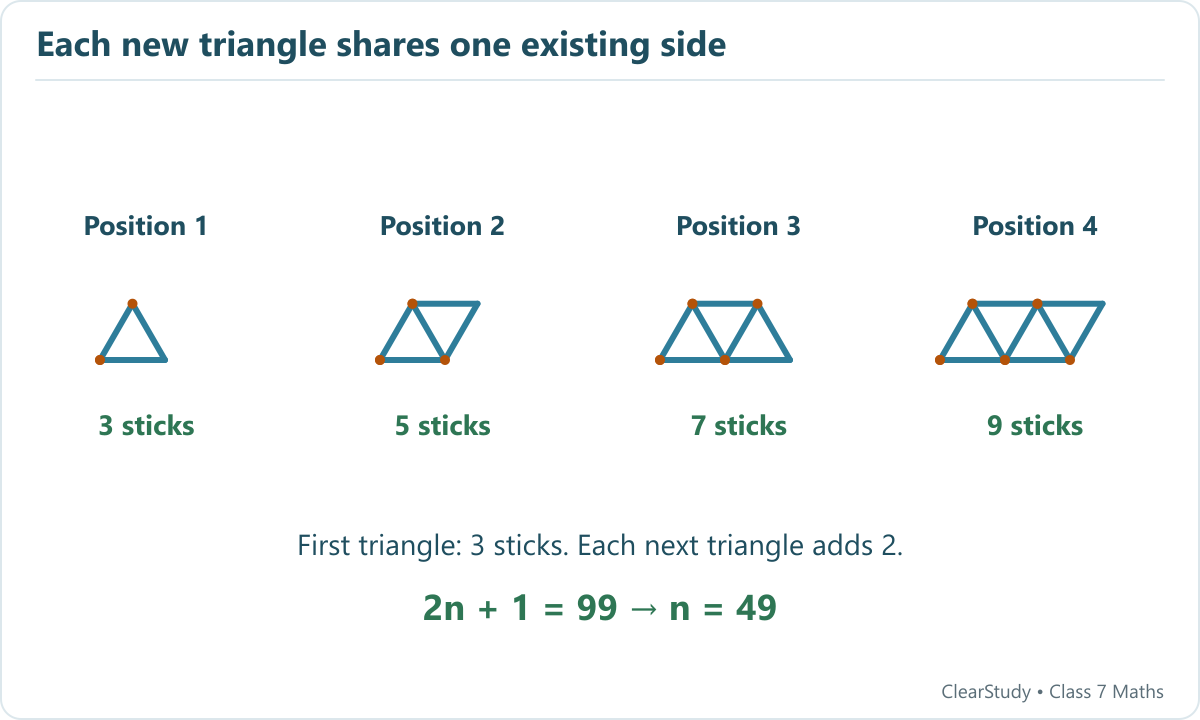
Math Talk — Matchstick equationCan you find ways to get the value of n, such that 2n + 1 = 99? Is it possible to make an arrangement using exactly 200 sticks?Answer. 2n + 1 = 99 → 2n = 98 → n = 49, so the 49th arrangement uses 99 sticks. For 200 sticks: 2n + 1 = 200 → 2n = 199, which is odd, so n is not a whole number — no arrangement uses exactly 200 sticks (the stick count 2n + 1 is always odd).
The first four positions use 3, 5, 7 and 9 sticks. The general count is 2n + 1; 99 sticks give position 49, while 200 cannot give a whole-number position.
Math Talk — Framing equations from the scalesFor figures 7.6–7.11, frame equations using letter-numbers for the unknown weight; solve and check.Answer.Fig. 7.6: 2e = 3 × 2 = 6 → egg e = 3.Fig. 7.7: 4 + 2y = 4 × 4 = 16 → circular object y = 6.Fig. 7.8: 2b + 4 = 10 → banana b = 3.Figs. 7.9–7.11: respectively s + 2 = 12, 2s = s + 14, and 5s = 2s + 21; their solutions are 10 kg, 14 kg and 7 kg.Substitute each result into its own equation to check that both pans have equal total weights.
Math Talk — Frame 5 equationsFrame 5 equations. Find methods to solve them.Answer. For example: (1) x + 7 = 12 → x = 5; (2) 3y = 21 → y = 7; (3) 2a − 5 = 9 → a = 7; (4) z/4 = 3 → z = 12; (5) 4m + 1 = 2m + 9 → 2m = 8 → m = 4. Method: move number terms to one side and variable terms to the other using inverse operations, then divide.
Math Talk — Inverse operations (Examples 1&2)Is finding 14593 − 1459 + 145 − 14 by subtracting 88, and dividing 5,80,888 by 7, the same as doing the same operation on both sides?Answer.Yes. Subtracting 88 from both sides of (… + 88 = 13353) removes the +88 and leaves the wanted expression = 13353 − 88 = 13265. Dividing both sides by 7 removes the factor 7 and leaves the expression = 5,80,888 ÷ 7 = 82984. Addition/subtraction are inverses, and so are multiplication/division.
Try This — Trial and errorTry solving 5x − 4 = 7 using trial and error.Answer. Test values: x = 1 → 1; x = 2 → 6; x = 3 → 11 (too big). The answer lies between 2 and 3. Trying x = 11/5 = 2.2 gives 5(2.2) − 4 = 11 − 4 = 7. ✓ So x = 11/5 — which shows why the systematic method is quicker than guessing.
Math Talk — Generating equations (chains)Write equations whose solution is y = 5. Can you form a chain from the bottom equation to the top? Without calculating, find the value of the unknown in each equation of the chains.Answer.All equations in the two printed chains have y = 5. Each step is reversible, so the solution set stays the same.First chain upward: 5 = y → −1 = −6 + y (subtract 6) → −y − 1 = −6 (subtract y) → y + 1 = 6 (multiply by −1).Second chain upward: y = 5 → y + 2 = 7 (add 2) → 3y + 6 = 21 (multiply by 3) → 3y = 15 (subtract 6).Use reversible operations: multiplication by zero, for example, would erase the information about y.
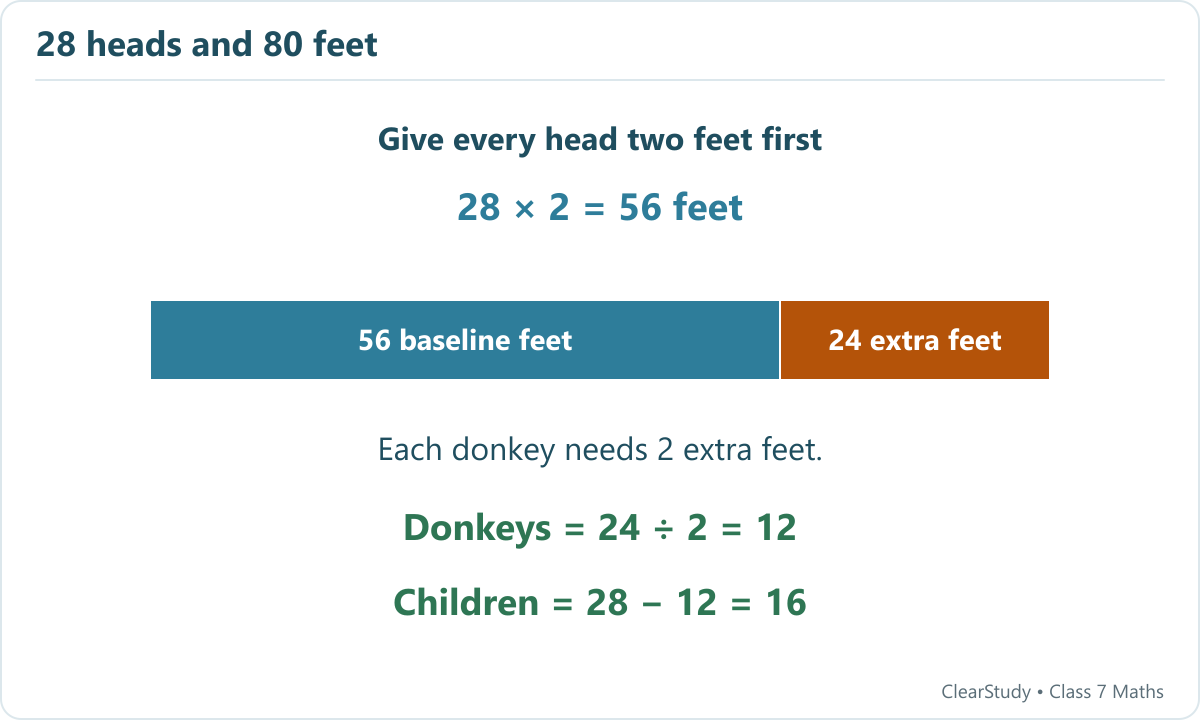
Try This — Children and donkeys (Q20)There are some children and donkeys on a beach. Together they have 28 heads and 80 feet. How many donkeys are there? How many children are there?Answer. Let donkeys = d, children = c. Heads: c + d = 28. Feet: 2c + 4d = 80. From the first, c = 28 − d; substitute: 2(28 − d) + 4d = 80 → 56 + 2d = 80 → 2d = 24 → d = 12. So there are 12 donkeys and 16 children. Check: heads 12 + 16 = 28; feet 4×12 + 2×16 = 48 + 32 = 80. ✓
Two feet for each of the 28 heads account for 56 feet. The remaining 24 feet provide two extra feet for each of 12 donkeys, leaving 16 children.
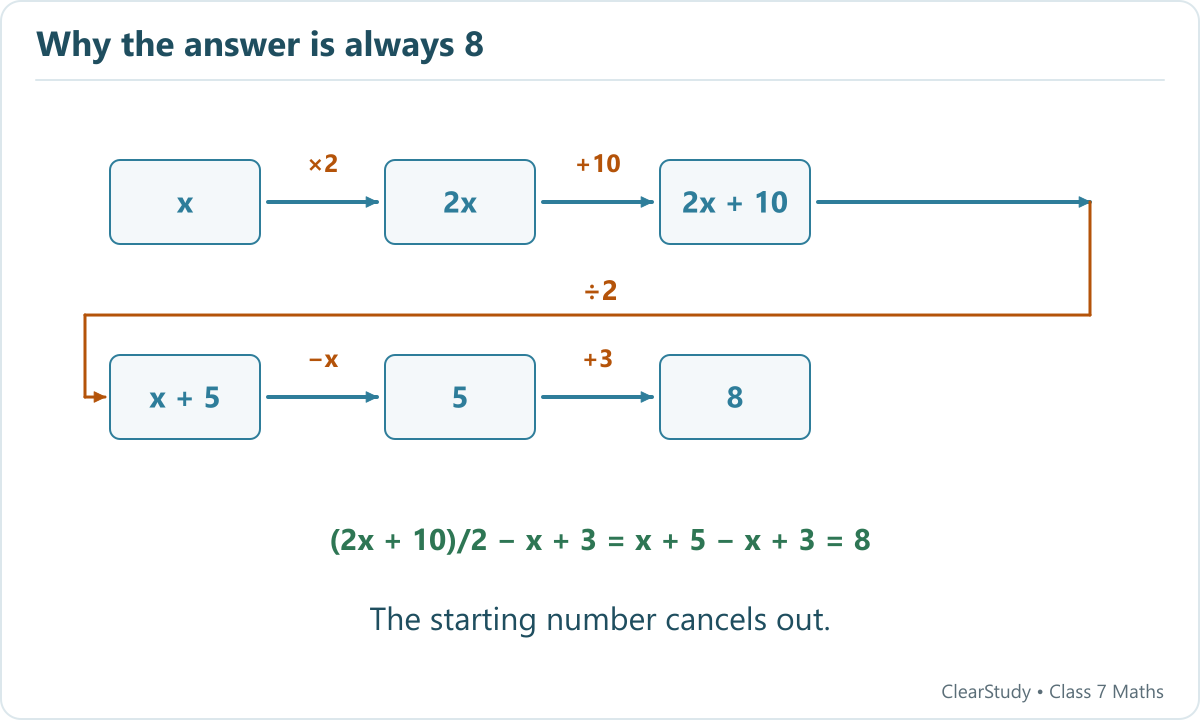
Try This — The Magic TrickThink of a number, multiply by 2, add 10, divide by 2, subtract the original number, add 3. The prediction is 8. Why does it work?Answer. Let the number be x. Steps give: 2x → 2x + 10 → (2x + 10)/2 = x + 5 → (x + 5) − x = 5 → 5 + 3 = 8. The x cancels out, so the answer is always 8 whatever number you start with — that is why the trick works for everyone.
Doubling x, adding 10 and halving gives x + 5. Subtracting the original x leaves 5, and adding 3 gives 8 for every starting number.
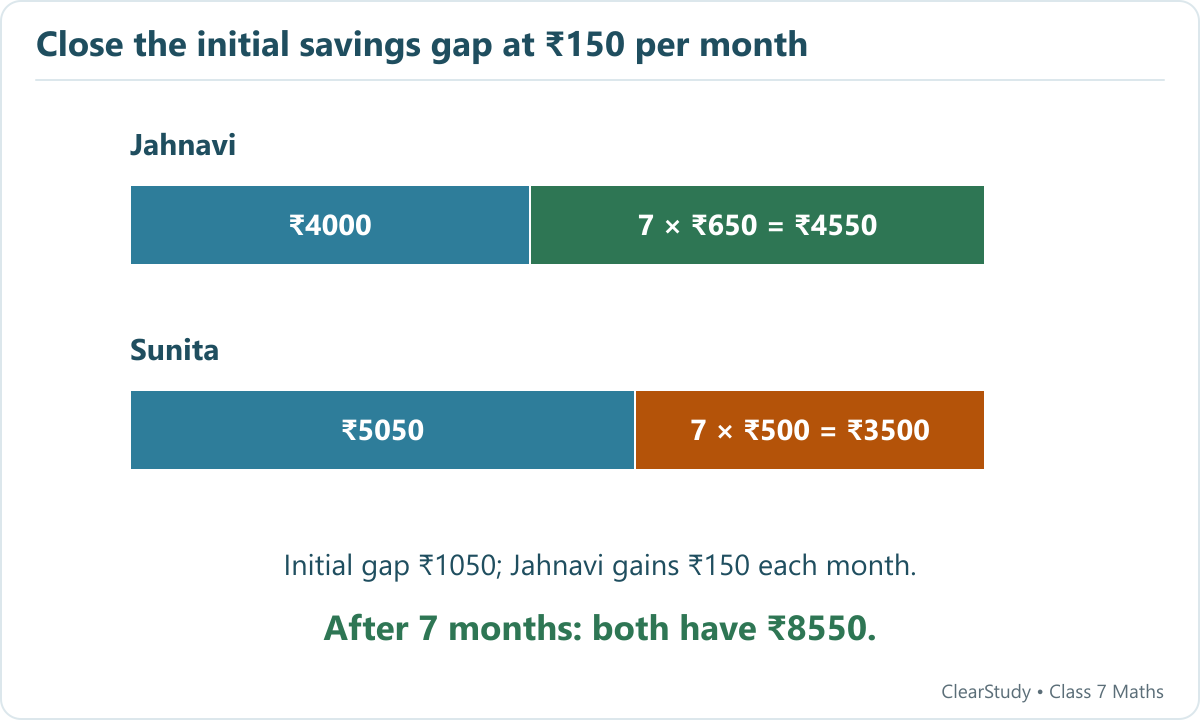
Brahmagupta’s formula (A Pinch of History)Using x = (D − B)/(A − C) for Ax + B = Cx + D, solve 2x + 3 = 4x + 5.Answer. Here A = 2, B = 3, C = 4, D = 5, so x = (5 − 3)/(2 − 4) = 2/(−2) = −1. Check: 2(−1) + 3 = 1 and 4(−1) + 5 = 1. ✓ The same formula gives m = (5050 − 4000)/(650 − 500) = 1050/150 = 7 for the savings equation.
Worked word-problem examples (pp. 174–179)
Ranjana’s T-shaped tiles
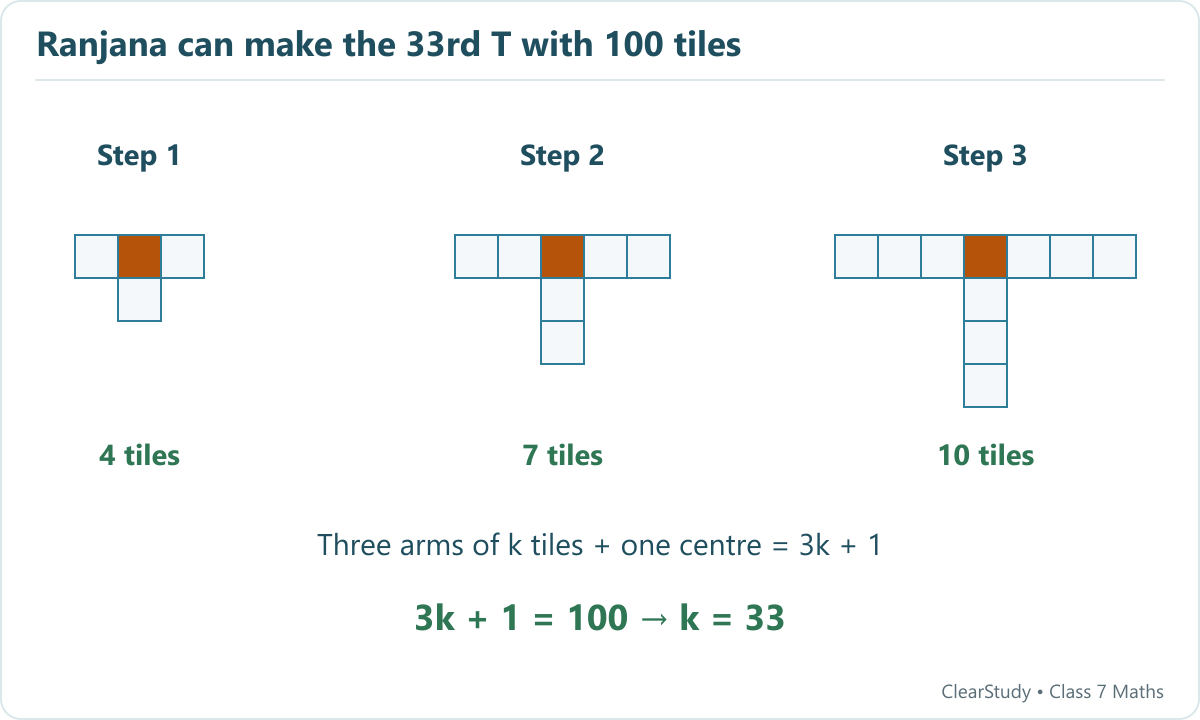
There are k tiles in each of three arms and one central tile. Thus 3k + 1 = 100 → 3k = 99 → k = 33. Yes, 100 tiles make the 33rd arrangement.
The T shapes use 4, 7 and 10 tiles at steps 1, 2 and 3. Three arms of k tiles plus one central tile give 3k + 1; 100 tiles make step 33.
Madhubanti’s snack budget
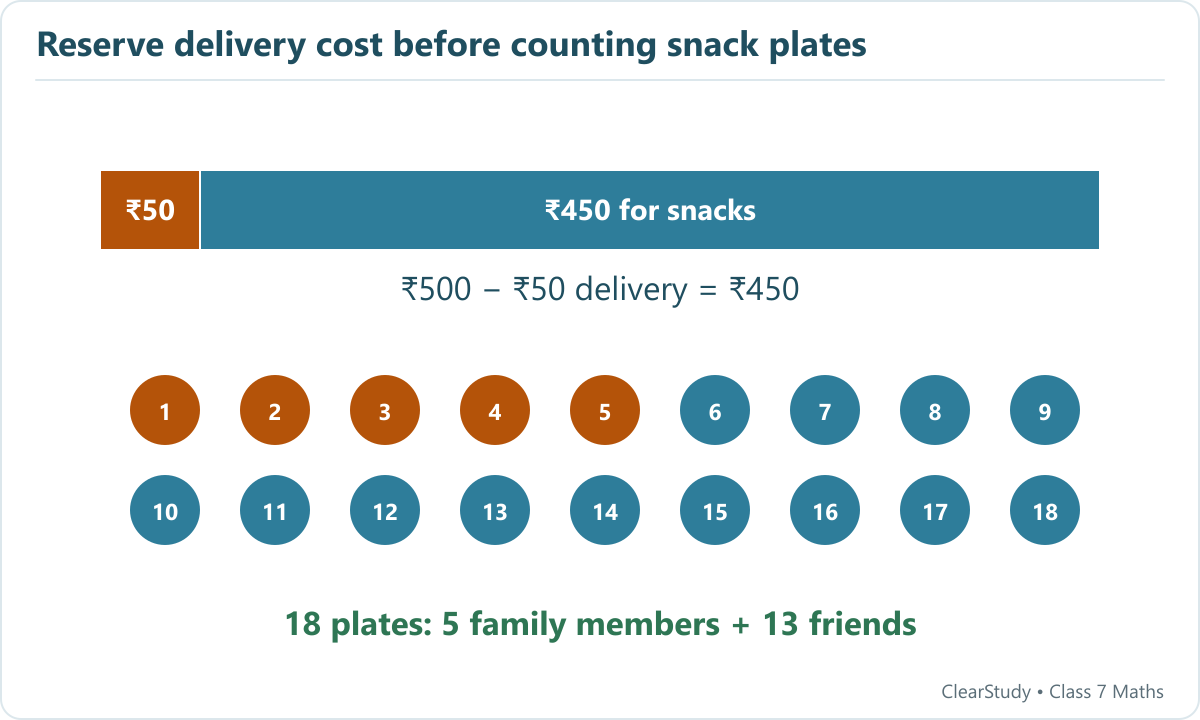
Let f be the number of friends. Including five family members, 25(f + 5) + 50 = 500 → f + 5 = 18 → f = 13. This is the maximum number within the stated budget: 18 plates cost ₹450, and delivery adds ₹50.
The ₹500 budget pays ₹50 for delivery and ₹450 for 18 plates at ₹25 each. Five plates go to family members, so Madhubanti can invite 13 friends.
Jahnavi starts ₹1050 behind Sunita but saves ₹150 more each month. After seven months both have ₹8550, assuming the stated fixed savings and no interest or withdrawals.
Riyaz’s number trick
Starting with x, the steps give x − 3, then 4(x − 3), then 4(x − 3) + 8 = 4x − 4. A final answer of 24 gives x = (24 + 4)/4 = 7. For any final answer F, the starting number is F/4 + 1.
Ramesh and Suresh’s marbles
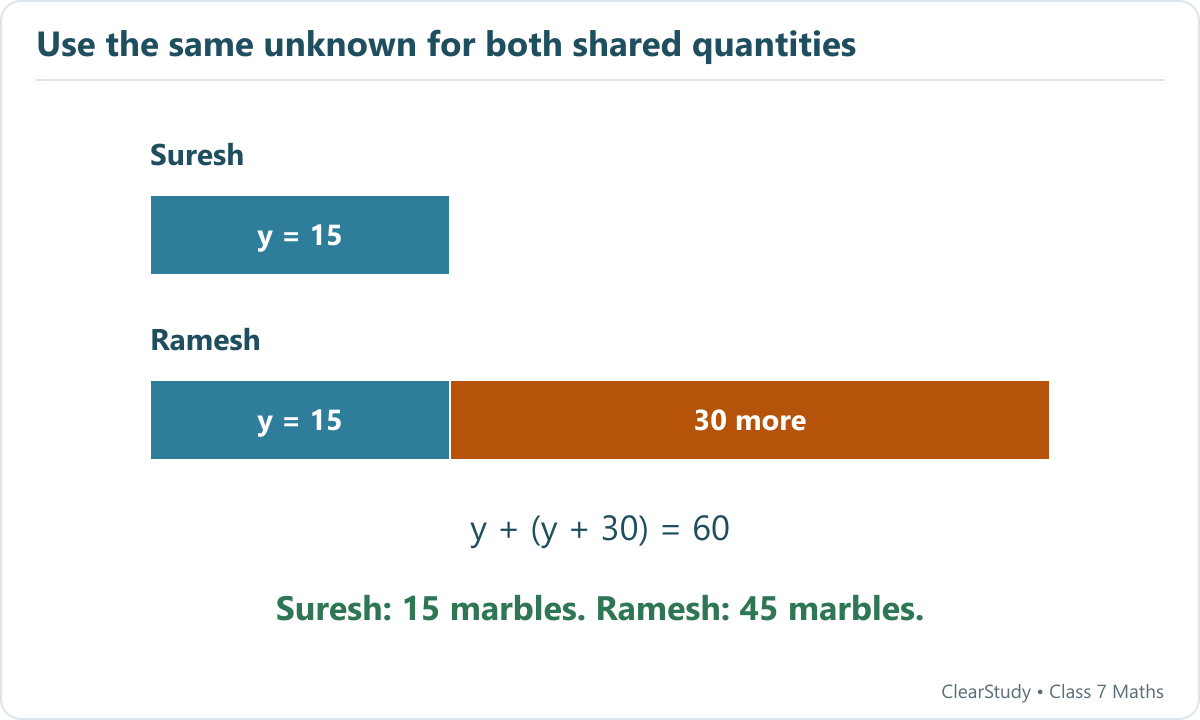
Let Suresh have y marbles, so Ramesh has y + 30. Then y + (y + 30) = 60 → 2y = 30 → y = 15. Suresh has 15; Ramesh has 45. Their total is 60 and their difference is 30.
Ramesh has 30 more marbles than Suresh. Removing that extra 30 from their total of 60 leaves two equal groups of 15.
A situation for 100x + 75 = 250
Suppose 100 identical items cost ₹x each, with a fixed ₹75 delivery charge, and the total is ₹250. Then 100x + 75 = 250 → x = 175/100 = ₹1.75 per item.
The horse-price problem (p. 183)
If one horse costs ₹x, equal wealth gives 300 + 6x = 10x − 100. Hence 400 = 4x and x = ₹100. Both people then have net wealth ₹900.
Common Mistakes to Avoid
Watch out for these
Moving a term across the “=” without changing its sign — a term that was being added must be subtracted on the other side, and vice versa.
Dividing only one part of a side by a number. To go from 2v − 4 = 6 to v, you must divide the whole equation, not just the 2v term.
Expanding brackets wrongly: 4(4q + 2) = 16q + 8, not 16q + 2; and −2(3 − 4x) = −6 + 8x, watching the signs.
Forgetting that 15w − 4w is simply 11w — combine like terms before transposing.
Treating 3x + 1 as 3(x + 1). Dividing the whole side by 3 gives x + 1/3; fractional terms are allowed.
Skipping the check. Always substitute your answer back to confirm LHS = RHS.
Practice MCQs & Assertion–Reason
1. The solution of 3x − 10 = 35 is:
(a) 12 (b) 15 (c) 9 (d) 45
2. The nth arrangement in the matchstick pattern uses how many sticks?
(a) n + 1 (b) 2n (c) 2n + 1 (d) 3n + 1
3. Which equation has no solution?
(a) x + 4 = 5 (b) x + 4 = x + 5 (c) 2x = 8 (d) x − 1 = 0
4. Solving u/15 = 6 gives u =
(a) 21 (b) 9 (c) 90 (d) 2.5
5. The weight of a brick is 1 kg more than half its weight. The brick weighs:
(a) 1 kg (b) 1.5 kg (c) 2 kg (d) 3 kg
6. The solution of 7m = m − 3 is:
(a) −1/2 (b) 1/2 (c) −3 (d) 3
7. A taxi charges ₹800 fixed plus ₹20 per km. If the bill is ₹2200, the distance is:
(a) 50 km (b) 60 km (c) 70 km (d) 110 km
8. Two numbers add to 76 and one is three times the other. The larger number is:
(a) 19 (b) 38 (c) 57 (d) 60
9. Using Brahmagupta’s formula, the solution of 2x + 3 = 4x + 5 is:
(a) 1 (b) −1 (c) −4 (d) 4
10. To keep an equation balanced you may:
(a) add a number to one side only (b) add the same number to both sides (c) divide only the LHS (d) change a term’s sign on the same side
For each Assertion–Reason question, choose: (A) Both Assertion and Reason are true and the Reason is the correct explanation of the Assertion; (B) Both are true but the Reason is not the correct explanation; (C) Assertion is true but Reason is false; (D) Assertion is false but Reason is true.
A-R 1. Assertion: The solution of 2n + 1 = 99 is n = 49.
Reason: Subtracting 1 from both sides gives 2n = 98, and dividing by 2 gives n = 49.
A-R 2. Assertion: The equation x + 4 = x + 5 has no solution.
Reason: Subtracting x from both sides gives 4 = 5, which is never true.
A-R 3. Assertion: From 3x + 1 = −12 we can write x + 1 = −4 by dividing by 3.
Reason: Dividing the entire left side by 3 gives x + 1/3.
A-R 4. Assertion: Adding or subtracting the same quantity, or multiplying or dividing by the same nonzero number, preserves equality.
Reason: The LHS and RHS of an equation have the same value, like equal weights on a balanced scale.
A-R 5. Assertion: For Ax + B = Cx + D with A ≠ C, the solution is x = (D − B)/(A − C).
Reason: Rearranging the equation gives (A + C)x = D − B.
Answer key: 1-(A), 2-(A), 3-(D), 4-(A), 5-(C). (A-R 3: the assertion is false and the reason is true. A-R 5: the assertion is true; the reason is false because the coefficient is A − C.)
Quick Revision Summary
An equation states that two algebraic expressions are equal (LHS = RHS).
Solving an equation means finding the value of the unknown that makes LHS = RHS.
Add or subtract the same quantity on both sides; multiply or divide both sides by the same nonzero number.
Move a term to the other side by changing its sign; remove a factor by dividing; remove a divisor by multiplying.
Bring all unknown terms to one side and number terms to the other, then isolate the unknown.
Trial and error works but is slow; the systematic (balancing) method is efficient and reliable.
For Ax + B = Cx + D with A ≠ C, Brahmagupta’s formula gives x = (D − B)/(A − C). Always check your answer.
How to score full marks in this chapter
Write each step on a new line and state what you are doing (“subtracting 7 from both sides”). Expand brackets when helpful, combine like terms, and remember a term changes sign when it crosses the equal sign. For word problems, clearly define your letter (“let the number be x”), form the equation from the given facts, solve it, and finish with a one-line check by substituting back — that last step often carries an easy mark.
Frequently Asked Questions
What is Class 7 Maths Ganita Prakash Chapter 15 about?
Chapter 15, Finding the Unknown (Ganita Prakash Part II, Chapter 7), is the algebra chapter on framing and solving simple linear equations. It uses the balanced weighing scale to explain why the same operation on both sides keeps an equation balanced, then teaches the trial-and-error and systematic methods, real-life word problems, and Brahmagupta’s formula.
How many Figure it Out exercises are there in Chapter 15?
There are three “Figure it Out” sets — on page 172, page 181 and pages 185–189 — plus the “Mind the Mistake, Mend the Mistake” set and several Math Talk and Try This tasks, with worked solutions and supporting diagrams on this page.
How do you solve a simple equation step by step?
Expand any brackets and combine like terms, move all unknown terms to one side and number terms to the other (changing signs as they cross the equal sign), then divide both sides by its nonzero coefficient. If the coefficient becomes zero, check whether the remaining statement is always true or impossible. Finally substitute the answer back to check LHS = RHS.
Are these Class 7 Maths Ganita Prakash Chapter 15 solutions free?
Yes. All solutions are free and follow the official NCERT Ganita Prakash (Part II) textbook for the 2026–27 session, with worked explanations and original teaching diagrams.