
NCERT Solutions for Class 7 Science (Curiosity) Chapter 8: Measurement of Time and Motion (NCERT 2026–27)
These Class 7 Science Curiosity Chapter 8 solutions cover Measurement of Time and Motion from the new NCF-2023 textbook (2026–27). The chapter explains how time has been measured from ancient sundials and water clocks to modern atomic clocks, introduces the simple pendulum and its time period, defines speed and its units, and explores uniform and non-uniform linear motion. Below you will find every “Let Us Enhance Our Learning” exercise question solved step by step, with all numeric answers verified.
Class 7 Science Curiosity Chapter 8 Solutions – Overview
Chapter 8 of Curiosity, Measurement of Time and Motion, traces how humans learned to keep track of time. Early people noticed repeating natural events — sunrise and sunset, the phases of the Moon and the seasons — and used them to build calendars. To measure shorter intervals within a day they invented sundials, water clocks, hourglasses and candle clocks. The discovery that a simple pendulum of a given length takes approximately the same time for each small oscillation (its time period) led to the pendulum clock, and modern quartz and atomic clocks use far more rapid, regular vibrations. The chapter then defines speed as the distance covered in unit time, gives its SI unit (m/s) and the relation between speed, distance and time, and finally distinguishes uniform linear motion (constant speed, equal distances in equal times) from non-uniform linear motion (changing speed).
Key Concepts & Formulae
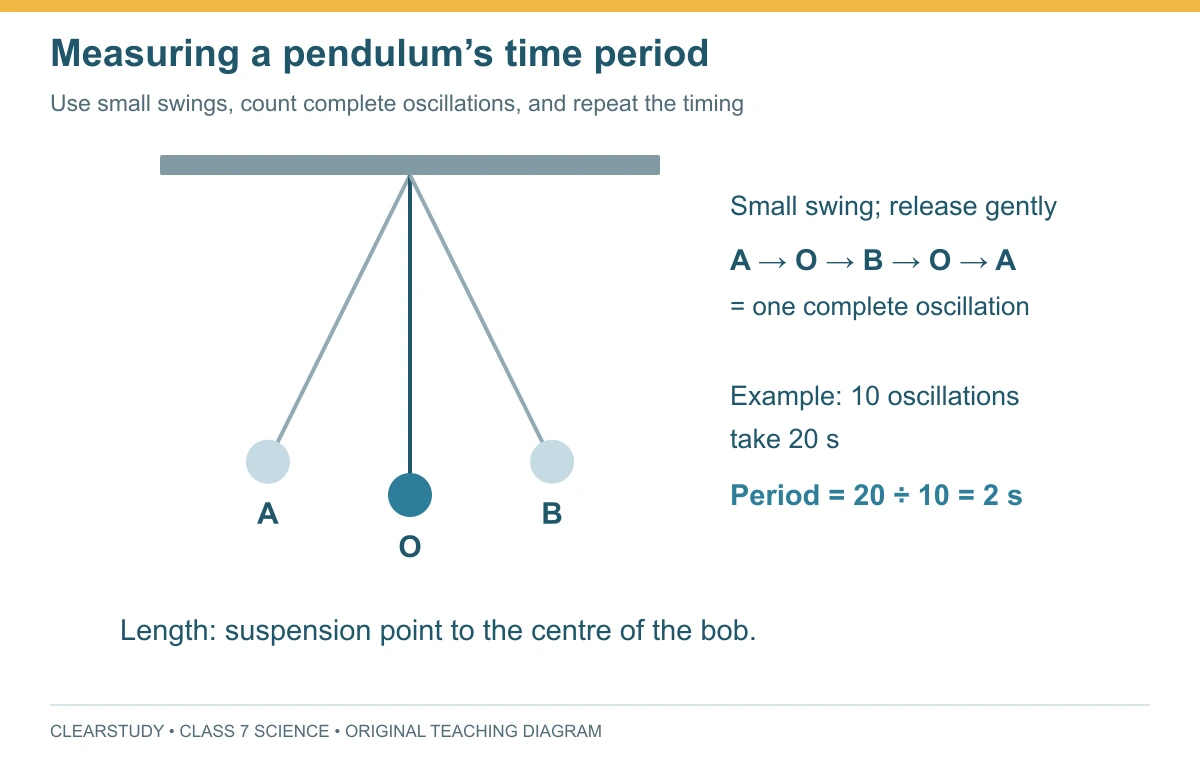
Time period of a pendulum: the time taken by the pendulum to complete one oscillation. For small swings at a fixed place, it depends mainly on the pendulum length, not the bob mass. The length is measured from the suspension point to the centre of the bob. Gravity also matters, and large swings need a more detailed treatment.
One oscillation: the bob moving from its mean position O to extreme position A, then to extreme position B, and back to O (or from A to B and back to A).
SI unit of time: the second (symbol s). 60 s = 1 min; 60 min = 1 h.
Speed: the distance covered by an object in unit time.
Average speed = Total distance covered ÷ Total time taken. SI unit = metre/second (m/s); also km/h.
Rearranged forms: Distance = Speed × Time, and Time = Distance ÷ Speed.
Unit conversions: 1 km = 1000 m, 1 h = 3600 s. To change m/s → km/h, multiply by 3.6; to change km/h → m/s, divide by 3.6.
Uniform linear motion: motion along a straight line with constant speed (equal distances in equal time intervals). Non-uniform linear motion: motion along a straight line with changing speed (unequal distances in equal time intervals).
“Let Us Enhance Our Learning” — NCERT Solutions
All questions below are reproduced verbatim from the NCERT Curiosity (Grade 7) textbook, Chapter 8. Answers are original and the calculations have been independently verified.
1. Calculate the speed of a car that travels 150 metres in 10 seconds. Express your answer in km/h.
2. A runner completes 400 metres in 50 seconds. Another runner completes the same distance in 45 seconds. Who has a greater speed and by how much?
3. A train travels at a speed of 25 m/s and covers a distance of 360 km. How much time does it take?
4. A train travels 180 km in 3 h. Find its speed in: (i) km/h (ii) m/s (iii) What distance will it travel in 4 h if it maintains the same speed throughout the journey?
5. The fastest galloping horse can reach the speed of approximately 18 m/s. How does this compare to the speed of a train moving at 72 km/h?
6. Distinguish between uniform and non-uniform motion using the example of a car moving on a straight highway with no traffic and a car moving in city traffic.
7. Data for an object covering distances in different intervals of time are given in the following table. If the object is in uniform motion, fill in the gaps in the table.
| Time (s) | 0 | 10 | 20 | 30 | 40 | 50 | 60 | 70 |
|---|---|---|---|---|---|---|---|---|
| Distance (m) | 0 | 8 | 16 | 24 | 32 | 40 | 48 | 56 |
8. A car covers 60 km in the first hour, 70 km in the second hour, and 50 km in the third hour. Is the motion uniform? Justify your answer. Find the average speed of the car.
9. Which type of motion is more common in daily life—uniform or non-uniform? Provide three examples from your experience to support your answer.
10. Data for the motion of an object are given in the following table. State whether the speed of the object is uniform or non-uniform. Find the average speed.
| Time (s) | 0 | 10 | 20 | 30 | 40 | 50 | 60 | 70 | 80 | 90 | 100 |
|---|---|---|---|---|---|---|---|---|---|---|---|
| Distance (m) | 0 | 6 | 10 | 16 | 21 | 29 | 35 | 42 | 45 | 55 | 60 |
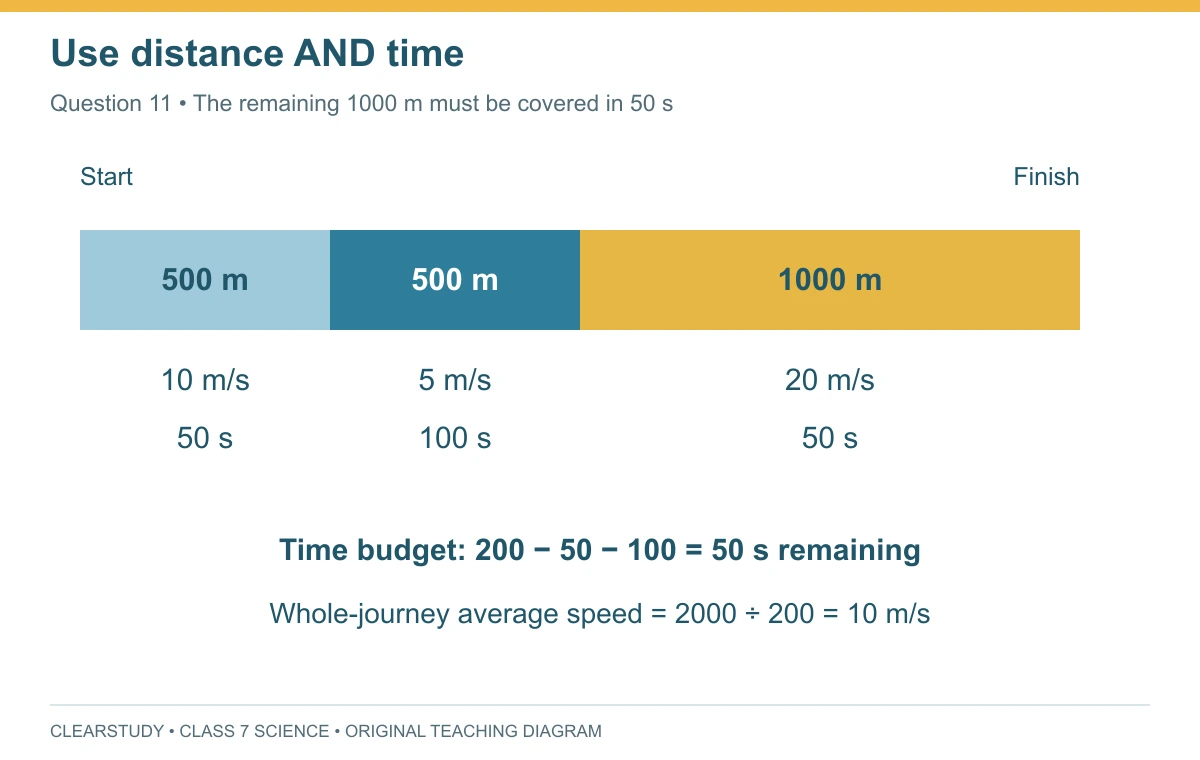
11. A vehicle moves along a straight line and covers a distance of 2 km. In the first 500 m, it moves with a speed of 10 m/s and in the next 500 m, it moves with a speed of 5 m/s. With what speed should it move the remaining distance so that the journey is complete in 200 s? What is the average speed of the vehicle for the entire journey?
Extra Practice Questions
These questions and MCQs are ClearStudy practice, separate from the NCERT exercise.
Short Answer Type Questions
Q1. Name any four time-measuring devices used in ancient times.
Q2. What is meant by the time period of a simple pendulum?
Q3. State the SI unit of time and write the relations between the second, minute and hour.
Q4. Define speed and give its SI unit.
Q5. On what factors does the time period of a simple pendulum depend, and on what does it not depend?
Long Answer Type Questions
Q1. Describe how you would set up a simple pendulum and measure its time period.
Q2. Explain the difference between uniform and non-uniform linear motion with the help of the data given for two trains X and Y travelling between 10:00 AM and 11:00 AM in equal 10-minute intervals.
| Time (AM) | Train X distance in 10 min (km) | Train Y distance in 10 min (km) |
|---|---|---|
| 10:00–10:10 | 20 | 20 |
| 10:10–10:20 | 20 | 15 |
| 10:20–10:30 | 20 | 15 |
| 10:30–10:40 | 20 | 25 |
| 10:40–10:50 | 20 | 20 |
| 10:50–11:00 | 20 | 25 |
Q3. Trace the development of timekeeping devices from ancient to modern times.
MCQs & Assertion–Reason
1. Which of the following is NOT an ancient time-measuring device?
(a) Sundial (b) Water clock (c) Atomic clock (d) Candle clock
2. The SI unit of time is the:
(a) minute (b) hour (c) second (d) day
3. The time taken by a pendulum to complete one oscillation is called its:
(a) frequency (b) time period (c) amplitude (d) speed
4. The time period of a simple pendulum depends on its:
(a) mass of the bob (b) colour (c) length (d) material of the thread
5. A speed of 36 km/h is equal to:
(a) 6 m/s (b) 10 m/s (c) 12 m/s (d) 36 m/s
6. Speed is calculated as:
(a) time ÷ distance (b) distance × time (c) distance ÷ time (d) distance + time
7. An object covering equal distances in equal intervals of time along a straight line is in:
(a) non-uniform motion (b) uniform linear motion (c) circular motion (d) oscillatory motion
8. The instrument in a vehicle that displays its speed in km/h is the:
(a) odometer (b) thermometer (c) speedometer (d) barometer
9. The pendulum clock was invented by:
(a) Galileo Galilei (b) Christiaan Huygens (c) Aryabhata (d) Varahamihira
10. A car travels 100 m in 5 s. Its speed is:
(a) 5 m/s (b) 20 m/s (c) 50 m/s (d) 500 m/s
For each Assertion–Reason question, choose: (A) Both true and the Reason correctly explains the Assertion; (B) Both true but the Reason is not the correct explanation; (C) Assertion true, Reason false; (D) Assertion false, Reason true.
A-R 1. Assertion: The time period of a simple pendulum of a given length is constant at a place.
Reason: A pendulum’s oscillatory motion is periodic, repeating its path after a fixed interval of time.
A-R 2. Assertion: The time period of a pendulum changes when the mass of the bob is changed.
Reason: The time period of a simple pendulum depends on its length at a fixed place for small swings, not on the bob’s mass.
A-R 3. Assertion: A car moving in heavy city traffic is usually in non-uniform motion.
Reason: In city traffic the car keeps speeding up and slowing down, so it covers unequal distances in equal time intervals.
A-R 4. Assertion: To compare a speed in m/s with a speed in km/h, the two must first be converted to the same unit.
Reason: A speed of 72 km/h is equal to 20 m/s.
A-R 5. Assertion: A sundial can be used to measure time at night.
Reason: A sundial determines time from the changing position of a shadow cast by the Sun during the day.
Common Mistakes to Avoid
Watch out for these
- Forgetting to convert units before calculating — always make distance and time match (e.g. change km to m and h to s) before dividing.
- Confusing the m/s ↔ km/h conversion — multiply by 3.6 for m/s → km/h, and divide by 3.6 for km/h → m/s.
- Thinking the pendulum’s time period depends on the bob’s mass — at a fixed place and for small swings, changing length changes the period.
- Writing ‘sec’ for second or ‘hrs’ for hour — the correct symbols are s, min and h, written in lowercase and singular, with no full stop.
- Mixing up the speedometer (measures speed) with the odometer (measures distance travelled).
- Assuming average speed is the simple average of two speeds — always use total distance divided by total time.
Quick Revision Summary
- Ancient clocks — sundials, water clocks, hourglasses and candle clocks — used repeating processes; modern quartz and atomic clocks use rapid, regular vibrations.
- The time period of a pendulum is the time for one oscillation; it is constant for a given length and does not depend on the bob’s mass.
- The SI unit of time is the second (s); 60 s = 1 min, 60 min = 1 h.
- Speed = total distance ÷ total time; SI unit m/s, also km/h (multiply m/s by 3.6 to get km/h).
- Uniform linear motion: constant speed, equal distances in equal times. Non-uniform linear motion: changing speed, unequal distances in equal times.
- A speedometer shows a vehicle’s speed; an odometer shows the distance it has travelled.
How to write a clear answer
In every numerical, write the formula first, convert all quantities to consistent units, then substitute and show each step with the correct unit on the answer. Remember the handy fact that 1 m/s = 3.6 km/h. For “uniform or non-uniform?” table questions, compare the distance covered in each equal time interval — equal distances mean uniform motion. Always find average speed as total distance ÷ total time, do not simply average speeds unless they apply for equal time intervals.
Frequently Asked Questions
What is Class 7 Science Curiosity Chapter 8 about?
Chapter 8, Measurement of Time and Motion, explains how time was measured from ancient sundials and water clocks to modern atomic clocks, introduces the simple pendulum and its time period, defines speed and its units, and distinguishes uniform from non-uniform linear motion.
What is the time period of a simple pendulum?
The time period is the time taken by a pendulum to complete one oscillation. It is constant for a pendulum of a given length at a place and does not depend on the mass of the bob.
How do you convert m/s to km/h?
Multiply the speed in m/s by 3.6 to get km/h (because 1 km = 1000 m and 1 h = 3600 s, so 1 m/s = 3.6 km/h). To go the other way, divide the km/h value by 3.6.
Are these Class 7 Science Curiosity Chapter 8 solutions free?
Yes. All solutions are free and follow the official NCERT Curiosity textbook for session 2026–27, with every exercise question solved and the calculations verified.