
NCERT Solutions for Class 7 Social Science (Exploring Society) Chapter 12: Understanding Markets
These Class 7 Social Science Exploring Society Chapter 12 solutions cover Understanding Markets from Exploring Society: India and Beyond (Part 1), the NCERT textbook (2026–27 reprint). This economics chapter explains what a market is and how it functions, how the price of a good is decided by the interaction of demand and supply, the different kinds of markets (physical and online, domestic and international, wholesale and retail), the role of markets in people’s lives, the government’s role in markets, and how consumers can assess the quality of goods and services. Below you get step-by-step answers to all Questions and activities, clear notes on key terms, extra practice, MCQs, Assertion–Reason questions and FAQs.
Understanding Markets – Chapter Overview
Chapter 12, Understanding Markets, explains that a market is any place — physical or online — where people buy and sell goods and services. Every market needs a buyer, a seller and a price on which both agree, and buyers and sellers often negotiate and bargain to reach it. Over time, the amount supplied by sellers and the amount demanded by buyers settle the price at a level that is high enough for the seller and low enough for the buyer. The chapter describes markets in many forms — physical and online, domestic and international, and wholesale and retail — with a chain of participants (producers, wholesalers, distributors, retailers and aggregators) that brings goods to the consumer, using examples like the Hampi Bazaar, the Surat textile market and the Ima Keithal (Mother’s Market) of Imphal. It shows how markets benefit society beyond money, the government’s role in controlling prices, ensuring quality and safety, mitigating harmful effects and providing public goods, and how consumers judge quality using certification marks like FSSAI, ISI, AGMARK and BEE Star ratings, plus reputation and online reviews.
Key Concepts & Terms
Market: a place where people buy and sell goods and services — also called bazaar, haat (Hindi) or mārukatté (Kannada). It can be a physical place or, increasingly, online.
Need vs Want: a need is something a person requires to survive, such as food, water, clothing and shelter; a want is something a person desires but does not need for survival.
Trade: the buying and selling or exchange of goods and services between people or countries.
Price: the amount at which a buyer is willing to buy and a seller is willing to sell a particular good or service; both must agree on it for a transaction to take place.
Demand & Supply: demand is the quantity of a product or service that consumers are willing and able to buy at a particular price at a given time; supply is the quantity that sellers are willing and able to sell at a particular price at a given time. Their interaction determines the price.
Physical & online markets: in a physical market buyers meet sellers in person (haats, local shops, malls); in an online market buyers and sellers transact through apps or websites without meeting.
Domestic & international markets: a domestic market is within a country’s boundaries; an international market lies outside, where sellers export products to another country or buyers import products made in another country.
Export & Import: export is selling goods or services produced in one country to a buyer in another country; import is buying goods or services from other countries and bringing them into one’s own.
Wholesaler, Retailer, Distributor, Aggregator: a wholesaler buys goods in large quantities from producers and stores them in godowns; a retailer sells in small quantities to final consumers; a distributor supplies goods from manufacturers and wholesalers to retailers; an aggregator is a website or app that combines offers from many sellers and sells to consumers in one place.
Public goods: in economics, these are goods for which excluding people is difficult and one person’s use does not substantially reduce simultaneous availability to others, as with street lighting. The textbook groups these with publicly provided services such as roads, parks and policing. Roads and parks can become crowded; public provision is not the same as unlimited availability or freedom from wear.
Labels and standards: FSSAI regulates food businesses; its logo and licence/registration number identify regulatory compliance information, not proof that every packet was government-tested. The BIS Standard Mark (commonly ISI) concerns conformity to the relevant Indian Standard; AGMARK grades specified agricultural products; BEE stars describe energy efficiency. Each label has a different purpose.
“Questions and activities” — Full Solutions
All questions below are reproduced verbatim from the NCERT textbook’s end-of-chapter Questions and activities section. Answers are original, written in exam-ready style. Activity-based questions include a model answer that can be adapted to your own observations.
1. What are the main features of a market? Recall a recent visit to a market to purchase a product. What are the different features of a market that you observed during this visit?
2. Remember the epigraph from a famous economist at the beginning of the chapter? Discuss its relevance in the context of the chapter you have read.
3. In the example of buying and selling of guavas, imagine that the seller is getting a good price, and is able to make a profit. He will try to get more guavas from farmers to be able to sell them at the same price and increase his earnings. What is the farmer likely to do in this kind of a situation? Do you think he will start thinking about the demand for guavas in the next season? What is likely to be his response?
4. Match the following types of markets with their characteristics:
| S.No. | Markets | Criteria |
|---|---|---|
| 1 | Physical market | Goods and services flow outside the nation’s boundaries |
| 2 | Online market | Deals in bulk quantities |
| 3 | Domestic market | Serves the final consumers with goods and services |
| 4 | International market | Requires physical presence of buyers and seller |
| 5 | Wholesale market | Buyers and sellers meet virtually and can transact at any time |
| 6 | Retail market | Lies within the boundaries of a nation |
| Market | Correct characteristic |
|---|---|
| 1. Physical market | Requires physical presence of buyers and seller |
| 2. Online market | Buyers and sellers meet virtually and can transact at any time |
| 3. Domestic market | Lies within the boundaries of a nation |
| 4. International market | Goods and services flow outside the nation’s boundaries |
| 5. Wholesale market | Deals in bulk quantities |
| 6. Retail market | Serves the final consumers with goods and services |
5. Prices are generally determined by the interaction between demand from buyers and supply by sellers. Can you think of products where prices are high despite lesser number of buyers demanding the product? What could be the reasons for that?
6. Look at the real life situation that a retail seller of vegetables encountered: A family came to shop for vegetables. The price of beans that the seller on the cart was offering was ₹30 / kg. The lady started to bargain with the seller to bring the price down to ₹25 / kg. The seller protested and refused to sell at that price saying he would make a loss at that price. The lady walks away. The family then goes to a super bazaar nearby. They buy vegetables in the super bazaar where they pay ₹40 / kg for the beans that is neatly packed in a plastic bag. What are the reasons that the family does this? Are there factors that affect buying and selling which are not directly connected to price?
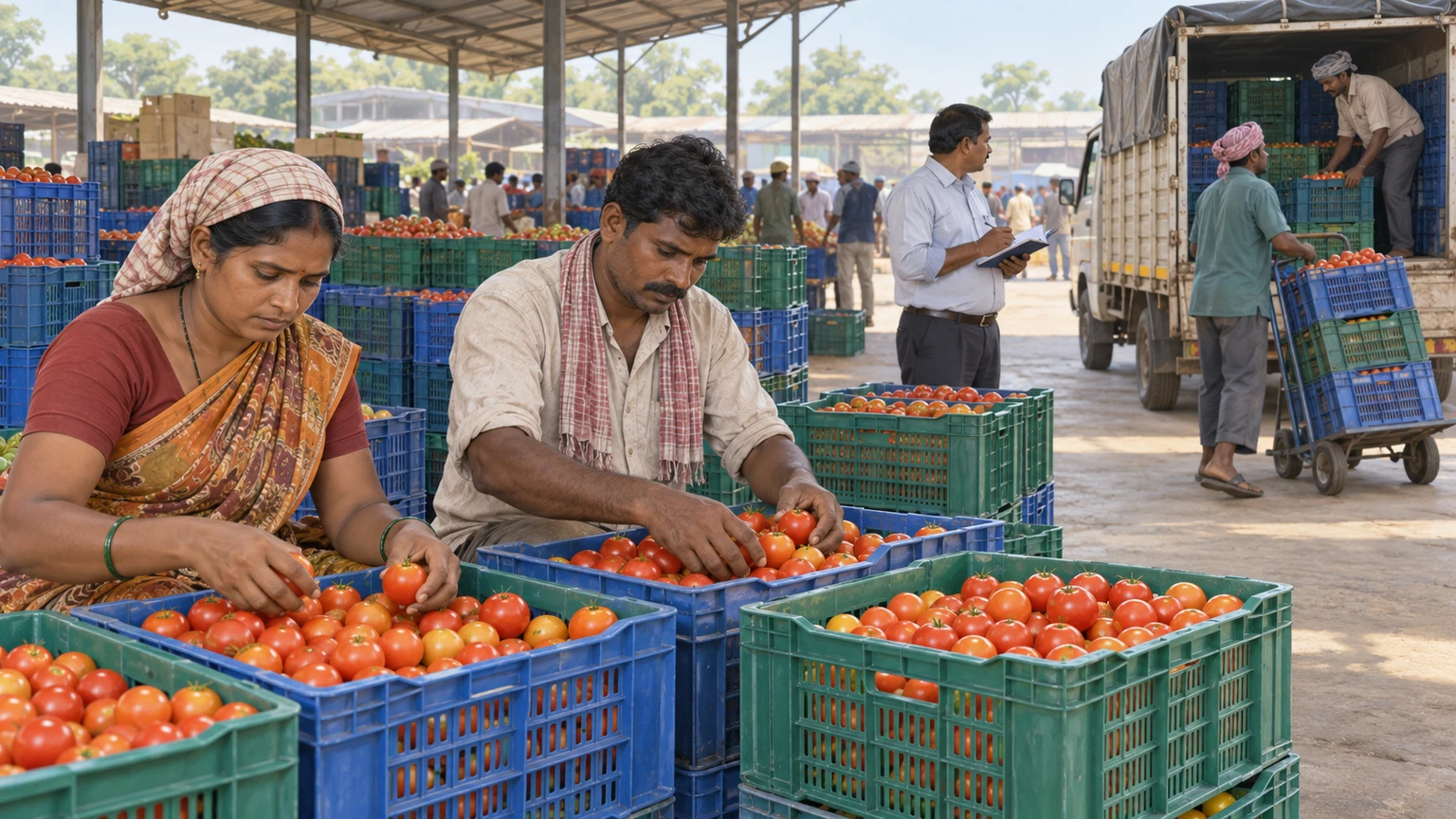
7. There are some districts in India that are famous for growing tomatoes. However, during some seasons, the situation is not good for farmers. With a large quantity of harvest, there are reports of farmers throwing away their produce and all their hard work going to waste. Why do you think farmers do this? What role can wholesalers play in such situations? What are the possible ways of ensuring that the tomatoes are not wasted, and the farmers are also not at a loss?
8. Have you heard about or visited a school carnival / fair organized by your school or any other school? Discuss with your friends and teachers about the kind of activities organized by students there. How do they conduct selling and negotiation with the buyers?
9. Choose any 5 products and check out the label with the certification signs discussed in the chapter. Did you find products that did not have a logo? Why do you think this is so?
| Example to inspect | Information to look for |
|---|---|
| Packaged gram flour | FSSAI logo and licence/registration details, ingredients, dates and net quantity |
| Packaged honey or spices | Food-label details; record AGMARK only if it is actually present |
| Electric iron | Relevant BIS mark and licence information where applicable |
| Refrigerator | BEE label, model, capacity, label period and annual energy consumption |
| Loose vegetables | Freshness, condition, handling and correct weighing; no individual package label |
10. You and your classmates have manufactured a soap bar. Design a label for its packaging. What in your opinion should be mentioned on the label for the consumer to know the product better?
| Front | CLASSROOM SOAP LABEL — DESIGN EXERCISE Product name: [chosen name] Net quantity: [measured amount] Price: [classroom example] |
|---|---|
| Back | Ingredients: [actual ingredient list] Batch: [identifier] · Made on: [date] Use-by information: [only if established] Maker/contact: [class project details] Directions: [appropriate instructions] For external use; avoid contact with eyes. |
Extra Practice Questions
These questions and MCQs are ClearStudy practice, separate from the NCERT exercise.
Short Answer Type Questions
Q1. What is a market? Name any two other words used for it.
Q2. Differentiate between a need and a want with one example each.
Q3. How is the price of a good determined in a market?
Q4. Distinguish between a wholesaler and a retailer.
Q5. What is the difference between export and import?
Long Answer Type Questions
Q1. Explain the different types of markets described in the chapter.
Q2. Describe the chain of participants that brings goods from the producer to the consumer.
Q3. Discuss the role of the government in markets.
MCQs & Assertion–Reason
1. A place where people buy and sell goods is called a:
(a) godown (b) market (c) factory (d) port
2. The amount at which a buyer is willing to buy and a seller is willing to sell is called the:
(a) demand (b) supply (c) price (d) profit
3. The prosperous Hampi Bazaar belonged to which empire?
(a) Maurya (b) Gupta (c) Vijayanagara (d) Chola
4. Selling goods produced in one country to a buyer in another country is called:
(a) import (b) export (c) retail (d) barter
5. Who buys goods in large quantities directly from producers and stores them in godowns?
(a) Retailer (b) Consumer (c) Wholesaler (d) Aggregator
6. A website or mobile application that combines offers from many sellers and sells them to consumers at one place is an:
(a) aggregator (b) exporter (c) importer (d) auditor
7. The Ima Keithal (Mother’s Market), run entirely by women, is located in:
(a) Jaipur (b) Imphal (c) Surat (d) Bengaluru
8. Which food regulator’s logo and licence/registration details are found on packaged food labels?
(a) ISI (b) BEE Star (c) AGMARK (d) FSSAI
9. For comparable appliances under the same BEE label period, more stars indicate that the appliance:
(a) is more expensive (b) is more energy efficient (c) is larger in size (d) lasts longer
10. Surat’s market described in this chapter is especially associated with:
(a) textiles and garments (b) the largest fish market (c) a spice market (d) a flower market
For each Assertion–Reason question, choose: (A) Both true and the Reason correctly explains the Assertion; (B) Both true but the Reason is not the correct explanation; (C) Assertion true, Reason false; (D) Assertion false, Reason true.
A-R 1. Assertion: A transaction takes place only when the buyer and the seller agree on a price.
Reason: If the buyer and the seller do not reach a mutually agreeable price, the transaction may not take place.
A-R 2. Assertion: Retailers sell goods in large quantities meant for resale.
Reason: Retailers sell goods in small quantities to final consumers for their own consumption.
A-R 3. Assertion: The government announces minimum support prices for crops such as wheat and paddy.
Reason: Support-price policy aims to protect farmers against very low crop prices, although outcomes depend on procurement and market access.
A-R 4. Assertion: Consumers should check the FSSAI logo and licence/registration information on packaged food labels.
Reason: This information helps identify the food business’s regulatory details, but does not prove that every packet has been government-tested.
A-R 5. Assertion: Markets have only economic significance in people’s lives.
Reason: Markets bring people together and enable the exchange of ideas and traditions across communities.
In-text activities: worked guidance
Late-day vegetables and end-of-season clothes: sellers may discount to reduce spoilage or unsold stock. Seasonal demand for woollens can fall; these are plausible reasons, not a rule that every seller must reduce prices.
Guava skit: Seller: “The price is ₹80/kg.” Buyer: “Would you accept ₹60?” Seller: “I can offer ₹70.” Buyer: “I agree.” These are invented classroom figures; either party may decline. Compare with fixed-price shops where bargaining is uncommon.
Online versus physical shopping: buyers compare convenience and choice with delivery costs, returns and ability to inspect goods. Sellers compare customer reach with platform fees, competition and logistics. Services such as a haircut require physical work even if booked online.
Onion shortage: if supply falls while demand remains similar, prices may rise. Authorities can examine supply disruptions, facilitate movement and consider lawful relief measures; no single action guarantees an immediate price fall.
Ghee measure: 1/50 = 2%. For a base measure of 1 kg, the extra allowance described in the textbook would be 20 g, intended to compensate for material sticking to the vessel.
BEE activity: compare stars within the same appliance type, capacity and label period, and read the energy-consumption figure. A larger five-star appliance can use more total electricity than a smaller one.
Retailer interview: record the product, place of origin and confirmed suppliers, then draw that actual chain. Label missing information “not known”. For markets’ financial side, revisit From Barter to Money.
Reviewed against NCERT Exploring Society: India and Beyond, Class 7, Part 1, Chapter 12, pp. 247–272 (2026–27 reprint), and official FSSAI, BIS, BEE and government sources on 10 October 2026. Food-label reference: FSSAI labelling regulations.
Exam Tips & Common Mistakes
How to write a clear answer
Learn the four features of a market (buyer, seller, goods/services and an agreed price) and always link the price to the interaction of demand and supply. Keep the pairs clear: physical vs online, domestic vs international, and wholesale vs retail. Memorise the chain of participants — producer → wholesaler → distributor → retailer → consumer (and aggregator for online). For the government’s role, remember four points: controlling prices, ensuring quality and safety, mitigating harmful effects, and providing public goods. Know the certification marks — FSSAI (food), ISI/BIS (electrical/construction), AGMARK (agriculture) and BEE Star (energy efficiency). Use the textbook examples — Hampi Bazaar, Surat textile market and Ima Keithal — to enrich your answers.
Common mistakes to avoid
- Forgetting that a market needs a price agreed by both buyer and seller — not just any buyer and seller.
- Mixing up export (selling abroad) with import (buying from abroad).
- Confusing a wholesaler (bulk, to retailers) with a retailer (small quantities, to consumers).
- Saying buying decisions depend only on price — quality, hygiene, convenience and trust also matter (Q6).
- Confusing the certification marks — remember FSSAI is for food, AGMARK for agriculture, ISI for goods, BEE for energy.
- Leaving activity questions (Q1, Q8, Q9, Q10) blank — write your own observations using the model answers.
Frequently Asked Questions
What is Chapter 12 of Class 7 Social Science Exploring Society about?
Chapter 12, Understanding Markets, explains what a market is and how it functions, how prices are set by demand and supply, the different types of markets (physical and online, domestic and international, wholesale and retail), the role of markets and of the government, and how consumers can assess the quality of goods and services using labels and standards information, including FSSAI details, ISI, AGMARK and BEE Star.
How is the price of a product decided in a market?
Demand and supply influence price, alongside costs, competition, quality and applicable rules. Buyers and sellers accept a price for a transaction; bargaining is not required in every market, and an agreed sale does not guarantee a profit.
What is the exercise heading for Chapter 12 of Exploring Society?
The end-of-chapter exercise in Exploring Society: India and Beyond (Part 1) Chapter 12 is headed Questions and activities and contains 10 numbered questions, all answered step by step on this page.