
CLASS 8 · Artificial Intelligence
Class 8 CT and AI: Ethics and Responsible AI Solutions
Work through Ethics and Responsible AI with explanations for the Class 8 CBSE Computational Thinking and Artificial Intelligence handbook.
Jump to a question or activity
- Before you begin
- Reflect
- Privacy scenario
- Accountability scenario
- A. MCQ 1
- A. MCQ 2
- A. MCQ 3
- A. MCQ 4
- A. MCQ 5
- B. Fill in the blank 1
- B. Fill in the blank 2
- B. Fill in the blank 3
- B. Fill in the blank 4
- B. Fill in the blank 5
- B. Fill in the blank 6
- C. Short answer 1
- C. Short answer 2
- C. Short answer 3
- C. Short answer 4
- C. Short answer 5
- C. Short answer 6
- D. Case-based question 1
- D. Case-based question 2
- D. Case-based question 3
- D. Case-based question 4
- E. One-word challenge 1
- E. One-word challenge 2
- E. One-word challenge 3
- E. One-word challenge 4
- E. One-word challenge 5
- Short concept lessons
- Additional practice questions
Key ideas
Responsible AI aims to be useful, fair, safe and accountable. Protect personal information, check claims before sharing them, test for unequal errors, and make sure humans can review consequential decisions and correct mistakes.
Short Concept Lessons
Learn a method, follow the example, then use it in the additional practice.
Ask what a system should do
AI ethics guide responsible design and use, including fairness, safety, privacy and accountability.
A fast system still needs checking if its mistakes harm a particular group.
Remember: Average accuracy alone does not measure every consequence.
Think before sharing personal data
Check why information is needed, who can access it and how it will be used.
A simple calculator asking for contacts deserves careful questioning.
Remember: Seek help from a trusted adult when a request is unclear.
Check for unequal outcomes
Incomplete or unrepresentative data can contribute to unequal errors.
A model tested only in one place may work poorly under different conditions.
Remember: Use relevant, representative data and examine performance across groups.
Verify before forwarding
Misinformation is false or misleading information that is shared.
Check an exam-cancellation claim against the school’s official notice.
Remember: A realistic image or familiar-sounding voice is not proof.
Keep responsibility with people
People and organisations should explain, review and correct AI-supported decisions.
A school should provide a person to review a disputed automated recommendation.
Remember: Saying the computer decided does not resolve responsibility.
Use meaningful human review
A reviewer needs relevant evidence and the ability to question or override a result.
A teacher checks an automated mark against the student’s actual answer.
Remember: Approving every output without checking is not useful supervision.
Questions and Solutions
Before you begin. Before we begin, let us consider a few important questions:
• What do we mean by AI ethics?
• Why is privacy important in the digital world?
• How can bias affect AI decisions?
• What is misinformation, and why does it spread so easily?
• Who is responsible when AI systems make mistakes?
Solution
- AI ethics: principles guiding responsible design and use.
- Privacy: protects control over personal information and reduces misuse.
- Bias: can create systematic errors or unfair treatment of some groups.
- Misinformation: false or misleading information; rapid sharing and emotional headlines can spread it before checks occur.
- Responsibility: the people and organisations building, deploying and using a system must remain accountable for their roles.
Reflect. Can a system be considered successful if it is fast and accurate but harms certain groups of people?
Why or why not? Discuss your ideas with your classmates.
Solution
Sample response
No. A system that harms a group or denies people fair treatment fails an essential part of responsible design, even if its average accuracy is high. Examine performance for different groups, the seriousness of errors and whether affected people can obtain human review and correction.
Privacy scenario. Before sharing data online, ask yourself a few questions:
• Why is this information needed?
• Who will be able to see it?
• How long will it be stored?
• Can I delete it later?
Consider the following scenario:
A student is installing an app on a mobile phone. On the phone screen, a message appears asking for permissions such as Location, Contacts, Photos, and Camera. The student pauses and thinks before clicking Allow. A small thought bubble appears with questions like, why does the app need this? and Who can see my data?

Solution
Sample response
Ask why each permission is needed for the app’s function, who can access the data, how long it is kept and how to remove it. Decline unnecessary permissions and seek help from a trusted adult when unsure. Do not share passwords, PINs or OTPs with another person or an unfamiliar service. A permission request is not evidence that the data are necessary.
Accountability scenario. Let us imagine an AI system is used in a hospital. The system analyses patient data and suggests which patient needs urgent care. This may be helpful. But suppose the system makes a mistake.
Who should be responsible?
The machine?
Or the people who created and used it?
Whenever AI is used, we must ask some important questions:
• Who created the system?
• Who checks whether it works correctly?
• Who fixes mistakes if they occur?
• Who is responsible if harm happens?
Consider the following scenario:
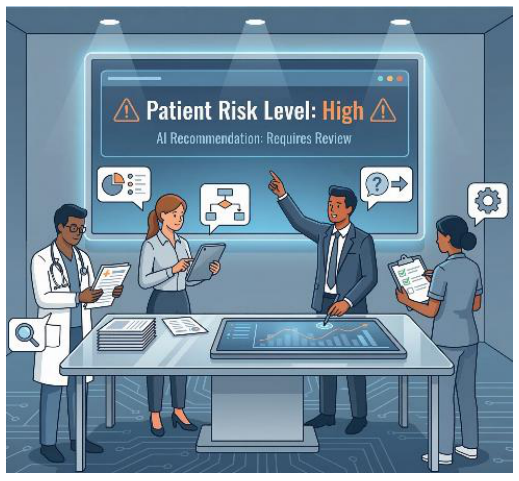
A team of doctors is sitting in a hospital meeting room reviewing a patient’s medical report. On a large screen, an AI system displays the message: Patient Risk Level: High. The doctors carefully examine the data and discuss the result. One doctor points to the screen and suggests that the AI’s recommendation should be checked again before making a final decision.
Solution
Qualified healthcare professionals should check the prediction alongside the patient’s information and clinical evidence before using it for care. The deploying organisation should provide oversight and correction procedures, while developers investigate system faults. Responsibility cannot simply be passed to “the machine”.
A. MCQ 1. AI ethics focus on:
Solution
A. MCQ 2. Privacy means:
Solution
A. MCQ 3. AI bias can occur when:
Solution
A. MCQ 4. Before sharing information online, what should you do?
Solution
A. MCQ 5. AI systems learn patterns from:
Solution
B. Fill in the blank 1. Misinformation means _____________ information.
Solution
B. Fill in the blank 2. Fair AI systems treat people _____________.
Solution
B. Fill in the blank 3. Humans must remain _____________ for AI decisions.
Solution
B. Fill in the blank 4. AI systems learn patterns from _____________.
Solution
B. Fill in the blank 5. Incorrect or misleading information shared online is called _____________.
Solution
B. Fill in the blank 6. Humans must remain _____________for decisions made using AI systems.
Solution
C. Short answer 1. Why is privacy important in the digital world?
Solution
It helps people control their personal information and reduces risks such as impersonation, fraud and unwanted disclosure. Collecting only necessary information and restricting its use can reduce harm.
C. Short answer 2. Give one example of misinformation.
Solution
Sample response
An unverified post falsely saying that tomorrow’s school examination is cancelled is misinformation. Check the school’s official notice before acting on or sharing it.
C. Short answer 3. What does accountability mean in AI systems?
Solution
People and organisations remain answerable for how an AI system is built and used, for investigating errors and for putting problems right. There should be a clear route for questions, review and correction.
C. Short answer 4. What are AI ethics?
Solution
They are principles for developing and using AI responsibly, including fairness, privacy, safety, transparency and human accountability.
C. Short answer 5. What is misinformation?
Solution
It is false, inaccurate or misleading information that is shared. It can appear as text, pictures, audio or video and can spread online or offline.
C. Short answer 6. Why is human supervision important when AI systems are used?
Solution
People can check context, spot errors and unfair outcomes, assess consequences and correct or override unsuitable outputs. This is especially important when decisions affect health, education or other significant opportunities.
D. Case-based question 1. A student installs an app that asks for permission to access location, contacts, and photos. The student pauses and thinks about why the app needs this information.
• What important digital habit is the student practising?
Solution
The student is practising privacy awareness and thoughtful data sharing: checking whether permissions are necessary before allowing access.
D. Case-based question 2. An AI system used in healthcare suggests that a patient has a high-risk level. Doctors carefully review the AI’s recommendation before making a final decision.
• Why is human review important in this situation?
Solution
Human review checks whether the recommendation fits the patient’s evidence and catches possible mistakes or missing context before a decision affects care.
D. Case-based question 3. An AI system is trained mostly with data from one city and later used in other places. The system does not work well for people from different regions.
• What problem in AI does this example show?
Solution
This illustrates unrepresentative data and possible AI bias. The training set may not cover other regions’ conditions. Broader representative data and region-wise testing can reveal and reduce the problem.
D. Case-based question 4. A message spreads quickly on social media, but the information in it is incorrect.
• What is this situation called, and what should users do before sharing such messages?
Solution
This is misinformation. Pause, inspect the source and date, compare reliable evidence and official notices, and do not forward the claim while it is unverified.
E. One-word challenge 1. Protection of personal information
Write one word that matches the description: __________________
Solution
E. One-word challenge 2. Incorrect or misleading information shared online
Write one word that matches the description: __________________
Solution
E. One-word challenge 3. Unfair patterns learned by AI from data
Write one word that matches the description: __________________
Solution
E. One-word challenge 4. Moral principles guiding technology use
Write one word that matches the description: __________________
Solution
E. One-word challenge 5. Responsibility for AI decisions
Write one word that matches the description: __________________
Solution
Additional Practice Questions with Solutions
Choose an answer, use a hint if needed, then open the worked solution to check your reasoning.
Solved 0 of 10 · Checked 0 of 10
Your practice progress lasts until you reset or reload this page.
Apply · Responsible AI
Practice Q1. A model is fast but repeatedly harms one group through errors. Is speed enough to call it successful?
Show hint
Consider who is affected and how.
Show worked solution
Option (b) No, harmful unequal outcomes need attention.
Responsible evaluation includes fairness, safety and consequences, not speed alone.
Common mistake: A high average score can hide serious group-specific errors.
Apply · Privacy
Practice Q2. A calculator app requests your contact list. What is a thoughtful first response?
Show hint
Match the permission to the app’s purpose.
Show worked solution
Option (c) Check why the permission is needed and decline unnecessary access.
Question the need for contacts, avoid unnecessary access and ask a trusted adult if unsure.
Common mistake: A permission request does not prove that access is necessary.
Apply · Bias
Practice Q3. A system trained on one region performs poorly in other regions. What should be investigated?
Show hint
Compare training coverage with intended use.
Show worked solution
Option (a) Whether the data represent the other regions.
Investigate missing conditions or groups, improve representative data and test across regions.
Common mistake: Broader use requires evidence that relevant differences are covered.
Apply · Misinformation
Practice Q4. A forwarded message says tomorrow’s exam is cancelled. What should you do before sharing it?
Show hint
Use an authoritative source for the actual claim.
Show worked solution
Option (d) Check the school’s official notice or contact the school.
Verify the claim with the school before acting on it or forwarding it.
Common mistake: Appearance and popularity do not establish truth.
Apply · Accountability
Practice Q5. An AI-supported decision contains an error. Which response shows accountability?
Show hint
Responsibility includes responding when something goes wrong.
Show worked solution
Option (b) Investigate, explain and correct the error through responsible people.
People and organisations should investigate the error, explain it and provide correction or review.
Common mistake: Using AI does not remove human responsibility.
Apply · Human review
Practice Q6. Which is meaningful human supervision?
Show hint
A reviewer must be able to question the result.
Show worked solution
Option (c) Check evidence and correct unsuitable outputs.
Human review checks context and evidence and can correct or override an unsuitable output.
Common mistake: A rubber stamp is not effective supervision.
Apply · Personal information
Practice Q7. Which item should you avoid sharing with another person?
Show hint
Some information can give access to an account.
Show worked solution
Option (a) Your password or OTP.
Passwords and OTPs can allow account access and should not be shared with another person.
Common mistake: Public facts and account credentials have different risks.
Apply · Verification
Practice Q8. A video looks realistic. What follows?
Show hint
Realistic appearance alone is weak evidence.
Show worked solution
Option (d) Its source and claims still need verification.
Check the source, context and independent evidence; realistic media can be edited or generated.
Common mistake: Visual realism is not a guarantee of truth.
Apply · Transparency
Practice Q9. Which feature helps a student understand an AI recommendation?
Show hint
The student needs understandable information and a way to respond.
Show worked solution
Option (b) A clear explanation of the relevant reasons and a review route.
Clear reasons and a review route help students question mistakes or unsuitable recommendations.
Common mistake: Transparency should support understanding and correction.
Apply · Ethics
Practice Q10. Which word means responsibility for decisions made using AI?
Show hint
Think of being answerable for actions and their consequences.
Show worked solution
Option (c) Accountability.
Accountability means people and organisations remain answerable for decisions and for addressing errors.
Common mistake: Technical performance and responsibility are different ideas.