
CLASS 8 · Computational Thinking
Class 8 CT and AI: Power Play Solutions
Work through Power Play with explanations for the Class 8 CBSE Computational Thinking and Artificial Intelligence handbook.
Jump to a question or activity
Key ideas
Evaluate powers before comparing them. In selection and packing problems, enforce all constraints together and justify why an answer is maximal or minimal.
Short Concept Lessons
Learn a method, follow the example, then use it in the additional practice.
Evaluate before comparing
A larger base does not always give a larger power.
2⁵=32 and 5²=25, so 2⁵ is larger.
Remember: Keep the original positions when checking an ordering.
Practise this method →Spot powers in a sequence
Subtracting a constant can reveal a geometric pattern.
4,10,28,82 become 3,9,27,81 after subtracting 1.
Remember: Test the rule on every supplied term.
Practise this method →Count independent choices
Multiply the counts when every option can pair with every option in the other group.
4 shirts and 3 trousers give 12 pairs.
Remember: Restrictions can remove some combinations.
Practise this method →Bound the possible powers
Use the smallest and largest allowed values to eliminate cases.
A two-digit base to the fourth power is at least 10⁴=10000.
Remember: Strict inequalities exclude the endpoints.
Practise this method →Maximise under constraints
Account for compulsory choices before filling remaining capacity.
If a bag holds 10 units and compulsory items use 6, only 4 remain.
Remember: High points alone are not enough; compare points per load.
Practise this method →Read reciprocal exponents carefully
For positive numbers, an exponent of one half means square root.
9^(1/2)=3, while(1/9)²=1/81.
Remember: Changing the base and changing the exponent are different operations.
Practise this method →Questions and Solutions
Q1. Each term is written in exponential form.
If the terms are rearranged in ascending order of their numerical values from left to right, how many terms remain in the same position as in the original arrangement?

Solution
Option (c) 2. Values in the original order are 64, 16, 27, 256, 25, 729. Sorted they are 16, 25, 27, 64, 256, 729. Only positions 3 and 6 stay unchanged.
Q2. What will come in place of “?” in the given series? 6, 26, 126, 626, ?
Solution
Option (b) 3126. These are 5¹ + 1, 5² + 1, 5³ + 1 and 5⁴ + 1. Next is 5⁵ + 1 = 3126. Equivalently multiply the previous term by 5 and subtract 4.
Q3. A team is to be formed from a group of 7 students: A, B, C, D, E, F, and G where:
• A and B cannot be in the same team, but at least one of them must be included in the team
• C and D must either both be included or both be excluded from the team
• E and F must either both be included or both be excluded from the team
If the team consists of 4 students, in how many different ways can it be formed?
Solution
Option (b) 4. Choose exactly one of A/B, exactly one of the pairs CD/EF, and G. The teams are ACDG, AEFG, BCDG and BEFG. Both pairs would already require four people before A/B; neither pair leaves too few people.
Q4. Let X, Y, and Z be single-digit whole numbers.
The number XY is a two-digit number formed using digits X and Y. If 4000 < (XY)ᶻ < 5000, what is the minimum possible value of XY?
Solution
Option (b) 16. Any power of at least four is too large even for base 10. Cubes give 15³ = 3375 and 16³ = 4096. Bases 10–15 cannot work with lower powers either. Thus 16 is the minimum.
Q5. Raj must select three numbers from the grid from three DISTINCT shapes such that:
1. Each number is chosen from a different row
2. The number selected from Row R1 is the nth power of 3
3. No digit is repeated among the bases and exponents of the chosen numbers
Based on these rules, what is the sum of the three selected numbers?

Solution
Option (c) 1482. R1 must contribute a power of 3. The pentagon must then come from R3; choose 2⁷ since its other pentagon 3⁵ repeats 3. R2 cannot repeat 2 or 7. Taking its square 4⁵ would force another square in R1, so choose the circle 5⁴ and the square 3⁶. The six digits 3,6,5,4,2,7 are distinct. Sum = 729 + 625 + 128 = 1482.
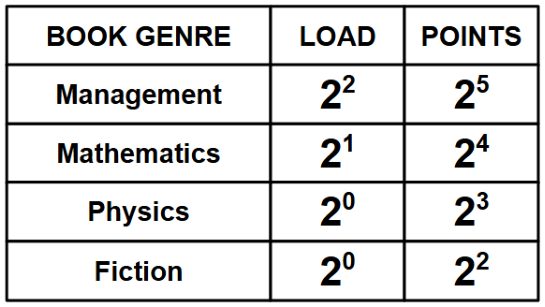
Q6. A man has a bag with a maximum capacity of 2⁴ units. He earns certain points for the books he carries in that bag and the load of each book is shown in the table below:
● For every Management book added to the bag, 2 Fiction books must be added
● For every Mathematics book added to the bag, 2 Physics books must be added
If he has to carry at least one book of each genre, what is the maximum number of points he can earn without exceeding the bag’s capacity?
Solution
Option (b) 120. Capacity is 2⁴ = 16 units. Management, Mathematics, Physics and Fiction have respective (load, points) of (4,32), (2,16), (1,8), (1,4). One Management, one Mathematics, two Physics and two Fiction use 10 units and score 72. Add six Physics books to reach 16 units and 120 points. This is optimal: all books score at most 8 per load unit, while the mandatory two Fiction books each lose 4 relative to that bound. Hence score ≤ 16 × 8 − 8 = 120.
Q7. How many possible combinations of 1 owl and 1 tree can be made from 3 owls and 5 trees?
Solution
Option (c) 15. Each owl has five possible tree partners, so 3 × 5 = 15 distinct pairs.
Q8. Sam has Rs.
4000 in such a way that he has Re. 1 coins in power of 10, Rs. 2 coins in power of 5, Rs. 5 coins in power of 2, and the remaining coins of Rs. 10. The amount of money of each individual denomination of Re. 1, Rs. 2, and Rs. 5 is greater than or equal to thousand. At MAXIMUM, how many coins of Rs. 10 can he have?
Solution
Option (b) 47. Minimise the allowed amounts in the other denominations while keeping each at least ₹1000: 10³ one-rupee coins give ₹1000; 5⁴ two-rupee coins give ₹1250; 2⁸ five-rupee coins give ₹1280. Their total is ₹3530. Remaining ₹470 gives 47 ten-rupee coins.
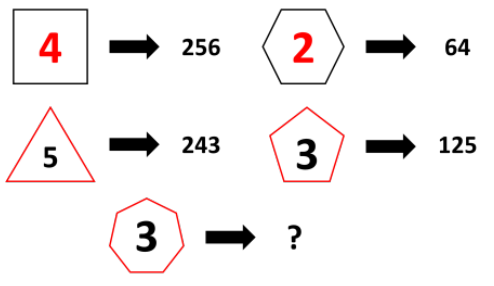
Q9. What will come in place of “?”
Solution
Option (c) 343. With a black outline, the inside number is the base and the number of sides is the exponent. A red outline reverses them. Thus a red heptagon containing 3 represents 7³ = 343.
Q10. Sam and Tim are playing a number-maximizing game. Their numbers are shown in the table below (where A and B are undefined). They must modify their numbers using ONLY ONE of the following rules:
● If the base is smaller than the exponent, the base n is replaced with 1/n
● If the base is greater than the exponent, the exponent n is replaced with 1/n
Sam and Tim choose A and B and apply the rule exactly once in a way that maximizes their own numbers. What is the difference between the final numbers of Sam and Tim, where A and B are single-digit natural numbers?

Solution
Option (c) 1. For Sam’s 4ᴬ, choose A = 1: replacing the exponent by its reciprocal gives 4¹ = 4. Exponents 2 or 3 give smaller roots; A > 4 makes the base ¼, producing a number below 1. Equality A = 4 triggers neither rule. For Tim’s B² choose B = 9, giving 9½ = 3. B = 1 gives 1; B = 2 triggers neither rule. Thus 4 − 3 = 1.
The Thinking Spot
Enter all the letters and the numbers of the Set in the empty squares of the grid given below, such that:
– Every vowel must have an even number in at least one of its adjacent squares
– The letter 'H' is not adjacent to 'A' or 6
– Two consecutive numbers cannot be in any adjacent squares
What will come in place of “?”
Note: Squares are considered to be adjacent only if they share a common side. Squares sharing a common corner are not considered adjacent

Solution
Option (c) E. The upper-left cell must be Y: 2,4,6 would be consecutive to 3 or 5, while a vowel there would have no even neighbour. The upper-right cell is 2; 4 and 6 are consecutive to 5 and a vowel again has no even neighbour. At the centre, H excludes A and 6; 3 and 5 exclude 4; Y and 2 are used. Therefore the centre is E. One completed grid is:
| Left | Middle | Right |
|---|---|---|
| Y | 5 | 2 |
| 3 | E | H |
| A | 6 | 4 |
Additional Practice Questions with Solutions
Choose an answer, use a hint if needed, then open the worked solution to check your reasoning.
Solved 0 of 10 · Checked 0 of 10
Your practice progress lasts until you reset or reload this page.
Apply · compare
Practice Q1. Which value is greatest?
Show hint
Evaluate the four powers.
Show worked solution
Option (b) 2⁵.
The values are 25,32,27,16;32 is greatest.
Common mistake: Compare values, not just bases.
Apply · series
Practice Q2. What comes next:4,10,28,82,?
Show hint
Subtract 1 from every term.
Show worked solution
Option (c) 244.
The terms are 3¹+1,3²+1,3³+1,3⁴+1;next is 3⁵+1=244.
Common mistake: Check that the same rule fits all terms.
Apply · choices
Practice Q3. How many pairs can be made from one of 4 shirts and one of 3 trousers?
Show hint
Each shirt has 3 possible partners.
Show worked solution
Option (a) 12.
4×3=12 pairs.
Common mistake: Add only when choices are alternatives, not pairs.
Apply · bounds
Practice Q4. What is the smallest two-digit base whose cube is greater than 1000?
Show hint
10³ equals the boundary.
Show worked solution
Option (d) 11.
10³=1000 is excluded;11³=1331 is greater.
Common mistake: Greater than is not greater than or equal to.
Apply · optimise
Practice Q5. A bag holds 10 units. Two compulsory items use 3 units each. How much capacity remains?
Show hint
Subtract both compulsory loads.
Show worked solution
Option (b) 4.
10−2×3=4 units remain.
Common mistake: Count each compulsory item.
Apply · reciprocal
Practice Q6. What is 16^(1/2)?
Show hint
A half exponent means square root.
Show worked solution
Option (c) 4.
The positive square root of 16 is 4.
Common mistake: Do not divide the base by 2.
Apply · compare
Practice Q7. Arrange 3²,2³,2⁴ in ascending order. Which is first?
Show hint
Their values are 9,8,16.
Show worked solution
Option (a) 2³.
8<9<16, so 2³ is first.
Common mistake: Evaluate powers before sorting.
Apply · choices
Practice Q8. Choose exactly one of A or B, and exactly one of C or D. How many two-person teams are possible?
Show hint
List AC,AD,BC,BD.
Show worked solution
Option (d) 4.
Two choices in each independent group give 2×2=4.
Common mistake: AB andCD do not satisfy the group rule.
Apply · bounds
Practice Q9. Which exponent z gives 100<3ᶻ<300?
Show hint
Compare nearby powers.
Show worked solution
Option (b) 5.
3⁴=81,3⁵=243,3⁶=729;only 243 is within the interval.
Common mistake: Both inequalities must hold.
Apply · optimise
Practice Q10. Item P gives 12 points for 3 load units; Q gives 10 points for 2 units. Which gives more points per load unit?
Show hint
Divide points by load.
Show worked solution
Option (c) Q.
P gives 4 per unit;Q gives 5 per unit.
Common mistake: Total points and efficiency are different.