
Harvest Hymn — Class 8 English Poorvi Questions and Answers
Harvest Hymn by Sarojini Naidu celebrates a community’s gratitude at harvest time. This Class 8 English Poorvi guide explains the stanzas, imagery, textbook questions, farming tools, paddy-cultivation listening task and sample speaking and writing activities.
Source: NCERT Poorvi, Grade 8, Unit 4, printed pages 173–184; listening transcript 203; supplied reprint 2026–27. Open-ended and personal responses are examples to adapt. These explanations are study support, not an official NCERT answer key.
- Poem Overview
- About the Poet
- Central Idea & Stanza Summary
- Word Meanings
- Poetic Devices
- Before reading
- NCERT textbook exercises
- Listen
- Speak
- Write
- Explore
- Extra Questions
- MCQs & Answer Key
- Assertion–Reason Questions
- FAQs
Poem Overview
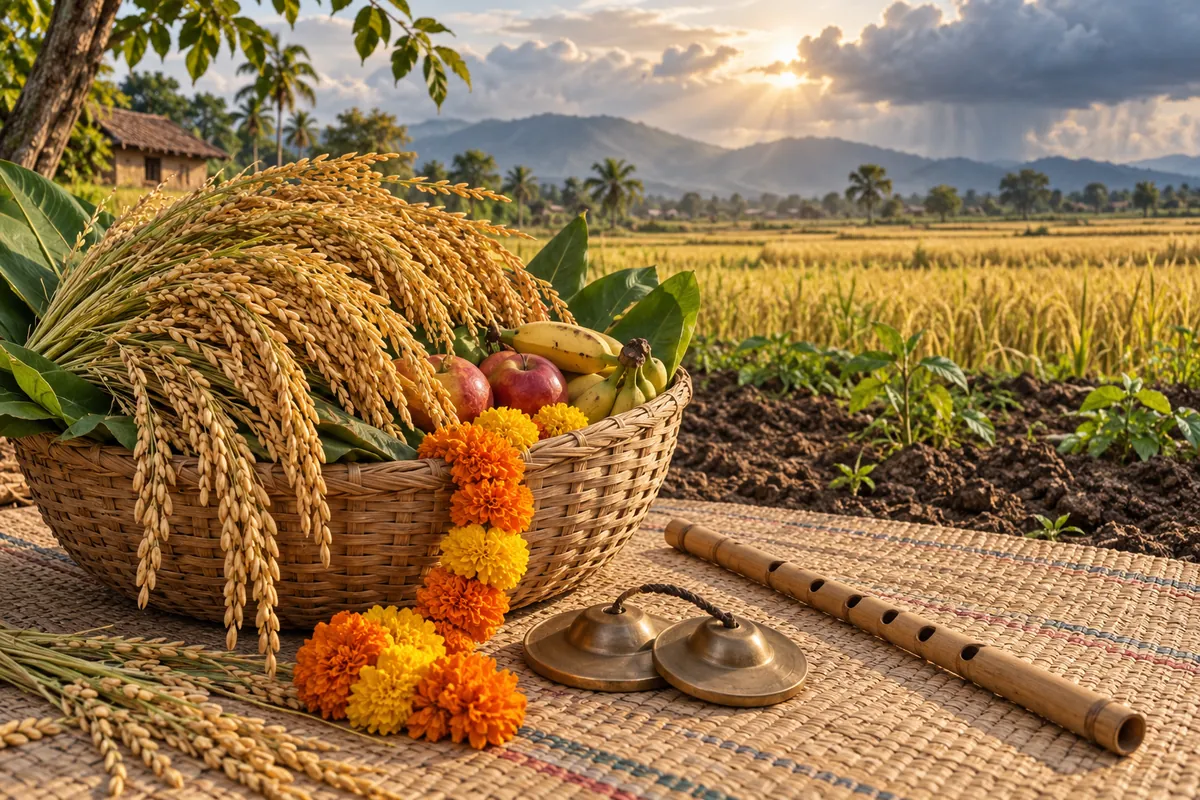
“Harvest Hymn” is a joyous song of thanksgiving sung by farming folk at harvest time in rural India. The poem is arranged as a chorus: the Men’s Voices first praise Surya (the Sun) and then Varuna (the rain-god of the waters); the Women’s Voices praise Prithvi (the Earth); and finally All Voices together praise Brahma, the Lord of the Universe. The villagers offer their songs, garlands, grain, love, lives and labour as tribute to the gods who blessed their fields with a rich harvest. The poem’s mood is grateful, devotional and celebratory, full of music — cymbal, flute, pipe, drum and prayer. Its central message is the deep bond between human beings, nature and the divine: a good harvest is seen as a gift to be received with humility and gratitude.
About the Poet – Sarojini Naidu
Sarojini Naidu (1879–1949) was a poet and participant in India’s independence movement. Her musical language and images of Indian life are evident in this poem. She became the first Indian woman to preside over the Indian National Congress in 1925; “first woman” alone is inaccurate. See King’s College London’s biographical profile.
Central Idea & Stanza Summary
Central idea: The poem expresses the gratitude of Indian farmers to the forces of nature — the Sun, the rain, the Earth and the Supreme Creator — for a bountiful harvest. Through the voices of men, women and the whole community, it celebrates the sacred partnership between humanity and nature, and reminds us that all the wealth of the fields is ultimately a divine blessing for which thanks must be given.
Stanza 1 – Men’s Voices (Surya, the Sun): The men hail the radiant Sun as “lord of the lotus” and “lord of the harvest”. They acknowledge that it is his bounty (generosity) that helped their seeds sprout and ripened their corn. In gratitude they bring songs, garlands, the golden grain of their fields and the golden fruit of their trees, praising Surya with cymbal and flute.
Stanza 2 – Men’s Voices (Varuna, the rain): The men now praise Varuna, the great and kind “lord of the main” (the waters). It is his mercy that watered their furrows and nourished their grain. They offer thanks, garlands and the freshly gathered, ripe wealth of their valleys, hailing the sender of rain and dew with cymbal and pipe.
Stanza 3 – Women’s Voices (Prithvi, the Earth): The women address the Earth as a sweet, all-powerful mother. Her plentiful bosom feeds her children, and her womb is where all their riches are born. They bring love, garlands and the gifts of her own generous giving, praising Prithvi — the source of their many joys — with cymbal and drum.
Stanza 4 – All Voices (Brahma, the Creator): Finally the whole community joins to praise Brahma, the eternal Father and “ineffable Om”, the Lord of the Universe and of their very being. He is the “Seed and the Scythe” of every harvest — its beginning and its end — and their Hands, Heart and Home. They offer their lives and labours as tribute and beg his help (succour), counsel and care, praising him with cymbal and prayer.
Word Meanings (शब्दार्थ)
| Word | English Meaning | हिंदी अर्थ |
|---|---|---|
| munificent | extremely generous | अत्यंत उदार, दानशील |
| bounty | generous gift; abundance | उदारता, प्रचुर दान |
| tribute | an act of respect or gratitude | श्रद्धांजलि, भेंट |
| mellowing | making soft, ripe and warm | परिपक्व/मधुर बनाने वाली |
| radiance | bright glowing light | दीप्ति, उज्ज्वल प्रकाश |
| hail | to greet or praise with joy | जय-जयकार करना, वंदना करना |
| beneficent | kind and doing good | परोपकारी, हितकारी |
| the main | the great waters / the sea | महासागर, जलराशि |
| mercy | kindness and compassion | दया, करुणा |
| furrows | long grooves cut in soil for sowing | हल से बनी खेत की कूड़ें |
| fostered | helped to grow; nurtured | पोषित किया, पाला |
| new-garnered | freshly gathered (harvested) | हाल ही में काटा/संचित किया गया |
| dewfall | the falling of dew | ओस का गिरना |
| gourd-flower | flower of the gourd (a climbing vegetable) | लौकी/कद्दू का फूल |
| omnipotent | all-powerful | सर्वशक्तिमान |
| bosom | the chest / loving embrace | वक्षस्थल, गोद |
| opulent | rich and plentiful | समृद्ध, वैभवशाली |
| manifold | many and varied | अनेक प्रकार का |
| eternal | lasting forever | शाश्वत, अनंत |
| ineffable | too great to be described in words | अवर्णनीय |
| scythe | a curved blade for cutting crops | हँसिया/दराँती |
| succour | help and support in difficulty | सहायता, मदद |
| counsel | advice and guidance | परामर्श, सलाह |
Poetic Devices in the Poem
| Device | Explanation / Example from the poem |
|---|---|
| Hymn (poetic form) | The whole poem is a song of praise and worship offered to the gods of nature. |
| Apostrophe | The poet directly addresses absent/divine beings: “O Surya”, “O Prithvi”, “Father eternal, ineffable Om!” |
| Personification | The Earth is given human form as a “sweet and omnipotent mother” with a “bosom” and a “womb”. |
| Metaphor | “Thou art the Seed and the Scythe of our harvests” — the divine is the beginning and end of life. |
| Alliteration | “Bright and munificent lord of the morn”; “Seed and the Scythe”; “Hands and our Heart and our Home”. |
| Refrain / Repetition | “Thine is the bounty…”, “We bring thee…”, “We praise thee…” recur to create a chant-like rhythm. |
| Imagery | “The gold of our fields and the gold of our fruit”; “new-garnered and ripe” paint vivid harvest scenes. |
| Symbolism | Surya = light/energy/life; Varuna = rain and mercy; Prithvi = fertile, nurturing Earth; “gold” = ripe crops and wealth. |
| Allusion | References to Hindu deities — Surya, Varuna, Prithvi, Brahma — and the sacred syllable “Om”. |
Before reading
I. Harvest festivals and hymns — sample responses
A harvest festival celebrates gathered crops and the work that produced them. Name the festival actually celebrated in your region, its season and local customs; practices differ between communities. A hymn is a song of praise, often addressed to a deity and sung in a religious or communal gathering to express gratitude or devotion. These are descriptions of the poem’s cultural setting, not a requirement to share a particular belief.
II. Archaic pronouns
1–iii, 2–iv, 3–ii, 4–v, 5–i: thou = you (subject); art = are; thee = you (object); thy = your; thine = yours. Example in modern English: “You are my friend, and I trust you. Your kindness is great; what is mine is yours.”
III. Meanings in context
1 radiance: (i) glow; 2 tribute: (i) respect; 3 cherished: (ii) loved; 4 counsel: (i) advice; 5 munificent: (ii) generous. “Brilliance” can also mean brightness, but “glow” best suits the evening light in this context.
NCERT textbook exercises
Let us discuss
I. Write the stanza number for the main idea of each stanza given below.
| Main idea | Stanza |
|---|---|
| 1. The speakers recognise the lord’s kindness and praise him for nourishing the field. | Stanza 2 (Varuna, the rain) |
| 2. The speakers praise the generosity of the creator of the universe who ensures a rich harvest. | Stanza 1 (Surya, the Sun) |
| 3. The speakers devote their lives and work as a mark of respect to the lord and seek his support, wisdom, and care. | Stanza 4 (Brahma, All Voices) |
| 4. The speakers pay homage to the Earth and appreciate her role in supporting life, by dedicating their harvest. | Stanza 3 (Prithvi, the Earth) |
II. Fill in the blanks by choosing the appropriate words or phrases from within the brackets.
III. Identify the poetic device used in the following lines from the poem. • Bright and munificent lord of the morn! • We bring thee our lives and our labours for tribute
IV. Match the lines from the poem in Column 1 with their expressions in Column 2. Choose the appropriate poetic device from the box and write in Column 3.
| Column 1 (Line) | Column 2 (Expression) | Column 3 (Device) |
|---|---|---|
| 1. sweet and omnipotent mother | (iii) the earth is being given human-like qualities | Personification |
| 2. The wealth of our valleys, new-garnered and ripe | (i) creates a clear description of the scene and appeals to the senses | Imagery |
| 3. Thou art the Seed and the Scythe | (ii) implied comparison of growth and reaping with beginning and end of all life | Metaphor |
V. Certain words or phrases are repeated in the same line of the poem. For example, “The gold of our fields and the gold of our fruit”. Find more such repetitions from the poem. What is the poet’s purpose of using repetition in the poem?
VI. The poem uses symbolism to convey deeper meanings. Match the symbols in Column 1 with the meanings they convey in Column 2.
| Column 1 (Symbol) | Column 2 (Meaning) |
|---|---|
| 1. Prithvi (the Earth) | (iii) fertile land, motherhood, nurturing — the source of all life |
| 2. Surya (the Sun) | (i) light, energy, life — representing the giver of warmth and prosperity |
| 3. Varuna (Rain) | (ii) mercy and nourishment — crucial for agriculture and sustenance |
Let us think and reflect
I.1. Read the extract and answer the questions. “We bring thee our songs and our garlands for tribute, / The gold of our fields and the gold of our fruit; / O giver of mellowing radiance, we hail thee, / We praise thee, O Surya, with cymbal and flute.”
(i) What does the act of bringing songs and garlands as tribute suggest about the people’s relationship with the divine? A. They fear the gods and wish to calm them in any way possible. B. They have a deep sense of reverence and gratitude towards the divine. C. They are forced to perform rituals without understanding the divine. D. They depend on the gods for their daily needs and activities.
(ii) Complete the following sentence suitably. The word ‘gold’ in the phrases ‘the gold of our fields’ and ‘the gold of our fruit’ symbolises ________________.
(iii) How does the description ‘O giver of mellowing radiance’ help us understand Surya’s role in the harvest?
(iv) Fill in the blank by selecting the correct option. The use of cymbal and flute signifies ________________. (joy and celebration / meditation and worship)
I.2. Read the extract and answer the questions. “All Voices: / Lord of the Universe, Lord of our being, / Father eternal, ineffable Om! / Thou art the Seed and the Scythe of our harvests, / Thou art our Hands and our Heart and our Home.”
(i) In the phrase ‘Lord of our being,’ what does the word ‘being’ most likely refer to? A. Our physical body B. Our entire existence C. Our spiritual practices D. Our earthly possessions
(ii) Identify whether the following statement is true or false. The imagery of ‘the Seed and the Scythe’ symbolises the divine’s role as both the beginning (creation) and the end (harvest) of the agricultural cycle.
(iii) Identify the phrases from the extract that mean the following: A. The divine as a timeless, everlasting presence B. Beyond human comprehension or description
(iv) How do we know that these lines from the extract are spoken as a chorus?
II. Answer the following questions.
The farmers hail Varuna, the god of rain, because his mercy waters their furrows and nourishes their grain. Without rain and dewfall their fields would stay dry and barren, so they thank him for sending the water that makes the harvest possible. 2. What is being referred to as ‘wealth of our valleys’? Why?
The “wealth of our valleys” refers to the freshly harvested, ripe grain and crops gathered from the fields. It is called wealth because the harvest is the farmers’ true riches — their food, income and security for the whole year. 3. State one reason why the women refer to the Earth as a ‘source of manifold gladness’.
The women see the Earth as a mother whose “plentiful bosom” feeds them and whose “womb” gives birth to all their riches. Because she generously provides food, crops and prosperity in many forms, she is the source of their many (manifold) joys. 4. Why does everyone in the poem offer their ‘labours for tribute’?
In the final stanza all the people offer their lives and labours to Brahma, the Creator. They believe their hard work in the fields is itself an act of worship — a way of thanking the divine, who is the “Hands and Heart and Home” behind all their effort, and of seeking his continued help, counsel and care. 5. Why has the poet presented the poem as voices of men, women, and all voices?
The poet uses different voices to show that thanksgiving at harvest is a shared community act. The men praise the Sun and the rain, the women praise the nurturing Earth, and finally all voices unite to praise the Supreme Creator. This structure mirrors a real harvest celebration and shows the whole village joining together in gratitude. 6. How does the poet create the joyous atmosphere of rural India at harvesting time?
The poet fills the poem with images of golden fields and ripe fruit, with offerings of songs, garlands and grain, and with the lively sounds of cymbal, flute, pipe, drum and prayer. The repeated, chant-like lines and the gathering of men and women in joint praise build a warm, festive and devotional mood typical of an Indian harvest festival. 7. Why is the poem presented as a hymn?
A hymn is a song of praise to the divine. The poem is presented as a hymn because the farmers sing it to praise and thank the gods of nature — Surya, Varuna, Prithvi and Brahma — for their bounty. Its repeated lines, reverent tone and musical accompaniment make it sound like a sacred song of worship.
Let us learn
I. Match the pictures of the farming implements in Column 1 with their use in Column 2. Then, fill in the blanks in Column 3 to complete the name of the implement.
| Picture | Name | Matching use |
|---|---|---|
| 1 | SICKLE | (iii): short-handled curved harvesting blade |
| 2 | SCYTHE | (vi): long-handled curved blade for cutting grass |
| 3 | PLOUGH | (iv): turns soil for sowing |
| 4 | TROWEL | (ii): small hand tool for digging |
| 5 | RAKE | (i): teeth gather leaves or hay |
| 6 | SPADE | (v): digging tool, following the printed word pattern |
The supplied page has six pictures and six word patterns. Picture 6 is drawn like a hoe, but its printed pattern S P _ D _ requires SPADE. A sickle’s short handle distinguishes it from a scythe.
II. Choose the correct synonyms for the underlined words in the given sentences from the box (generous, help, brightness, indescribable, kind).
III. You have learnt about some archaic words. Some more archaic words are given below. Refer to a dictionary to find commonly used words similar in meaning. (1. morrow 2. hither 3. quoth 4. betwixt 5. yonder)
| Archaic word | Modern meaning |
|---|---|
| 1. morrow | the next day / tomorrow / morning |
| 2. hither | to this place; here |
| 3. quoth | said |
| 4. betwixt | between |
| 5. yonder | over there; that (at a distance) |
Discuss I: The intended one-to-one stanza key is 2, 1, 4, 3. Item 2 is imprecisely worded: stanza 1 praises Surya’s bounty, while the explicit “Lord of the Universe” belongs to stanza 4. Use the full stanza to explain the distinction.
Discuss V: For repetitions within a single line, use “Lord of … lord of …”, “Queen of … queen of …”, “our … our … our …”, or repeated “life” and “all”. Repeated “Thine is the bounty” and “Thine is the mercy” occur across successive lines. Both patterns add rhythm, but only the former set directly meets the within-one-line instruction.
Spelling: The supplied poem prints “Bramha”; “Brahma” is a common English spelling used in this guide. Both refer to the deity addressed in the final stanza. “Corn” here can mean grain generally, not necessarily maize.
Let us listen — paddy cultivation
Use the transcript on printed page 203. In the order of its explanation, the listed stages are 2 → 4 → 6 → 1 → 5 → 3 → 7: ploughing → puddling → irrigation → transplanting → harvesting → threshing → milling.
Numbers in the seven printed blanks: 4, 1, 6, 2, 5, 3, 7. The talk mentions irrigation before transplanting; watering remains an ongoing part of cultivation rather than a single isolated step. Drying also appears in the talk between threshing and milling, although it is not one of the seven listed events.
II. Multiple-choice answers
- (iii) Puddling the soil — the speaker calls soaking the soil the most important preparation step.
- (ii) 4–5 weeks — the interval stated before transplanting.
- (iii) To store the rice grains for longer — drying reduces moisture.
This is the textbook talk’s simplified sequence. Rice-growing methods and timing vary; it is not a farming manual.
Let us speak — silent letters and a festive dish
I. Pronunciation
The final n is silent in hymn, column, autumn, solemn. The final b is silent in womb, tomb, bomb, climb, comb. Say the words aloud without adding a separate sound for the silent letter. This applies to the listed words; not every n beside m or b beside m is always silent.
II. Group presentation — sample framework
Choose a harvest dish your group knows. Cover its name, regional variants, ingredients, preparation, serving, taste, any associated custom and a real personal memory. Divide the presentation so everyone speaks.
Sample opening: “Good morning. Our group will describe the sweet rice dish made in our homes during a harvest celebration. First we will introduce its ingredients; next we will explain its preparation and serving; finally we will share a memory.”
Sample details: “Our version uses rice, jaggery, ghee and cardamom. An adult cooks the rice and combines it with the other ingredients. It is served warm and tastes sweet. Recipes and rituals vary between families, so we will describe only the practice we know.”
Sample ending: “Preparing and sharing the dish reminds us to appreciate food and the people who grow it. Thank you for listening.”
Replace the generic dish description with its local name and verified details. Do not invent a family memory or present one household’s custom as universal.
Let us write — original farmer-appreciation slogans
- Every Meal Begins with a Farmer’s Care.
- Thank the Hands That Grow Our Food.
- Value Every Grain, Honour Every Farmer.
Choose one short message for the notice board. Use large, legible lettering and a small drawing of grain or a field. Avoid overcrowding the chart.
Let us explore — millets and harvest songs
I. Millet activity
- Find local examples: ask which millet dishes your household eats. Record the grain’s name and its local name. “Bajra” is pearl millet; other millets are different grains.
- Make a recipe booklet: include a title, ingredients, preparation, serving suggestions and the source or person who shared the recipe. Use the FSSAI millet books as a research starting point.
- Original recipe idea: a cooked-millet vegetable bowl. Combine cooled, fully cooked millet with chopped cucumber, grated carrot, a little lemon juice and seasoning. Add roasted chickpeas if suitable. Ask an adult to supervise cooking; check ingredients for allergies. Explain how your version differs from the recipe that inspired it.
The textbook’s nutrition table describes a particular grain and quantity. Values differ by variety and preparation; do not turn its promotional health claims into promises to treat illness or guarantee weight loss.
II. Harvest songbook
Ask an elder to share a traditional harvest song they know. Record its title, language, festival or occasion, the contributor’s name with permission, and a short explanation of its meaning. Ask permission before recording audio. Work with your teacher to compile original or appropriately permitted material; no invented song should be labelled a traditional one.
Additional ClearStudy questions
This practice is separate from the printed textbook exercises.
Short Answer Questions (30–40 words)
Surya represents the Sun and its life-giving warmth; Varuna the rain and its mercy; Prithvi the nurturing Mother Earth; and Brahma the Supreme Creator of the whole universe and of all life. Q2. What offerings do the villagers bring to the gods?
They bring songs, garlands, the gold of their fields and fruit, their thanks, the ripe wealth of their valleys, their love, and finally their own lives and labours as tribute to the divine. Q3. Why does the poet call the Earth a ‘mother’?
Because, like a mother, the Earth feeds her children from her “plentiful bosom” and gives birth to all their riches from her “womb”. She nurtures and sustains all life selflessly, just as a mother cares for her young. Q4. What musical instruments are mentioned, and why?
Cymbal, flute, pipe and drum are the musical instruments mentioned. Prayer is also mentioned, but it is an act of devotion, not an instrument. They show that the praise is sung joyfully with music, giving the hymn a festive, celebratory atmosphere fitting for a harvest thanksgiving. Q5. What does the line ‘Thou art our Hands and our Heart and our Home’ mean?
It means the divine is present in every part of the people’s lives — in their work (Hands), their feelings and devotion (Heart), and their shelter and belonging (Home). God is the centre of all they are and do.
Long Answer Questions (100–120 words)
The poem shows farming life as a sacred partnership with nature. The villagers do not treat the Sun, rain and Earth as mere natural forces but as kind, generous beings whose bounty and mercy make the harvest possible. In return, the people give back gratitude — songs, garlands, grain, love and labour. By praising Surya, Varuna, Prithvi and finally Brahma, the poem teaches that human prosperity depends entirely on natural forces and divine grace. Gratitude, humility and respect for nature run through every stanza. The harvest is presented not as something humans simply “produce”, but as a blessing received, deepening the bond between people and the living world around them. Q2. Discuss the structure of ‘Harvest Hymn’ and how the changing voices add to its meaning.
The poem is built like a community song with marked parts: Men’s Voices, Women’s Voices and All Voices. The men first praise Surya the Sun, then Varuna the rain — the forces of sky and water. The women praise Prithvi the Earth, the nurturing mother — fittingly given to women’s voices. Finally, all voices unite to praise Brahma, the Creator who contains all the rest. This rising structure moves from particular gods of nature to the one Supreme Lord, and from separate groups to a single chorus. It mirrors a real harvest celebration where the whole village joins in, and it underlines the theme of unity, shared gratitude and the oneness of creation. Q3. What values does ‘Harvest Hymn’ teach a modern reader?
For a modern reader, the poem is a reminder to value and protect nature. It teaches gratitude — the habit of giving thanks for the food, water and sunlight we often take for granted. It teaches humility, showing that human effort alone cannot create a harvest; we depend on the Sun, the rain and the soil. It also teaches community spirit, as men and women join their voices in shared thanksgiving. In an age of environmental damage, the poem’s reverence for the Earth as a generous “mother” encourages us to use natural resources wisely, work in harmony with nature and honour the people — farmers — who feed us.
ClearStudy MCQ practice
1. Who is the poet of ‘Harvest Hymn’?
(a) Rabindranath Tagore (b) Sarojini Naidu (c) Ruskin Bond (d) Toru Dutt
2. The Men’s Voices first praise which deity?
(a) Varuna (b) Prithvi (c) Surya (d) Brahma
3. ‘Lord of the rainbow… lord of the main’ refers to —
(a) Surya (b) Varuna (c) Prithvi (d) Brahma
4. The Earth (Prithvi) is praised by the —
(a) Men’s Voices (b) Women’s Voices (c) Children’s Voices (d) Priest’s Voice
5. The word ‘munificent’ means —
(a) powerful (b) very generous (c) bright (d) ancient
6. ‘Thou art the Seed and the Scythe’ is an example of —
(a) simile (b) metaphor (c) hyperbole (d) irony
7. With which instruments is Surya praised?
(a) cymbal and drum (b) cymbal and pipe (c) cymbal and flute (d) cymbal and prayer
8. ‘Ineffable’ in the poem means —
(a) everlasting (b) all-powerful (c) too great to describe in words (d) merciful
9. The ‘wealth of our valleys’ refers to the —
(a) gold coins (b) freshly harvested ripe crops (c) flowing rivers (d) cattle
10. In the last stanza, all the people offer their ________ as tribute.
(a) songs and garlands (b) gold and fruit (c) lives and labours (d) love and prayers
ClearStudy assertion–reason practice
For each, choose: (a) Both A and R are true and R is the correct explanation of A. (b) Both A and R are true but R is NOT the correct explanation of A. (c) A is true but R is false. (d) A is false but R is true.
1. Assertion (A): The poem is called a ‘hymn’.
Reason (R): It is a song of praise sung to the gods of nature in gratitude for the harvest.
Answer: (a) — R correctly explains why the poem is a hymn.
2. Assertion (A): The Earth is addressed as a ‘sweet and omnipotent mother’.
Reason (R): The poet uses personification to present the Earth as a loving, all-powerful human-like figure.
Answer: (a) — R correctly explains the device used.
3. Assertion (A): The villagers thank Varuna for the harvest.
Reason (R): Varuna sends the rain and dewfall that water the furrows and nourish the grain.
Answer: (a) — R correctly explains the thanksgiving to Varuna.
4. Assertion (A): The poem is sung by a single speaker throughout.
Reason (R): It is divided into Men’s Voices, Women’s Voices and All Voices.
Answer: (d) — A is false (it has several voices); R is true.
5. Assertion (A): ‘Thou art the Seed and the Scythe of our harvests’ shows the divine as both beginning and end.
Reason (R): The seed marks the start of growth and the scythe marks the harvesting (the end) of the crop.
Answer: (a) — R correctly explains the metaphor.
📌 Exam Tips
• Remember the order of voices: Men → Surya, then Varuna; Women → Prithvi; All → Brahma. Use the speaker labels to explain who praises whom.
• Learn the symbol pairs: Surya = light/life, Varuna = rain/mercy, Prithvi = nurturing Earth.
• Quote short phrases — “the gold of our fields”, “sweet and omnipotent mother”, “Seed and the Scythe” — to support your interpretation.
• For device questions, link the line to the device and give a one-line reason.
⚠ Common Mistakes to Avoid
• Do not confuse the gods: students often write that the women praise Surya — in fact the women praise Prithvi (Earth).
• Do not call “Thou art the Seed and the Scythe” a simile — there is no ‘like’ or ‘as’; it is a metaphor.
• “The main” means the great waters/sea, not “the main thing”.
• ‘Bounty’ and ‘mercy’ refer to the gods’ generosity and kindness, not to the crops themselves.
• Spell the deities and key words correctly: Surya, Varuna, Prithvi, Brahma, munificent, ineffable, succour.
Frequently Asked Questions (FAQs)
Who wrote the poem ‘Harvest Hymn’ in Class 8 Poorvi?
The poem was written by Sarojini Naidu (1879–1949), the famous Indian poet and freedom fighter known as the “Nightingale of India”.
What is the central idea of ‘Harvest Hymn’?
It is a song of thanksgiving in which Indian farmers praise the Sun (Surya), the rain (Varuna), the Earth (Prithvi) and the Creator (Brahma) for a rich harvest, celebrating the bond between human beings, nature and the divine.
Why is the poem arranged in different voices?
The poem uses Men’s Voices, Women’s Voices and All Voices to show a whole village joining in praise — the men hail Surya and Varuna, the women hail Mother Earth, and everyone together praises Brahma, the Supreme Lord.