Class 8 Maths Ganita Prakash Chapter 14 Solutions (NCERT 2026–27) – Area

These Class 8 Maths Ganita Prakash Chapter 14 solutions cover Area — the areas of triangles, parallelograms, rhombuses, trapeziums and composite figures. This is Chapter 7 of Ganita Prakash Part II (the 14th and final chapter of the Class 8 course). Use the worked solutions, original diagrams and dissection examples below to choose the right base and perpendicular height, explain equal areas, and practise square-unit conversions.

Class: 8 Subject: Mathematics Book: Ganita Prakash (Part II) Chapter: 14 (Part II Ch 7) Exercises: 5 “Figure it Out” sets Session: 2026–27

Chapter 14 Overview

Chapter 14 of Ganita Prakash, Area, is the closing chapter of the Class 8 course (Chapter 7 of Part II). It starts from the familiar idea that the area of a rectangle is length × width, then builds the area of a triangle (½ × base × height) by enclosing it in a rectangle. From there the chapter derives special formulas for the parallelogram, rhombus and trapezium using dissection — cutting a figure into pieces and rearranging them into a rectangle of equal area, a method that traces back to the ancient Indian Śulba-Sūtras. It also shows that any polygon can be split into triangles, and closes with real-life area units (cm2, in2, ft2, m2, acres, km2). The solutions below include the five exercise sets and guidance for the measurement activities.

Key Concepts & Definitions

Area: the number of unit squares (sidelength 1 unit) that exactly fill a region; written in square units such as cm2 or sq. cm.

Base & height of a triangle: any side can be the base; the height is the perpendicular distance from the opposite vertex to the line containing that base, which may need to be extended.

Diagonal of a rectangle: divides it into two congruent triangles, so each triangle is half the rectangle.

Dissection: cutting a figure into pieces and rearranging them into a different figure of equal area.

Perimeter is not area: two regions can have the same perimeter but different areas, and a larger perimeter does not mean a larger area.

Polygon → triangles: any polygon can be divided into triangles, so its area is the sum of the triangle areas.

Median property: the line joining a vertex to the midpoint of the opposite side splits a triangle into two triangles of equal area.

Important Formulas (Chapter 14)

Rectangle: Area = length × width.

Triangle: Area = ½ × base × height.

Parallelogram: Area = base × height (height = perpendicular distance between the base and its opposite side).

Rhombus: Area = ½ × product of the diagonals = ½ × d1 × d2.

Trapezium: Area = ½ × height × (sum of the two parallel sides) = ½ × h × (a + b).

Unit conversions: 1 in = 2.54 cm, so 1 in2 = 6.4516 cm2; 1 ft = 12 in; 1 acre = 43,560 ft2.

Opening Math Talk: equal parts, area and perimeter

A square can be divided into four equal areas by four equal strips, by its two diagonals, or by its horizontal and vertical midlines. More patterns are possible by transferring equal-area pieces between neighbouring regions.

The 7 cm × 4 cm rangoli rectangle has area 28 cm2, so it needs more powder than the 8 cm × 3 cm rectangle of area 24 cm2 when spread equally thickly. A diagonal divides the first rectangle into triangles of area 14 cm2 each.

Perimeter does not determine area: rectangles 1 × 9 and 4 × 4 have perimeters 20 and 16 units but areas 9 and 16 square units. For nonrectangular examples, an isosceles triangle with base 10 and height 1 has area 5 and perimeter 10+2√26 >20; a right triangle with legs 3 and 4 has area 6 and perimeter 12. The longer boundary can surround less area.

Figure it Out — Rectangles & Composite Figures (Page 150)

1. Identify the missing sidelengths. (i) A staircase-shaped figure made of rectangles labelled with areas 28 in2, 21 in2, 35 in2, 14 in2, with given lengths 4 in, 3 in, 7 in, 2 in. (ii) A figure of total area 50 m2 split into parts of 29 m2 and 11 m2, with a given side 4 m.
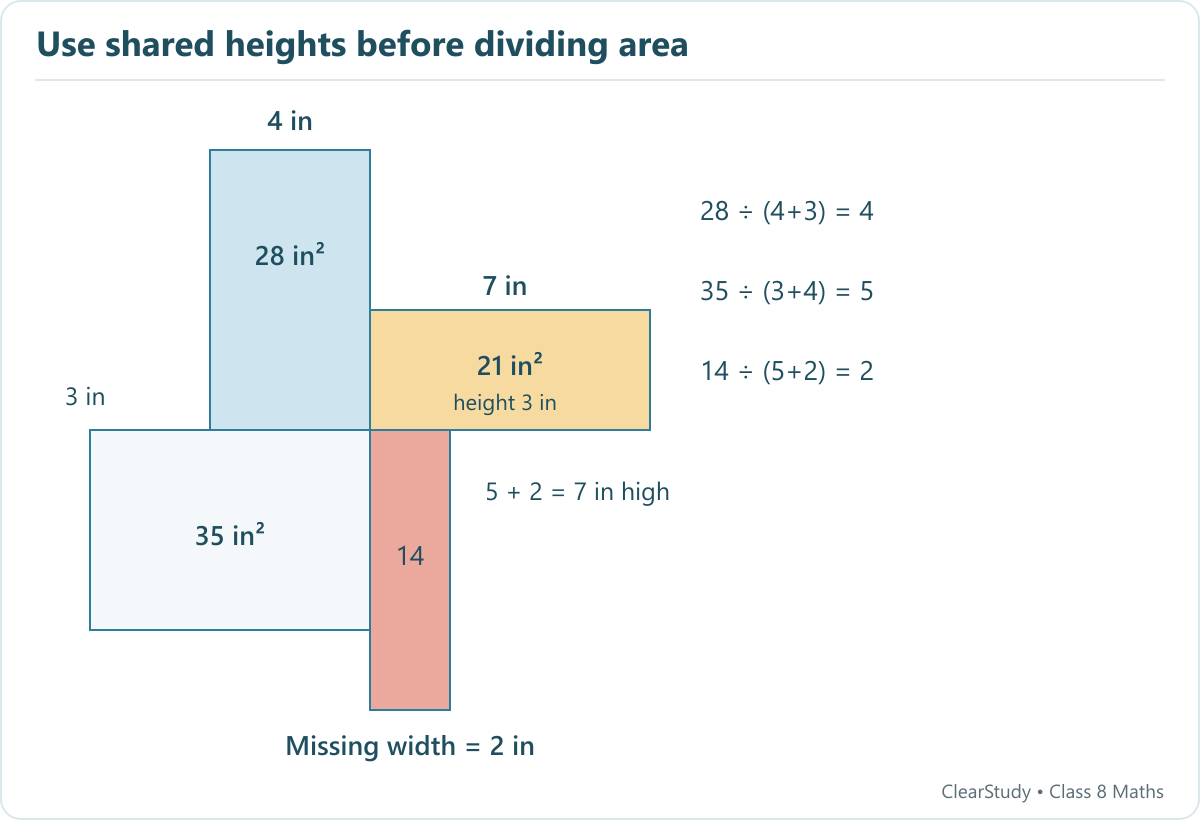
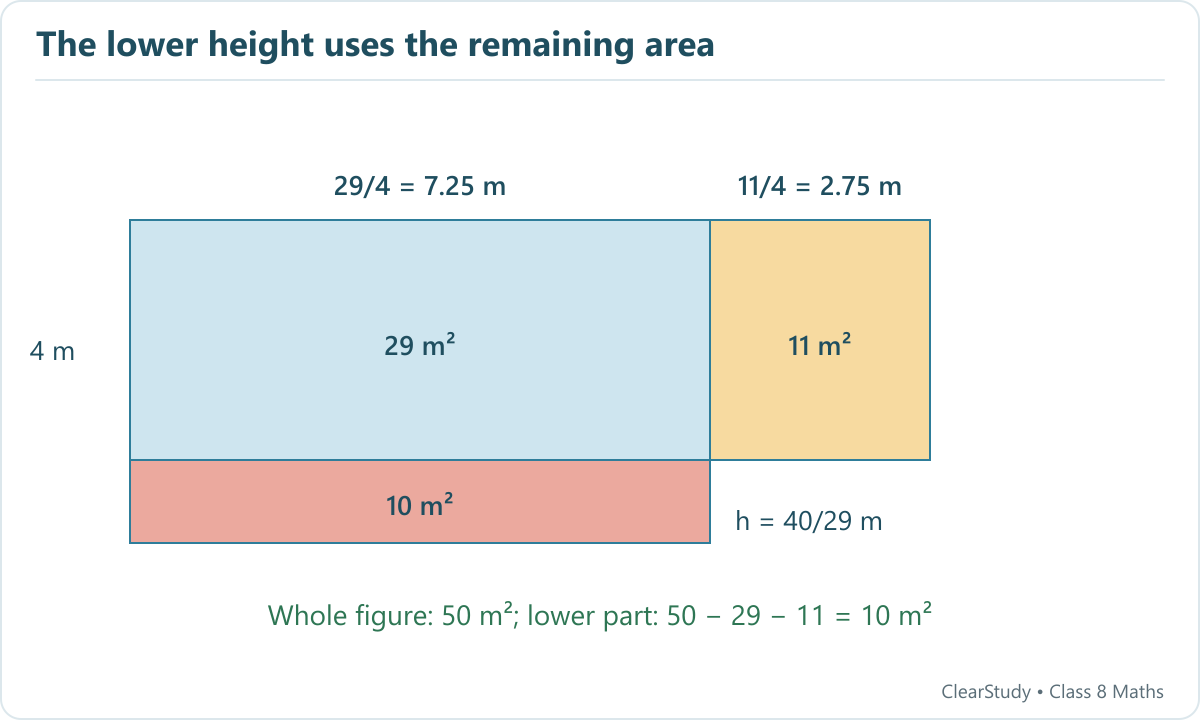
SOLUTION(i) The 21 in2 rectangle has width 7 in, so height=21/7=3 in. The 28 in2 rectangle extends 4 in above it, so its full height is 3+4=7 in and width=28/7=4 in.The 35 in2 rectangle has width 3+4=7 in, so its height is 35/7=5 in. The 14 in2 strip extends 2 in lower, so its height is 5+2=7 in. Its missing width is 14/7=2 in.(ii) Both top rectangles are 4 m high. Their widths are 29/4=7.25 m and 11/4=2.75 m. Taking the labelled 50 m2 as the area of the whole composite figure, the lower rectangle has area 50−29−11=10 m2. It shares width 29/4 m, so its missing height is 10 ÷ (29/4)=40/29 m ≈1.38 m. The outline is not a full rectangle of height 4 m.
Four rectangles: the 21-square-inch block is 3 inches high; the 28 block is 7 high and 4 wide; the 35 block is 7 wide and 5 high; the 14 block is 7 high and 2 wide.
Taking 50 square metres as the whole composite area, top widths are 7.25 and 2.75 metres, and lower height is 10 divided by 7.25, or 40/29 metres.

2. The figure shows a path (the shaded portion) laid around a rectangular park EFGH. (i) What measurements do you need to find the area of the path? Once you identify the lengths to be measured, assign possible values of your choice to these measurements and find the area of the path. Give a formula for the area. [Hint: There is a relation between the areas of EFGH, the path, and ABCD.] (ii) If the width of the path along each side is given, can you find its area? If not, what other measurements do you need? Assign values of your choice to these measurements and find the area of the path. Give a formula for the area using these measurements. [Hint: Break the path into rectangles.] (iii) Does the area of the path change when the outer rectangle is moved while keeping the inner rectangular park EFGH inside it, as shown?

SOLUTION (i) The path = outer rectangle ABCD − inner park EFGH. So you need the length and width of both rectangles. Area of path = Area(ABCD) − Area(EFGH). Example: let ABCD = 12 m × 8 m = 96 m2 and EFGH = 8 m × 4 m = 32 m2. Area of path = 96 − 32 = 64 m2. (ii) Knowing only the width of the path is not enough; you also need the inner park’s length and width (or the outer dimensions). Break the path into 4 corner squares + 4 side rectangles. Example: park = 8 m × 4 m, uniform path width w = 1 m. Outer = (8 + 2)(4 + 2) = 10 × 6 = 60 m2; path = 60 − 32 = 28 m2. Formula with park L × B and width w: Area = (L + 2w)(B + 2w) − LB = 2w(L + B) + 4w2. (iii) If the outer rectangle slides but stays the same size and still contains EFGH, the path area = Area(ABCD) − Area(EFGH) is unchanged, since both areas stay the same. (Only the shape of the strips changes, not the total.)

If the surrounding path has different widths l, r, t, b at the left, right, top and bottom, an inner park L × B gives path area (L+l+r)(B+t+b)−LB. Equal width w gives 2w(L+B)+4w2.

3. The figure shows a plot with sides 14 m and 12 m, and with a crosspath. What other measurements do you need to find the area of the crosspath? Once you identify the lengths to be measured, assign some possible values of your choice and find the area of the path. Give a formula for the area based on the measurements you choose.
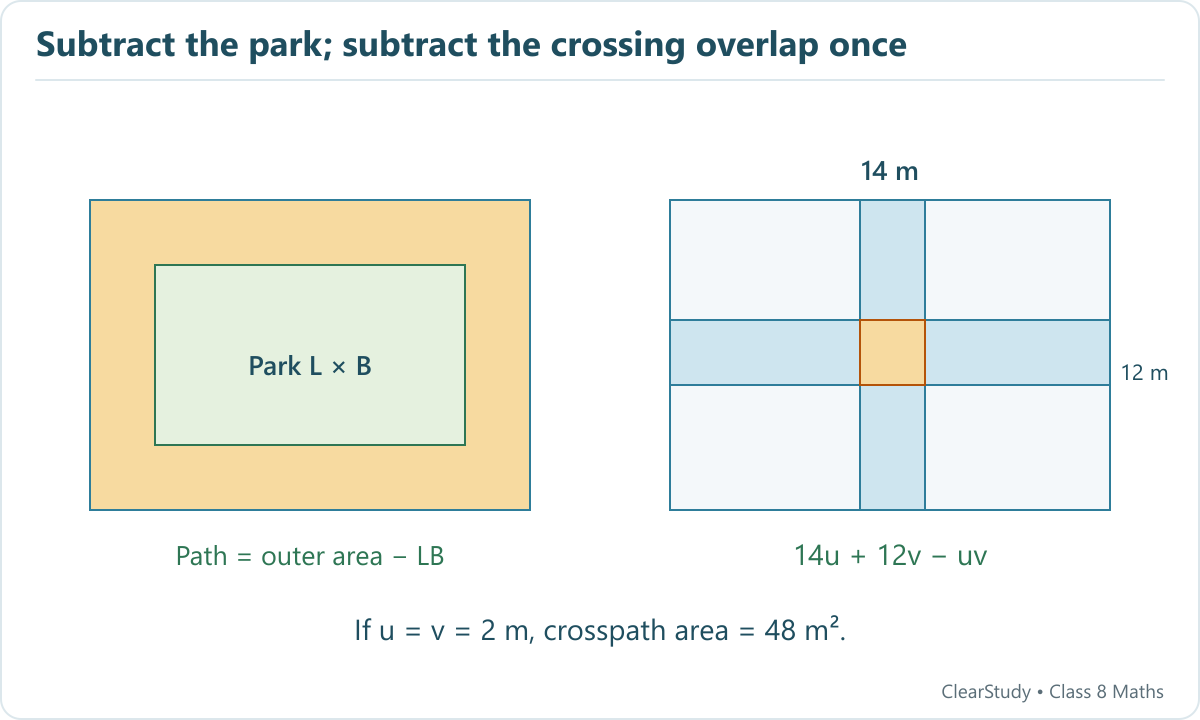
SOLUTIONMeasure the width u of the path running across the 14 m length, and the width v of the path running across the 12 m length. Their areas are 14u and 12v. The overlap has area uv and was counted twice.Crosspath area = 14u+12v−uv m2, with u and v measured in metres. If both widths are 2 m, the area is 28+24−4=48 m2. For a plot L × B and equal width w, the formula is w(L+B)−w2.
A surrounding path equals outer rectangle minus park. Crossing strips of widths u and v have area 14u+12v−uv because the overlap is counted twice.

4. Find the area of the spiral tube shown in the figure. The tube has the same width throughout. [Hint: There are different ways of finding the area. Here is one method.] What should be the length of the straight tube if it is to have the same area as the bent tube on the left?
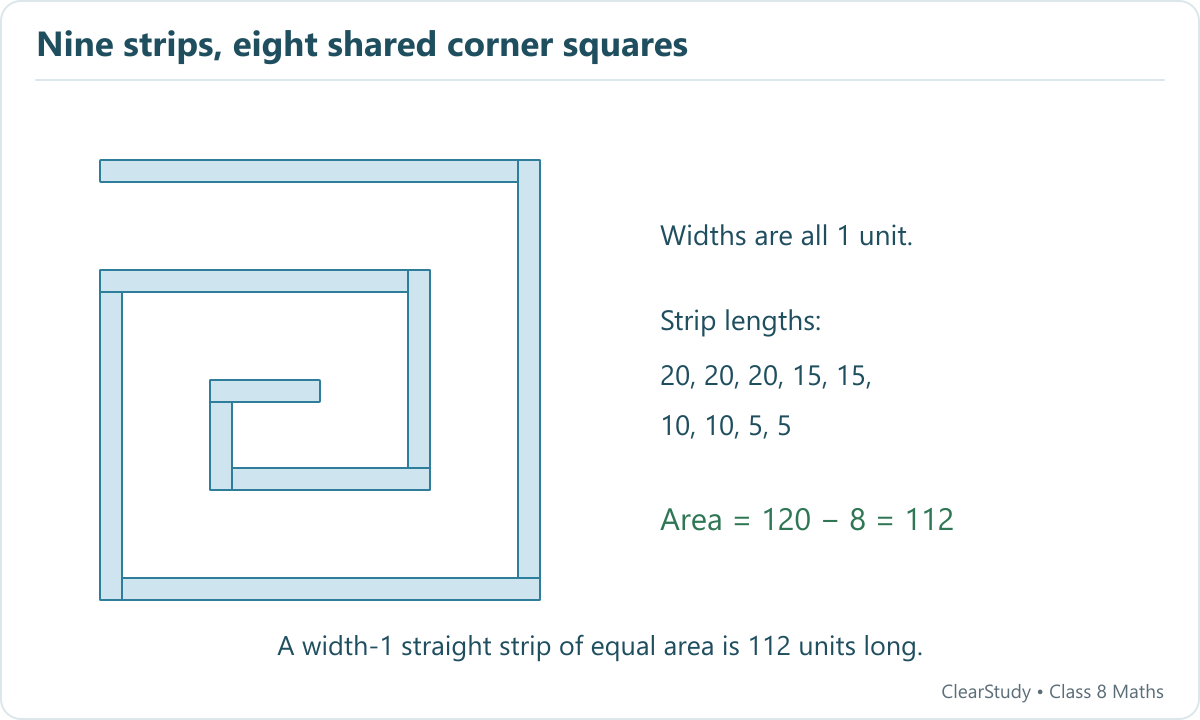
SOLUTIONThe diagram has nine strips of width 1, with outside lengths 20, 20, 20, 15, 15, 10, 10, 5 and 5 units. Their area sum is 120 square units. At each of the eight bends, a 1 × 1 corner square was counted twice.Spiral area = 120−8=112 square units. A width-1 straight strip with the same area would be 112 units long. The marked outside lengths are not centre-line lengths.Separate L-shaped hint: its two 5 × 1 arms overlap in one unit square, so its area is 5+5−1=9 square units. The straight strip in that hint is 9 units long.
The spiral has nine unit-width strips whose lengths sum to 120. Subtract eight 1 by 1 corner overlaps to get 112 square units.

5. In this figure, if the sidelength of the square is doubled, what is the increase in the areas of the regions 1, 2 and 3? Give reasons.
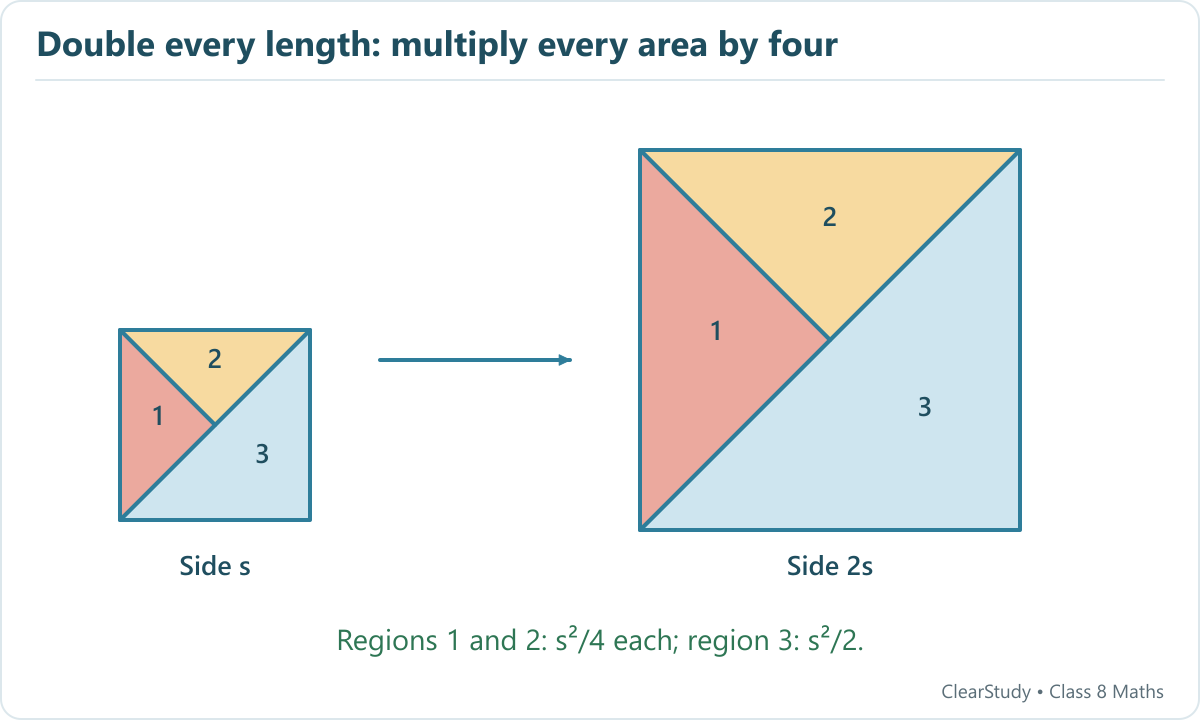
SOLUTION All three regions are parts of the square, so each one’s area is a fixed fraction of the square’s area. When the side is doubled (s → 2s), the square’s area becomes (2s)2 = 4s2 — 4 times the original. Every region scales by the same factor. So each of regions 1, 2 and 3 also becomes 4 times its original area, i.e. the increase is 3 times (300% of) the original area of that region. (The shapes stay similar; doubling lengths multiplies any area by 22 = 4.)
The square is split into two quarter-area triangles and one half-area triangle. Doubling its side quadruples each area, an increase of 300 percent.

6. Divide a square into 4 parts by drawing two perpendicular lines inside the square as shown in the figure. Rearrange the pieces to get a larger square, with a hole inside. You can try this activity by constructing the square using cardboard, thick chart paper, or similar materials.
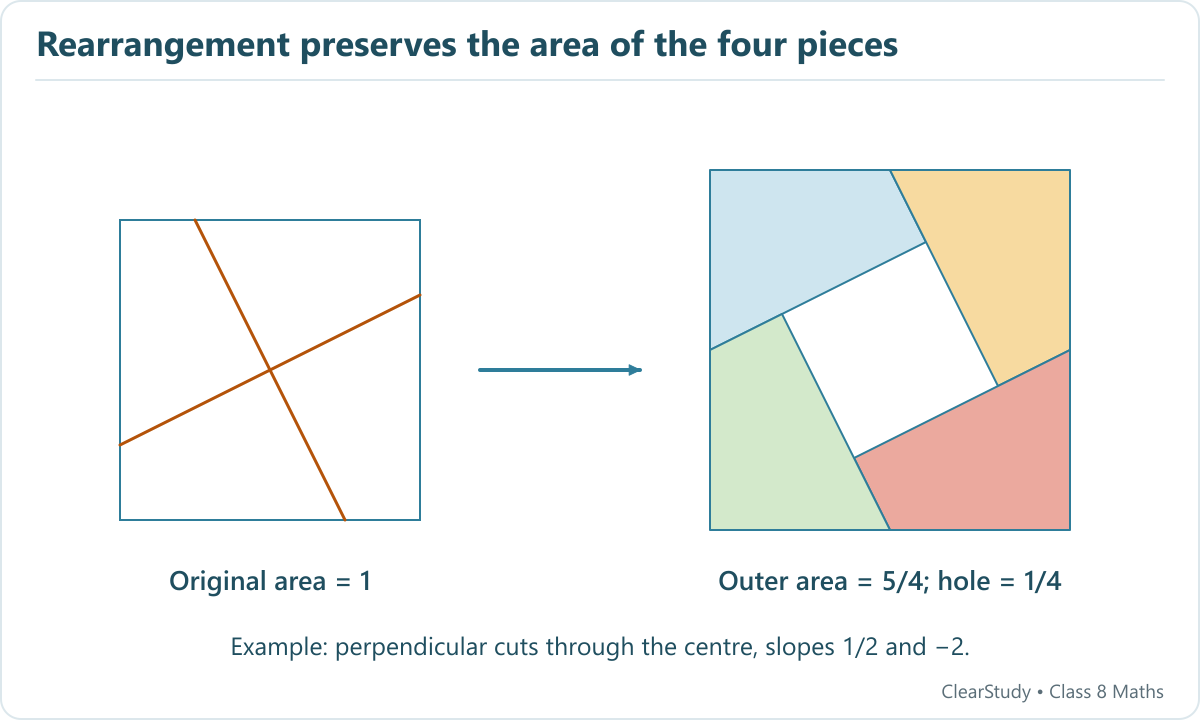
SOLUTIONCut along the two perpendicular lines. Rearrange the four pieces without stretching or overlapping them so that their cut-line right angles become the four outside corners. The other vertices bound the square hole.One exact example uses a unit square centred at the origin and cuts y=x/2 and y=−2x. The four congruent pieces can be placed as shown below. The outer side is √5/2, so its area is 5/4; the hole has side 1/2 and area 1/4.The area check is 5/4−1/4=1, the original square area. The hole accounts for the larger outside square; rearrangement creates no extra material.
One exact example cuts a unit square through its centre along perpendicular slopes one half and minus two. Reassembled pieces form an outer square of area 5/4 around a hole of area 1/4.

Triangles between parallel lines (pages 153–157)

Triangles with a common base and their opposite vertices on one parallel line have the same perpendicular height and therefore equal area. The 5-by-4 example has triangle area 10 square units. In the separate worked example on page 155, BY=15/4=3.75 units.

For a fixed base and an unrestricted parallel line, the isosceles triangle whose apex lies on the perpendicular bisector has the least perimeter. Reflect a base endpoint across the parallel line to prove this with a straight shortest path. There is no greatest perimeter if the apex may move arbitrarily far along the line.

Figure it Out — Triangles (Page 157)

1. Find the areas of the following triangles: (i) ▵ABC with base BC = 4 cm and height AE = 3 cm (AE ⊥ BC). (ii) ▵DEF with DF = 5 cm and the perpendicular EN from E to DF equal to 3.2 cm. (iii) Right triangle NAT, right-angled at A, with AT = 3 cm and AN = 4 cm.
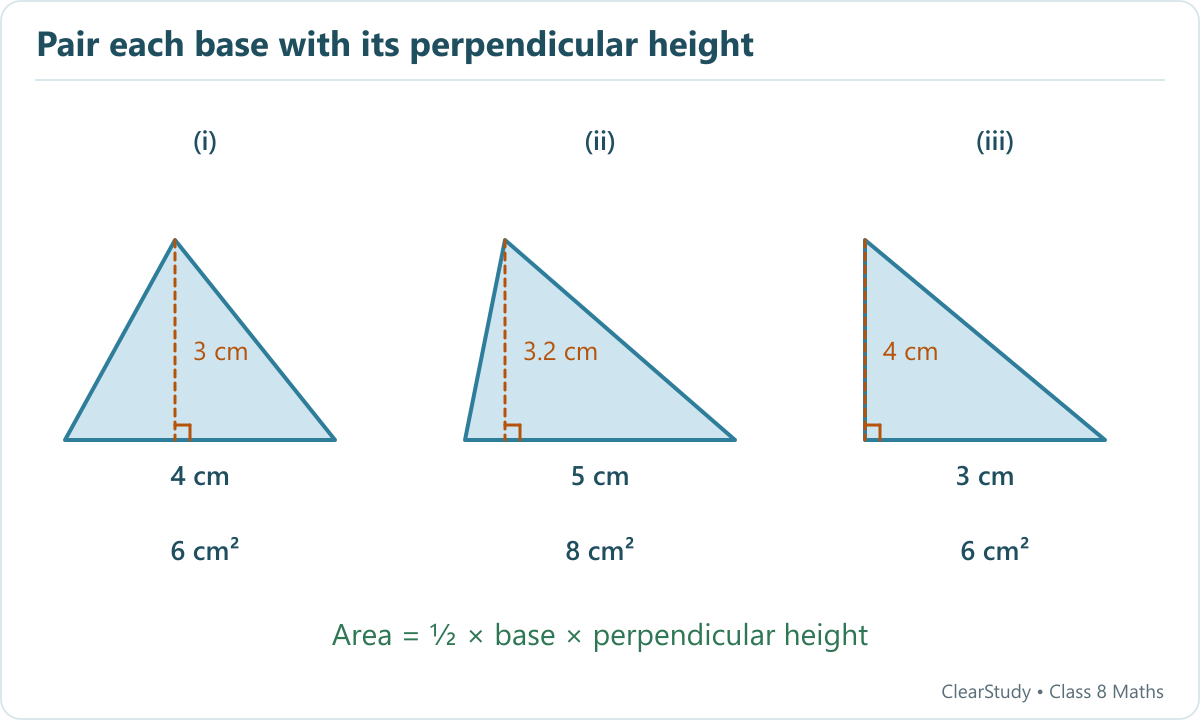
SOLUTION (i) Area = ½ × base × height = ½ × 4 × 3 = 6 cm2. (ii) Take DF = 5 cm as the base and EN = 3.2 cm as the height: Area = ½ × 5 × 3.2 = 8 cm2. (iii) The legs AT = 3 cm and AN = 4 cm meet at the right angle, so they are base and height: Area = ½ × 3 × 4 = 6 cm2.
Three exercise triangles give areas 6, 8 and 6 square centimetres from perpendicular base-height pairs.

2. Find the length of the altitude BY. (In ▵ABC, AX = 4 units is the perpendicular height, with X on BC extended beyond B, BC = 6 units, and AC = 8 units; BY is the altitude from B to AC.)
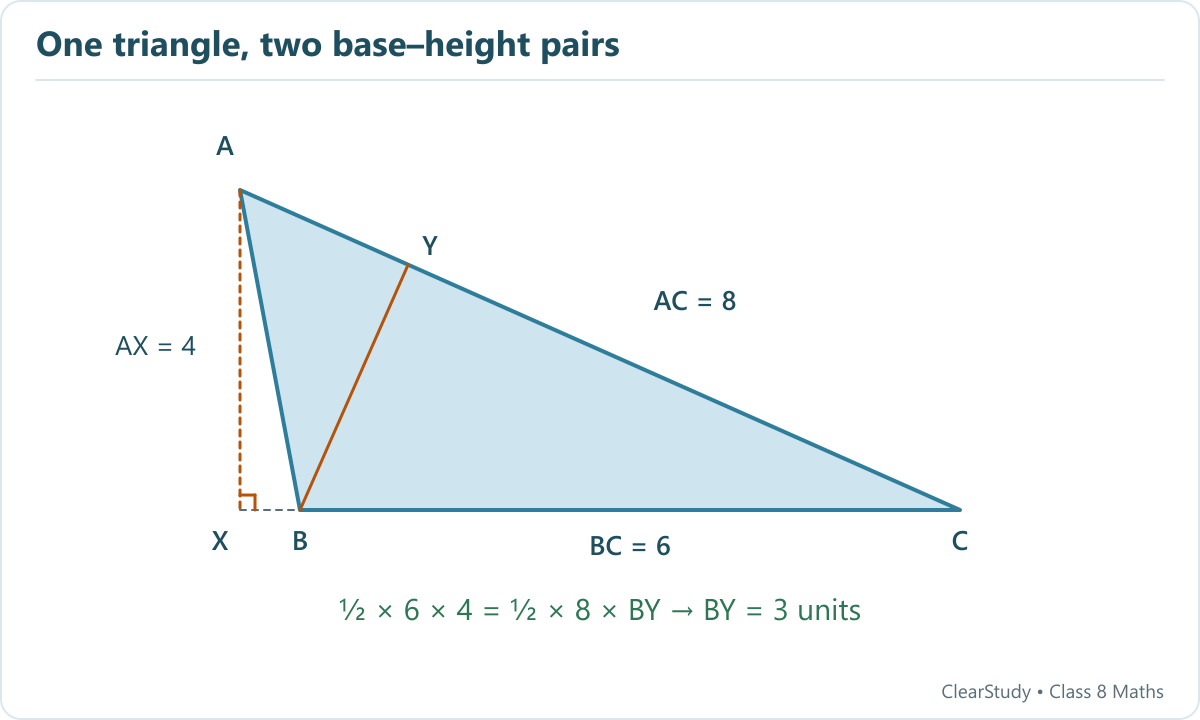
SOLUTION Find the area two ways. Using base BC = 6 and height AX = 4: Area(▵ABC) = ½ × 6 × 4 = 12 sq. units. Using base AC = 8 and height BY: Area = ½ × 8 × BY = 4·BY. Equate: 4·BY = 12 ⇒ BY = 3 units.
AX is the external altitude of length 4, not side AB. Equal area expressions using bases BC=6 and AC=8 give BY=3 units.

3. Find the area of ▵SUB, given that it is isosceles, SE is perpendicular to UB, and the area of ▵SEB is 24 sq. units.

SOLUTION In an isosceles triangle SUB (SU = SB), the altitude SE from the apex to the base UB is also the median, so E is the midpoint of UB and UE = EB. Therefore ▵SEU and ▵SEB have equal bases and the same height SE, so Area(▵SEU) = Area(▵SEB) = 24 sq. units. Area(▵SUB) = Area(▵SEU) + Area(▵SEB) = 24 + 24 = 48 sq. units.

4. [Śulba-Sūtras] Give a method to transform a rectangle into a triangle of equal area.

SOLUTION Take rectangle PQRS. On the line of one side PQ (the base), keep the base PQ. A triangle of equal area on the same base must have height = 2 × (rectangle’s height), because triangle area = ½ × base × height while rectangle area = base × height. Method: extend the side and mark a point T at a perpendicular distance 2h from base PQ (where h = PS). Join P–T–Q. Then Area(▵PQT) = ½ × PQ × 2h = PQ × h = Area of the rectangle.

5. [Śulba-Sūtras] Give a method to transform a triangle into a rectangle of equal area.
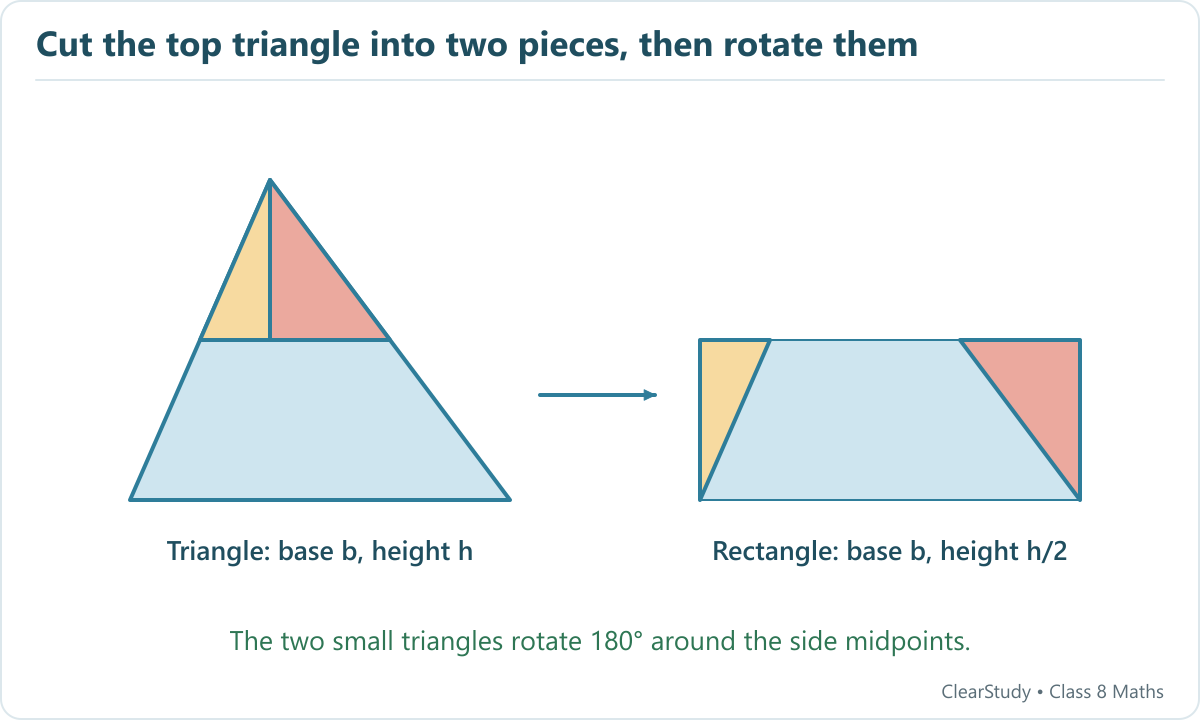
SOLUTIONChoose a base BC=b with altitude h whose foot lies inside the base; the longest side is a suitable choice. Mark midpoints P of AB and Q of AC. The midline PQ lies at height h/2. Cut along PQ.Split the top triangle APQ along its altitude into two right triangles. Rotate the left small triangle by 180° about P and the right one by 180° about Q. They fill the two upper corners beside the remaining trapezium, forming a rectangle of width b and height h/2.Its area is b(h/2)=bh/2, exactly the original triangle area. A rectangle of both width b/2 and height h/2 would have only bh/4 and is not the required answer.
Cut a triangle along its midline and split the top triangle along its altitude. Rotate those two pieces about the side midpoints to fill a rectangle of base b and height h/2.

6. ABCD, BCEF, and BFGH are identical squares. (i) If the area of the red region is 49 sq. units, then what is the area of the blue region? (ii) In another version of this figure, if the total area enclosed by the blue and red regions is 180 sq. units, then what is the area of each square?
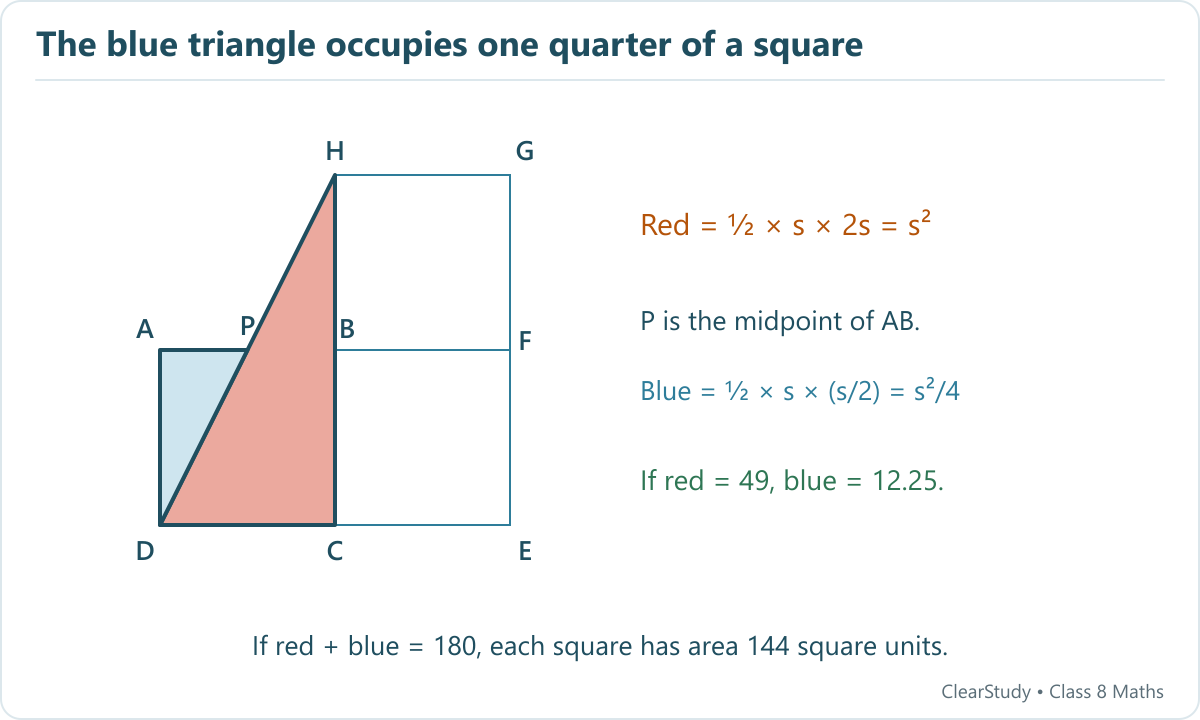
SOLUTIONLet each square have side s and let P=DH ∩ AB. Red triangle DCH has base DC=s and height CH=2s, so its area is s2. Since AB lies halfway up CH, P is halfway along AB: AP=s/2.Blue triangle DAP has area (1/2)×AD×AP=(1/2)×s×(s/2)=s2/4.(i) Red area 49 means s2=49, so blue area=49/4=12.25 square units.(ii) Combined area s2+s2/4=180, so (5/4)s2=180 and each square has area 144 square units.
Three identical squares show red triangle DCH of area s squared and blue triangle DAP of area s squared divided by four. Red 49 gives blue 12.25; combined area 180 gives each square area 144.

7. If M and N are the midpoints of XY and XZ, what fraction of the area of ▵XYZ is the area of ▵XMN? [Hint: Join NY]

SOLUTION Join NY. Since N is the midpoint of XZ, the median YN splits ▵XYZ into two equal halves, so Area(▵XYN) = ½ Area(▵XYZ). In ▵XYN, M is the midpoint of XY, so NM is a median and Area(▵XMN) = ½ Area(▵XYN) = ½ × ½ Area(▵XYZ). Therefore Area(▵XMN) = ¼ of the area of ▵XYZ.

8. Gopal needs to carry water from the river to his water tank. He starts from his house. What is the shortest path he can take from his house to the river and then to the water tank? Roughly recreate the map in your notebook and trace the shortest path.
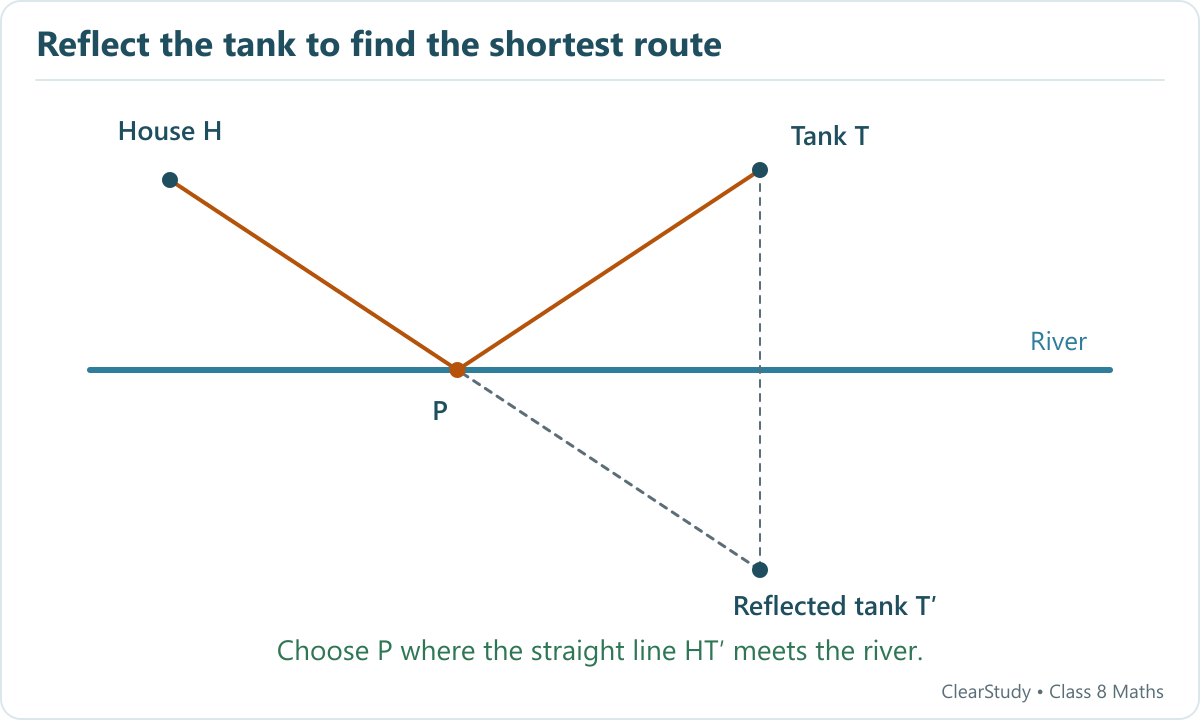
SOLUTION This is the “reflection” shortest-path problem (the same idea used earlier for the minimum-perimeter triangle). Method: Reflect the water tank across the river line to get the image point T′. Draw the straight line from the House to T′; the point P where it crosses the river is the best touch point. The shortest path is House → P (on the river) → Water tank, because House–P–Tank has the same length as the straight segment House–T′, and a straight line is the shortest distance.
For a straight river bank, reflect the tank across the river and join the house to the reflected tank. Its crossing P gives the shortest route House-P-Tank.

Figure it Out — Area of any Polygon (Page 160)

1. Find the area of the quadrilateral ABCD given that AC = 22 cm, BM = 3 cm, DN = 3 cm, BM is perpendicular to AC, and DN is perpendicular to AC.

SOLUTION Diagonal AC = 22 cm splits ABCD into ▵ABC (height BM = 3 cm) and ▵ACD (height DN = 3 cm), both on base AC. Area(▵ABC) = ½ × 22 × 3 = 33 cm2; Area(▵ACD) = ½ × 22 × 3 = 33 cm2. Area(ABCD) = 33 + 33 = 66 cm2. (Equivalently ½ × AC × (BM + DN) = ½ × 22 × 6 = 66 cm2.)

2. Find the area of the shaded region given that ABCD is a rectangle. (AB = 10 + 8 = 18 cm along the top with E on AB so that AE = 10 cm and EB = 8 cm; the height is 10 cm with F on AD so that AF = 6 cm and FD = 4 cm; DC = 18 cm. The shaded region is quadrilateral D-F-E-C.)
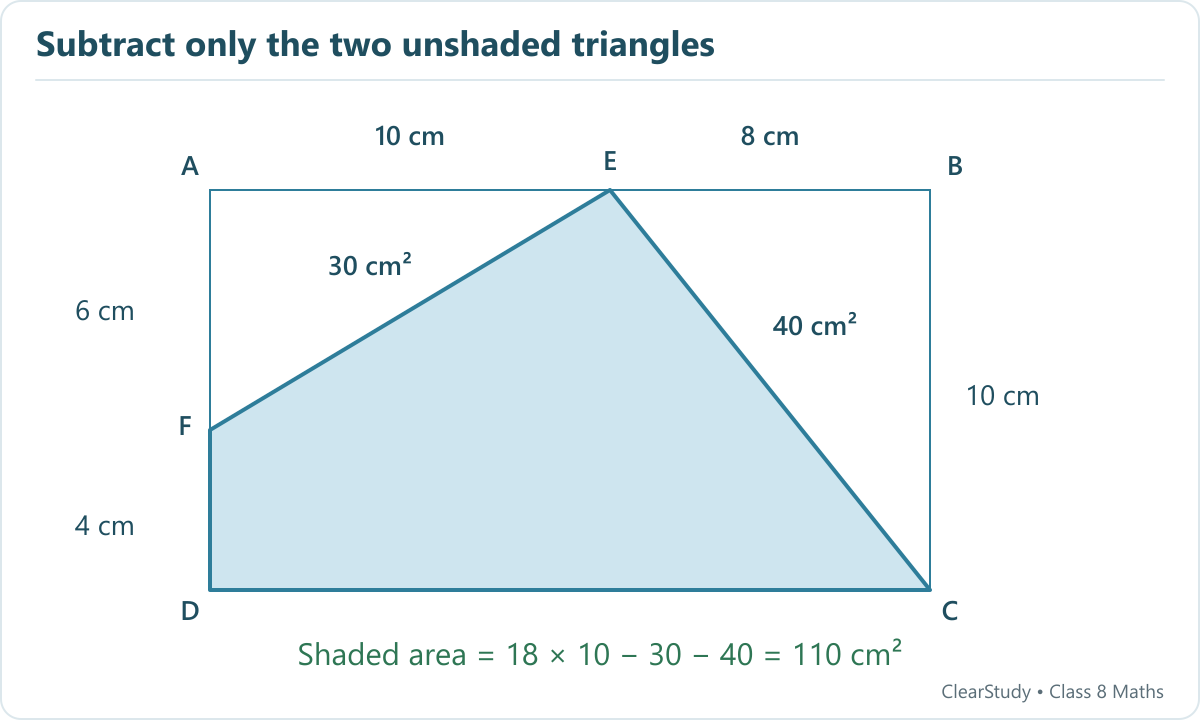
SOLUTIONThe rectangle has area 18×10=180 cm2. Only triangles AEF and EBC are unshaded.Area(AEF)=(1/2)×10×6=30 cm2. Area(EBC)=(1/2)×8×10=40 cm2.Shaded area=180−30−40=110 cm2. Triangle FDC lies inside the shaded region and must not be subtracted.
In rectangle ABCD, shaded D-F-E-C excludes only triangles AEF of area 30 and EBC of area 40. The shaded area is 110 square centimetres.

3. What measurements would you need to find the area of a regular hexagon?

SOLUTION Split the regular hexagon into 6 identical triangles by joining the centre to all vertices. You need the side length of the hexagon (the base of each triangle) and the apothem — the perpendicular distance from the centre to a side (the height of each triangle). Then Area = 6 × (½ × side × apothem) = 3 × side × apothem. (Equivalently, ½ × perimeter × apothem.)

4. What fraction of the total area of the rectangle is the area of the blue region?
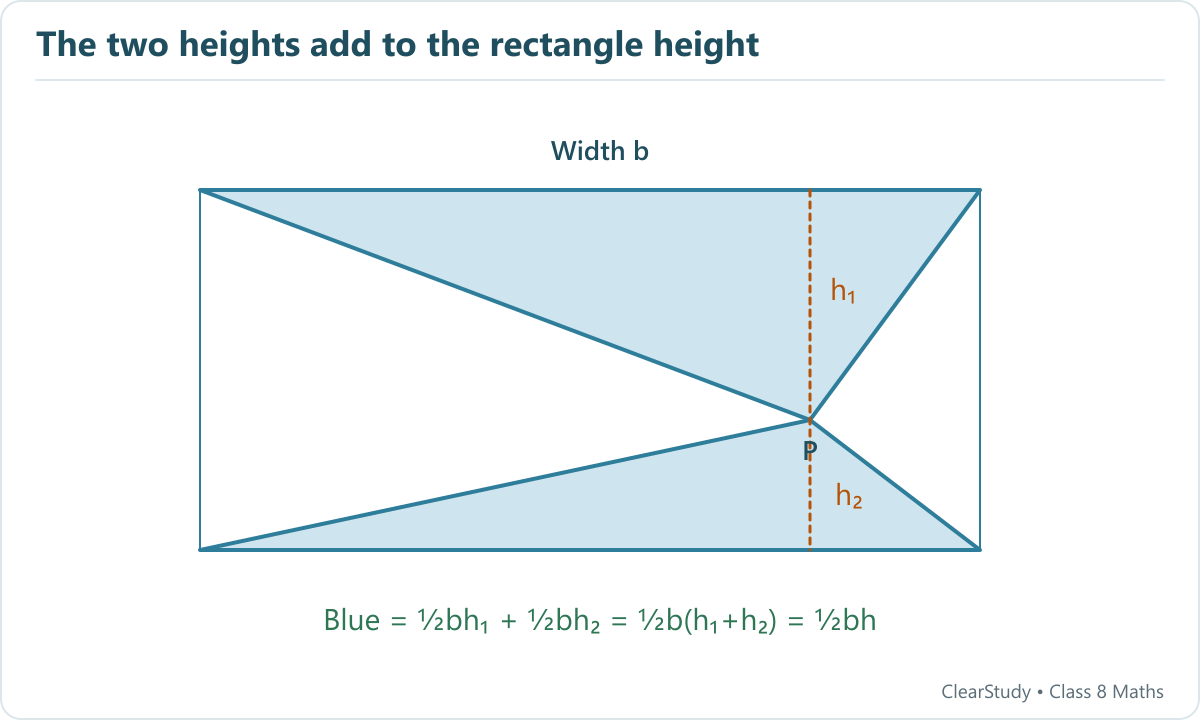
SOLUTIONLet the rectangle have width b and height h, and call the interior meeting point P. The blue triangles have the full top and bottom sides as bases. Let their perpendicular heights be h1 and h2.Because P lies inside the rectangle, h1+h2=h. Blue area=(1/2)bh1+(1/2)bh2=(1/2)bh. Thus the fraction is 1/2. P need not be the centre, and the two blue areas need not be equal.
The textbook blue triangles have the full top and bottom edges as bases and a common interior vertex P. Their heights add to h, so the blue area is half the rectangle even when P is not the centre.

5. Give a method to obtain a quadrilateral whose area is half that of a given quadrilateral.
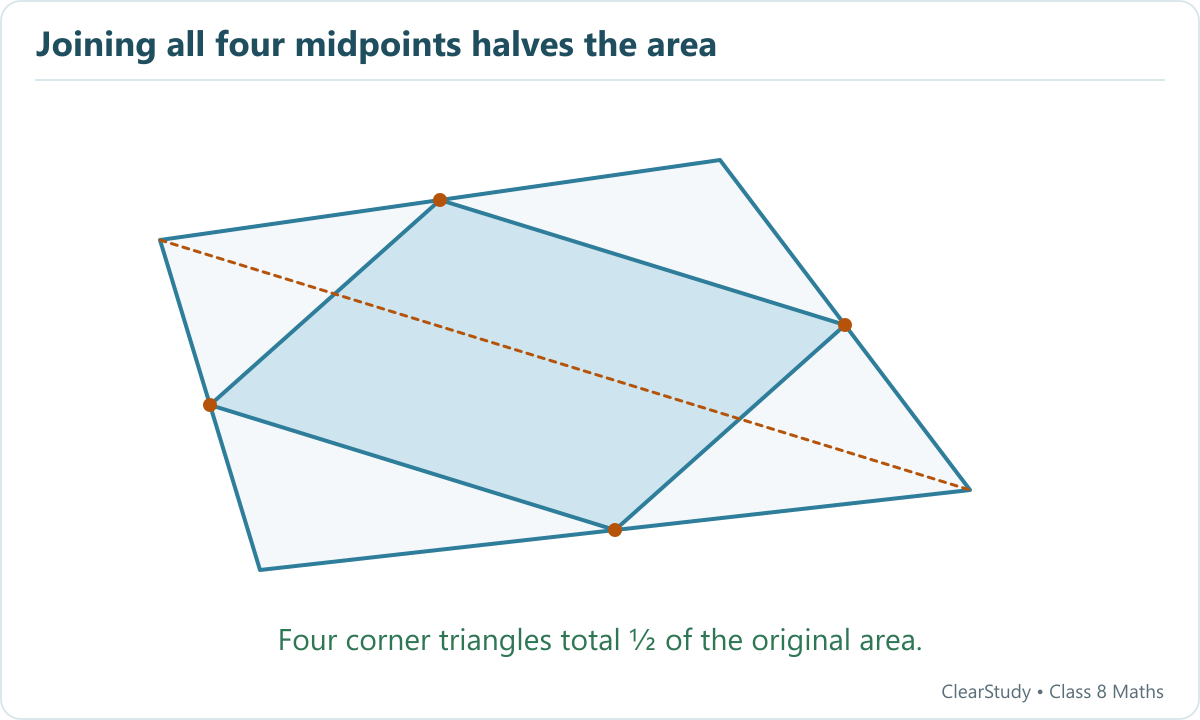
SOLUTIONFor a convex quadrilateral PQRS, mark midpoints A, B, C and D on PQ, QR, RS and SP, and join them in order. The inner figure is the Varignon parallelogram.Draw diagonal PR. In triangle PQR, corner triangle QAB has both adjacent sides half as long and hence one quarter its area. The analogous opposite corner SCD has one quarter the area of PRS. Together these two corners are one quarter the quadrilateral area. Drawing QS proves the other two corners together are another quarter. Removing all four corners leaves half the original area.
Joining the side midpoints of a convex quadrilateral forms an inner parallelogram of half its area. A diagonal supports the proof using quarter-area corner triangles.

Figure it Out — Parallelograms (Page 162)

1. Observe the parallelograms in the figure below. (i) What can we say about the areas of all these parallelograms? (ii) What can we say about their perimeters? Which figure appears to have the maximum perimeter, and which has the minimum perimeter?
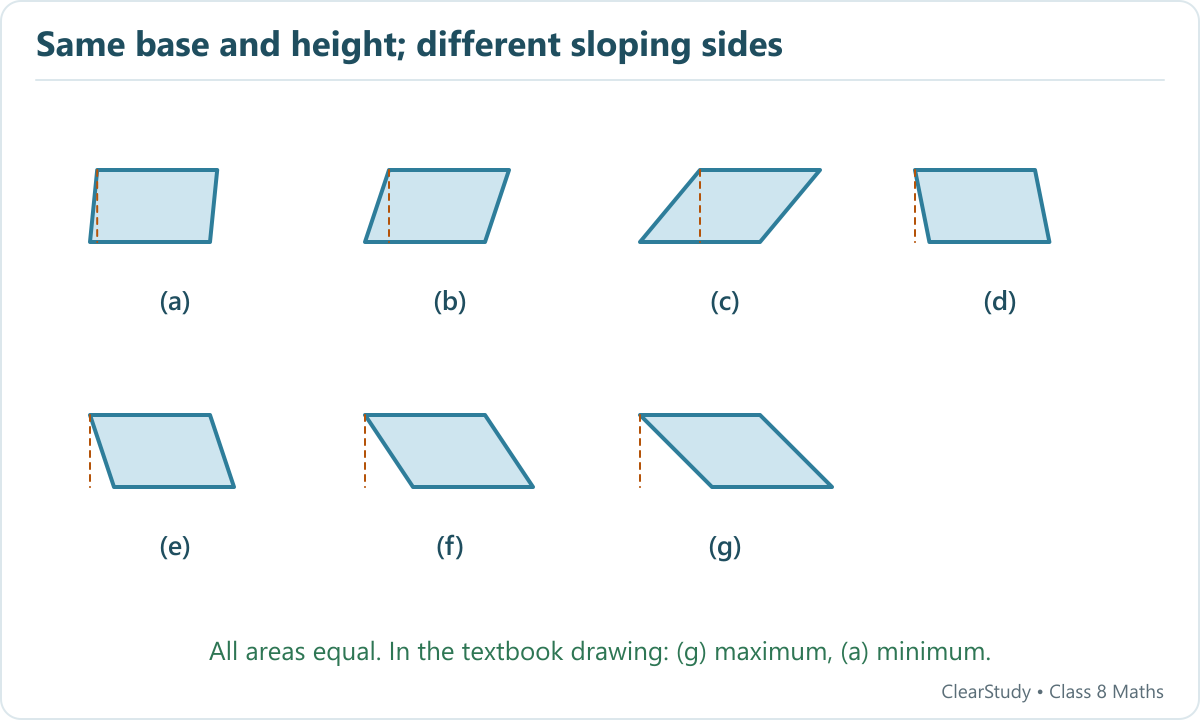
SOLUTION(i) All seven have equal base lengths and the same perpendicular height on the grid, so their areas are equal.(ii) The perimeters differ because the sloping side lengths differ. In the textbook drawing, (g) appears to have the greatest perimeter and (a) the least. A rectangle is the minimum among all shears with this base and height, but none of these drawings needs to be exactly rectangular.
Seven parallelograms share equal base and perpendicular height. The textbook drawing has greatest slant and perimeter in g, and least in a.

2. Find the areas of the following parallelograms: (i) base 7 cm, height 4 cm. (ii) base 5 cm, height 3 cm. (iii) base 5 cm, corresponding height 4.8 cm. (iv) base 2 cm, corresponding height 4.4 cm.

SOLUTION Area of a parallelogram = base × height. (i) 7 × 4 = 28 cm2. (ii) 5 × 3 = 15 cm2. (iii) 4.8 × 5 = 24 cm2. (iv) 4.4 × 2 = 8.8 cm2.

3. Find QN. (In parallelogram PQRS, base SR with M on it, QM = 6 cm is the height onto SR, SR = 12 cm; PS = 7.6 cm is another side and QN is the height onto the line PS, with N the foot of the perpendicular.)
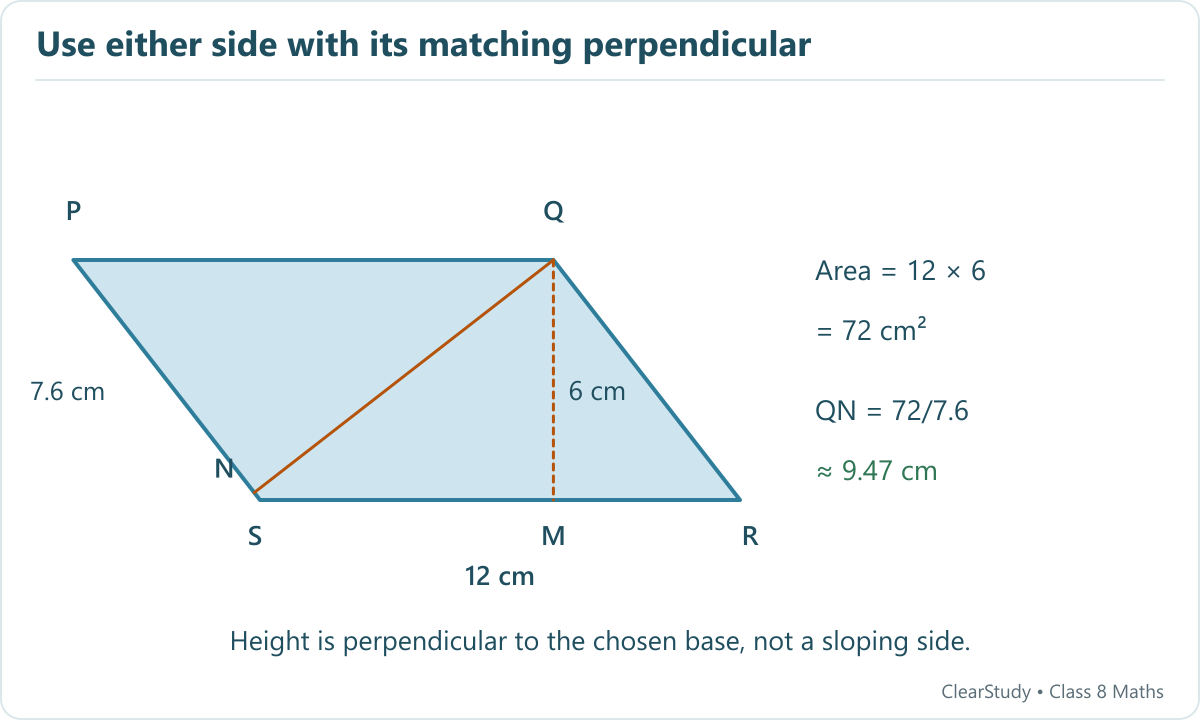
SOLUTION Find the area using base SR = 12 cm and height QM = 6 cm: Area = 12 × 6 = 72 cm2. The same area, using base PS = 7.6 cm and height QN: Area = 7.6 × QN. So 7.6 × QN = 72 ⇒ QN = 72 ÷ 7.6 = 9.47 cm (approximately 9.5 cm).
Parallelogram PQRS has area 12 times 6, or 72 square centimetres. With side PS=7.6 as base, its corresponding height QN is 180/19, about 9.47 centimetres.

4. Consider a rectangle and a parallelogram of the same sidelengths: 5 cm and 4 cm. Which has the greater area? [Hint: Imagine constructing them on the same base.]

SOLUTION Rectangle 5 cm × 4 cm has area = 20 cm2, with height equal to the full side 4 cm. In the parallelogram with the same sides, the slant side 4 cm is not the height; the perpendicular height is less than 4 cm. So its area = 5 × (height < 4) < 20 cm2. Therefore the rectangle has the greater area. (Among all parallelograms with given sides, the rectangle is the largest.)

5. Give a method to obtain a rectangle whose area is twice that of a given triangle. What are the different methods that you can think of?

SOLUTIONIf the triangle has base b and perpendicular height h, its area is bh/2. A rectangle of dimensions b × h has twice that area.Another rectangle is (b/2) × (2h); more generally any positive dimensions with product bh work. Alternatively, join the triangle to a congruent rotated copy to make a parallelogram, then dissect that parallelogram into a rectangle.

6. [Śulba-Sūtras] Give a method to obtain a rectangle of the same area as a given triangle.

SOLUTIONChoose a base BC=b with altitude h whose foot lies inside the base; the longest side is a suitable choice. Mark midpoints P of AB and Q of AC. The midline PQ lies at height h/2. Cut along PQ.Split the top triangle APQ along its altitude into two right triangles. Rotate the left small triangle by 180° about P and the right one by 180° about Q. They fill the two upper corners beside the remaining trapezium, forming a rectangle of width b and height h/2.Its area is b(h/2)=bh/2, exactly the original triangle area. A rectangle of both width b/2 and height h/2 would have only bh/4 and is not the required answer.

7. [Śulba-Sūtras] An isosceles triangle can be converted into a rectangle by dissection in a simpler way. Can you find out how to do it? [Hint: Show that triangles ▵ADB and ▵ADC can be made into halves of a rectangle. Figure out how they should be assembled to get a rectangle. Use cut-outs if necessary.]

SOLUTION In isosceles ▵ABC (AB = AC), drop the altitude AD to the base BC. Since the triangle is isosceles, AD is also the median, so BD = DC and ▵ADB ≅ ▵ADC. Cut along AD to get two congruent right triangles. Flip one and place it beside the other so the two equal slant sides line up — they form a rectangle of base BD (= ½BC) and height AD. Rectangle area = ½BC × AD = ½ × base × height = Area of the isosceles triangle.

8. [Śulba-Sūtras] Give a method to convert a rectangle into an isosceles triangle by dissection.
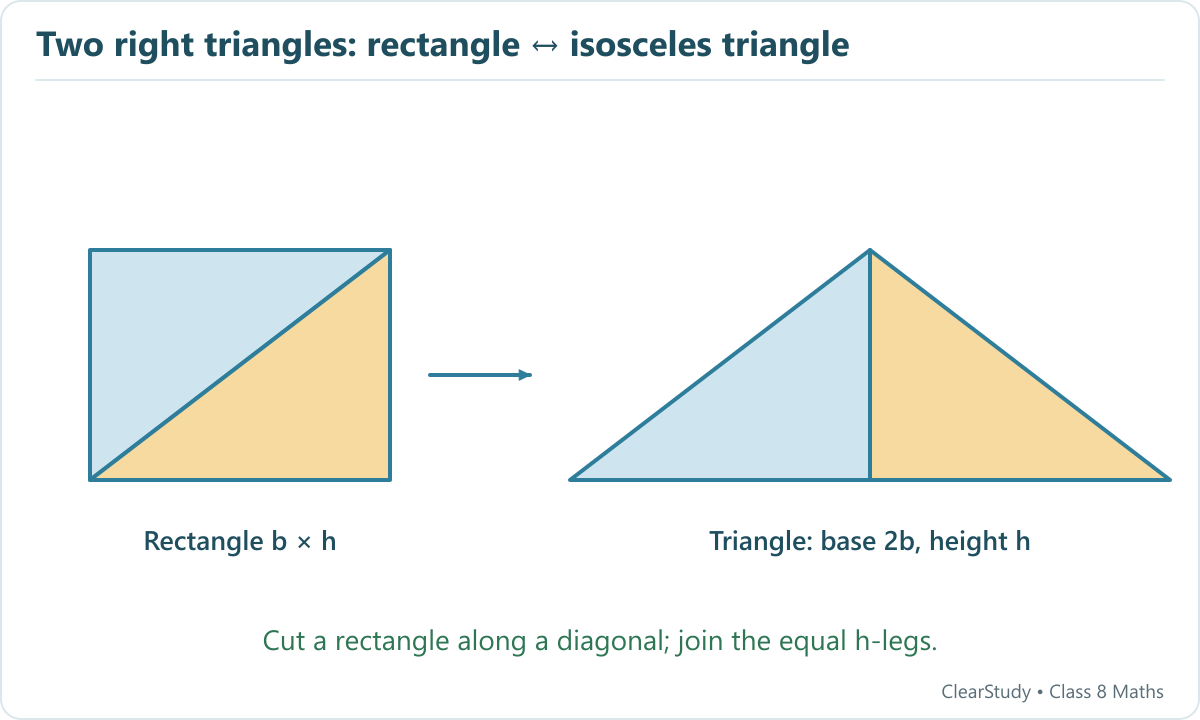
SOLUTIONTake a rectangle of width b and height h. Cut along a diagonal, producing two congruent right triangles with perpendicular legs b and h. Reposition them on opposite sides of a common h-leg.Their b-legs form a straight base of length 2b, while the common h-leg is the altitude. The two outer sloping sides are the equal hypotenuses, so the result is isosceles. Its area is (1/2)×2b×h=bh, equal to the rectangle.
Cutting a rectangle along a diagonal gives two congruent right triangles. Join their equal height legs to form an isosceles triangle of base twice the rectangle width and the same height.

9. Which has greater area — an equilateral triangle or a square of the same sidelength as the triangle? Which has greater area — two identical equilateral triangles together or a square of the same sidelength as the triangle? Give reasons.

SOLUTION Let the common side be s. Square area = s2. Equilateral triangle area = (√3 / 4) s2 ≈ 0.433 s2. Since 0.433 s2 < s2, the square has the greater area than one equilateral triangle. Two equilateral triangles = 2 × 0.433 s2 = 0.866 s2, which is still less than s2. So the square still has the greater area than two such triangles.

Figure it Out — Rhombus & Trapezium (Page 169)

1. Find the area of a rhombus whose diagonals are 20 cm and 15 cm.

SOLUTION Area of a rhombus = ½ × product of diagonals = ½ × 20 × 15. = ½ × 300 = 150 cm2.

2. Give a method to convert a rectangle into a rhombus of equal area using dissection.
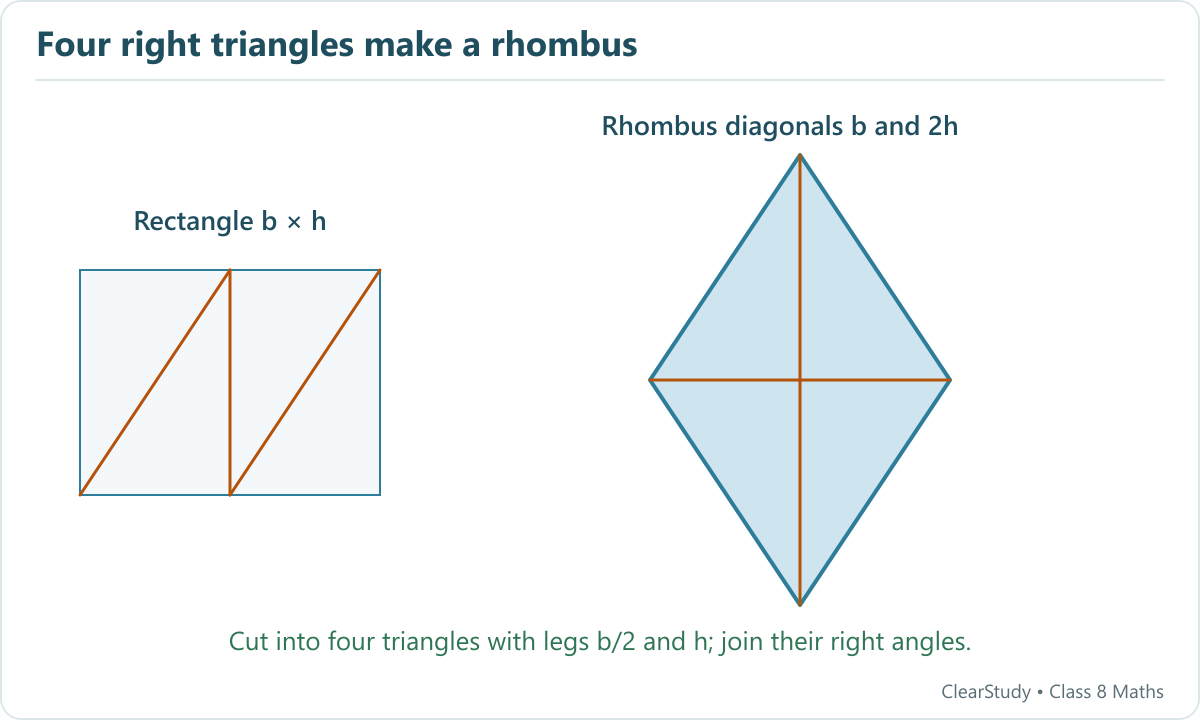
SOLUTIONTake a b × h rectangle. Divide it into two rectangles of width b/2 and height h, then cut each along a diagonal. This gives four congruent right triangles with legs b/2 and h.Arrange all four right angles together at one point, with the b/2 legs paired along one straight line and the h legs along a perpendicular line. The four hypotenuses form the equal sides of a rhombus.Its diagonals are b and 2h, so its area is (1/2)×b×2h=bh. All four original pieces are used without overlap.
Bisect a rectangle into two narrower rectangles, then cut each diagonally. Four congruent right triangles with legs b/2 and h assemble into a rhombus with diagonals b and 2h.

3. Find the areas of the following figures: (i) A trapezium with parallel sides 10 ft and 7 ft; the perpendicular distance between them is 16 ft. (ii) A trapezium with parallel sides 24 m (top) and 36 m (bottom) and height 14 m. (iii) A trapezium with vertical parallel sides 14 in and 6 in; their perpendicular separation is 10 in. (iv) A trapezium with parallel sides 12 ft (top) and 18 ft (bottom) and height 8 ft.
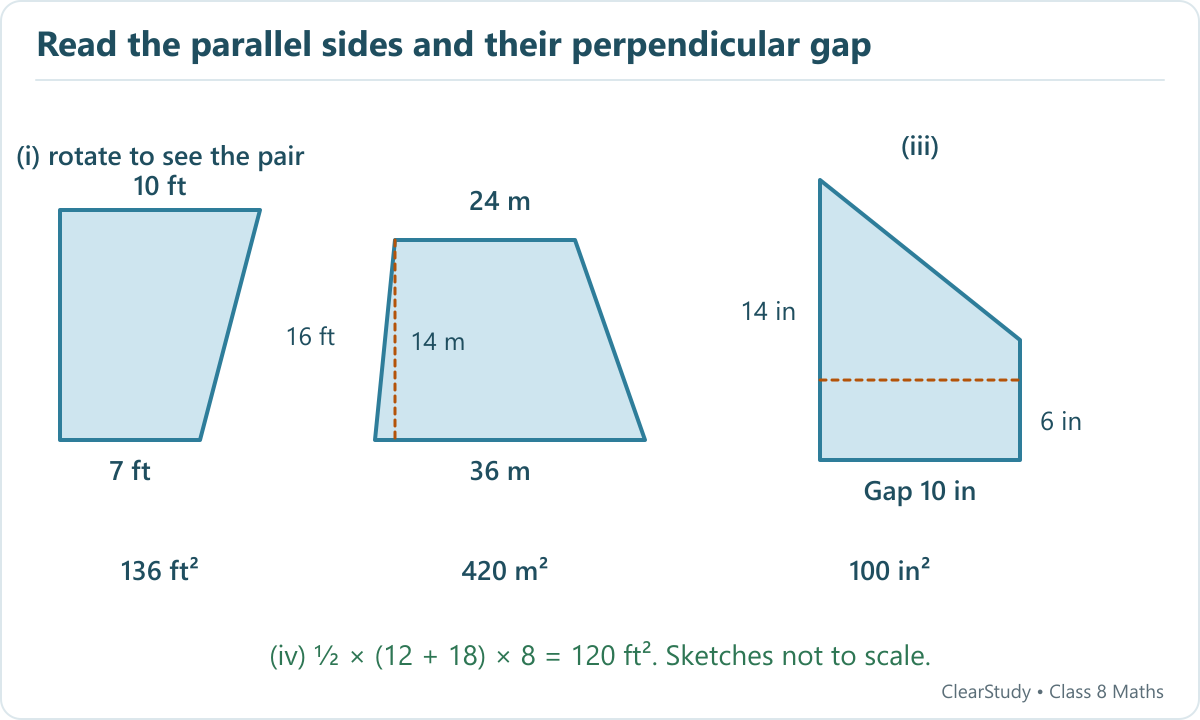
SOLUTIONUse A=(1/2)(a+b)h, where a and b are the parallel sides and h is their perpendicular gap.(i) (1/2)×(10+7)×16=136 ft2. The 16 ft dashed segment is the height; this is not a parallelogram.(ii) (1/2)×(24+36)×14=420 m2.(iii) (1/2)×(14+6)×10=100 in2. The parallel sides are vertical.(iv) (1/2)×(12+18)×8=120 ft2.
Exercise results use parallel sides 10 and 7 feet with gap 16, 24 and 36 metres with gap 14, and 14 and 6 inches with gap 10. Areas are 136 square feet, 420 square metres, 100 square inches and 120 square feet.

4. [Śulba-Sūtras] Give a method to convert an isosceles trapezium to a rectangle using dissection.

SOLUTIONMark the midpoint of each nonparallel side. Draw a perpendicular through each midpoint to the two parallel-side lines. Cut off the two small bottom corner triangles outside these perpendiculars.Rotate each cut triangle by 180° about the midpoint of its sloping side. Each exactly fills the corresponding top gap. The resulting rectangle has height h and width (a+b)/2, so its area is h(a+b)/2.

5. Here is one of the ways to convert trapezium ABCD into a rectangle EFGH of equal area. Given the trapezium ABCD, how do we find the vertices of the rectangle EFGH? [Hint: If ▵AHI ≅ ▵DGI and ▵BEJ ≅ ▵CFJ, then the trapezium and rectangle have equal areas.]
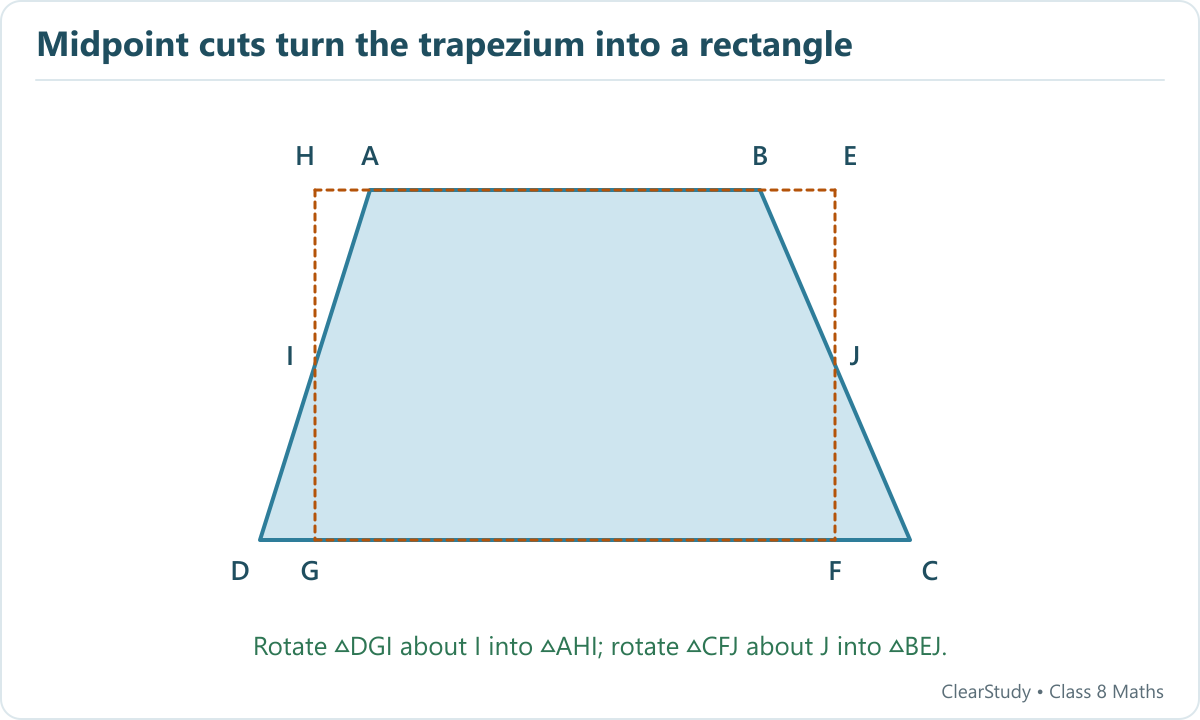
SOLUTIONMark I, the midpoint of AD, and J, the midpoint of BC. Through I draw a line perpendicular to DC, meeting the top-side line at H and the bottom-side line at G. Through J draw a parallel perpendicular meeting those lines at E and F.Because AI=DI, the vertical angles at I are equal and the angles at H and G are right angles, triangles AHI and DGI are congruent. Similarly, BEJ and CFJ are congruent.Rotate the outside bottom triangles DGI and CFJ by 180° about I and J to fill the top gaps AHI and BEJ. This forms rectangle EFGH, of height h and width (AB+DC)/2, with the same area.
Mark midpoints I and J of the nonparallel sides. Perpendiculars through them meet the parallel side lines at H G and E F. Rotate the two outer bottom triangles to fill the top gaps of the equal-area rectangle.

6. Using the idea of converting a trapezium into a rectangle of equal area, and vice versa, construct a trapezium of area 144 cm2.

SOLUTIONConstruct a 14 cm segment DC. At both ends erect perpendiculars on the same side and mark a parallel line 12 cm away. On that line mark A above a point 2 cm along DC and B above a point 12 cm along DC. Then AB=10 cm, DC=14 cm and the height is 12 cm.Join AD and BC to complete the trapezium. Its area is (1/2)×(10+14)×12=144 cm2. Cutting through the side midpoints and moving the corner triangles as above gives a 12 cm × 12 cm rectangle. Merely shearing a rectangle would keep it a parallelogram, so the unequal parallel lengths must be constructed explicitly.

7. A regular hexagon is divided into a trapezium, an equilateral triangle, and a rhombus, as shown. Find the ratio of their areas.
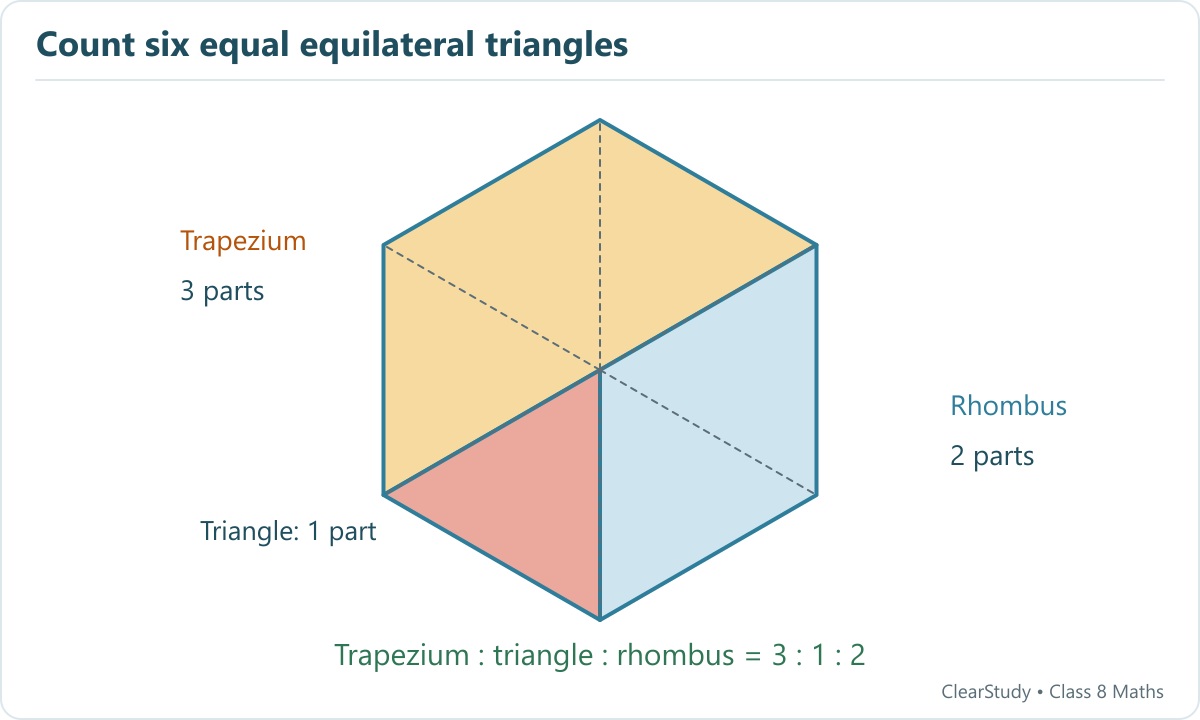
SOLUTION A regular hexagon of side s is made of 6 identical equilateral triangles, each of area t = (√3/4)s2. Read off how many such unit triangles each piece contains. The equilateral triangle = 1 unit triangle. The rhombus (two unit triangles) = 2 unit triangles. The trapezium (the remaining half-hexagon, three unit triangles) = 3 unit triangles. So Trapezium : Equilateral triangle : Rhombus = 3 : 1 : 2. (Listed as triangle : rhombus : trapezium it is 1 : 2 : 3.)
A regular hexagon is six equal equilateral triangles. The trapezium contains three, the separate triangle one and the rhombus two.

8. ZYXW is a trapezium with ZY∥WX. A is the midpoint of XY. Show that the area of the trapezium ZYXW is equal to the area of ▵ZWB.
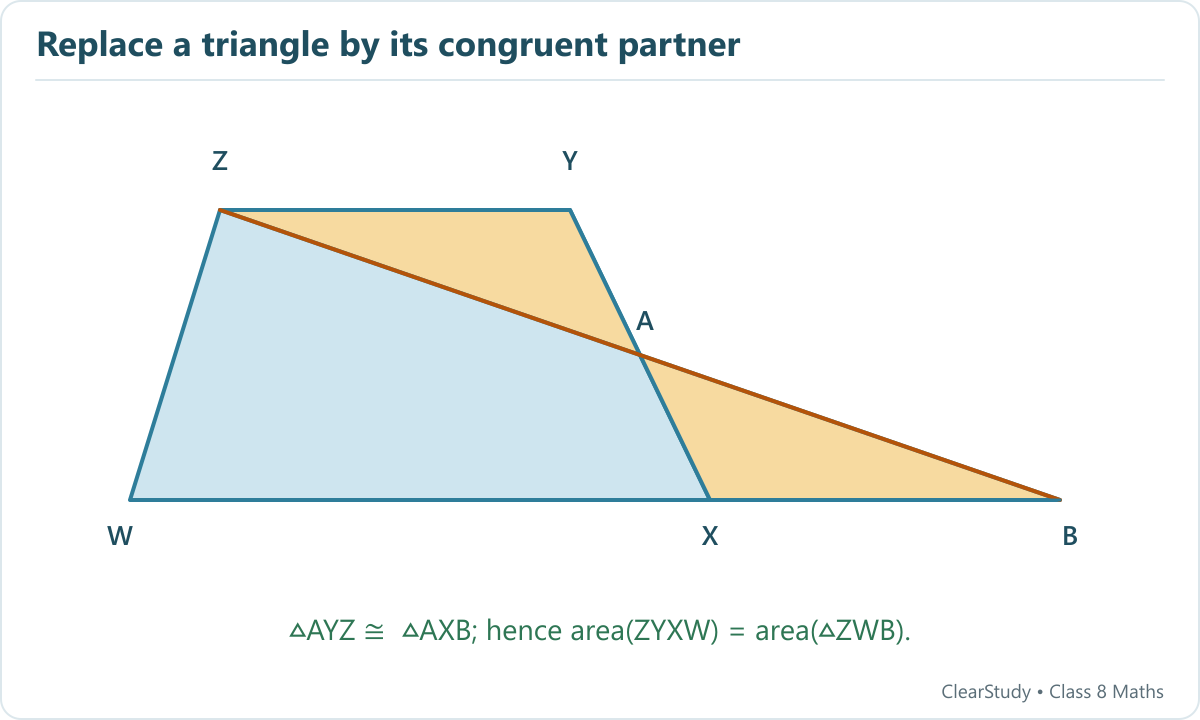
SOLUTION Extend WX to a point B and join ZA, then AB, so that A (the midpoint of XY) lies on segment ZB. Consider ▵AYZ and ▵AXB: AY = AX (A is the midpoint), the angles at A are vertically opposite and equal, and ∠ZYA = ∠BXA (alternate angles, since ZY∥WX). So ▵AYZ ≅ ▵AXB (ASA). Congruent triangles have equal area, so removing ▵AYZ from the trapezium and adding the equal ▵AXB turns trapezium ZYXW into ▵ZWB without changing the area. Hence Area(ZYXW) = Area(▵ZWB).
Extend ZA to meet WX extended at B. Because A is the midpoint of XY and ZY is parallel to WX, triangles AYZ and AXB are congruent; exchanging them preserves the area.

Complete the trapezium arguments (pages 167–168)

For a trapezium with top base a, bottom base b and perpendicular height h, with b≥a, draw through the upper-right vertex a line parallel to the left side. It gives a parallelogram of area ah and a triangle of base b−a and height h. Total area=ah+(1/2)(b−a)h=(1/2)(a+b)h. This works even when an altitude lies outside the trapezium. Equivalently, join a rotated congruent copy along a sloping side: the result is a parallelogram of base a+b and height h, so one copy has half its area.

Areas in real life (pages 170–171)

PromptWorked answer
A4 sheet21 × 29.7 = 623.7 cm2
5 in; 7.4 in to cm5 × 2.54=12.7 cm; 7.4 × 2.54=18.796 cm
5.08 cm; 11.43 cm to inches5.08/2.54=2 in; 11.43/2.54=4.5 in
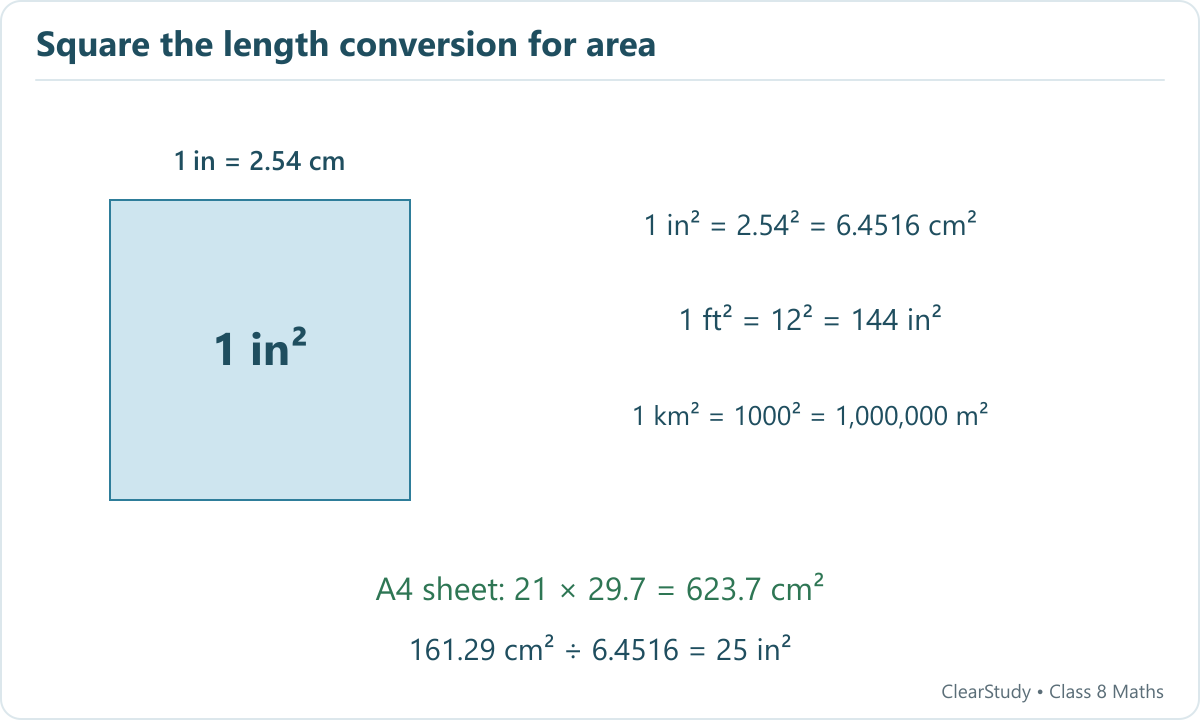
1 in2; 10 in26.4516 cm2; 64.516 cm2
161.29 cm2 to in2161.29/6.4516=25 in2
1 ft2 to in2122=144 in2
1 km2 to m210002=1,000,000 m2
Area conversions square the length scale: 1 square inch is 6.4516 square centimetres, 1 square foot is 144 square inches, and 1 square kilometre is one million square metres.

Measurement projects: measure a rectangular tabletop or classroom length and width in the same unit, then multiply. Divide the tabletop area in cm2 by 623.7 for an approximate A4-sheet area equivalent; fitting actual sheets also depends on shape and arrangement. Estimate a school plot by rectangles or triangles, then compare with its documented area. To compare town and school, convert both areas to the same unit and divide town area by school area.

Local land units and city comparisons: record your location and consult the local land-record or municipal authority for unit definitions. Units such as bigha and katha vary by region. For the largest/smallest-city project, first define city as municipal limits, urban built-up area, or metropolitan area; record a date and use the same definition for every comparison. There is no single unambiguous ranking without that choice. Record each official boundary area and its source rather than mixing unlike definitions.

Common Mistakes to Avoid

Watch out for these

  • Forgetting the ½ in the triangle and rhombus/trapezium formulas (triangle = ½ × base × height, not base × height).
  • Using a slant side as the height of a parallelogram or trapezium — the height must be the perpendicular distance.
  • In a trapezium, multiplying by only one parallel side instead of the sum of both parallel sides.
  • Forgetting to square the units — areas are in cm2, m2, ft2, not cm or m.
  • Mixing units in one figure (e.g. cm and in) without converting (remember 1 in = 2.54 cm, 1 in2 = 6.4516 cm2).
  • For a crosspath, counting the overlap square twice — subtract it once.
  • Assuming “larger perimeter means larger area” — this is false; perimeter does not measure area.

Practice MCQs & Assertion–Reason

1. The area of a triangle with base 8 cm and height 5 cm is:

(a) 40 cm2    (b) 20 cm2    (c) 13 cm2    (d) 80 cm2

2. The area of a parallelogram is given by:

(a) ½ × base × height    (b) base × height    (c) base + height    (d) ½ × product of diagonals

3. The area of a rhombus with diagonals 12 cm and 10 cm is:

(a) 120 cm2    (b) 60 cm2    (c) 22 cm2    (d) 240 cm2

4. The area of a trapezium with parallel sides 9 cm and 7 cm and height 6 cm is:

(a) 96 cm2    (b) 48 cm2    (c) 22 cm2    (d) 16 cm2

5. A diagonal of a rectangle divides it into two triangles that are:

(a) of unequal area    (b) congruent    (c) equilateral    (d) right-angled isosceles always

6. 1 in2 equals how many cm2?

(a) 2.54    (b) 5.08    (c) 6.4516    (d) 25.4

7. The line joining a vertex of a triangle to the midpoint of the opposite side divides it into two triangles of:

(a) equal area    (b) ratio 1 : 2    (c) ratio 1 : 3    (d) unequal area

8. If M and N are midpoints of two sides of ▵XYZ meeting at X, the area of ▵XMN is what fraction of ▵XYZ?

(a) ½    (b) ⅓    (c) ¼    (d) ⅛

9. A rectangle and a nonrectangular parallelogram have the same side lengths 6 cm and 4 cm. Which has the greater area?

(a) the parallelogram    (b) the rectangle    (c) both equal    (d) cannot say

10. The area of a rectangle of length 14 cm and width 4 cm is:

(a) 18 cm2    (b) 36 cm2    (c) 56 cm2    (d) 28 cm2

Answer key: 1-(b), 2-(b), 3-(b), 4-(b), 5-(b), 6-(c), 7-(a), 8-(c), 9-(b), 10-(c).

For each Assertion–Reason question, choose: (A) Both Assertion and Reason are true and the Reason is the correct explanation of the Assertion; (B) Both are true but the Reason is not the correct explanation; (C) Assertion is true but Reason is false; (D) Assertion is false but Reason is true.

A-R 1. Assertion: The area of a triangle is ½ × base × height.

Reason: Two congruent copies of a triangle can form a parallelogram with the same base and height, whose area is base × height.

A-R 2. Assertion: A rhombus with diagonals 8 cm and 6 cm has area 48 cm2.

Reason: The area of a rhombus is ½ × product of its diagonals.

A-R 3. Assertion: Two regions with the same perimeter must have the same area.

Reason: Perimeter is the length of the boundary of a region.

A-R 4. Assertion: A trapezium with parallel sides 5 cm and 3 cm and height 4 cm has area 16 cm2.

Reason: The area of a trapezium is ½ × height × sum of the parallel sides.

A-R 5. Assertion: All parallelograms on the same base and between the same parallel lines have equal area.

Reason: Such parallelograms have the same base and the same height.

Answer key: 1-(A), 2-(D), 3-(D), 4-(A), 5-(A).

Quick Revision Summary

  • Area of a rectangle = length × width; area is measured in square units (cm2, m2…).
  • Area of a triangle = ½ × base × height; the formula holds for every type of triangle.
  • Any polygon can be split into triangles, so its area = sum of the triangle areas.
  • Area of a parallelogram = base × height (perpendicular height, not the slant side).
  • Area of a rhombus = ½ × product of its diagonals.
  • Area of a trapezium = ½ × height × (sum of the parallel sides).
  • Dissection rearranges pieces without changing area; the median of a triangle halves its area.
  • Units: 1 in = 2.54 cm, 1 in2 = 6.4516 cm2, 1 ft = 12 in, 1 acre = 43,560 ft2.

How to score full marks in this chapter

Always state the formula first, then substitute. Use the perpendicular height — never a slant side. Write the final answer with squared units. For composite figures, split neatly into triangles, rectangles and trapeziums and add (or subtract) the parts, and for a crosspath remember to subtract the overlap once. Keep surds like √3 in exact form unless a decimal is asked.

Frequently Asked Questions

What is Class 8 Maths Ganita Prakash Chapter 14 about?

Chapter 14, Area (Chapter 7 of Part II, the final chapter of Class 8), derives and applies the area formulas for triangles, parallelograms, rhombuses, trapeziums and composite figures, including dissection methods from the Śulba-Sūtras and real-life area units.

What are the main area formulas in this chapter?

Triangle = ½ × base × height; parallelogram = base × height; rhombus = ½ × product of diagonals; trapezium = ½ × height × (sum of parallel sides); rectangle = length × width.

How many exercises does Ganita Prakash Chapter 14 have?

The chapter has five “Figure it Out” sets (on rectangles/composite figures, triangles, area of any polygon, parallelograms, and rhombus & trapezium), plus Math Talk and Try This prompts — all solved on this page.

Are these Class 8 Maths Ganita Prakash Chapter 14 solutions free?

Yes. All solutions are free and follow the official NCERT Ganita Prakash Part II textbook for 2026–27.

Textbook reference: NCERT Ganita Prakash, Chapter 14 (official PDF). ClearStudy diagrams and worked explanations are original teaching aids.

Scroll to Top