
Class 8 Maths Ganita Prakash Chapter 6 Solutions (NCERT 2026–27) – We Distribute, Yet Things Multiply
These Class 8 Maths Ganita Prakash Chapter 6 solutions cover We Distribute, Yet Things Multiply from the new NCF-2023 textbook (Part I, 2026–27). Use the worked exercise answers, original area diagrams and growing-pattern illustrations to understand distributivity and algebraic identities. The explanations also address missing cases and common sign errors.
- Chapter overview
- Key concepts & definitions
- Important formulas & identities
- Figure it Out (Page 142–143)
- Math Talk & Try This (Sections 6.1–6.2)
- Figure it Out (Page 149)
- Mind the Mistake, Mend the Mistake (Page 150)
- Patterns and shaded areas
- Figure it Out (Page 154–156)
- Common mistakes to avoid
- Practice MCQs & Assertion–Reason
- Quick revision summary
- FAQs
Chapter 6 Overview
Chapter 6 of Ganita Prakash, We Distribute, Yet Things Multiply, uses the distributive property of multiplication over addition to explain a wide range of multiplication patterns through algebra. It begins with how a product changes when its factors are increased or decreased, builds the general identity (a + m)(b + n) = ab + mb + an + mn, and then derives the three special identities — (a + b)2, (a − b)2 and (a + b)(a − b). Along the way it shows quick methods for multiplying by 11, 101, 1001…, links the ideas to Brahmagupta and Sridharacharya, and explores number patterns geometrically. The Class 8 Maths Ganita Prakash Chapter 6 solutions below work through every exercise question in exact book order.
Key Concepts & Definitions
Distributive property: multiplying a number by a sum equals the sum of the separate products — a(b + c) = ab + ac. It also extends to more terms, e.g. (3a/2)(a − b + 1/5) = (3/2)a2 − (3/2)ab + (3/10)a.
Expanding: writing a product of bracketed expressions as a sum of terms by multiplying every term in one bracket by every term in the other.
Identity: a statement of equality between two algebraic expressions that is true for every value of the letter-numbers (e.g. (a + 1)(b − 1) = ab + b − a − 1).
Like terms: terms with exactly the same letter-numbers (same variables and powers); only like terms can be added into a single term.
Increase / decrease of a product: if a and b become a + m and b + n, the product changes by an + bm + mn (a negative change means a decrease); signs follow the rules of integer multiplication when m or n is negative.
Important Formulas & Identities (Chapter 6)
Distributive property: a(b + c) = ab + ac • (a + b)c = ac + bc
General product of two binomials (Identity 1): (a + m)(b + n) = ab + mb + an + mn, and in general (a + b)(c + d) = ac + ad + bc + bd
Identity 1A: (a + b)2 = a2 + 2ab + b2
Identity 1B: (a − b)2 = a2 + b2 − 2ab
Identity 1C: (a + b)(a − b) = a2 − b2
Useful pattern results: 2(a2 + b2) = (a + b)2 + (a − b)2 • a2 = (a + b)(a − b) + b2 (Sridharacharya’s method)
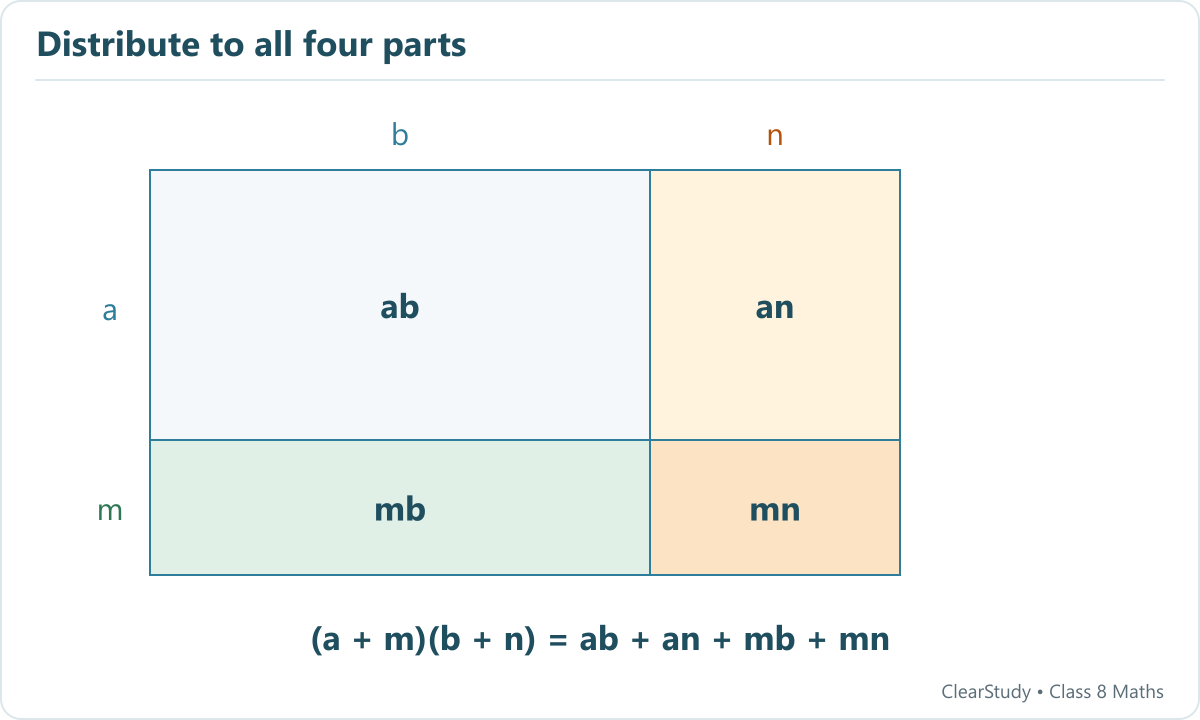
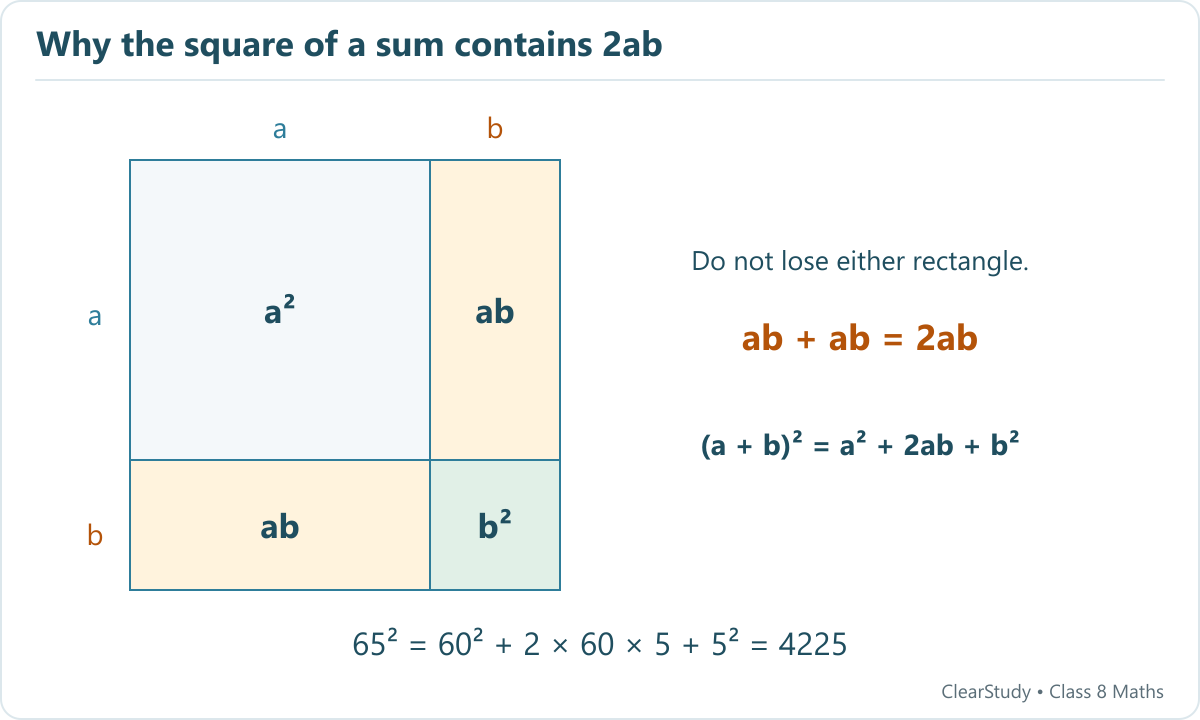
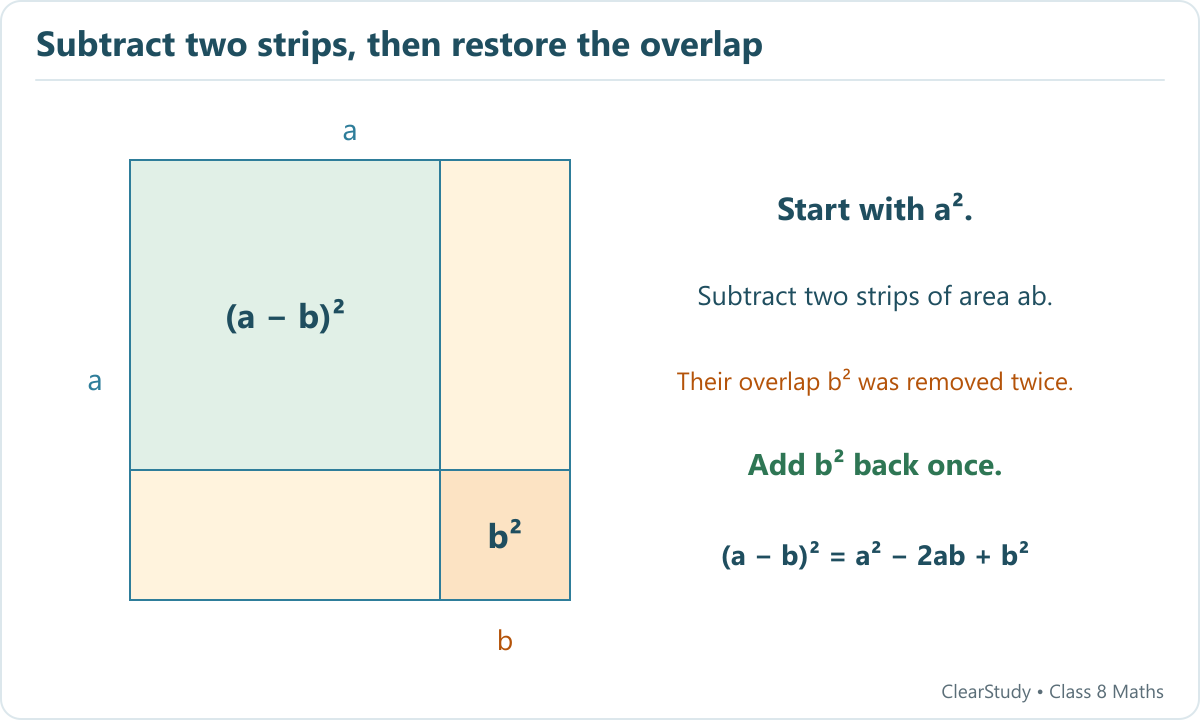
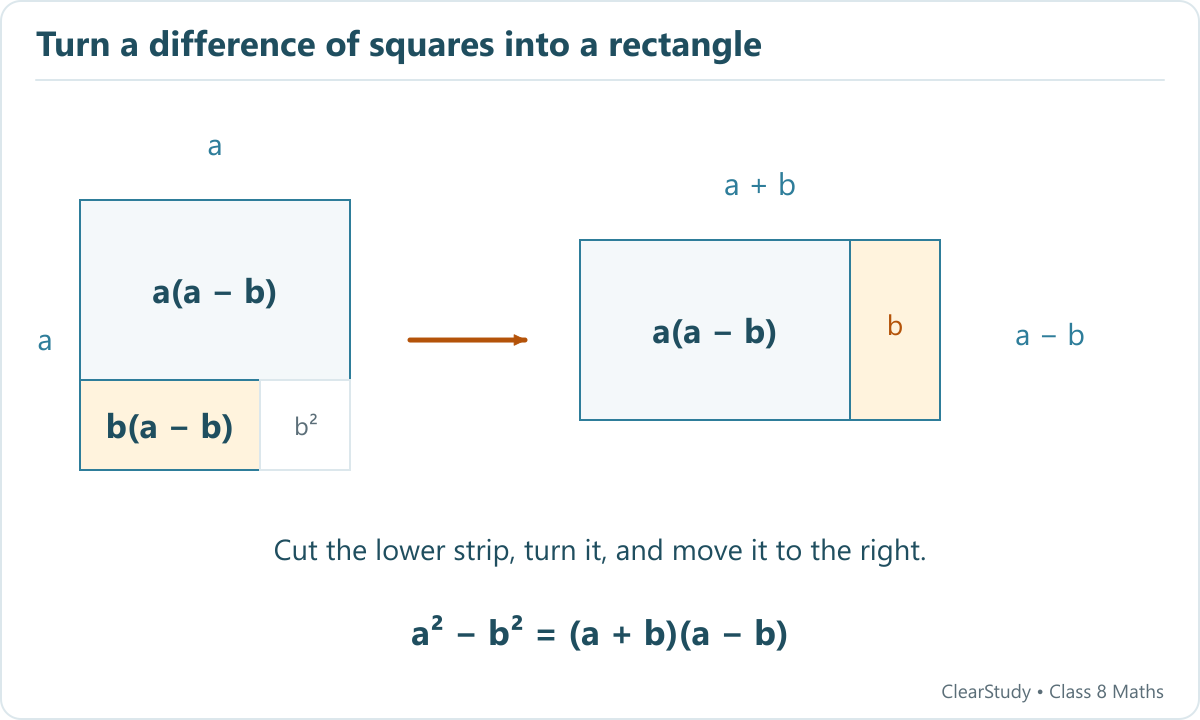
Figure it Out (Page 142–143)
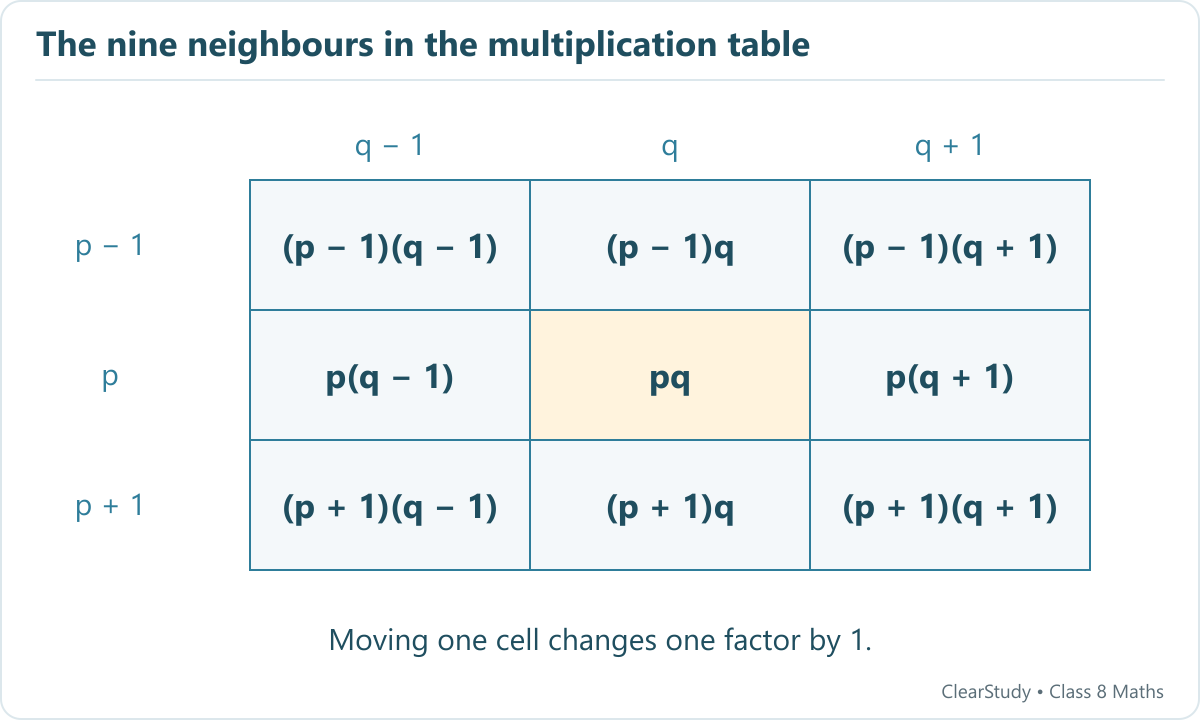
1. Observe the multiplication grid below. Each number inside the grid is formed by multiplying two numbers. If the middle number of a 3 × 3 frame is given by the expression pq, as shown in the figure, write the expressions for the other numbers in the grid.
| (p − 1)(q − 1) | (p − 1)q | (p − 1)(q + 1) |
| p(q − 1) | pq | p(q + 1) |
| (p + 1)(q − 1) | (p + 1)q | (p + 1)(q + 1) |
2. Expand the following products. (i) (3 + u)(v − 3) (ii) (2/3)(15 + 6a) (iii) (10a + b)(10c + d) (iv) (3 − x)(x − 6) (v) (−5a + b)(c + d) (vi) (5 + z)(y + 9)
3. Find 3 examples where the product of two numbers remains unchanged when one of them is increased by 2 and the other is decreased by 4.
4. Expand (i) (a + ab − 3b2)(4 + b), and (ii) (4y + 7)(y + 11z − 3).
5. Expand (i) (a − b)(a + b), (ii) (a − b)(a2 + ab + b2) and (iii) (a − b)(a3 + a2b + ab2 + b3). Do you see a pattern? What would be the next identity in the pattern that you see? Can you check it by expanding?
Math Talk & Try This (Sections 6.1–6.2)
These are the in-text reflective questions from the chapter. Each is solved with verified working.
[Page 138] Will the product always increase? Find 3 examples where the product decreases.
[Page 140] Use Identity 1 to find how the product changes when (i) one number is decreased by 2 and the other increased by 3; (ii) both numbers are decreased, one by 3 and the other by 4.
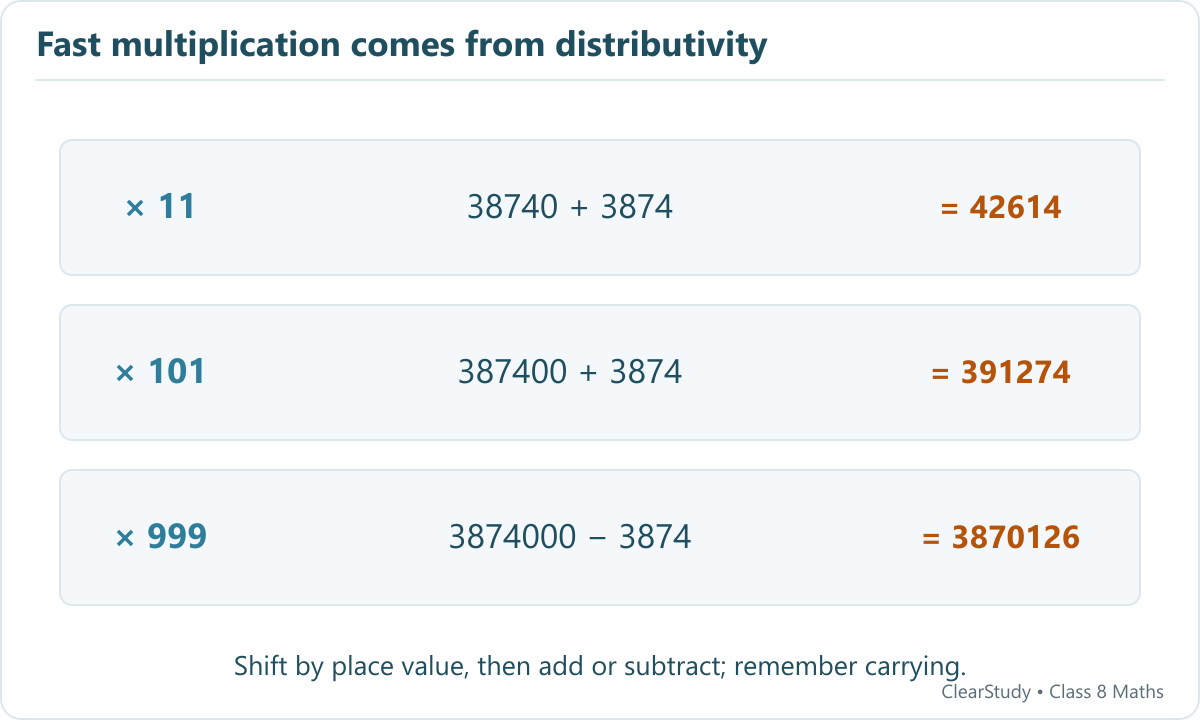
[Pages 143–144] Explain multiplication by 11, 101, 1001 and similar numbers. Evaluate the textbook examples and all six practice products.
[Pages 145–147] Square identities: additional in-text questions.
[Page 147, Try This] Expand the following using both Identity 1B and the distributive property: (i) (b − 6)2, (ii) (−2a + 3)2, (iii) (7y − (3/4)z)2.
[Page 148] Use Identity 1C to calculate 98 × 102 and 45 × 55.
Figure it Out (Page 149)
1. Which is greater: (a − b)2 or (b − a)2? Justify your answer.
2. Express 100 as the difference of two squares.
3. Find 4062, 722, 1452, 10972, and 1242 using the identities you have learnt so far.
4. Do Patterns 1 and 2 hold only for counting numbers? Do they hold for negative integers as well? What about fractions? Justify your answer.
Mind the Mistake, Mend the Mistake (Page 150)
Below, each simplification is checked; if there is a mistake the reason is explained and the correct expression is given.
Patterns and shaded areas (Pages 150–154)
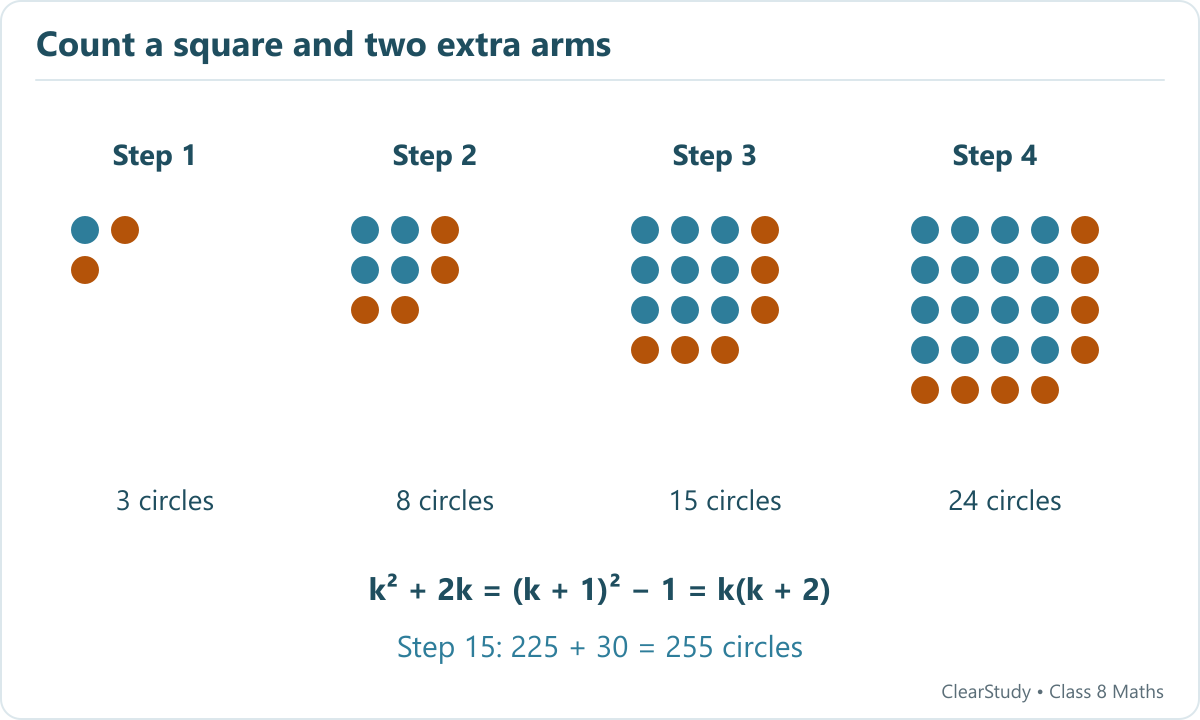
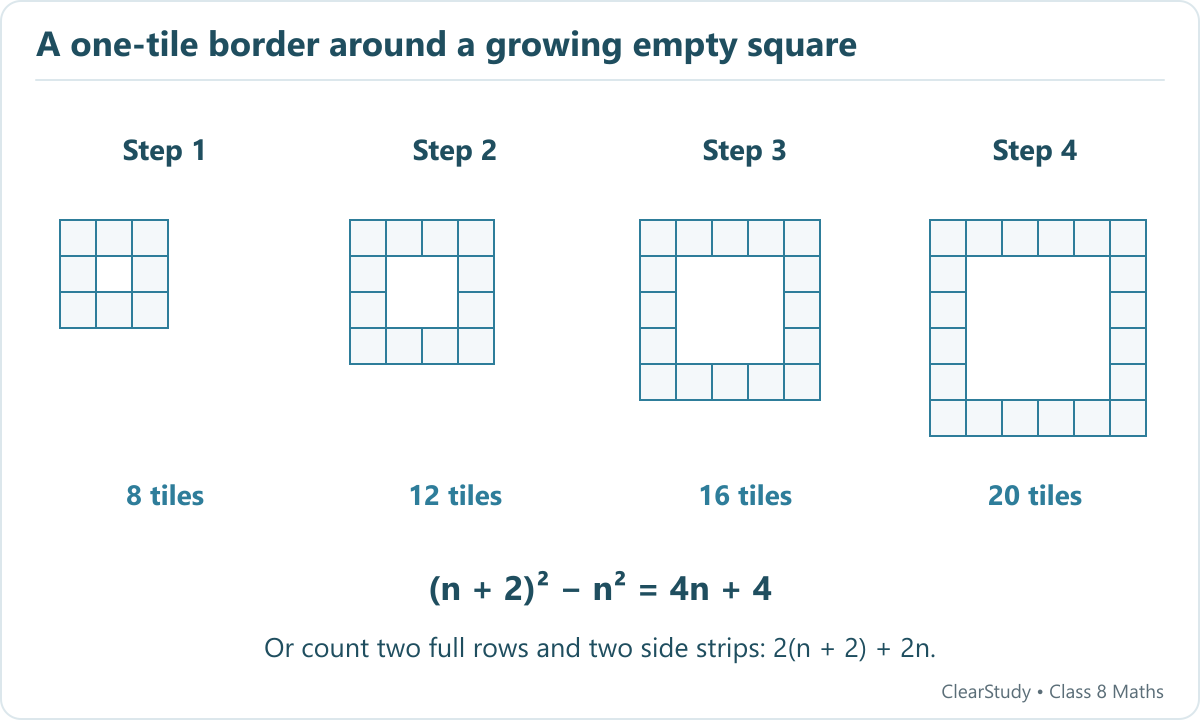
[Section 6.4] Use the formula k2 + 2k to find the number of circles in Step 15. Also write the number of square tiles in Step n.
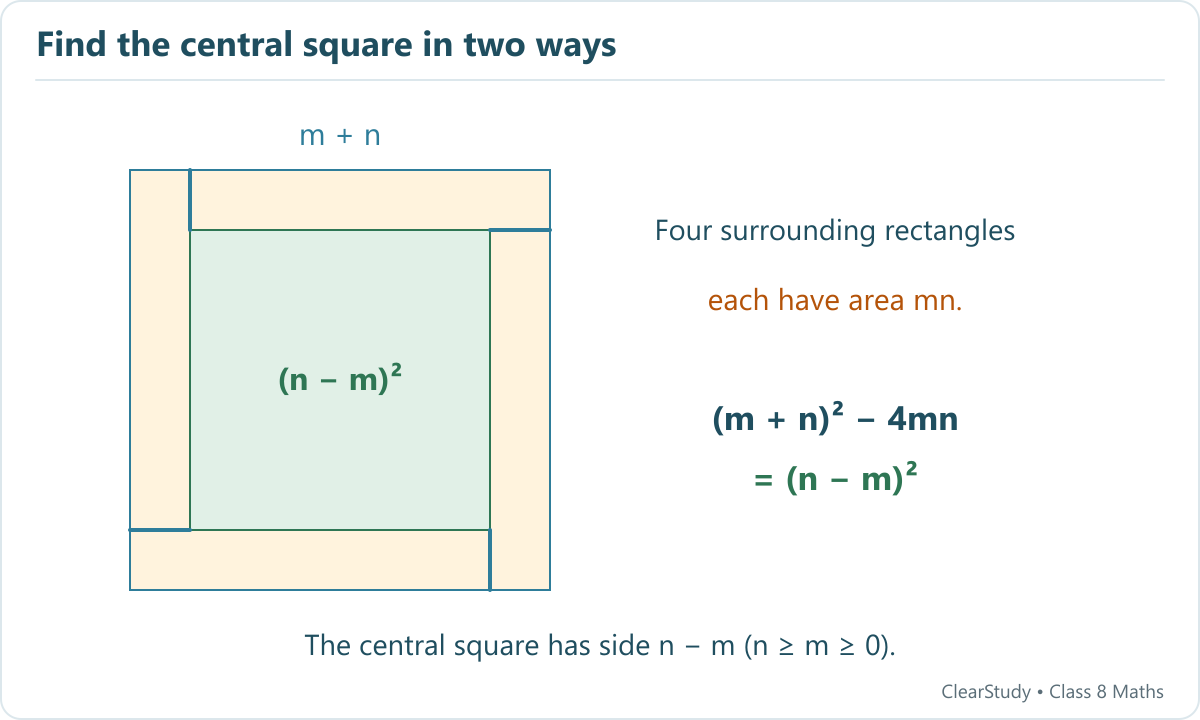
[Page 153–154] Verify (m + n)2 − 4mn = (n − m)2; and write the area of the dashed region (Substitute p = 6, r = 3.5, s = 9).
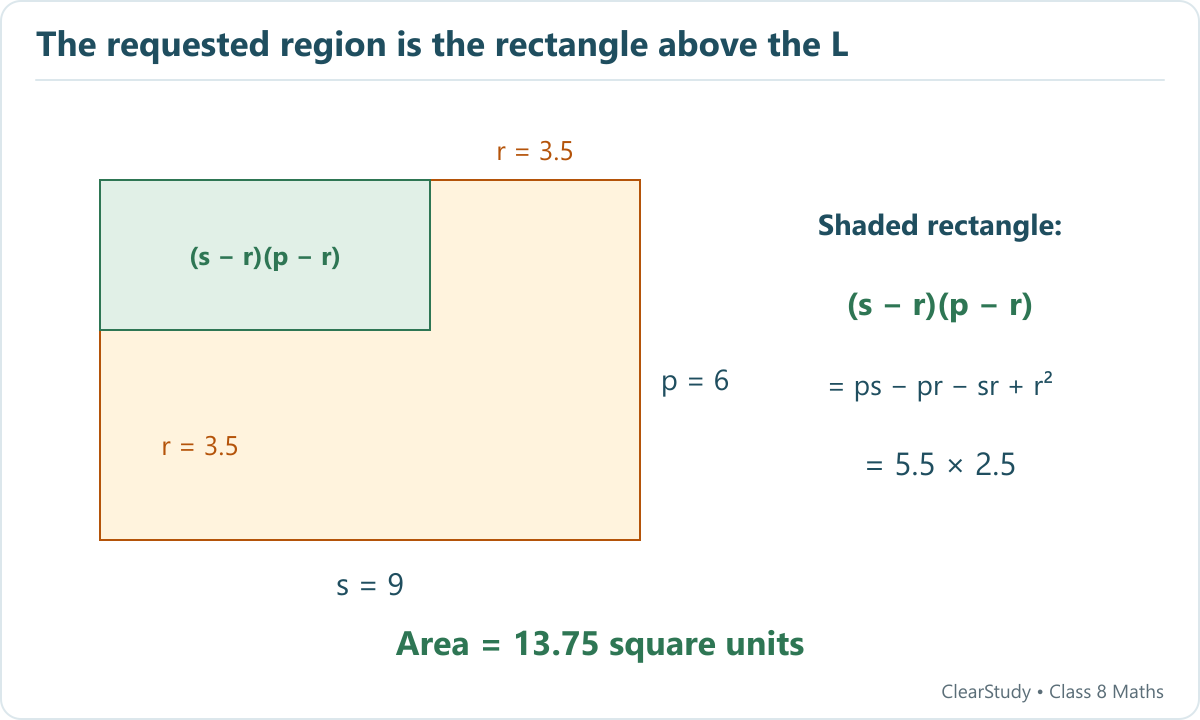
[Pages 153–154] Three equal rectangles: compare the three shaded-area methods and substitute x = 8, y = 3.
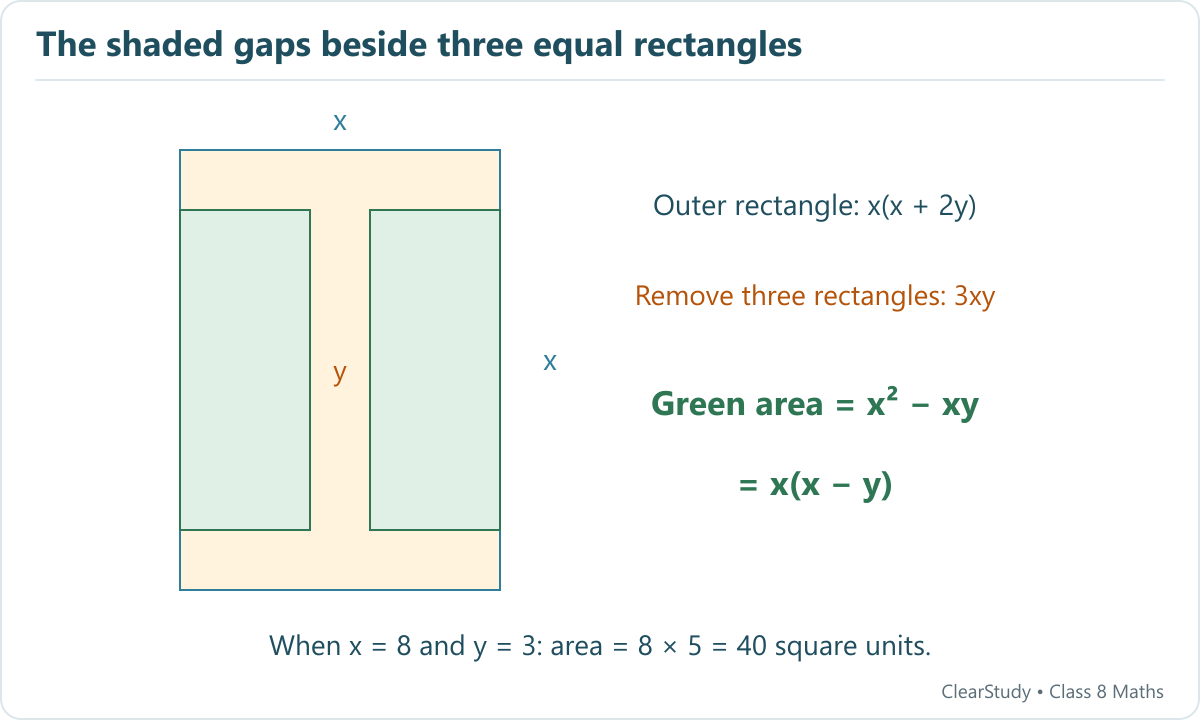
Figure it Out (Page 154–156)
1. Compute these products using the suggested identity. (i) 462 using Identity 1A for (a + b)2 (ii) 397 × 403 using Identity 1C for (a + b)(a − b) (iii) 912 using Identity 1B for (a − b)2 (iv) 43 × 45 using Identity 1C for (a + b)(a − b)
2. Use either a suitable identity or the distributive property to find each of the following products. (i) (p − 1)(p + 11) (ii) (3a − 9b)(3a + 9b) (iii) −(2y + 5)(3y + 4) (iv) (6x + 5y)2 (v) (2x − 1/2)2 (vi) (7p) × (3r) × (p + 2)
3. For each statement identify the appropriate algebraic expression(s). (i) Two more than a square number: 2 + s, (s + 2)2, s2 + 2, s2 + 4, 2s2, 22s (ii) The sum of the squares of two consecutive numbers: m2 + n2, (m + n)2, m2 + 1, m2 + (m + 1)2, m2 + (m − 1)2, (m + (m + 1))2, (2m)2 + (2m + 1)2
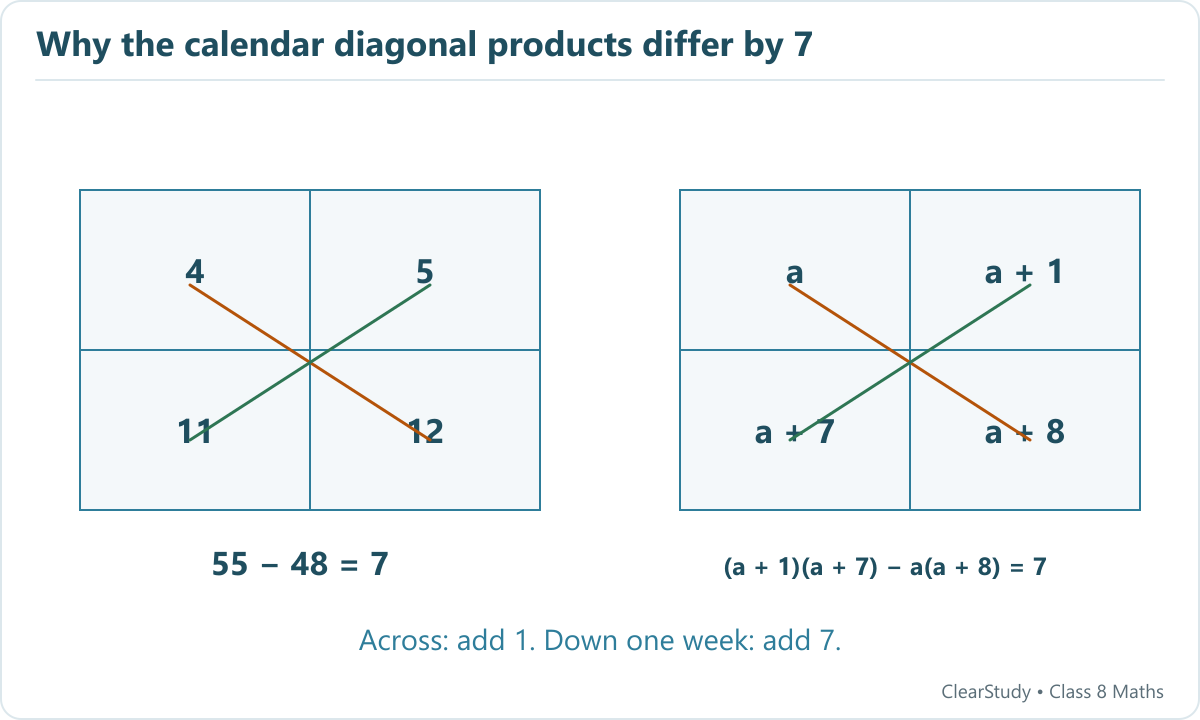
4. Consider any 2 by 2 square of numbers in a calendar. Find products of numbers lying along each diagonal — 4 × 12 = 48, 5 × 11 = 55. Do this for the other 2 by 2 squares. What do you observe about the diagonal products? Explain why this happens.
5. Verify which of the following statements are true. (i) (k + 1)(k + 2) − (k + 3) is always 2. (ii) (2q + 1)(2q − 3) is a multiple of 4. (iii) Squares of even numbers are multiples of 4, and squares of odd numbers are 1 more than multiples of 8. (iv) (6n + 2)2 − (4n + 3)2 is 5 less than a square number.
6. A number leaves a remainder of 3 when divided by 7, and another number leaves a remainder of 5 when divided by 7. What is the remainder when their sum, difference, and product are divided by 7?
7. Choose three consecutive numbers, square the middle one, and subtract the product of the other two. Repeat with other sets. What pattern do you notice? How do we write this as an algebraic equation? Expand both sides to check it is a true identity.
8. What is the algebraic expression describing the steps — add any two numbers, multiply this by half of the sum of the two numbers? Prove that this result will be half of the square of the sum of the two numbers.
9. Which is larger? Find out without fully computing the product. (i) 14 × 26 or 16 × 24 (ii) 25 × 75 or 26 × 74
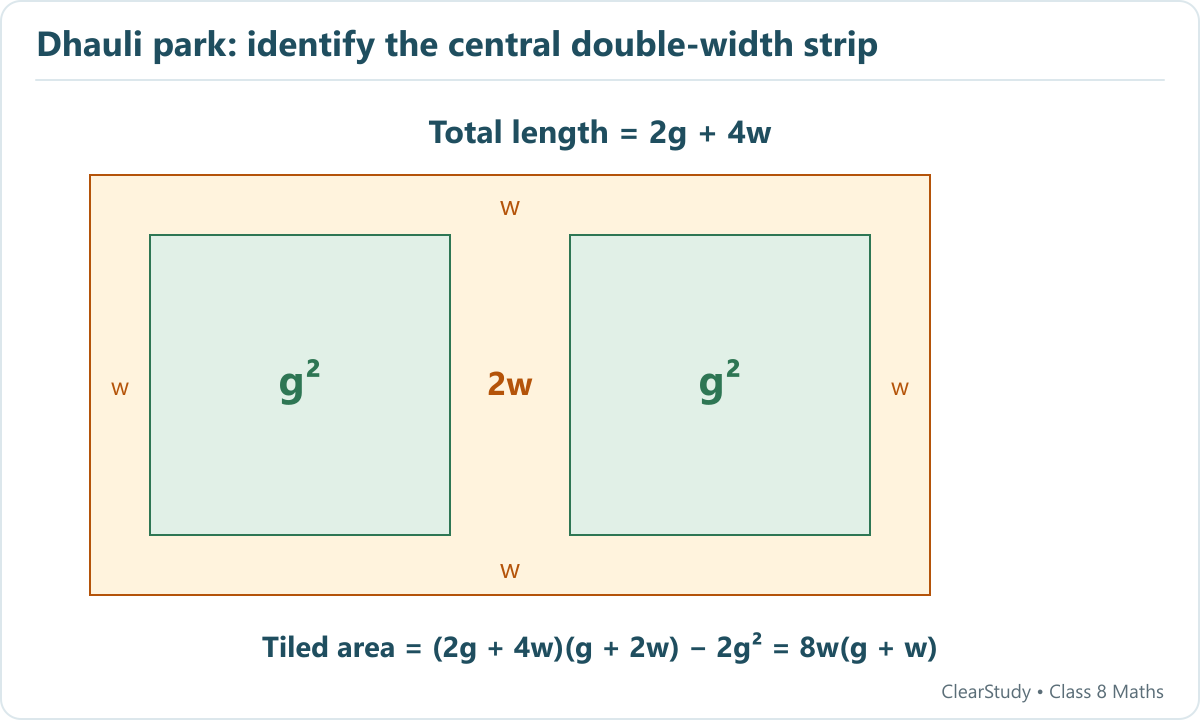
10. A tiny park is coming up in Dhauli. The two square plots, each of area g2 sq. ft., will have a green cover. All the remaining area is a walking path w ft. wide that needs to be tiled. Write an expression for the area that needs to be tiled.
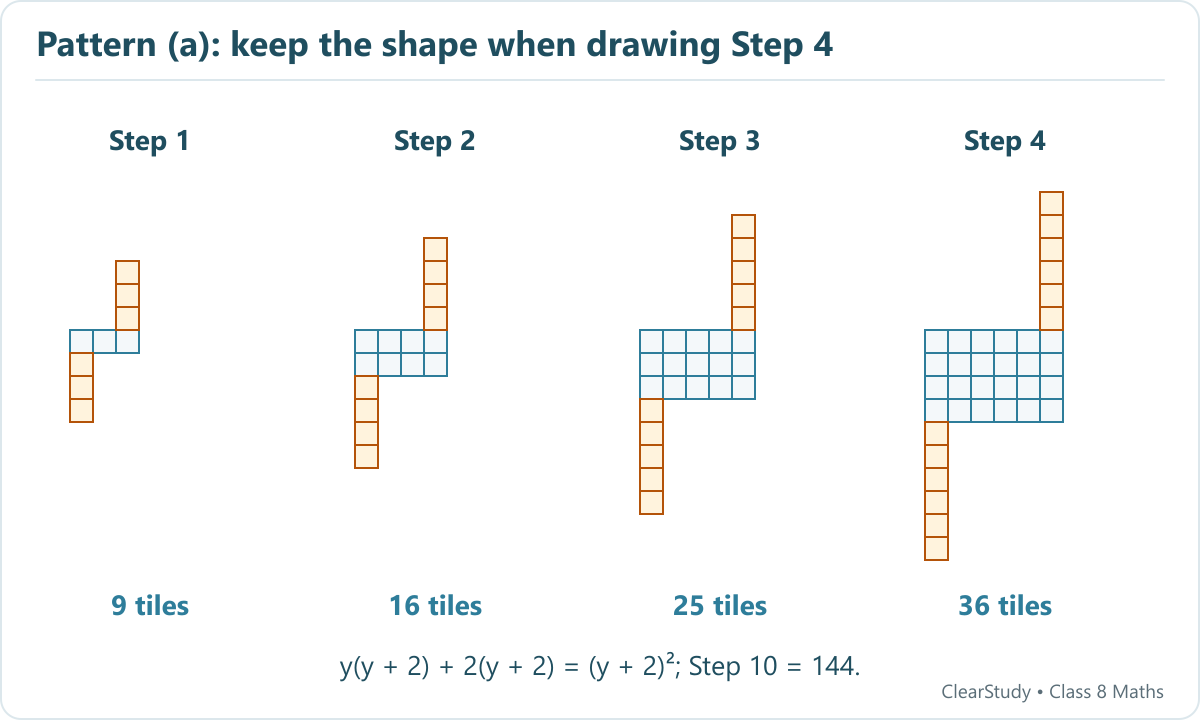
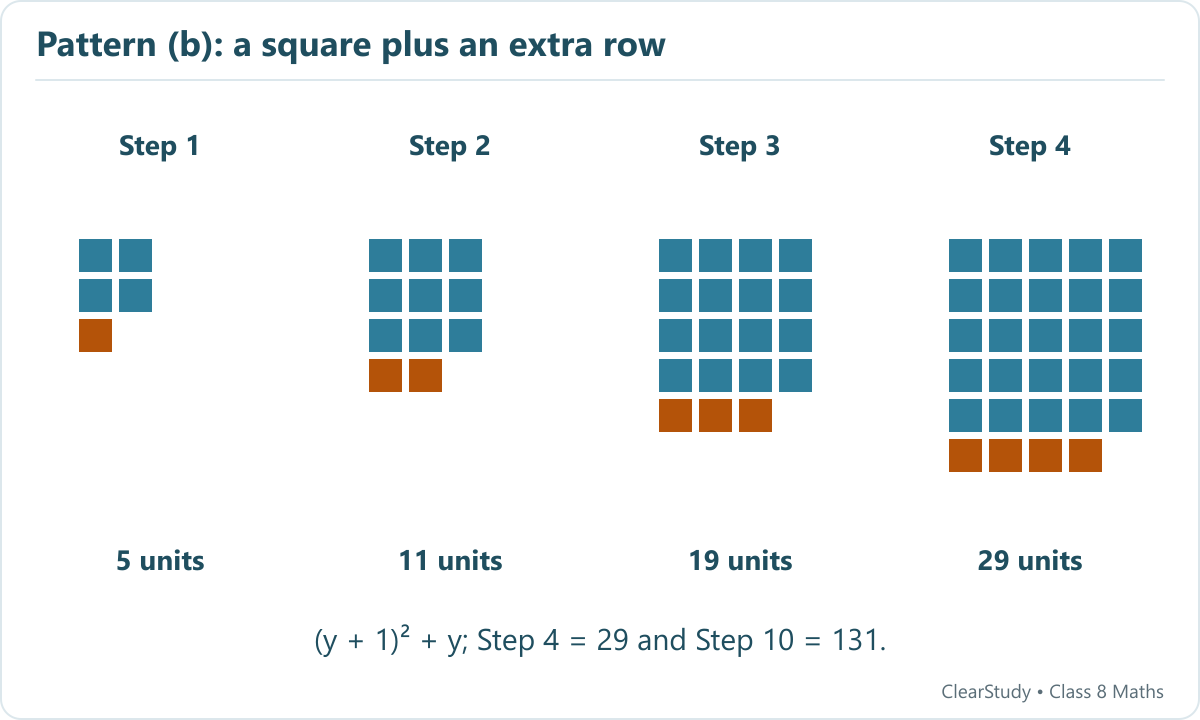
11. For each pattern shown, (i) draw the next figure, (ii) find the number of basic units in Step 10, (iii) write an expression for the number of basic units in Step y.
Common Mistakes to Avoid
Watch out for these
- Forgetting the middle term 2ab: writing (a + b)2 = a2 + b2 is wrong; it equals a2 + 2ab + b2.
- Not distributing to every term — e.g. 2(x − 1) is 2x − 2, not 2x − 1.
- Adding unlike terms: 5w2 + 6w is not 11w2; only like terms combine.
- Mixing up a sum with a product inside brackets: 3a(2b × 3c) = 3a × 6bc = 18abc, not 6ab × 9ac.
- Sign errors with negatives — treat (a − b) as (a + (−b)) and follow integer-multiplication rules.
- In (a − b)2, the middle term is −2ab; do not make it +2ab.
Practice MCQs & Assertion–Reason
1. The expansion of (a + b)2 is:
(a) a2 + b2 (b) a2 + 2ab + b2 (c) a2 − 2ab + b2 (d) a2 − b2
2. (a + b)(a − b) equals:
(a) a2 + b2 (b) a2 − b2 (c) a2 + 2ab + b2 (d) 2ab
3. Using the identity, 1022 equals:
(a) 10404 (b) 10400 (c) 10204 (d) 10004
4. The product 99 × 101 is:
(a) 9999 (b) 10000 (c) 9899 (d) 10001
5. Which of these are like terms?
(a) 5w2 and 6w (b) 2a2b and 3ab2 (c) 4xy and −7xy (d) p2 and p3
6. The expansion of 3a(2a − 5) is:
(a) 6a2 − 5 (b) 6a2 − 15a (c) 6a − 15a (d) 5a2 − 15a
7. (x − 5)2 is equal to:
(a) x2 − 25 (b) x2 + 25 (c) x2 − 10x + 25 (d) x2 + 10x + 25
8. The value of 2(a2 + b2) using the chapter’s pattern equals:
(a) (a + b)2 (b) (a − b)2 (c) (a + b)2 + (a − b)2 (d) (a + b)(a − b)
9. To multiply 6453 by 11 quickly, you add:
(a) 6453 to itself (b) 64530 + 6453 (c) 6453 × 10 only (d) 6453 + 11
10. The number of circles at Step k in the pattern 3, 8, 15, … is:
(a) k2 (b) k2 + 2k (c) 2k + 1 (d) k2 − 1
For each Assertion–Reason question, choose: (A) Both Assertion and Reason are true and the Reason is the correct explanation of the Assertion; (B) Both are true but the Reason is not the correct explanation; (C) Assertion is true but Reason is false; (D) Assertion is false but Reason is true.
A-R 1. Assertion: (a + b)2 = a2 + 2ab + b2.
Reason: (a + b)2 = (a + b)(a + b), expanded using the distributive property.
A-R 2. Assertion: 45 × 55 = 2475.
Reason: 45 × 55 = (50 − 5)(50 + 5) = 502 − 52.
A-R 3. Assertion: 5w2 + 6w can be simplified to 11w2.
Reason: Only like terms (same letter-numbers) can be added into a single term.
A-R 4. Assertion: (a − b)2 and (b − a)2 are always equal.
Reason: Squaring a number and its negative gives the same value.
A-R 5. Assertion: n2 − (n − 1)(n + 1) is always 1.
Reason: (n − 1)(n + 1) = n2 − 1 by the identity (a + b)(a − b) = a2 − b2.
Quick Revision Summary
- Distributive property: a(b + c) = ab + ac; it extends to any number of terms and to all integers and fractions.
- General product: (a + b)(c + d) = ac + ad + bc + bd; the product is the sum of each term of one bracket times each term of the other.
- Identity 1A: (a + b)2 = a2 + 2ab + b2.
- Identity 1B: (a − b)2 = a2 + b2 − 2ab.
- Identity 1C: (a + b)(a − b) = a2 − b2.
- Fast multiplication: ×11 (shift one place + add), ×101 (shift two places + add), ×1001 (shift three places + add), and ×99, ×999 via (100 − 1), (1000 − 1).
- Patterns: 2(a2 + b2) = (a + b)2 + (a − b)2; a2 = (a + b)(a − b) + b2 (Sridharacharya).
- Only like terms can be combined; always distribute to every term and keep the middle term in squares.
How to score full marks in this chapter
Memorise the three identities (1A, 1B, 1C) and recognise when a product fits one of them — this saves time on numbers like 1022, 98 × 102 or 397 × 403. Show one line of working even when using an identity, distribute carefully to every term, and combine only like terms. For “Mind the Mistake”-style questions, always state the error before writing the corrected expression.
Frequently Asked Questions
What is Class 8 Maths Ganita Prakash Chapter 6 about?
Chapter 6, We Distribute, Yet Things Multiply, uses the distributive property to expand products of algebraic expressions and to derive the identities (a + b)2, (a − b)2 and (a + b)(a − b). It also covers fast multiplication tricks and number patterns explained through algebra.
What are the three key identities in this chapter?
(a + b)2 = a2 + 2ab + b2; (a − b)2 = a2 − 2ab + b2; and (a + b)(a − b) = a2 − b2. These are labelled Identity 1A, 1B and 1C in the textbook.
How many exercises does Ganita Prakash Chapter 6 have?
It has three “Figure it Out” exercise sets (on pages 142–143, 149, and 154–156), plus the “Mind the Mistake, Mend the Mistake” activity and several Math Talk / Try This tasks — with worked explanations below.
Are these Class 8 Maths Ganita Prakash Chapter 6 solutions free?
Yes. All solutions are free and follow the official NCERT Ganita Prakash (Part I) textbook for the 2026–27 session.
Textbook reference: NCERT Ganita Prakash, Chapter 6 (official PDF). ClearStudy diagrams and worked explanations are original teaching aids.