
Class 8 Science Curiosity Chapter 10 Solutions (NCERT 2026–27) – Light: Mirrors and Lenses
These Class 8 Science Curiosity Chapter 10 solutions cover Light: Mirrors and Lenses from the new NCF-2023 textbook (2026–27), with every “Keep the curiosity alive” question solved step by step.
Class 8 Science Curiosity Chapter 10 Solutions – Overview
Chapter 10 of Curiosity, Light: Mirrors and Lenses, moves beyond the plane mirror to spherical mirrors (concave and convex) and lenses (convex and concave). It explains how a concave mirror can give an enlarged or inverted image while a convex mirror always gives an erect, diminished image, and where each is used (torch reflectors, dental mirrors, side-view and road-safety mirrors). It states the two laws of reflection, shows how concave mirrors converge and convex mirrors diverge light, and introduces convex (converging) and concave (diverging) lenses with everyday examples like magnifying glasses, cameras, eyeglasses and the eye. These Class 8 Science Curiosity Chapter 10 solutions answer every textbook question step by step.
Key Concepts & Definitions
Spherical mirror: a mirror whose reflecting surface is part of a hollow sphere. A concave mirror curves inwards; a convex mirror curves outwards.
Concave mirror image: can be enlarged, diminished or same size, and erect or inverted, depending on the object distance (erect & enlarged when close, inverted when far). Convex mirror image: always erect and diminished.
Laws of reflection: (1) the angle of incidence (i) equals the angle of reflection (r); (2) the incident ray, the normal at the point of incidence, and the reflected ray all lie in the same plane. They hold for plane and spherical mirrors.
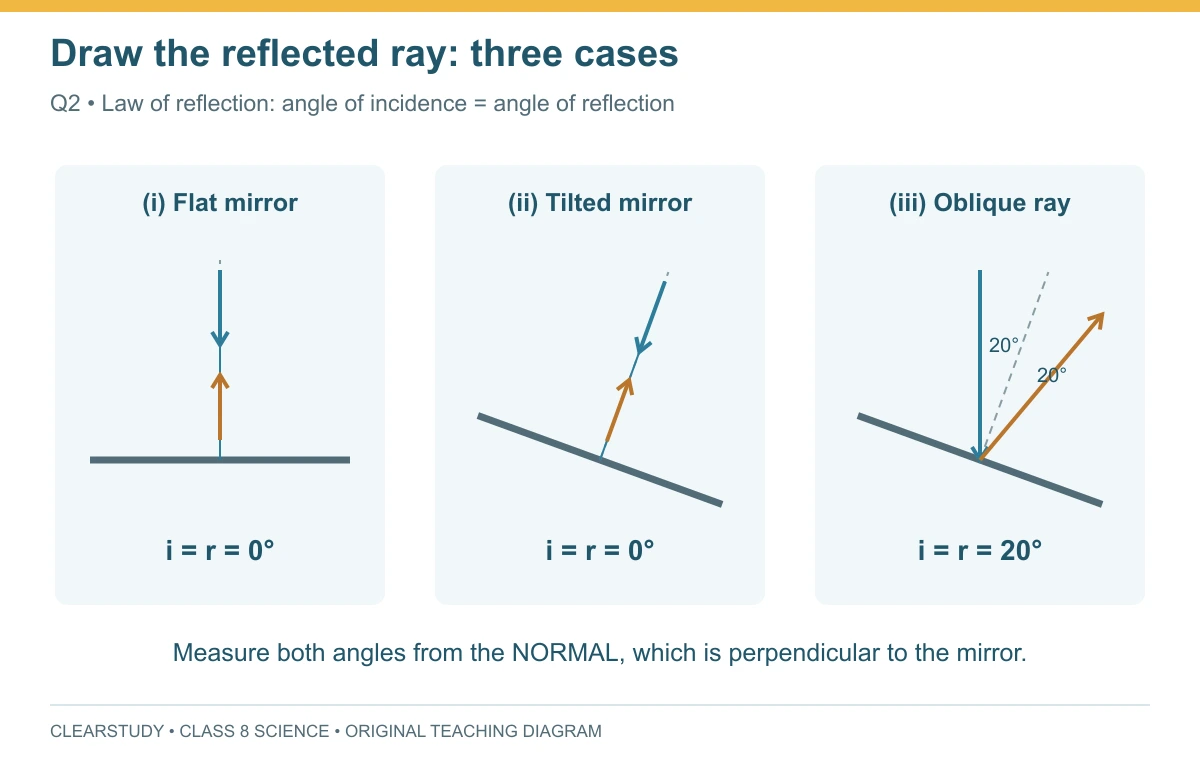
Normal: the line drawn at 90° to the mirror at the point of incidence. Angle of incidence (i): between incident ray and normal. Angle of reflection (r): between reflected ray and normal.
Converge / diverge: a concave mirror and a convex lens converge a parallel beam; a convex mirror and a concave lens diverge it.
Lens: a transparent optical element with at least one curved surface. A convex lens is thicker in the middle (converging); a concave lens is thicker at the edges (diverging). We see things through a lens, not in it.
“Probe and Ponder” & In-text Questions — Answers
Can we make mirrors which can give enlarged or diminished images?
On side-view mirrors of vehicles, there is a warning that says “Objects in mirror are closer than they appear”. Why is this warning written there?
Why is there a curved line on some reading glasses?
(Activity 10.1) When you hold the inner and outer curved surfaces of a shiny metallic spoon close to your face, how do the two images differ?
(Activity 10.3) When an object is placed in front of concave and convex mirrors and slowly moved away, what changes are seen in the images?
(Activity 10.6) What happens when multiple parallel beams of light fall on plane, concave and convex mirrors?
Class 8 Science Curiosity Chapter 10 Solutions — Keep the Curiosity Alive
1. A light ray is incident on a mirror and gets reflected by it (Fig. 10.21). The angle made by the incident ray with the normal to the mirror is 40°. What is the angle made by the reflected ray with the mirror? (i) 40° (ii) 50° (iii) 45° (iv) 60°
2. Fig. 10.22 shows three different situations where a light ray falls on a mirror: (i) The light ray falls along the normal. (ii) The mirror is tilted, but the light ray still falls along the normal to the tilted surface. (iii) The mirror is tilted, and the light ray falls at an angle of 20° from the normal. Draw the reflected ray in each case (Use a ruler and protractor for accurate drawing). What is the angle of reflection in each case?
3. In Fig. 10.23, the cap of a sketch pen is placed in front of three types of mirrors. Match each image with the correct mirror.
| Image | Mirror |
|---|---|
| (i) Smaller, erect image | Convex mirror |
| (ii) Larger, erect (enlarged) image | Concave mirror |
| (iii) Same-size, erect image | Plane mirror |
4. In Fig. 10.24, the cap of a sketch pen is placed behind a convex lens, a concave lens, and a flat transparent glass piece — all at the same distance. Match each image with the correct type of lens or glass.
| Image | Lens/glass type |
|---|---|
| (i) Larger (enlarged), erect image | Convex lens |
| (ii) Smaller (diminished), erect image | Concave lens |
| (iii) Same-size image | Flat transparent glass piece |
5. When the light is incident along the normal on the mirror, which of the following statements is true: (i) Angle of incidence is 90° (ii) Angle of incidence is 0° (iii) Angle of reflection is 90° (iv) No reflection of light takes place in this case
6. Three mirrors—plane, concave and convex are placed in Fig. 10.25. On the basis of the images of the graph sheet formed in the mirrors, identify the mirrors and write their names above the mirrors.
7. In a museum, a woman walks towards a large concave mirror (Fig. 10.26). She will see that: (i) her erect image keeps decreasing in size. (ii) her inverted image keeps decreasing in size. (iii) her inverted image keeps increasing in size and eventually it becomes erect and magnified. (iv) her erect image keeps increasing in size.
8. Hold a magnifying glass over text and identify the distance where you can see the text bigger than they are written. Now move it away from the text. What do you notice? Which type of lens is a magnifying glass?
9. Match the entries in Column I with those in Column II.
| Column I | Column II |
|---|---|
| (i) Concave mirror | (a) Spherical mirror with a reflecting surface that curves inwards. |
| (ii) Convex mirror | (b) It forms an image which is always erect and diminished in size. |
| (iii) Convex lens | (c) Object placed behind it may appear inverted at some distance. |
| (iv) Concave lens | (d) Object placed behind it always appears diminished in size. |
10. The following question is based on Assertion/Reason. Assertion: Convex mirrors are preferred for observing the traffic behind us. Reason: Convex mirrors provide a significantly larger view area than plane mirrors. Choose the correct option: (i) Both Assertion and Reason are correct and Reason is the correct explanation for Assertion. (ii) Both Assertion and Reason are correct but Reason is not the correct explanation for Assertion. (iii) Assertion is correct but Reason is incorrect. (iv) Both Assertion and Reason are incorrect.
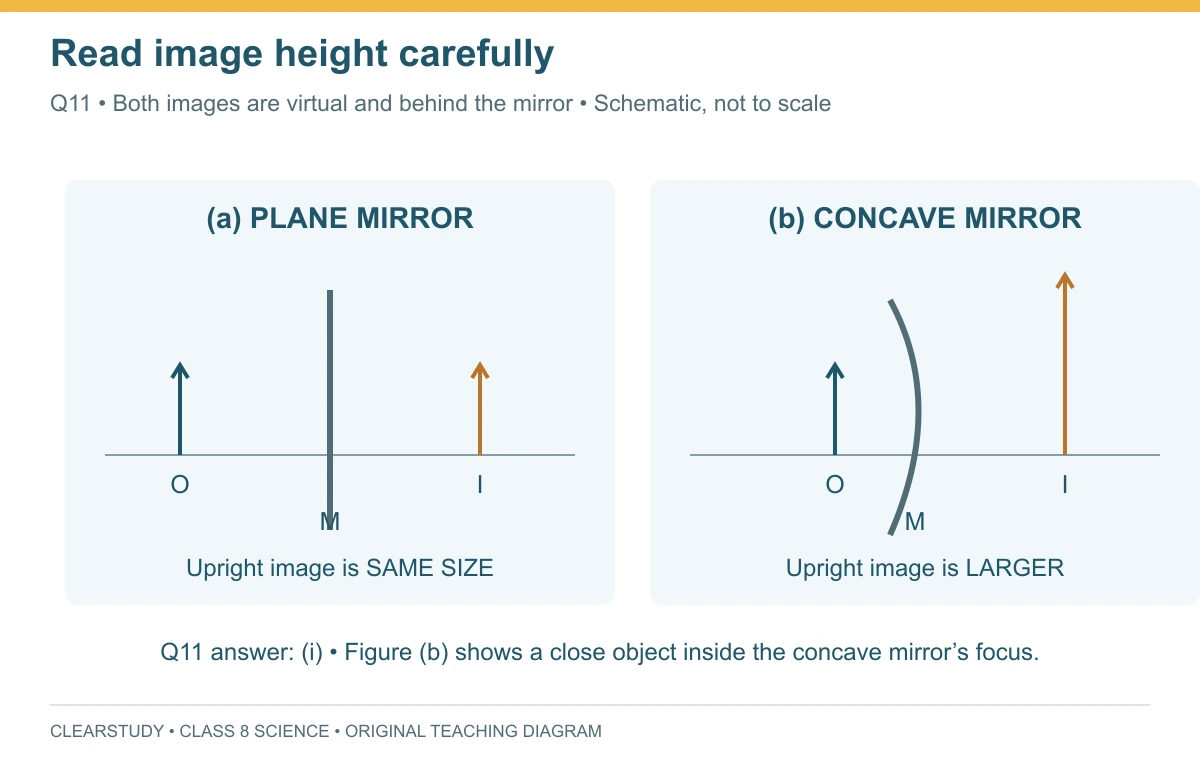
11. In Fig. 10.27, note that O stands for object, M for mirror, and I for image. Which of the following statements is true? (i) Figure (a) indicates a plane mirror and Figure (b) indicates a concave mirror. (ii) Figure (a) indicates a convex mirror and Figure (b) indicates a concave mirror. (iii) Figure (a) indicates a concave mirror and Figure (b) indicates a convex mirror. (iv) Figure (a) indicates a plane mirror and Figure (b) indicates a convex mirror.
12. Place a pencil behind a transparent glass tumbler (Fig. 10.28a). Now fill the tumbler halfway with water (Fig. 10.28b). How does the pencil appear when viewed through the water? Explain why its shape appears changed.
Common Misconceptions to Avoid
Watch out for these
- Measuring the angle of incidence/reflection from the mirror surface — both angles are always measured from the normal.
- Thinking a concave mirror only enlarges — it enlarges when the object is close, but gives an inverted, smaller image when the object is far.
- Believing a convex mirror can magnify — it always gives an erect, diminished image.
- Mixing up the shapes: a convex lens is thicker in the middle (converging); a concave lens is thicker at the edges (diverging).
- Confusing converging behaviour — concave mirror & convex lens converge; convex mirror & concave lens diverge.
- Saying we see an image “in” a lens — with lenses we see things through the lens (light passes through), unlike mirrors.
Extra Practice Questions
These questions and MCQs are ClearStudy practice, separate from the NCERT exercise.
Very Short Answer Type Questions
Q1. Which type of spherical mirror always forms an erect and diminished image?
Q2. What is the line drawn at 90° to a mirror at the point of incidence called?
Q3. Name the lens used as a magnifying glass.
Short Answer Type Questions
Q1. State the two laws of reflection.
Q2. Why are convex mirrors used as side-view mirrors in vehicles?
Long Answer Type Question
Q1. Compare the images formed by a concave mirror and a convex mirror as the object is moved from close to far, and give one practical use of each.
MCQs & Assertion–Reason
1. A mirror whose reflecting surface curves inwards is a:
(a) plane mirror (b) concave mirror (c) convex mirror (d) glass slab
2. A convex mirror always forms an image that is:
(a) erect and diminished (b) inverted and enlarged (c) erect and enlarged (d) same size as object
3. The angle of incidence is always measured from the:
(a) mirror surface (b) reflected ray (c) normal (d) object
4. If the angle of incidence is 35°, the angle of reflection is:
(a) 0° (b) 35° (c) 55° (d) 90°
5. A parallel beam of light is converged by a:
(a) convex mirror (b) concave mirror (c) plane mirror (d) concave lens
6. A lens that is thicker at the middle than at the edges is a:
(a) concave lens (b) convex lens (c) plane mirror (d) glass slab
7. A concave lens is also called a:
(a) converging lens (b) diverging lens (c) magnifying lens (d) plane lens
8. The mirror used by a dentist to get an enlarged view of teeth is a:
(a) convex mirror (b) plane mirror (c) concave mirror (d) concave lens
9. When light falls along the normal on a mirror, the angle of reflection is:
(a) 0° (b) 45° (c) 90° (d) 180°
10. A convex lens concentrates a parallel beam near its focus because it:
(a) diverges the light (b) converges the light to a point (c) absorbs the light (d) reflects the light
For each Assertion–Reason question, choose: (A) Both true and the Reason correctly explains the Assertion; (B) Both true but the Reason is not the correct explanation; (C) Assertion true, Reason false; (D) Assertion false, Reason true.
A-R 1. Assertion: A convex mirror is used as a side-view mirror in vehicles.
Reason: A convex mirror gives a wide, erect and diminished view of the traffic behind.
A-R 2. Assertion: A concave mirror can form an enlarged image.
Reason: When the object is placed close to a concave mirror, the image is erect and magnified.
A-R 3. Assertion: A convex lens is called a diverging lens.
Reason: A convex glass lens in air brings a parallel beam towards a focus.
A-R 4. Assertion: The angle of incidence equals the angle of reflection.
Reason: The incident ray, the normal and the reflected ray do not lie in the same plane.
A-R 5. Assertion: A pencil seen through a water-filled glass tumbler appears bent and thicker.
Reason: Light refracts as it passes from water and glass into air, and the tumbler acts like a convex lens.
Quick Revision Summary
- Image formed by a concave mirror can be enlarged, diminished or of the same size, and erect or inverted, depending on the object distance.
- Image formed by a convex mirror is always erect and diminished in size.
- Two laws of reflection: (i) angle of incidence = angle of reflection; (ii) the incident ray, normal and reflected ray lie in the same plane.
- The laws of reflection hold for all mirrors — plane, concave and convex.
- A concave mirror converges a light beam; a convex mirror diverges it.
- Image formed by a convex lens can be enlarged, diminished or same size, and erect or inverted; a concave lens always gives an erect, diminished image.
- A convex lens converges light (converging lens); a concave lens diverges it (diverging lens).
Real-life Applications
Spherical mirrors and lenses are all around us. Concave mirrors form the reflectors of torches, car and scooter headlights, dentists’ mirrors, reflecting telescopes and solar concentrators (even solar cookers and solar furnaces hot enough to melt steel). Convex mirrors serve as vehicle side-view mirrors, road-safety mirrors at sharp bends, and surveillance mirrors in shops. Lenses are used in magnifying glasses, eyeglasses, cameras, telescopes and microscopes — and our own eye contains a flexible convex lens that lets us focus on near and far objects.
How to write a clear answer
Always measure i and r from the normal, not the mirror, and remember i = r. Memorise the fixed rule — convex mirror and concave lens always give erect, diminished images. For the concave mirror and convex lens, link the image to object distance (close = erect/enlarged, far = inverted). For “identify the mirror/lens” questions, compare the image size to the object: use both size and orientation: a close upright enlarged image suggests a concave mirror or convex lens, but these can also make same-sized or diminished inverted images at other distances.
Frequently Asked Questions
What is Class 8 Science Curiosity Chapter 10 about?
Chapter 10, Light: Mirrors and Lenses, covers spherical mirrors (concave and convex), the laws of reflection, how mirrors converge or diverge light, and convex and concave lenses, along with their everyday uses.
What is the difference between a concave and a convex mirror?
A concave mirror curves inwards and can form enlarged, diminished, erect or inverted images depending on the object distance; a convex mirror curves outwards and always forms an erect, diminished image with a wide field of view.
How many questions are in the “Keep the curiosity alive” exercise of Chapter 10?
There are 12 questions, all solved on this page along with the “Probe and ponder” and in-text activity questions.
Are these Class 8 Science Curiosity Chapter 10 solutions free?
Yes. All solutions are free and follow the official NCERT Curiosity textbook for 2026–27.