
Class 8 Science Curiosity Chapter 12 Solutions (NCERT 2026–27) – How Nature Works in Harmony
These Class 8 Science Curiosity Chapter 12 solutions cover How Nature Works in Harmony from the new NCF-2023 textbook (2026–27), with every “Keep the curiosity alive” question answered step by step.
Class 8 Science Curiosity Chapter 12 Solutions – Overview
Chapter 12 of Curiosity, How Nature Works in Harmony, explains how living and non-living parts of the environment depend on one another. It introduces habitats, biotic and abiotic components, and the levels of organisation — individual, population, community and ecosystem. It explores feeding relationships through food chains, food webs and trophic levels, the roles of producers, consumers and decomposers, and interactions such as competition, mutualism, commensalism and parasitism. It also looks at how one change can cascade through nature, the importance of biodiversity and conservation (the Sundarbans, protected areas), and sustainable farming. These Class 8 Science Curiosity Chapter 12 solutions answer every textbook question step by step.
Key Concepts & Definitions
Habitat: the place that provides the right conditions for an organism to live and grow (e.g. a pond, a forest, even the bark of a tree).
Biotic components: the living parts of a habitat (plants, animals, microbes). Abiotic components: the non-living parts (air, water, soil, sunlight, temperature).
Levels of organisation: Individual → Population (same species in the same area at the same time) → Community (different populations together) → Ecosystem (community + abiotic components interacting).
Producers (autotrophs): green plants, algae and some bacteria that make food using sunlight. Consumers (heterotrophs): herbivores, carnivores, omnivores. Decomposers (saprotrophs): fungi and bacteria that break down dead matter and recycle nutrients.
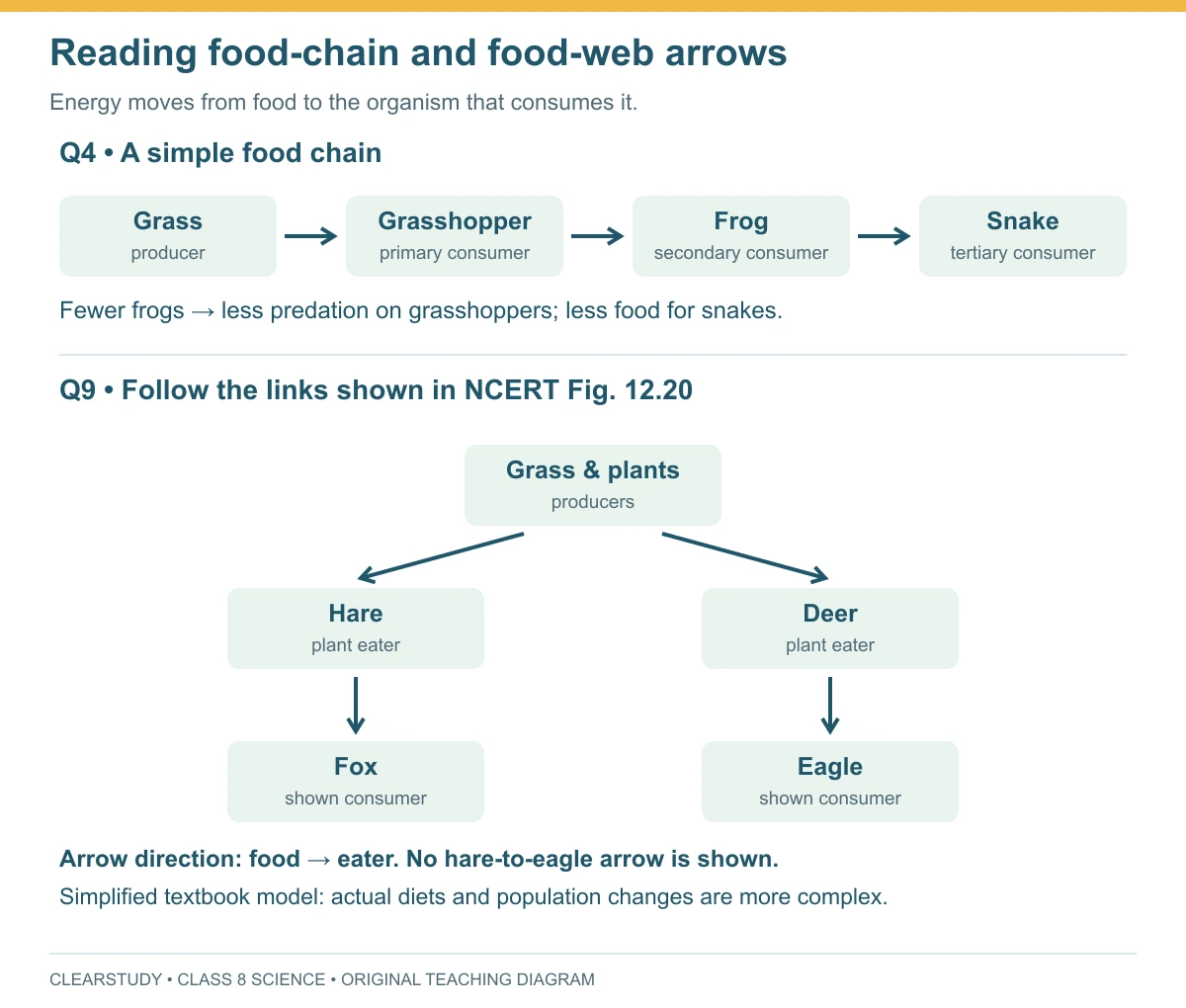
Food chain: a linear “who eats whom” sequence. Food web: interlinked food chains forming a network. Trophic level: the position of an organism in a food chain.
Interactions: competition, mutualism (both benefit), commensalism (one benefits, the other unaffected) and parasitism (one benefits, the other is harmed).
“Probe and Ponder” & In-text Answers
How might the loss of forest cover and changes in rainfall patterns lead to elephants to enter human farms and villages?
Imagine you are a tree in a dense forest. What kind of relationships would you have with water, sunlight, other animals, and other components of the forest?
Do you think the Earth can thrive without humans? Can humans survive without the Earth?
If two kinds of birds compete for the same fruit, how might their way of living change over time?
Can human actions cause natural disasters?
(Activity 12.5) How do plants get their food, and how are organisms classified by what they eat?
Class 8 Science Curiosity Chapter 12 Solutions — Keep the Curiosity Alive
1. Refer to the given diagram (Fig. 12.19) and select the wrong statement. (i) A community is larger than a population.(ii) A community is smaller than an ecosystem.(iii) An ecosystem is part of a community.
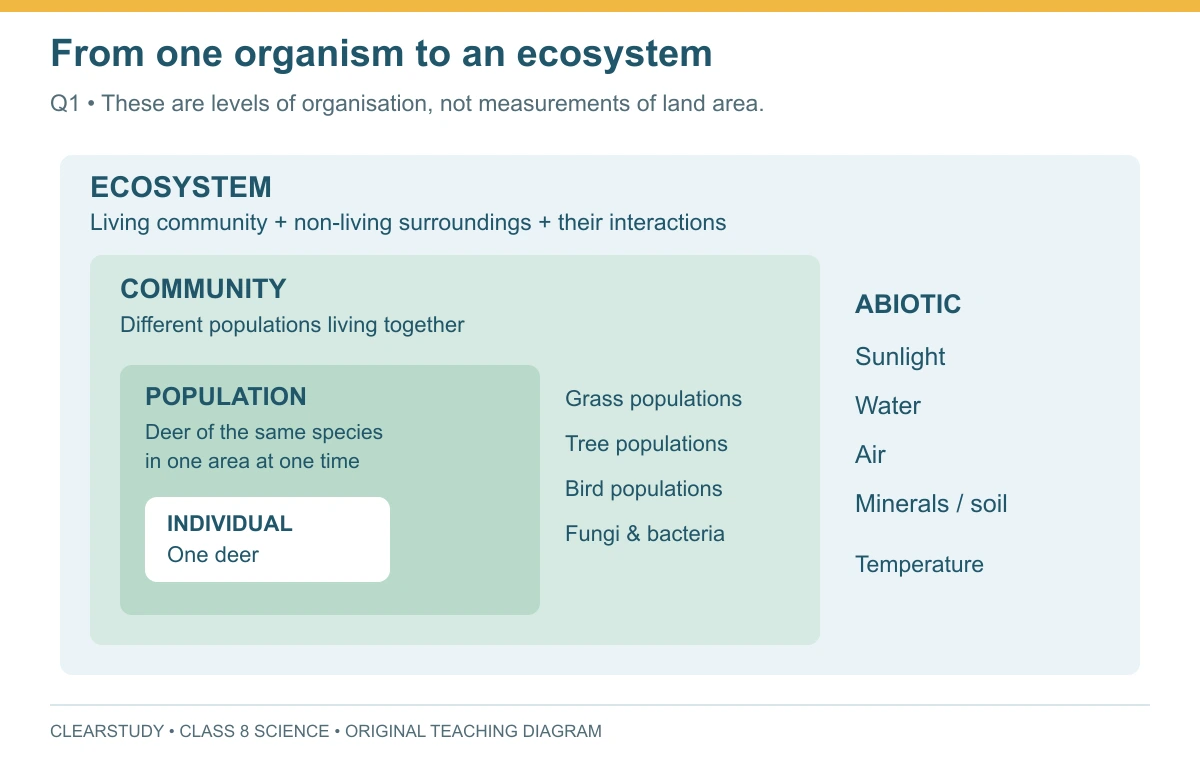
2. A population is part of a community. If all decomposers suddenly disappear from a forest ecosystem, what changes do you think would occur? Explain why decomposers are essential.
3. Selvam from Cuddalore district, Tamil Nadu, shared that his village was less affected by the 2004 Tsunami compared to nearby villages due to the presence of mangrove forests. This surprised Sarita, Shabnam, and Shijo. They wondered if mangroves were protecting the village. Can you help them understand this?
4. Look at this food chain: Grass → Grasshopper → Frog → Snake. If frogs disappear from this ecosystem, what will happen to the population of grasshoppers and snakes? Why?
5. In a school garden, students noticed fewer butterflies the previous season. What could be the possible reasons? What steps can students take to have more butterflies on campus?
6. Why is it not possible to have an ecosystem with only producers and no consumers or decomposers?
7. Observe two different places near your home or school (e.g., a park and a roadside). List the living and non-living components you see. How are the two ecosystems different?
| Place | Living (biotic) components | Non-living (abiotic) components |
|---|---|---|
| Park | Grass, trees, flowers, butterflies, birds, squirrels, earthworms | Soil, water, air, sunlight, stones |
| Roadside | A few hardy grasses/weeds, stray dogs, crows, ants | Concrete, dust, air (often polluted), sunlight, little soil |
8. ‘Human-made ecosystems like agricultural fields are necessary, but they must be made sustainable.’ Comment on the statement.
9. If the Indian hare population (Fig. 12.20) drops because of a disease, how would it affect the number of other organisms?
Common Misconceptions to Avoid
Watch out for these
- Confusing the order of levels — correct order is population → community → ecosystem, not the reverse.
- Thinking decomposers recycle energy — they recycle nutrients; energy passes through an ecosystem and is eventually dissipated as heat.
- Treating a food chain and a food web as the same — a web is many food chains interlinked.
- Believing only plants are biotic — animals and microbes are also biotic; only air, water, soil, sunlight and temperature are abiotic.
- Mixing up the interactions — mutualism (both benefit), commensalism (one benefits, other unaffected), parasitism (one benefits, other harmed).
- Assuming human-made ecosystems run by themselves — unlike natural ones, farms and parks need human care and management.
Extra Practice Questions
These questions and MCQs are ClearStudy practice, separate from the NCERT exercise.
Very Short Answer Type Questions
Q1. What is a habitat?
Q2. What are organisms that break down dead matter called?
Q3. Name the two main types of ecosystems in nature.
Short Answer Type Questions
Q1. Differentiate between biotic and abiotic components with examples.
Q2. What is the difference between a food chain and a food web?
Long Answer Type Question
Q1. Explain mutualism, commensalism and parasitism with one example each.
MCQs & Assertion–Reason
1. The living parts of a habitat are called:
(a) abiotic components (b) biotic components (c) producers only (d) trophic levels
2. A group of organisms of the same kind living together in a habitat is a:
(a) community (b) ecosystem (c) population (d) food web
3. Green plants that make their own food are called:
(a) consumers (b) decomposers (c) producers (d) parasites
4. Organisms that eat both plants and animals are:
(a) herbivores (b) carnivores (c) omnivores (d) autotrophs
5. A network of interlinked food chains is called a:
(a) food chain (b) food web (c) trophic level (d) habitat
6. Fungi and bacteria that break down dead matter are:
(a) producers (b) herbivores (c) decomposers (d) carnivores
7. In the relationship between honeybees and flowers, both benefit. This is an example of:
(a) parasitism (b) commensalism (c) competition (d) mutualism
8. The largest mangrove forest in the world, a UNESCO World Heritage Site, is the:
(a) Western Ghats (b) Sundarbans (c) Chilika Lake (d) Manas forest
9. Growing the same crop repeatedly on the same land is called:
(a) crop rotation (b) monoculture (c) decomposition (d) pollination
10. The position an organism occupies in a food chain is called its:
(a) habitat (b) population (c) trophic level (d) community
For each Assertion–Reason question, choose: (A) Both true and the Reason correctly explains the Assertion; (B) Both true but the Reason is not the correct explanation; (C) Assertion true, Reason false; (D) Assertion false, Reason true.
A-R 1. Assertion: Decomposers are essential for an ecosystem.
Reason: They break down dead matter and recycle nutrients back into the soil.
A-R 2. Assertion: Mangrove forests can protect coastal villages during storms and tsunamis.
Reason: Their dense roots and stems slow down strong waves and winds.
A-R 3. Assertion: A food web is more realistic than a single food chain.
Reason: In nature most organisms are eaten by only one type of organism.
A-R 4. Assertion: Green plants are called producers.
Reason: Plants depend on other organisms for their food.
A-R 5. Assertion: Overuse of synthetic fertilisers and pesticides makes farming unsustainable.
Reason: It reduces soil fertility, harms useful microbes and pollinators, and damages the environment.
Quick Revision Summary
- A habitat provides the right conditions for an organism to live and grow; it has biotic (plants, animals, microbes) and abiotic (air, water, soil, temperature) components.
- The interaction of biotic and abiotic components in an area forms an ecosystem — terrestrial (forests, grasslands, deserts) or aquatic (ponds, lakes, seas, oceans).
- Levels of organisation: individual → population → community → ecosystem.
- Organisms are producers (plants), consumers (herbivores, carnivores, omnivores) and decomposers (bacteria, fungi) that recycle nutrients.
- Food chains show who eats whom; food webs show how chains interconnect; positions in a chain are trophic levels.
- Relationships include mutualism (both benefit), commensalism (one benefits, other unaffected) and parasitism (one benefits, one harmed).
- Ecosystems give clean air, water, food, medicine and climate regulation; pollution, deforestation, habitat loss and overexploitation threaten them, so conservation (national parks, sanctuaries) is vital.
Real-life Applications
This chapter explains many everyday observations: why mangrove forests like the Sundarbans shield coasts from tsunamis and storms; why over-harvesting Indian bullfrogs led to more crop pests and forced India to ban the export of frog legs; why elephant corridors are marked so herds can move safely without entering villages; and why farmers turn to organic and natural farming to protect soil, pollinators and food security. It also explains how decomposers keep soil fertile and how protecting national parks and biosphere reserves safeguards biodiversity for future generations.
How to write a clear answer
Learn the four levels (individual → population → community → ecosystem) in the correct order. Be able to define producer, consumer and decomposer with one example each, and draw a simple food chain and food web. For “what if” questions (a species disappears), always trace the effect both up and down the chain. Remember one example each of mutualism, commensalism and parasitism, and link conservation to a real case like the Sundarbans.
Frequently Asked Questions
What is Class 8 Science Curiosity Chapter 12 about?
How Nature Works in Harmony covers habitats, biotic and abiotic components, populations, communities and ecosystems, food chains, food webs and trophic levels, producers/consumers/decomposers, interactions like mutualism and parasitism, and conservation of ecosystems such as the Sundarbans.
What is the difference between a food chain and a food web?
A food chain is a single linear ‘who eats whom’ sequence, while a food web is a network of many interlinked food chains, since most organisms are eaten by more than one kind of organism.
How many questions are in the “Keep the curiosity alive” exercise of Chapter 12?
There are 9 questions, all solved on this page along with the “Probe and ponder” and in-text prompts.
Are these Class 8 Science Curiosity Chapter 12 solutions free?
Yes. All ClearStudy NCERT solutions for Class 8 Science Curiosity are free and follow the official NCERT textbook for 2026–27.