
Class 8 Science Curiosity Chapter 2 Solutions (NCERT 2026–27) – The Invisible Living World: Beyond Our Naked Eye
These Class 8 Science Curiosity Chapter 2 solutions cover The Invisible Living World: Beyond Our Naked Eye from the new NCF-2023 textbook (2026–27). You get every “Keep the curiosity alive” exercise question solved step by step, the “Probe and ponder” prompts answered, plus extra practice, MCQs, Assertion–Reason and FAQs.
Class 8 Science Curiosity Chapter 2 Solutions – Overview
Chapter 2 of Curiosity, The Invisible Living World: Beyond Our Naked Eye, opens the hidden world of tiny living things that the unaided eye cannot see. It traces how the lens and the microscope (Robert Hooke’s Micrographia and Antonie van Leeuwenhoek, the Father of Microbiology) revealed the cell — the basic unit of life. You study the parts of a cell (cell membrane, cytoplasm, nucleus and the plant cell wall), how cells vary in shape and function, the levels of organisation (cell → tissue → organ → organ system → organism) and the four main groups of microorganisms — bacteria, fungi, protozoa and algae — along with viruses. The chapter also shows how microbes decompose waste, fix nitrogen, ferment food and make curd, bread and biogas.
Key Concepts & Definitions
Magnifying lens: a convex lens, thicker at the centre than at the edge, can make a nearby object look larger when used at a suitable distance. Not all lenses have this shape or magnify in every position.
Cell: the basic structural and functional unit of life; the word was first used by Robert Hooke (1665) for the box-like spaces he saw in cork.
Parts of a cell: cell membrane (selectively controls entry and exit), cytoplasm (where many cell processes occur) and, in typical plant and animal cells, a nucleus containing genetic material. Bacteria have a nucleoid region rather than a membrane-bound nucleus. Plant cells have an extra rigid cell wall, plus plastids (e.g. chloroplasts with chlorophyll) and a large vacuole.
Levels of organisation: Cell → Tissue → Organ → Organ system → Organism.
Microorganisms (microbes): tiny living beings not visible to the naked eye — bacteria, fungi, protozoa and some algae. They may be unicellular (bacteria, protozoa) or multicellular (most fungi, many algae).
Viruses: microscopic and acellular; they multiply only inside a living host cell and may cause disease.
Useful microbes: bacteria and fungi decompose waste into manure; Rhizobium fixes nitrogen in legume root nodules; yeast (a fungus) makes dough rise; Lactobacillus turns milk into curd; microalgae release oxygen and make biofuel.
“Probe and ponder” — Answers
Have you ever wondered what you might see if the invisible world around you became visible?
How do you think your observation of this hidden world might change the way you think about size, complexity, or even what counts as ‘living’?
Have you thought how these tiny living beings interact with each other?
(The book also invites you to “Share your questions” — write your own curiosities, e.g. “How do bacteria move without legs?”)
Class 8 Science Curiosity Chapter 2 Solutions — Keep the Curiosity Alive
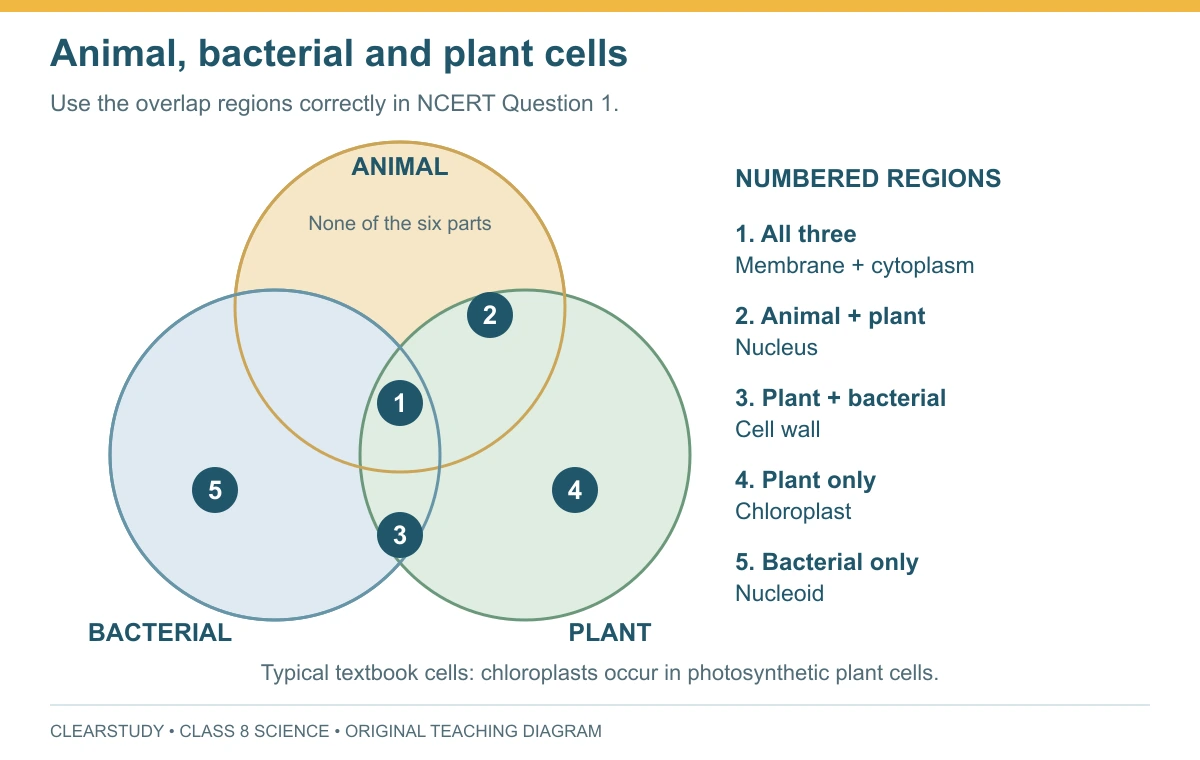
1. Various parts of a cell are given below. Write them in the appropriate places in the following diagram. Nucleus Cytoplasm Chloroplast Cell wall Cell membrane Nucleoid (The diagram is a Venn diagram with regions: “Only in Animal Cell”, “Common to all three cells”, “Only in Bacterial Cell” and “Only in Plant Cell”.)
| Region | Given cell parts |
|---|---|
| All three | Cell membrane; cytoplasm |
| Animal + plant only | Nucleus |
| Plant + bacterial only | Cell wall |
| Plant only | Chloroplast |
| Bacterial only | Nucleoid |
| Animal only | None of the six listed parts |
2. Aanandi took two test tubes and marked them A and B. She put two spoonfuls of sugar solution in each of the test tubes. In test tube B, she added a spoonful of yeast. Then she attached two incompletely inflated balloons to the mouth of each test tube. She kept the set-up in a warm place, away from sunlight. (i) What do you predict will happen after 3–4 hours? She observed that the balloon attached to test tube B was inflated. What can be a possible explanation for this? (a) Water evaporated in test tube B and filled the balloon with the water vapour. (b) The warm atmosphere expanded the air inside the test tube B, which inflated the balloon. (c) Yeast produced a gas inside the test tube B which inflated the balloon. (d) Sugar reacted with warm air, which produced gas, eventually inflating the balloon. (ii) She took another test tube, 1/4 filled with lime water. She removed the balloon from test tube B in such a manner that the gas inside the balloon did not escape. She attached the balloon to the test tube with lime water and shook it well. What do you think she wants to find out?
3. A farmer was planting wheat crops in his field. He added nitrogen-rich fertiliser to the soil to get a good yield of crops. In the neighbouring field, another farmer was growing bean crops, but she preferred not to add nitrogen fertiliser to get healthy crops. Can you think of the reasons?
4. Snehal dug two pits, A and B, in her garden. In pit A, she put fruit and vegetable peels and mixed it with dried leaves. In pit B, she dumped the same kind of waste without mixing it with dried leaves. She covered both the pits with soil and observed after 3 weeks. What is she trying to test?
For a fair comparison, keep the peel quantity, pit size, moisture, temperature and observation time as similar as possible. Record what happens; adding dried leaves is the tested factor, not a guaranteed outcome.
5. Identify the following microorganisms: (i) I live in every kind of environment, and inside your gut. (ii) I make bread and cakes soft and fluffy. (iii) I live in the roots of pulse crops and provide nutrients for their growth.
Yeast is the expected textbook answer for (ii). In everyday baking, many cakes instead use baking powder or baking soda; fermentation is not the only way to make cakes rise.
6. Design an experiment to test that microorganisms need optimal temperature, air, and moisture for their growth.
7. Take 2 slices of bread. Place one slice in a plate near the sink. Place the other slice in the refrigerator. Compare after three days. Note your observations. Give reasons for your observations.
8. A student observes that when curd is left out for a day, it becomes more sour. What can be two possible explanations for this observation?
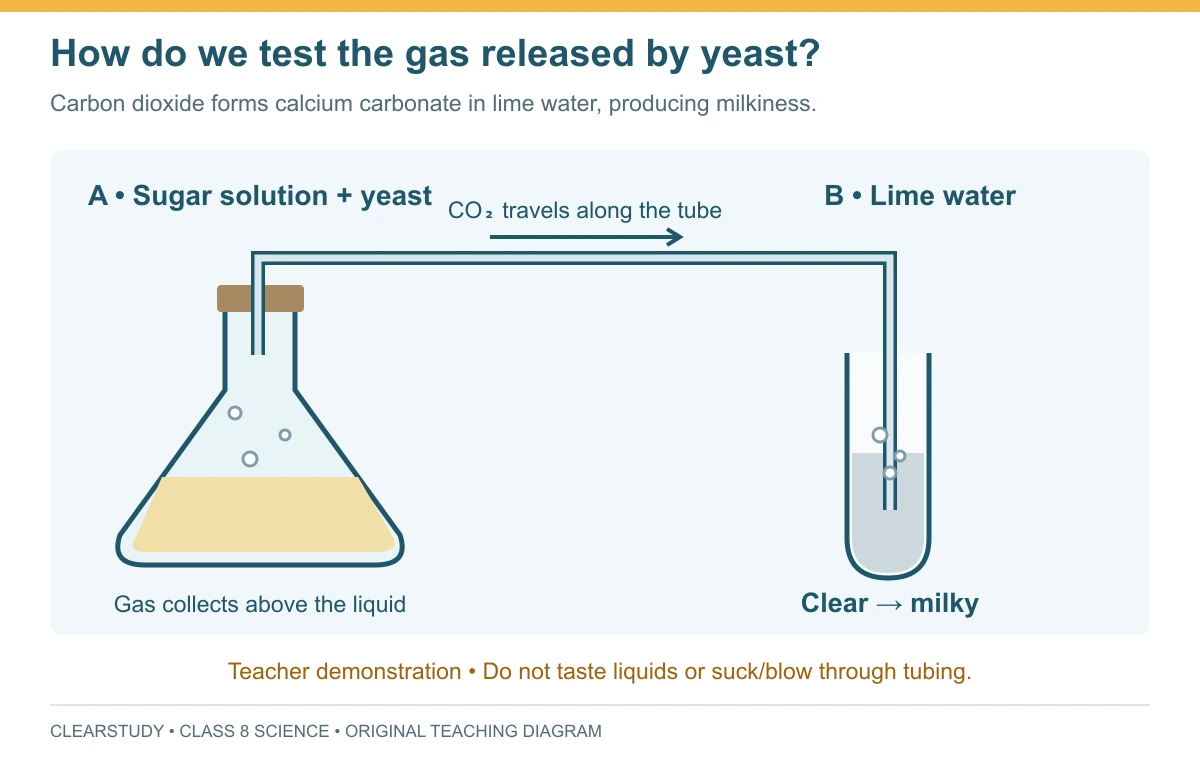
9. Observe the set-up given in Fig. 2.15 and answer the following questions. (Flask A holds warm sugar solution + yeast, connected by a tube to test tube B containing lime water.) (i) What happens to the sugar solution in flask A? (ii) What do you observe in test tube B after four hours? Why do you think this happened? (iii) What would happen if yeast was not added in flask A?
Common Misconceptions to Avoid
Watch out for these
- Thinking microorganisms are always harmful — many are beneficial (decomposers, nitrogen fixers, yeast, Lactobacillus, microalgae).
- Treating viruses as ordinary microorganisms — viruses are acellular and multiply only inside a living host cell.
- Saying bacteria have a nucleus — bacteria have no true nucleus; they have a nucleoid instead.
- Confusing the cell wall with the cell membrane — the wall is the extra rigid outer layer in plant, fungal and bacterial cells; the membrane is present in all cells.
- Believing all fungi are multicellular — yeast is a unicellular fungus, while mould is multicellular.
- Thinking yeast makes dough rise by producing oxygen — it actually produces carbon dioxide (which turns lime water milky), not oxygen.
Extra Practice Questions
These questions and MCQs are ClearStudy practice, separate from the NCERT exercise.
Very Short Answer Type Questions
Q1. Who is known as the “Father of Microbiology”?
Q2. Name the bacterium that helps in the formation of curd.
Q3. What is the genetic region of a bacterial cell called?
Short Answer Type Questions
Q1. List the levels of organisation in the body of a multicellular organism.
Q2. How do microorganisms help in cleaning the environment?
Long Answer Type Question
Q1. Describe the basic parts of a cell and state the function of each.
MCQs & Assertion–Reason
1. The basic structural and functional unit of life is the:
(a) tissue (b) organ (c) cell (d) nucleus
2. Who first used the word “cell” after observing a thin slice of cork?
(a) Antonie van Leeuwenhoek (b) Robert Hooke (c) A. M. Chakrabarty (d) Louis Pasteur
3. Which of these is NOT a part of a typical cell?
(a) cell membrane (b) cytoplasm (c) nucleus (d) lens
4. Amoeba and Paramecium are examples of:
(a) fungi (b) protozoa (c) algae (d) viruses
5. Which microorganism helps in making the dough of bread rise?
(a) Lactobacillus (b) Rhizobium (c) yeast (d) Amoeba
6. Bacteria lack a true nucleus; instead they have a:
(a) vacuole (b) nucleoid (c) chloroplast (d) cell wall only
7. Rhizobium bacteria living in the root nodules of legumes help by:
(a) fixing nitrogen (b) producing oxygen (c) causing disease (d) making curd
8. Which of the following is acellular (not made of cells)?
(a) bacterium (b) virus (c) yeast (d) alga
9. The gas produced by yeast during fermentation, which turns lime water milky, is:
(a) oxygen (b) hydrogen (c) carbon dioxide (d) nitrogen
10. Microalgae such as Chlorella are important because they:
(a) cause food to rot (b) release oxygen and serve as food/supplements (c) have no nucleus (d) cannot live in water
For each Assertion–Reason question, choose: (A) Both true and the Reason correctly explains the Assertion; (B) Both true but the Reason is not the correct explanation; (C) Assertion true, Reason false; (D) Assertion false, Reason true.
A-R 1. Assertion: Yeast makes dough rise and become fluffy.
Reason: Yeast respires on sugar and releases carbon dioxide, which forms bubbles in the dough.
A-R 2. Assertion: Bacteria are eukaryotic cells with a well-defined nucleus.
Reason: Bacteria have a nucleoid and lack a nuclear membrane.
A-R 3. Assertion: Legumes can grow well without nitrogen fertiliser.
Reason: Rhizobium bacteria in their root nodules fix nitrogen from the air for the plant.
A-R 4. Assertion: Viruses are considered different from other microorganisms.
Reason: Viruses are acellular and multiply only inside a living host cell.
A-R 5. Assertion: Pickles and murabbas do not get infected by microorganisms easily.
Reason: High concentrations of salt or sugar reduce available water and inhibit the growth of many spoilage microbes.
Classification note: Spirulina is commonly called a blue-green alga in food contexts, but biologically it is a cyanobacterium and has no membrane-bound nucleus. Chlorella is a eukaryotic green alga. See the FAO AGRIS reference on Spirulina.
Quick Revision Summary
- Microorganisms are tiny organisms not visible to the unaided eye; they live in water, soil, air and inside plants and animals.
- They are unicellular or multicellular: bacteria and protozoa are unicellular; fungi may be unicellular (yeast) or multicellular (mould); plants and animals are multicellular.
- The cell is the basic unit of life. A typical cell has a cell membrane, cytoplasm and a nucleus; plant, fungal and bacterial cells have an extra cell wall, and bacteria lack a true nucleus.
- Cells differ in shape and size, and their shape suits their function.
- Bacteria, fungi and protozoa are the main kinds of microorganisms; viruses are small but different because they reproduce only inside a host.
- Microbes can be beneficial or harmful: they decompose waste, fix nitrogen in root nodules, and make curd (Lactobacillus), bread and cakes (yeast) and biogas.
Real-life Applications
Microbes are useful in food production and nutrient recycling. Yeast releases gas in bread dough, while mixtures of bacteria and yeasts can ferment traditional batters. Lactic-acid bacteria help make curd. Rhizobium can reduce legumes’ need for added nitrogen. Decomposers recycle organic waste; anaerobic microbial communities produce biogas, with methane formed by specialised archaea. Photosynthetic microbes contribute oxygen, and some are cultivated for food or studied for biofuel. Salt and sugar can slow many spoilage microbes, but preserved food is not automatically sterile.
How to write a clear answer
Remember the four groups of microbes (bacteria, fungi, protozoa, algae) with one example each, and keep viruses separate as “acellular”. Know the three basic cell parts plus the plant cell wall, and that bacteria have a nucleoid (not a nucleus). For experiment questions on yeast, always state that the gas is carbon dioxide and that it turns lime water milky. Link each useful microbe to its job: Rhizobium → nitrogen fixing, yeast → fermentation/rising dough, Lactobacillus → curd.
Frequently Asked Questions
What is Class 8 Science Curiosity Chapter 2 about?
It is about the invisible living world — how microscopes revealed the cell, the parts of a cell, the levels of organisation (cell to organism), and microorganisms such as bacteria, fungi, protozoa and algae, plus viruses, and how microbes help us.
What is the exercise of Chapter 2 called and how many questions does it have?
The end-of-chapter exercise is titled “Keep the curiosity alive” and has 9 questions (some with sub-parts), all solved step by step on this page.
Why does the balloon on the test tube with yeast inflate?
Yeast feeds on the sugar and respires, releasing carbon dioxide gas. This gas collects and inflates the balloon. Shaking the gas with lime water turns it milky, proving it is carbon dioxide.
Are these Class 8 Science Curiosity Chapter 2 solutions free?
Yes. All ClearStudy NCERT Solutions for Class 8 Science Curiosity are free and follow the official NCERT textbook for 2026–27.