
Class 8 Social Science Part II Chapter 8: Cultural Currents: 13th to 17th Centuries Solutions
These Class 8 Social Science Part 2 Chapter 8 solutions explain Cultural Currents: 13th to 17th Centuries. Explore how devotional traditions, crafts, learning, language and everyday practices continued and changed across regions. Use the original answers and clearly labelled project examples alongside your textbook.
Use the chapter title and Part II numbering to match your school textbook. These are original ClearStudy explanations. Open-ended tasks have sample answers; your observations and local examples may differ. Question prompts are shortened for reference; read the complete tasks in your textbook.
- Chapter overview and revision
- The Big Questions
- In-text questions and activities
- Questions and activities: exercise solutions
- Frequently asked questions
Cultural Currents: 13th to 17th Centuries: chapter overview
The chapter studies cultural developments during the 1200s to the 1600s. Political conflicts caused serious losses, while communities, artisans, teachers, poets and patrons continued to transmit knowledge. Cultural exchange produced new forms without erasing every older tradition.
| Area | Continuity and change |
|---|---|
| Devotion | Bhakti poetry in regional languages and Sufi teachings emphasised devotion; many teachers challenged social divisions. |
| Music and painting | Older musical traditions continued; Hindustani and Carnatic streams developed. Rajput and Mughal painters exchanged techniques while retaining distinct themes. |
| Education and craft | Local schools, religious institutions and apprenticeships sustained learning. Weaving combined inherited skills with new designs and patronage. |
| Language and knowledge | Regional literature grew, Sanskrit and Persian texts were translated, and scholars developed mathematics, astronomy and practical technologies. |
| Daily life | Food, gardens and clothing adapted outside influences to regional ingredients, materials and preferences. |
Key terms: bhakti means devotion; zikr is remembrance of God in Sufi practice; an atelier is an artist’s studio; a charbagh is a four-part garden design; brocade is fabric with a raised woven pattern; an apprentice learns skills from an experienced practitioner.
Accuracy notes: the Rashtrapati Bhavan gardens are now called Amrit Udyan. For Amer, do not repeat the textbook figure’s fifteenth-century attribution to Raja Man Singh I: Rajasthan Tourism dates his palace construction to 1592; later rulers added to the complex. The Kerala School’s work on infinite series was a major mathematical achievement, but Nilakantha’s planetary model was not identical to the modern Sun-centred model.
The Big Questions
Big Question 1: How did Indian culture endure and grow richer despite political instability?
Culture was carried by many institutions and people, rather than one ruler or capital. Families, devotional gatherings, schools, temples, religious communities and craft apprenticeships passed on practices locally. Patrons supported artists and scholars, while regional languages made ideas accessible. People also adapted incoming styles and techniques. This combination of continuity, local participation and selective exchange helped cultural traditions survive, although wars also destroyed institutions and disrupted lives.
Big Question 2: What were the major cultural trends and movements?
Major trends included the renewed spread of Bhakti devotion, Sufi spiritual traditions, regional poetry and storytelling, developments in Hindustani and Carnatic music, miniature painting, garden and architectural design, and the growth of learning and skilled crafts. Sanskrit–Persian translation projects and exchanges in food and clothing were also significant. These trends were diverse and did not develop uniformly across India.
Big Question 3: How did different cultural currents interact?
Musicians, poets, artisans, translators, traders and patrons created opportunities for exchange. Devotional singing carried ideas across social boundaries. Court ateliers brought painters with different training together. Translators made knowledge available to new readers, and craftspeople adapted motifs and materials. Interaction could involve cooperation, borrowing and debate alongside conflict; it did not mean that all beliefs or traditions became identical.
In-text questions and activities
Follow the textbook page references below. Suggested responses help you reason through discussion, observation and project tasks.
Page 220: What is the message of Kabir’s wheat-and-flour couplet?
Separate grains become one flour when ground. Kabir uses this familiar process to question rigid divisions between worshippers of Ram and Rahim. His message is that sincere awareness of the divine can take a person beyond hostility based on religious labels. The example stresses spiritual unity and mutual respect, rather than asking everyone to abandon their customs.
Page 221: Why were music and dance important in spreading Bhakti?
People could listen, sing and participate even if they could not read formal texts. Repetition helped them remember messages, regional languages made the words understandable, and rhythm and performance expressed emotion. Shared gatherings could bring people from different occupations and backgrounds together. Music offered an accessible way to communicate devotion and ideas about equality.
Page 224: Explore storytelling traditions in your region.
Choose a tradition actually practised near you, such as puppetry, a sung narrative or storytelling with painted scrolls. With your teacher, identify a practitioner and request a demonstration. Record the local name, language, themes, instruments or pictures used, and how performers learn. A sample enquiry might study Rajasthani puppetry; do not claim it is your local tradition unless that is true. Ask permission before recording or sharing a performer’s work.
Page 228: Compare the miniature paintings in the chapter.
The examples share detailed figures, clothing, decorative patterns and carefully arranged scenes. Several Rajput examples portray stories from the epics, Krishna devotion or festivals, while the Mughal examples include a ruler’s court and a Persian manuscript illustration. Compare the actual figures: backgrounds, buildings, gestures, palettes and the placement of people differ. Courtly subjects and natural details also crossed between traditions. These selected examples do not define every Rajput or Mughal painting.
Page 230: Investigate the survival and transmission of local art and craft.
Select one local craft and speak to an artisan, with adult guidance. Ask how long training takes, whether learning happens in families, workshops or institutions, and how designs and tools have changed. Present an observation table: skill, teacher or training route, older practice, current change, and evidence. For example, a weaving study could compare handloom skills with newer designs and online sales. Report real findings; do not invent an interview or assume a craft has disappeared.
Page 232 — recall: Recall women who challenged the expectations of their time.
Razia Sultan exercised political authority despite resistance to a woman ruler. Nur Jahan played an influential role in Mughal governance. Mirabai expressed her devotion through poetry despite pressures concerning family and social expectations. Their motivations and circumstances differed: political leadership, participation in governance and spiritual expression. Exceptional lives show possibilities, but do not prove that all women enjoyed the same freedom.
Page 232 — traveller’s account: What vocations did women undertake in the Vijayanagara king’s staff?
The account mentions wrestling, astrology and divination, keeping accounts of expenditure, writing and comparing records of the kingdom, playing musical instruments and singing. It indicates that some women in the royal establishment held skilled roles. A court traveller’s account has a particular setting and viewpoint, so it should not be treated as a description of every woman’s occupation.
Page 233 — donations: What do women’s donations suggest about their status?
Donations of villages and resources, and the building of wells or community halls, suggest that some women had access to wealth and the ability to make or influence decisions. Their gifts could support religious institutions and public facilities. These records chiefly concern queens and wealthier women; they do not establish equal property rights or prosperity for all women.
Page 233 — future historian: What would a future historian examine about women in the twenty-first century?
I would examine education, paid and unpaid work, property ownership, political representation, health, safety, sport, science and access to technology. I would compare regions and social groups and distinguish legal rights from everyday opportunities. School statistics, laws, interviews, newspapers and household records would provide different kinds of evidence. I would avoid describing all women through only a few famous achievements.
Page 235: What was the impact of the destruction of major universities?
Destruction damaged buildings, manuscripts, teaching networks and the lives of scholars and students. It interrupted the accumulation and exchange of knowledge and dispersed learned communities. Some learning survived through scholars who moved and through other centres, local institutions and oral traditions. Survival elsewhere does not erase the loss, and we cannot calculate every lost work or assume that knowledge development stopped everywhere.
Page 238: Find Persian loan words in your regional language.
For a Hindi/Urdu example, investigate bazaar, darwaza, rang and khush. Make a table showing the present word, meaning, Persian source and a dictionary reference. Persian was also a route through which words of other origins entered Indian languages; do not call every word used in Persian originally Persian. Use a reliable etymological dictionary and adapt the task to your own language.
Page 246: Explore the origins and cultural influences of regional dishes.
A possible study could compare a local lentil-and-rice dish, samosa and jalebi. The chapter presents samosa and jalebi as adaptations of food forms associated with West Asia, while local ingredients and preferences changed their preparation. The familiar potato filling is a later development, not evidence that medieval sambuseh contained potatoes. Document ingredients and reliable histories; many dishes have layered origins rather than one inventor or one country.
Page 247: What continuity and change do you see in clothing today?
Saris, regional textiles and embroidery continue, while ready-made garments, new fibres and combinations of older and newer styles are common. Climate, occupations, cost, convenience, trade, fashion and personal preference can influence clothing. Compare dated family photographs or garments with permission and note the place and occasion. Clothing differs within every community and should not be used to stereotype people.
Questions and activities: exercise solutions
Answers follow the printed exercise order (pages 248–249).
Question 1: Which path to moksha became popular during this period?
The Bhakti marga, or path of devotion, became especially popular. It emphasised sincere devotion to the divine and could be expressed through prayer, songs and everyday life. The tradition existed before the thirteenth century; this period saw renewed spread and many regional expressions.
Question 2: Name three Bhakti saints from different regions and explain their messages.
| Saint and region | Key message |
|---|---|
| Kabir — north India | Devotion to one divine reality, criticism of empty ritual and hostility between communities. |
| Chaitanya Mahaprabhu — eastern India | Love and devotion to Krishna expressed through collective singing and participation. |
| Purandaradasa — southern India | Devotion expressed through accessible compositions, with ethical and spiritual teaching through music. |
Other well-supported combinations are acceptable if you identify genuinely different regions and explain each teacher’s message.
Question 3: Why did Kabir use the everyday example of wheat becoming flour?
Grinding grain was familiar to ordinary people, so the comparison made an abstract spiritual idea understandable. Distinct grains no longer remain visibly separate in flour. In a similar way, Kabir suggests that awareness of divine unity can overcome rigid divisions associated with the names Ram and Rahim. The image is memorable, easy to repeat and suited to an oral tradition.
Question 4: Why could smaller local educational systems survive political turmoil?
They were distributed across many settlements, so the destruction of one centre did not destroy the whole network. Local support, modest buildings, teaching in homes or religious spaces, and apprenticeships made some systems adaptable. Skills could also be passed through practice and oral teaching. However, local systems could still suffer from war, poverty or exclusion; their survival did not replace everything lost at large universities.
Question 5: Why did women’s roles change differently across regions?
The intensity and location of warfare, enslavement and insecurity differed. Local customs, elite court practices, social position, access to property and education, and the opportunities offered by patrons also differed. The chapter contrasts increased seclusion among some northern elite groups with evidence of skilled public and court roles in the south. Neither region was uniform. Political events were one influence among several, and a queen’s experience cannot represent all women.
Question 6: Why might adaptation support cultural survival better than copying or rejection?
Adaptation allows people to use a useful new idea while fitting it to local needs, values, materials and skills. A garden plan can be adjusted to the terrain, a dish to available ingredients, or a musical form to existing traditions. Copying without adjustment may be unsuitable, while rejecting every outside influence can prevent learning. Cultural survival can therefore combine continuity with thoughtful change; people may also choose to retain a practice unchanged.
Question 7: Give examples of cultural interactions that produced new art forms.
- Qawwali: Sufi devotional performance developed through interaction with musical practices in South Asia; the chapter associates it with Indo-Persian traditions and Amir Khusrau.
- Miniature painting: Persian-influenced Mughal ateliers involved Indian painters, while exchange with Rajput workshops affected techniques, motifs and subjects.
- Textiles: weaving expertise, patronage and floral or geometric designs interacted in rich brocades and shawl traditions.
- Gardens and buildings: Persian-derived garden geometry and architectural elements were adapted to regional settings and craftsmanship.
These were gradual developments involving many people. Claims that one individual invented an entire musical form or instrument require careful evidence.
Question 8: Prepare a three-minute presentation on a Bhakti or Sufi saint and a poem.
Suggested subject: Kabir, using the wheat-and-flour couplet on textbook page 220.
- Share the poem (about 40 seconds): identify Kabir and read the printed couplet from the textbook. My original explanatory paraphrase is: “Grains become one flour when ground; knowing the divine can take us beyond divisions between Ram and Rahim.” This is a paraphrase, not a literal translation.
- Explain the message (40 seconds): the familiar grain image expresses spiritual unity and challenges hostility based on religious labels.
- Explain its appeal (50 seconds): everyday language and a household activity made the idea accessible to listeners, including those outside formal education. Oral performance helped it circulate.
- Discuss relevance (50 seconds): respect across communities and criticism of prejudice remain relevant. Give a school example such as including classmates fairly without judging their religion.
Credit the textbook passage and any additional translation you use. Do not invent a quotation or present a modern singer’s recording as the saint’s original performance.
Question 9: Create a regional culture project showing continuity and change.
Suggested project: a local textile tradition. Choose a craft actually available in your region. Examine a textile or museum example, consult a trustworthy source and interview a consenting artisan with teacher guidance.
| Enquiry | What to record |
|---|---|
| Continuity | Motifs, weaving or stitching skills, occasions of use and training practices that remain. |
| Change | Materials, tools, colours, prices, buyers or sales methods that have changed, with dated evidence. |
| Possible reasons | Availability, cost, technology, migration, demand and artisans’ choices; distinguish explanations from proven causes. |
Present a title, location, method, labelled photographs or drawings, findings and references. A four-page illustrated report could include one page each for context, continuity, change and conclusions. Say “our evidence suggests” where appropriate. Do not invent observations or claim that one household represents the whole region.
Frequently asked questions
How many exercise questions are in Chapter 8?
The supplied June 2026 Part II textbook has nine numbered questions and activities on pages 248–249. These solutions follow that order.
Are Bhakti and Sufism the same tradition?
They are distinct traditions. The chapter highlights points of interaction, including devotion, poetry and music; shared themes do not make all their beliefs and practices identical.
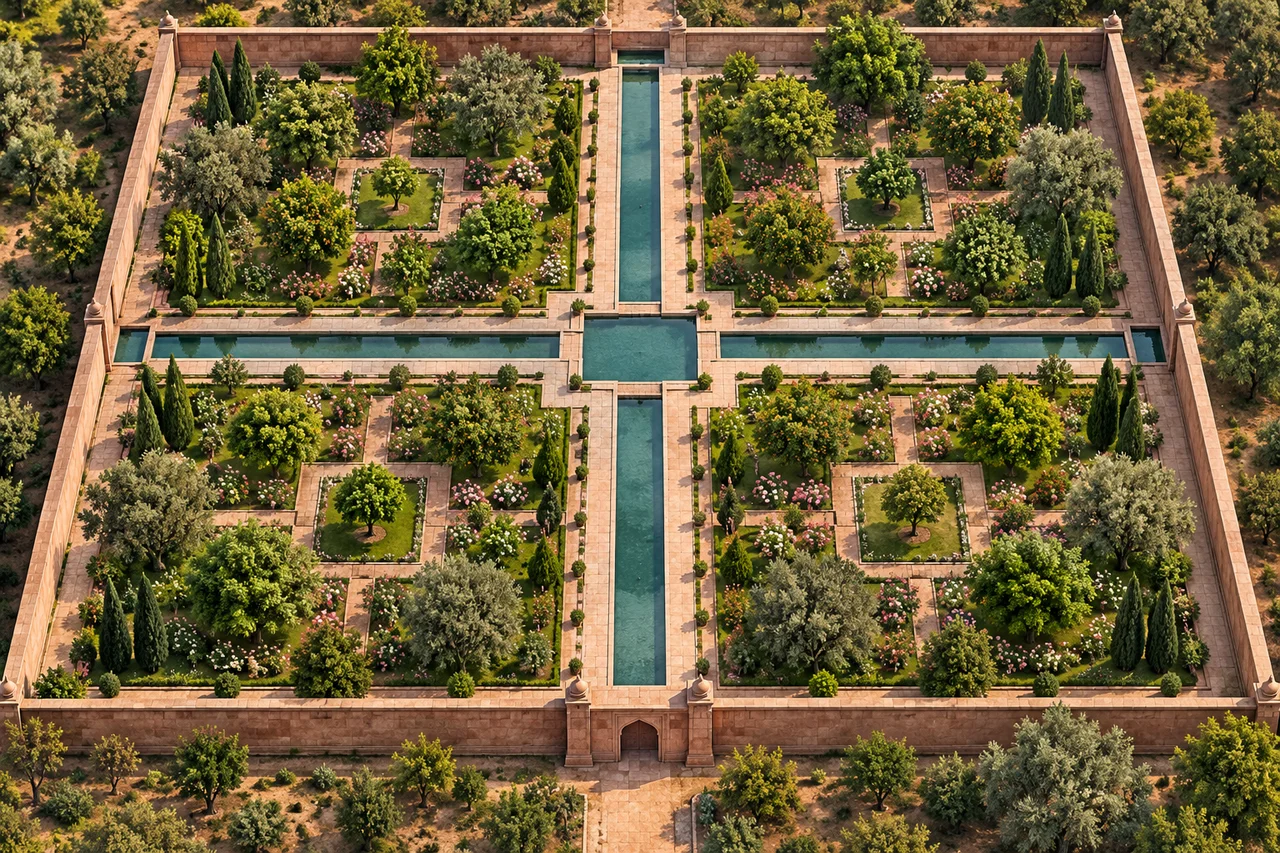
What does the charbagh illustration show?
It shows the concept of a garden divided into four main sections by intersecting water channels. It is an original conceptual reconstruction, not a photograph or an exact plan of a named garden.
Was Urdu created by one poet?
No. It developed over time through interaction among speakers and literary traditions. Amir Khusrau was an important early Indo-Persian and Hindavi poet, but calling him a pioneer is different from claiming that he alone created Urdu.
Textbook reference: NCERT, Exploring Society: India and Beyond, Grade 8, Part 2, first edition June 2026, Chapter 8, “Cultural Currents: 13th to 17th Centuries”. Compare with your school’s copy; official NCERT textbook portal. Accuracy references: Rajasthan Tourism: Amer, Rashtrapati Bhavan: Amrit Udyan, and Ministry of Culture: Kerala School. ClearStudy is an independent study resource.