
Vitamin-M Questions and Answers | Class 9 Kaveri
Checked against NCERT Kaveri, first edition January 2026, pages 97–125; listening transcript 266. Personal, discussion and creative responses are samples: adapt them to your experience. This independent study guide is not an official NCERT answer key.
Chapter Overview
This delightfully humorous story turns the tables on every assumption we make about the elderly. Ravi’s mother wishes someone would invent “Vitamin-M” — a memory vitamin for old people — after her seventy-five-year-old father has experienced some serious lapses. Asked to keep Grandpa from going out alone, Ravi secretly trails him through a hilarious day — park, tea stall, barber shop and a bus chase — only to mistake a stranger for him. The story celebrates the dignity, independence and sharpness of the elderly, ending with the gentle irony that it is Ravi’s mother, not Grandpa, who needs Vitamin-M.
About the Author – Asha Nehemiah
NCERT credits Asha Nehemiah for “Vitamin-M” and acknowledges its source as Favourite Stories for Boys. The story combines a comic pursuit with questions about affection, independence and assumptions based on age.
Summary in English
Ravi’s mother, Vidya, hurriedly sorting her father’s tablets, wishes someone would invent a memory vitamin — “Vitamin-M” — for old people. Grandpa, seventy-five and recently moved in after a fall at his beloved small-town house, seems frail: he once took a double dose of medicine, got lost on a walk, and hears, sees and remembers poorly. A retired lawyer who kept house alone for ten years after his wife’s death, he hates the noisy city, the poky flat, and most of all being forbidden to go out alone. With the holidays starting, Ravi is put in charge — and warned never to let Grandpa out by himself.
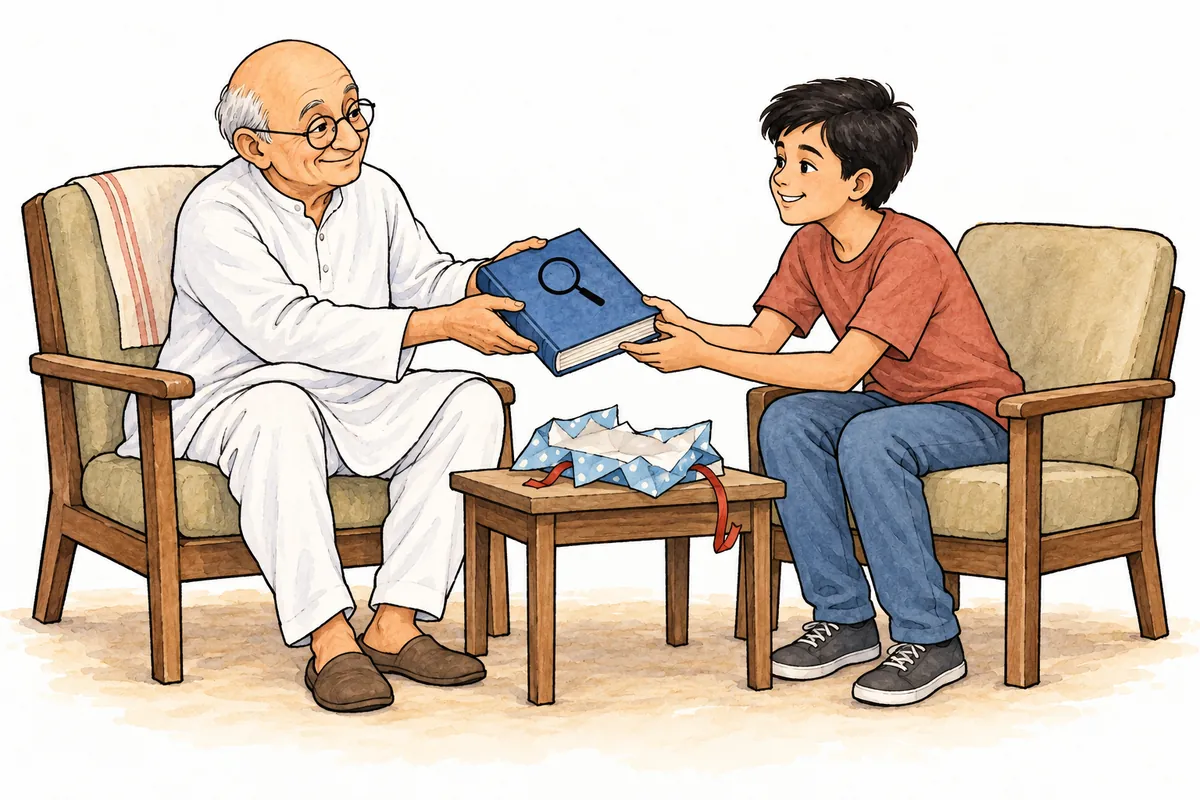
Grandpa, of course, promptly announces a walk to the corner shop for his Tamil newspaper and, twirling his eagle-head mahogany walking stick in his bright-yellow cap, sets off. Ravi follows secretly — and suffers one comic disaster after another: crouching behind an elephant-shaped bush in the park (where Grandpa munches peanuts), being threatened by a little boy’s umbrella-waving mother, surrounded by loud vendors at the tea stall (where Grandpa enjoys forbidden sugary tea, bananas and ice cream), and ejected from a ladies’ hairdressing salon next to the barber shop. When a man Ravi mistakes for Grandpa boards a bus, Ravi gets on just before it starts — only to find the yellow cap now sits on a total stranger, to whom the generous old gentleman gifted it on a hot day. Grandpa has vanished. Frantic, Ravi rushes home — and finds Grandpa peacefully snoring in bed. Overcome with affection, Ravi hugs him. That evening Grandpa coolly mentions that Ravi “just disappeared”, then distributes gifts — for it is his own birthday, which his daughter, despite circling the date in red, has forgotten. His gift to Ravi: The Best Detective Stories, “to learn how to avoid getting fooled when trailing a suspect”. And his verdict, delivered with a twinkle: his daughter needs some Vitamin-M — for her memory.
Summary in Hindi (सारांश हिंदी में)
रवि की माँ विद्या अपने पिता की दवाइयाँ रखते हुए कहती हैं — काश कोई बूढ़ों की याददाश्त के लिए ‘विटामिन-एम’ बना देता! पचहत्तर वर्षीय नाना, जो पत्नी के निधन के बाद दस वर्ष अकेले अपना घर सँभालते रहे, पिछले महीने बगीचे में गिरने के बाद बेटी के पास शहर आए हैं। वे दवा की दोहरी खुराक ले चुके हैं, एक बार सैर पर रास्ता भूल चुके हैं — इसलिए माँ ने आदेश दिया है कि नाना अकेले बाहर न जाएँ। छुट्टियाँ शुरू होते ही यह ज़िम्मेदारी रवि को सौंप दी जाती है।
पर नाना तो नाना हैं! पीली टोपी पहन, चील के सिर वाली महोगनी की छड़ी घुमाते हुए वे तमिल अखबार लाने निकल पड़ते हैं। रवि चुपके से पीछा करता है — और एक के बाद एक मज़ेदार मुसीबतों में फँसता है: पार्क में हाथी के आकार की झाड़ी के पीछे छिपना, एक बच्चे की माँ की छतरी से धमकी, चाय की दुकान पर फेरीवालियों का घेराव (जहाँ नाना मज़े से वर्जित मीठी चाय, केले और आइसक्रीम खाते हैं), और महिला सैलून से धक्के! जब रवि पीली टोपी वाले एक व्यक्ति को नाना समझकर बस में चढ़ते देखता है, तो वह भी पीछे जाता है — पर पीली टोपी एक अजनबी के सिर पर निकलती है, जिसे दयालु नाना ने गर्मी देखकर अपनी टोपी भेंट कर दी थी। घबराया रवि घर लौटता है — और नाना को आराम से सोता पाता है! शाम को नाना शांत भाव से कहते हैं कि रवि तो दिन भर ‘गायब’ था। फिर वे सबको उपहार देते हैं — क्योंकि आज उनका जन्मदिन है, जिसे कैलेंडर पर लाल घेरा लगाने के बावजूद बेटी भूल गई! रवि को मिलती है किताब — श्रेष्ठ जासूसी कहानियाँ — “ताकि सीख सको कि पीछा करते समय धोखा कैसे न खाओ।” और नाना की चुटीली टिप्पणी — “मेरी बेटी को विटामिन-एम की ज़रूरत है — याददाश्त के लिए!”
Reading carefully: Grandpa’s gift and final remark strongly suggest that he noticed Ravi following him. The narrator does not confirm that every event was planned or that giving away the cap was a deliberate trick. His chess knowledge and birthday memory do not erase the earlier medicine error, getting lost or fall.
Word Meanings (शब्दार्थ)
| Word | English Meaning | हिंदी अर्थ |
|---|---|---|
| frail | weak and delicate | दुर्बल, कमज़ोर |
| shuddered | trembled (with fear or unpleasant memory) | सिहर उठी |
| poky | small and cramped | तंग, छोटा-सा |
| forbid | to order not to do something | मना करना |
| pottering | moving about doing small unhurried tasks | इधर-उधर छोटे-मोटे काम करना |
| winced | showed an expression of embarrassment/discomfort | असहज होकर मुँह बनाना |
| bustle | busy activity | चहल-पहल, भागदौड़ |
| jauntily | happily and confidently | मस्ती और आत्मविश्वास से |
| dilemma | a difficult choice between two options | दुविधा |
| crouch | bend the body low | उकड़ूँ बैठना, झुकना |
| ducking | moving your head or body down quickly | झुककर बचना |
| quizzical | questioning, puzzled | प्रश्नभरी (दृष्टि) |
| conceded defeat | accepted that one has lost | हार मान ली |
| a volley of | a lot of (coming at once) | बौछार |
| deterred | prevented, discouraged (from doing) | हतोत्साहित किया |
| confront | to face someone directly | सामना करना |
| attire | clothing, dress | पोशाक |
| frantic | very frightened, desperate | बदहवास |
| creases | lines, wrinkles | सिलवटें, झुर्रियाँ |
| darted (a look) | looked at somebody quickly | तुरंत नज़र डाली |
| stricken | severely affected by an unpleasant feeling | आहत, व्यथित |
| trailing | following (a suspect) | पीछा करना |
| solemnly | seriously | गंभीरता से |
| craftily | cleverly, cunningly | चतुराई से |
NCERT Exercise Solutions
Reflect and Respond
I. From your experience with an elderly person, complete the graphic organiser on ‘Caring for the Elderly’.
| Why should we care for the elderly? | Older people deserve dignity, care and inclusion, regardless of whether they have cared for us or have particular achievements. Their experiences can enrich family and community life. |
|---|---|
| Problems faced by the elderly | Some older people may face health or mobility difficulties, loneliness, inaccessible surroundings or age-based disrespect. Needs vary; these are not features of every older person. |
| Possible reasons for the problems | Natural ageing of the body, loss of spouse and friends, families having little time, unfamiliar city surroundings, lack of patience from younger people. |
| How can we take care of them? | Spend time talking and playing with them, respect their independence and opinions, help responsible adults with agreed routines and appointments, include them in family decisions, never speak to them as if they were children. |
II. Fill in the table for the words: frail, shuddered, poky, forbid, pottering, winced.
frail — weak and delicate; shuddered — trembled with fear or at an unpleasant memory; poky — small and cramped; forbid — to order someone not to do something; pottering — moving about doing small, unhurried jobs; winced — made a small expression of pain or embarrassment. (Tick the self-assessment columns as per your own familiarity with each word.)
III. Think of a tradition, story, or recipe passed down by grandparents. What does it mean to you?
My grandmother taught my mother — and now me — her recipe for festival kheer, made with hand-pounded rice and a pinch of saffron from a little silver box that belonged to her mother. Every time we make it, the kitchen fills with the same fragrance she grew up with. The recipe connects three generations: it reminds me that I carry my family’s story in something as simple as a sweet dish, and it makes festivals feel like a chain of memories rather than a single day.
Check Your Understanding (after Part I)
I. Why did Grandpa dislike living in the city with his daughter?
Grandpa hated the noise and bustle of city life and found the flat poky and cramped. He longed for his small brick house in town, with its big mango tree and such silence that at dusk one could even hear a leaf fall. Above all, he resented losing his independence — being forbidden to go out alone after managing much of his own life and keeping house alone for the ten years since his wife died.
II. Why did Vidya not want her father to go out alone?
Because his recent record frightened her: he had absent-mindedly taken a double dose of his medicines and landed in hospital, he had got lost while out on a walk, and a month earlier he had slipped in his garden and lain outside all night with no one to help. She felt it was simply too dangerous for him to be out by himself.
III. Was Ravi in favour of his mother treating Grandpa like a child? How can you say so?
No. Ravi winced at the over-loud tone his mother used while speaking to Grandpa, as though addressing a child who could not hear or understand. When Grandpa suspiciously asked whether his mother had told Ravi to keep him a prisoner, Ravi loyally insisted that she would never treat him like a baby or a prisoner — showing he disliked the disrespect even while obeying his mother.
IV. Would Ravi be able to keep up his promise to his mother?
It seems unlikely. Grandpa is strong-willed, crafty and determined to keep his independence — he outwits Ravi within minutes by extracting an admission that he is not a prisoner. The best Ravi can manage is to follow him secretly and hope to keep him from harm.
Check Your Understanding (after Part II)
I. Complete the flow chart by describing Grandpa’s day out.
Grandpa goes out to get the Tamil newspaper → Ravi follows Grandpa → Grandpa first stops at 1. the children’s park, buys 2. a paper-cone of peanuts and watches the children play → Ravi hides behind a bush to observe → Grandpa next goes to 3. the tea stall → Ravi hides behind a banyan tree and watches → Ravi gets scolded by 4. the little boy’s mother and the vendors → Grandpa drinks 5. a sugary cup of tea and eats two bananas (and an ice cream) → Grandpa then crosses the road and enters a 6. barber shop → Next Grandpa walks quickly to a 7. bus stop and boards the first bus — as Ravi initially thinks → Ravi enters the bus and discovers that the cap-wearer is a stranger. The chart follows Ravi’s mistaken perception at step 7; the text does not establish that Grandpa took that bus.
II. Was Grandpa lost as feared by Ravi’s mother?
At the end of Part II, his whereabouts are unknown to Ravi. Part III reveals that he has returned home safely. The text does not show Grandpa taking the bus or establish that his entire outing was a plan to mislead Ravi.
III. How would Ravi feel after seeing Grandpa (asleep at home)?
Ravi felt immense relief and a sudden rush of love. After hours of panic, he knelt by the bed, pressed his cheek against his grandfather’s wrinkled face, breathed in the familiar smell of eucalyptus ointment and shaving cream, and hugged him.
IV. Do you think Ravi’s mother will get to know about what had happened?
Probably not the full story. Ravi cannot tell her without confessing that he let Grandpa go out and then lost him, and Grandpa — though he slyly mentions that Ravi “disappeared” — keeps the secret with a twinkle in his eye. The ending leaves this uncertain; it suggests a private joke but does not show whether the complete account is later shared.
Check Your Understanding (after Part III)
I. Describe how Ravi’s emotional reaction upon finding Grandpa safe at home reveals his feelings towards his grandfather.
Ravi’s anxiety dissolves into pure tenderness. He kneels by the bed, lays his cheek against the old man’s creased face, notices lovingly its map-like wrinkles and its familiar smell, and hugs the sleeping Grandpa. The gesture shows that his care is not mere duty to his mother — he deeply loves and treasures his grandfather.
II. What might be the significance of Grandpa’s habit of giving gifts to everyone on his birthday rather than receiving them?
It reveals his generosity and self-respect. He does not wait to be remembered or honoured; instead he turns his birthday into an occasion of giving, treating even his grown daughter and son-in-law as his ‘babies’. He remembers this meaningful date even though his daughter forgets it. This shows a retained memory, not that he never has memory difficulties.
III. Why do you think Grandpa gave Ravi a detective story book as a gift? What might this suggest about Grandpa’s awareness of Ravi’s actions earlier in the day?
The detective book and his remark about avoiding deception while following a suspect strongly suggest awareness of Ravi’s pursuit. The twinkle leaves Ravi unsure, so this remains a well-supported inference. The story does not confirm when Grandpa noticed him or whether the cap gift was planned to mislead him.
Critical Reflection
I. Read the extracts given below and answer the questions that follow. (Extract 1: Grandpa’s longing for his town house — textbook page 109)
(i) Choose the emotion displayed by the Grandfather.
C. nostalgic — he speaks longingly of the home and life he has left behind.
(ii) Grandpa hated the busy and noisy city life because ______.
…he was used to the peace of his small-town house, where it was so quiet at dusk that one could even hear a leaf fall.
(iii) Why did Grandpa come to the city despite his dislike for city life?
Because one evening he slipped and fell while pottering in his garden and lay outside all night with no one to help him up. After that, his daughter locked up the brick house and brought him to live with her family.
(iv) Choose an expression similar in meaning to ‘you can even hear a leaf fall’.
D. pin drop silence
(v) State one advantage and one disadvantage of the Grandfather living in the house in town.
Advantage: peace, fresh air, his own garden with the big mango tree, and complete independence. Disadvantage: he lived all alone, so in an emergency — like his fall — there was nobody to help him.
(Extract 2: Grandpa’s cool reply and the gift-wrapped parcel — textbook page 110)
(i) Choose the option that displays the tone of the Grandfather’s response.
C. calm — he answers “coolly”, enjoying his private joke.
(ii) Why was Ravi confused and embarrassed?
Because Grandpa had casually exposed his absence from home. Ravi could not defend himself without confessing the truth — that he had been secretly following Grandpa all day and had even been given the slip.
(iii) Ravi’s mother was impatient because ______.
…she thought her father’s memory had failed again — that he had confused the date and forgotten Ravi’s birthday was three months ago.
(iv) True or False: Grandfather forgot that Ravi’s birthday was three months ago.
False — Grandpa knew perfectly well; the gifts were for his own birthday, on which he always gives presents to every child in the house.
(v) Why did Grandpa say he didn’t know what kind of morning Ravi might have had?
It was his sly, playful way of revealing that he knew Ravi had not stayed at home — that the boy had “disappeared” to trail him. Without telling on Ravi directly, he let him know that the old detective had outdetected the young one.
II. Answer the following questions.
1. Grandpa is portrayed as a person with failing memory in the beginning. Give two evidences to disprove the statement.
First, Grandpa remembers thousands of chess games in detail — he can quote the exact opening Karpov played against the computer and the mistake Bobby Fischer made against Spassky. Second, he remembers his own birthday and his lifelong custom of giving gifts on it — the very date his daughter forgot despite circling it in red on the calendar. These examples challenge the assumption that he is generally incapable; they do not disprove every lapse reported at the beginning.
2. Give two characteristic traits of each character.
Grandfather: fiercely independent and crafty-witted; generous and affectionate (gifts his cap to a stranger, gives presents to all). Ravi: caring and loyal towards both mother and grandfather; determined but comically inexperienced as a ‘detective’. Ravi’s mother: loving and anxious for her father’s safety; ironically forgetful and somewhat patronising in her manner towards him.
3. Why was Ravi worried about what Grandfather had at the tea stall?
Because Grandpa consumed sugary tea and bananas that were restricted at home, followed by ice cream — a sugary cup of tea, two bananas and an ice cream from a cart. Ravi is anxious about these choices and imagines his mother’s alarm. The story does not give a medical diagnosis; do not infer a particular illness or general dietary rule from it.
4. Do you think it was easy for Ravi to follow his Grandfather? If no, why not?
No, it was a comedy of disasters. He had to crouch behind an elephant-shaped bush, was threatened by a little boy’s umbrella-waving mother, was surrounded and scolded by loud vendors under the banyan tree, was thrown out of a ladies’ hairdressing salon amid shrieks, and had to sprint and board the bus just before it started — only to discover he had been fooled by the yellow cap.
5. ‘Ravi is a good detective.’ Give one argument in favour of and against the statement.
For: he is persistent and quick — he keeps Grandpa in sight across a park, a tea stall and a road crossing, and manages to reach the bus before it starts. Against: he is clumsy and conspicuous — children, mothers and vendors all notice him, and he follows the yellow cap without confirming the wearer’s identity.
6. Was Grandfather aware that Ravi was following him? How do you know?
Probably: his birthday gift to Ravi is a book of detective stories, recommended “solemnly” for tips on how to avoid getting fooled when trailing a suspect; he also tells Vidya that Ravi “just disappeared” all morning. The twinkle supports this interpretation, but a planned cap trick is not confirmed.
7. In your opinion, who needs Vitamin-M? And why?
Ravi’s mother. The story opens with her wishing for a memory vitamin for the old — and closes with the revelation that she has forgotten her own father’s birthday, a date she herself circled in red. Grandpa remembers this occasion, while Vidya forgets it; the humour reverses their roles without proving that his earlier lapses were imaginary. The irony teaches us not to assume that age alone weakens the mind.
8. Give an example where opinions were disregarded because of age.
(Model answer) In our colony meeting, my seventy-year-old neighbour suggested rainwater harvesting, but the younger members brushed him aside as ‘old-fashioned’ — until an engineer made the same proposal a month later and everyone applauded. I have also seen the reverse: a class suggestion of mine was ignored ‘because children don’t understand these things’. Both show how age bias makes us deaf to good ideas.
Vocabulary and Structures in Context
I. Classify the words into movement words and sound words; then fill in the blanks.
| Column 1 — Movement | Column 2 — Sound |
|---|---|
| pottering (given), twirling, crouch, bustle, crawl, creeping, ducked, zigzagging, evicted, briskly, sprinting, jumping, darted, trailing | boomed (given), thudded, shrieks, whirr, grunted, snoring |
Detective paragraph: 1. trailing 2. bustle 3. briskly 4. thudded 5. twirling 6. crouch 7. creeping 8. grunted 9. darted 10. whirr (a distant low sound); snoring is also a possible personifying choice if explained.
II. Fill in the boxes with words synonymous with ‘dilemma’.
1. QUANDARY 2. PREDICAMENT
III. Fill in the table (meaning, part of speech, synonym, antonym).
| Word | Meaning | Part of Speech | Synonym | Antonym |
|---|---|---|---|---|
| craftily | in a clever, cunning way | adverb | cunningly, slyly | honestly, openly |
| dilemma | a difficult choice between two options | noun | quandary, predicament | certainty, solution |
| furious | extremely angry | adjective | enraged, livid | calm, pleased |
| boomed | sounded loudly and deeply | verb | thundered, roared | whispered, murmured |
| humiliation | a feeling of shame and loss of dignity | noun | embarrassment, disgrace | honour, pride |
| attire | clothing, dress | noun | garments, outfit | No exact everyday antonym for the noun “clothing”; “nudity” is a contrast in state, not a precise lexical opposite. |
IV. Match the emotions/expressions with their meanings. One meaning is extra.
1. embarrassed — (v) felt uncomfortable | 2. countered — (iv) reply to an argument | 3. flushed — (vi) became red in the face | 4. stricken — (i) affected severely by an unpleasant feeling | 5. gleam — (iii) expression of emotion (a flash in the eyes). Extra meaning: (ii) to be confused.
V. Underline the prepositions; then fill in the blanks with appropriate prepositions.
Prepositions in the phrases: 1. across (to) 2. over 3. under 4. behind
Paragraph: I walked (i) through the village, crossed a bridge (ii) over a brook, and found a quiet garden (iii) near a cottage. Sitting on a bench (iv) in the garden, I enjoyed the peaceful surroundings. Later, I strolled (v) along a riverbank, exploring the forest and heading (vi) into the unknown. (Towards is also grammatical if the intended meaning is movement in its direction rather than entry.)
VI. Choose the correct answer (types of interrogative sentences).
A. The words in the quotes are (i) interrogative sentences.
B. Sentences 1, 4, and 5 are (ii) Yes/No type interrogative sentences.
C. Sentences 2 and 3 are (iii) Wh- type interrogative sentences.
D. So, there are (iv) two types of interrogative sentences.
VII. Complete the sentences in reported speech.
Arvind asked Priya if she 1. helped in taking care of her grandparents at home, for which Priya replied in the affirmative and said that they 2. took turns making sure they were alright. Priya further asked Arvind 3. if he had grandparents living with him. Arvind replied in the negative and said that 4. he and his parents visited his grandpa every weekend. He further enquired 5. how she managed her grandparents’ medical needs. Priya responded by saying that they 6. had a schedule for giving medications and visits to the doctor.
Grammar clarification: The exercise groups questions as Yes/No and Wh- types, so its intended blanks are interrogative; Yes/No; Wh-; two. However, “Shall we play chess or watch…?” is an alternative/choice question, not a straightforward Yes/No question. Question tags are another construction. In reported speech, backshift and changes such as today → that day depend on the reporting context; they are not compulsory when the original time reference still applies.
Listen and Respond
I. You will listen to a podcast on meditation. Complete the sentences with not more than three exact words that you hear.
1. Meditation is a form of yoga that usually refreshes the mind and helps with stress management.
2. Meditation leads to a better health condition both physically and emotionally.
3. Meditation also aids in lessening undesirable feelings and improving self-awareness.
4. It is advised that we meditate every day so that it becomes a routine.
5. Meditating on a daily basis is beneficial in comfortably tackling exam-related pressure.
Speaking Activity
I. Practise question intonation.
Use these as common patterns, with meaning and context guiding your voice:
- Wh-question: “What did you both do today?” ↘
- Yes/No question: “Are you playing hide and seek?” ↗
- Choice question: “Shall we play chess ↗ or watch the cricket match on TV?” ↘
- Tag seeking agreement: “This is your notebook, isn’t it?” ↘ when fairly sure.
- Tag expressing uncertainty: “You weren’t in the library yesterday, were you?” ↗ when unsure.
Correction to the printed tag guidance: rising versus falling pitch is not fixed by whether the main clause is positive or negative. A rise commonly signals greater uncertainty; a fall commonly seeks confirmation of something the speaker expects. See Cambridge’s explanation of question tags.
II. Narrate an experience of helping an older person.
Imagined model; replace with your own experience: During a school holiday, I spent afternoons with my grandfather while an adult family member managed his care. I read newspaper articles aloud when he asked and helped him find books. I learnt to ask before offering assistance, because some tasks he preferred doing himself. Our conversations showed me his humour and interests, while listening patiently helped me become less hurried. The experience taught me that support should respect a person’s preferences rather than assume that age makes everyone’s needs identical.
Writing Task
Our Inspiring Elderly — sample four-paragraph article
Our Inspiring Elderly
By a Class IX student — replace with your name and class
Older people contribute to our lives through relationships, work and experiences. Listening to them can help us question assumptions and discover perspectives different from our own. Respect should not depend on age, physical strength or exceptional achievements.
In “Vitamin-M”, Grandpa’s chess knowledge, generosity and wit show abilities that his family sometimes overlooks. His gift to Ravi creates humour while reminding us that support and independence need to be considered together. A useful quotation from the story is his reminder, “I always give a gift to every child in the house on my birthday.”
Grandpa has also faced loss and changes in his living arrangements. His experiences remind me that resilience can coexist with real difficulties. I can learn from his determination while recognising Vidya’s concern after his fall and other incidents. Understanding both viewpoints encourages patient conversation rather than quick judgement.
We can show respect by asking about preferences, including older people in decisions and offering appropriate help. Their lives are varied, so we should listen to individuals instead of assuming one description fits everyone. Care becomes more meaningful when it protects dignity as well as responding to need.
The instruction about “skills and passions” on page 119 does not match this task; follow the stated title Our Inspiring Elderly and the four-paragraph outline.
Learning Beyond the Text
I. Revisit the story and choose the image that correctly displays Grandpa’s walking stick.
Choose the second picture from the left, showing the eagle-head handle. The story describes a shiny-black mahogany walking stick with a brass handle carved in the shape of an eagle’s head — that is Grandpa’s stick as described in the story.
II. A picture is worth a thousand words! Make a slide show of memorable family photographs.
Slide 1: A photo clicked at my grandparents’ village home during Diwali 2024. The people are my grandparents, my parents, my sister and I on the terrace, lighting diyas. It is memorable because it was the last Diwali at the old house before we moved — and the lamps in my grandmother’s hands look like the stars she always compared us to. (Prepare 4–5 such slides.)
III. Read the story ‘The Lost Child’ by Mulk Raj Anand and discuss.
In the story, a little boy at a spring fair desires sweets, flowers, balloons and a ride, but is refused or moves on, until he suddenly finds his parents gone. A kind stranger offers him everything he had wanted — the roundabout, the music, the balloons, the garland, the sweets — but the weeping child refuses each with the same cry: “I want my mother, I want my father!” The excerpt ends without showing a reunion. It shows that the child’s immediate need is the security of his parents rather than the attractions he wanted earlier — a fitting companion to Vitamin-M, where love across generations outweighs every other care.
Extra Questions with Answers
Q1. What was ‘Vitamin-M’, and who first wished for it? (30–40 words)
Vitamin-M was an imaginary ‘memory vitamin’ that Ravi’s mother wished someone would invent for old people, to improve their memories. Ironically, by the end of the story Grandpa suggests that she herself needs it.
Q2. Describe Grandpa’s appearance when he set out for his walk. (30–40 words)
He wore his usual white pyjama and shirt with a bright-yellow cap, and carried his beautiful shiny-black mahogany walking stick with a brass handle carved like an eagle’s head, twirling it jauntily as he went.
Q3. How did Grandpa’s chess talk amaze Ravi? (30–40 words)
Grandpa played cool, cunning chess and quoted historic games — Karpov’s opening against the computer, Fischer’s mistake against Spassky. Ravi marvelled that a man who forgot people’s names could remember thousands of chess games.
Q4. How was Ravi fooled on the bus? (30–40 words)
Following the yellow cap, Ravi boarded the bus and pushed to the front — but the cap-wearer was a stranger in similar white clothes. The generous Grandpa had gifted his cap to the man because it was a hot day.
Q5. Sketch Grandpa’s character.
Q6. What does the story suggest about attitudes towards older people?
Additional MCQs
1. ‘Vitamin-M’ was imagined as a vitamin for — (a) strength (b) eyesight (c) memory (d) immunity
2. Grandpa was a retired — (a) doctor (b) teacher (c) lawyer (d) banker
3. Grandpa’s age was — (a) sixty-five (b) seventy (c) seventy-five (d) eighty
4. Grandpa went out saying he wanted to buy — (a) peanuts (b) the Tamil newspaper (c) medicines (d) ice cream
5. Ravi hid in the park behind a bush trimmed in the shape of — (a) a peacock (b) an elephant (c) a horse (d) a lion
6. At the tea stall Grandpa did NOT have — (a) sugary tea (b) two bananas (c) an ice cream (d) a samosa
7. Ravi was thrown out of — (a) the barber shop (b) a ladies’ hairdressing salon (c) the tea stall (d) the park
8. The stranger in the bus had Grandpa’s — (a) walking stick (b) newspaper (c) yellow cap (d) spectacles
9. The gifts were given because it was — (a) Ravi’s birthday (b) Grandpa’s birthday (c) Diwali (d) Mother’s birthday
10. Grandpa gifted Ravi — (a) a chess set (b) a yellow cap (c) The Best Detective Stories (d) a walking stick
Answer key: 1-c, 2-c, 3-c, 4-b, 5-b, 6-d, 7-b, 8-c, 9-b, 10-c
Assertion–Reason Questions
Options for each: (a) Both A and R are true and R explains A. (b) Both A and R are true but R does not explain A. (c) A is true, R is false. (d) A is false, R is true.
1. A: Vidya forbade her father from going out alone. R: Grandpa had once got lost on a walk and had taken a double dose of medicine. — (a)
2. A: Ravi followed Grandpa secretly. R: He wanted to obey his mother without hurting Grandpa’s feelings. — (a)
3. A: Ravi followed the wrong man onto the bus. R: Grandpa had gifted his yellow cap to a stranger at the barber shop. — (a)
4. A: Grandpa remembered his own birthday when his daughter forgot it. R: Grandpa always gave a gift to every child in the house on his birthday. — (b)
5. A: Grandpa gave Ravi a book of detective stories. R: The detective gift and remark suggest he had noticed Ravi’s pursuit. — (a)
FAQs
Who wrote Vitamin-M?
Asha Nehemiah. NCERT acknowledges the story’s source as Favourite Stories for Boys.
What does Vitamin-M mean here?
It is the imaginary memory aid Vidya wishes someone would invent. The ending turns her joke back on her when she forgets Grandpa’s birthday.
Did Grandpa board the bus Ravi followed?
The passenger Ravi finds is a stranger wearing Grandpa’s cap. The story does not establish that Grandpa took that bus.
Also read: Chapter 3 – Winds of Change · Kaveri – All Chapters · NCERT Solutions Home. Official textbook catalogue: ncert.nic.in