
Bharat Our Land Questions and Answers | Class 9 Kaveri
Checked against NCERT Kaveri, first edition January 2026, pages 23–32 and listening transcript 260. Personal, discussion and creative responses are samples: adapt them to your experience. This independent study guide is not an official NCERT answer key.
Poem Overview & Central Idea
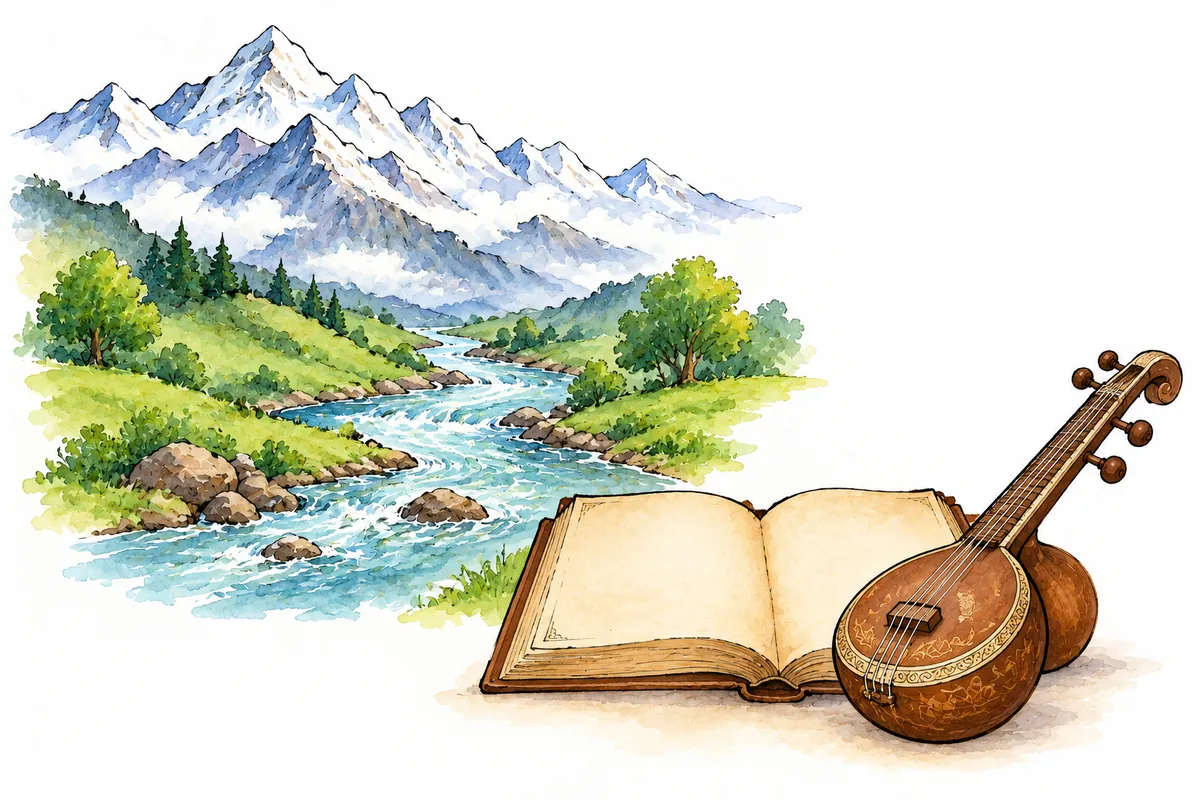
Bharat Our Land is a patriotic ode in which the poet celebrates the unmatched greatness of India. Across two stanzas he praises her natural majesty (the mighty Himalayas, the life-giving Ganga), her spiritual wealth (the Upanishads, Brahma-knowledge, the Buddha’s teachings) and her human glory (gallant warriors, holy sages and divine music). The refrain — calling the motherland peerless and urging us to praise her — runs through the poem like a chant of devotion. The central idea is that India’s combination of natural beauty, heroic history and spiritual wisdom makes her incomparable, and that her children should feel deep pride and reverence for her.
About the Poet – Subramania Bharati
Subramania Bharati was a Tamil poet whose patriotic writing celebrates the motherland. In the English text presented in Kaveri, his speaker brings together natural beauty, courage, music and spiritual learning to express love for India. Read the poem as a lyrical tribute rather than as a factual ranking of countries or traditions.
Stanza-wise Explanation
Stanza 1: lines 1–8
The speaker claims the Himalayas, the Ganga and the Upanishads as a shared inheritance. “Ours” builds belonging. The questions assert admiration rather than ask for information. The sunny, golden land suggests radiance and richness, and the refrain invites readers to join in praise.
Stanza 2: lines 9–16
The focus moves to warriors, sages, music and spiritual traditions. Brahma-knowledge refers here to knowledge of ultimate reality; the Buddha’s dhamma adds another philosophical tradition. “Hoary antiquity” celebrates the civilisation’s long past. The final refrain repeats the speaker’s patriotic admiration. The page break between printed pages 24 and 25 does not create a separate third stanza.
Interpretation note: “peerless” and “no equal” are hyperbolic expressions of the speaker’s love. They are not objective claims that other countries, rivers or traditions have no value. The river’s “grace” is poetic imagery, not a statement that it is always calm.
Summary in English
The poem is a song of praise for Bharat — India. The poet proudly claims the mighty Himalayas, the graceful and generous Ganga and the sacred Upanishads as treasures that have no equal anywhere in the world. He describes India as a sunny golden land. He then recalls the gallant warriors who lived here, the many sages who sanctified the soil, the divine music heard here and the presence of all auspicious things. Finally, he celebrates India as the home of the highest spiritual knowledge, where the Buddha preached his dhamma, and as a civilisation of immense antiquity. The two stanzas end with the same refrain: India is peerless — let us praise her. The poem awakens love, pride and reverence for the motherland.
Summary in Hindi (सारांश हिंदी में)
यह कविता भारत माता की महिमा का गीत है। कवि गर्व से कहता है कि विशाल हिमालय हमारा है — पृथ्वी पर उसकी कोई बराबरी नहीं; उदार गंगा हमारी है — उसकी शोभा की तुलना कौन-सी नदी कर सकती है; पवित्र उपनिषद हमारे हैं — उनके समकक्ष कौन-से शास्त्र रखे जा सकते हैं। कवि भारत को ‘स्वर्णिम धूप से चमकता देश’ कहता है। फिर वह बताता है कि इस धरती पर वीर योद्धा हुए, अनेक ऋषियों ने इस भूमि को पवित्र किया, यहाँ दिव्य संगीत गूँजा और यहाँ सब कुछ शुभ-मंगलमय है। अंत में कवि कहता है कि यहीं ब्रह्मज्ञान की जड़ें जमीं और यहीं भगवान बुद्ध ने अपना धम्म सिखाया; भारत की सभ्यता अति प्राचीन है। दोनों पदों के अंत में कवि की टेक (refrain) दोहराती है — भारत अद्वितीय है, आओ उसकी वंदना करें। कविता हृदय में देशभक्ति, गौरव और श्रद्धा जगाती है।
Poetic Devices in the Poem
| Device | Explanation / Example from the poem |
|---|---|
| Ode | The whole poem is a lyrical song of deep admiration and reverence for India, written in elevated language. |
| Refrain | The repeated line calling India peerless and urging praise — it creates a chant-like rhythm and reinforces pride. |
| Personification | India and the Ganga are spoken of as living women — “she”, “her grace”. |
| Metaphor | India is called a “sunny golden land”, suggesting brightness, richness and glory. |
| Hyperbole | Claims like “no equal anywhere on earth” are grand exaggerations to glorify the motherland. |
| Imagery | Word pictures of the mighty Himalayas, the flowing Ganga and the golden land appeal to our senses. |
| Allusion | Brief cultural references to the Upanishads, Brahma-knowledge and the Buddha’s dhamma draw on readers’ wider knowledge. An allusion can name its subject; it need not describe its whole background. |
| Symbolism | Himavant = strength; Ganga = purity and generosity; Upanishads = spiritual and philosophical legacy; golden land = prosperity. |
| Rhetorical question | Questions such as which river can match the Ganga’s grace emphasise that none can. |
| Rhyme scheme | The translated poem follows no fixed rhyme scheme — it is in free verse with a measured, chant-like rhythm. |
Word Meanings (शब्दार्थ)
| Word | English Meaning | हिंदी अर्थ |
|---|---|---|
| mighty | very strong and powerful | शक्तिशाली, विशाल |
| Himavant | the Himalayas | हिमालय |
| generous | giving freely | उदार |
| grace | elegance, beauty of movement | शोभा, लालित्य |
| sacred | holy | पवित्र |
| scriptures | holy writings | धर्मग्रंथ |
| peerless | incomparable, unmatched | अद्वितीय, बेजोड़ |
| gallant | brave, heroic | वीर, साहसी |
| sage | a wise holy person | ऋषि, संत |
| sanctified | made holy, purified | पवित्र किया |
| divinest | most godly, heavenly | सर्वाधिक दिव्य |
| auspicious | favourable, promising good fortune | शुभ, मंगलमय |
| Brahma-knowledge | knowledge of the ultimate truth | ब्रह्मज्ञान |
| dhamma | the Buddha’s teachings (dharma) | धम्म, बुद्ध की शिक्षाएँ |
| hoary antiquity | very ancient times, time immemorial | अति प्राचीन काल |
| refrain | a line repeated at intervals in a poem | टेक, स्थायी पंक्ति |
NCERT Exercise Solutions
Reflect and Respond
The anthem names historical and cultural regions as well as geographical features, not a list of present-day Indian states. Sindh is now in Pakistan; “Dravida” refers broadly to the southern region and “Maratha” to the Maratha/Maharashtra region.
I. Recall the lines of the National Anthem and complete the table given below with the names of the states, mountain ranges, and rivers mentioned in it.
| States/Provinces | Mountain Ranges | Rivers |
|---|---|---|
| Punjab, Sindh, Gujarat, Maratha, Dravida, Utkala (Odisha), Banga (Bengal) | Vindhya, Himachala (Himalaya) | Yamuna, Ganga |
II. Work in pairs. Discuss what the words ‘जय हे’ (Jaya he) in the last two lines of the National Anthem convey.
“Jaya he” expresses praise or a wish for victory—often rendered “victory to thee”. In the anthem’s closing refrain, its repetition gives the words an uplifting, celebratory force and expresses collective hope and reverence.
III. Read the underlined words in the given lines of the poem. Choose the odd one out that does not correspond with the meaning of the underlined word.
1. peerless — odd one out: valuable (incomparable and unmatched are the correct senses).
2. sanctified — odd one out: applauded (blessed and purified match).
3. auspicious — odd one out: fantastic (fortunate and favourable match).
4. hoary antiquity — odd one out: recent past (ancient times and time immemorial match).
Check Your Understanding
I. Fill in the blanks by choosing appropriate words from the box given below to complete the summary of the poem.
1. historical greatness 2. Himavant 3. Ganga 4. Upanishads 5. warriors 6. sages 7. Brahma-knowledge 8. Buddha 9. peerless 10. praise
II. Complete the following features about the poem.
1. The impact on the readers (mood): a mood of pride, reverence and patriotic joy.
2. The poet’s attitude (tone): celebratory, admiring and devotional.
3. The rhyme scheme: there is no fixed rhyme scheme — the poem is in free verse with a chant-like rhythm.
4. Examples of personification: India is addressed as “she” who is peerless; the river is called “generous” and is referred to through “her grace”.
III. What is the impact of the refrain, ‘she’s peerless, let’s praise her!’?
The refrain acts like the chorus of a devotional song. Each time it returns, it sums up the stanza’s catalogue of glories in one assertion — India has no equal — and invites the reader to join in her praise. It creates a musical, chant-like rhythm, binds the stanzas together and steadily deepens the feeling of pride and reverence.
IV. Complete the following sentence appropriately.
India is metaphorically described as ‘this sunny golden land,’ suggesting that it is _________.
…bright, prosperous and glorious — a land blessed with warmth, richness and radiance like gold.
V. The poet uses symbolism. Match the symbols in Column 1 to what they suggest in Column 2.
| Column 1 | Column 2 |
|---|---|
| 1. Himavant | (v) strength and permanence |
| 2. Ganga | (iii) purity and generosity |
| 3. Upanishads | (ii) spiritual and philosophical legacy |
| 4. Gallant warriors and sages | (vi) courage and wisdom |
| 5. Brahma-knowledge and Buddha’s Dhamma | (i) knowledge and enlightenment |
| 6. Sunny golden land | (iv) richness and glory |
VI. The poet uses imagery. Give any two examples from the poem.
(i) The picture of the mighty, unequalled Himalayas standing guard over the land. (ii) The vision of India as a “sunny golden land”, glowing with warmth and prosperity. (The graceful, generous flow of the Ganga is a third fine example.)
VII. What is the impact of the use of hyphens in the first stanza? Select the options that are true.
True options: 1 (creates deliberate pauses reinforcing admiration and pride), 3 (lends a lyrical, measured, chant-like rhythm) and 5 (presents a key element of India’s greatness before the hyphen and a strong assertion of its uniqueness after it). Options 2 and 4 are not true.
VIII. The poet uses hyperbole in the poem. (Identify examples.)
The poet exaggerates to glorify India: declaring that the Himalayas have no equal anywhere on earth, asking which river could ever match the Ganga’s grace, claiming no scriptures can be named beside the Upanishads, and calling India peerless. These statements are not literal measurements but dramatic assertions of the motherland’s matchless greatness.
IX. The poem is an ode. Identify examples from the poem that correspond to it being an ode.
The poem praises one exalted subject — India — in elevated, emotional language. It celebrates her extraordinary qualities (mighty Himalayas, generous Ganga, sacred Upanishads, brave warriors, holy sages, divine music, ancient wisdom) and repeatedly calls upon readers to praise her. This sustained, reverent celebration in a lyrical form is exactly what makes a poem an ode.
X. The poet uses allusion. Read the explanations and identify the matching allusions from the poem.
• Allusion to the ancient Indian scriptures symbolising deep wisdom — the Upanishads.
• Allusion to spiritual knowledge associated with self-realisation and ultimate truth — Brahma-knowledge.
• Allusion to Gautama Buddha’s teachings of compassion, non-violence and enlightenment — the Buddha preaching his dhamma.
Critical Reflection
I. Read the extract given below and answer the questions that follow. (Stanza 1, lines 1–6 — see textbook page 28)
1. Complete the sentence. The word ‘mighty’ refers to the __________ of the Himavant.
…immense strength, vastness and grandeur of the Himavant.
2. Choose the correct option. The question mark at the end of the fourth and sixth line of the extract is used to __________.
(i) show doubt and uncertainty (ii) emphasise a point (iii) highlight confusion and hesitation (iv) reveal inquiry and curiosity
(ii) emphasise a point — the rhetorical questions assert that nothing can match the Ganga or the Upanishads.
3. The poet uses the word ‘generous’ to describe the Ganga. Why?
Because the Ganga gives endlessly without asking anything in return — her waters irrigate fields, quench the thirst of millions, support life along her entire course and are believed to purify all who bathe in them. Like a generous mother, she nourishes the whole land.
4. Why has the movement of the river been described as graceful?
The word “grace” invites us to imagine an elegant, flowing movement. The poet’s affectionate personification emphasises the river’s beauty; it does not mean every stretch of the Ganga is slow or calm.
5. Fill in the blank with the correct option from the words given in the brackets.
The poet is implying that the Upanishads are _________ (unmatched/abundant) in their wisdom and spiritual depth.
unmatched
II. Answer the following questions.
1. How does the poem reflect a strong connection to cultural identity and heritage?
The poem draws its pride entirely from India’s heritage — her sacred river and mountains, the Upanishads, Brahma-knowledge, the Buddha’s dhamma, her sages, warriors and music. By claiming each of these as “ours”, the poet binds the reader personally to this shared inheritance, turning cultural memory into a living identity that every Indian can feel and celebrate.
2. What can you infer about the poet’s attitude towards India from the repeated phrase ‘she’s peerless, let’s praise her!’?
The refrain shows that the poet’s love for India is absolute and devotional. To him she is not merely a country but a goddess-like mother without equal. The plural invitation “let’s” shows he wants every Indian to share this reverence — his patriotism is both a personal passion and a public call.
3. What does the line ‘many a sage has sanctified this land’ suggest about India’s spiritual heritage?
It suggests that India’s holiness is the gift of countless generations of rishis and saints whose penance, wisdom and teachings have blessed the very soil. India is presented as a land made sacred not by nature alone but by an unbroken spiritual tradition stretching back to antiquity.
4. How does the poet connect warriors and music to India’s greatness?
The poet places gallant warriors and the divinest music side by side to show that India’s greatness is complete — she has both valour and refinement. Her heroes prove her strength and courage, while her music proves her artistic and spiritual depth; together they show a civilisation great in war and in peace alike.
5. How does this poem foster a sense of national pride?
By listing treasure after treasure — Himalayas, Ganga, Upanishads, sages, warriors, music, the Buddha’s dhamma — and declaring each without equal on earth, the poem makes the reader feel heir to an incomparable inheritance. The chant-like refrain turns this feeling into participation: we are not just told India is peerless, we are invited to praise her ourselves.
Vocabulary in Context
I. Complete the table by choosing words from the poem.
| Suffix | Meaning | Example from the poem |
|---|---|---|
| -ous | full of, having the qualities of kindness | 1. generous |
| -ity | the state of being very old or ancient | 2. antiquity |
| -est | superlative form | 3. divinest |
| -less | without something | 4. peerless |
II. Complete the following table by adding a different suffix to form new words. Also, create a sentence using the created word.
| Suffix | Meaning | Word & Sentence |
|---|---|---|
| -tion | the action or process of | celebrate — celebration: The whole village joined the Independence Day celebration. |
| -ive | quality or nature of | create — creative: Bharati was one of the most creative poets of his age. |
| -ment | the action or result of | achieve — achievement: Learning to read at sixty-two is a remarkable achievement. |
| -ed | past-tense version of a verb | praise — praised: The poet praised the motherland in glowing words. |
Listen and Respond
Checked against the pictures on printed page 30 and the listening transcript on page 260.
I. Identify the speakers shown in the two pictures.
Picture 2: Speaker 2—the person is climbing, matching the mountain-adventure enthusiast.
II. Match the statements to speakers.
| Statement | Answer and reason |
|---|---|
| 1. Beautiful green surroundings | Speaker 4—explores forests and shares videos of biodiversity. |
| 2. Group visits make difficult areas easy | Not used; the transcript does not state this. |
| 3. Quietness brings peace | Speaker 1—enjoys serene riversides for reflection. |
| 4. Risk and thrill appeal most | Speaker 2—enjoys mountain adventure. |
| 5. Dry expanses appeal to exploration | Not used; the desert speaker stresses photography rather than exploration. |
| 6. Beauty must be captured | Speaker 3—the photographer values desert light, dunes and shadows. |
Speaking Activity
I. In pairs, take turns to speak about the aspects of your village/town/city that you feel are an asset.
One thing that I find truly wonderful about my city is its mix of history and greenery. If I had to describe it in one word, it would be “alive”. I have always been fascinated by the way the people of my city celebrate every festival together, irrespective of religion. What I want other people to know is that our old fort and the weekly craft bazaar carry centuries of tradition. When it comes to the scenery, my city truly shines because of the lake at its centre, golden at sunset. I feel a deep sense of pride when I think about how my city welcomes everyone like family.
Writing Task
Write a paragraph about a memorable visit.
Last winter I visited a riverside town with my parents to spend a weekend with my aunt. We booked our tickets, checked the weather and packed warm clothes and a notebook. We stayed at my aunt’s house near a public garden. During the day we walked beside the river, watched birds and visited a local museum. In the evening I sketched the changing colours of the water. My aunt explained how the river shaped the town’s work and festivals. I remember the visit because it brought together family, nature and learning. The quiet sound of the water remains especially vivid in my memory.
Learning Beyond the Text
I. Find a patriotic poem or song in a regional language.
Language reference: NIOS Hindustani Music, Book 2.
II. Prepare a six-member geography project.
| Feature and example | Region | Why it matters | Example languages |
|---|---|---|---|
| Mountains: Himalayas | Northern India and neighbouring countries; focus your map on one Indian Himalayan area. | River headwaters, habitats, farming and tourism. | In selected Indian areas: Hindi, Nepali, Ladakhi. |
| River: Ganga | Northern and eastern India. | Agriculture, settlements, livelihoods and cultural life. | Hindi, Bhojpuri and Bengali along different stretches. |
| Desert: Thar | Western Rajasthan and adjoining areas. | Pastoral livelihoods, crafts and desert ecosystems. | Marwari and other Rajasthani varieties; Hindi. |
| Valley: Kangra | Himachal Pradesh. | Tea cultivation, settlements and cultural heritage. | Kangri and Hindi. |
| Islands: Andaman and Nicobar | Bay of Bengal. | Marine and forest habitats, fishing and island communities. | Hindi, Bengali, Tamil and Nicobarese, among others. |
| Plateau: Deccan | Peninsular India. | Farming, mineral resources and settlements. | Marathi, Telugu and Kannada in different parts. |
Bring the six contributions together under one title. Explain the connection between geography, livelihoods and language without treating a region as culturally uniform.
Extra Questions with Answers
Q1. Why does the poet call India ‘peerless’? (30–40 words)
The poet calls India peerless because her treasures — the Himalayas, the Ganga, the Upanishads, her sages, warriors and music — have no equal anywhere on earth. This expresses the speaker’s patriotic admiration, not a factual comparison that devalues other lands.
Q2. Name the two great spiritual traditions alluded to in the second stanza. (30–40 words)
The second stanza alludes to the Vedic-Upanishadic tradition of Brahma-knowledge — the pursuit of ultimate truth — and to Buddhism, recalling that the Buddha preached his dhamma of compassion and non-violence on Indian soil.
Q3. What qualities of the Ganga does the poet highlight? (30–40 words)
The poet highlights the Ganga’s generosity — she nourishes the whole land selflessly — and her grace, the calm, elegant beauty of her flow, declaring that no other river can match her.
Q4. “Bharat Our Land is both a poem and a prayer.” Discuss. (100–120 words)
As a poem, it is a finely crafted ode rich in imagery, metaphor, allusion and refrain; as a prayer, it expresses devotion rather than mere description. The poet does not simply state facts about India — he claims her treasures lovingly as “ours”, addresses her as “she”, and ends each stanza with a refrain that works like a chant in worship. The catalogue of her glories — mountains, river, scriptures, sages, warriors, music and the Buddha’s dhamma — reads like the recital of a deity’s virtues. The poem thus turns patriotism into reverence: reading it aloud feels less like studying verse and more like joining a congregation in praising the motherland.
Additional MCQs
1. The poem ‘Bharat Our Land’ is written by — (a) Rabindranath Tagore (b) Subramania Bharati (c) Sarojini Naidu (d) Toru Dutt
2. ‘Himavant’ in the poem refers to — (a) the Vindhyas (b) the Aravallis (c) the Himalayas (d) the Western Ghats
3. The river praised for her grace is — (a) Yamuna (b) Kaveri (c) Godavari (d) Ganga
4. The scriptures called sacred and unmatched are — (a) the Puranas (b) the Upanishads (c) the Epics (d) the Sutras
5. The poem is an example of — (a) a ballad (b) a sonnet (c) an ode (d) an elegy
6. ‘She’s peerless, let’s praise her!’ is the poem’s — (a) metaphor (b) refrain (c) simile (d) allusion
7. Who preached his dhamma in this land? — (a) Mahavira (b) the Buddha (c) Adi Shankara (d) Guru Nanak
8. ‘Of hoary antiquity is Bharat’ means India is — (a) newly formed (b) extremely ancient (c) very crowded (d) golden in colour
Answer key: 1-b, 2-c, 3-d, 4-b, 5-c, 6-b, 7-b, 8-b
Assertion–Reason Questions
Options for each: (a) Both A and R are true and R explains A. (b) Both A and R are true but R does not explain A. (c) A is true, R is false. (d) A is false, R is true.
1. A: The poem is called an ode. R: It expresses deep admiration and reverence for India in elevated language. — (a)
2. A: The poet uses rhetorical questions in the first stanza. R: He genuinely doubts whether any river can match the Ganga. — (c)
3. A: The refrain returns at the end of the stanzas. R: Repetition of a key line strengthens the poem’s central feeling of pride. — (a)
4. A: The poem follows a strict ABAB rhyme scheme. R: Translated free verse often has no fixed rhyme scheme. — (d)
FAQs
Who wrote the poem Bharat Our Land?
Subramania Bharati (1882–1921), the great Tamil poet and freedom fighter known as Mahakavi Bharati. The English version is a translation of his Tamil ode.
What type of poem is Bharat Our Land?
It is an ode — a lyrical poem of deep admiration — written in free verse with a recurring refrain, celebrating India’s natural, cultural and spiritual greatness.
What is the central idea of the poem?
The speaker celebrates India’s natural, cultural and spiritual heritage and invites readers to share his pride. Claims of having “no equal” are poetic exaggerations expressing admiration.
Also read: Kaveri – All Chapters · Class 9 – All Subjects · NCERT Solutions Home. Official NCERT textbook catalogue: ncert.nic.in