
Nine Gold Medals Questions and Answers | Class 9 Kaveri
Checked against NCERT Kaveri, first edition January 2026, pages 156–168; listening transcript 268–269. Personal, discussion and creative responses are samples: adapt them to your experience. This independent study guide is not an official NCERT answer key.
Poem Overview & Central Idea
Nine Gold Medals by David Roth is a narrative poem in eight stanzas. Nine runners begin a hundred-yard dash, but the smallest falls. The others return to help, and all finish together. Their shared medals and the spectators’ applause celebrate compassion and solidarity.
Reading note: answer from the events presented in the poem. The NCERT text does not identify a date, venue or named historical race, or establish that Roth personally witnessed it. A confident storytelling voice is not independent historical evidence.
About the Poet – David Roth
NCERT Kaveri credits David Roth as the writer of this poem. His direct storytelling, changing pace and vivid actions guide readers from anticipation through distress to an uplifting ending. For these answers, distinguish the poem’s narrator from biographical claims about its author.
Stanza-wise Explanation
Athletes have travelled from all over the country, their weeks and months of training now coming down to these games and their dreams of gold, silver and bronze. Spectators ring the old field, cheering the young men and women as the day’s final event — the hundred-yard dash — approaches. Nine resolved athletes wait at the starting line, poised for the gun.
The pistol explodes and the runners explode with it, charging ahead — but the smallest among them stumbles, staggers and falls to the asphalt. His cry of frustration and anguish says everything: his dreams and efforts lie dashed in the dirt. The narrator then assures the audience that an unexpected change followed. This creates suspense; it does not establish an eyewitness biography.
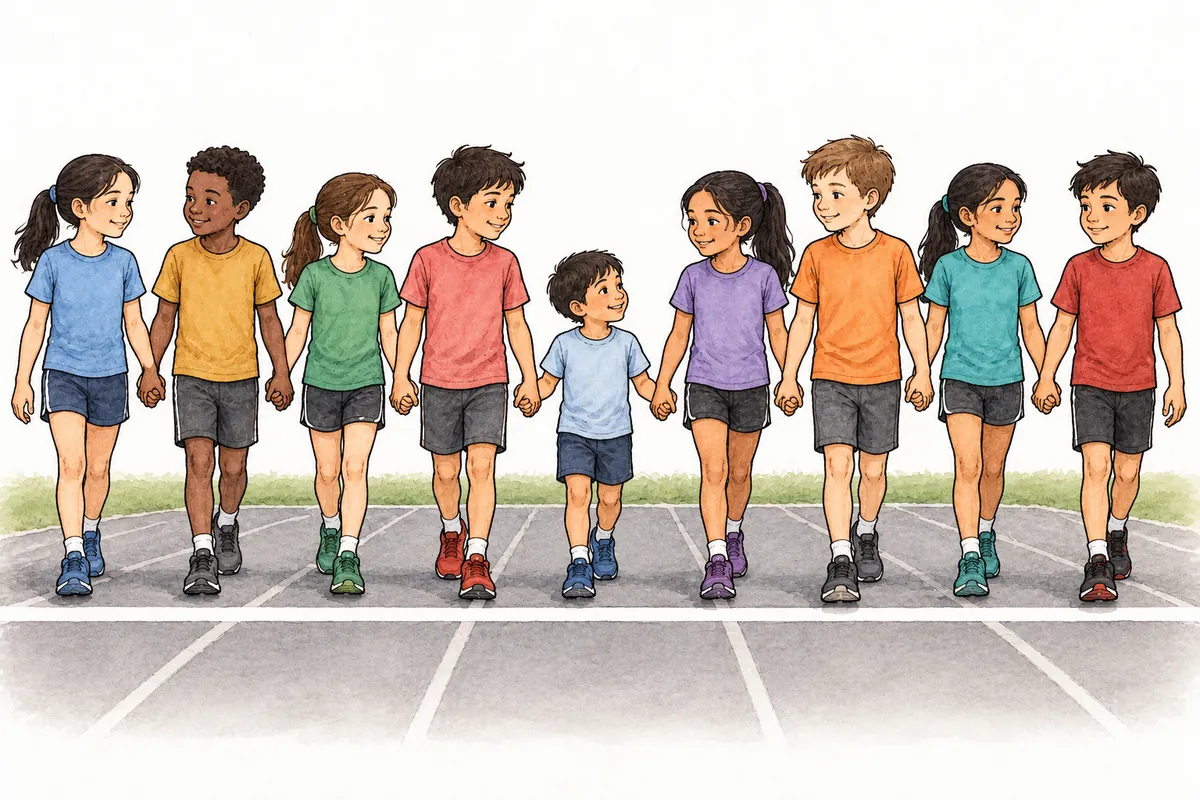
The eight other runners stop in their tracks. One by one, the very athletes who trained so long to compete turn around, go back, and raise the young boy to his feet. Then all nine join hands and finish the hundred-yard dash — now a walk — together, beneath a banner reading “Special Olympics” that could not have been more fitting. The race ends with nine gold medals, nine beaming faces still holding hands at the finish line, and a standing ovation that says more than words ever could.
Summary in English
Athletes have trained for weeks and months and travelled from across the country to compete. Spectators eagerly await the final event, a hundred-yard dash. Nine determined runners start at the gunshot. The smallest stumbles and falls onto the asphalt, crying in frustration and anguish.
The other eight stop and return to help him stand. All nine join hands and walk to the finish together. The banner above them reads “Special Olympics”. In the poem’s ending, they receive nine gold medals, smile and earn a standing ovation. Their actions show that care for another person can matter more than an individual result. The poem celebrates this particular choice; it does not say that all competitive ambition is wrong or describe a general medal-awarding rule.
Summary in Hindi (सारांश हिंदी में)
देश के विभिन्न भागों से आए खिलाड़ियों ने कई सप्ताह और महीनों तक अभ्यास किया है। दर्शक दिन की अंतिम स्पर्धा, सौ गज की दौड़, के लिए उत्साहित हैं। संकेत मिलते ही नौ धावक दौड़ते हैं, लेकिन सबसे छोटा धावक लड़खड़ाकर डामर की सतह पर गिर जाता है। वह दुख और निराशा से रो पड़ता है।
बाकी आठ धावक रुककर वापस आते हैं और उसे उठने में सहायता करते हैं। फिर सभी नौ हाथ पकड़कर साथ चलते हुए अंतिम रेखा तक पहुँचते हैं। उनके ऊपर “Special Olympics” का बैनर है। कविता में सभी को स्वर्ण पदक मिलते हैं और दर्शक खड़े होकर तालियाँ बजाते हैं। यह अंत करुणा, सहयोग और साझा खुशी को महत्त्व देता है। इसे किसी निश्चित ऐतिहासिक दौड़ का प्रमाण या हर प्रतियोगिता में पदक देने का नियम नहीं समझना चाहिए।
Poetic Devices in the Poem
| Device | Example and effect |
|---|---|
| Narrative form | Eight four-line stanzas tell a story with anticipation, a crisis, a turning point and a resolution. |
| Alliteration | “stumbled and staggered” repeats /st/; “dreams … dashed … dirt” repeats /d/. |
| Visual imagery | The gathered spectators, the fall and the joined hands make the action easy to picture. |
| Auditory imagery | The starting pistol and the runner’s cry evoke contrasting sounds. |
| Symbolism | Joined hands suggest solidarity; the nine medals give shared care the value normally attached to individual victory. |
| Tone | Anticipation changes to concern, then admiration and celebration. |
| Direct address | The narrator addresses an audience as a storyteller. This makes the account immediate without proving an eyewitness claim. |
| Contrast | A dash becomes a walk: the change in pace highlights a change in priorities. |
Word Meanings (शब्दार्थ)
| Word | English Meaning | हिंदी अर्थ |
|---|---|---|
| spectators | people watching an event | दर्शक |
| resolved | determined | दृढ़-संकल्प |
| poised | ready and steady | तैयार, सधे हुए |
| blocks | starting blocks used by sprinters | प्रारंभ-खंड (स्टार्टिंग ब्लॉक) |
| hundred-yard dash | a short sprint race of 100 yards | सौ गज की तेज़ दौड़ |
| stumbled | stepped awkwardly, lost balance and almost fell | ठोकर खाई |
| staggered | walked or moved with difficulty | लड़खड़ाया |
| asphalt | hard black substance used to make roads | डामर, तारकोल की सतह |
| anguish | extreme pain or suffering | तीव्र वेदना |
| dashed in the dirt | destroyed, ruined | धूल में मिल जाना |
| pulled up on their heels | stopped suddenly | एकदम रुक गए |
| on the mark | exactly right, fitting | एकदम सटीक |
| standing ovation | audience standing up to applaud | खड़े होकर अभिनंदन |
| beaming | smiling brightly | दमकते, मुस्कुराते |
NCERT Exercise Solutions
Reflect and Respond
I. Olympics, Paralympics and Special Olympics
| Movement | Main distinction |
|---|---|
| Olympics | International elite sport under Olympic qualification rules; it should not be defined as excluding every athlete with a disability. |
| Paralympics | Elite sport for athletes who meet sport-specific impairment eligibility, classification and qualification requirements. Eligible intellectual impairments are included in some sports. |
| Special Olympics | Year-round training and competition for people with intellectual disabilities, with ability-based divisions and an emphasis on inclusion and personal achievement. |
These are distinct organisations. Special Olympics is not another name for the Paralympics. Source: Special Olympics comparison.
II. Match the three responses.
- Sympathy — expressing sorrow for another person’s difficulty.
- Empathy — trying to understand that person’s feelings and perspective.
- Compassion — understanding distress and acting to help.
This is the intended one-to-one match. In real situations the categories overlap: the first response also offers food, which can be an act of compassion.
III. Words associated with empathy — samples
Check Your Understanding
I. Match the words and phrases in Column 1 with their meanings in Column 2.
1. dashed in the dirt — (ii) destroyed | 2. stumbled — (iv) step awkwardly, lose balance and almost fall | 3. staggered — (i) walk or move with difficulty | 4. anguish — (v) extreme pain or suffering | 5. asphalt — (iii) a hard black substance used to make roads and paths
II. Identify the gist of each stanza. Write the number of the stanza in the boxes given.
| Gist | Stanza |
|---|---|
| 1. Spectators cheered participants and waited for the final event to start. | 2 |
| 2. Runners dashed ahead at the gunshot; one athlete tripped and fell. | 4 |
| 3. The race finished with nine athletes holding hands and winning gold; smiles and a standing ovation conveyed everything. | 8 |
| 4. Participants got ready at the starting line; nine determined athletes awaited the gun. | 3 |
| 5. Athletes from various parts of the country had trained for months, dreaming of medals. | 1 |
| 6. The eight athletes stopped to help the fallen athlete stand up, forgetting the competition. | 6 |
| 7. Nine athletes walked hand in hand; the gesture represented the ethos of the Special Olympics. | 7 |
| 8. The young athlete felt his dreams were shattered and cried in pain, but something unique happened. | 5 |
III. Let us appreciate the poem.
1. Two examples of alliteration: (i) “stumbled and staggered” (repetition of ‘st’) and (ii) “dreams… dashed in the dirt” (repetition of ‘d’).
2. Three examples of visual imagery: (i) the spectators gathered around the old field; (ii) the runners charging ahead as the smallest stumbles and falls to the asphalt; (iii) the nine athletes crossing the finish line holding hands, faces beaming.
3. An example of auditory imagery: “the pistol exploded” (also the boy’s cry of frustration and anguish).
4. How does the use of imagery make the poem more appealing?
The imagery turns the poem into a live telecast: we see the crowded field and the fall, hear the gun and the cry, and watch nine athletes holding hands cross the line. Because we witness the scene rather than being told about it, the emotional turn from heartbreak to joy strikes us with full force.
5. How does the poet’s tone change from the beginning to the end?
It begins excited and expectant as the race builds up, plunges into shock and anguish when the smallest runner falls, and then rises into warmth, admiration and quiet triumph as the eight turn back and all nine finish together.
6. What is the overall mood created by the poem?
Inspiring and heart-warming — the reader is left moved, uplifted and full of faith in human goodness.
7. What is the message being conveyed by the poem?
That compassion is greater than competition. True sportsmanship — and true humanity — lies in helping the fallen, even at the cost of one’s own victory; the shared medals in this poem symbolise the value of care. This is not a rule that all participants receive gold in actual competitions.
Gist answer order: 2, 4, 8, 3, 1, 6, 7, 5. Item 7 in the printed exercise says the athletes held the banner; the poem instead places the banner above them. They hold one another’s hands. Match it to stanza 7 while noting this wording error.
Critical Reflection
I. Read the extracts given below and answer the questions that follow. (Extract 1: the eight runners turning back — stanza 6)
(i) The phrase ‘pulled up on their heels’ means that the runners ______.
B. stopped running
(ii) Mention one character trait common to all the eight other runners.
Compassion (empathy) — they valued a fellow runner’s dignity above their own victory.
(iii) What is the tone of the poet in these lines?
Admiring and appreciative — he narrates the runners’ selfless act with wonder and warmth.
(iv) How might the young athlete have felt on being helped by the others?
He may have felt relief, gratitude and renewed confidence when the other runners helped him. Their actions showed that he was included. These feelings are reasonable inferences; the poem does not call this the proudest moment of his life.
(v) Would you consider this incident as a turning point in the poem?
Yes. Until this stanza the poem is an ordinary race story of training, ambition and mischance; from the moment the eight turn back, it becomes a story about humanity. The competition dissolves into companionship, and the poem’s real theme — empathy above ambition — takes over.
(Extract 2: the finish with nine gold medals — stanza 8)
(i) How did the nine contestants feel when they reached the finishing line together?
They felt joyful, proud and content — their “beaming faces” showed a happiness deeper than any single victory could give.
(ii) Why do you think all the nine contestants were given gold medals?
Within the poem, the nine medals honour shared compassion and the decision to finish together. The ending makes them equal participants in this moral victory. The text does not explain an official judges’ decision or establish a real competition rule.
(iii) The holding of hands signifies a feeling of ______.
…unity, solidarity, equality and shared joy.
(iv) The spectators giving a ‘standing ovation’ indicates that they were ______.
A. amazed
(v) Explain the last line of the extract.
The poet admits that language has limits: the sight of the audience on its feet and nine radiant faces at the finish line expressed the beauty of that moment more completely than any words — including the poem’s own — ever could. Some truths are felt, not told.
II. Answer the following questions.
1. Describe how the setting established in the first two stanzas creates a vivid atmosphere for the events that follow.
The opening stanzas assemble all the ingredients of high drama: athletes drawn from all over the country, months of training compressed into one day, dreams of gold, silver and bronze, and spectators ringing the old field, their excitement peaking as the final event approaches. This charged, festive atmosphere makes the sudden fall more heartbreaking — and the act of kindness that follows more luminous.
2. How do you think the youngest athlete might have felt when he fell?
His cry directly expresses frustration and anguish: he fears that his training and hopes have come to nothing. Embarrassment is a possible inference. The question calls him “youngest”, while the poem itself says “smallest”; physical size does not prove exact age.
3. Why were the athletes eager to begin the race?
They had trained for many weeks and months for this moment; it was the final event of the day, the crowd was cheering, and each was resolved to win the gold, silver or bronze that their efforts had pointed towards.
4. What does the transformation of the hundred-yard dash to a walk symbolise?
It symbolises the victory of fellowship over rivalry. Speed — the very essence of a dash — is willingly surrendered so that no one is left behind; competition becomes companionship. The walk declares that reaching the goal together matters more than reaching it first.
5. How might the poem be different if the focus was solely on individual achievement rather than collective support?
A version focused only on individual achievement might follow the leading runner’s speed, effort and result. The shared walk and mutual support would no longer be its centre. This is a hypothetical contrast; an individual winner need not be unkind, and the poem does not describe every alternative outcome.
6. How does the poet’s use of language and tone enhance the reader’s engagement with the poem?
Roth writes like a storyteller at the trackside: simple, vivid verbs (charging, stumbled, staggered), sound effects (the exploding pistol), and a personal oath — “as sure as I’m standing here” — that makes us trust the tale. The tone rises and falls with the action, so the reader’s heart races, sinks and soars along with the runners.
7. What might be the poet’s purpose of writing this poem?
A likely purpose is to invite readers to value empathy and shared dignity alongside achievement. The story’s unexpected turn asks us to consider what makes someone a winner. This is an interpretation of the poem, not proof of a particular historical incident.
Vocabulary in Context
I. ‘Standing ovation’ is an adjective–noun collocation. Identify two other similar examples from the poem.
“final event” and “beaming faces” (also acceptable: “young women”, “starting line”).
II. Write four nouns that collocate with the adjectives.
| 1. big (given) | disappointment, failure, surprise, decision |
| 2. heavy | rain, traffic, burden, heart |
| 3. strong | opinion, wind, bond, argument |
| 4. large | crowd, amount, family, area |
| 5. great | joy, effort, honour, achievement |
III. Choose the correct adjectives for the underlined words. Do not use the same adjective twice.
1. littlest — youngest 2. smiling — positive 3. huge — loud 4. terrible — significant 5. gaudy — noisy
Listen and Respond
I. You will listen to a radio-talk about Patrick Gomes, a coach of special athletes. Write true or false.
1. Patrick Gomes began his career in sports with track events. — True (he began with track events in 1991 in Chennai).
2. Patrick Gomes has been coaching special athletes for 10 years. — False (the transcript says over 15 years at the time of that account; this is not a freshly updated duration).
3. Patrick Gomes does all the household work himself. — True (he lives by himself and does all the daily chores).
II. Choose the correct option for each question.
1. ‘Push your boundaries’ means listeners should — (i) challenge themselves.
2. Patrick Gomes is at present — (ii) a coach of special athletes.
3. The Special Olympic Games at Connecticut was a — (ii) turning point for him.
4. As a special athlete, he mostly participated in — (iii) football.
5. Sports is essential because it encourages — (i) a positive outlook along with fitness (and discipline).
Speaking Activity
I. Take turns to express your points of view regarding the Special Olympics.
A: What is your opinion on the Special Olympics?
B: Personally, I believe that they are among the most important sporting events in the world, because they promote inclusion — they give athletes with intellectual disabilities a stage to train, compete and be celebrated. How do you feel about their impact on the athletes themselves?
A: I hold the opinion that the impact is life-changing: athletes gain confidence, fitness, friendships and dignity — like Patrick Gomes, whose whole life changed after his first Games. In your view, how can we create more awareness?
B: From my perspective, schools should screen events like the Special Olympics, invite para and special athletes as guests, and run inclusive sports days — shared play can support acceptance when it is accessible, respectful and well organised.
Writing Task
I. Three original sample slogans
- Special Olympics: Train Together, Celebrate Every Athlete.
- Share the Track, Respect Every Dream.
- Make Room for Talent, Friendship and Joy.
Each is within the textbook’s eight-to-ten-word maximum. Create your own wording for class.
Poster — model awareness layout
Celebrate skill, friendship and inclusion.
Draw athletes supporting one another, inspired by the poem.
Listen • Include • Encourage
Learn about Special Olympics and welcome every classmate.
This is an awareness poster, not an announcement of a real event. If your class organises an event, add its confirmed date, venue and contact details before displaying it.
Learning Beyond the Text
I. Indian achievers — textbook facts and additional research
| Athlete | Achievement described on page 167 |
|---|---|
| Ravimathi Arumugam | Berlin 2023: gold, women’s 400 m Level C. |
| Aanchal Goyal | Berlin 2023: gold, women’s 400 m Level B. |
| Saket Kundu | Berlin 2023: silver in Level B mini javelin and bronze in men’s 400 m Level B. |
Two further examples: Special Olympics Bharat’s Berlin 2023 report records four powerlifting silvers for T. Vishal of Puducherry and an 800 m Level C gold for Geetanjali Nagvekar of Goa. Use the sport, event, division, year and source in a short athlete profile rather than combining these results with Paralympic medals. Read the official report, printed page 39.
III. Create a sport infographic — sample content
4 × 100 metres relay
| Infographic panel | Short text |
|---|---|
| Team | Four runners work as one team. |
| Distance | Each runs one leg of 100 metres; total 400 metres. |
| Equipment | A baton is passed from one runner to the next. |
| Key skill | Speed plus a smooth, correctly timed baton exchange. |
| Teamwork | Practise communication and handover timing with your coach. |
Simple diagram: Runner 1 → baton → Runner 2 → baton → Runner 3 → baton → Runner 4 → finish.
This diagram shows the sequence, not the shape or scale of the track. Base any detailed rule panel on the current World Athletics relay information. Present it with short labels and credited images. The textbook’s Olympic/Special Olympics infographic is an example of a format, not a requirement to copy its entire history section.
Extra Questions with Answers
1. Why is the banner “on the mark”?
2. What do the runners give up by returning?
3. Does the narrator’s assurance establish that the poet was an eyewitness?
4. How does the poem broaden the meaning of victory?
Additional MCQs
1. ‘Nine Gold Medals’ is written by — (a) Charles Swain (b) David Roth (c) Robert Langley (d) Walter de la Mare
2. The final event of the day was — (a) the marathon (b) the relay (c) the hundred-yard dash (d) the long jump
3. The number of athletes at the starting line was — (a) eight (b) nine (c) ten (d) seven
4. The runner who fell was — (a) the tallest (b) the oldest (c) the smallest (d) the fastest
5. He fell on the — (a) grass (b) track sand (c) asphalt (d) cinder
6. On seeing him fall, the other eight runners — (a) ran faster (b) stopped and turned back to help (c) called the officials (d) waited at the finish
7. The hundred-yard dash was reduced to a — (a) crawl (b) jog (c) walk (d) march
8. The banner above said — (a) Paralympics (b) Special Olympics (c) Youth Games (d) Finish Line
9. The spectators honoured the athletes with — (a) flowers (b) a standing ovation (c) trophies (d) a song
10. The poem ends with nine — (a) tearful faces (b) tired runners (c) beaming faces (d) silver medals
Answer key: 1-b, 2-c, 3-b, 4-c, 5-c, 6-b, 7-c, 8-b, 9-b, 10-c
Assertion–Reason Questions
Options for each: (a) Both A and R are true and R explains A. (b) Both A and R are true but R does not explain A. (c) A is true, R is false. (d) A is false, R is true.
1. A: All nine athletes received gold medals. R: They finished the race together, embodying the spirit of the Special Olympics. — (a)
2. A: The smallest runner’s dreams were ‘dashed in the dirt’. R: He stumbled, staggered and fell at the start of the race. — (a)
3. A: The hundred-yard dash was reduced to a walk. R: The nine runners joined hands and moved towards the finish line together. — (a)
4. A: The spectators gave a standing ovation. R: They were amazed and moved by the athletes’ act of compassion. — (a)
Revision: use the gist order 2, 4, 8, 3, 1, 6, 7, 5; distinguish the poem’s narrative from historical claims; explain how the change from dash to walk develops its theme.
FAQs
Who wrote Nine Gold Medals?
David Roth is the writer credited in NCERT Kaveri.
Why do all nine runners receive gold medals in the poem?
They help the fallen runner and finish together. The shared medals symbolise compassion and solidarity within the poem’s ending.
Is Special Olympics the same as the Paralympics?
No. They are separate organisations with different participation structures. Special Olympics provides training and competition for people with intellectual disabilities.
Also read: Poem 4 – I Cannot Remember My Mother · Kaveri – All Chapters · NCERT Solutions Home. Official textbook PDF: ncert.nic.in