
Believe in Yourself Questions and Answers | Class 9 Kaveri
Checked against NCERT Kaveri, first edition January 2026, pages 245–258; listening transcript 275–276. Personal, discussion and creative responses are samples: adapt them to your experience. This independent study guide is not an official NCERT answer key.
Poem Overview & Central Idea
In Believe in Yourself, Robert Langley encourages readers to face a challenge, recognise fear and take a first step towards growth. Four quatrains move from personal responsibility to confidence and action. The message is motivational: self-belief can help us begin, while real-world progress also depends on effort, support, opportunity and circumstances.
About the Poet
NCERT credits Robert Langley as the poet. The speaker addresses the reader like a supportive guide. The poem pairs with Follow That Dream, whose practical advice about planning and support complements this emphasis on confidence.
Stanza-wise Explanation
Stanza 1: personal responsibility
Stanza 2: fear and choice
Stanza 3: comfort and change
Stanza 4: beginning with confidence
Summary in English
The speaker encourages the reader to take responsibility for facing a challenge. Fear may make choices difficult, and familiar comfort may discourage change. Beginning can feel especially hard, but confidence helps a person act. The poem’s direct address, question and contrasts create an encouraging tone. Read critically, its advice is useful alongside preparation, help from others and a willingness to adjust when necessary.
Summary in Hindi (सारांश हिंदी में)
कविता पाठक को चुनौती का सामना करने और अपनी भूमिका की जिम्मेदारी लेने के लिए प्रेरित करती है। भविष्य से जुड़े निर्णयों में डर हो सकता है और परिचित स्थिति में बने रहना आसान लग सकता है। कवि उपयोगी बदलाव से बचने के बजाय पहला कदम उठाने को कहता है। आत्मविश्वास शुरुआत में सहायक है, लेकिन सफलता के लिए तैयारी, प्रयास, अवसर और दूसरों का सहयोग भी आवश्यक हो सकते हैं। “पीछे न मुड़ना” संकल्प का काव्यात्मक आग्रह है; इसका अर्थ किसी अनुपयुक्त योजना को कभी न बदलना नहीं है।
Poetic Devices in the Poem
| Device | Explanation / Example from the poem |
|---|---|
| Direct address | The poem speaks to “you” throughout, like a guide encouraging the reader personally. |
| Rhetorical question | “Will it pull you forward / Or push you back in fear?” — asked to make the reader reflect, not to be answered. |
| Antithesis | “pull you forward” vs “push you back in fear” — opposite ideas in parallel structure; also comfort/status quo vs growth. |
| Metaphor | “The first step is the hardest” — the step stands for the act of beginning any new endeavour; “future to be on track” pictures life as a railway line. |
| Symbolism | Comfort/status quo = stagnation; the future = the unknown; the first step = the leap of faith of self-improvement. |
| Rhyme scheme | abcb — the second and fourth lines of each stanza rhyme (see/be, fear/near, quo/grow, back/track). |
| Tone / Mood | Motivational and encouraging; thoughtful at the start, determined by the end. |
Word Meanings (शब्दार्थ)
| Word/Phrase | English Meaning | हिंदी अर्थ |
|---|---|---|
| step up to | come forward to face | आगे बढ़कर सामना करना |
| challenge | a difficult task that tests one | चुनौती |
| crowd | a large group of onlookers | भीड़ |
| pull forward | draw ahead, attract onward | आगे खींचना |
| push back | force backwards | पीछे धकेलना |
| ease | comfort, freedom from effort | आराम |
| status quo | the existing state of affairs; keeping things the same | यथास्थिति |
| turning back | retreating, going back | पीछे मुड़ना |
| on track | moving in the right direction | सही दिशा में |
NCERT Exercise Solutions
Reflect and Respond
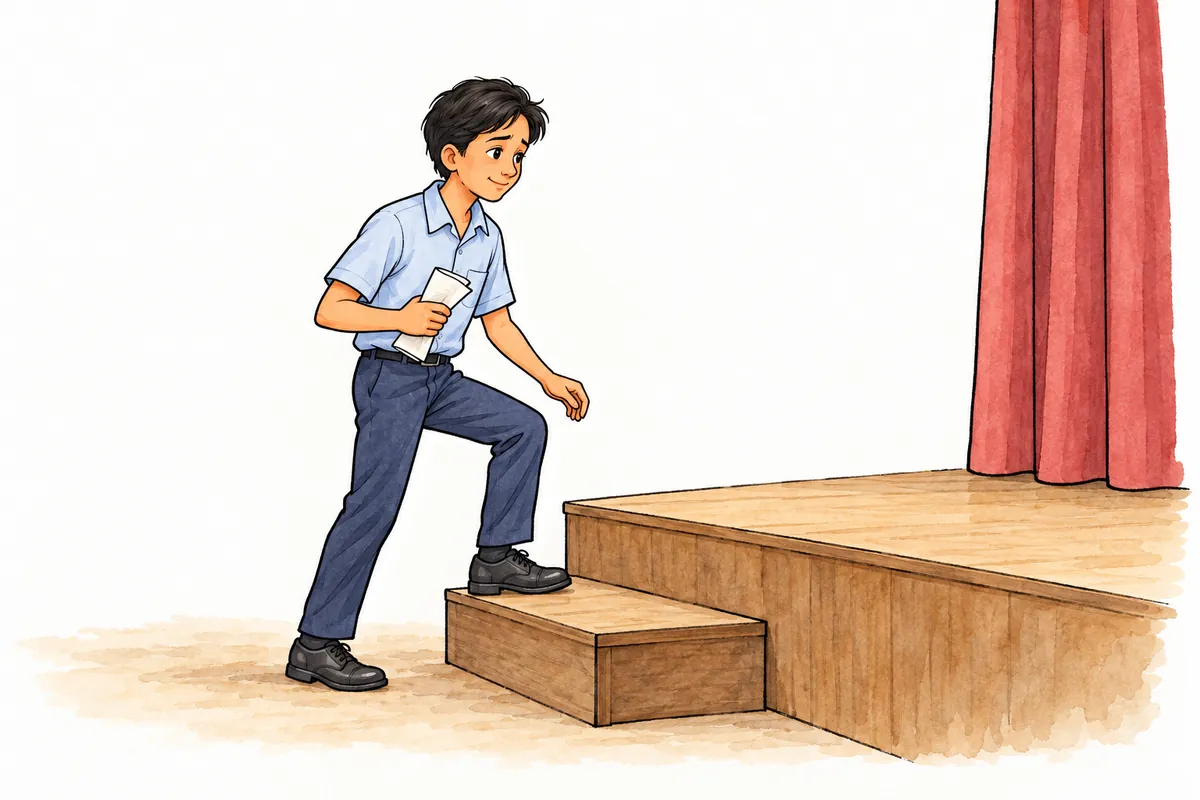
I. Imagine that you are the person in the image. 1. What emotions do you feel standing at the base of a difficult task? 2. What might make you take the first step?
1. A mixture of emotions — nervousness and self-doubt about whether I can succeed, fear of failing before others, but also excitement and a flutter of hope at the thought of reaching the top.
2. The vision of where I want to be, encouragement from people who believe in me, the memory of past challenges I overcame — and above all, the decision to trust myself more than my fear.
II. Think about a time when you had to face a challenge.
1. My challenge was speaking in the inter-school debate for the first time. At the start I felt my heart pounding — I was sure I would forget my points and embarrass my school.
2. But the moment I decided to walk to the podium, the fear strangely shrank; with each sentence my voice steadied, and by the end I felt taller — proud that I had not let fear decide for me.
III. What does the phrase ‘believe in yourself’ mean to you? Write some words or phrases you associate with it.
To me it means trusting my own abilities even when the outcome is uncertain. Associated words: confidence, courage, self-trust, determination, positive thinking, inner strength, never giving up, “I can do it”.
IV. Select the correct meaning of ‘status quo’ based on the given sentence.
2. A situation to keep things the same.
Check Your Understanding
I. Select the correct central idea for each stanza.
Stanza 1 — (i) Facing challenges requires personal responsibility and a clear focus on one’s future.
Stanza 2 — (i) Fear and uncertainty make it difficult to make choices as the future approaches.
Stanza 3 — (ii) Personal growth requires leaving behind comfort and embracing change.
Stanza 4 — (ii) The first step towards change is difficult, but having self-belief and confidence helps you stay on track.
II. Rhyme Scheme — fill in the blank.
The poem follows a simple, yet effective rhyme scheme abcb that flows steadily through each stanza (see/be, fear/near, quo/grow, back/track).
III. Tone — true or false.
1. The overall tone of the poem is motivational and encouraging. — True
2. The tone shifts from thoughtful in the beginning to one of determination by the end. — True
IV. Speaker — fill in the blanks.
The speaker comes across as a guide who understands the struggle and is encouraging the reader to take control of his/her own future. The use of direct address ‘You’ creates a close connection, as though the speaker is talking directly to the reader.
V. Imagery — match the phrases with the imagery they represent (one extra).
1. “There is no crowd to see…” — (ii) Suggests a solitary journey, stressing individual effort.
2. “push you back in fear?” — (iii) Evokes the mental barrier that prevents growth.
Extra: (i) Represents the difficulty of beginning a new challenge.
VI. Symbolism — complete the sentences with words/phrases from the box.
1. Comfort and the status quo represent stagnation and fear of change, symbolising the comfort zone that holds one back.
2. The future symbolises the unknown, the potential for change and success that lies ahead but requires courage to step into.
3. The first step symbolises the initial leap of faith required to begin the journey of self-improvement or personal development.
VII. Metaphor — explain why ‘The first step is the hardest’ is metaphorical.
The line does not speak of a literal footstep. ‘The first step’ stands for the initial act of beginning any new endeavour — applying, auditioning, starting to train — which can demand courage because uncertainty may feel strongest before beginning. By picturing an abstract beginning as a physical step, the poet makes the struggle vivid and universal.
VIII. Antithesis — identify the lines from the poem that show antithesis and explain.
“Will it pull you forward / Or push you back in fear?” — the line pairs two opposite responses (being drawn ahead vs being driven back) in a parallel structure, sharpening the choice every challenge forces on us. A second antithesis runs through stanza 3: the ease of comfort set against how we grow — familiarity contrasted with growth to stress the need for constructive change. The clearest parallel antithesis is “pull you forward” / “push you back”.
Critical Reflection
I.1. What does “no crowd” suggest?
I.2. Complete the idea of “you and the future”.
I.3. Latha will ___ her efforts.
I.4. Most suitable title
I.5. Analogy
II.1. Why is the first step metaphorical?
II.2. What does the antithesis convey?
II.3. Is self-belief enough? — critical response
II.4. Apply the message — fictional model
Vocabulary in Context
I. Fill in the blanks with the Latin expressions used in English.
(i) I enjoy reading fantasy books, e.g. Harry Potter and Magical Paint Brush.
(ii) After helping Tanya with the homework, Ritu asked for a quid pro quo — to borrow her notes next time.
(iii) I love all kinds of outdoor activities, such as trekking, hiking, biking, etc.
(iv) The park is not very special per se; it becomes more fun when you visit with friends.
(v) We created an ad hoc team to organise the school festival.
(vi) The movie started in medias res, with the hero already fighting the villain in a huge battle.
II.1. What do the given rhetorical questions intend to achieve?
(i) “Isn’t it obvious that we must act now? Don’t we all have a responsibility…?” — they press the listeners to accept the urgency of action and their shared responsibility, treating agreement as self-evident.
(ii) “Will we let fear control us, or will we rise above it?” — it challenges the listeners to reflect on their own response to fear and inspires them to choose courage.
II.2. Match the situations to the rhetorical questions.
(i) Standing up for what is right — F (“How can we stay silent when we know what is right?”)
(ii) Owning up to a mistake in a group project — B (“Isn’t it better to admit our mistakes than to let them define us?”)
(iii) Trying something challenging, like public speaking — A (“How can we ever grow if we never try anything new?”)
(iv) Choosing between two career paths — D (“Can I really move forward without knowing which path to take?”)
(v) Deciding whether to apologise for a mistake — C (“If I don’t take responsibility now, when will I?”)
(vi) Stepping out of your comfort zone — E (“What’s the point of playing it safe if it means staying stuck?”)
Spelling note: the textbook prints “in media res”, but the standard expression is in medias res, meaning into the middle of events. See the Oxford Learner’s Dictionary entry. The rhetorical-question matches above are a coherent one-to-one set; A and E can overlap when discussing a new challenge, so explain your reasoning.
Listen and Respond
I. One to three exact words from the transcript
- so nervous (or nervous)
- taking action
- you’ll shine
For item 3, “he would shine” is a correct paraphrase but is not the exact wording requested. The girl’s final words are addressed directly to Karan.
II. Four true statements
2, 4, 5 and 7.
| Statement | Reason |
|---|---|
| 2 | Ananya encourages Karan to trust his preparation. |
| 4 | She describes self-doubt as part of the process. |
| 5 | He feels not good enough despite having practised. |
| 7 | She says acting through nervousness can build confidence. |
1 is false because he is nervous rather than confident. 3 is not supported: no assurance about the audience’s reaction is given. 6 is false because she encourages action despite nerves, not perfect performance without nerves.
Speaking Activity
1. Don’t judge a book by its cover — fictional role-play
Meaning: first impressions do not reveal everything about a person.
A: You have been quiet in our group. I thought you were not interested.
B: I needed time to understand the problem. I have drawn a plan we could try.
A: I should have asked instead of assuming. Your plan is useful.
Conclusion: Listen and learn about someone before judging them.
2. Actions speak louder than words — fictional role-play
Meaning: what people do can show commitment more clearly than promises.
A: I keep saying I will improve my marks, but I have not changed my routine.
B: I started with twenty minutes of revision and asked for help with one difficult topic each week.
A: I will choose a manageable action today and check my progress.
Conclusion: Practical effort gives an intention substance.
3. When the going gets tough, the tough get going — fictional role-play
Meaning: respond constructively to difficulty instead of giving up immediately.
A: Our model has stopped working. I do not know what to do.
B: Let us check one connection at a time and ask our teacher for help if needed.
A: We can simplify the model and explain what we learned.
Conclusion: Persistence may include help, rest or a revised approach; the proverb does not require unsafe effort or guarantee a prize.
Writing Task
I. Morning-assembly speech — original four-paragraph model
Good morning, respected Principal, teachers and fellow students. I am Asha of Class IX. Have you ever avoided a task because you were afraid of getting it wrong? Today I would like to discuss how challenges can create opportunities to learn and how preparation and support help us respond.
First, a difficulty can reveal a skill we need to develop. For example, speaking at assembly may feel frightening. Practising a short introduction, using cue cards and listening to feedback can make the task more manageable. Even an imperfect attempt can show us what to improve next.
Second, we do not have to handle every obstacle alone. A teacher may explain a difficult idea, a friend may rehearse with us and a family member may help us organise our time. Some barriers also need resources or changes around us. Seeking help is a responsible action, not a failure of confidence.
In conclusion, self-belief is useful when joined with effort, planning and support. Not every difficulty has an easy benefit, but we can look for a sensible next step. Let us encourage one another to try, learn and adjust. Thank you.
Learning Beyond the Text
I. Research the three leaders
- Dr B. R. Ambedkar: study his education, opposition to caste discrimination and role as chair of the Constitution’s Drafting Committee. The Ministry of External Affairs resource is a starting point. Do not reduce discrimination to a problem solved by confidence alone.
- Lal Bahadur Shastri: the official former-prime-minister profile describes early hardship, education and public service.
- A. P. J. Abdul Kalam: consult the official presidential profile for his scientific work and service as India’s eleventh President.
Local-personality presentation — research template
Choose a person from your village, town, city or state. Record their field, the challenge, actions taken, support received, an achievement and reliable sources. Ask permission before using private interview details or photographs. Distinguish documented facts from the person’s recollections and your interpretation. Do not invent an interview or a local success story.
Compare “Always Believe in Yourself”
Extra Questions with Answers
1. Why may choices feel difficult as the future approaches?
2. How is the status quo used?
3. Does “no turning back” forbid changing a plan?
4. How does the poem complement Follow That Dream?
Additional MCQs
1. ‘Believe in Yourself’ is written by — (a) Dorothy Hewitt (b) Robert Langley (c) Charles Swain (d) David Roth
2. When you step up to the challenge, there is no — (a) time to lose (b) crowd to see (c) road ahead (d) help available
3. It’s just you and — (a) your fear (b) the world (c) the future (d) the past
4. The challenge may pull you forward or push you back in — (a) doubt (b) anger (c) fear (d) shame
5. There is such ease in — (a) effort (b) comfort (c) success (d) growth
6. ‘Status quo’ means — (a) high status (b) a new plan (c) the existing state of things (d) a quick change
7. The hardest step is — (a) the last (b) the first (c) the middle one (d) every step
8. Self-belief keeps your future — (a) on track (b) in sight (c) at bay (d) in doubt
9. The rhyme scheme of the poem is — (a) aabb (b) abab (c) abcb (d) free verse
10. “Will it pull you forward / Or push you back in fear?” is a — (a) simile (b) refrain (c) rhetorical question (d) hyperbole
Answer key: 1-b, 2-b, 3-c, 4-c, 5-b, 6-c, 7-b, 8-a, 9-c, 10-c
Assertion–Reason Questions
Options for each: (a) Both A and R are true and R explains A. (b) Both A and R are true but R does not explain A. (c) A is true, R is false. (d) A is false, R is true.
1. A: The poet rejects the comfort of the status quo. R: Comfort is not what we are made for, nor how we grow. — (a)
2. A: The poem addresses the reader directly as ‘you’. R: Direct address creates a close, personal connection, as if a guide is speaking to the reader. — (a)
3. A: The poem says a large, cheering crowd watches us face our challenges. R: Facing a challenge is presented as a solitary journey of individual effort. — (d)
4. A: The first step is called the hardest. R: In the poem’s interpretation, beginning can feel difficult because fear and uncertainty hold us back. — (a)
Revision: explain the stanza ideas, ABCB rhyme, direct address, antithesis and first-step metaphor. Practise the Latin expressions and use exact wording when the listening task requests it. Support critical answers with both the poem and realistic reasoning.
FAQs
Who wrote Believe in Yourself in Kaveri?
NCERT credits Robert Langley. It is the main poem paired with Follow That Dream in Unit 8.
What is its central idea?
Self-belief can help a person face fear and begin a challenge. Practical progress also needs effort, preparation, support and opportunity.
What does status quo mean?
The existing state of affairs. In the poem, keeping it unchanged symbolises remaining in familiar comfort instead of pursuing growth.
Also read: Poem 7 – Words · Chapter 1 – How I Taught My Grandmother to Read · NCERT Solutions Home. Official textbook PDF: ncert.nic.in