
Solutions for Building Blocks in Economics: The Problem of Choice, Chapter 8 of NCERT Understanding Society: India and Beyond, Grade 9, Part 1 (June 2026), pages 183–194. The ten exercise answers follow the textbook order. Personal examples are samples to adapt to your own observations.
Questions and activities: answers
1. Why wants change, and how production responds
People’s wants change with age, income, technology, advertising, social influences and circumstances. A student may first need a school bag and later want a bicycle for a longer journey. Producers respond by changing the kinds, quantities and qualities of goods and services they offer, although their decisions also depend on costs and available resources.
All wants cannot be satisfied at once because land, water, materials, labour, time and productive capacity are limited relative to competing uses. More money does not make physical resources or time unlimited. Individuals and societies must choose which wants to meet first.
2. Wants and environmental pressure
Frequent replacement of usable products can increase mining, energy use, emissions and waste. Expanding production may put pressure on forests, water and habitats. However, fulfilling an essential need is not the same as wasteful consumption, and environmental harm depends on how production is organised.
A better balance requires durable and repairable products, reuse, careful recycling, efficient resource use, cleaner energy, responsible extraction and effective pollution controls. Consumers can avoid unnecessary purchases; producers can reduce waste; governments can protect ecosystems and enforce standards. Recycling helps but does not eliminate the need to limit damaging extraction.
3. A scarce resource used wastefully
Sample: freshwater in a water-stressed locality. Leaking pipes, overflowing tanks and unsuitable irrigation can waste water. Metering where appropriate, repairing leaks, rainwater harvesting, protecting recharge areas and selecting suitable crops can improve management. Reuse treated water only for safe, suitable purposes. Check actual local conditions before presenting this as a description of your region.
4. Freedom and innovation in economic systems
A market-oriented system generally offers more freedom to consumers and private producers to choose what to buy, sell and produce. Competition and the possibility of earning profits can encourage new products and lower-cost methods. Yet freedom is unequal when some people lack purchasing power, and a monopoly can restrict choice.
Reasoned judgement: a well-designed mixed economy can combine enterprise and competition with public education, research, infrastructure, fair competition rules and support for people excluded by markets. Innovation is not exclusive to private firms: public institutions also develop technologies. No system guarantees innovation merely through its label.
5. Why pure systems rarely exist
A purely market-based system may underprovide public goods, ignore pollution costs and leave basic needs unmet when people cannot pay. Market power can weaken competition. A highly centralised planned system can struggle to obtain detailed information about changing local needs; rigid targets and weak incentives may create shortages, surpluses or low-quality production. Public planning can nevertheless coordinate major investments and essential provision.
A mixed economy allows markets to organise many activities while government supplies public services, regulates harmful conduct, supports social protection and addresses wider economic problems. This is often practical because both markets and governments have strengths and limitations. Effective institutions, accountability and suitable policies matter more than simply describing an economy as “mixed”.
6. ₹100: notebook or future tennis racket?
Correct option: (b) Opportunity cost. If the student buys the notebook, the best alternative use of the money—saving ₹100 towards the racket—is forgone. If the student saves instead, the opportunity to use a new notebook now is forgone. The choice depends on the urgency of the need and the value of the alternative.
7. How opportunity cost improves decisions
It makes us compare the benefit of a choice with the value of the best alternative forgone. For example, using an hour for gaming gives up the next-best use of that hour, such as completing an assignment. A school spending its limited improvement fund on a playground should also consider the benefits forgone from the best alternative, perhaps library resources. Opportunity cost includes time and other benefits, not only cash payments; it is not the sum of all rejected options.
8. Why reliable data matters
Decisions can be attempted without data, but their quality is less dependable. A vegetable seller who checks past sales, current stock and expected customer numbers can order more appropriately than one who guesses. Ordering too much may cause spoilage; ordering too little may cause lost sales. Data should be relevant, recent and checked for errors. Even good data cannot remove every uncertainty, so decision-makers must also consider risks and changing circumstances.
9. Present choices and the long-term future
Investment in education and health can improve people’s capabilities and future productivity. Maintaining infrastructure can prevent larger repair costs later. Conversely, exhausting groundwater or degrading soil may raise current output while reducing future production and harming communities. Excessive borrowing without productive benefits can constrain later spending.
Considering future consequences helps balance immediate needs with sustainable livelihoods and fairness to future generations. The decision should compare benefits, costs, risks, who gains or loses, and whether damage can be reversed. Long-term thinking should not become an excuse to ignore urgent needs today.
10. Newspaper example of a production decision
Sample based on a dated report: The Economic Times/Reuters report of 31 May 2025 describes an OPEC+ decision to raise July oil output targets by 411,000 barrels per day. Producers were adjusting supply while considering market conditions, demand and market share; the decision illustrates “how much to produce”. An announced target is not proof that the exact additional quantity was subsequently produced.
This is a historical sample, not a report of today’s oil market. If your teacher asks for a recent article, choose one with a clear date, identify the product and decision-maker, and explain the stated reason in your own words.
Production possibility curve: barley and wheat
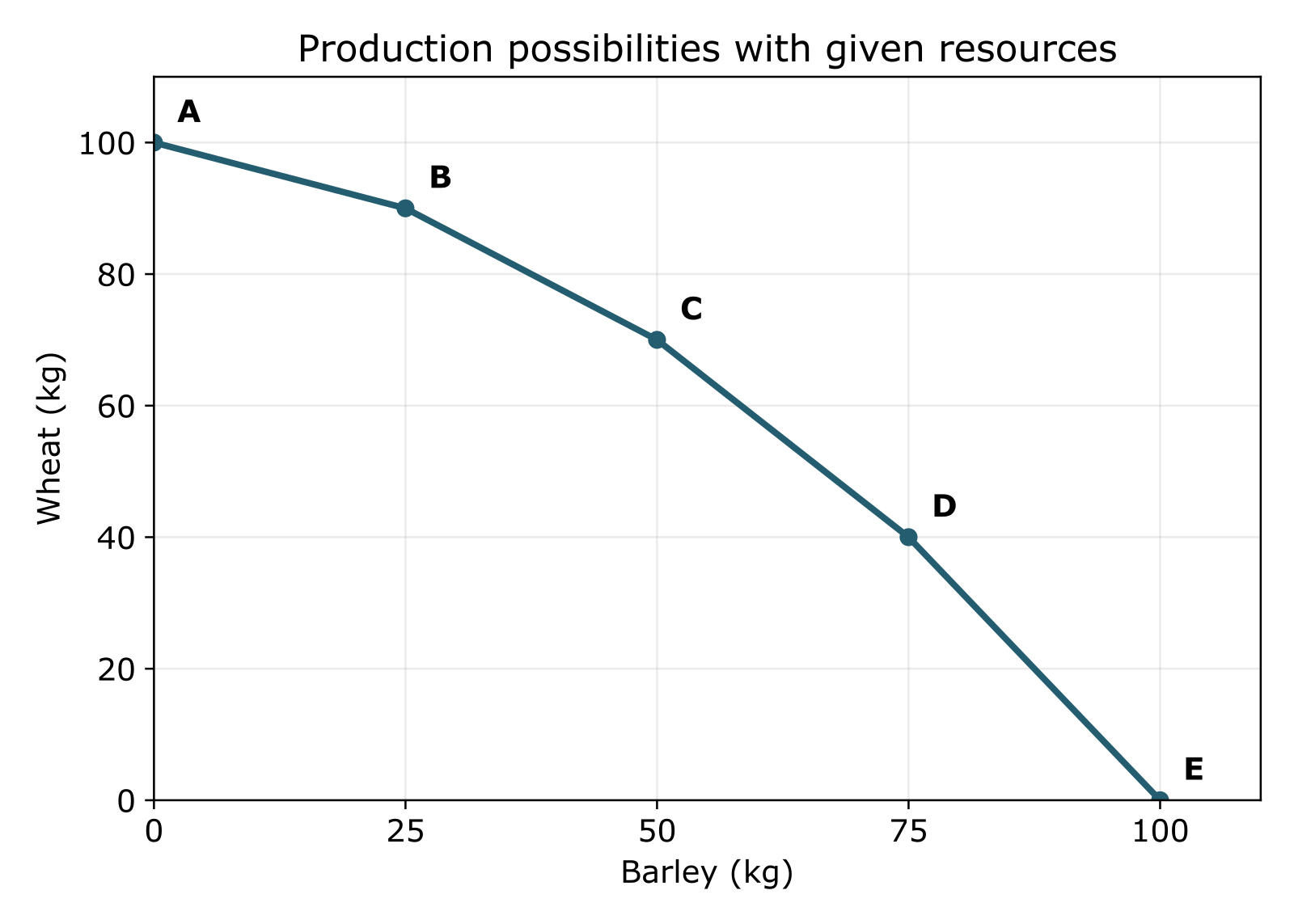
The textbook’s five combinations assume given resources and technology. More barley requires giving up some wheat. The graph below plots the supplied quantities exactly; straight segments join the observations rather than inventing unprovided intermediate production data.
| Combination | Barley (kg) | Wheat (kg) | Extra barley from previous point | Wheat forgone |
|---|---|---|---|---|
| A | 0 | 100 | — | — |
| B | 25 | 90 | 25 kg | 10 kg |
| C | 50 | 70 | 25 kg | 20 kg |
| D | 75 | 40 | 25 kg | 30 kg |
| E | 100 | 0 | 25 kg | 40 kg |
The successive opportunity costs of an additional 25 kg of barley are 10, 20, 30 and 40 kg of wheat. Per additional kilogram of barley, these are 0.4, 0.8, 1.2 and 1.6 kg of wheat over the respective intervals. Thus the opportunity cost rises in this example. Points on the frontier use the assumed resources efficiently; a point inside indicates that greater production of at least one good is possible under those assumptions. A point outside is unattainable with the stated resources and technology.
Three central economic questions
Choose goods, services and quantities: for example, grain for food or cotton for fabric.
Choose methods and a mix of labour, equipment, land and technology.
Consider who receives the output, who can afford it and how access is arranged.
Identify the best alternative use of scarce resources before deciding.
In-text activities: sample responses
Page 184: classify three purchases
| Example purchase | Classification and reason |
|---|---|
| Rice or another staple food | Need: basic nourishment. |
| Medicine prescribed for an illness | Need: necessary treatment. |
| A decorative phone cover replacing a usable one | Want in this example: appearance rather than an essential replacement. |
These are illustrative purchases, not claims about your family. Context matters: a phone or internet connection can be needed for work or study. Many competing wants can strain a limited budget and increase waste; prioritising needs helps.
Page 186: family choices and scarce time
Sample interview response: a family compares price, usefulness, quality and available funds before buying. If it buys an essential school bag instead of an optional outing, the outing is the opportunity cost only if it was the next-best alternative. Ask your family for its actual example without sharing private financial details.
Time is scarce because each person has only a limited number of hours in a day. A sample after-school plan might reserve time for homework, exercise, rest and recreation. Spending an extra hour on one activity reduces the time available for another; the most valued alternative forgone is the opportunity cost.
Page 189: healthcare and education or defence and space?
Sample answer: all can serve important needs. Healthcare and education directly improve well-being and capabilities; defence supports security; space research can provide communication, weather information and scientific knowledge. Rather than claiming that one category should always receive all extra funds, compare unmet needs, expected benefits, urgency, existing capacity and the costs of postponing each option. Explain your priorities using evidence.
Page 191: should government stay completely out of enterprise decisions?
Sample answer: no. Enterprises need room to innovate, but rules are necessary to protect workers and consumers, prevent harmful pollution and maintain fair competition. Poorly designed or unpredictable rules can also raise unnecessary costs. Illustrative example: a well-maintained public road can help small producers reach buyers, while a lengthy, avoidable permit delay can postpone production. These are hypothetical mechanisms, not an invented news incident.
Useful concept clarifications
- Scarcity is relative: a resource can be plentiful in absolute quantity yet scarce relative to competing wants.
- Opportunity cost: use the value of the next-best alternative, not every alternative added together.
- India’s mixed economy: India had both public and private sectors before 1991. The reforms changed their roles; they did not create a mixed economy from nothing. See NCERT’s introduction to economic systems.
- Public provision versus public goods: in the strict economic sense, a public good is non-rival and non-excludable. Education has major social benefits and may be publicly provided, but a classroom has limited places; it is not automatically a pure public good. Roads and parks may also become congested or restrict access.
- Efficiency and fairness: efficient production does not by itself prove that benefits are distributed fairly or that environmental costs have been considered.