
Solutions for Managing Your Personal Finances, NCERT Class 9 Understanding Society: India and Beyond, Part 2, Chapter 5, September 2026 edition, pages 107–124. All nine exercises and the in-text calculations are covered. Budgets and investment scenarios below are classroom examples, not personal investment recommendations.
Exercises 1–9 · Budget pie chart · Compounding correction · Tax example
Questions and activities: solutions
1. Why manage money wisely at every income level?
Income is limited relative to possible uses. Planning helps prioritise essentials, avoid unnecessary debt and prepare for future needs. Higher income does not automatically prevent overspending, while a low-income household may need to make difficult choices even with careful planning. Financial management cannot by itself remove poverty or guarantee that there is money left to save.
2. Balancing present needs and future goals
A budget records money available, essential expenses, optional spending and intended saving. It helps identify which purchases can be postponed. For example, saving ₹500 a month for six months produces ₹3,000 before interest. A family should also allow for irregular expenses and review its plan when income or costs change. Saving for a goal should not mean neglecting food, medicines or other essentials.
3. School reopening budget: ₹3,000
Illustrative prices only: replace them with prices checked locally and reuse suitable items already owned.
| Item | Sample cost |
|---|---|
| School bag | ₹500 |
| Books | ₹600 |
| Uniform and shoes | ₹1,000 |
| Notebooks | ₹400 |
| Pens | ₹80 |
| Pencils | ₹60 |
| Art supplies | ₹160 |
| Total initial expenses | ₹2,800 |
| Optional geometry box | ₹120 |
| Final expenses | ₹2,920 |
| Money left | ₹80 |
The initial budget leaves ₹200, so the optional ₹120 geometry box fits. Final check: ₹2,920 + ₹80 = ₹3,000. If actual costs exceed the limit, postpone an optional item, compare suitable alternatives or reuse a serviceable bag; do not cut necessary supplies without discussing it with a parent.
4. Saving, investing and long-term wealth
Saving creates a surplus, but cash kept without interest may lose purchasing power as prices rise. Investing can generate interest, dividends or capital gains, and reinvesting returns can produce compounding. However, investments can also lose value and do not always beat inflation. The result depends on returns, costs, taxes, risk and the period invested. Saving and investing therefore serve related but different purposes.
5. Investment planning with ₹1,500
The question does not specify a birthday date, investment product or purchase and sale prices. Consequently, there is no single factual historical return. The following one-year hypothetical calculation teaches the method; none of its rates is a current quotation or promised return. It ignores charges and taxes and assumes returns are not withdrawn.
| Asset | Amount | Assumed return | Gain/loss | End value |
|---|---|---|---|---|
| Fixed deposit | ₹500 | 6% | ₹30 | ₹530 |
| Shares | ₹800 | 10% | ₹80 | ₹880 |
| Gold | ₹200 | 5% | ₹10 | ₹210 |
| Total | ₹1,500 | 8% overall | ₹120 | ₹1,620 |
Alternative using the same assumptions: ₹1,000 FD + ₹300 shares + ₹200 gold gives ₹60 + ₹30 + ₹10 = ₹100, ending at ₹1,600. These are weighted results; do not simply average the three rates.
Loss scenario: if shares instead fall 10% and gold falls 5%, the original allocation gives ₹30 − ₹80 − ₹10 = −₹60, leaving ₹1,440. Higher risk does not promise a gain.
Sample reasoning: money needed soon for school expenses should prioritise accessibility and capital preservation. Shares and gold fluctuate and may be unsuitable for such a short goal. For the actual research task, record exact dates, product, official FD terms or historical prices, dividends and charges; then calculate the net change. The small amounts may not meet real product minimums, so this is an arithmetic exercise rather than a purchase instruction. See SEBI’s explanation of investment factors.
6. Inflation and purchasing power
Inflation is an increase in the general price level. If a bag costing ₹1,000 rises by 6%, its new price is ₹1,060. Unchanged savings of ₹1,000 then cannot buy that same bag. People should consider expected inflation when planning future costs and compare returns after charges and taxes with the change in prices. A general inflation rate does not mean every individual item rises by exactly that percentage.
7. Is higher risk always best?
No. Higher risk means a greater possibility of an unfavourable outcome, not a guaranteed higher return. A suitable choice depends on the goal, time available, need for cash, ability to bear losses, product understanding and costs. Diversification can reduce concentration risk but cannot eliminate every risk. Mutual funds differ substantially: an equity fund, a debt fund and a narrowly focused fund should not all be treated as equally risky.
8. Why buy insurance if a loss may never occur?
A household pays a premium to transfer specified financial risks to an insurer under a contract. Many policyholders contribute to a pool, while covered claims help those who suffer insured events. The benefit is protection against a potentially unaffordable loss, even if no claim occurs. Cover is subject to exclusions, limits, waiting periods, deductibles and other policy conditions. Insurance is not a promise that every expense will be paid or that all premiums will be returned.
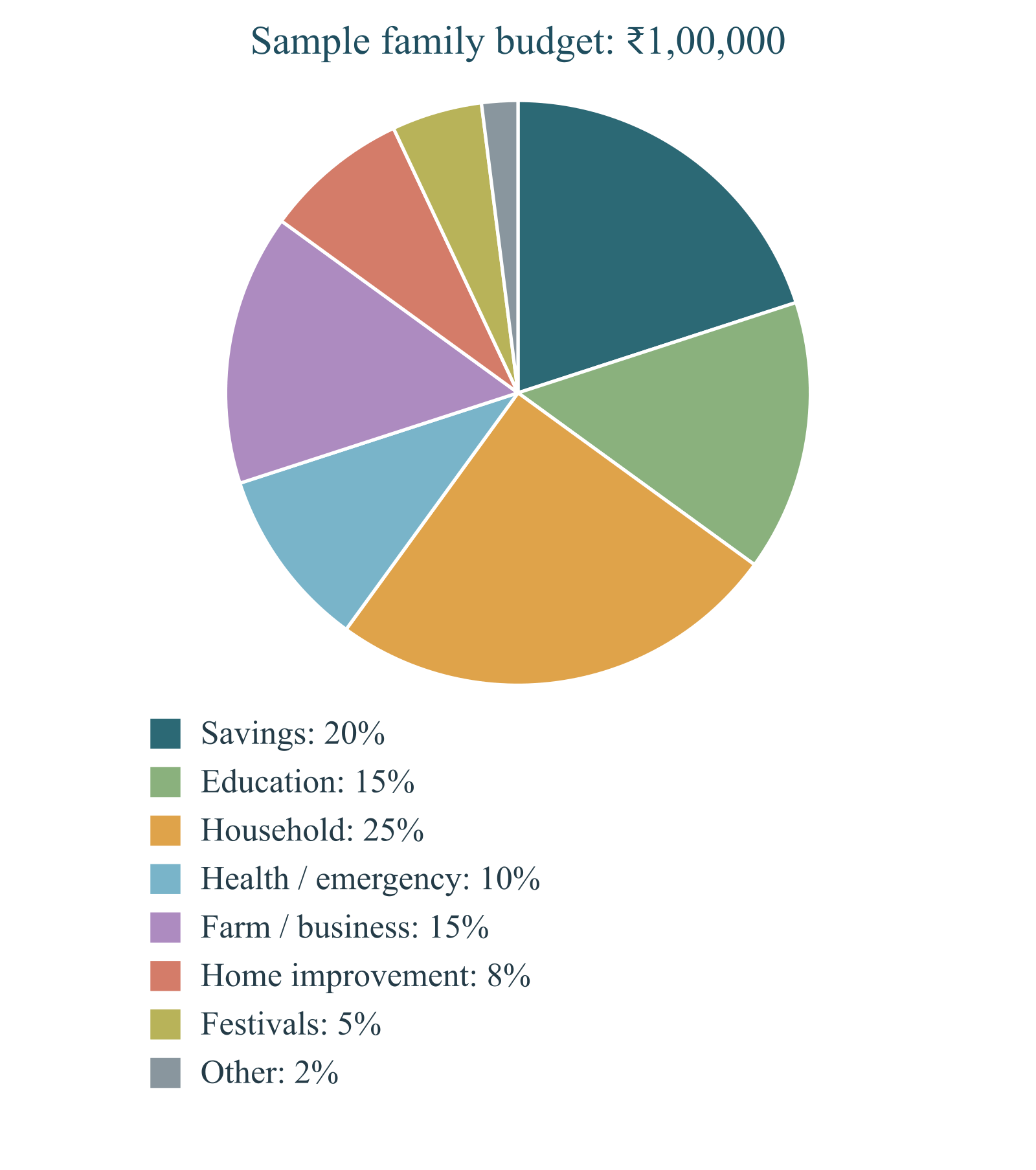
9. Family money-management activity: ₹1,00,000
Step 1: sample allocation
Treat this as a one-time amount available for allocation. If part of it comes from earlier savings, it is not all newly earned income.
| Category | Amount | Percentage |
|---|---|---|
| Savings | ₹20,000 | 20% |
| Education | ₹15,000 | 15% |
| Household expenses | ₹25,000 | 25% |
| Health and emergency fund | ₹10,000 | 10% |
| Farm or business investment | ₹15,000 | 15% |
| Home improvement | ₹8,000 | 8% |
| Festivals and recreation | ₹5,000 | 5% |
| Other | ₹2,000 | 2% |
| Total | ₹1,00,000 | 100% |
Step 2: needs and wants
- School fees: an educational need.
- New mobile phone: often a want if an adequate phone is already available; a basic device needed for learning or work may be a need.
- Suitable seeds or livestock feed: a livelihood need, subject to the farm’s actual requirements.
- Festival celebrations: discretionary spending whose scale can be adjusted.
- Water storage tank: a need where reliable safe water storage is lacking.
Household essentials and necessary health care are needs. Cosmetic home improvements may be wants, whereas repairing a dangerous roof is a need. Saving is an allocation for future use, not itself a consumed item.
Step 3: ₹30,000 at 8% compounded annually for five years
This is a separate hypothetical calculation from the ₹20,000 savings line in the sample budget.
A = P(1 + r)n
A = ₹30,000 × (1 + 0.08)5
A = ₹30,000 × 1.4693280768
Amount = ₹44,079.84 (rounded to paise).
Interest = ₹44,079.84 − ₹30,000 = ₹14,079.84.
Assumptions: the 8% rate remains fixed, interest is added annually, there are no withdrawals or extra deposits, and fees and taxes are ignored. Use r = 0.08, not 8, in this formula.
Steps 4 and 5: save first and reflect
- Percentage saved in the sample: ₹20,000 out of ₹1,00,000 = 20%. The separate ₹10,000 health/emergency allocation must not be counted twice. If all of it is retained as a reserve, total money set aside is 30%.
- Needs and wants: use the context-sensitive classifications above.
- Security: reserves help meet shocks and future costs without immediately borrowing.
- Compounding: reinvested interest earns further interest, so the growth amount can increase over time.
Under the textbook’s simplified rule, ₹1,00,000 − ₹20,000 = ₹80,000 remains for other allocations. Real plans must also account for essential expenses, debt obligations and irregular income.
In-text activities and worked examples
Pages 107–110: money habits, skills and a racket budget
Personal-response sample: I would record my pocket money, pay for necessary stationery first and save an agreed amount for a future goal. For a future earning skill, I might learn design, coding or tutoring skills; any work must be age-appropriate, lawful and compatible with education.
Racket sample: if a suitable racket costs ₹900 and I have ₹300, the gap is ₹600. Saving ₹150 a week for four weeks would close it. I would compare repair or borrowing equipment and discuss affordability with my parents instead of taking an unsuitable loan. These are assumed prices.
Weekly budget example: ₹500 available; transport ₹200, stationery ₹80, snacks ₹70, saving ₹100 and buffer ₹50. The allocations total ₹500. Track actual spending and adjust rather than treating the plan as proof of what was spent.
Page 111: ₹100, needs and saving first
Sample: if no urgent need exists, I could save ₹60 and use up to ₹40 for an agreed purchase. If I need essential stationery, that need comes first. Setting savings aside early can make a goal easier, but a household whose income barely meets essentials may be unable to save. This is a resource constraint, not necessarily poor discipline.
Priya and Sameer: ₹500 at an assumed 8% for one year earns ₹40 and becomes ₹540. Priya’s cash remains ₹500 in nominal terms. The example illustrates interest; it does not establish that an 8% scheme is currently available or suitable.
Page 112: compounding and a textbook percentage correction
At a constant positive rate, interest is earned on an expanding balance, so later annual increases are larger and the curve becomes steeper. With ₹1,000 deposited at each year-end, 7% annual compounding, and respectively 40 and 30 deposits:
| Person | Deposits | Total contributed | Amount at the end |
|---|---|---|---|
| Bhavisha | 40 | ₹40,000 | ₹1,99,635.11 |
| Dhruv | 30 | ₹30,000 | ₹94,460.79 |
The calculation sums the compounded value of every deposit. Equivalently, the end value is ₹1,000 multiplied by ((1.07)n − 1), divided by 0.07.
Bank-rate research: record the bank, effective date, tenure, deposit size, eligibility, interest-payment method and early-withdrawal terms from its official rate sheet. There is no single FD rate for every bank and deposit. This guide does not substitute an invented rate for your family’s bank.
Pages 114–115: SENSEX fluctuations and mutual-fund risk
Share prices respond to expected profits, interest rates, economic conditions, company news, global events and changing investor demand. A broad index can fall sharply even if it has grown over a longer period. Its past growth is not a promise of future returns. The textbook chart includes a 2026–27 label; do not treat a partly elapsed financial year as a completed annual observation or infer precise returns without dated data.
The mutual-fund risk warning exists because the underlying assets can lose value. Read the scheme’s objectives, risk level, charges and conditions. Diversification and professional management do not guarantee a profit.
Page 117: EMI calculations
A family may spread an essential purchase across instalments to preserve cash for other needs, provided repayment is affordable. Too many EMIs reduce money available for daily expenses, saving and emergencies.
In the textbook example, ₹3,000 × 12 = ₹36,000, which is ₹6,000 more than the ₹30,000 cash price. This difference is the additional total cost under the simplified example. It is not enough to infer the loan’s annual percentage rate without the payment timing, outstanding balance and fees.
Pages 119–120: income tax and Sai’s answer
Sai: taxable income of ₹3,80,000 is below ₹4,00,000, so tax under the displayed FY 2025–26 new-regime slabs is nil, assuming ordinary slab-rate income as in the exercise.
Priya’s textbook example: ₹14,00,000 salary − ₹75,000 standard deduction = ₹13,25,000 taxable income. Slab tax is ₹0 + ₹20,000 + ₹40,000 + ₹18,750 = ₹78,750. With 4% Health and Education Cess, the total in this simplified case is ₹81,900, before tax-payment credits and assuming no other income or adjustments.
Use the Income Tax Department’s AY 2026–27 guidance and tax computation notes. The ₹4 lakh nil slab is different from the eligible resident-individual rebate up to ₹12 lakh; special-rate income and other conditions matter. Tax liability is not determined by citizenship alone.
Year clarification: FY 2025–26/AY 2026–27 remains governed by the relevant provisions of the Income-tax Act, 1961. The 2025 Act applies from 1 April 2026, with transitional rules preserving earlier years. See the department’s transition explanation. The textbook’s reference to the 2025 Act should not be read as changing the law applicable to its FY 2025–26 example.
Sample report: filing an income-tax return
A taxpayer identifies the applicable year and form, gathers income and tax-payment records, reconciles relevant statements, checks prefilled information, reports income and permitted deductions, computes tax, pays any amount due, submits the return and completes the required verification. The taxpayer keeps the acknowledgement and checks processing or notices. Use the official e-filing portal for the applicable instructions. This is a classroom outline, not a completed interview or an instruction to file a real return. Do not include anyone’s PAN, passwords, OTPs or private tax records in a school report.
Investment and protection: important qualifications
- FDs: read the issuer’s terms. Eligible bank deposits are insured by DICGC up to ₹5 lakh per depositor per bank in the same right and capacity, including principal and interest—not ₹5 lakh per account. See DICGC’s explanation.
- Shares and bonds: shareholders may receive dividends; ordinary shares do not generally pay contractual interest. Bonds may pay interest, but issuer default and market-price risks must be considered.
- Insurance: health, motor, property and crop cover depend on the policy. Crop insurance should not be assumed to cover every market-price fall; PMFBY material distinguishes yield protection from price risk.
- Returns: neither a long holding period nor a “high risk” label guarantees wealth. Use product-specific information rather than a universal ranking of every FD, fund and share.