
Class 8 Social Science Part II Chapter 2: India’s Long Road to Independence Solutions
These Class 8 Social Science Part 2 Chapter 2 solutions cover India’s Long Road to Independence. Follow the many contributions to the freedom struggle, compare different methods and understand both independence and the human suffering of Partition.
Use the chapter title and Part II numbering to match your school textbook. These are original ClearStudy explanations. Open-ended tasks have sample answers; your observations and local examples may differ. Question prompts are shortened for reference; read the complete tasks in your textbook.
- Chapter overview and revision
- The Big Questions
- In-text questions and activities
- Questions and activities: exercise solutions
- Frequently asked questions
India’s Long Road to Independence: chapter overview
The struggle developed through social reform, political associations, Swadeshi, revolutionary organisations, mass movements, wartime developments and negotiations. Its participants shared many hopes but disagreed about methods, representation and the future state. Independence was a collective achievement; it cannot be explained by a single leader or event.
- Swadeshi: supporting domestic goods, production and self-reliance.
- Boycott: refusing selected goods or institutions as a form of protest.
- Satyagraha: disciplined resistance grounded in truth and nonviolence.
- Purna Swaraj: complete independence.
- Separate electorate: an arrangement in which a designated community elects its own representatives separately.
- Reserved seats in a joint electorate: designated representation without separating the overall electorate in the same way.
The Big Questions
Big Question 1: How did a diverse land unite to challenge British rule?
People in different regions experienced colonial exploitation, restrictions and unequal treatment. Associations, newspapers, songs, local campaigns and national organisations connected their grievances. Swadeshi, satyagraha and other movements drew students, women, workers, peasants and many communities into public action. Unity grew through shared demands, cooperation and sacrifice, although disagreements and divisions did not disappear.
Big Question 2: What were the main developments and some important figures?
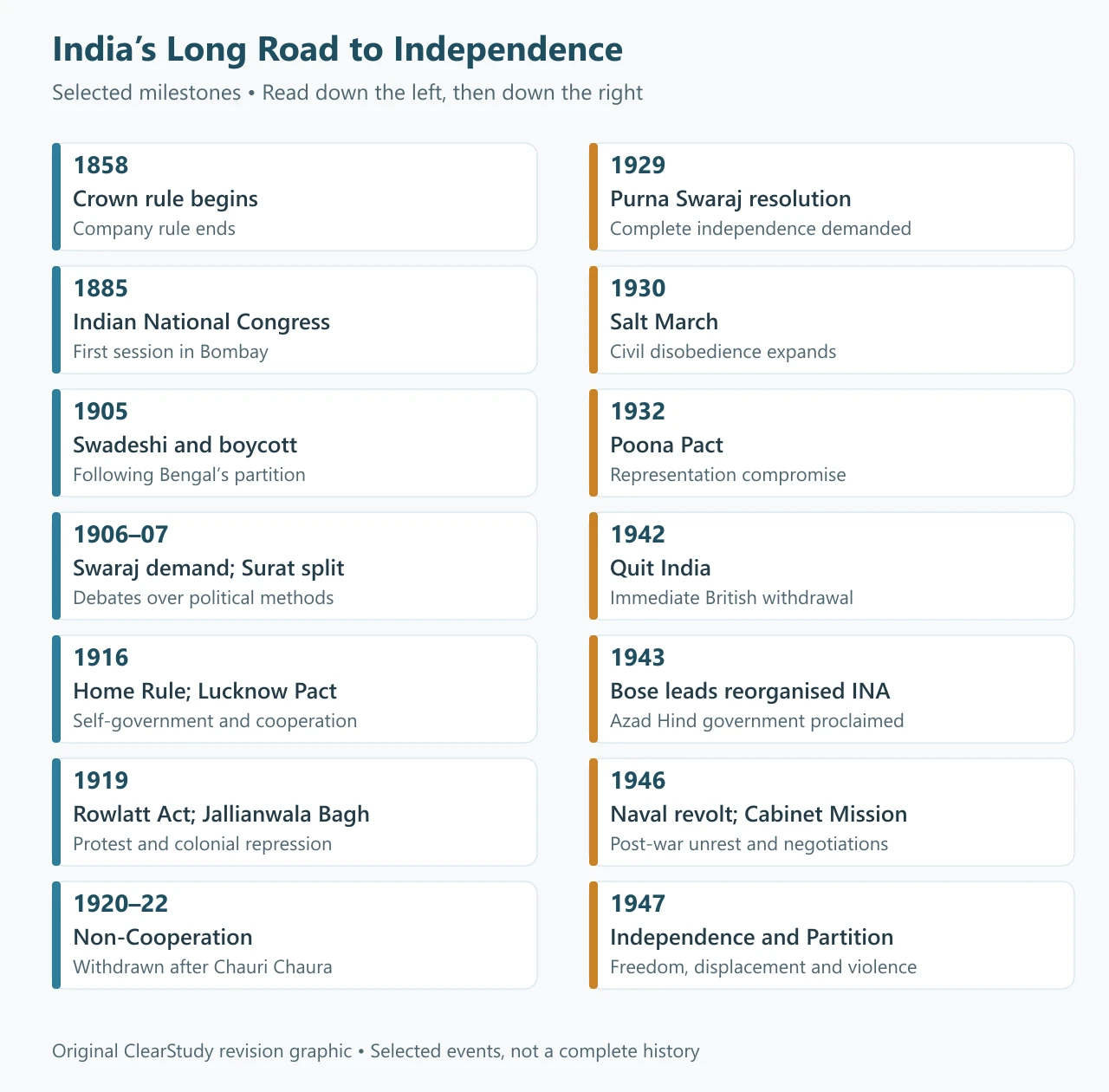
Examples include the Congress’s founding in 1885; the 1905 Swadeshi movement; revolutionary efforts; Home Rule in 1916; mass non-cooperation in 1920–22; Purna Swaraj in 1929; civil disobedience from 1930; Quit India in 1942; the INA and post-war unrest; and independence in 1947. Leaders such as Naoroji, Tilak, Aurobindo, Gandhi, Nehru, Patel, Ambedkar and Bose contributed in different ways. Women, tribal leaders, workers and innumerable less-recorded participants were also essential.
Big Question 3: What did freedom fighters agree or disagree upon?
Many opposed foreign domination and wanted dignity and greater control over India’s future. They differed over gradual reform or immediate independence, council participation or boycott, nonviolence or armed action, and political representation for different communities. Gandhi and Ambedkar disagreed about separate electorates for the Depressed Classes; leaders also differed over Partition. Studying these disagreements helps us understand the movement without treating it as one uniform organisation.
In-text questions and activities
Follow the textbook page references below. Suggested responses help you reason through discussion, observation and project tasks.
p. 38 · Let’s Explore: Collect family memories and compare paths to freedom.
Ask an older relative what they heard from earlier generations, which local events or leaders were remembered, and whether the account is a personal memory or a story passed on. Record the date and place, with their permission. Compare it with a reliable historical source. A possible conclusion is that people could support different methods while sharing opposition to colonial rule. Do not invent an interview if you cannot conduct one.
p. 39 · Let’s Remember: Distinguish directly governed territories and princely states on the Part I map.
According to the textbook legend, red or pink indicates areas directly administered by the British; yellow indicates princely states. These states had their own rulers but operated under British paramountcy, with varying degrees of internal autonomy. The colours show a political arrangement at the map’s historical date, not the present borders of India.
p. 42 · Let’s Explore: Explain the meaning of the National Song’s first two stanzas.
The song praises the motherland through images of plentiful water, fruitful land, cooling breezes, green crops, moonlit nights, blossoming trees and a kindly, welcoming presence. These images connect love of the land with affection and gratitude. Write the meaning in your own words; a line-by-line translation can vary. This is the National Song, distinct from the National Anthem.
p. 43 · Let’s Explore: How can Vivekananda’s values help young people today?
Self-confidence can help us attempt difficult work; perseverance helps us practise; inquiry encourages us to test ideas and learn science; service reminds us to use learning for others’ benefit. I could apply these values by setting a realistic study goal, reviewing mistakes and helping a classmate. Confidence should go with humility and respect for people with different beliefs.
p. 50 · Let’s Explore: Why use ‘absolute national autonomy’, and what do the newspaper’s title boxes show?
The phrase expresses full control over national affairs, rather than minor concessions under colonial rule. Avoiding a politically sensitive word may have helped communicate a strong demand in another form, but the passage alone cannot prove the editor’s precise reason. The left title box identifies a Swadeshi paper of India; the right declares a policy of India for Indians. Both frame the paper as an instrument of national self-rule.
p. 52 · Let’s Explore: Compare the two images of Mother India and observe Vijaya’s cover.
Both personify the motherland as a woman and encourage attachment to India. Abanindranath Tagore’s painting uses a calm, four-armed figure in saffron clothing, holding symbolic objects such as a book, grain, cloth and beads. Vijaya places a maternal figure with children against a map, accompanied by smaller scenes and text. The painting’s devotional symbolism differs from the magazine cover’s more explicit geographical and public-message setting. Describe only the details visible in the reproduced image.
p. 55 · Let’s Explore: Research a freedom fighter from the Northeast.
One choice is Kanaklata Barua of Assam, who was killed while leading a flag procession in Gohpur during Quit India in 1942. Another is Rani Gaidinliu, associated with resistance to colonial rule in the Naga region. Prepare a note giving the person’s place, dates, role and sources. Include a less-known local contribution if you can document it; avoid assuming that every regional movement followed the same method.
p. 56 · Let’s Explore: Interpret Tilak’s words after sentencing and his demand for Swaraj.
Tilak suggested that enduring imprisonment could strengthen the cause by awakening public sympathy and resolve. His claim to Swaraj shows determination and his belief that self-government was a right rather than a favour from rulers. This is an interpretation of his message; it does not imply that suffering automatically guarantees political success.
p. 62 · Think About It: Why was spinning khadi a political symbol?
Spinning linked personal action with Swadeshi: it supported local work, challenged dependence on imported textiles and made participation possible beyond formal politics. The spinning wheel became a symbol of self-reliance and collective effort. Yarn is spun; cloth is woven from yarn—these are separate stages.
p. 63 · Let’s Explore: What did Tagore mean by rulers congratulating themselves after Jallianwala Bagh?
He criticised the colonial authorities for treating repression as a lesson successfully imposed on Indians rather than recognising the victims’ suffering and public indignation. Returning his knighthood rejected an honour from the same power whose conduct he condemned. His words contrast official self-satisfaction with the moral injury felt by people.
p. 69 · Let’s Explore: Analyse the Purna Swaraj resolution.
The resolution connects political freedom with economic opportunity, dignity and the right to benefit from one’s labour. It argues that a government which denies these rights and exploits people loses its claim to obedience. The demand therefore moves beyond minor reforms towards ending British rule. Compare the political, economic and ethical arguments, then discuss why a shared resolution could unite different grievances.
p. 76 · Think About It: What do the imprisonment and casualty figures reveal about collective sacrifice?
The chapter’s figures indicate the scale of repression and public participation across different campaigns. Arrests affected families, income, education and daily security, as well as those imprisoned. Treat them as the textbook’s historical estimates and note the movement and period attached to each; do not combine them into a precise total of unique individuals, because one person could have been imprisoned more than once.
p. 80 · Think About It: Add a documented freedom fighter and recognise family contributions.
You could research Durgawati Devi, who helped revolutionary activity and is often remembered as Durga Bhabhi, or a documented participant from your district. Record what they did and cite a museum, archive or reliable biography. Families also provided support, faced lost earnings and endured separation and harassment. Recognising them helps us move beyond a history consisting only of famous leaders.
Questions and activities: exercise solutions
Answers follow the printed exercise order (pp. 81–84; printed activity groups).
True or False: Ten statements in the printed order (pp. 81–82).
- False. At its beginning in 1885, the Congress sought reforms and greater Indian participation; it did not initially demand complete independence.
- True. Tilak used public Shivaji celebrations, as well as Ganesh festivals, to spread patriotic ideas.
- True. The Ghadar effort aimed to encourage rebellion in the British Indian Army during World War I.
- True. Patel’s leadership of the Bardoli satyagraha in Gujarat in 1928 was associated with the title ‘Sardar’.
- True. The Kakori action in 1925 sought government funds for the HRA’s revolutionary activities.
- False. Gandhi’s ‘Do or Die’ call belongs to Quit India in August 1942, not Non-Cooperation in 1920.
- False. Ambedkar and Gandhi disagreed on separate electorates; the 1932 Poona Pact provided a compromise involving reserved seats in joint electorates.
- False. Cripps proposed a post-war constitutional settlement, not immediate independence endorsed by Churchill.
- True, with an important distinction. Bose helped establish the Indian Legion in Germany from Indian prisoners of war. This was distinct from the INA in Southeast Asia, which he later led and reorganised in 1943. If the statement were specifically ‘the INA was raised in Germany’, that would be false.
- False. The Radcliffe boundary awards were publicly announced on 17 August 1947, after independence, not weeks before it.
Who Am I?: Identify the ten figures in the printed order (pp. 82–83).
- Lala Lajpat Rai — the ‘Lion of Punjab’, injured during the 1928 protest.
- Bal Gangadhar Tilak — associated with the Swaraj declaration, Kesari and public festivals.
- Aurobindo Ghose (Sri Aurobindo) — wrote in Bande Mataram advocating national autonomy.
- Jatindranath Mukherjee (Bagha Jatin) — the revolutionary associated with the planned German arms shipment.
- Rash Behari Bose — linked with the 1912 attack on the Viceroy and later organising in Japan.
- Khudiram Bose — executed after the attempted attack on Kingsford.
- Bhagat Singh — with Batukeshwar Dutt, threw low-intensity bombs in the Assembly in 1929. His execution with Rajguru and Sukhdev in 1931 was in the Lahore conspiracy case concerning Saunders’s killing; it was not simply a sentence for the Assembly protest.
- Mahatma Gandhi — mass mobilisation through ahimsa and satyagraha.
- Subhas Chandra Bose — sought Axis assistance against British rule and led the INA.
- Cyril Radcliffe — chaired the boundary commissions for Partition.
Reflection on sacrifice: What sacrifices might freedom require, and would you have participated?
Participants risked imprisonment, injury, lost livelihoods and interrupted education. Their families faced separation, financial strain and insecurity. A possible personal response is: ‘I would have chosen a nonviolent campaign and been willing to give time, comfort and opportunities to support freedom and equal dignity.’ There is no compulsory personal answer. Explain your reasons respectfully, without suggesting that every person had the same choices or circumstances.
Tilak’s values: What values does the Swaraj statement express, and how are they relevant today?
It expresses self-respect, determination, confidence and a claim to political freedom. Young people can apply these values by speaking against unfairness, learning about rights, accepting responsibility and persisting in worthwhile goals. Today these values should be practised through peaceful, democratic and respectful participation.
Contributions beyond political leaders: How did peasants, workers, tribal communities and students contribute?
Peasants resisted unfair revenue and exploitative arrangements; workers used strikes and collective action; tribal communities defended land, resources and autonomy; students joined meetings, boycotts, volunteer networks and underground communication. Their participation made resistance a wider social movement. Political leaders helped organise and negotiate, but local groups also brought their own grievances, initiative and sacrifices.
Nehru’s speech: Explain ‘redeem our pledge’ and the ‘soul of a nation’.
To redeem the pledge means to fulfil the long-standing promise of freedom, while recognising that social and economic justice still required work. The ‘soul of a nation’ is a metaphor for people’s shared aspirations, memories, values and desire for dignity. It does not erase India’s many languages, communities or differences. Freedom allowed these aspirations to find public expression through self-government.
Freedom-fighter debate: Choose a method, compare alternatives and discuss unity and disagreement.
a) I would support nonviolent civil disobedience because it can involve many people and challenge an unjust law without deliberately harming others.
b) A classmate might favour petitions, council participation, social reform or another historical approach. Ask how that method would work, who could join and what risks it carried.
c) Shared goals do not require identical opinions. Respectful debate helps identify strengths and limits; unity can mean cooperation on common aims while acknowledging disagreement. Discuss armed strategies historically rather than planning or endorsing present violence.
News-report activity: Write a headline, public reaction and explanation of importance.
Fictional classroom report based on a historical event
Gandhi Breaks Salt Law at Dandi
Dandi, 6 April 1930. After a march from Sabarmati, Gandhi broke the colonial salt law on the Gujarat coast. The act challenged the government’s control of an everyday necessity and became a signal for wider civil disobedience.
Imagined public reaction: A local supporter said that even a basic household need should not be used to burden ordinary people. This reaction is invented for the exercise, not an archival quotation.
The event mattered because salt linked the demand for freedom with daily life. Similar protests and boycotts spread, and the authorities responded with arrests. A real report would require verified interviews and sources.
Museum-exhibition activity: Choose a title, three objects and a visitor message.
a) Title: ‘Many Paths, One Hope: India’s Freedom Struggle’.
b) Objects: a reproduction of an early Congress resolution to show political demands; a spinning wheel or khadi sample to explain Swadeshi; a dated Partition photograph to show displacement and the human cost of freedom. Label reproductions clearly, credit sources and explain each object’s date and context.
c) Visitor note: Freedom involved many methods and countless participants. Visitors should understand the courage of ordinary people, the value of democratic rights and the need to reject communal hatred.
Class skit: Write and stage a short Freedom Movement play.
Suggested skit: ‘A Household Discusses Salt, 1930’. A narrator explains the salt law. A student asks why it matters; a worker describes its effect on a family; a volunteer explains the nonviolent protest; a relative worries about arrests. The characters agree to discuss risks and responsibilities before acting. End with a narrator explaining how the Salt March connected daily concerns with national politics.
Assign roles fairly, check dates and use invented dialogue labelled as dramatic reconstruction. Avoid presenting fictional lines as authentic statements by historical leaders.
Responsibilities today: Write 5–10 lines on protecting and strengthening freedom.
We should respect the Constitution and the equal dignity of all people.
We should reject discrimination and communal hatred.
We should learn about public issues and check information before sharing it.
Eligible citizens should participate responsibly in elections.
We should express disagreement peacefully and listen to others.
We should care for public property and the environment.
We should help people who are excluded or treated unfairly.
Freedom becomes stronger when rights are protected and responsibilities are taken seriously.
Frequently asked questions
How should the chapter’s activity groups be used?
The textbook offers suggested activities to choose from. This page keeps their printed order, including all ten true/false and ten identification items, followed by the reflection and project groups.
Did Bose form the INA in Germany?
The Indian Legion in Germany and the INA in Southeast Asia were distinct forces. Bose later took leadership of and reorganised the INA in Southeast Asia in 1943.
Why are news reports and personal reflections labelled sample answers?
They require original choices, imagined dialogue or personal views. Examples show an approach without pretending to be actual interviews or the only acceptable response.
Textbook reference: NCERT, Exploring Society: India and Beyond, Grade 8, Part 2, first edition June 2026, Chapter 2, “India’s Long Road to Independence”. Compare with your school’s copy; official NCERT textbook portal. Historical checks: The National Archives on Bose and the Indian Legion; Partition boundary announcement; Ministry of Culture on the Simon Commission. ClearStudy is an independent study resource.